Thermal Interface Materials Market Snapshot

Key Players

  • Dow Corning (United States)
  • Henkel AG & Co. KGaA (Germany)
  • Honeywell International (United States)
  • 3M Company (United States)
  • Parker Chomerics (United States)
  • Momentive Performance Materials (United States)
  • Indium Corporation (United States)
  • Fujipoly (Japan)
  • Shin-Etsu Chemical (Japan)
  • Laird Technologies (United Kingdom)

Market Size

Base Year 2024
$4.67 Bn
CAGR
11.4%
Forecast 2034
$13.75 Bn

Market Segments

By Product
  • Elastomeric Pads
  • Tapes & Films
  • Greases & Adhesives
  • Metal Based
  • Phase Change Materials
  • Others
By Application
  • Computer
  • Medical Devices
  • Automotive Electronics
  • Consumer Durables
  • Telecom
  • Industry Machinery
  • Others

Market Dynamics

Drivers
  • Increasing electronic device miniaturization
  • Rising demand for efficient thermal management
Restraints
  • High production cost
  • Stringent environmental regulations
Opportunities
  • Growing electric vehicle sector
  • Increasing electronics miniaturization

Market Size

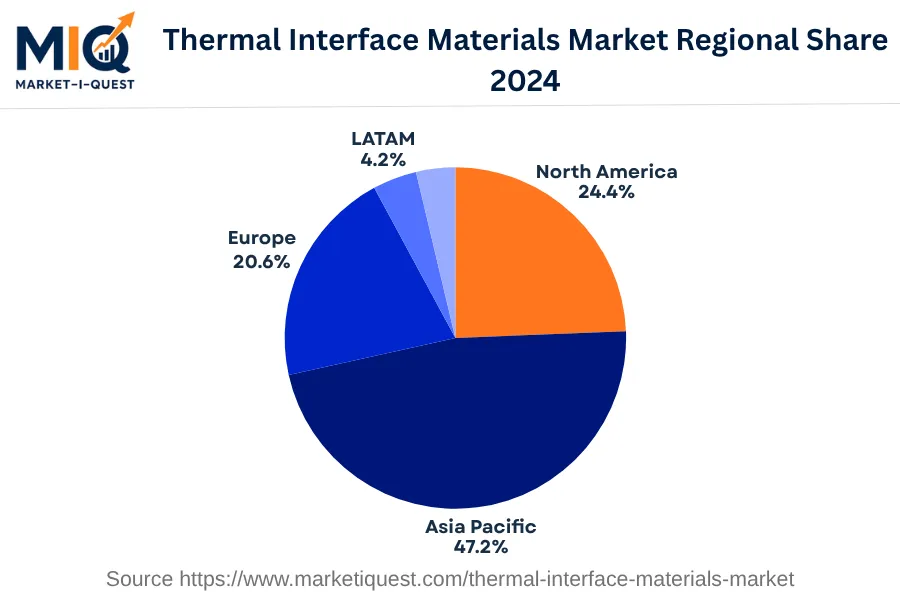
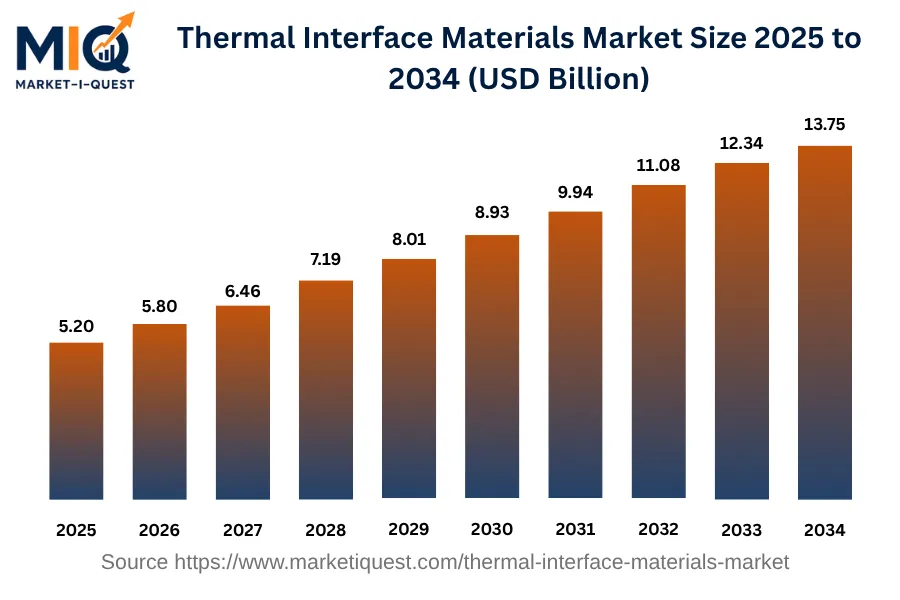
The Thermal Interface Materials Market is expected to grow from 5.20 billion USD in 2025 to 13.75 billion USD in 2034, registering a CAGR of 11.4%. The market experienced growth from 4.67 billion USD in 2024 to 5.20 billion in 2025. As it continued to expand over the next decade, it nearly tripled its size, reaching 13.75 billion USD by 2034. This increase was mainly due to consistent demand for these materials. In terms of regional market share in 2024, Asia Pacific led the way with 47.2%, followed by North America with 24.4%. Europe held 20.6% of the market, followed by LATAM and MEA with 4.2% and 3.7% respectively, illustrating a diverse geographical distribution.

Key Takeaways

  • By Product - Greases & Adhesives led accounting for a substantial market share in the base year.
  • By Application - Computer sector held the leading share of the segment.
thermal-interface-materials-market market size

Key Driving Factors

Implementation of 5G Bandwidth

The global rollout of 5G networks have significantly impacted the thermal interface materials market. 5G technology demands high-speed performance but generates substantial heat, potentially damaging essential equipment. Effective heat dissipation is crucial to maintain longevity and uninterrupted high-speed service, leading to an increased demand for thermal interface materials in the design of 5G infrastructure, devices, and equipment. Whether it's the base stations, repeaters, or the 5G enabled devices themselves, heat management, driven by thermal interface materials, is a prime concern. The accelerated adoption of 5G globally presents a unique opportunity for the growth and development of the thermal interface materials market.

High-Power Density Electronics in Electric Vehicles

The push toward electric vehicles (EVs) in the automotive sector has created significant opportunities for the thermal interface materials market. As electric vehicles gain market share, the requirement for effective thermal management has become increasingly critical. High-power density electronics used in EVs such as battery modules, chargers, inverters, and electric motors generate a considerable amount of heat. Without proper heat distribution and dissipation, these components risk overheating, leading to reduced performance and potential failure. Therefore, the use of thermal interface materials in the thermal management strategy of EV design is becoming more and more prevalent. Adoption of thermal interface materials in EVs is an emerging strong driver for the thermal interface materials market.

Market Evolution by Timeline

2019-2023
This period saw increased usage of Thermal Interface Materials (TIMs) within electronics, automotive, and telecommunication sectors due to higher need for efficient thermal management solutions. The primary buyers were from Asia Pacific due to rapid urbanization and industrialization. Suppliers developed silicone-based TIMs to meet the evolving demands. Constraints included high costs and capability issues in extreme temperature environments. Regulations such as the Restriction of Hazardous Substances (RoHS) Directive influenced the adoption of TIMs because of environmental concerns. The commercial model frequently involved long-term contracts and result-based pricing. A notable challenge was the improper application of TIMs causing performance issues.
2024
In 2024, the demand for TIMs expanded into energy and defense sectors, aiming for high-performance cooling solutions. North America, particularly the United States, emerged as influential buyers. The industry was introduced to liquid metal TIMs which exhibited excellent thermal conduction. Still, the technology's integration wasn't mature, remaining above average cost. TIMs complied with the EU's Energy-related Products (ErP) Directive promoting energy-efficient products. Contracts continued to be long-term, with changeling supplier-customer partnerships being established. One major risk was potential leakage from liquid TIMs causing significant hardware damage.
2025-2029
During 2025–2029, TIMs usage was further pushed within CPU and LED lighting systems due to increased computing capabilities and thermal dissipation requirements. This adoption was notable in Middle-East and Africa regions. Advanced silicone-free TIMs were introduced offering high thermal conductivity but faced limitations in mass production. New policies like the Ecodesign Directive by EU mandating reduced energy consumption shaped the TIMs production strategy. Performance-based pricing became more common, and there was a rise in strategic alliances between suppliers for increased R&D. However, potential environmental effects from TIMs posed a serious risk.
2030-2034
Predictably, from 2030 to 2034, the market may experience increased demand driven by newer applications in healthcare and space sectors. Specific geographical highlights could potentially be Europe and Latin America. Manufacturers might pilot graphene-based TIMs, though the mainstream adoption may be plagued by high production expenses. Stricter regulations are likely on the environmental footprint of these materials. Commercially, real-time dynamic pricing could be the new normal impacted by supply-demand fluctuations. The risk lies in managing the lifecycle of TIMs and ensuring their safe disposal post usage.

Future Market Outlook

Future Opportunities

Looking forward, the thermal interface materials market is poised to experience significant growth, driven by ongoing advancements in technology and increasing regulatory mandates. For instance, as of April 2023, the European Union's Eco-design Directive has raised standards for energy-efficient thermal materials in consumer electronics. This regulation could stimulate the development of green alternatives, presenting lucrative opportunities for manufacturers focused on sustainability. Additionally, strategic partnerships between companies such as LOCTITE and 3M open new avenues for product innovation in high-performance thermal materials. The continuing expansion of semiconductor manufacturing in regions like Southeast Asia is expected to fuel demand for robust thermal management solutions, especially for chip packaging and assembly. Furthermore, the emphasis on electric vehicles in the global automotive market creates opportunities for specialized thermal materials designed to enhance battery performance and safety. Companies like Ather Energy are already investing in these solutions as they prepare for increased EV production. Research institutions are actively pursuing next-generation materials like nanoparticle-infused polymers to overcome current limitations, providing a fertile ground for breakthroughs. The integration of smarter thermal management systems within Internet of Things devices will also broaden the application spectrum. Overall, the convergence of technological needs, environmental targets, and regulatory frameworks suggests that the industry is at a pivotal moment, ripe with opportunities.

Segmentation Analysis

By Product

The market is divided into subsegments including Elastomeric Pads, Tapes & Films, Greases & Adhesives, Metal Based, Phase Change Materials, and others. Of these, Greases & Adhesives accounted for the largest revenue share while Phase Change Materials is expected to grow at the fastest CAGR during the forecast period.

Largest Revenue Share

Greases & Adhesives

Market Share Leader

Greases and Adhesives led the market in terms of revenue share in the base year 2024. This is primarily due to their wide application across various end-use industries such as electronics, automotive, industrial manufacturing, among others. The greases and adhesives have unique properties such as high thermal conductivity, stability at extreme conditions which makes them suitable for thermal management applications. The high demand for these products from the massively growing electronics industry, particularly in regions like Asia-Pacific, is fueling the market growth. The increased incorporation of electronics in automotive, coupled with the surge in demand for electric and hybrid vehicles, is further boosting the use of greases and adhesives in this sector. Strict regulatory norms to reduce CO2 emissions have compelled automakers to adopt thermal management solutions for improved efficiency, consequently driving the need for greases and adhesives. Moreover, the high switching cost associated with these products also contributes to its substantial revenue share.

Fastest CAGR

Phase Change Materials

Forecast Period Growth Leader

Phase Change Materials (PCMs) predicted to be the fastest-growing segment in the forecasted period. PCMs have been gaining significant traction owing to their unique properties such as high thermal storage capacity and efficiency. They help in reducing energy consumption by effectively managing heat, which makes them ideal for applications in building and construction, HVAC systems, and electronics. Regulatory drivers such as policies and incentives to improve energy efficiency and reduce carbon footprints are propelling the adoption of PCMs. Lately, industries are investing in research and development activities to enhance the capabilities of PCMs, translating into significant market growth. Furthermore, the strategic partnerships between key players to manufacture and distribute PCMs are expected to spur market growth. However, the higher initial capital cost may act as an adoption barrier in the near term, which needs to be addressed by industry players for sustained growth.

By Application

The market is divided into subsegments, including Computer, Medical Devices, Automotive Electronics, Consumer Durables, Telecom, Industry Machinery, and Others. In 2024, the Computer subsegment accounted for the largest revenue share, while Industry Machinery is expected to grow at the fastest CAGR during the forecast period.

Largest Revenue Share

Computer

Market Share Leader

The largest segment by revenue in the year 2024 was the Computer industry. This can be reasoned by the continued digitization of nearly all sectors, necessitating the use of computers for a wide range of applications, including but not limited to data analysis, communication, and information management. Both businesses and individual consumers contributed significantly to the large revenue generated in this segment. Developed nations led the demand in this segment due to their early adoption of digital technologies. Additionally, the regulations targeted at fostering digital transition, particularly in the public sector, also propelled the growth of this segment. Another factor contributing to the Computer segment's sizeable revenue includes the considerable switching costs associated with shifting to different technologies or platforms. Product loyalty and reliance on certain software also add to these costs. Finally, the established distribution network and sales channels in the computer industry played a vital role in facilitating strong sales figures.

Fastest CAGR

Industry Machinery

Forecast Period Growth Leader

The 'Industry Machinery' subsegment is forecasted to grow at the fastest CAGR in the coming years. Technological advancements and the resulting improvement in production efficiency are key drivers for growth in this subsegment. Manufacturers are increasingly adopting smart machinery to meet the demand for high-quality products in a shorter timeframe. Industry 4.0, characterized by digitalization, interconnectivity, and automation, have also created an conducive environment for growth in the industry machinery segment. Industry Machinery's growth may, however, be hindered by the high capital investment required for advanced machinery. This can be particularly challenging for small and medium-sized enterprises. Furthermore, potential policy changes encouraging green manufacturing could compel producers to adopt energy-efficient machinery, giving a further boost to this subsegment. Nonetheless, market volatility and the unpredictability of consumer demand pose as near term risks to this industry's growth.

Competitive Analysis

Key Market Players

Manufacturers / OEMs

3M Company
US
Henkel AG & Co. KGaA
Germany
Indium Corporation
US

Key Suppliers & Raw Materials

Shin-Etsu Chemical Co., Ltd.
Japan
Dow Inc.
US
Momentive Performance Materials Inc.
US

Distributors, Integrators & Channel Partners

Master Bond Inc.
US
Parker Chomerics
US
Laird Technologies
US

Porter’s Five Forces Analysis

A comprehensive evaluation of the competitive forces in the Thermal Interface Materials Market.

Supplier Bargaining Power

Medium

Suppliers are limited, but the variety in thermal interface materials mitigates their power.

Buyer Bargaining Power

High

Buyers have many potential suppliers, allowing them to negotiate for better terms.

Threat of Substitutes

Medium

While some alternative cooling solutions exist, they may not provide the same level of efficiency.

Threat of New Entrants

Low

High R&D and capital costs create significant barriers to market entry.

Competitive Rivalry

High

Numerous established players make the thermal interface materials market highly competitive.

Regional Analysis

Geographic market dynamics and growth opportunities across key regions

Global Market Outlook

thermal-interface-materials-market market regional share

North America

In 2024, the thermal interface materials market in North America notably evolved, reflecting both demand-side and supply-side developments. Rising electronics usage, spurred by an increase in remote working and e-commerce, led to a surge in demand for effective thermal management solutions in the United States, Canada, and Mexico. Enhanced regulatory scrutiny on device safety further intensified the market dynamic. High investment in R&D led to the adoption of innovative technologies such as nanotechnology, driving supplier competitiveness and capability.

Customer preferences shifted towards products with higher conductivity and narrower thermal resistance, favoring suppliers with advanced offerings. Multi-channel distribution became the norm, with industry giants such as Henkel AG and 3M leveraging online and offline channels to expand their reach. Partnerships and M&A activity emerged as a key trend; multinational conglomerates sought alliances with regional entities to consolidate their market presence. This market expansion was primarily underpinned by contributions from sectors such as consumer electronics, automotive, and telecom. At the same time, the demand for thermal interface materials within the renewable energy sector made a significant impact. Regulatory standards, such as ISO 14001 and RoHS, enforced by government bodies, impacted industry-wide practices and added layers of responsible product design and manufacturing. Thus, the North American thermal interface materials market in 2024 demonstrated increased dynamism driven by technological advancement, investment, accreditation, and shifts in distribution channels.

Asia Pacific

In 2024, the Asia Pacific market for thermal interface materials (TIMs) witnessed significant growth, underpinned by the expansion of electronics and automotive industries and surge in infrastructure development. Greater demand for high-performance electronics led to an increase in use of these materials, especially in Japan and South Korea, known for advanced tech manufacturing. Similarly, in India and China, growing infrastructure, particularly in telecom, and public transportation required TIMs for heat management solutions contributing to market growth.

An upward trend was noticed for high-power computing applications, primarily in China, driving change in buying behavior towards high-quality TIMs. Supply dynamics in the region also evolved, with the rise of local manufacturers in India and ASEAN markets reducing dependency on imports. In terms of product shift, nanofiller-containing TIMs gained popularity, attributed to their superior thermal conductivity. Government regulations in Australia mandated the use of environmentally friendly TIMs in utility and public sectors, reflecting policy enforcement toward sustainability. Lastly, strategic alliances for technological advancement proliferated, exemplified by a partnership between a major Japanese tech giant and a Chinese TIM producer.

Europe

In the year 2024, the European Thermal Interface Materials (TIM) market reflected mainstream technology adoption and supply evolution to meet diverse needs. Driven by the increasing demand for effective thermal management in consumer electronics, automotive, and telecommunications, producers accelerated innovation in high-performance products. Regulatory norms for electronics manufacturing safety in countries like Germany and the United Kingdom encouraged this innovation rush. Investment in research and development by major European manufacturers, like the France-based Saint-Gobain, suggested an answer to market demand and global standards.

Consumer behavior leaned towards energy-efficient, reliable, and high endurance products in this period. This stimulated enhanced partnership activities and strategic M&A among major players such as Henkel in Germany and Italy's Bergquist company to increase their market dominance. Distribution channel dynamics trended towards direct sales, minimizing middlemen to ensure product quality and customer satisfaction. The implementation of the RoHS directive in Europe enforced strict guidelines on hazardous substances in electrical and electronic equipment, thus influencing the TIM production standards. This particularly impacted sectors like government, healthcare, utilities, and manufacturing — all prioritizing energy-efficient, secure, and compliant thermal management solutions. Retail and enterprise sectors showed a significant demand, considering the proliferation of electronics in workplaces and homes. These trends and drivers shaped the European TIM market in 2024.

Latin America

In 2024, the Thermal Interface Materials Market cemented its position as a pivotal segment in Latin America's tech industry, anchored by strong demand from Brazil, Mexico, Argentina, Colombia, Chile, and Peru. Growth drivers included high-volume data centers demand for thermal management solutions, as companies in sectors such as enterprise and manufacturing heightened their digital transformations. Changes in environmental regulations led to an increase in demand due to the need for energy-efficient electronics that reduce heat emissions. High investments by major markets served as a catalyst for market expansion as they aimed to integrate advanced technology to optimize systems heat dissipation, while supply dynamics were also influenced by the reduced cost of raw materials.

On the trend front, the buyer behavior demonstrated a clear shift towards high-performance thermal interface materials, with a marked preference for phase change materials in applications like automotive electronics and LED lighting. Emergence of innovative channel dynamics, such as partnerships between suppliers and product manufacturers, bolstered the market's product development initiatives. The institution of stricter policy enforcement by LATAM countries saw a substantial rise, with regulations levied against the use of hazardous substances in electronics which prompted manufacturers to adhere to sustainable production practices. Electronic manufacturing in sectors like healthcare, retail, and utilities saw a conspicuous adoption of these materials to maintain device longevity and optimum performance.

Middle East & Africa

In 2024, the Thermal Interface Materials (TIMs) market in the Middle East and Africa grew significantly due to various industry-specific drivers and trends. The escalating demand for efficient thermal management solutions in sectors as diverse as telecom or IT, automotive manufacturing, and oil and gas was a significant driver. In countries like Saudi Arabia and UAE, major investments in data centres led to increased adoption of TIMs. Concurrently, regulatory standards emphasizing environment-friendly industrial operations in Egypt and South Africa propelled the use of sustainable TIMs. The rise in equipment prices, however, did temper market progress to some extent.

The trend towards miniaturization in electronics, evident in Israel and Kenya's tech sectors, spurred shifts towards high-performance TIMs. Meanwhile, in the retail hardware sector, demand for customer-comfort optimization led to increased use of TIMs in devices such as Point of Sale (POS) systems. The consolidation of companies in Nigeria’s telecom sector fostered growth via partnerships, facilitating more widespread TIM adoption. Stringent enforcement of thermal management standards became apparent in government projects across Qatar and South Africa, further driving TIM demand. In summary, the confluence of sectoral demands, regulatory norms, and evolving technologies significantly shaped the Middle East and Africa's TIMs market landscape in 2024.

Recent Industry Developments

Latest market innovations, product launches, and strategic initiatives

December 2025

Henkel launched the Bergquist TGF 10000, a liquid gap filler with extremely high heat transfer capabilities. It is engineered to solve severe heat blockages in high-power automotive computers and telecom networks without the material shifting, drying, or failing over long-term use.

June 2025

Wacker Chemie debuted the SEMICOSIL 9649 TC at the Battery Show Europe. This product is a heat-conducting filler formulated specifically to safely cool down the demanding power electronics and battery systems found in electric vehicles.

Frequently Asked Questions