
Specialty Surfactants Market Snapshot

Key Players

  • BASF SE (Germany)
  • Evonik Industries AG (Germany)
  • AkzoNobel N.V. (Netherlands)
  • Clariant AG (Switzerland)
  • Stepan Company (United States)
  • Croda International Plc (United Kingdom)
  • Solvay SA (Belgium)
  • Galaxy Surfactants Ltd. (India)
  • Huntsman Corporation (United States)
  • Kao Corporation (Japan)

Market Size

Base Year 2024
$38.95 Bn
CAGR
5.37%
Forecast 2034
$65.72 Bn

Market Segments

By Type
  • Anionic Surfactants
  • Cationic Surfactants
  • Non-Ionic Surfactants
  • Amphoteric Surfactants
  • Others
By Application
  • Wetting Agents
  • Emulsifiers
  • Dispersants
  • Foaming Agents
  • Stabilizers
  • Others
By End-User Industry
  • Personal Care
  • Food and Beverage
  • Oil and Gas
  • Agriculture
  • Paints and Coatings
  • Others

Market Dynamics

Drivers
  • Increasing industrialization rate
  • Rising demand in end-use industries
Restraints
  • High production costs
  • Stringent environment regulations
Opportunities
  • Rising clean label trend
  • Increasing cosmetic sector growth

Market Size

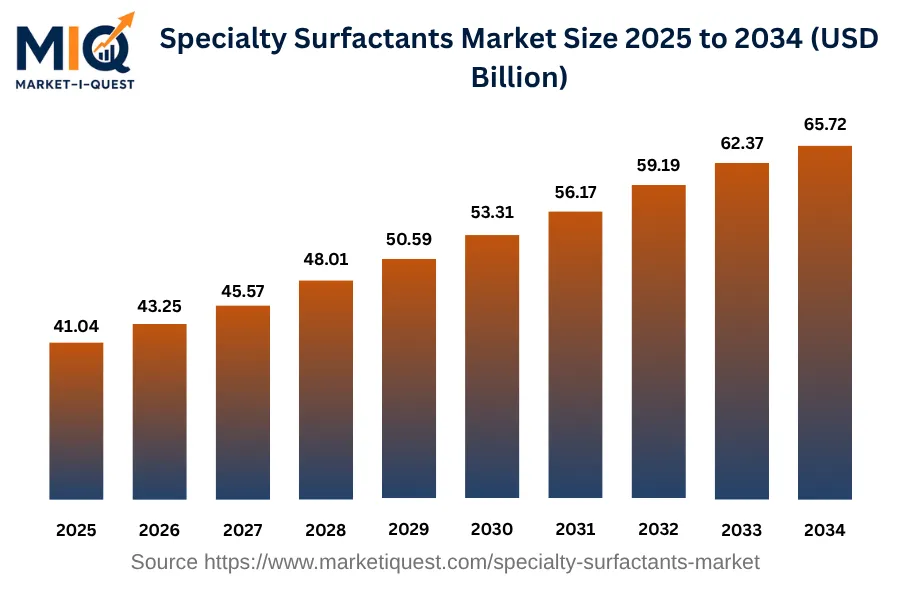
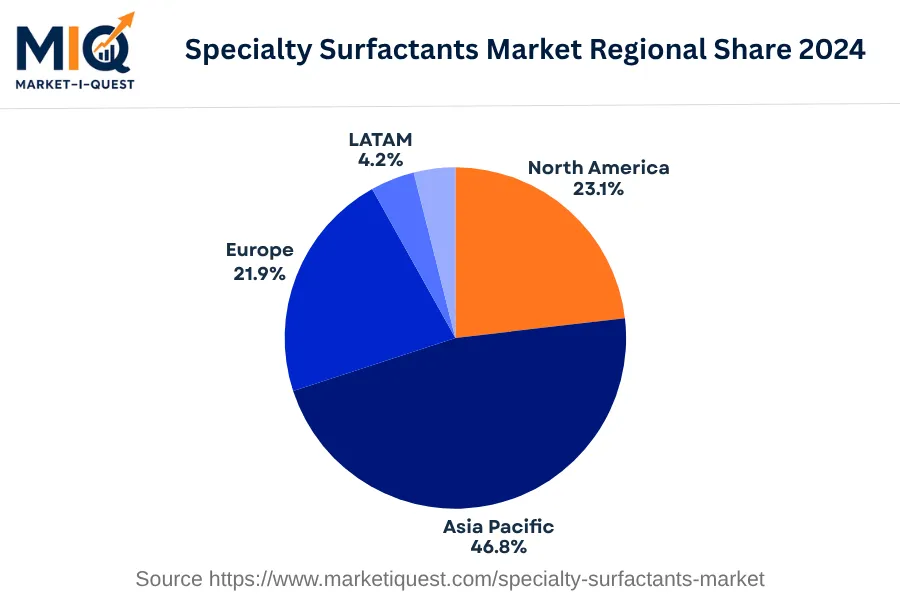
The Specialty Surfactants Market was sized at $41.04 billion in 2025 and is expected to expand to $65.72 billion by 2034, marking a CAGR of 5.37%. This growth path points to consistent market enlargement over the nine-year span from 2025 to 2034. The rise in the market size is primarily due to a steady demand for specialty surfactants in multiple industrial applications during this period. Considering the regional market shares in 2024, the Asia Pacific secured the leading position occupying 46.8% of the total market, followed by North America and Europe with market shares of 23.14% and 21.92%, respectively. The Latin America and Middle East and Africa regions held shares of 4.18% and 3.93%, forming a modest yet integral portion of the global Specialty Surfactants Market.

Key Takeaways

  • By Type - Anionic Surfactants led the market holding major share in the base year.
  • By Application - Emulsifiers continued to dominate contributing significant market share.
  • By End-User Industry - Food and Beverage was the leading sector commanding the highest share in the base year.
specialty-surfactants-market market size

Key Driving Factors

Implementation of Strict Environmental Regulations

One major driver pushing growth in the Specialty Surfactants market is the implementation of strict environmental regulations worldwide. Governments and regulatory bodies are introducing and enforcing stringent laws aimed at reducing the impact of surfactants on the environment. For instance, the Euro detergents regulation, enforced by the European Union (EU), dictates that biodegradable surfactants must be used in household detergents and cleaners. These legal mandates are pressing the surfactants industry to innovate and switch from non-biodegradable ingredients to environmentally-friendly alternatives. Specialty surfactants, known for their biodegradable quality and less ecological toxicity, are an optimal choice. Thus, these regulatory changes are compelling manufacturers to pivot toward specialty surfactants, thereby driving market growth.
Shift in Consumer Preferences Towards Bio-Based Products

Another driving factor for the Specialty Surfactants market is the shift in consumer preferences towards bio-based and sustainable products. This recent trend is predominantly noticeable in industries like personal care and cosmetics, where consumers are actively seeking products made with natural, eco-friendly components over traditional synthetic ingredients. This switch in buyer preferences is being driven by increased consumer awareness of environmental impact and health benefits associated with natural ingredients. Specialty surfactants, primarily those derived from bio-based sources, are gaining popularity due to their lower ecological footprint and perceived health benefits. Consequently, as industries adapt to meet this rising demand for natural ingredients, the uptake of specialty surfactants is gaining momentum, accelerating market growth.

Market Evolution by Timeline

2019-2023
During this period, North American and European industries such as personal care and home care indicated a high demand for specialty surfactants. This was primarily for green and sustainable surfactants, indicating the growing concern for environmentally friendly products. However, the supply was often constrained by increasing raw material prices, impacting profitability. Regulations such as REACH in Europe affected surfactant production, steering towards sustainable and renewable products. Procurement through contracts was common, with buyers seeking long-term contracts to hedge against price volatility. Mergers and acquisitions, as seen with BASF acquiring Cognis, were key in building capacity and gaining technical expertise. Potential risks revolved around the uncertainty related to raw material prices and environmental regulations.
2024
In 2024, Asia-Pacific region, majorly China and India, showed a rising demand for specialty surfactants due to the growth of end-use industries such as construction and agriculture. Before 2024, manufacturers were increasing production capacities to address this anticipated demand. Green surfactants became more popular due to their integration with various end-use industries. But, they were comparatively expensive than their petroleum-based counterparts, affecting affordability. With stricter pollution norms, companies started adopting greener methods, with Nippon Surfactant Industries introducing a plant-based surfactant. Despite this promise, supply-side risks were a concern, primarily around the ability to scale up production quickly to match demand surges.
2025-2029
From 2025 to 2029, technological shifts played a significant role. Manufacturers began using bio-based materials to create surfactants, showcasing the maturation of sustainable production techniques. Additionally, the continuous rise of consumer consciousness triggered high demand for sustainable surfactants, particularly in the personal care segment. Government programs such as the BioPreferred Program in the United States encouraged bio-based product usage. In terms of commercial aspects, a shift to performance-based contracts began to take shape. Meanwhile, risks included potential supply chain disruptions due to global geopolitical tensions and the impact of natural disasters amplified by climate change.
2030-2034
By 2030, it's likely that eco-friendly surfactants will have taken a considerable market share. Countries like Brazil and Argentina could push the demand spike due to aggressive growth in agriculture and industrial sectors. At the supply side, technological advancements in bio-refining could significantly bring down the cost of production, scaling up the production of these eco-friendly components. Strong regulations like European Green Deal would reinforce the transition towards cleaner production methods. Volatile feedstock prices and uncertain regulatory environments in developing nations might add to the risk environments.

Future Market Outlook

Future Opportunities

The specialty surfactants market is poised for opportunities centered around sustainability and new application areas. With rising consumer awareness regarding sustainable products, a noteworthy trend is the shift toward palm oil-free surfactants. In 2021, the Roundtable on Sustainable Palm Oil revised its certification standards to address environmental concerns, prompting suppliers to innovate around alternative feedstocks. Moreover, sectors such as agriculture and personal care are increasingly implementing natural surfactants due to their lower environmental impact. In 2022, companies like Croda International introduced surfactants formulated from bio-based materials to penetrate the personal care sector more effectively. Another opportunity lies in the formulation of multifunctional surfactants, which can enhance product performance while reducing raw material costs. The 2020 collaboration between two leading surfactant manufacturers focused on these multifunctional applications, paving the way for broader market penetration. Furthermore, regulatory frameworks regarding chemical safety are continuously evolving, potentially driving demand for compliant specialty surfactants. Clients are increasingly seeking formulations aligned with regulations from the U.S. Environmental Protection Agency, especially for cleaning products. This shifting landscape underscores the necessity for manufacturers to adapt their product lines to maintain compliance while simultaneously addressing consumer demands, prompting ongoing innovation in the market.

Segmentation Analysis

By Type

The market is divided into subsegments including Anionic Surfactants, Cationic Surfactants, Non-Ionic Surfactants, Amphoteric Surfactants, and Others. Anionic Surfactants accounted for the largest revenue share while Amphoteric Surfactants is expected to grow at the fastest CAGR during the forecast period.

Largest Revenue Share

Anionic Surfactants

Market Share Leader

Anionic Surfactants hold the largest market share due to their superior properties and extensive use in various industries. They dominate in applications such as detergents, personal care products, and industrial cleaners because of their excellent cleaning and foaming properties. Anionic surfactants are preferred by consumers due to their cost-effectiveness compared to the alternatives. They are also extensively produced and supplied, making them easily accessible and driving their demand. Typically, the largest markets for anionic surfactants are developed countries due to stricter regulations on cleanliness and hygiene coupled with high consumer purchasing power. Their dominance is further reinforced by their versatility, as they can be used in both liquid and powder form. Potential barriers to switching include the significant investment necessary to reformulate products and reeducate consumers.

Fastest CAGR

Amphoteric Surfactants

Forecast Period Growth Leader

Amphoteric surfactants are forecasted to grow at the fastest rate. As businesses increasingly work towards sustainability and consumers become more environmentally aware, Amphoteric surfactants are gaining favor due to their biodegradability and low toxicity. This transition is driven by regulations promoting environmentally friendly products. Technological advancements have improved their performance and versatility, making them suitable for various applications, including personal care and industrial cleaning. Their mildness on skin makes them an especially preferred choice in personal care products. Companies are beginning to see the value of investing in this subsegment due to the increased consumer demand and the clearing regulatory path. However, the relatively high cost compared to traditional surfactants presents a hurdle; hence, economies of scale will be crucial to their wider adoption.

By Application

The market application has diverse subsegments including wetting agents, emulsifiers, dispersants, foaming agents, stabilizers, and others. In the year 2024, emulsifiers accounted for the largest revenue share in the market, while wetting agents are projected for the fastest growth in the coming years.

Largest Revenue Share

Emulsifiers

Market Share Leader

Emulsifiers held the largest market share in 2024 due to their wide application in various industries. They are an essential component in many food products, personal care items, and pharmaceutical formulations. In the food industry, emulsifiers are used to improve food texture, enable oil and water mix, extend product shelf life, and delivery of dietary fat. In the personal care industry, they play a vital role in smaller contexture and spreadability of creams and lotions. The demand for bio-based and natural emulsifiers has been increasing due to the shift of consumer preference towards natural products, thus driving the emulsifier market. A surge in packaged, convenience and processed food products, especially in emerging economies, further fuels its demand. However, stringent regulations by food safety authorities worldwide may bind the growth of the emulsifier market.

Fastest CAGR

Wetting Agents

Forecast Period Growth Leader

Wetting agents are expected to grow at the fastest rate. They are extensively used to lower the surface tension of liquids, allowing them to spread easily. With the increasing demand in textile, printing, cleaning, and many industrial processes, the market of wetting agents is expected to reach new heights. Additionally, they have been widely adopted in the agriculture sector to enhance the effectiveness of pesticides and other agricultural chemicals, thus ensuring better crop yield. Technological advancements and research in the chemical industry coupled with favorable government initiatives in developing economies are further boosting its growth. However, environmental concerns surrounding certain synthetic wetting agents and the regulatory barriers imposed could be potential obstacles in the growth trajectory.

By End-User Industry

The market is divided into subsegments including Personal Care, Food and Beverage, Oil and Gas, Agriculture, Paints and Coatings, and Others. The Food and Beverage subsegment accounted for the largest revenue share, while the Personal Care subsegment is projected to grow at the fastest CAGR during the forecast period.

Largest Revenue Share

Food and Beverage

Market Share Leader

In 2024, the Food and Beverage industry emerged as the leader in terms of revenue share, largely due to the continuous need for nourishment and hydration among the human population. This industry's scale and significance in maintaining public health and sustenance make it a formidable contender in the market. It is also propelled by different economic variables like consumer spending power, demographic trends, and cultural influences which all contribute to a robust demand structure. Given the ever-rising global population, the demand for food and beverages is in a perpetual upward trajectory. Moreover, innovations in food processing and packaging, along with regulatory compliances related to food safety, contribute to its market dominance. Guaranteeing a steady client base, this subsegment is further buoyed by diverse distribution channels, ranging from conventional brick and mortar grocery stores to the influx of online delivery services.

Fastest CAGR

Personal Care

Forecast Period Growth Leader

The Personal Care industry subsegment is expected to grow at the quickest CAGR during the forecast period. This rapid growth can be attributed to a multitude of factors that drive the industry, mainly revolving around increased consumer consciousness for personal hygiene, health, and aesthetics. As individuals continue to prioritize personal wellness, companies in the industry have seized the opportunity by providing a variety of products catering to these needs. Furthermore, the proliferation of the internet has fuelled growth through e-commerce channels, enabling the reach to diverse global demographics. However, while technology is a catalyst, it also presents a risk in form of competition, as small businesses and startups can now reach out to larger audiences more conveniently than ever. Regulatory pressures and fluctuations in ingredient prices are other significant factors the industry must navigate.

Competitive Analysis

Key Market Players

Manufacturers / OEMs

BASF SE
Germany
The Dow Chemical Company
US
Evonik Industries AG
Germany

Key Suppliers & Raw Materials

Akzo Nobel N.V.
Netherlands
Kao Corporation
Japan
Huntsman International LLC
US

Distributors, Integrators & Channel Partners

Shell Chemicals
Netherlands
Unilever
UK
Procter & Gamble Co.
US

Porter’s Five Forces Analysis

Analysis of the competitive landscape within the Specialty Surfactants Market using Porter’s Five Forces model.

Supplier Bargaining Power

Medium

Limited number of suppliers offers some degree of pricing power, tempered by availability of raw material sources.

Buyer Bargaining Power

High

Buyers have high bargaining power due to numerous suppliers and relatively low switching costs.

Threat of Substitutes

Medium

Potential threats from bio-based and other alternative surfactants exist, but performance concerns limit the threat.

Threat of New Entrants

Medium

Entry barriers are moderate due to required technical expertise and investment, but market growth encourages new players.

Competitive Rivalry

High

The market experiences high rivalry due to the presence of numerous local and international suppliers.

Regional Analysis

Geographic market dynamics and growth opportunities across key regions

Global Market Outlook

specialty-surfactants-market market regional share

North America

In 2024, the North American market for specialty surfactants was marked by a robust demand due to its broad application in industries like healthcare, manufacturing, and retail. With growing eco-consciousness, the demand for bio-based surfactants increased, attracting more investments into R&D for greener alternatives. Stricter environmental regulations in the U.S., Canada, and Mexico also compelled manufacturers to seek sustainable surfactants which further drove innovation. High-performance sectors such as automotive and electronics drove demand with their needs for specialty surfactants for precision cleaning.

Key trends included an increased preference towards online purchase of specialty surfactants. Notably, large-scale buyers sought direct suppliers’ portals for procurement, leading to a drop in traditional sales channels. Any introduction of innovative, green surfactant drew immediate attention, leveraging on the growing preference for eco-friendly products. A significant trend was the strategic partnerships and joint ventures among major manufacturers and raw material suppliers for seamless supply-chain operation. In the healthcare sector, specialty surfactants found increased use in hand sanitizers, amid heightened hygiene awareness. Retail sector increasingly used specialty surfactants in personal care products, while the manufacturing sector used them for paint formulations and coatings. Across North America, stringent enforcement of quality standards upped the ante for manufacturers, furthering the market competition for specialty surfactants.

Asia Pacific

In 2024, the Specialty Surfactants Market in the Asia Pacific showcased a notable stabilization amidst evolving dynamics. Key drivers included a surge in end-use applications, particularly in manufacturing and retail sectors in India and China. These markets saw robust demand influenced by growing consumer preference for high-quality goods. Regulatory changes from governments, such as Japan's enforcement of stringent environmental standards, also incentivized manufacturers to invest in eco-friendly surfactant technologies. Additionally, Australia, buoyed by efficient supply chains, achieved remarkable pricing stability, boosting market confidence.

Surrounding trends revealed a shift towards niche surfactants with unique properties. In South Korea, buyer behavior gravitated towards products that promise eco-friendliness and efficiency, supported by advanced technology adoption. Similar trends were observed in key ASEAN markets, with rising awareness triggering demand for bio-based specialty surfactants. Channel dynamics in China and Japan leaned towards online platforms, driven by the digital transformation wave engulfing the retail sector. Notably, partnerships and M&A activities marked the landscape, with companies strategically collaborating to exploit technology advancements and expand reach. Policy enforcement also played a significant role, particularly in India, where increased regulations ensured strict compliance to environment-friendly manufacturing practices. These developments remarkably shaped the Specialty Surfactants Market in the Asia Pacific in 2024.

Europe

In 2024, the European specialty surfactants market was characterized by a strong demand largely led by robust industrial and domestic sectors. Regulatory pushes for sustainable and bio-degradable products spurred investment in R&D, advancing technology adoption and encouraging bio-surfactant production. Germany, the UK, and France were key innovators in this space, facilitating a shift in supply dynamics significantly. Pricing pressure was also noteworthy due to volatile crude oil prices directly impacting raw material costs.

Significant trends included an upswing in demand for milder, skin-friendly surfactants, particularly in personal care and cosmetics sectors in Italy and Spain, altering buyer behavior. The market also saw changes in channel dynamics, with a rise in online retail, as the online shopping prevalence increased across Europe. Partnerships and M&A activity were also high, especially in the Nordics, focusing on expanding production capabilities while maintaining eco-friendly procedures. Lastly, policy enforcement regarding environmental standards was stringent, particularly in Benelux and Central & Eastern Europe, which demanded continuous innovation from manufacturers. The key sectors contributing to the market included manufacturing, personal care, home care, food processing, oil and gas, and agriculture. These industries shaped the demand for specialty surfactants in Europe in 2024.

Latin America

In 2024, the specialty surfactants market in Latin America demonstrated significant momentum. Drivers include environmental regulations in Brazil and Argentina, necessitating biodegradable surfactants in household cleaning products, leading to industry investment in green chemistry. Technology adoption, particularly in Mexico, fueled demand as the country's burgeoning personal care sector embraced alkyl polyglucosides for their high foaming abilities and mildness. Fluctuating crude oil prices across LATAM influenced supply dynamics, with Colombia shifting towards bio-based surfactants due to cost-effectiveness.

Consistent trends included a notable shift in consumer preference towards eco-friendly products in the retail sector. Brazil's robust manufacturing sphere witnessed growth in sustainable surfactants, aligning product portfolios with global norms. Colombia introduced stringent policy enforcement on surfactant discharge into the water bodies, pushing industries to adopt safer production methods. In Peru and Chile, proliferation of public-private partnerships was significant, aimed at advancing local surfactant production capabilities. Sensitized by Argentina's policy on wastewater treatment, utilities sector increasingly patronized specialty surfactants with reduced aquatic toxicity. Overall, demand factors, regulatory environment, and market maturation in Brazil, Mexico, Argentina, Colombia, Chile, and Peru shaped the specialty surfactants landscape in 2024.

Middle East & Africa

In 2024, the Specialty Surfactants Market in the Middle East and Africa had matured into a dynamic economy. Strong demand drivers included stringent environmental regulations in Israel and South Africa, pushing companies to adopt these eco-friendly materials. Saudi Arabia's robust investment in its burgeoning cosmetic industry equally amplified demand. Technological innovation in Nigeria's oil and gas sector, embracing novel surfactant applications, remained a definitive catalyst.

Among notable trends, the specialty surfactants market saw changing buyer behaviour in the United Arab Emirates. Health-conscious consumers prioritized surfactant-infused personal care products. In Egypt, there was a marked shift towards bio-based surfactants, largely promoted by government advocacy. Kenya featured prominently with telecom companies employing surfactants in cleaning electronic components. A notable alliance was seen between South African and Qatari manufacturers to secure stable surfactant supplies, impacting channel dynamics. In manufacturing, the automotive sector in Saudi Arabia increasingly utilized surfactants in the production of high-performance coatings. Egypt's healthcare industry saw steady demand for surfactants in drug formulations. The retail sector in the United Arab Emirates reflected a similar pattern, especially in the sale of cleaning products. Meanwhile, financial services in Qatar integrated surfactants into their operations for maintaining hygiene in their facilities. However, strict policy enforcement in Israel tended towards sustainable surfactant choices.

Recent Industry Developments

Latest market innovations, product launches, and strategic initiatives

May 2026

Praana Group Completes Acquisition of Halliburton's Multi-Chem Business – Praana Group, an India-based holding group, completed its acquisition of a portion of Halliburton's Multi-Chem business. Multi-Chem now operates within the Sterling Specialty Chemicals platform. The acquisition brings together Sterling Specialty Chemicals' expertise in specialty chemical manufacturing, polymer technologies, and advanced surfactant systems with Multi-Chem's field service capabilities and relationships across the global energy industry.

February 2026

Evonik Streamlines Specialty Surfactants Distribution Network in North America – Evonik Coating Additives announced a streamlined distribution network across the United States and Canada to enhance market responsiveness for specialty surfactants in coatings and inks.

Frequently Asked Questions