
Specialty Oleochemicals Market Snapshot

Key Players

  • BASF (Germany)
  • Evonik Industries (Germany)
  • Emery Oleochemicals (Malaysia)
  • Croda International (United Kingdom)
  • KLK OLEO (Malaysia)
  • Wilmar International (Singapore)
  • Oleon NV (Belgium)
  • Venator Materials PLC (United Kingdom)
  • IOI Oleochemical Industries Berhad (Malaysia)
  • Chemical Associates (United States)

Market Size

Base Year 2024
$13.85 Bn
CAGR
6.35%
Forecast 2034
$25.63 Bn

Market Segments

By Product Type
  • Fatty Acids and Derivatives
  • Glycerine and Derivatives
  • Esters
  • Amides
  • Non-ionic Surfactants
  • Ionic Surfactants
  • Bio-based Solvents
  • Others
By Source
  • Plant-based
  • Animal-based
  • Microbial-based
By End-User Industry
  • Food and Beverage
  • Pharmaceutical
  • Personal Care and Cosmetics
  • Industrial and Institutional Cleaning
  • Automotive
  • Oil and Gas
  • Paper and Pulp
  • Textile
  • Others

Market Dynamics

Drivers
  • Growing environmental concerns
  • Increased industrial applications
Restraints
  • High production costs
  • Stringent environmental regulations
Opportunities
  • Growing bio-based product demand
  • Emerging Asian-Pacific market potential

Market Size

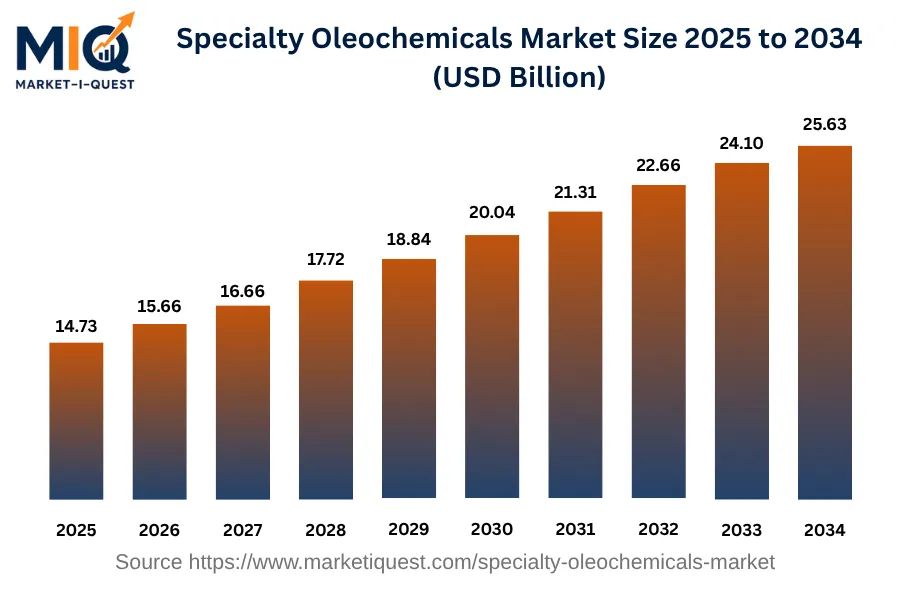
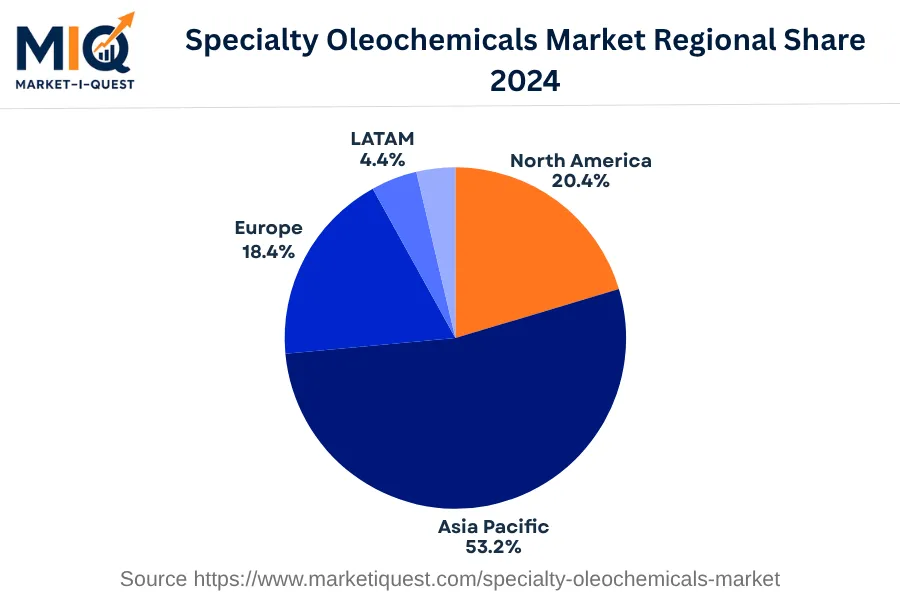
The Specialty Oleochemicals Market valued at $14.73 billion in 2025, an increase from $13.85 billion in the previous year, 2024. By 2034, the market size is anticipated to reach $25.63 billion, expanding over this period at a CAGR of 6.35%. The growth over this period of just under a decade is likely the result of an increase in demand for sustainable and biodegradable products which are derived from natural fats and oils, coupled with the rise in demand for eco-friendly products across numerous industry verticals. In terms of regional shares in 2024, the majority stake was held by the Asia Pacific region, accounting for 53.2% of the global market. This was followed by North America and Europe with a relatively smaller share at 20.4% and 18.4% respectively. The rest of the market was split between Latin America (4.4%) and the Middle East and Africa (MEA) (3.7%).

Key Takeaways

  • By Product Type - Fatty Acids and Derivatives held the leading position in the Specialty Oleochemicals Market in 2024.
  • By Source - Animal-based contributed to the majority share in the market sector during the base year.
  • By End-User Industry - Oil and Gas featured as the top sector in 2024.
specialty-oleochemicals-market market size

Key Driving Factors

Shift towards Bio-based and Sustainable Products

An environmental trend impacting the Specialty Oleochemicals Market today is a strong shift towards bio-based and sustainable products. This is spurred by strict environmental regulations being enforced by governments globally to curb the ecological imprints of industries. These regulations encourage manufacturers for developing eco-friendly formulations. Oleochemicals, being extracted from plant and animal fats, are emerging as a key market for these initiatives. Cosmetics and personal care industries, in particular, are integrating specialty oleochemicals into their products due to their bio-degradability and non-toxic nature. Consumers are becoming more conscious about the content of the products they use, demanding more natural and less harmful components leading to an increase in the demand for Specialty Oleochemicals.
Development in End-use Industries

Specialty Oleochemicals Market has been witnessing growth due to developments in various end-use industries. Certain industries such as personal care, textiles, and polymers have been significantly growing over the past few years. Speciality oleochemicals such as fatty acids and methyl esters are increasingly being used in these sectors due to their distinctive properties such as lubrication, moisturization, and softening. Moreover, the expansion of these end-use industries, especially in emerging regions such as China, India, and Brazil, carried by increasing spending power and changing lifestyle trends of consumers is providing a significant impetus to the specialty oleochemicals market.

Market Evolution by Timeline

2019-2023
During this period, Europe held the largest share in the Specialty Oleochemicals market due to a shift towards bio-based chemicals, primarily influenced by strict environmental policies. Southeast Asia accounts for the major supply, especially Malaysia and Indonesia being the leading producers of palm oil. Notably, soap and detergent manufacturers were the primary buyers due to an increasing preference for natural-based ingredients in products. Yet, low commodity prices and a shifting raw material supply posed growth constraints. Licensing partnerships were the norm, as evident from major companies such as Evonik, KLK OLEO. A notable disruption was EU's amendment to the Renewable Energy Directive (RED II), stimulating the use of sustainable raw materials.
2024
In 2024, the shift towards sustainable and eco-friendly solutions gained more traction, contributing to the increasing demand for bio-based specialty oleochemicals. This demand was high in developing countries such as India and China, which were working towards reducing their carbon footprint. Meanwhile, the supply of specialty oleochemicals, notably from Indonesia and Malaysia, remained steady. Technological advancements led to more efficient production. However, ongoing trade tensions, particularly between U.S. and China, added to pricing volatility and supply uncertainty. Alternatives to long-term contracts emerged, with spot buying seen amongst smaller businesses.
2025-2029
This period might witness an increasing demand for specialty oleochemicals in home and personal care products in North America and European markets. Suppliers will likely focus on improving extraction techniques and better yield. Adoption will further boost by favorable policy measures such as EU's focus on cleaner production methods and extended RED II regulations. The pandemic situation led to a short-term price hike followed by a reduction in contractual agreements. While the large corporations might use strategic alliances as a tool for ensuring raw material supply, newer greenfield projects may face challenges such as land availability and capital investment.
2030-2034
The demand for Specialty Oleochemicals is anticipated to rise substantially across sectors such as food & beverages, pharmaceuticals due to increasing awareness about the benefits of bio-based products. The key supplying regions are expected to remain Southeast Asia, despite the growing oil palm sector in South America, notably Colombia. Technological advances will aim at achieving optimized production process. Major buyers will likely lean towards flexible contract agreements, and spot buying could become more prevalent. Revised standards like US Farm Bill's emphasis on biobased markets will impact consumption. Key challenges will include securing stable raw material sources and addressing environmental concerns.

Future Market Outlook

Future Opportunities

The future of the specialty oleochemicals market appears promising, primarily driven by the escalating demand for renewable and biodegradable products. With the International Maritime Organization’s regulations on sulfur emissions set to take effect, there is an anticipated increase in the use of renewable oleochemical derivatives in marine fuels. This trend may open avenues for companies like Croda International, which is already exploring alternatives in this sector. Additionally, the growing market for bio-based surfactants, particularly in Asia Pacific, indicates a shift as consumers increasingly reject synthetic ingredients. In response to these market dynamics, collaborations are forming, such as the partnership between Dow and the University of California, focusing on developing bio-based plasticizers derived from oleochemicals. Moreover, legislative advancements in regions such as North America provide a supportive framework that encourages investment in biobased products. The rise of the circular economy concept also suggests that companies can harness waste materials in oleochemical production, enhancing sustainability. Observations from the industry indicate that companies focusing on tailored specialty products are likely to thrive, as mentioned by the American Oil Chemists’ Society.

Segmentation Analysis

By Product Type

The market is divided into subsegments including Fatty Acids and Derivatives, Glycerine and Derivatives, Esters, Amides, Non-ionic Surfactants, Ionic Surfactants, Bio-based Solvents, and others. Fatty Acids and Derivatives accounted for the largest revenue share while Bio-based Solvents are expected to grow at the fastest CAGR during the forecast period.

Largest Revenue Share

Fatty Acids and Derivatives

Market Share Leader

Fatty Acids and Derivatives, a subsegment of the market, control a significant share of the market revenue. These compounds have pervasive use across multiple established industries such as food processing, textiles, and pharmaceuticals, driving its leadership in revenue generation. The value of Fatty Acids and their Derivatives is profoundly recognized in the food industry, where they serve as essential building blocks for a variety of products, implying a steady consumer base. The widespread application in textile manufacturing as softening agents also bolsters their market position. Geographically, regions with robust industrial sectors, such as North America and Europe, serve as key revenue contributors. Moreover, stringent regulations favoring the use of less toxic compounds encourage the use of Fatty Acids and Derivatives. With high switching costs due to their unique properties and industrial applications, their market leadership appears solid. Effective supply chains have also played a role in cementing this subsegment's significant revenue.

Fastest CAGR

Bio-based Solvents

Forecast Period Growth Leader

Bio-based Solvents present the fastest growing subsegment in the market, although their share of current revenue is still overshadowed by other subsegments. This industry's growth is propelled by several catalytic factors, including changing regulations favoring eco-friendly products, technology advancements in cleaner production methods, and increased capital expenditures in green technologies. These solvents' unique benefits, such as better environmental footprint and less toxification, have boosted their popularity in recent times, particularly within environmentally conscious industries. Nonetheless, obstacles to this growth trend include adoption barriers from established industries resistant to change, and the fact that bio-based solvents usually demand a higher upfront investment. However, new partnerships and investments are believed to reduce these barriers, while risks lie in potential regulatory changes and supply chain disruptions. The shift towards a green economy presents a strong growth prospect for this subsegment.

By Source

The market is divided into subsegments including plant-based, animal-based, and microbial-based sources. In 2024, the animal-based subsegment held the largest revenue share, while the plant-based category is projected to exhibit the fastest growth rate moving forward.

Largest Revenue Share

Animal-based

Market Share Leader

The animal-based subsegment accounts for the largest revenue in the market primarily due to the established food production processes that derive ingredients from animal sources. The heavy reliance on animal products in global food supply chains makes this subsegment the most dominant. It comprises a vast array of food items, including meat, dairy, and other derivative products that form the basis of many dietary consumption patterns worldwide. Developed regions such as North America and Europe significantly contribute to this subsegment due to their high consumption of animal-based foods. Regulations in these regions, focusing on food safety, ensure the sustained demand for animal-based food. The high switching costs associated with moving to alternative food sources secure animal-based food's dominance. However, the growing awareness towards sustainable and alternative food sources could pose challenges for this subsegment's future growth.

Fastest CAGR

Plant-based

Forecast Period Growth Leader

Despite the current dominance of the animal-based subsegment, the plant-based category is expected to register the fastest growth in the near future. Driving this growth are multiple factors such as evolving consumer preferences toward plant-based diets for wellness and ethical reasons, tech-driven advancements in food processing, and policy support promoting sustainable food systems. The health benefits of plant-based foods and the surging availability of plant-based alternatives are playing crucial roles in accelerating the uptake of these products. Additionally, efficient capex models and strategic partnerships among startups and established entities in the food industry aim to bolster the supply and distribution of plant-based foods. Despite these growth catalysts, the potential market penetration of plant-based foods could still be hindered by adoption barriers, including their higher cost compared to traditional food items, perceived differences in taste, and the deeply ingrained dietary habits of certain consumer segments.

By End-User Industry

The market is divided into subsegments including Food and Beverage, Pharmaceutical, Personal Care and Cosmetics, Industrial and Institutional Cleaning, Automotive, Oil and Gas, Paper and Pulp, Textile, and Others. The Oil and Gas subsegment accounted for the largest revenue share, while the Pharmaceutical sector is anticipated to grow at an aggressive pace during the forecast period.

Largest Revenue Share

Oil and Gas

Market Share Leader

The Oil and Gas industry clinches the highest revenue share in 2024, substantiated by its ubiquity and indispensability in an array of applications. The need for refined petroleum products, lubricants, wax, and other petroleum specialties is on a constant upsurge, thus driving remarkable revenue for this subsegment. Furthermore, the overarching importance of this industry as the global energy backbone promotes its relentless industrial sway, which ensures steady revenue influx. The expansive extraction operations, coupled with the processing of crude oil into a spectrum of essential products, underline the industry's potent economic influence. The sophisticated, capital-intensive nature of the oil and gas operations often limits newcomers' market entry, thereby enabling the well-entrenched players to control the market dynamics and revenue. Geographically, notable oil and gas production regions like the Middle East, North America, and some parts of Africa significantly contribute to the industry's revenue.

Fastest CAGR

Pharmaceutical

Forecast Period Growth Leader

The Pharmaceutical industry is projected as the fastest-growing segment, fueled by a series of catalysts. There has been a surge in healthcare spending, increased life expectancy, and a soaring demand for medicines worldwide. The recent global health crisis has catalyzed the discovery and manufacture of new drugs, therapeutics, and vaccines, implying that growth in this industry will snowball in the coming years. Also, increased capital expenditure in research and development, propelled by strategic partnerships between pharmaceutical giants, is another factor that would expedite the growth rate. Yet, there are challenges like stringent regulations and patent cliffs that pose barriers to adoption. However, with technology evolution, wherein big data and artificial intelligence are transforming drug discovery and development, the industry is slated for significant growth. The near-term risks include dealing with regulatory changes, and competition from generic and biosimilar drugs, that could influence the industry's growth trajectory.

Competitive Analysis: Specialty Oleochemicals Market

Key Market Players

Manufacturers / OEMs

BASF SE
Germany
Wilmar International Ltd.
Singapore
Evonik Industries
Germany

Key Suppliers & Raw Materials

Eastman Chemical Company
US
PTT Public Company Limited
Thailand
ExxonMobil
US

Distributors, Integrators & Channel Partners

Univar Solutions Inc.
US
Brenntag AG
Germany
Hawkins Inc.
US

Porter’s Five Forces Analysis

This analysis delves into the competitive landscape of the Specialty Oleochemicals market by examining five key forces.

Supplier Bargaining Power

High

Suppliers hold sway due to the dependency on specific raw materials, mainly natural oils and fats.

Buyer Bargaining Power

Medium

Large volume buyers such as industrial manufacturers hold leverage over prices.

Threat of Substitutes

Low

Few substitutes exist due to the specialized applications of these chemicals in industries.

Threat of New Entrants

High

Relatively low capex and no strict regulations encourage new entrants in the market.

Competitive Rivalry

Medium

Rivalry is medium due to balanced market share among key players.

Regional Analysis

Geographic market dynamics and growth opportunities across key regions

Global Market Outlook

specialty-oleochemicals-market market regional share

North America

In 2024, the North American Specialty Oleochemicals market experienced significant development due to various factors. Industry growth was largely driven by increased demand for sustainable and environmentally friendly products in sectors such as personal care, pharmaceuticals, and food and beverages. Technological adoption in the production process was another driver, with firms increasingly leveraging advanced manufacturing techniques to improve efficiency and product quality. Government regulations favoring bio-based products over petroleum derivatives also boosted the market. Moreover, investment in the sector was robust, with firms allocating capital to enhance their production capacities and capabilities.

Market trends included shifts in buyer behavior, with an increased preference for natural and biodegradable substances leading to companies modifying their product offerings. In the tech sphere, it was observed that companies made significant strides in the adoption of green chemistry and manufacturing. Channel dynamics also evolved, with the rise of e-commerce providing an additional sales outlet for companies. Additionally, partnerships and mergers & acquisitions became a prominent trend as firms sought strategic alliances to bolster their market presence. Lastly, stronger policy enforcement was observed, with the implementation of stringent standards and guidelines to ensure product safety and environmental sustainability. The specialty oleochemicals market's consistent growth significantly impacted various sectors, including personal care, food and beverage, pharmaceutical, and manufacturing industries.

Asia Pacific

The Specialty Oleochemicals Market in the Asia Pacific was strongly influenced by consumption patterns, regulatory developments, and technology advancements in 2024. Drivers include steady demand from key sectors such as personal care, pharmaceuticals, and food and beverages, particularly in growth markets like China and India. Regulatory policies encouraging environmental sustainability have incentivized the use of bio-based oleochemicals, notably in Japan and Australia. Investments in technological innovation in ASEAN markets have improved efficiencies in oleochemical production, affecting supply dynamics and pricing.

Trends include the increasing adoption of green surfactants by consumers, particularly in South Korea, signifying a shift towards biodegradable and hypoallergenic products. Growing online sales channels in China and India have influenced manufacturers' operational strategies. Furthermore, the implementation of stringent standards by governments across the region, focusing on sustainable manufacturing, has promoted the development of bio-based oleochemicals. Partnerships and M&A activities have been prevalent, primarily to access advanced technologies and secure raw material supply. In terms of policy enforcement, governments have displayed consistency in promoting cleaner, safer, and more sustainable industrial practices in the specialty oleochemicals market.

Europe

In 2024, Europe's specialty oleochemicals market exhibited significant growth and dynamism. Prominent drivers included stringent European Union regulations advocating for greener substitutes to petrochemicals, raising demand for these bio-based chemicals in sectors such as manufacturing and retail. Investment in research and development, especially in Germany and the United Kingdom, also propelled market growth, with heightened adoption of advanced production technologies improving overall supply dynamics. Fluctuating prices of raw materials, mainly vegetable and animal fats, presented a formidable challenge, yet also offered opportunities for strategic sourcing and cost-efficiency.

Concurrent market trends revealed evolving buyer behaviors, with a distinct preference for sustainably manufactured specialty oleochemicals due to increasing environmental consciousness. Novel product developments were observed, particularly in France and Italy, driven by technological integration in operations and product development processes. The shifts in channel dynamics, spurred mainly by e-commerce penetration in Spain, Benelux, and Central & Eastern Europe, facilitated efficient and wide-reaching distribution networks. Mergers and acquisitions, especially in the Nordics, bolstered market consolidation and expansion efforts. Additionally, rigorous enforcement of EU's REACH (Registration, Evaluation, Authorisation and Restriction of Chemicals) policy steered producers to meet stringent compliance and quality standards. The healthcare and utilities sectors, in particular, were high-demand arenas for specialty oleochemicals due to their utility in bio-based products and cleaner energy solutions.

Latin America

In 2024, the LATAM Specialty Oleochemicals market experienced significant dynamism due to multiple drivers and trends. Notably, the regulatory push for green and sustainable production processes fueled increased adoption of bio-based specialty oleochemicals, particularly in Brazil and Mexico, two of the largest economies in the region. Investment in innovative production technologies emerged, spurred by increasing demand from end-user industries like pharmaceuticals and personal care. Meanwhile, the volatility of crude oil prices affected the supply dynamics, pushing some manufacturers to migrate to vegetable oil-based oleochemicals.

Consumer preference for eco-friendly products was a notable trend affecting market behavior, culminating in increased demand for specialty oleochemicals in sectors such as household and personal care. Technological advancements in production processes, seen especially in Argentina and Chile, saw improved efficiency and reduction of waste, garnering significant interest from foreign investors. Mergers and acquisitions became a common strategy amongst key players, aiming to consolidate market position and expand product offerings. Enforcement of stringent environmental policies, particularly in Colombia and Peru, forced manufacturers to comply with sustainable production methods. The market also saw increased demand from the food and beverage industry, attributable to the rising awareness of health and nutrition benefits associated with specialty oleochemicals like medium-chain triglycerides.

Middle East & Africa

The Middle East and Africa specialty oleochemicals market demonstrated a significant growth in 2024, reflecting various macroeconomic and industry-specific drivers along with emerging trends in the region. The increased preference for bio-based products due to stringent environmental regulations was a primary driver, particularly in geographies like Saudi Arabia and the United Arab Emirates. Furthermore, enhanced investment in technology adoption, especially in South Africa's manufacturing sector, amplified supply dynamics, contributing to market growth. Another critical driver came from Nigeria and Kenya where growth in the oil and gas sector stimulated demand for specialty oleochemicals. Conversely, the market experienced downward price pressure due to the competitive regional market, notably in Egypt, impacting overall earnings.

Trending in 2024, the demand for renewable and sustainable products influenced buyer behavior leading to a shift towards green products which significantly defined the purchase pattern in the sector. Another notable trend was the increased partnership and merger and acquisition activities as seen in Saudi Arabia and Israel, broadening opportunities for business expansion. Increased enforcement of environmental policies in the Region notably in the United Arab Emirates elicited a new trend, where companies adopted more environmentally friendly manufacturing processes. Lastly, the manufacturing, oil and gas, and healthcare sectors showed increased uptake of specialty oleochemicals in their operations, shaping the market landscape in 2024.

Recent Industry Developments

Latest market innovations, product launches, and strategic initiatives

June 2026

Nextchem (MAIRE) Completes Acquisition of Ballestra Group for €148.2 Million – Nextchem finalized the acquisition of Ballestra Group, which includes the well-known Mazzoni brand for oleochemistry solutions and BUSS ChemTech. The purchase price was €148.2 million, based on an enterprise value of €108.2 million and adjusted net cash of €40.0 million.

February 2026

BASF Launches AdBlue® GE Produced with Renewable Electricity – BASF launched AdBlue® GE produced entirely with renewable electricity, significantly lowering the carbon footprint of this urea-based oleochemical derivative used in diesel emission control systems.

Frequently Asked Questions