Rapid Medical Diagnostic Kits Market Snapshot

Key Players

  • Abbott Laboratories (United States)
  • Roche Diagnostics (Switzerland)
  • Siemens Healthineers (Germany)
  • Danaher Corporation (United States)
  • BioMérieux (France)
  • Bio-Rad Laboratories Inc. (United States)
  • QIAGEN N.V. (Netherlands)
  • Thermo Fisher Scientific (United States)
  • PerkinElmer Inc. (United States)
  • BD (Becton Dickinson and Company) (United States)

Market Size

Base Year 2024
$22.84 Bn
CAGR
8.62%
Forecast 2034
$52.21 Bn

Market Segments

By Product
Over-the-Counter (OTC) Kits, Professional Kits
By Technology
Lateral Flow, Agglutination, Solid Phase, Other Technologies
By Application
Blood Glucose Testing, Infectious Disease Testing, Cardiometabolic Testing, Pregnancy and Fertility Testing, Fecal Occult Blood Testing, Coagulation Testing, Toxicology Testing, Lipid Profile Testing, Other Applications
By End Use
Hospitals & Clinics, Home Care, Diagnostic Laboratories

Market Dynamics

Drivers
  • Increasing demand for quick results
  • Advancements in Medical Technology
Restraints
  • High manufacturing costs
  • Regulatory approval challenges
Opportunities
  • Emerging markets growth potential
  • Technological advancements in diagnostic kits

Market Size

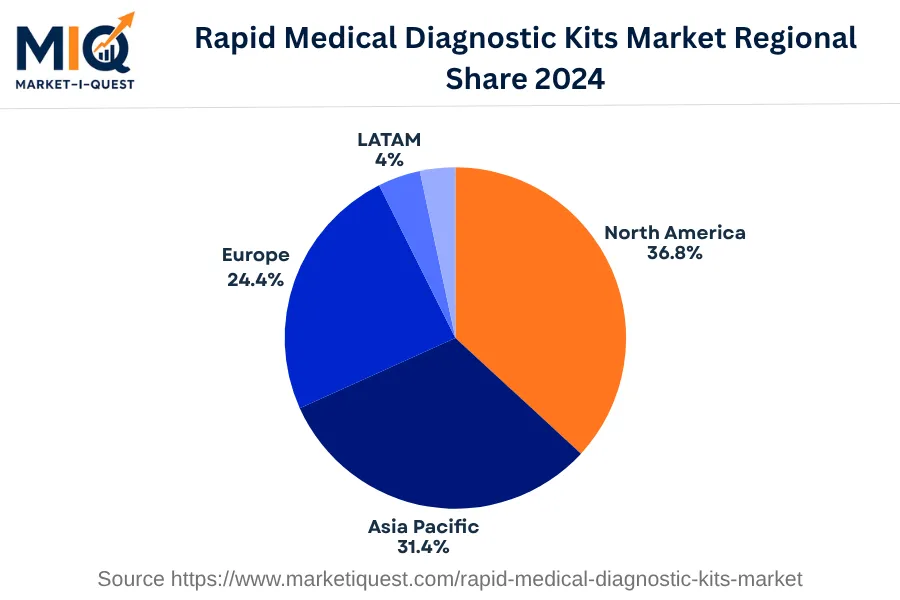
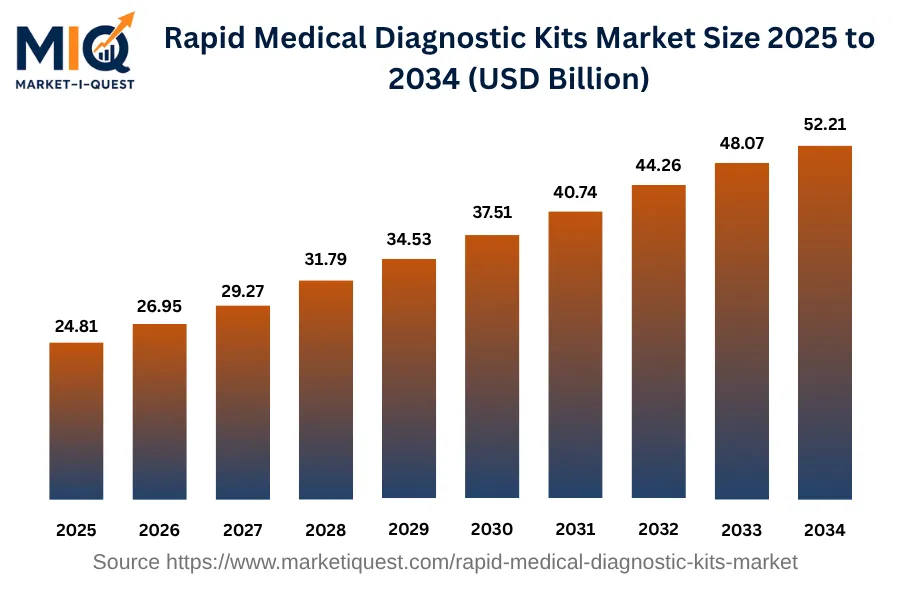
The Rapid Medical Diagnostic Kits Market valued at $24.81 billion in 2025 and is projected to reach $52.21 billion by 2034, at a CAGR of 8.62%. Market increase from $22.84 billion in 2024, before nearly doubling in value by 2034. Exploring the increasing health consciousness globally, the demand for quick and accurate diagnostic tools substantially contributed to this growth. Handy equipment for prompt medical diagnosis has paved the path for the industry's significant expansion in less than a decade. However, the North America held 36.84%, making it the largest market. The Asia Pacific region followed closely with 31.42%, while Europe accounted for 24.36% of the market. LATAM and MEA regions held smaller shares at 4.03% and 3.35% respectively.

Key Takeaways

  • By Product - Professional Kits led the market accounting for the majority share in 2025.
  • By Technology - Lateral Flow Phase showcased rapid expansion leading in terms of growth rate in 2025.
  • By Application - Infectious Disease Testing emerged as the dominant subsegment in 2025.
  • By End Use - Hospitals & Clinics lead the market holding the majority market share in 2025.
rapid-medical-diagnostic-kits-market market size

Key Driving Factors

Strict Regulations for Disease Control

Increased regulatory pressure on public health systems globally is a prominent driver. Specifically, World Health Organization guidelines and directives are driving nations for improving their disease surveillance and control mechanisms. One way to achieve this is through the use of rapid medical diagnostic kits, which can quickly and accurately identify a range of infectious diseases. Therefore, policymakers are focusing on ensuring adequate supply of these kits in healthcare facilities across both urban and rural areas. This drive towards regulatory compliance in disease control is consequently pushing the demand in the rapid medical diagnostic kits market.

Need for Prompt Patient-Centric Care

Today's healthcare providers strive to achieve prompt patient-centric care. Patients no longer want to wait days for lab results. They want immediate answers to their health concerns. To meet this need, healthcare providers are gradually integrating rapid medical diagnostic kits into routine patient care workflows. Rapid medical diagnostic kits can deliver fast, on-the-spot results, helping healthcare providers to make timely diagnoses, promptly begin treatment procedures, and quicken discharge plans when necessary. As such, the shift toward quicker, more patient-centric care delivery is driving the rapid medical diagnostic kits market forward.

Market Evolution by Timeline

2019-2023
The Rapid Medical Diagnostic Kits Market saw an increasing uptake by government healthcare agencies and private hospitals worldwide, especially in regions such as North America and Europe. The kits were principally used to detect infectious diseases, including influenza and HIV. The most popular kits, such as QuickVue, were shipped globally, but the technology integration was complex, often requiring specialist training. FDA regulations, such as the U.S. CLIA (Clinical Laboratory Improvement Amendments), influenced adoption. The typical commercial model included bulk purchasing contracts, with major players such as Quidel Corporation and Abbott Laboratories forming key partnerships. Pricing dynamics pivoted towards value-based pricing.
2024
In 2024, global public health emergencies stimulated demand for rapid diagnostic kits, with African and Southeast Asian countries showing significant interest. Other than infectious diseases, chronic conditions like diabetes also featured as key use cases. Technology improvements facilitated easier kit integration. However, manufacturing constraints surfaced due to increased demand. In response, companies like Roche Diagnostics stepped up production. Compliance with policies like the EU's In Vitro Diagnostics Regulation (IVDR) was critical for market acceptance. Most sales contracts were direct and on a large scale. However, smaller healthcare institutions commonly procured kits through distribution partnerships. Amid this growth, issues persisted around the reliability of some tests and market counterfeit, which companies tackled through rigorous validation process and legal measures.
2025-2029
From 2025–2029, buyers diversified to include not just healthcare institutions but also private corporations and individuals, particularly in urban areas of China and India. Use cases will also likely expand to include genetic disorders and lifestyle diseases. Companies such as BioMérieux and BD is expected to pioneer in developing advanced probes and assays improving diagnostic accuracy. Overcoming previous constraints, the supply of kits will likely upscale. Policies such as China's Medical Devices Regulation might play a significant role in standardizing kit use and quality. The commercial model may lean more towards online sales, directly and through e-commerce platforms.
2030-2034
By 2030–2034, global corporations, non-profit organizations and individual consumers became key buyers of rapid diagnostic kits. The market might witness an upward trend in developed and developing countries alike. The dominant use case are expected to become early detection of chronic and genetic diseases. Technological advances might facilitate miniaturization and precision of the kits such as Siemens Healthineers' Atellica Solution. Key constraints mainly lay in the adequate training of staff and users, and adapting to regulations such as the Global Harmonization Task Force's (GHTF) standards. The commercial model will likely witness a shift towards subscription and lease agreements.

Future Market Outlook

Future Opportunities

As the global focus on public health has intensified, opportunities within the rapid medical diagnostic kits market have become increasingly pronounced. The U.S. CDC emphasized the need for rapid and accurate testing methods for infectious diseases beyond COVID-19, hinting at a broader demand for flu and RSV testing capabilities. This evolving landscape opens avenues for companies like QuidelOrtho to innovate and expand their product lines. The shift toward home-based and decentralized testing options, accelerated by the pandemic, is expected to create further growth opportunities, a trend observed with the rise of kits like the Ellume COVID-19 Home Test. The integration of artificial intelligence and machine learning into diagnostic processes is expected to enhance accuracy and speed, evidenced by partnerships such as that between Siemens Healthineers and Tempus. Regulatory bodies are increasingly supporting initiatives for streamlined approval processes, as seen in the FDA's flexible approach to diagnostic test validation measures during health emergencies. Targeting emerging markets, such as Southeast Asia and Africa, represents a significant opportunity for rapid diagnostic kit integration, as seen with efforts by companies like Mylab Discovery Solutions to launch affordable testing solutions for endemic diseases.

Segmentation Analysis

By Product

The market is divided into subsegments including Over-the-Counter (OTC) Kits and Professional Kits. Professional Kits accounted for the largest revenue share while Over-the-Counter (OTC) Kits is expected to grow at the fastest CAGR during the forecast period.

Largest Revenue Share

Professional Kits

Market Share Leader

Professional Kits have been leading in revenue primarily due to their higher adoption in clinical settings and institutions, where professionals are trained to utilize these kits optimally, thus increasing their demand and consequently, revenue. These kits often command a higher price due to their specialized nature and the expert supervision required to operate them, contributing to their larger revenue share. Prevalent in established markets with robust healthcare systems and infrastructure, professional kits typically cater to a more premium segment of customers, further raising revenue. Further, purchasing decisions often hinge on the kit's efficacy, accuracy, and ease of use in a professional setting, features often found in professional kits. Barriers to switch from professional to over-the-counter kits can be high, considering the stringent regulations in place for clinical usage and the inherent reliance on professional judgement and supervision, thereby cementing the leading position of professional kits in terms of revenue generation.

Fastest CAGR

Over-the-Counter (OTC) Kits

Forecast Period Growth Leader

Over-the-Counter (OTC) Kits are expected to experience the fastest growth, driven primarily by their convenience of use, accessibility, and lower cost relative to professional kits. Technological advancements that improve the accuracy and reliability of these kits, coupled with policy initiatives promoting self-care and home healthcare, are further catalyzing this growth. Rising healthcare costs and the increasing preference for self-medication, especially in developing regions, serve as driving factors. Despite these accelerators, adoption barriers exist. Consumer skepticism about the accuracy and safety of OTC kits and a lack of awareness in certain regions may slow growth. Near-term risks include regulatory hurdles and recalls due to potential product defects or misrepresentations, but strategic partnerships with healthcare professionals can mitigate these risks and guide consumers towards correct usage, accelerating the growth of this market segment.

By Technology

The market is divided into subsegments including Lateral Flow, Agglutination, Solid Phase, and Other Technologies, among which the Solid Phase accounted for the largest revenue share while Lateral Flow is expected to grow at the fastest CAGR during the forecast period.

Largest Revenue Share

Solid Phase

Market Share Leader

Solid Phase technology has dominated the market in terms of revenue in the base year 2024. The widespread adoption of Solid Phase technology in a variety of applications, including diagnostics and antibody detection, is a major revenue driver. More robust and sensitive results offered by Solid Phase technology compared to other technologies make it preferred choice among customers. Additionally, the rising requirements of solid phase in developing countries have also expanded the global footprint of this segment. Regulatory support in different geographies further strengthens its position by making the technology more accessible and standardised. Technical benefits like low-cost processing and easy compatibility with automated systems boosted its demand. While the initial investment cost and complexity may, to some extent, discourage small scale laboratories, its long-term cost effectiveness and superior results are significant purchasing criteria for larger entities.

Fastest CAGR

Lateral Flow

Forecast Period Growth Leader

Despite not being the largest segment in terms of current revenue, Lateral Flow is showing the fastest growth in terms of CAGR. Critical growth drivers for Lateral Flow technology include ease of use, reduced testing times, and the ability to deliver quick and accurate results. These factors make Lateral Flow a primary choice for point of care testing. Potential barriers to adoption include the need for further standardization of test procedures and regulatory hurdles in some regions. However, investments in technological improvements and research partnerships are helping to overcome these challenges. For instance, advances in nanotechnology have led to improved sensitivity and specificity, enhancing the accuracy of lateral flow assays. Near-term market risks include potential supply-chain disruptions and unfavourable price performance due to factors like raw material fluctuations. Nevertheless, the potential for easy integration with digital technology, growing demand for home-based testing, and supportive government policies serve as positive catalysts for growth.

By Application

The market is divided into subsegments including Blood Glucose Testing, Infectious Disease Testing, Cardiometabolic Testing, Pregnancy and Fertility Testing, Fecal Occult Blood Testing, Coagulation Testing, Toxicology Testing, Lipid Profile Testing, and Other Applications. In 2024, the Infectious Disease Testing accounted for the largest revenue share while the Blood Glucose Testing is expected to grow at the fastest CAGR during the forecast period.

Largest Revenue Share

Infectious Disease Testing

Market Share Leader

Infectious Disease Testing falls under the umbrella of the diagnostic market and it accounted for the highest revenue share in 2024. Its demand is primarily driven by the rising prevalence of infectious diseases worldwide, coupled with the escalating awareness about early diagnosis. The testing segment plays a significant role in identifying seasonal outbreaks along with pandemic situations, which factor in the increase in revenue. Emerging markets have seen a formidable increase in the need for such testing due to high population density and lack of sanitation, promoting the growth of this segment further. The advancement in technology coupled with the adoption of molecular diagnostic techniques have given a much-needed boost to this market. Moreover, the favorable regulations and availability of funds for R&D have expanded the potential of this segment. It must be underlined that regular monitoring and control measures by health organizations also play a significant role in keeping the revenue high for the infectious disease testing segment.

Fastest CAGR

Blood Glucose Testing

Forecast Period Growth Leader

Blood Glucose Testing is expected to register the fastest growth, majorly due to the surge in diabetes cases globally. Diabetes has been dubbed as a global epidemic by WHO, and this reinforces the need for regular blood glucose testing for effective management of the disease. The sedentary lifestyle observed today further increases the propensity towards diabetes, thus propelling the demand for blood glucose testing. The technological advancements in glucose meters and test strips are also acting as catalysts in the market growth. The advent of non-invasive glucose monitoring devices is expected to fuel the market growth looking at the convenience and ease it promises to the users. However, the high cost associated typically with consistent blood glucose monitoring might be a potential barrier in the adoption of these devices and can also add up as a near-term risk. In such a scenario, partnerships between manufacturers and health organizations might be key in overcoming these challenges and fostering growth.

By End Use

The market is divided into subsegments including Hospitals & Clinics, Home Care, and Diagnostic Laboratories. Hospitals & Clinics accounted for the largest revenue share while Home Care is expected to grow at the fastest CAGR during the forecast period.

Largest Revenue Share

Hospitals & Clinics

Market Share Leader

Given their essential role in providing healthcare services, Hospitals & Clinics form the subsegment with the largest revenue. As these institutions address a wide array of health conditions, the demand for their services remains consistently high. Further, they rely on a range of medical equipment and consumables for diagnosis, treatment, and patient care, which contributes substantially to their revenue. In terms of geographies, urban areas with higher population densities contribute the most due to the scarcity of hospitals and clinics. Demand in developing countries is also expected to be high due to both rapid urbanization and the increasing healthcare cover offered by governments. The purchasing ability of these institutions is typically high, making them less sensitive to price fluctuations, which can contribute to higher revenues. Their capacity to afford high switch costs also supports technology upgrades, contributing to higher revenues for medical device manufacturers.

Fastest CAGR

Home Care

Forecast Period Growth Leader

The Home Care subsegment displays the fastest growth rate, mainly driven by technological advancements and changes in healthcare policies. The rising demand for at-home treatments and care is a major growth driver, particularly in developed economies where the aging population is on the rise. Adding to this, there are considerable reductions in capital expenditure as technology continues to evolve – the improving efficiency and effectiveness of home-based medical devices are further facilitating this trend. However, the adoption of home care does face its challenges, such as the initial reluctance by some patients to move away from traditional institution-based care. Adjusting to the use new technologies may also pose as an adoption barrier for some. Other risks include regulatory concerns over patient safety and accountability in home care settings, which can impact the rate of adoption in the short-term.

Competitive Analysis

Key Market Players

Manufacturers / OEMs

Abbott Laboratories
US
Becton, Dickinson and Company
US
Bio-Rad Laboratories, Inc.
US

Key Suppliers & Raw Materials

Thermo Fisher Scientific Inc.
US
Merck KGaA
Germany
Sigma-Aldrich Co.
US

Distributors, Integrators & Channel Partners

McKesson Medical-Surgical Inc.
US
Henry Schein, Inc.
US
Cardinal Health
US

Porter’s Five Forces Analysis

This analysis digs into the competitive scenario of the Rapid Medical Diagnostic Kits Market.

Supplier Bargaining Power

Medium

Material suppliers have moderate power due to the requirement of specialized components.

Buyer Bargaining Power

High

High competition and availability of diverse products offer more power to the buyers.

Threat of Substitutes

Low

Low threat due to unique value proposition of rapid diagnostic kits.

Threat of New Entrants

Medium

Regulation barriers and high R&D expenses cause medium threat of new entrants.

Competitive Rivalry

High

Numerous established players with advanced solutions fuel intense competitive rivalry.

Regional Analysis

Geographic market dynamics and growth opportunities across key regions

Global Market Outlook

rapid-medical-diagnostic-kits-market market regional share

North America

In 2024, the Rapid Medical Diagnostic Kits Market in North America was marked by strong demand, flourishing technology adoption, and regulatory reforms. The imposition of stringent accuracy standards by the U.S. Food and Drug Administration (FDA) elevated the region's investment in innovative diagnostics technologies, driving the market. Tech giants like Apple and IBM significantly ventured into medical diagnostics, promoting widespread adoption. The paramount concern of healthcare accuracy led to a surge in demand in the U.S., Canada, and Mexico's healthcare sectors. Telehealth platforms' growing influence has further underscored the requirement for remote diagnostic possibilities. Meanwhile, changes in supply dynamics owing to the reduction in direct purchases from China stirred a shift towards domestic supply chains, leading to fluctuating price trends.

The trend of remote medical diagnostics gained considerable momentum, with the Canadian population embracing digital platforms at an impressive rate. Technology adoption proved pivotal in altering buyer behavior and redefining sales channels. A substantial rise in partnerships and M&A activities was observed, especially in the United States between health insurance companies and diagnostic kit manufacturers, aiming to provide cost-effective solutions to policyholders. The enforcement of stringent accuracy standards by health authorities across North America has directed the market trends towards quality assurance and transparency.

Asia Pacific

In 2024, Asia Pacific's Rapid Medical Diagnostic Kits market experienced considerable growth. This upswing was propelled by increased healthcare investment from nations such as China, India, and Australia, which expanded access and demand. Technological adoption has accelerated, fueled by Japan and South Korea's leading innovation in digital diagnostics. Regulatory frameworks, particularly in key ASEAN markets, also influenced growth for stricter quality assurance, creating competition and destabilizing pricing dynamics. Simultaneously, the market has evolved alongside consumer behaviors and technological shifts. Unlike prior reliance on traditional hospital visits, preference has skewed towards at-home testing, driving demand for products such as cholesterol and glucose monitors. The region has also witnessed an intensifying trend of partnerships and mergers, such as the significant union of Japanese and Indian diagnostic companies to circumscribe market gaps. The bolstering of healthcare policies in China, combined with stringent enforcement, has led to stricter quality standards for diagnostic kits, affecting the regional market significantly.

Key sectors driving the market trends include the healthcare segment which made substantial advancements in telemedicine, and the enterprise sector with a compelling emphasis on employees' health. From a customer perspective, significant demand stemmed from government bodies procuring these kits for public health use, along with increasing volume in retail outlets. Also, manufacturing units saw a surge in demand for employee health monitoring.

Europe

In 2024, the European Rapid Medical Diagnostic Kits Market saw a dynamic shift due to several key factors. Government investment in healthcare combined with increased patient awareness drove demand, particularly in countries such as Germany, France, the United Kingdom, and Italy. Newly implemented regulations promoting the use of rapid diagnostic kits in hospitals and clinics across Europe also played a significant role. Finally, cost-effective production strategies adopted by manufacturers bolstered supply, ensuring the market met demand effectively.

Regarding trends, buyer behavior leans towards kits providing instant results, with a growing preference for home-based testing solutions. This shift has catalyzed advancements in product technology, notably PCR-based kits. The healthcare sector, including large-scale hospitals and clinics in Benelux and Central & Eastern Europe, largely dominates purchases. Distribution primarily goes through e-commerce platforms and long-established pharmaceutical chains, driving the potential for partnerships and M&A among market players. The introduction and enforcement of CE marking standards for in-vitro diagnostic medical devices have ensured quality and reliability, further reinforcing market growth. The Nordics, led by Sweden, have been at the forefront of this policy implementation, contributing positively to the broader market trend across Europe.

Latin America

In 2024, the Rapid Medical Diagnostic Kits market in Latin America proved to be a resilient facet in healthcare systems, propelled by technological advancements and specific demand dynamics. Increased access to healthcare services in Brazil and Mexico primarily drove the demand for these kits. Also, efforts to improve diagnostic capacities in Argentina, given its advanced healthcare infrastructure, was another major driver. Furthermore, government initiatives in Colombia, Chile, and Peru enhancing primary healthcare coverage fueled the market expansion. The adoption of innovative technologies for faster disease diagnosis was actively visible in these regions.

New trends emerged, such as decentralized testing, which gained traction among healthcare professionals and patients, primarily in Brazil. A noticeable shift towards the use of molecular diagnostic kits in Mexico, facilitated by the implementation of stringent standards, was evident. Increased public-private partnerships to improve healthcare infrastructure in Argentina and the industrial-scale production of rapid diagnostic tests in Colombia influenced market trends. Lastly, an increased focus in Chile and Peru towards policy enforcement and the improvement of regulation controls around the manufacturing and distribution of rapid diagnostic kits shaped the industry’s landscape. The primary customers included healthcare providers, public health agencies, and retail pharmacy chains across these nations.

Middle East & Africa

In 2024, the Rapid Medical Diagnostic Kits Market in the Middle East and Africa was highly active, driven primarily by the healthcare, government and retail sectors. Rising health awareness among consumers, increasing investment in healthcare infrastructure in countries like Saudi Arabia, the United Arab Emirates, and Qatar, and the strong presence of key manufacturers led to a heightened demand for these kits. Technological adaptations in Nigeria and Kenya fueled the expansion of these kits into digital platforms, favoring ease-of-use and accuracy.

Market trends pointed toward partnerships among manufacturers and local healthcare facilities, particularly in South Africa and Israel. Encouraged by favorable government policies, these collaborations led to the co-development of region-specific diagnostic kits. Sophisticated product offerings surged, particularly DNA-based testing kits and those addressing widespread health conditions. Within retail, online sales channels prominently advanced, particularly in Egypt, influenced by a notable shift in buyer preferences towards online shopping. Policy/regulations, specifically those related to product quality and safety in Saudi Arabia and the UAE, played a crucial part in shaping market trends, enforcing regular monitoring and updating of these kits. Consequently, the market landscape was significantly impacted by demand factors, evolving technology, and policy enforcement pertinently in the base year.

Recent Industry Developments

Latest market innovations, product launches, and strategic initiatives

June 2026

Global Fund Launches Early Adopter Initiative for Near-Point-of-Care TB Testing – Thirteen countries began rolling out a new, first-in-class near-point-of-care (NPOC) molecular diagnostic test for TB across health facilities as part of an Early Adopter initiative driven by the Global Fund.

January 2026

WHO Delists Meril Diagnostics Products from Prequalified IVD List – WHO delisted malaria, HIV, and HIV/syphilis rapid diagnostic tests manufactured by Meril Diagnostics Pvt. Ltd. from the list of prequalified IVDs on January 5, 2026, issuing alerts to users and national regulatory authorities.

Frequently Asked Questions