
Railway Management System Market Snapshot

Key Players

  • Alstom SA (France)
  • Siemens AG (Germany)
  • Hitachi Ltd. (Japan)
  • Bombardier Inc. (Canada)
  • IBM Corporation (United States)
  • Cisco Systems Inc. (United States)
  • ABB Ltd (Switzerland)
  • GE Transportation (United States)
  • Toshiba Corporation (Japan)
  • Huawei Technologies Co. Ltd. (China)

Market Size

Base Year 2024
$42.85 Bn
CAGR
9.34%
Forecast 2034
$104.65 Bn

Market Segments

By Component
Solutions, Services (Managed), Services (Professional)
By Deployment Mode
On-Premises, Cloud
By Rail Type
Passenger Rail, Freight Rail
By End User
Railway Operators, Infrastructure Managers

Market Dynamics

Drivers
  • Rising urbanization
  • Digitalization in transportation sector
Restraints
  • High installation costs
  • Technological integration challenges
Opportunities
  • Advanced technological incorporation
  • Increased global transportation needs

Market Size

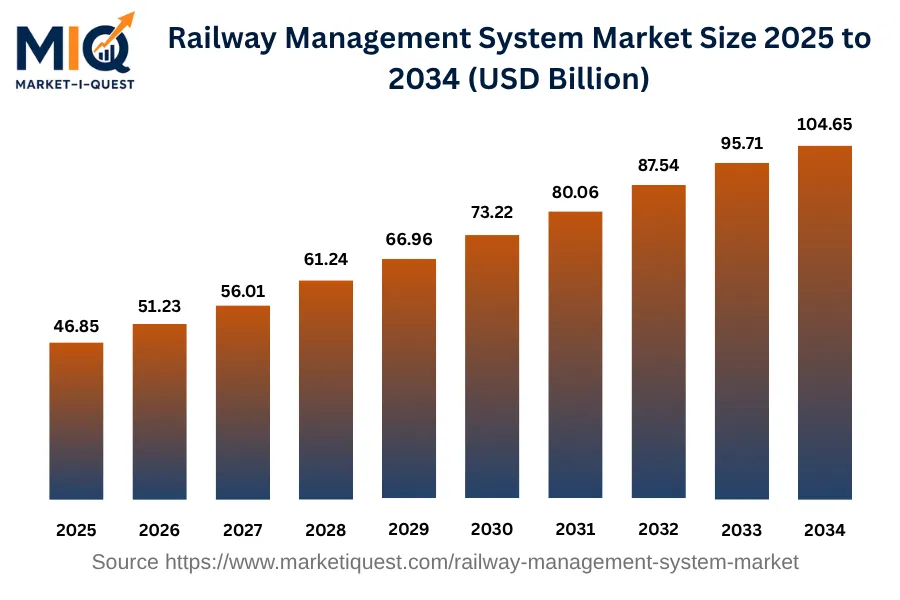
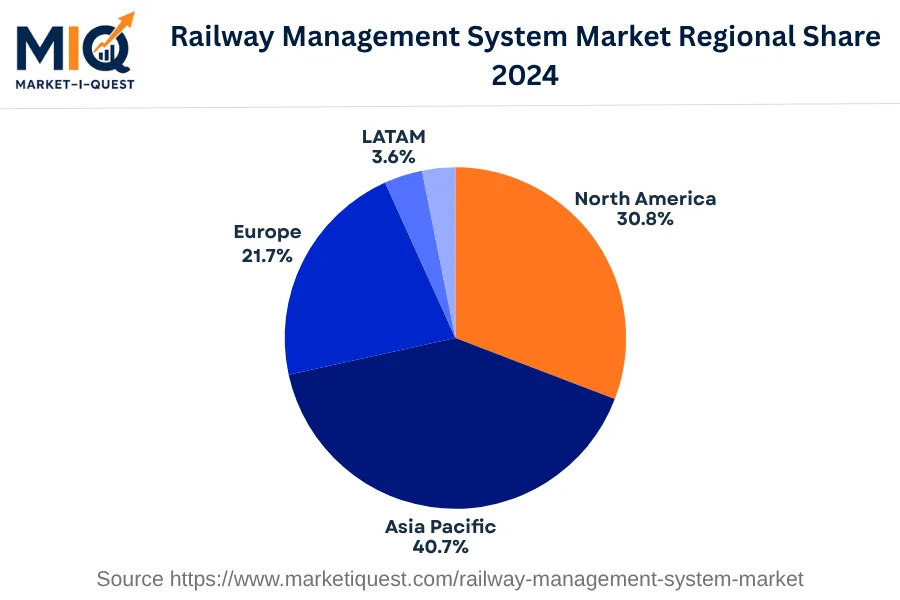
The Railway Management System Market had a valuation of 46.85 billion USD in 2025, which will increase to a value of 104.65 billion USD by 2034, growing at a compound annual growth rate of 9.34%. This consistent enlargement of the market is attributed to a notable rise in the overall expenditure in the rail sector, coupled with the digitization and automation of railways all over the world, to ensure advanced management, passenger comfort and systems efficiency, leading to a steady year-on-year growth of this market. In terms of regional share in 2024, the Asia Pacific accounted for the largest part of the market with 40.74%, followed by North America with 30.82%, Europe with 21.68%, Latin America with 3.62% and Middle East & Africa with 3.14% respectively, reflecting the worldwide distribution of this market.

Key Takeaways

  • By Component - Solutions led the market accounting for a significant portion in the base year.
  • By Deployment Mode - On-Premises proved to be growing at the fastest rate with a steady forecast for the next decade.
  • By Rail Type - Freight Rail held the leading market share in its segment.
  • By End User segment - Railway Operators were dominant accounting for a majority share in the given year.
railway-management-system-market market size

Key Driving Factors

Government Regulations on Safety and Efficiency

In line with the rising concerns for public safety and efficiency across global railway networks, several governments have introduced stringent regulations. One such regulation is the Positive Train Control (PTC) in the United States, a system designed to prevent train-to-train collisions, over-speed derailments and other accidents. This has led to a gradual increase in the demand for proficient railway management systems. These systems enable train operators to comply with the government benchmarks by ensuring increased safety, operational efficiency and reduced operating costs. As these regulatory requirements become more stringent, the impact on the Railway Management System Market will intensify.
Rising Popularity of Public-Private Partnerships (PPPs)

There's been an increasing trend in governments seeking collaborations with private entities to renovate and modernize existing railway infrastructure or to construct new ones. Such public-private partnerships (PPPs) aim to leverage the technical and managerial skills of the private sector alongside the regulatory and financial support of the government. This combines to stimulate the demand for modern railway management systems that can handle dynamic scheduling, fare collection, infrastructure development, and other operation elements efficiently. The global shift towards PPPs in rail infrastructure projects should continue to positively influence the growth of the Railway Management System Market.

Market Evolution by Timeline

2019-2023
During this period, demand for railway management systems increased primarily in Asia due to infrastructure growth, especially in China and India. New systems were implemented with technologies like rail analytics and geospatial analytics. However, integration of these technologies still posed a challenge. Policy influence came from EU's Technical Specifications for Interoperability (TSI), affecting adaptation of systems in Europe. Commercial models showing patterns of both outright purchasing and leasing, driven by budget constraints of rail businesses. Main risks involved in cybersecurity threats and responses saw increased investments in cybersecurity measures.
2024
In this year, the railway management system market started evolving around North America, driven by higher urbanization in USA and Canada. The rise of Internet of Things (IoT) and Machine Learning technologies saw their applications in railway management systems for advanced analytics. Integration also improved with most systems offering interoperability. Regulations followed continued adaptation of prior EU's TSI standards. Pricing in the commercial models started shifting towards subscription models with longer-term contracts. Risks became more evident in data breaches and networks began focusing on stronger encryption methods.
2025-2029
The market continued to develop with higher demands from Middle East and Africa, due to their growing investments in transport infrastructure. Technological advancements centered around AI and predictive analytics for optimizing resources and maintenance schedules. Regulations now covered more comprehensive cybersecurity guidelines, pressing need for risk mitigation plans. The preferred commercial model was long-term contracts with flexible payment plans to address buyer constraints. Principal risk shifted to system compatibility, countered by increased focus on system interoperability.
2030-2034
The market matured with demands diversifying across all regions. The technology focus moved towards automated systems using AI and Machine Learning for self-diagnosis and rectification. Policy included common global standards for railway management system operations and stronger data privacy regulations. Commercial models saw more partnerships between technology providers and railway operators, driving shared risks and benefits. Risks turned to potential AI failures, leading to requirement of robust backup systems. Pricing models likely evolved to performance-based pricing.

Future Market Outlook

Future Opportunities

As railway management systems continue to evolve, multiple future opportunities emerge, particularly stemming from regulatory changes and technological advancements. A notable shift is expected in 2024, with the introduction of stringent safety regulations in the European Union that mandate the adoption of automated train safety systems. This regulatory environment presents opportunities for technology firms specializing in safety solutions, as evidenced by the increased partnership activity among companies like Alstom and Thales focused on safety-critical systems. Furthermore, urbanization trends, especially in countries like India, highlight the burgeoning need for efficient urban transit solutions, making smart city integration a prime area for market expansion. The successful pilot of automated metro systems in cities like Shanghai in early 2023 has set a precedent that may drive demand for integrated railway solutions across urban environments globally. Moreover, the emphasis on sustainability creates room for growth in alternative energy sources for rail systems, such as hydrogen fuel cells and electrification initiatives being pursued in Australia and the EU. As nations prioritize carbon-neutral public transport systems, companies producing electric locomotives are likely to find increased demand for their solutions. Overall, the alignment of technological capabilities with regulatory requirements is expected to open new avenues for innovation and investment within the railway management system segment, addressing contemporary challenges and enhancing service delivery.

Segmentation Analysis

By Component

The market is divided into subsegments including Solutions, Managed Services, and Professional Services. Solutions accounted for the largest revenue share while Managed Services is expected to grow at the fastest CAGR during the forecast period.

Largest Revenue Share

Solutions

Market Share Leader

The Solutions component of the market claims the lion's share of the revenue, and this trend is expected to continue based on typical industry logic. Customers have a pronounced need for robust and reliable solutions that can address complex business problems while providing value for their investment. Solutions often come with a high level of intricacy and require significant capital outlay, thus contributing to major revenues. Owing to their complexity and the crucial role they play in operations, switching costs for solutions are typically high, further solidifying their position in the revenue chart. This subsegment is expected to continue leading, fueled by its broad adoption across various geographies and industries. Rigorous regulatory compliances and the need for modern, efficient systems to navigate them also drive the demand for solutions. These factors combined with the traditional sales channels that are deeply entrenched in the industry set the stage for continued revenue dominance for the Solutions subsegment.

Fastest CAGR

Managed Services

Forecast Period Growth Leader

Projected to experience the fastest CAGR during the forecast period is the Managed Services subsegment. The growth is expected to be driven by companies’ increasing reliance on third-party providers to manage aspects of their business process. Rapid technological advancements and evolving business practices have created a favorable environment for managed services. Despite the growth trajectory, there are adoption barriers including data security concerns, fear of loss of direct control, and integration issues with existing systems. Companies are capitalizing on opportunities such as inorganic growth strategies - including partnerships and collaborations - with other players in the value chain to expand their offerings and customer base. Furthermore, supportive government policies coupled with corporate investments are acting as catalysts for the Managed Services subsegment growth. It’s worth noting however, that short term market instabilities caused by external factors could pose a risk to this anticipated rapid growth.

By Deployment Mode

The market is divided into two main deployment modes: On-Premises and Cloud. As per the year 2024, Cloud-based technologies have accounted for the largest revenue share, while On-Premises deployments are expected to grow at the fastest CAGR during the forecast period.

Largest Revenue Share

Cloud

Market Share Leader

There seems to be a remarkable surge in the adoption of cloud-based services. This primary growth driver of the cloud segment is due to its versatility and ease of implementation. The premium placed on flexibility, scalability, and remote access by businesses worldwide has effortlessly shifted preference toward this deployment mode. The cloud model allows companies to trade capital expenses for operational ones, lowering the initial cost of setup. Apart from cost-efficiency, automation capabilities of cloud platforms are enhancing productivity and operational efficiency, quickly making it the go-to option for many organizations. Data regulations have also been a significant factor influencing more businesses to embrace the cloud as it provides enhanced security features, enabling organizations to meet compliance requirements. Geographically, the growth of this segment can be attributed to the mature markets of North America and the emerging economies of Asia-Pacific, accounting for the largest share of its revenue.

Fastest CAGR

On-Premises

Forecast Period Growth Leader

Though the on-premises deployment mode might not bring in as much revenue as the cloud does currently, it is expected to grow at the fastest CAGR. On-premise solutions offer full control over data, infrastructure, and security, which is something many enterprises still prefer. Amidst growing concerns related to data privacy and security breaches, many enterprises are sticking to the traditional on-premises deployment mode which provides them better control over their system. Technological advancements and enhancements in on-premise solutions are breaking adoption barriers. Partnering with tech companies to develop robust, secure, and scalable solutions could be a catalyst for growth in this segment. However, high upfront costs and the need for regular maintenance and updates pose as near-term risks for the deployment of on-premises solutions.

By Rail Type

The rail market is divided into subsegments including Passenger Rail and Freight Rail. In 2024, Freight Rail accounted for the largest revenue share while Passenger Rail is expected to grow at the fastest CAGR during the forecast period.

Largest Revenue Share

Freight Rail

Market Share Leader

Freight Rail accounted for the highest revenue share in 2024 due to several factors. Key amongst them is the fact that rails provide efficient and economical freight logistics especially for bulk commodities like coal, oil, gas, grains and other heavy goods which are ubiquitously transported globally. Furthermore, governments, particularly in emerging economies are investing heavily in rail infrastructure to facilitate cargo transport. Moreover, the need for safe and efficient transportation of hazardous materials also drives the demand in this segment. Strong demand from mining and manufacturing sectors, particularly from regions such as Asia-Pacific and North America, contribute significantly to the revenues of this segment. Additionally, there is an increasing trend toward the adoption of intermodal freight transport, which leverages the strengths of various transportation modes including rail to achieve high efficiency and environmental sustainability. The inherent advantages of rail transport such as lower fuel costs, larger carrying capacity, and lesser impact on environment make freight rail a vital segment of the rail industry with a substantial revenue share.

Fastest CAGR

Passenger Rail

Forecast Period Growth Leader

In contrast, it is projected that the Passenger Rail subsegment will show the fastest growth. Several growth drivers exist for this trend. Primarily, there is an increasing population in urban areas which necessitates efficient public transit systems, with passenger rail forming a crucial part of such solutions. Urbanization and growth in commuting for work purpose are intensifying the demand for rapid transit systems. This, along with growing environmental concerns encouraging citizens to use public transportation, supports faster growth in the passenger rail sector. Technology advances such as the advent of high-speed trains are also a major factor boosting the segment’s growth potential. Major economies like China, Japan, and countries in Europe are heavily investing in this advanced rail technology. However, substantial capital expenditure and planning complexities can pose as growth barriers in the short term. Overall, factors such as urban migration, investment in rail infrastructure, and environmental sustainability drive the fast-paced growth of the Passenger Rail subsegment.

By End User

The market is divided into subsegments including Railway Operators and Infrastructure Managers, with Railway Operators accounting for the largest revenue share while Infrastructure Managers are expected to grow at the fastest CAGR during the forecast period.

Largest Revenue Share

Railway Operators

Market Share Leader

Railway operators lead in revenue generation due to several reasons. The primary source of revenue for railway operators is from transporting goods and commuters. Given the ever-growing need for transportation of goods in various industries such as agriculture, automotive, and mining, the demand for railway operators and their services continues to rise. Moreover, densely populated cities also rely on railway systems for commuting, creating a high-volume, stable revenue stream. Additionally, the shift towards sustainable transport is driving up the demand for railway systems. Rail transport's energy efficiency, reliability, and capacity make it a suitable alternative for other freight transport means ranging from trucking to sea freight, thereby further expanding revenue opportunities for railway operators. Lastly, regulatory support, low switching costs, and effective supply chain integration have enabled railway operators to remain dominant in this market segment.

Fastest CAGR

Infrastructure Managers

Forecast Period Growth Leader

Infrastructure Managers is the faster-growing subsegment, driven mainly by increased governmental investments in rail infrastructure development and the push to modernise legacy railway systems. In many regions, a need to improve transport connectivity and reduce carbon emissions has stimulated interest in and funding for rail infrastructure. Infrastructure managers are integral in these initiatives, tasked with constructing and maintaining modern, efficient rail systems. At the same time, technological advancements have provided new growth opportunities by improving efficiency and reducing costs. Increased digitisation and automation, such as predictive maintenance and smart infrastructure systems, are just some examples of innovations propelling growth in this subsegment. Despite promising growth, barriers such as high initial capital expenditures and regulatory complexities may slow near-term progress but are unlikely to derail the long-term positive outlook for infrastructure managers.

Competitive Analysis

Key Market Players

Manufacturers / OEMs

IBM Corporation
US
Hitachi Ltd.
Japan
Siemens AG
Germany

Key Suppliers & Raw Materials

Thales Group
France
Toshiba Corporation
Japan
ABB Ltd.
Switzerland

Distributors, Integrators & Channel Partners

Alstom SA
France
GE Transportation
US
Bombardier Inc.
Canada

Porter’s Five Forces Analysis

This analysis scrutinizes the competitive forces shaping the Railway Management System Market.

Supplier Bargaining Power

Medium

Suppliers provide critical hardware and software components, making their power moderately high.

Buyer Bargaining Power

Low

Limited availability of alternative providers limits consumers' bargaining power.

Threat of Substitutes

Low

Substitution threat is low due to significant switching costs and system dependencies.

Threat of New Entrants

Low

High development costs, growing technological complexity, and certification barriers prevent new entrants.

Competitive Rivalry

High

Intense rivalry exists due to the limited number of providers and high stakes competitive tenders.

Regional Analysis

Geographic market dynamics and growth opportunities across key regions

Global Market Outlook

railway-management-system-market market regional share

North America

In 2024, the North American Railway Management System Market saw sizeable activity driven by various factors. Demand for streamlined operations in railway management was a key driver, with the U.S., Canada, and Mexico focusing on enhancing the effectiveness of their railway systems. Moreover, there were significant technological advancements, especially in the adoption of automated system management, that fueled the growth. Furthermore, regulations geared towards safety compliance played a pivotal role in shaping the market dynamics. For example, rules requiring signal system upgrades contributed to healthy sales of related equipment.

On the trends front, environmentally friendly technologies were particularly conspicuous. The shift towards green railway technology, led by the enterprise sector, was a major development. Also, the switch from manual management to software-based solutions gained momentum, and technology companies further expanded their footprints through partnerships and M&A. For instance, stakeholder tie-ups with tech firms that inject AI into railway management became a common sight. From a policy standpoint, strict enforcement of standards regarding equipment quality and safety took center stage. Finally, buyer behavior centered around products offering enhanced operational efficiency and security, with minimal environmental impact. In summation, 2024 witnessed the North American market for Railway Management Systems shaped by multifaceted drivers and diverse trends.

Asia Pacific

In 2024, the Railway Management System Market in Asia Pacific showed significant growth due to various drivers and emerging trends. Key drivers included increased urbanization and infrastructural development in countries like China and India, leading to higher demand for efficient transport systems. Government initiatives across Japan, South Korea, and ASEAN countries boosted investments, with emphasis on modernizing railway infrastructure and adopting advanced technologies such as IoT and machine learning. In Australia, these efforts also revolved around sustainability, with renewable energy-powered trains gaining attention.

The market saw trends like the increasing integration of digital technologies in rail management. Across China, India, and South Korea, artificial intelligence and big data analytics were applied to optimize operations, leading to improved efficiencies and lower operating costs. Japan led in the adoption of autonomous train technology, while Australia leveraged predictive analytics for maintenance tasks. User-centric services, such as mobile ticketing platforms and personalized travel updates, became prevalent across the region. Additionally, there was a surge in collaboration between railway operators and technology providers, aiming to enhance operational performance. These changes predominantly impacted enterprise and government sectors, but retail also benefited from improved supply chain efficiency and reliable transport for goods. Manufacturers benefitted as well from the increased adoption of technologies in railway systems, driving demand for tech components and services. The market dynamics were shaped by sectors using these technologies to their advantage while adhering to specific regional policies and standards.

Europe

In 2024, Europe's Railway Management System (RMS) market entrenched itself as a technological hub due to enhanced operational efficiency and connectivity. Key drivers included the European Union's regulations for interoperability, stimulating investment in advanced RMS. For instance, Germany and France expedited technology adoption in centralized traffic control systems for real-time data tracking. In the United Kingdom and Benelux, increased demand for efficient supply chains due to e-commerce growth resulted in RMS adoption for cargo logistic management.

Simultaneously, several trends shaped the market. The deployment of 5G in railway communication systems was a significant trend across Spain and Italy, enhancing real-time communication and data transfer. Additionally, AI-based predictive maintenance systems became prevalent in the Nordics amid heightened concerns about railway infrastructure safety. Further, Central & Eastern Europe witnessed a surge in public-private partnerships aiming to modernize their RMS, exemplified by the Polish State Railways' strategic partnership with Indra. On the customer front, government and enterprise sectors constituted the majority of RMS users. Governments invested in RMS to streamline public transportation, while enterprises utilized it for efficient logistics management. The healthcare industry also showed interest in RMS for reliable and timely transportation of medical supplies and equipment. However, the retail sector lagged, waiting for more comprehensive solutions integral to supply chain management.

Latin America

In 2024, the Railway Management System market in Latin America saw heightened activity due to infrastructural advancements and governmental endorsements. Significant drivers included the inflow of substantial investments for railway system modernization in countries like Brazil and Mexico, catalyzed by favorable government regulations focusing on efficient transportation. An evident rise in the adoption of advanced technologies such as AI and IoT facilitated real-time monitoring and management, further propelling the market. The robust supply ecosystem, coupled with competitive pricing strategies, further stimulated market growth.

Trends observed included the growing inclination of buyers towards digitized, automated railway solutions, driven by the need for capacity enhancements and cost-effectiveness. Technological shifts towards cloud-based management systems gained popularity due to their remote accessibility and scalability. Strategic partnerships and mergers significantly shaped the dynamics in industry, with notable examples including the alliance between Argentina's government and China Railway Construction Corporation. The introduction of stringent safety and operation standards became a primary focus, leading to an increased emphasis on data-driven decision-making systems. The Railway Management System market catered to various sectors, including enterprise and government, due to its versatility for significant transportation needs. Among these, the government sector remained dominant, accounting for the majority market share due to initiatives aimed at public transportation improvement across nations like Chile and Peru.

Middle East & Africa

In 2024, the Railway Management System market in the Middle East and Africa witnessed significant advancements. Factors such as robust infrastructure investment from governments, particularly in Saudi Arabia and the United Arab Emirates, fueled market growth. In South Africa and Kenya, increasing urbanization led to a rise in demand for efficient and fast transportation systems, thus boosting adoption. Technological strides, such as the implementation of advanced signaling systems in Israel and Nigeria, also played a crucial role in market progression.

Evolving consumer preferences marked a notable trend in the sector, with increased demand for comfort and punctuality influencing railway services in nations like Egypt and Qatar. Digitization emerged as a key trend, with railway systems incorporating technologies like AI and IoT to improve operation efficiency and passenger experiences. Furthermore, strategic partnerships enhanced railway system development, such as the alliance between South Africa's Transit Authority and a global software provider, aiming to modernize the nation's signaling systems. Primary customers of railway management systems included government bodies and the utilities sector, who utilized these advances to optimize service efficiency, particularly in urban areas of United Arab Emirates and Saudi Arabia. Moreover, oil and gas industry in Nigeria and Saudi Arabia was another key sector, relying heavily on railway logistics for transportation of goods, thus driving the demand for effective railway management.

Recent Industry Developments

Latest market innovations, product launches, and strategic initiatives

June 2026

Indian Railway Minister Orders Release of New Wagon Design Policy Within 15 Days – On June 25, Railway Minister Ashwini Vaishnaw directed the release of a new wagon design policy within 15 days, aimed at building a modern, customer‑oriented, and innovation‑driven freight transport system.

March 2026

Indian Government Proposes Merger of RVNL and Ircon – The Indian government is considering merging Rail Vikas Nigam Limited (RVNL) with Ircon International Limited to enhance execution capacity and efficiency in railway infrastructure project delivery.

Frequently Asked Questions