
Radio Frequency Cables Market Snapshot

Key Players

  • TE Connectivity (Switzerland)
  • Amphenol Corporation (United States)
  • Nexans (France)
  • Belden Inc. (United States)
  • Sumitomo Electric Industries (Japan)
  • Prysmian Group (Italy)
  • HUBER+SUHNER (Switzerland)
  • CommScope (United States)
  • Hansen Technologies (Australia)
  • RF Industries (United States)

Market Size

Base Year 2024
$8.38 Bn
CAGR
6.14%
Forecast 2034
$15.21 Bn

Market Segments

By Frequency Range
50–110 GHz, 110–325 GHz, 325–660 GHz, Above 660 GHz
By Connector Type
SMA, N-Type, BNC, TNC, F-Type
By Jacket Material
Polyvinyl Chloride (PVC), Polyethylene (PE), Polypropylene (PP), Teflon (PTFE), Thermoplastic Elastomer (TPE)
By Shielding
Single-Shielded, Double-Shielded, Triple-Shielded

Market Dynamics

Drivers
  • Increasing wireless communication demand
  • Technological advancements in RF cables
Restraints
  • High installation costs
  • Rapid technological changes
Opportunities
  • Growing telecom infrastructure
  • Advancements in RF technology

Market Size

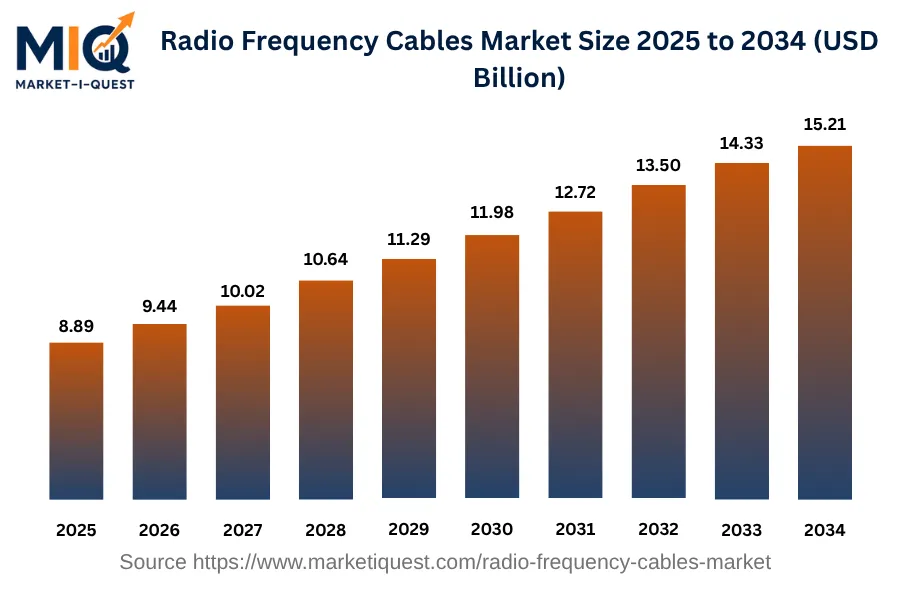
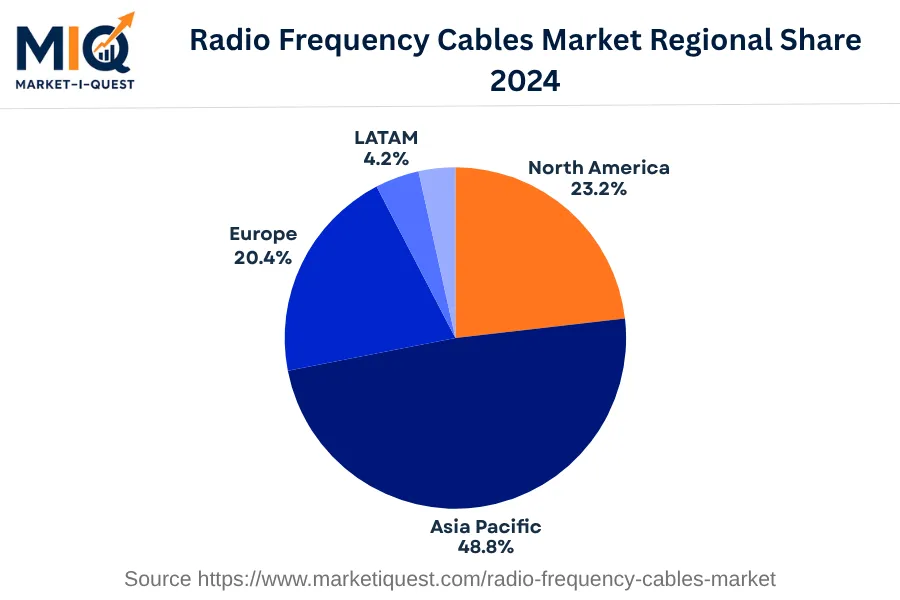
The Radio Frequency Cables Market was valued at USD 8.38 Billion in 2024. By 2025, the value slightly increased to USD 8.89 Billion, showcasing growth within the market. The market is projected to USD 15.21 Billion by 2034, with a CAGR of 6.14%. In 2024, the regional shares for the market were divided with Asia Pacific holding the majority at 48.76%, followed by North America at 23.18%, and Europe at 20.42%. The remaining shares were held by LATAM and MEA, which accounted for 4.17% and 3.47% respectively.

Key Takeaways

  • By Frequency Range - 50–110 GHz segment led accounting for a significant share in 2024.
  • By Connector Type - N-Type connectors held a dominant position in 2024.
  • By Jacket Material - Polyvinyl Chloride (PVC) was the leading material in 2024.
  • By Shielding - Double-Shielded cables led the market in 2024.
radio-frequency-cables-market market size

Key Driving Factors

Implementation of 5G Network Infrastructure

The implementation of 5G network infrastructure is a significant driver of the radio frequency cables market. With the rise of 5G technology, there is urgent requirement for advanced and improved performance RF cables that can effectively transmit high-speed data and signals with minimal loss. These cables are crucial in setting up 5G base stations and ensuring efficient connectivity, pushing telecom companies to enhance their infrastructure. This need can significantly stimulate the demand for RF cables, positively impacting the market. Although 5G network is not globally conventional, the initiative is growing up in countries like the US, China, and South Korea, contributed to the significant market growth.
Expanding Internet of Things (IoT) Applications

Internet of Things (IoT) application’s dominance is another major factor driving the growth of the radio frequency cables market. IoT devices rely heavily on RF cables for seamless data and signal transmission. As more objects are embedded with sensors and gain the ability to communicate and the amount of data transmitted over networks significantly increases. This demands high-performing RF cables to ensure lossless and fast data transmission, accelerating the market demand. Popular sectors provoking this growth include home automation, healthcare, and industrial IoT, providing sufficient opportunities for RF cable manufacturers to expand their businesses.

Market Evolution by Timeline

2019-2023
From 2019 to 2023, North America dominated the Radio Frequency (RF) Cables market, due to its robust telecommunication sector. South-East Asia, with initial efforts towards 5G implementation, also boosted the demand. The manufacturers heavily focused on reducing signal loss, high-frequency operation, and enhanced coating in RF cables. Technology limitations included restrictions in data transmission and compatibility issues with devices. No significant policies or regulations impacted the market. Pricing was based on quality and performance parameters like bandwidth and propagation delay. Partnerships between cable manufacturers and telecommunication providers were typical.
2024
In 2024, the military and aerospace sector is showing increased demand for RF cables, especially in the USA and Western Europe, as these cables becoming an integral part of advanced communication systems. Enhancements will be made in terms of shielding, temperature resistance, and durability. Regulations will came under directives like REACH (Registration, Evaluation, Authorisation, and Restriction of Chemicals). The pricing model will witness a slight increase due to the rise in production costs.
2025-2029
From 2025 to 2029, the demand for RF cables in Asia-Pacific will grow due to the aggressive 5G expansion in countries like China, India, and South Korea. Cables with higher performance capabilities will be increasingly sought after to Accommodate vast amounts of data transmission. However, the integration of these cables with existing systems will be a challenge. The international standard or protocol named Internet Protocol Version 6 (IPv6) will influence the market. The commercial model will remain the same, with prices dependent on quality and performance.
2030-2034
In the period 2030 to 2034, the Internet of Things (IoT) applications will led demand for RF cables in several regions, including the Middle East and Africa. Technology will be capable of addressing signal integrity issues, resistance to harsh environments, and high-speed data transfer. Companies will have to cooperate with the Restriction of Hazardous Substances (RoHS) directive, limiting the use of certain hazardous materials in electrical and electronic equipment. These regulatory challenges will somewhat influence pricing and commercial models.

Future Market Outlook

Future Opportunities

As the reliance on wireless communication expands, particularly in emerging markets, the radio frequency cables market is situated for substantial growth. Global companies are actively investing in regional infrastructure, with governments like those in India promoting initiatives such as Digital India to enhance connectivity. In 2023, the Indian government announced a collaboration with leading telecommunications operators to enhance rural broadband access, thus increasing the market for RF cables. With 5G technology becoming more common, demand for specialized cables to support higher frequency bands is expected to surge. The ongoing developments in satellite communication and space exploration, spearheaded by agencies like NASA and SpaceX, indicate further opportunities for rugged RF cable applications. Players who can provide advanced solutions for these niche segments may find unique market openings. Additionally, with a growing emphasis on cybersecurity, as noted by the recent updates from the National Institute of Standards and Technology (NIST), the industry can expect increased focus on secure transmission modes within RF technology. The combination of smart technologies, as evidenced by smart city projects globally, further illustrates the potential for radio frequency cables to play an integral role in connecting multiple systems.

Segmentation Analysis

By Frequency Range

The market is divided into subsegments including 50–110 GHz, 110–325 GHz, 325–660 GHz, and above 660 GHz. The 50–110 GHz subsegment accounted for the largest revenue share while 325–660 GHz is expected to grow at the fastest CAGR during the forecast period.

Largest Revenue Share

50–110 GHz

Market Share Leader

The 50-110 GHz frequency range subsegment is leading the market revenue-wise. The main driver of this revenue dominance is its widespread use in both commercial and defense industries due to its suitability for modern digital systems and radar applications. Another contributing factor is its use in high-speed communication systems, enabling the transmission of more information per unit of time. The broad customer base includes telecommunications companies, defense equipment manufacturers, and companies creating devices for high-speed data transfer. Regulatory favorability, especially in nations leading telecommunications advancement, also propels this subsegment; the spectrum's allocation broadly encircles applications for these frequencies. High switching costs associated with changes in system frequencies also contribute to this subsegment's dominant performance. Notably, advancements in e-band communications have boosted the revenue prospects from the 50-110 GHz subsegment.

Fastest CAGR

325–660 GHz

Forecast Period Growth Leader

The 325-660 GHz frequency range subsegment is anticipated to achieve the highest growth rate during our considered period. This optimistic projection is driven by robust growth drivers, comprising advancing technologies that command higher frequencies, namely in scientific studies and radio astronomy where these frequencies gives better resolution. Another catalyst is governmental policies promoting research and development into higher frequency ranges, aiming to keep pace with technological advancement. Such actions invite capital investments that further stimulate growth. However, the adoption of this frequency range faces specific barriers, particularly technological challenges such as high signal loss which thwart efficient usage; investments and research into overcoming these challenges are key catalysts for growth. Moreover, strategic international partnerships assembling advancements in technologies utilizing these high-frequency ranges offer other avenues for expansion.

By Connector Type

The market is divided into subsegments including SMA, N-Type, BNC, TNC, and F-Type. In 2024, N-type connectors accounted for the largest revenue share while BNC connectors are expected to grow at the fastest CAGR during the forecast period.

Largest Revenue Share

N-Type

Market Share Leader

N-Type connectors are known for their ability to handle high power and frequency levels, making them popular in industries that require robust and reliable connections such as wireless communication, industrial, and military. Their superior performance in terms of reducing signal loss and improving connection strength has led to increased adoption compared to other connector types. Geographically, markets with advanced telecommunications infrastructure like North America and Europe account for a major share of N-Type connector use. Strict industry regulations also favour the use of high-performance connectors like N-Type. Lastly, the selection of connectors often involves high switching costs, leading to a preference for tried-and-true connector types. The combined effects of product's technical superiority, geographic factors, regulatory influences, and economic aspects have drove N-Type connectors to account for the largest revenue share in the connector market as of the base year 2024.

Fastest CAGR

BNC

Forecast Period Growth Leader

BNC connectors are projected to have the fastest CAGR during the forecast period. Known for their quick connect/disconnect feature using a bayonet mount. They are witnessing increasing adoption in rapidly evolving areas such as video streaming, broadcasting, and surveillance applications. While the initial cost for implementing BNC connectors may present a barrier, the long term benefits in terms of easier maintenance and reduced downtime are major catalysts for growth. Adoption is also driven by tectonic shifts in data consumption patterns with increasing demand for high definition video content, necessitating the transition to quick disconnect connectors like BNC. Partnerships between connector manufacturers and digital technology providers could further ramp up the use of BNC connectors. However, the progressive tech trends and increased digital consumption offer a positive growth outlook for this segment.

By Jacket Material

The market is divided into subsegments including Polyvinyl Chloride (PVC), Polyethylene (PE), Polypropylene (PP), Teflon (PTFE), and Thermoplastic Elastomer (TPE). PVC took the highest revenue share in 2024 while Teflon (PTFE) is projected to be the fastest-growing subsegment.

Largest Revenue Share

Polyvinyl Chloride (PVC)

Market Share Leader

Polyvinyl Chloride (PVC) garnered the highest revenue share in 2024. The dominance is primarily due to its widespread usage in manufacturing a wide range of products and its relative accessibility. PVC is renowned for its durability, versatility, and ease of use – factors that make it inviting to industries ranging from construction to electronics. In addition, strict environmental regulations have encouraged manufacturers to opt for PVC over other materials, as it is more environmentally friendly and recyclable. Its inherent resistance to environmental impact, chemicals and UV rays further stick its position as a preferred material in various industries. Moreover, an increase in global population and urbanization have stimulate construction activities worldwide, creating an increased demand for PVC. Its cost-effectiveness and durability make it a favorite among manufacturers searching for a balance between price and performance.

Fastest CAGR

Teflon (PTFE)

Forecast Period Growth Leader

Teflon (PTFE) emerges as the fastest-growing subsegment due to its unique properties, making it suitable for diverse range of applications. PTFE is chemically inert, can withstand high temperatures, and has excellent electrical properties. It is widely used in industries such as automotive, electronics, and chemicals due to its unmatched benefits. Its market growth is pushed mainly by advancements in technology and increased demand for high-performance polymers especially in medical and electrical industries. Though its initial acquisition cost might be high, its long-term benefits in terms of durability, performance, and maintenance costs make it attractive to many manufacturers.

By Shielding

The market is divided into subsegments including single-shielded, double-shielded, and triple-shielded wiring. The double-shielded subsegment accounted for the largest revenue share while the single-shielded is expected to grow at the fastest CAGR during the forecast period.

Largest Revenue Share

Double-Shielded

Market Share Leader

The double-shielded subsegment leads the market in revenue. With shielding as a key factor in wiring reliability, the double-shielded configuration provides a robust balance of protection and affordability. It offers a significant measure of interference protection, reducing the risk of data loss or error making it a popular choice in industries such as telecommunications and computing where data integrity is supreme Additionally, its dual shield offers protection against both electromagnetic interference (EMI) and radiofrequency interference (RFI) – an advantage over single-shielded cables that makes them suitable for use in both professional and domestic contexts, further expanding its potential market. Thus the double-shielded subsegment offers strong resilience combined with broad market appeal which drives its revenue leadership.

Fastest CAGR

Single-Shielded

Forecast Period Growth Leader

Despite generating lower revenue than its double-shielded counterpart, the single-shielded subsegment is elegan for the fastest growth. The barrier to adopting the single-shielded cabling lies in the awareness and perception of shielding as a premium feature, referring cost and complexity. However, with the increasing presence of digital devices and increasing public awareness about interference issues, the demand for affordable, yet effective solutions is growing. Single-shielded cables offer cost-effective interference protection, making them an attractive option for cost-sensitive applications, such as home electronics setups and price-sensitive industries. Additionally, the emerging trend of remote work and learning signifies the rise in data transmission requirements in home environments, potentially prompting the demand for single-shielded cables.

Competitive Analysis

Key Market Players

Manufacturers / OEMs

Amphenol RF
US
Radiall
France
HUBER+SUHNER
Switzerland

Key Suppliers & Raw Materials

Praxair Surface Technologies
US
IW Microwave Products Division
US
Electro Adapter
US

Distributors, Integrators & Channel Partners

TE Connectivity
Switzerland
RS Components
UK
Mouser Electronics
US

Porter’s Five Forces Analysis

This is an analysis of the competitive forces impacting the Radio Frequency Cables Market.

Supplier Bargaining Power

Medium

Limited suppliers and need for high-quality cables give suppliers moderate power.

Buyer Bargaining Power

Low

Highly specialized requirements limit bargaining power of buyers.

Threat of Substitutes

Low

Limited substitutes exist for the specialized functionality of RF cables.

Threat of New Entrants

Medium

Technological advancements and lowering capital costs allow for potential new entrants.

Competitive Rivalry

High

Intense competition amidst established players leads to a high level of rivalry.

Regional Analysis

Geographic market dynamics and growth opportunities across key regions

Global Market Outlook

radio-frequency-cables-market market regional share

North America

In 2024, the North American radio frequency cables market experienced substantial growth due to several driving factors and market trends. Dominated by the US, Canada, and Mexico, the demand was driven by the rapid adoption of 5G technology, strict regulatory specifications for high-performance cables, and substantial investment from major telecommunications companies such as Verizon and Telus. Moreover, the increasing need for reliable, high-speed communication networks in sectors like defense, healthcare, and manufacturing drove the market expansion.

The year witnessed shift towards low-loss cables to accommodate higher frequencies offered by 5G networks. The trend in combining of wired and wireless networks was an essential factor, subsequently increasing the demand for more flexible and high-capacity radio frequency cables. We saw partnerships and mergers in the industry, such as the strategic alliance between Belden Inc. and CommScope Holding Company, to develop enhanced cable solutions. Lastly, the rise in enforcement of standards by the Federal Communications Commission (FCC) created additional market dynamics in favor of more compliant manufacturers. between these developments, enterprise customers emerged as a significant customer segment for radio frequency cable producers, driven by the increasing need to support advanced enterprise applications. Meanwhile, the transition towards digital healthcare further raised the demand for sophisticated radio frequency cables to ensure reliable and secure connections.

Asia Pacific

In 2024, the Asia Pacific region witnessed a vibrant Radio Frequency Cables Market motivated majorly by the massive telecom sector's requirements. Demand hopped due to the adoption of advanced technologies like 5G and IoT, with countries like China, South Korea, and Japan due to their accelerated digital transformation initiatives. Regulatory thrusts, specifically in India and key ASEAN markets, towards improved telecom infrastructure, also drive market activity. Moreover, significant investment from both public and private entities for enhanced connectivity promoted a healthy supply side.

As Current Market Dynamics, increased buyer preference for high-speed data services elevated the demand for superior quality RF cables, particularly in enterprise and retail sectors. Further, the development of smart cities in Australia and China positioned RF cables as a key component for establishing smart utilities. Furthermore, partnerships and M&A activities Gained significant traction, as seen with major technology players in Japan and South Korea, aiming to standardize RF cable specifications and boost market competitiveness. The addition of remote healthcare services also impacted the RF cable market positively, with regulatory bodies pushing strict policy enforcements regarding reliable healthcare data transmission. By the close of 2024, the Radio Frequency Cables Market in the Asia Pacific Became firmly established as an essential part in the region's digital and connected future.

Europe

In 2024, the Radio Frequency (RF) Cables market in Europe experienced considerable growth due to a combination of factors across several countries. Market drivers included increased demand for faster and more efficient data transmission, as seen in Germany's widespread adoption of 5G technology, which heavily engaged RF cables. Regulatory decisions also catalyzed market growth, such as the UK's requirement for RF cables in public safety communication setups. Moreover, heavy investments in telecommunication infrastructure by the Italian government played a central role in this upward trend.

Leading market trends involved a shift towards higher frequency cables to serve to the rising consumer expectations for speed and bandwidth in Spain, France, and the Nordics. We also observed notable Channel dynamic changes, with more online sales transactions occurring, particularly in Benelux countries and Central & Eastern Europe. Additionally, an flood of partnerships and mergers were noted, especially in the enterprise and manufacturing sectors, to extend market reach and increase production volume. In sum, advancements in communication technologies, regulatory decisions, investments in infrastructure, changes in sales channels, and strategic business collaborations were instrumental to the expansion of the RF cables market across key European regions in 2024.

Latin America

In 2024, the Radio Frequency (RF) Cables Market in Latin America exhibited significant growth due to various driving forces and conventional trends. The main drivers included the elevated demand for high-speed data and signal transmission in sectors like enterprise, retail, and manufacturing, leading to substantial investment in RF technology. Policies such as Brazil's 'National Broadband Plan' encouraged the adoption of advanced technologies, while favorable import pricing in Mexico promoted a robust supply dynamic.

Simultaneously, several trends shaped the market perspective. In Brazil and Argentina, governmental buyers showed a preference for locally-manufactured cables, reflecting a shift in buyer behavior. With Mexican communication service providers actively seeking partnerships for network expansions, M&A activity rose notably. Technological adaptation was visible across LATAM with the integration of high-density interconnects in manufacturing and enterprise sectors to meet advanced connection requirements. Notable sectors included Colombia's healthcare industry, which integrated RF cables for interconnecting advanced medical equipment. In Peru, the utility sector initiated a shift towards RF cables for efficient power generation and distribution systems. Overall, 2024 was a key year for the RF Cables Market in Latin America, shaped by dynamic drivers and emerging trends across key sectors.

Middle East & Africa

In 2024, the Radio Frequency (RF) cables market in the Middle East and Africa witnessed a significant uptick in demand. This expansion was driven by strict government regulations in countries like Saudi Arabia and Nigeria, pushing for an upgrade in communication infrastructure and increasing adoption of advanced technologies across various sectors. Large-scale investments were observed in radio communication setups in the UAE and Kenya due to accelerating growth in telecom and utilities industry. Meanwhile, supply dynamics experienced a shift because of changing trade policies which led to competitive pricing in the market.

Conventional trends identified in the year were a rising preference for durable RF cable types across South Africa's mining sector, and enhanced product quality led by Israel's strict cable manufacturing standards enforcement. There was a noticeable shift in buyer behavior in Egypt, with a higher reliance on online channels for procuring RF cables for government projects. The market saw a surge in partnerships and M&A activities in the telecom sector across Qatar. The adoption of digital strategies in the healthcare sector in South Africa and retail in Saudi Arabia brought on an increased dependency on RF cables for higher bandwidth, thereby positively influencing market dynamics.

Recent Industry Developments

Latest market innovations, product launches, and strategic initiatives

June 2026

Cinch Connectivity Solutions Introduces New 2.4 mm and 2.92 mm Cable Assemblies – At IMS 2026, Cinch Connectivity Solutions showcased its newest Johnson RF product lineup, including 2.4 mm and 2.92 mm cable assemblies configured as between-series solutions combining 2.4 mm or 2.92 mm interfaces on one end with SMP or SMPM on the other.

February 2026

EN IEC 60966-4-4:2026 Standard Published for Semi-Rigid Cable Assemblies – The European standard EN IEC 60966-4-4:2026 was published, providing subfamily detail requirements and severities for semi-rigid cable assemblies used in mobile communication. The standard applies specifically to cable assemblies used between main feeders and antennas, between main feeders and equipment systems, or between remote radio heads and antennas.

Frequently Asked Questions