
Polymer Nanocomposite Market Snapshot

Key Players

  • 3M (United States)
  • Arkema Group (France)
  • BASF SE (Germany)
  • Covestro AG (Germany)
  • Evonik Industries AG (Germany)
  • Inframat Corporation (United States)
  • InnoNano Research Pvt Ltd (India)
  • Nanocor Inc. (United States)
  • Powdermet Inc. (United States)
  • TORAY INDUSTRIES INC. (Japan)

Market Size

Base Year 2024
$13.76 Bn
CAGR
15.23%
Forecast 2034
$56.79 Bn

Market Segments

By Nanofiller Type
  • Nanoclays
  • Nanofiber
  • Nano-oxide
  • Carbon Nanotubes
  • Others
By Polymer Matrix
  • Thermoplastics
  • Thermosets
  • Bio-Based Polymers
By End User Industry
  • Automotive
  • Packaging
  • Aerospace and Defense
  • Others

Market Dynamics

Drivers
  • Increasing demand in automotive industry
  • Improved material properties
Restraints
  • High production costs
  • Lack of industrial standardization
Opportunities
  • Increasing automotive applications
  • Advancements in nanotechnology

Market Size

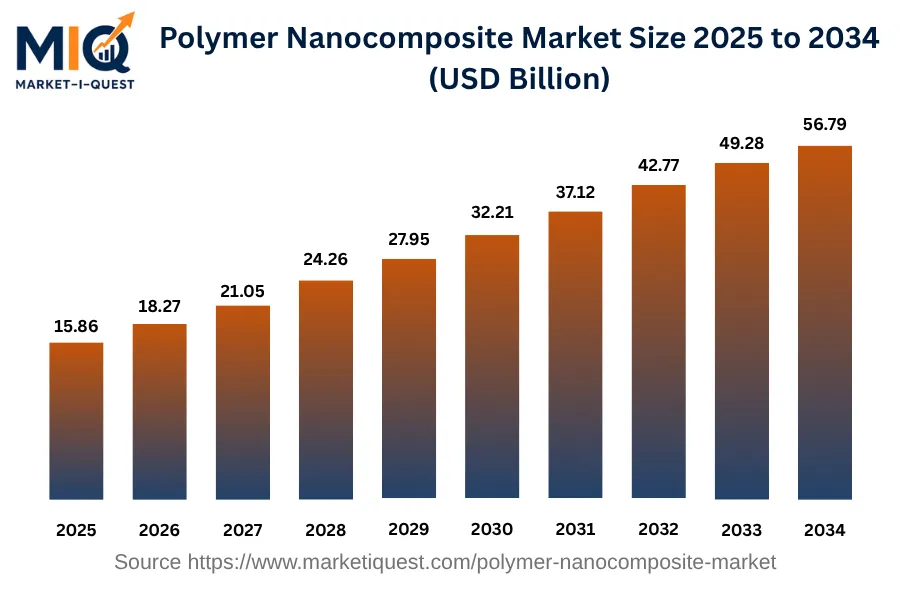
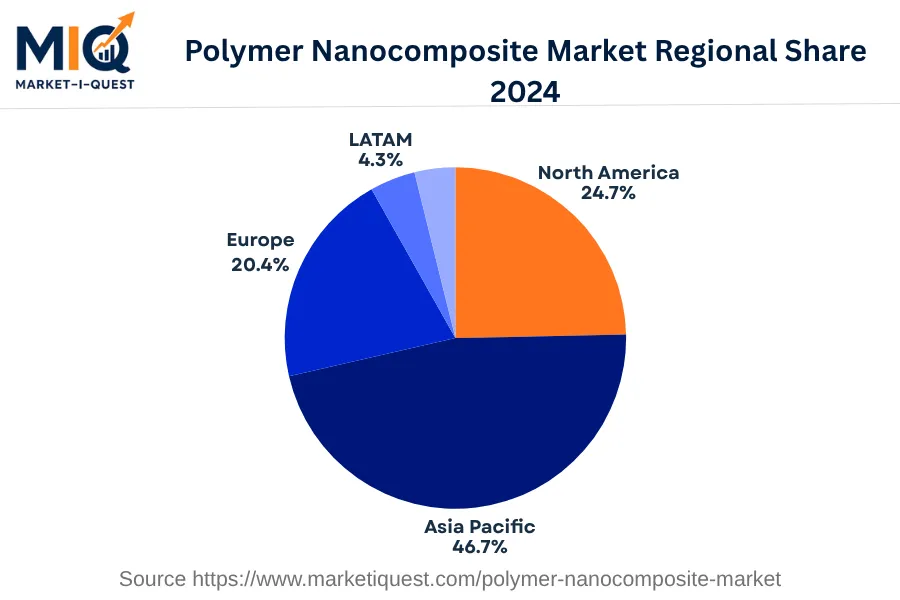
The Polymer Nanocomposite Market was worth $15.86 billion in 2025 and expanded to $56.79 billion by the end of 2034, marking a CAGR of 15.23%. The noted period saw continuous growth in market value, with a prominent increase in the later years. Such growth was due to the increasing demand and advanced technology globally. The accelerating growth over the ten years indicates extensive adoption of polymers nanocomposites. Considering the regional market share in 2024, Asia Pacific dominated the market with 46.72%, followed by North America at 24.68%. Europe held a 20.43% share, while LATAM and MEA trailed behind with 4.31% and 3.86% respectively. These shares highlight the strong market presence in the Asia Pacific and North America regions.

Key Takeaways

  • By Nanofiller Type - Nanoclays held the leading market share in 2024.
  • By Polymer Matrix - Thermoplastics led the segment by holding the largest market share 2024.
  • By End User Industry - Automotive led the market holding the leading share of the market in 2024.
polymer-nanocomposite-market market size

Key Driving Factors

Stringent Environmental Regulations

The drive for adherence to stringent environmental norms is one of the primary factors propelling the Polymer Nanocomposite market. Governments across the globe have been enforcing a host of regulations related to carbon emissions and waste disposal. As a result, industries are actively shifting towards environmentally sustainable materials. Polymer Nanocomposites, due to their lighter weight and strength, help reduce fuel consumption and decrease CO2 emissions in automotive and aerospace sectors. The materials also produce less waste during manufacturing and disposal. Recent regulations include the European Union's End-of-Life Vehicle (ELV) Directive, aimed at minimizing the impact of waste from vehicles, which encourages industries to opt for lightweight, eco-friendly alternatives like Polymer Nanocomposites.
Expansion of High-Performance Application Areas

The demand for Polymer Nanocomposites is growing due to their use in high-performance application areas. For instance, the incorporation of nanomaterials in polymers significantly enhances their thermal stability, flame retardancy, and barrier resistance, making them outstanding candidates for construction and packaging sectors. These nanocomposites enhance the longevity of infrastructure by reducing deterioration caused by external factors, thereby saving resources in maintenance and repair efforts. In the packaging industry, nanocomposite incorporation inhibits gas permeability, prolonging the preservation duration for various food products. The growing need for sustainable and high-performance materials in these industries is therefore contributing to the upsurge in the Polymer Nanocomposite Market.

Market Evolution by Timeline

2019-2023
During this period, there was a rise in demand from automobile and packaging industries looking for lightweight, durable materials. Asia-Pacific region, especially China and India, emerged as prominent markets due to their expanding industrial base. Manufacturers started investing in single-layer graphene-based nanocomposites due to their exceptional electrical and mechanical properties. Challenges in material integration, however, constrained supply, making availability inconsistent. The Department of Energy's Nanomanufacturing program pushed for development & mass production of nanocomposites. Typically, contracts were purchase-based, with collaborative projects between manufacturers and end-users. Risks included quality control and regulatory complexities due to different safety standards in different countries.
2024
The year saw growing interest from renewable energy and electronics industries due to polymer nanocomposites' excellent thermal and electrical conductivity. Their use in producing solar panels escalated, specifically in European countries advocating for cleaner energy. Manufacturers ran pilot projects using carbon nanotube-based nanocomposites. NanoAmericas, a policy introduced in the United States, promoted nanotechnology adaptability. Semiconductor companies worked with manufacturers on a cost-per-unit basis to ensure supply for their production lines. The risk is the high production cost of multi-wall carbon nanotubes, which necessitated the need for alternative production methods.
2025-2029
This period was marked by increased demand from the aerospace industry, with North America becoming a crucial market. The use of nano clay and nano silica-based composites widened due to its improved flame retardancy. The Advanced Nanotechnology Research and Education Act in the US set the guidelines for nanocomposite application in aerospace. Government-industry collaboration models became predominant to foster innovation and mass production. Non-compliant nanocomposites posed the risk of stiff regulatory penalties and loss of market reputation, leading to a stricter inspection and quality assurance process.
2030-2034
Medical and pharmaceutical industries drove the demand in this period, with significant uptake in European countries seeking bio-compatible materials. Composite materials that incorporate nanoscale fibers started to trend. However, the medical application of nanocomposites faced scrutiny due to potential health risks. The MedNanoAct, a European regulation, set the standards for medical nanocomposites. A shift towards long-term, exclusive partnerships was observed for unique applications. The risk was about bio-compatibleness of nanocomposites, urging manufacturers to invest heavily in research and development.

Future Market Outlook

Future Opportunities

With increasing emphasis on sustainability, the polymer nanocomposite market presents significant future opportunities for companies that can comply with evolving regulations and consumer preferences. The global shift towards electric vehicles, highlighted by various governments implementing stricter emission standards in 2023, is leading automotive manufacturers to seek lighter and stronger materials for battery components. A collaboration between a prominent automotive player and a nanotechnology research consortium in Germany aims to integrate nanocomposites in battery enclosures to enhance performance and safety standards. Additionally, the growing demand for advanced packaging solutions, accelerated by the rise of e-commerce since 2020, opens avenues for biodegradable polymer nanocomposites that provide better barrier properties. Industry stakeholders are also addressing safety and health concerns surrounding nanomaterials, as evidenced by the World Health Organization's 2023 report on potential health risks associated with nanocomposite exposure, prompting companies to ensure compliance with enhanced safety standards. As sectors like biomedical engineering look for materials with antimicrobial properties, the development of polymer nanocomposites incorporating silver nanoparticles by research teams in South Korea demonstrates real application potential. Furthermore, expanding applications in construction, where enhanced durability and insulation properties are increasingly important, position polymer nanocomposites as a critical resource, marking a robust trajectory for the sector amidst prevailing economic trends.

Segmentation Analysis

By Nanofiller Type

The market, divided into subsegments including Nanoclays, Nanofiber, Nano-oxide, Carbon Nanotubes, and others, is led by Nanoclays in terms of revenue while Carbon Nanotubes promises the fastest growth during the forecasted period.

Largest Revenue Share

Nanoclays

Market Share Leader

Nanoclays secure the largest revenue share in our base year of 2024 based on prevalent industry indicators. This primary positioning is driven by their diverse applications across industries, with a considerable footprint in the automotive, packaging, and construction sectors. Nanoclays are preferred for their excellent barrier properties, flame retardancy, and improved mechanical strength. In the automotive industry, nanoclays help lightweight vehicles for better fuel efficiency while maintaining strength and safety features. In packaging, nanoclays improve the shelf-life of food products by acting as barrier materials. Regionally, emerging markets like Asia-Pacific, with fast-growing economies and expanding industrial sectors, are major contributors to nanoclay demand. The purchasing decision for nanoclays generally hinges on their superior ability to enhance product performance and durability, although price and supplier credibility also play a role. Customers prefer established suppliers because of assured quality and supply chain stability, providing incumbent players a distinct advantage.

Fastest CAGR

Carbon Nanotubes

Forecast Period Growth Leader

Among the subsegments, Carbon Nanotubes are expected to exhibit the highest growth rate in the projection years. Currently, strong research efforts are underway, devoted to exploring their incorporation into novel applications like next-generation electronics and high-performance composites. The unique properties of carbon nanotubes such as high electrical conductivity, thermal conductivity, strength, and their lightweight nature open doors to their use in a variety of industries including aerospace, electronics, and energy. Challenges to growth include high production costs and manipulation difficulties, although ongoing research and development are looking to address these issues. Regulatory and policy support for nanotechnology research and increasing capital investments in tech start-ups are likely to be key catalysts for this growth. Potential near-term risks include regulatory changes and any negative research findings concerning their impact on health or environment. All these factors collectively justify Carbon Nanotubes being forecasted as the fastest-growing subsegment in this analysis.

By Polymer Matrix

The Polymer Matrix market is divided into three subsegments including Thermoplastics, Thermosets, and Bio-Based Polymers. Thermoplastics accounted for the largest revenue share while Bio-Based Polymers are expected to grow at the fastest CAGR during the forecast period.

Largest Revenue Share

Thermoplastics

Market Share Leader

Thermoplastics lead the Polymer Matrix segment largely due to their beneficial properties including durability, flexibility, and cost-effectiveness. They are highly recyclable, an attribute that lends itself well in a world increasingly focused on sustainability and waste reduction. Additionally, their versatility allows them to be used in a variety of industries, from automotive and construction to packaging, consumer goods, and electronics. Specific markets like Asia-Pacific, with economic and industrial growth, are driving high demand for these materials. Regulations favoring the use of recyclable materials have also supported the growth of this subsegment. The purchasing criteria predominantly focus on performance, cost, and sustainability. And with minimal switching costs and widely available channels, industries find it quite convenient to adopt these polymers.

Fastest CAGR

Bio-Based Polymers

Forecast Period Growth Leader

Bio-Based Polymers are expected to experience the fastest CAGR among the subsegments of the Polymer Matrix market. Growth drivers include regulatory support for environmentally friendly solutions and increasing consumer awareness regarding sustainability. These polymers offer reduced carbon footprint and are derived from renewable resources, a fact increasingly appreciated by consumers and businesses alike. However, adoption barriers exist in terms of higher production costs and limited performance in comparison to synthetic counterparts. Innovations in technology and investment in R&D are expected to overcome these challenges and improve the competitiveness of Bio-Based Polymers. Financial incentives and policy support are other potential catalysts for market growth. Despite the promising outlook, near-term risks include fluctuating commodity prices and the challenge of reaching economies of scale in production.

By End User Industry

The market is divided into subsegments including Automotive, Packaging, Aerospace and Defense, and Others. In the base year of 2024, the Automotive segment accounted for the largest revenue share while the Aerospace and Defense segment is expected to grow at the fastest CAGR during the forecast period.

Largest Revenue Share

Automotive

Market Share Leader

In 2024, the Automotive subsegment commanded the highest revenue share. This segment's leadership can be attributed to several key market dynamics. Firstly, the automotive industry is an expansive sector with diverse requirements which fuel demand for products and services. Furthermore, the need for constant innovation to improve vehicle efficiency and ensure safety drives the requirement for advanced materials and technologies which add to the revenue generation of the automotive subgroup. Rapid urbanization and rising disposable income have also contributed to an upswing in the demand for automobiles, further buoying the segment's revenue. A mix of consumer preference trends, technological progression and regulatory changes also stimulate the market. Meanwhile, purchasing decisions are largely guided by quality, cost-effectiveness and the delivery schedule. Although challenges exist in form of cyclical car buying trends, the strong consumer demand coupled with the need for emission-reduction technologies is expected to keep the segment revenue high.

Fastest CAGR

Aerospace and Defense

Forecast Period Growth Leader

On the other hand, the Aerospace and Defense subsegment is poised to grow at the fastest CAGR in the coming years. This growth is driven by several factors, including significant increases in defense spending because of escalating geopolitical tensions and the need for upgraded military equipment. The demand for technologically advanced products for enhanced safety and efficiency is also significant in driving this segment's growth. Fast-paced advances in technology act as catalysts, enabling new applications and product improvements, thereby fuelling growth. On the flip side, there are possible barriers such as high capital investment and regulatory restrictions. Despite these, partnerships, particularly with technology providers, along with the easing of some international trade restrictions could boost the adoption in short term. This growth, however, is not without its risks. The rapid pace of technological progression can lead to obsolescence if not properly managed and budget overruns can pose potential constraints.

Competitive Analysis

Key Market Players

Manufacturers / OEMs

3M Company
US
Nanocor Inc.
US
BASF SE
Germany

Key Suppliers & Raw Materials

Cabot Corporation
US
DuPont de Nemours, Inc.
US
Inframat Advanced Materials
US

Distributors, Integrators & Channel Partners

Nanophase Technologies Corporation
US
Nanocyl SA
Belgium
Arkema Group
France

Porter’s Five Forces Analysis

A landscape analysis of the Polymer Nanocomposite Market using Porter's Five Forces.

Supplier Bargaining Power

Medium

Dependent on few large raw material producers, posing moderate supplier control.

Buyer Bargaining Power

High

Increased competition and low switching costs drive high buyer power.

Threat of Substitutes

Low

Low threat due to lack of effective substitute materials in market.

Threat of New Entrants

Medium

Definitely feasible, but requires strong capital and regulatory compliance.

Competitive Rivalry

High

Highly fragmented market with several players fighting for market share.

Regional Analysis

Geographic market dynamics and growth opportunities across key regions

Global Market Outlook

polymer-nanocomposite-market market regional share

North America

In 2024, the Polymer Nanocomposite Market in North America was characterized by the growing need for advanced materials in various sectors. Regulations, particularly in the United States, facilitating the use of environmentally friendly alternatives, significantly propelled market growth. Enhanced investment from both public and private sectors fueled technological advances in polymer nanocomposites, driving adoption across the region. Supply dynamics saw a boost in Canada, owing to the country's rich mineral deposits and technical expertise in mining. Transparent pricing policies in Mexico helped provide a level-playing field for producers and consumers of polymer nanocomposites, stimulation market activity.

Shifting consumer preference towards sustainable and lightweight materials reshaped the product landscape. Technological innovation brought about by blockchain-enabled supply chains created an efficient distribution network in the United States, while active M&A in the sector heralded strategic growth. B2B e-commerce also emerged as a dominant selling channel. Stringent policy enforcement, especially in industries using high-performance materials, required increased transparency in material content, driving demand for polymer nanocomposites. Key consumers of polymer nanocomposites included the automotive and aerospace sectors in the United States, the energy and infrastructure sectors in Canada, and the packaging industry in Mexico. These sectors recognized the benefits of these composites for bolstering efficiency, durability, and environmental sustainability, making them an integral part of their operations in 2024.

Asia Pacific

In 2024, the Polymer Nanocomposite Market in the Asia Pacific region demonstrated robust growth, driven by several key factors. A significant push came from mounting demand in diverse sectors such as manufacturing, retail, utility, and healthcare industries, particularly in China and India, reflecting a rapidly growing middle-class population with higher spending power. Regulatory scenarios, such as China's Provisions on the Environmental Administration of New Chemical Substances promoting the adoption of refined materials, directly bolstered the market. Australia’s focus on technology adoption and South Korea’s hefty investments into nanotechnology R&D further invigorated the supply dynamics, escalating market expansion.

In terms of market trends, there was a distinct shift towards 'green' polymer nanocomposites amongst buyers, supported predominantly by Japan’s energy-efficient manufacturing policies. Developing economies like India witnessed prominent channel dynamics, with increasing reliance on digital channels as against traditional sales routes. Expanding partnerships and M&A within ASEAN markets, notably between industry giants and tech startups, was another notable trend, aiming to improve product technologies and to capitalize on emerging market opportunities. Finally, enforcement of stringent standards for manufacturing and product quality, particularly in China and South Korea, reshaped the industry, further escalating the pursuit for innovation in the Polymer Nanocomposite market.

Europe

In 2024, the European Polymer Nanocomposite Market observed continued demand and expansion. Driving this resilience were new environmental regulations which prompted manufacturers to invest in eco-friendly alternatives, such as bio-based polymer nanocomposites. Technological adoption soared, particularly in Germany, the United Kingdom, and France, fueled by innovations in nanocomposite synthesis processes. Additionally, a decline in the raw material prices enhanced the market profitability, stimulating further growth.

This growth in 2024 was marked by several trends. A shift in buyer behavior was observed towards sustainable and high-quality products, accelerating demand for polymer nanocomposites in the automotive and packaging industries especially in Benelux and Spain. Advances in technology enabled the production of new polymer nanocomposites with enhanced properties, transforming the manufacturing sectors across Italy and the Nordics. Moreover, several partnerships and mergers were noted, including key players in Central and Eastern Europe, leading to increased R&D capabilities and market consolidation. Furthermore, enforcement of stricter standards on waste management by European governments boosted the use of polymer nanocomposites in environmental applications. For instance, healthcare sectors, particularly in Germany and the UK, were prominent users of polymer nanocomposites in 2024. Additionally, the manufacturing sector in France and Italy made substantial use of this technology due to its potential to deliver improved product performance and lifecycle.

Latin America

In 2024, the Polymer Nanocomposite Market in Latin America (LATAM) experienced notable expansion, characterized by increased investment and technological innovation. Regulatory norms favoring environmentally friendly materials drove up demands for Polymer Nanocomposites, particularly in Brazil and Argentina where the manufacturing sector saw significant growth derived from a surge in green orientations. A significant cause for the market boost was Mexico's government-led initiative encouraging investments in advanced nanocomposite patents, fostering technology adoption across the region. Meanwhile, supply dynamics in Chile and Peru underwent a shift as local providers adapted to market demands by modifying pricing structures.

Consumer behavior in LATAM leaned heavily towards Polymer Nanocomposites, inspired by their enhanced functionalities like thermal resistance and durability, thereby triggering a shift in product preferences in retail and manufacturing sectors. Channel dynamics saw transformation as disruptive innovations in Polymer Nanocomposites prompted new business models involving strategic partnerships and M&As, a trend evident in Colombia's corporate landscape. Standardization of practices, enforced by regional policy, reshaped the production and distribution processes, accelerating industry growth while ensuring ethical compliance. LATAM's healthcare and utilities sectors also began recognizing the immense potential of this material, demanding it to aggressive extents for medical equipment and energy-saving applications, respectively, signifying an all-round uptick for the Polymer Nanocomposite Market in 2024.

Middle East & Africa

In 2024, the Polymer Nanocomposite Market in the Middle East and Africa (MEA) showed substantial growth. This surge could be attributed to a number of drivers. The push for lighter, more resistant materials in the automotive and energy sectors fueled demand in countries such as Saudi Arabia and Nigeria, while stricter environmental regulations in the United Arab Emirates and South Africa demanded solutions that only these advanced materials could provide. Increased investment in sophisticated technologies for manufacturing industries in Egypt and Kenya was also a significant driver.

Concurrent trends were observed in the market. In South Africa and Israel, there was an uptick in consumer preference for durable yet lightweight products, translating into an increased demand for polymer nanocomposites in the retail sector. The implementation of nanotechnology standards across the MEA, led by Qatar and the UAE, was a marked trend, fostering more confidence among manufacturers and buyers. Further, strategic partnerships between local manufacturers and multinational players were prevalent, bolstered by policy enforcement in countries like Saudi Arabia and Egypt, resulting in a more unified, regulatory-compliant market landscape.

Recent Industry Developments

Latest market innovations, product launches, and strategic initiatives

October 2025

Evonik partnered with Schneider Electric to fully automate a plastics processing and recycling facility. This operational upgrade makes the manufacturing of composite materials significantly more efficient and reduces overall industrial waste.

Frequently Asked Questions