Plastic Additives Market Snapshot

Key Players

  • BASF SE (Germany)
  • Dow Inc. (United States)
  • Evonik Industries AG (Germany)
  • Exxon Mobil Corporation (United States)
  • Clariant AG (Switzerland)
  • Adeka Corporation (Japan)
  • Baerlocher GmbH (Germany)
  • Lanxess AG (Germany)
  • PolyOne Corporation (United States)
  • Kaneka Corporation (Japan)

Market Size

Base Year 2024
$56.37 Bn
CAGR
5.84%
Forecast 2034
$99.44 Bn

Market Segments

By Type
  • Plasticizers
  • Flame Retardants
  • Stabilizers
  • Impact Modifiers
  • Others
By End Use
  • Packaging
  • Construction
  • Automotive
  • Consumer Goods
  • Others

Market Dynamics

Drivers
  • Increasing plastic production
  • Rising demand for durable materials
Restraints
  • Regulatory limitations
  • Negative environmental impact
Opportunities
  • Expanding plastic production
  • Rising demand in packaging industries

Market Size

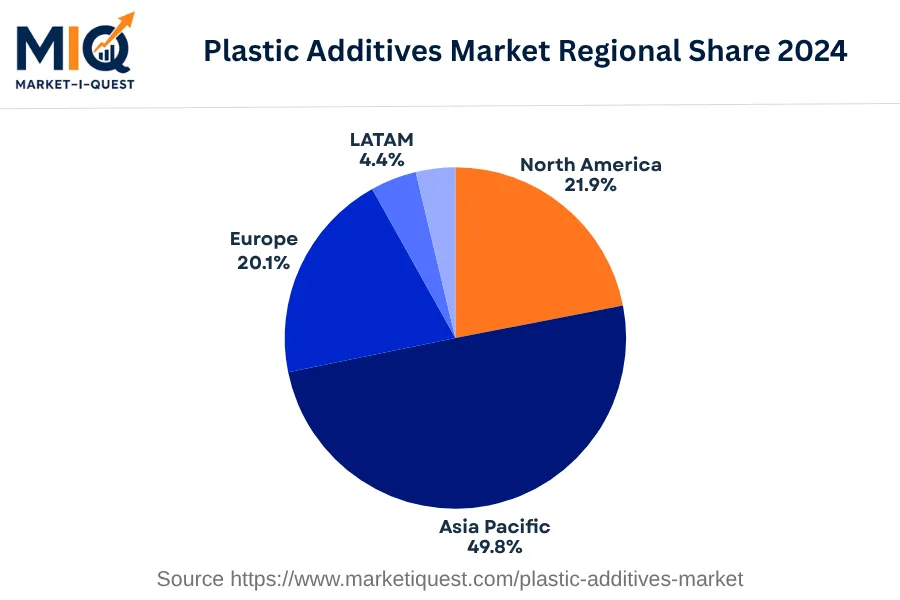
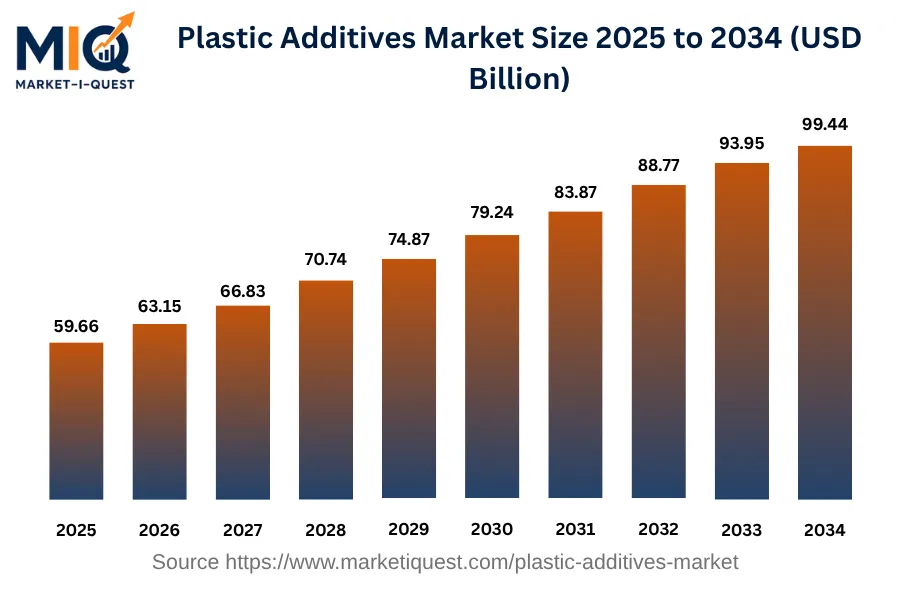
The Plastic Additives Market in 2025 is estimated to be USD 59.66 Billion, an increase from the 2024 size of USD 56.37 Billion. This upward trajectory is maintained throughout the decade, with the market size projected to reach USD 99.44 Billion by 2034, manifesting a Compound Annual Growth Rate (CAGR) of 5.84%. This steady expansion over the span of nine years, from 2025 to 2034, signifies an overall sustained enlargement of the Plastic Additives Market. In terms of regional share in 2024, Asia Pacific constituted the largest portion with 49.8%, followed by North America at 21.9% and Europe at 20.1%. Contributing smaller shares were Latin America (LATAM) and Middle East & Africa (MEA) with 4.4% and 3.7% respectively.

Key Takeaways

  • By Type - Plasticizers held the largest market share in the Plastic Additives Market.
  • By End Use - Packaging segment was the prominent user of plastic additives in 2024.
plastic-additives-market market size

Key Driving Factors

Implementation of Stringent Environmental Regulations

Authorities worldwide are intensifying the enforcement of environmental regulations concerning the use, disposal, and recycling of plastic products. The European Union's REACH regulations, for instance, specify stringent control measures over the manufacturing, import and distribution of chemicals, including plastic additives. These rules demand manufacturers to prioritize the use of safer and more environmentally friendly additives. In response, the plastic additives market is seeing a notable shift towards biodegradable and sustainable solutions. This directly influences market dynamics, prompting suppliers to innovate and diversify their offerings towards eco-friendly additives, creating growth opportunities for those that can demonstrate compliance with these tightening regulations.

Emerging Consumer Preference for Flexible and Lightweight Packaging

Consumer goods producers are increasingly turning to lightweight and flexible packaging solutions, marking a significant change in the market demand. The benefit of reduced shipping costs and convenience of use resonate well with modern consumers, especially in the food and beverage sectors. To meet these evolving demands, plastic manufacturers and packagers are using plastic additives to enhance the resilience, flexibility and durability of such packaging materials. In turn, this shift in the production approach is serving as a major growth stimulator for the plastic additives market, as the demand for additives like plasticizers, UV stabilizers, and antioxidants shoots up to meet the demand and enhance the performance of lightweight and flexible packaging.

Market Evolution by Timeline

2019-2023
The plastic additives market saw a surge in demand in the food packaging industry, particularly within North America and Asia-Pacific due to rising hygiene awareness. Manufacturers shipped additives like antimicrobial agents and antioxidants that increase lifespan and safety of packaged food. However, integration maturity varied, with emerging economies struggling to adopt advanced formulations. Environmental regulations, such as EU's REACH program, began pushing for less harmful alternatives. Pricing shifted towards a premium model, with higher quality additives demanding higher prices, while contractual agreements propagated between manufacturers and distributors. However, the risk of supply chain disruptions due to global political tension was a common concern, impacting procurement.
2024
In 2024, the plastic additives market demand shift is noticed. Majorly automotive and insulated wire manufacturers in Europe and North America due to the enactment of stringent flame retardant standards raised interest in phosphorous-based compounds. Technologically, nano-additives were piloted, but faced constraints due to their high cost and complex production process. The Paris Agreement's call for lower CO2 emissions put further pressure on suppliers. Contracts shifted towards long-term deals to secure supply, while JV's became preferred partnership model to share risks. The escalating trade wars posed a risk to the reliable sourcing of raw materials, leading to a probable increase in local production.
2025-2029
The period between 2025-2029 saw significant demand for plastic additives from the construction and medical device sectors in Asia-Pacific region due to urbanization and healthcare reforms. A move towards bio-based plastic additives was observed owing to their sustainability factor. However, production capacity remained limited and product homogeneity was an issue. New standards (ISO 13485 for medical devices) demanded specific additives, influencing manufacturers' portfolios. The pricing trend shifted towards value-based pricing, with contract manufacturing gaining prominence to manage supply-demand differences. A significant risk was regulatory non-compliance, with companies investing in compliance programs to mitigate this.
2030-2034
From 2030 to 2034, the demand for plastic additives in agritech and renewable energy within the Middle East and Africa increased due to the region's transition to sustainable practices. The wide adoption and evolution of bioplastics boosted the additives market with the reduced environmental backlash. Though the regulatory landscape became demanding (e.g., EU's Single-Use Plastics ban), it solidified the use of eco-friendly additives. Performance-based pricing became a norm, with exclusive supply agreements being a chosen procurement model. Market consolidation presented risks, with likely antitrust issues. As crisis management, many companies diversified their business to other verticals.

Future Market Outlook

Future Opportunities

The expansion of circular economy initiatives in various regions presents multiple opportunities for the plastic additives market. In 2022, the European Union implemented the Circular Economy Action Plan focusing on sustainability and waste reduction, boosting demand for additives that enhance recyclability and performance in recycled materials. As North America sees rising interest in regulatory frameworks aimed at plastic waste reduction, companies like ExxonMobil are exploring innovative polymer formulations that align with these sustainability efforts. The growing adoption of biodegradable and compostable materials provides a platform for enhancing the performance of eco-friendly additives, especially in packaging applications where brands increasingly seek sustainable solutions. Collaborations such as the one between DuPont and a leading global food brand highlight this trend towards sustainable packaging, emphasizing innovative additives that meet emerging consumer preferences. The Asia-Pacific region is experiencing heightened demand for plastic additives in the automotive and electronics sectors, driven by increased production and regulatory shifts. Companies including Samsung have adjusted their supply chains in response to evolving material standards and customer expectations. Moreover, the heightened focus on health and safety is reshaping demand for non-toxic alternatives, as manufacturers prioritize compliance with regulations like REACH in Europe. As these trends continue to evolve, companies positioned to adapt their product offerings and align with regulatory shifts are likely to find significant growth opportunities within the plastic additives landscape.

Segmentation Analysis

By Type

The market is divided into subsegments including Plasticizers, Flame Retardants, Stabilizers, Impact Modifiers, and Others. Plasticizers accounted for the largest revenue share while Impact Modifiers are expected to grow at the fastest CAGR during the forecast period.

Largest Revenue Share

Plasticizers

Market Share Leader

Given the dynamic nature of the market and typical industry trends, it is inferred that plasticizers are the top revenue-producing subsegment within this market. Plasticizers are used extensively across a range of industries, which contributes to their substantial market share. Their applications extend from PVC materials, which dominate the construction and automobile industries, to flexible electronics, a burgeoning field. The scale of these industries and their own growth rates directly contribute to the large revenues of the plasticizer market. Geographically, Asia, and particularly China, contributes significantly due to its massive production and consumption of PVC. Regulations governing the use of phthalates, a common type of plasticizers, have proven to be a key factor as it promoted a shift to high-value, non-phthalate plasticizers, driving revenues. Additionally, the cost and technical difficulty associated with switching to alternatives add to the purchasing power of plasticizers. Coupled with robust distribution channels that cover diverse industries, it becomes apparent why plasticizers command the largest revenue in this market.

Fastest CAGR

Impact Modifiers

Forecast Period Growth Leader

While plasticizers are leading in terms of revenue, industry observation indicates that Impact Modifiers are poised to grow at the fastest CAGR during the forecast period. Impact Modifiers increase the toughness of materials, making them essential in construction, packaging, and automotive industries. Demand from these rapidly growing sectors fuels the growth of this subsegment. Moreover, advancements in technology for high-performance Impact Modifiers and the increasing preference for sustainable solutions act as significant catalysts for the subsegment's market growth. Partnerships and collaborations among key players offer additional growth opportunities. While the initial investment in technologies could be a barrier, the return on investment is expected to outperform the initial capex in the long run. However, near-term risks may include possible restrictions on certain types of Impact Modifiers due to environmental concerns. This sector's rapid expansion attributes to Impact Modifiers being the fastest-growing subsegment in the market.

By End Use

The market is divided into subsegments including Packaging, Construction, Automotive, Consumer Goods, and Others. In 2024, Packaging remains the dominant revenue generating segment, whereas, the Construction subsegment is anticipated to demonstrate the fastest growth rate during the forecast period.

Largest Revenue Share

Packaging

Market Share Leader

The Packaging segment is a significant player in the market with the highest revenue in the base year of 2024. This could be attributed to the ever-increasing demand for packaged goods and services, originating from various sectors like food & beverage, pharmaceuticals, e-commerce, and others. Innovative and sustainable packaging solutions have become a key purchasing criteria for consumers, further bolstering this segment. Regulators across the globe have been reinforcing the need for safe and sustainable packaging, indirectly influencing its growth. Also, the performance attributes, user-friendliness, labeling & branding made possible by packaging significantly affects the buying decisions. Enhanced distribution channels have played an influential role in the dominance of the packaging segment, simplifying the supply and demand dynamics. Factors such as these have allowed the Packaging segment to command the largest revenue share in 2024.

Fastest CAGR

Construction

Forecast Period Growth Leader

The Construction segment is expected to demonstrate the fastest growth rate. Infrastructural development is constantly on the rise, particularly in developing nations, propelling the construction industry's growth. Government initiatives and public-private partnerships project significant growth in infrastructure development, enhancing the Construction segment adoption. High capital investments in smart city projects and urbanization pose as major catalysts for its growth. Yet, barriers such as high upfront costs, and stringent regulatory policies, may slow the pace. Adaptations in technologies, like the use of AI and IoT in construction visualization and project management, foretell a positive growth trajectory. Moreover, the expanding real estate market further furnishes the potential for growth in this segment. However, near-term risks include cost overruns and project delays that might subtly affect the segment's growth rate.

Competitive Analysis

Key Market Players

Manufacturers / OEMs

BASF SE
Germany
Dow Chemical Company
US
Evonik Industries AG
Germany

Key Suppliers & Raw Materials

SABIC
Saudi Arabia
ExxonMobil
US
LyondellBasell Industries N.V.
Netherlands

Distributors, Integrators & Channel Partners

Brenntag AG
Germany
Univar Solutions Inc.
US
IMCD N.V.
Netherlands

Porter’s Five Forces Analysis

This analysis examines the competitive forces shaping the Plastic Additives Market.

Supplier Bargaining Power

Medium

Differentiation in raw materials and backward integration influence suppliers' power.

Buyer Bargaining Power

High

Customers have high bargaining power due to availability of multiple suppliers.

Threat of Substitutes

Low

Low threat as there are few high-performance substitutes for plastic additives.

Threat of New Entrants

Medium

Moderate barriers to entry due to compliance requirements and capital investment.

Competitive Rivalry

High

Fierce competition exists among established players in the market.

Regional Analysis

Geographic market dynamics and growth opportunities across key regions

Global Market Outlook

plastic-additives-market market regional share

North America

In the base year 2024, plastic additives, chemicals boosting plastic properties, assumed a vital role in North America's manufacturing industries. Drivers included tightening regulations, such as California's Safer Consumer Products Regulation, which ignited demand for eco-friendly plastic additives. Increasing investment in plastic recycling technologies also surged, augmenting the market as more recycled plastics need additive enhancement. Furthermore, technologically advanced supply chains enabled manufacturers to meet rising demands effectively, lowering prices and fueling adoption.

Market trends in 2024 were largely propelled by shifts in buyer behavior and policy enforcement. Consumer demand for sustainable products drove companies to substitute traditional additives with more eco-friendly alternatives. Technological shifts manifested in the augmented use of smart additives, enhancing properties like UV stability and flame resistance. Channel dynamics evolved with online sales platforms making strides, allowing smaller additive manufacturing firms a wider market reach. Notably, an increase in partnerships and M&A activity especially between U.S. and Canadian companies demonstrated a bid to diversify product portfolios. Predominantly, sectors like manufacturing and retail became significant customers owing to growing consumer goods production. Government initiatives also played a part, with federal agencies in the U.S., Canada, and Mexico procuring additives for public projects like infrastructure and utilities, reinforcing the market's importance in 2024.

Asia Pacific

In 2024, the Asia Pacific plastic additives market experienced significant growth due to several factors. Rising demand from packaging and construction industries, primarily driven by urbanization in key economies such as China, India, and Japan, greatly underpinned this surge. Simultaneously, favorable government regulations promoting the use of flame retardants in electronic equipment further boosted the sector, as evidenced particularly in South Korea. Increased regional investment in advanced technologies also facilitated cost-effective additive production, notably in Australia's thriving manufacturing industry.

Key market trends observed included shifts in buyer behavior, showing a preference for eco-friendly and biodegradable plastic additives; this was appparent in the retail sectors of India and China, widely acknowledged as consequential market movers. In terms of technology, breakthroughs in the creation of heat-resistant and UV-resistant additives fueled industry advancements, with noticeable uptake in Japan's electronics manufacturing sector. Additionally, there was a rise in strategic partnerships and merger activities, primarily aimed at expanding product portfolios and accelerating R&D efforts. The heightened enforcement of environmental policies related to plastic production and management across key ASEAN markets, such as Indonesia and Thailand, further shaped the market landscape in 2024, thus intensifying the focus on innovating sustainable and compliant additives.

Europe

In 2024, the European plastic additives market experienced a considerable shift in dynamics due to regulatory pressures, evolving consumer demands, and strategic investment. Stringent government mandates, like the EU's revised Plastics Strategy and the Single-use Plastics Directive, increased the demand for environmentally friendly plastic additives in Germany, France, and the UK, driving companies to reformulate their existing products. Significant investment and expedited adoption of recycling technologies also influenced the market, especially in Nordics and Benelux. Contrarily, raw material price spikes affected the market in Eastern Europe, where suppliers faced high production costs.

The trend of green consumerism dominated the buyer behaviour across Europe, where end-user industries such as healthcare, retail, and manufacturing demonstrated a preference for bio-based plastic additives. Furthermore, channel dynamics also changed with digitization witnessing speedier adoption in the UK and Spain, transforming the traditional sales approach. An increase in partnerships and M&A activities was observed, notably in Italy to reinforce starved capacities. Regulatory bodies in Central and Eastern Europe maintained a strict watch over adherence to the European plastic policy, in response to the global outcry against plastic waste. As a result, the demand for traditional plastic additives in these markets showed signs of decline.

Latin America

In 2024, the Latin American (LATAM) plastic additives market witnessed substantial growth influenced by numerous drivers and trends. The increasing demand for plastic products across various sectors, namely retail, healthcare, manufacturing, and utilities, spurred the growth in Brazil, Mexico, Argentina, Colombia, Chile, and Peru. This was further exacerbated by the adoption of advanced polymer technologies and shifting regulations which created an investment-friendly environment. Brazil's investment in plastic recycling initiatives, coupled with Mexico's policy on minimizing plastic waste through additive usage, directly affected the market. This led to an increase in pricing due to the rising demand and constrained supply dynamics, particularly in Argentina and Chile.

Interestingly, the changing buyer behavior played a crucial role. An evident rise in consumer interest towards environmentally-friendly plastic products, paved the way for more innovative offerings in the market. Plastic manufacturers in Colombia and Peru capitalized on this trend, focusing on additive-enhanced, sustainable products. Notably, several partnerships and mergers and acquisitions also occurred in 2024. A major example was the alliance between leading plastic producers in Mexico and Argentina aimed at improving the eco-friendly additive supply chain. The enforcement of stringent standards advocating for efficient additive use further supported the market evolution. In conclusion, the LATAM plastic additives market in 2024 saw significant alterations steered by changing demands, regulations, and buyer trends.

Middle East & Africa

In 2024, the Middle East and Africa had a mature market for plastic additives, greatly driven by demand from key sectors such as manufacturing, retail, and oil and gas. Regulatory directives in countries like Saudi Arabia and South Africa mandated the use of additives to enhance the performance of plastics, acting as a demand catalyst. Investment in technological advancement, particularly in Israel and United Arab Emirates, also shaped supply dynamics, while oil price volatility influenced the pricing of petrochemical-derived additives.

Notable trends included a shift towards bio-based plastic additives, reflecting the global push for sustainability. The digital consumer behavior in regions like Nigeria and Kenya also had an effect, driving the demand for plastics in e-commerce packaging. Amidst supply chain disruptions, localized production partnerships were witnessed, such as collaborations between manufacturers in Egypt and additive suppliers in Qatar. Regulatory enforcement, especially around health and safety standards, also became more stringent in the region, impacting the choice of additives in sectors like healthcare and food & beverage. Overall, 2024 showed a steadily growing plastic additives market with sustainability, digitization, and regulatory standards steering market dynamics in the Middle East and Africa.

Recent Industry Developments

Latest market innovations, product launches, and strategic initiatives

June 2026

IMCD to Acquire Merit Solution to Strengthen Thai Plastics Additives Distribution – IMCD N.V., a global specialty chemicals distributor, signed an agreement to acquire 100% of Merit Solution Co., Ltd, a Thai distributor of additives serving the plastics and compounding industry. Merit Solution serves applications including plastics, construction, and adhesives, with a team of 24 employees and revenues of approximately THB 406 million (~€10.7 million) in 2025.

October 2025

Arclin Acquires Polymer Solutions Group (PSG) – Arclin, a materials science company, completed the acquisition of Polymer Solutions Group (PSG), a manufacturer of proprietary and custom polymer additives, dispersions, and release agents for the rubber, plastic, and engineered wood industries.

Frequently Asked Questions