
Plant Cell Culture Equipment Market Snapshot

Key Players

  • Thermo Fisher Scientific Inc. (United States)
  • Agilent Technologies Inc. (United States)
  • Merck KGaA (Germany)
  • GE Healthcare (United States)
  • Becton Dickinson and Company (United States)
  • Eppendorf AG (Germany)
  • Corning Incorporated (United States)
  • Lonza Group AG (Switzerland)
  • INFORS HT (Switzerland)
  • Sartorius AG (Germany)

Market Size

Base Year 2024
$1.53 Bn
CAGR
8.35%
Forecast 2034
$3.41 Bn

Market Segments

By Type
  • Cell Counters
  • Incubators
  • Seed Germinators
  • Microscopes
  • Centrifuges
  • Others
By Application
  • Plant Research
  • Plant Breeding
  • Quality Assessment
  • Others
By End Use
  • Laboratory
  • Agricultural Institutes
  • Others

Market Dynamics

Drivers
  • Rising interest in plant biotechnology
  • Increasing global food demand
Restraints
  • High equipment costs
  • Unskilled labor force
Opportunities
  • Rising biopharmaceutical investments
  • Evolving plant cell research advancements

Market Size

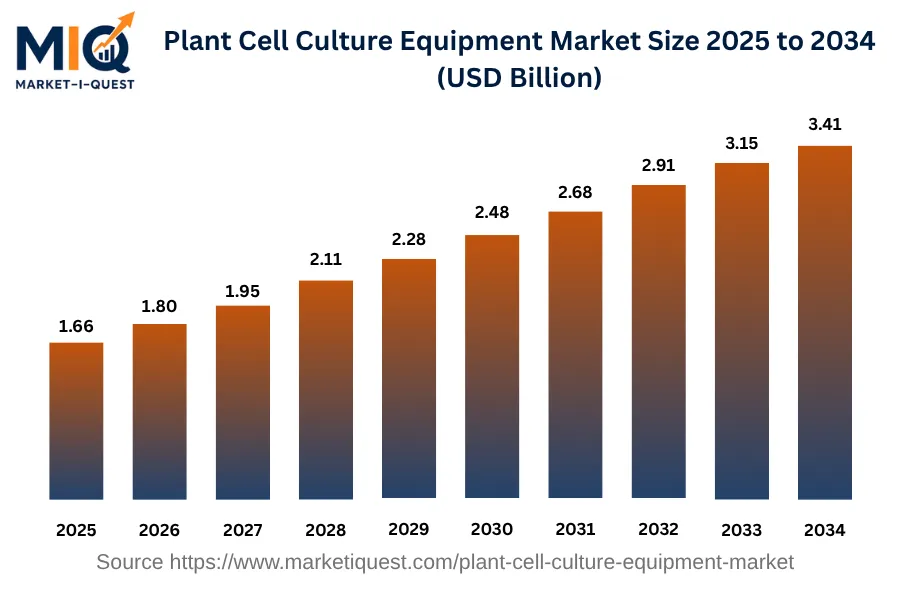
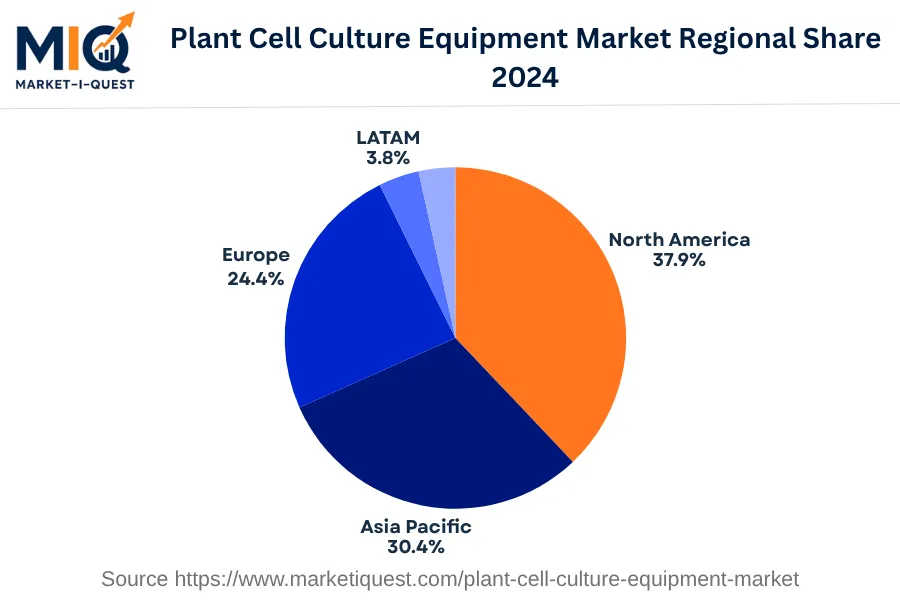
The Plant Cell Culture Equipment Market valued at $1.53 billion in 2024 and grew to $1.66 billion in 2025. By 2034, it is projected to reach a value of $3.41 billion, growing at a CAGR of 8.35%. The growth from 2024 to 2034 indicates that the market value has more than doubled over the decade. The expansion can be attributed to advancements in plant cell culture technology and increasing demand for such equipment in the biological sectors. This sector witnessed a steady growth in the forecasted period, indicating an rising trend in the usage of plant cell culture equipment. However, the regional share distribution North America accounting for 37.92%, Asia Pacific held a 30.41% share, Europe contributed 24.36%, with lesser shares held by Latin America and Middle East & Africa, at 3.84% and 3.47% respectively.

Key Takeaways

  • By Type - Microscopes led the market accounting for a major share in the base year.
  • By Application - Plant Breeding held the top position in the respective year.
  • By End Use -Laboratory expanded fastest signifying a robust growth trajectory.
plant-cell-culture-equipment-market market size

Key Driving Factors

Adoption of Plant Cell Culture Techniques in Nutraceutical Production

Plant cell culture techniques have become an integral part in the nutraceutical production industry. These techniques allow for mass production of plant cells that contain valuable natural compounds. This method produces nutraceuticals that may be costly or difficult for extracting from naturally grown plants. For instance, taxol, a high-value compound used in cancer treatment is traditionally extracted from yew trees, a process which is harmful to the trees and produces low yields. However, plant cell culture techniques enable cultivators for producing taxol in more sustainable and economical ways. This adoption in the nutraceutical industry provides a expanding value proposition for firms in the plant cell culture equipment market.
Regulations Encouraging Sustainable Agricultural Practices

In many countries, regulatory bodies are encouraging and even necessitating more sustainable and high-efficiency agricultural practices. Techniques such as plant cell culture fit neatly within these mandates, offering a way to produce plant compounds en masse, with minimal land usage and environmental impact. For instance, European Union's Green Deal and Farm to Fork strategy emphasize sustainable food systems which promote in vitro plant production methods. Consequently, companies in the plant cell culture equipment market are witnessing increased demand for their products as agritech firms and research institutions seek to adhere to these regulations. This regulatory landscape is a driving factor for the market growth of plant cell culture equipment.

Market Evolution by Timeline

2019-2023
By 2019, demand from bio-pharma industries primarily drives the Plant Cell Culture Equipment Market. Countries in North America, particularly the United States, are the largest buyers due to prominent bio-pharmaceutical industries. Regarding supply, manufacturers offered different types of cell culture equipment such as bioreactors, incubators, and cell culture vessels. Integration readiness appeared to be at an early stage, with manufacturers working toward providing integrated cell culture systems. The US FDA's guidelines on cell and tissue-based products indirectly influenced market growth. Per-unit pricing was the standard model, with products sold via B2B channels.
2024
In 2024, demand from agricultural-biotechnology industries grew in addition to bio-pharma industries, especially in Asia. China and India have increased bio-pharma and agricultural activities. Manufacturers introduced advanced bioreactors and automated cell culture systems, suggesting a mature state of integration. Regulatory environments evolved, with the European Union releasing new regulations to govern plant cell culture equipment. However, the per-unit pricing model persisted and established manufacturers preferred strategic partnerships for sales.
2025-2029
From 2025 to 2029, emerging markets in Africa and Latin America might portray increased demand in plant cell culture equipment due to growing bio-fuel industries. Innovations in automated and miniaturized cell culture systems effectively will likely address market needs. Regulatory bodies will likely embrace global harmonization policies, fostering ease of business operations globally. Pricing dynamics might shift from per-unit to performance-based pricing, considering the output capacity of equipment. Market risks may witness a pattern of skills shortage among human resources handling the cell culture equipment, prompting training initiatives from equipment manufacturers.
2030-2034
In the period from 2030 to 2034, the demand for plant cell culture equipment is expected to gain significant impetus from the alternative meat industry. Biotech firms and food technology startups, particularly in Europe, will likely increase their procurement. This period typifies the arrival of AI-enabled culture systems, reflecting a high degree of integration maturity. Meanwhile, the regulatory landscape is likely to drive towards clearer guidelines for cultured meat. Commercial aspects such as flexible pricing become prevalent aligned with volume-based contracts, and partnerships focus on technology sharing.

Future Market Outlook

Future Opportunities

Current advancements in plant cell culture equipment hint at significant opportunities in various sectors, notably agriculture and pharmaceuticals. Companies such as BASF are investing in biotechnological research to advance crop resilience through plant cell cultures, supporting sustainable farming practices. The increasing relevance of genetically modified organisms, regulated by the U.S. Department of Agriculture, encourages the development of suitable equipment for the propagation of these plants. Moreover, the rising demand for bioactive compounds from plant sources, fueled by consumer interest in natural products, opens avenues for specialized equipment tailored for the extraction and cultivation processes. The European Union implemented the Farm to Fork Strategy, promoting practices that enhance sustainable food systems, thereby creating a favorable environment for plant cell culture equipment advancements. Moreover, the pharmaceutical industry's focus on personalized medicine creates a need for innovative cell culture technologies, as seen in the strategic collaborations formed between key players in biopharma and equipment manufacturing sectors. As regulations continue to evolve, manufacturers must align their offerings with emerging standards, particularly regarding safety and efficacy. This dynamic environment provides ample space for growth as well as cross-industry collaborations aimed at harmonizing the application of plant cell cultures in various fields.

Segmentation Analysis

By Type

The market is divided into subsegments including Cell Counters, Incubators, Seed Germinators, Microscopes, Centrifuges, and Others. Microscopes accounted for the largest revenue share while Cell Counters is expected to grow at the fastest CAGR during the forecast period.

Largest Revenue Share

Microscopes

Market Share Leader

Microscopes dominate the segment due to their wide utility across various fields of science and research. Their critical importance in fields such as microbiology, nanotechnology, forensics and biotechnology, among other areas, has driven their adoption rates significantly compared to other equipment in the segment. Since microscopes are widely used in diagnosing diseases, studying biological organisms, and aids in developing new scientific discoveries, make it the highest revenue-generating tool in this segment. Moreover, the strong, established demand for microscopes globally is due to standard protocols or procedures that mandate its use, accelerating the sales in clinical, academic, and industrial research applications. In addition, continuous advancements in imaging technologies also pose opportunities for microscopy in both the short and long term. Finally, the relatively higher pricing of microscopes as compared to the other sub-segments adds to the revenue share.

Fastest CAGR

Cell Counters

Forecast Period Growth Leader

Cell Counters are projected to grow at the fastest rate in this segment. This is attributed to their rising application in biomedical research, particularly in the field of cellular biology, and more notably in cancer research. Digital automation has transformed the traditional, manual approach of blood cell counting providing increased accuracy and efficiency, therefore reducing the scope for error, which serves as a significant market driver. The growth of personalized medicine, along with the rise in funding for cellular research, acts as a catalyst for the subsegment's expansion. Emerging markets in developing countries and an increasing focus on regenerative medicine and stem cell research also contribute to the prolonged growth of this sub-segment. However, the relatively higher cost of automated counters and the lack of skilled technicians to operate advanced cell counting devices could pose near-term challenges.

By Application

The market application is divided into subsegments including Plant Research, Plant Breeding, Quality Assessment, and Others. In 2024, Plant Breeding held the largest revenue share, while Quality Assessment is expected to grow at the fastest rate during the forecast period.

Largest Revenue Share

Plant Breeding

Market Share Leader

Plant Breeding is the most revenue-generating subsegment in the base year 2024 due to several factors. It involves the science and art of improving plant species. Advances in genetics have made this process more precise, expeditious and predictable. The growing demand for improved crops that are resistant to pest, disease, and environmental stresses has propelled the market for plant breeding instruments. Other factors contributing to its high revenue share include the need to meet the increasing food demand brought by the rapidly expanding global population and the importance of enhancing agricultural productivity. Large agricultural producers are more willing to invest in plant breeding technologies to gain a competitive advantage in terms of improved yield and resistance against various agricultural ailments. Geographically, regions with a high concentration of agricultural activities, such as the Americas and Asia–Pacific, contribute significantly to its high revenue share.

Fastest CAGR

Quality Assessment

Forecast Period Growth Leader

Quality Assessment is projected to grow at the fastest rate during the forecast due to several key factors. There has been a remarkable shift in the agricultural sector, where quality is now prioritized over quantity to ensure food safety and maintain health standards. Stringent food regulations laid down by government bodies globally are acting as catalysts for the adoption of advanced technologies for Quality Assessment. The growing fear of food adulteration and increased consumer awareness about food quality are bolstering the growth in this segment. Technological progress is also making quality assessment more accessible and affordable for smaller scale growers and agricultural outfits. The application of technologies like portable spectroscopy instruments and hyperspectral imaging in remote sensing of crop health and quality assessment promises a high CAGR potential. However, high investment in advanced Quality Assessment technologies and lack of skilled personnel for operating these technologies pose a downgrade risk to this high growth forecast.

By End Use

The market is divided into subsegments including Laboratory, Agricultural Institutes, and Others. Agricultural Institutes accounted for the largest revenue share while Laboratory is expected to grow at the fastest CAGR during the forecast period.

Largest Revenue Share

Agricultural Institutes

Market Share Leader

Agricultural Institutes hold the highest market share in the year 2024. There are several compounding factors driving this dominance. Global emphasis on food security and sustainable agricultural practices entail a greater need for advanced farming technologies, thus fueling demand from agricultural institutes. These institutes carry growing responsibilities, including researching and testing new techniques, equipment, and crop strains, which require a consistent flow of funding and investment into their programs. Further, the vast geographical scope of these institutions, from developed to emerging economies, also widens the market potential. Regulatory measures supporting scientific agricultural development also favor this subsegment. Given the scale and buying capacity, these institutes form bulk of the customer base for the market. Even though switching costs are considerable, the need for up-to-date equipment in these institutes results in a steady revenue stream.

Fastest CAGR

Laboratory

Forecast Period Growth Leader

On the other hand, Laboratory subsegment shows the highest growth prospects. The major growth propulsion comes from the increasing importance of data-based decisions in various industries. Laboratories are responsible for providing this data, thus creating a favorable environment for this subsegment's growth. Another critical factor is the rise in public and private partnerships supporting science and innovation, which positively impacts laboratories' growth trajectory. Digitalization and technology advancements are also key catalysts, cutting the physical boundaries and allowing remote operations, adding to the scalability and growth rate. Meanwhile, the barriers to entry in this subsegment are the initial capital expenditure. Despite this, there remains a promising growth outlook over the forecast period in labs that can overcome these barriers and ride the wave of technological innovation. Integration of Artificial Intelligence and Machine Learning is a key trend that could drive near-term accelerated growth.

Competitive Analysis

Key Market Players

Manufacturers / OEMs

Eppendorf AG
Germany
Bertin Instruments
France
Labogene
Denmark

Key Suppliers & Raw Materials

Corning Incorporated
US
Thermo Fisher Scientific
US
Sartorius AG
Germany

Distributors, Integrators & Channel Partners

Sigma-Aldrich Co.
US
Merck KGaA
Germany
PromoCell GmbH
Germany

Porter’s Five Forces Analysis

This analysis evaluates the competitive dynamics within the plant cell culture equipment market.

Supplier Bargaining Power

Medium

Limited number of suppliers for specialized components increases their bargaining power.

Buyer Bargaining Power

High

Multiple equipment vendors allow buyers to demand better pricing and terms.

Threat of Substitutes

Low

Few substitutes exist due to unique capabilities and inherent complexity of the equipment.

Threat of New Entrants

Medium

High investment costs deter entry, but increasing market size attracts new players.

Competitive Rivalry

High

Numerous established entities compete fiercely, focusing on innovation and cost efficiencies.

Regional Analysis

Geographic market dynamics and growth opportunities across key regions

Global Market Outlook

plant-cell-culture-equipment-market market regional share

North America

In the base year 2024, North America becomes a key region in the plant cell culture equipment market as medical, academic, and biotech sectors exponentially increase their demand for such tools. Key drivers included tightened regulation of biotech research by the US government, prompting laboratories to upgrade to top-tier equipment to ensure compliance. Canada's significant investment in agritech research also fuels demand, as did burgeoning demand from Mexico’s blossoming pharmaceutical industry. Moreover, faster rates of technology adoption, particularly within the US and Canada, drive the market, with automation and precision-based instruments becoming industry standards in plant cell research.

Key trends, on the other hand, included burgeoning public-private partnerships, especially in the US. These were driven by policy enforcements encouraging collaborations between tech companies and public research universities to accelerate bioengineering innovations. A significant shift in buyer behavior was evident, as more organizations prioritize sustainable equipment, favoring vendors offering energy-efficient cell culture instruments. Channel dynamics also shifted with a notable expansion in direct, online sales due to pandemic-induced changes to purchasing habits. In Mexico, the popularity of lease-based purchasing models rose, providing affordable access to costly, high-tech research equipment. With such drivers and trends, the plant cell culture equipment market in North America continues to foster across enterprise, government, healthcare, and academic sectors.

Asia Pacific

In 2024, the Asia Pacific Plant Cell Culture Equipment market showcased significant growth due to increased demand from key sectors and region-specific factors. Rampant growth in biopharmaceuticals manufacturing, particularly in China and India, has heightened demand for efficient plant cell culture facilities. Parallelly, China's rigorous investment in healthcare and agricultural biotechnology sectors has fueled the uptake of the latest plant cell culture technologies. With the adaptation of Japan's Standards for Cell and Gene Therapy Products (CGTP), there was a surge in the demand for high-quality plant cell culture systems compliant with regulatory standards.

Noteworthy trends shaping the market include South Korea's focus on advanced bio-production facilities, aspiring towards self-sufficiency in biopharmaceuticals. Increased M&A activities were observed, with prominent players acquiring smaller entities to strengthen their footprint. Australia's growing adherence to Good Manufacturing Practices (GMP) precipitated interest in culture equipment capable of maintaining rigorous purity standards. The enforcement of the Association of Southeast Asian Nations (ASEAN) harmonized regulatory scheme stressed the importance of standardized and high-grade plant cell culture equipment across its key markets. Most importantly, the shift towards plant-based expression systems by major biopharmaceutical enterprises yielded a significant influence on the plant cell culture equipment market landscape.

Europe

In 2024, the European plant cell culture equipment market presented substantial growth opportunities across diverse sectors. A surge in demand due to increased bio-pharmaceutical research, coupled with stringent EU regulations promoting high-quality plant cellular products, has significantly driven market expansion. Additionally, the green transition investment plans of major economies, notably Germany and France, have fostered the adoption of innovative technologies within this market space. Emerging trends in 2024 demonstrated a shift in buyer behavior, favoring environmentally sustainable plant cell culture equipment over conventional methods. Heightened focus on resource-efficient systems by countries such as the UK and the Nordics resulted in a shift towards automated and digitized equipment. Concurrently, an increase in strategic partnerships and M&A activities, particularly in Italy and Spain, enhanced market consolidation and product diversity. Regulatory standards implemented by Benelux and Central & Eastern European nations enforced quality assurance and drove market compliance.

Key customers for 2024 included bio-pharmaceutical companies, plant research institutes, and agricultural bodies, each requiring precise and efficient plant cell culture processes. Furthermore, utility companies and certain manufacturing sectors leveraged these equipment for waste management and biofuel production, respectively, driving diversification in this market arena. The overall demand trajectory and market trends positioned the European plant cell culture equipment market favorably for robust growth.

Latin America

The Plant Cell Culture Equipment market in Latin America experienced dynamic shifts in 2024, driven predominantly by demand changes, beneficial regulations, active investments, and the adoption of novel technological solutions. Among market drivers, the surge in biopharmaceutical investments proved significant, particularly in Brazil and Mexico, as companies leveraged plant cell culture to produce cost-effective therapeutics. Updated safety regulations in Argentina and Chile spurred an influx in high-quality, stringent equipment to meet compliance, driving demand. Additionally, government-led initiatives in Colombia promoting advanced agricultural techniques and sustainable bioscience practices encouraged extensive uptake of cell culture tools.

Trendwise, the increasing preference for in-house plant tissue culturing among research institutions and agri-biotech industries — prominent in Peru — directed the purchase of lab-specific plant cell culture equipment. A rise in partnerships between local and international equipment providers expanded access to diverse technology, exemplified by Brazil's flourishing agri-tech space. Meanwhile, Mexico noticed firm enforcement of quality standards, steering manufacturers towards standardized, more reliable equipment.

In essence, the Plant Cell Culture Equipment market in Latin America marked 2024 with robust growth propelled by investments, regulatory enhancements, and burgeoning technology adoption. Concurrent consumer trends such as in-house culturing preference and quality affirmation further shaped this thriving market landscape.

Middle East & Africa

In 2024, the Plant Cell Culture Equipment Market in the Middle East and Africa demonstrated a notable growth. This was driven mainly by mounting global environmental concerns and increased adoption of biotech methodologies for plant research. Countries such as Saudi Arabia, United Arab Emirates and Israel made significant strides in setting up research facilities, encouraged by government and international investment into biotech industries. Furthermore, advancements in cell cultivation technology accelerated market growth. Trends in the Plant Cell Culture Equipment Market in 2024 included a shift towards automation, improving the efficiency and streamlining of cultivation processes. In countries like Egypt and South Africa, an increase in plant biology curricula in academic institutions spurred the market. Additionally, many key players engaged in strategic partnerships (like M&A) to enhance their market footprints and product portfolios.

The healthcare sector in countries such as Saudi Arabia and Israel showed significant interest in utilizing plant cell culture equipment for advanced research, with the aim of creating pharmaceuticals derived from plant cells. The oil and gas sector in Qatar and UAE fostered a burgeoning interest in biofuels, a potential alternative energy source. This renewed focus influenced the demand for plant cell culture equipment, contributing towards a vibrant market in 2024. The market's performance in 2024 largely stemmed from these influences.

Recent Industry Developments

Latest market innovations, product launches, and strategic initiatives

June 2026

Herbalife International India Pvt. Ltd. and IIT Madras launched India's first Centre of Excellence (CoE) dedicated to plant cell fermentation technology. The facility brings together advanced plant cell cultivation systems, modern downstream processing technologies, and metabolomics platforms under one roof, equipped with customized plant cell bioreactors, advanced analytical platforms, and pilot-scale processing facilities.

March 2026

Sumitomo Riko Company Limited and IntegriCulture Inc. entered into a strategic partnership memorandum to accelerate the industrialization of cellular agriculture. The collaboration leverages Sumitomo Riko’s advanced material science and IntegriCulture’s proprietary cultivation technology, centered on the Oxy-thru Cultivator™ — a specialized cell culture bag that has successfully cultivated plant cells.

Frequently Asked Questions