
Pico Projector Market Snapshot

Key Players

  • Sony Corporation (Japan)
  • AAXA Technologies (United States)
  • Philips (Netherlands)
  • LG Electronics (South Korea)
  • Acer Inc. (Taiwan)
  • Optoma Corporation (Taiwan)
  • Anker Innovations (China)
  • ViewSonic Corporation (United States)
  • Texas Instruments (United States)
  • Barco NV (Belgium)

Market Size

Base Year 2024
$5.12 Bn
CAGR
9.76%
Forecast 2034
$12.99 Bn

Market Segments

By Technology
DLP, LCD, Laser, LED
By Portability
Handheld, Compact, Mini
By Application
Home Entertainment, Business Presentations, Education, Gaming, Others
By End User
Consumers, Commercial, Educational Institutions, Others

Market Dynamics

Drivers
  • Increasing consumer electronics adoption
  • Advancements in display technologies
Restraints
  • High product cost
  • Limited Battery Life
Opportunities
  • Rising consumer electronics demand
  • Increasing portable device adoption

Market Size

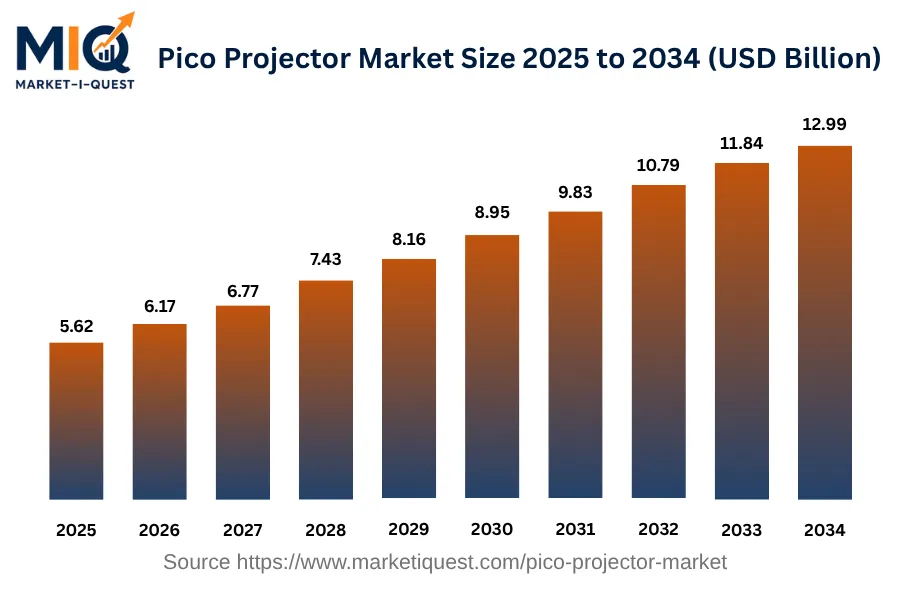
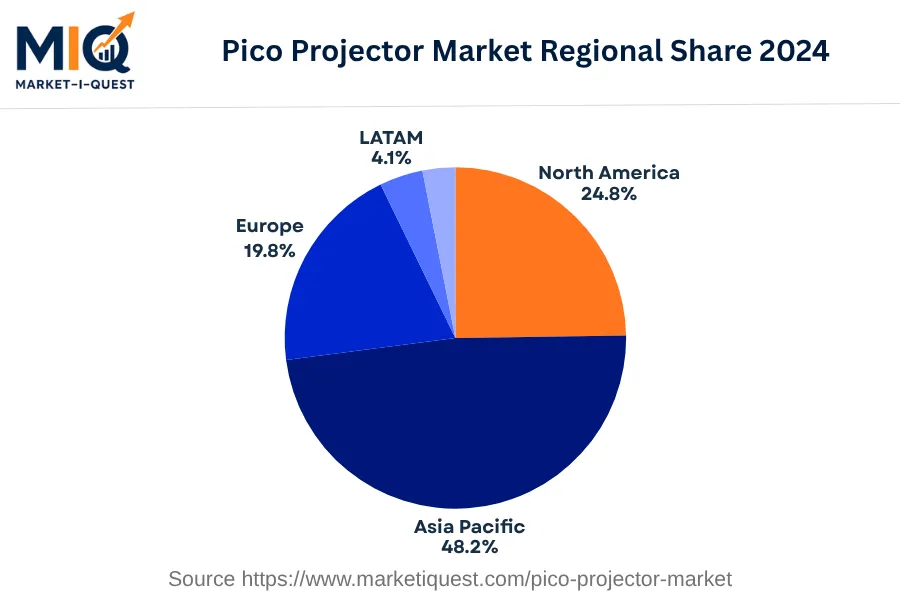
The Pico Projector Market stood at USD 5.12 billion in 2024 and increased to USD 5.62 billion by 2025. It is set to reach USD 12.99 billion by 2034, growing at a CAGR of 9.76%. The increase in market size from 2025 to 2034 is substantial, demonstrating a steady growth path over the decade. This ascension is a reflection of the enhanced demand for compact and portable projection devices in a variety of sectors including home entertainment, business and education. In 2024, the regional market shares were distributed as follows: Asia Pacific held the largest share at 48.1%, followed by North America at 24.8%, Europe at 19.8%, LATAM at 4.1%, and MEA at 3.1%.

Key Takeaways

  • By Technology - LCD held the highest share dominating the Pico Projector Market in recent years.
  • By Portability - Handheld emerged as the leading category in user preference.
  • By Application - Home Entertainment led the market accounting for the maximum user base.
  • By End User - Commercial subsegment held the key market share making it an area to watch closely for potential growth.
pico-projector-market market size

Key Driving Factors

Implementation of Pico Projectors in Smartphones

The rapid incorporation of pico projectors within the designs of smartphones currently remains a key driving force of the pico projector market. Mobile device manufacturers are continuously scouting for innovative features to offer consumers as a means of vying for market advantage. The integration of pico projectors serves as an attractive aesthetic and functional upgrade to standard smartphones, providing users the flexibility to project presentations, photographs, and videos onto various surfaces. This not only elevates the utility of the smartphone for professional uses but also promotes its appeal for entertainment purposes. As such, the collaboration between mobile device manufacturers and pico projector technology providers is fueling growth in the pico projector market.
Shift towards Portable Business Electronics

The gradual transition towards portable electronics in the business environment is contributing significantly to the growth of the pico projector market. Lightweight and compact, pico projectors rival their traditional counterparts in terms of convenience, drastically reducing the need for bulky projection equipment in business settings. Professionals in the sales and marketing sectors have found particular value in these units due to the advantage of presenting data and pitches to prospective clients in an array of environments, no longer tethered by the spatial limitations inherent with standard projectors. As businesses continue to embrace this shift towards portable business electronics, the demand for pico projectors will likely maintain an upward trajectory.

Market Evolution by Timeline

2019-2023
In this period, the key buyers were consumers and businesses based primarily in North America and Asia. Consumers used Pico projectors for mobile home entertainment and businesses for presentations. Major products included Optoma PK301 and 3M MPro120, which integrated with mobile devices and laptops. LED-light-source technology became mature in these projectors, but battery capacities remained a constraint. No specific regulations or standards influenced adoption. Pricing went down due to mass production and competition from China. Single-unit sales were typical, with partnerships emerging between projector and smartphone manufacturers. The inadequate brightness of projectors was a major risk, addressed through light-source improvements.
2024
By 2024, the Pico projector market saw an increased demand from educational institutes worldwide for distant learning due to COVID-19. The Philips PicoPix Max, a notable product, came integrated into smartphones. Laser light sources were beginning to replace LED technology. Being a consumer tech, no notable regulations directly influenced the market, although general electronic product regulations applied. Average prices dropped due to improvements in manufacturing technology. Bundled sales of projectors with high-end smartphones became popular. The potential harm of laser light to eyes emerged as a risk, causing makers to work on safer light sources.
2025-2029
In this period, the gaming industry was the primary demand driver in the US and Europe. The Samsung Beam 2025, integrated in a gaming console, became frequently used for creating a large gaming environment. Ultra Short Throw (UST) tech was well-adopted, overcoming the distance limitation. No explicit regulations or standards governed the use of Pico projectors. The commercial model leaned towards leasing the projectors bundled with gaming consoles. The problem of low contrast ratio in bright conditions was addressed by developing Ambient Light Rejection (ALR) technology.
2030-2034
From 2030 to 2034, the largest demand for Pico projectors came from the Augmented Reality (AR) and Virtual Reality (VR) markets, followed by autonomous vehicles for Heads-Up-Display (HUD). The Texas Instruments DLP Pico 2031, integrated in AR glasses and vehicle HUD systems, had a profound impact. Tiny Laser Projector tech was mature. The US implemented safety standards for vehicle HUDs, indirectly influencing Pico projector adoptions in vehicles. Cost became premium due to miniaturization and integration challenges. Projectors were built into other products rather than sold separately. The lack of long-lasting power sources for integrated projectors was the main risk, triggering high investments in battery tech.

Future Market Outlook

Future Opportunities

With the growing reliance on mobile devices and the rise of remote work, the pico projector market presents numerous opportunities for expansion and innovation. As of 2023, companies like Epson are actively developing models tailored for mobile professionals, recognizing the increasing need for on-the-go presentation solutions. Simultaneously, educational institutions are seeking advanced projection methods to enhance interactive learning experiences, leading to partnerships between technology firms and schools to create customized solutions. The recent surge in outdoor leisure activities has generated interest in portable projectors that can be used for movie nights and camping trips. By 2024, experts believe there will be greater incorporation of augmented reality in pico projectors, enabling immersive experiences for users. Additionally, regions such as Asia-Pacific are witnessing increased investments in entertainment technologies, with countries like China delving into innovative display technologies to meet consumer demands. In the smart home ecosystem, projector manufacturers are exploring integration with voice assistants, as demonstrated by recently released models that recognize commands via Alexa or Google Assistant. The events of 2022, particularly pivoting toward energy-efficient technologies, hint at an ongoing commitment to sustainability, inviting collaborations with environmental organizations. The convergence of these factors presents not only a potential for product enhancement but also new business models, as companies adapt to the evolving needs of diverse markets and leverage partnerships for greater reach.

Segmentation Analysis

By Technology

The market is divided into subsegments including DLP, LCD, Laser, and LED, with LCD accounting for the largest revenue share while LED is expected to grow at the fastest CAGR during the forecast period.

Largest Revenue Share

LCD

Market Share Leader

LCD, or Liquid Crystal Display, currently holds the lion's share in terms of revenue in the technology subsegment market as of the base year 2024. There are numerous factors contributing to this dominant position. Broadly, a longstanding history of application within numerous consumer electronics categories, wide-spread acceptance among consumers due to intuitive and flexible interfaces, and a consistent drop in prices due to advancements in manufacturing processes have worked in its favor. Geographically, the Asia-Pacific region, with a huge electronic consumer base, contributes largely to LCD's significant revenue. Additionally, regulatory approvals for the use of LCD in certain high-end, highly regulated industries such as aeronautics and industrial automation have further spurred growth. Key purchasing criteria influencing LCD demand include power efficiency, resolution quality, and durability. Immense proliferation across different sales channels, online and offline, has expanded the reach of LCD technology to diverse customer segments, reinforcing its leading position.

Fastest CAGR

LED

Forecast Period Growth Leader

Although LED (Light Emitting Diodes) technology doesn’t currently match LCD's market dominance, it's poised to register the fastest CAGR over the forecast period. The main drivers propelling the growth of the LED subsegment within the technology domain include efficiency gains, longer lifespan, and the advancing miniaturization of electronics. The adoption of LED technology continues to accelerate across various sectors such as automobile, consumer electronics, and lighting due to its excellent energy savings, leading to greater environment friendliness and cost reductions. However, the widespread adoption of LED faces barriers in terms of high initial capital expenditure, which is slowly being offset by partnerships between LED manufacturers and financing companies. Near-term risks including receiving permits and standards compliance can potentially impact growth. As for catalysts, policy regulations favoring energy-efficient technology, and technological innovations enabling the production of flexible and thin LEDs, are expected to drive the market.

By Portability

The market for portability is bifurcated into handheld, compact, and mini subsegments. In the base year of 2024, the handheld subsegment was seen to account for the largest revenue share, while the compact subsegment is projected to be the fastest-growing.

Largest Revenue Share

Handheld

Market Share Leader

The handheld subsegment leads in revenue generation due to its broad customer base and functional versatility. It is preferred by a plethora of user demographics including students, professionals, and casual users due to its multifunctional nature. Geographically, this subsegment enjoys a substantial presence in developed regions such as North America and Western Europe where the adoption of portable devices is high. Additionally, stringent regulations in place targeting the reduction of carbon footprint also lend an impetus to the sale of handheld devices, highlighting them as the environmentally friendly choice. From a supply perspective, the handheld subsegment benefits from established supply chains and diverse range of product offerings. The purchasing criteria continue to shift towards practicality and carbon footprint, thus benefitting this subsegment. While the switching costs from handheld devices are relatively high due to user habituation and a sense of familiarity, it also increases the subsegment’s market footprint. Therefore, this subsegment remains the dominant revenue generator in 2024.

Fastest CAGR

Compact

Forecast Period Growth Leader

The fastest growth is expected in the compact subsegment, driven by increasing technological advancements, and evolving consumer preferences towards more space-efficient and easy-to-carry devices. A rise in partnerships between device manufacturers and software companies strengthens the compact device segment's potential, promising better integration and user experience. A significant demand for compact devices is expected from developing regions where the market penetration of portable devices is still relatively low, presenting a golden opportunity for rapid growth. Despite the promising future, the compact subsegment faces potential barriers such as high capital expenditure required for manufacturing these devices and the quality of after-sales service, which may influence consumer adoption. However, the uplifted focus on research and development activities by major manufacturers and the trend of remote work and learn are encouraging the swift adoption of compact devices. Catalyzed by these market circumstances, the compact subsegment is poised to grow at a rapid pace.

By Application

The market, segmented by application, encompasses Home Entertainment, Business Presentations, Education, Gaming and Others. Among these, the Home Entertainment subsegment commanded the largest revenue share in 2024, whilst the Gaming subsegment is set to register the highest CAGR during the forecast period.

Largest Revenue Share

Home Entertainment

Market Share Leader

In 2024, the Home Entertainment subsegment accounted for the largest revenue share in the application market. This is primarily due to the increasing consumer spending on media and entertainment, fueled by the rise in disposable incomes and the growing demand for enhanced viewing experience. Additionally, technological advancements such as high-definition (HD) and ultra-high-definition (UHD) televisions have further spurred the market growth. Geographically, the Asia-Pacific region, being the most populated region, contributes a significant share to the global revenue, driven by factors such as rapid urbanization and improving living standards. Moreover, changing lifestyles and trends towards smart homes are expected to continue driving this subsegment. However, the high purchase and maintenance costs of these entertainment systems may act as a limiting factor.

Fastest CAGR

Gaming

Forecast Period Growth Leader

The Gaming subsegment is predicted to grow at the fastest rate during the forecast period. This rapid growth can be attributed to the escalating popularity of video games amongst various age groups, coupled with the proliferation of multiplayer and mobile gaming. Technological innovations such as virtual reality (VR) and augmented reality (AR), improving internet connectivity, and the increasing number of esports tournaments represent additional growth catalysts. Furthermore, industry initiatives like collaborations with game developers and investments in gaming infrastructure are expected to stimulate market expansion. However, high cost of gaming equipment and potential health concerns associated with prolonged gaming could pose challenges to adoption and act as near-term risks.

By End User

The market is divided into subsegments which include Consumers, Commercial, Educational Institutions, and Others. In base year 2024, the Commercial subsegment accounted for the largest revenue share, while Educational Institutions is expected to grow at the fastest CAGR during the following years.

Largest Revenue Share

Commercial

Market Share Leader

The Commercial subsegment prevailed as the highest revenue-generating segment in 2024. This dominance can be attributed to several factors. Primarily, the pervasive use and increasing acceptance of technology in commercial scenarios across various industry verticals. These encompass but are not limited to retail, hospitality, banking, and automotive industries. Sales growth is strongly driven by large scale enterprises' constant need for technological updates to stay competitive and enhance operational efficiency. Further, regulations mandating certain technological standards in several industries fuel revenue in the commercial subsegment. The purchasing criteria for these technological solutions is generally based on performance, security, and after-sales services. As such, higher switching costs involved due to integration with existing infrastructure further ensure customer retention and contribute towards revenue generation.

Fastest CAGR

Educational Institutions

Forecast Period Growth Leader

The Educational Institutions subsegment is pegged to witness the most robust growth rate in the coming years. This can be primarily attributed to the digital transformation sweeping across the education sector. Technological solutions are progressively being incorporated in schools and universities, boosting demand in this sector. Policy changes favoring digital literacy and infrastructure along with increased capex in edtech are vital catalysts for this growth. Partnerships between educational institutions and tech firms also provide tailwinds to this growth trajectory. However, challenges persist in the form of adoption barriers such as lack of infrastructure, particularly in emerging markets, which may present short-term risks to growth. The focus, therefore, should be on creating awareness about the benefits of such advanced technological solutions and investing in necessary infrastructure enhancements to surmount these barriers.

Competitive Analysis

Key Market Players

Manufacturers / OEMs

Sony Corporation
Japan
Samsung Electronics Co., Ltd.
South Korea
Optoma Corporation
Taiwan

Key Suppliers & Raw Materials

TI (Texas Instruments)
US
Panasonic Industrial Devices & Solutions
Japan
Seoul SemiConductor Inc.
South Korea

Distributors, Integrators & Channel Partners

Best Buy Co., Inc.
US
Alibaba Group Holding Ltd.
China
Amazon.com Inc.
US

Porter’s Five Forces Analysis

This analysis evaluates the competitive landscape of the Pico Projector market.

Supplier Bargaining Power

Medium

Limited suppliers of key components can influence prices and delivery timelines.

Buyer Bargaining Power

High

Numerous players and product differentiation provide buyers with options and bargaining power.

Threat of Substitutes

Low

Unique functionalities limit the availability of substitutes for Pico Projectors.

Threat of New Entrants

Medium

Technological advancements and lower setup cost can lead to new entrants in the market.

Competitive Rivalry

High

High competition due to numerous established players and their branding strategies.

Regional Analysis

Geographic market dynamics and growth opportunities across key regions

Global Market Outlook

pico-projector-market market regional share

North America

In 2024, the North American Pico Projector Market experienced a significant swell, driven by various factors and marked by key trends. Rising demand from business sectors, including enterprises and education institutes, led to more investments in Pico projectors for applications such as presentations and lectures. Technological innovation, particularly in reducing device size while enhancing resolution, propelled product adoption. Simultaneously, government regulations in the US endorsing energy-efficient electronic devices indirectly encouraged market growth. Trends in 2024 saw a significant shift towards portable and handheld projectors, altering the market dynamics. As consumer behavior gravitated towards mobile and compact devices, manufacturers rapidly pivoted their product lines. Notably, in Canada, the retail sector showed increased interest in Pico projectors for advertising and digital signage, fueling growth.

In the United States, partnerships and M&A became standard. Giant corporations acquired tech start-ups, integrating their technologies into their product portfolios. Likewise, Mexico saw a policy enforcement on corporate sustainability, leading many companies to opt for eco-friendly Pico projectors.Healthcare also emerged as a crucial sector, tailoring these projectors for patient education and medical imaging. Despite the varied product uses across sectors, the North American Pico Projector Market in 2024 shared a common theme—adapting to customer dynamics and technological evolution to optimize growth.

Asia Pacific

In 2024, the Pico Projector Market in Asia Pacific demonstrated significant expansion centered on technological advancements and increased user demand. Driving factors included a rise in digitalization, leading to unprecedented growth in India’s IT, retail, and hospitality sectors where compact, portable projectors fulfilled demand for flexible presentations solutions. High-definition vision adoption in China's education sector, compounded by increased government investment in smart classrooms, further fueled the market. In Japan and South Korea, a strengthened economy increased consumer purchasing power, triggering residential market growth. However, pricing remained a challenge due to high production costs, impacting supply dynamics.

Demand for wireless connectivity prompted product shifts, with companies integrating Bluetooth and Wi-Fi into Pico projectors. As businesses in Australia and key ASEAN markets moved to remote working arrangements, trends indicated a growing consumer preference for lightweight, mobile projection devices supporting digital connectivity. Consequently, there was an uptick in partnerships between Pico projector manufacturers and networking businesses across Asia Pacific. Evidence of regulatory influence was visible in Japan's proactive encouragement of energy-efficient devices, prompting manufacturers to streamline operations. More broadly, technology standardization became a pivotal focus, supporting compatibility across an increasingly networked region.

Europe

In 2024, the Pico Projector Market within Europe has witnessed considerable growth due to various drivers. Technological adoption has played a crucial role, with growing preference for portable and compact electronic gadgets across different sectors, including enterprise, healthcare and retail. Increased investment in R&D from major market players such as Texas Instruments and MicroVision has led to advancements in Pico Projector technologies, enhancing their resolution and brightness amidst competitive pricing conditions. Additionally, regulations promoting eco-friendly projectors have augmented the market dynamics.

Shifting trends comprising buyer behavior and channel dynamics have also influenced this market significantly. There has been a surge in online sales of Pico Projectors in countries like France, Germany, the United Kingdom and Italy. Central & Eastern Europe and the Nordics reported heightened usage of Pico Projectors in business presentations due to their portability and energy efficiency. Government and utilities sectors in Spain and Benelux notably adopted Pico Projectors for training and educational purposes. Meanwhile, the trend of partnerships and M&A has been prominent, with notable alliances formed between manufacturers and various tech firms across Europe. Finally, adherence to energy conservation standards has been a critical trend shaping the European Pico Projector Market.

Latin America

In 2024, the Pico projector market in Latin America witnessed robust growth propelled by technological advancements. Increasing demand for portable and convenient projectors in countries like Brazil and Mexico was ignited by rising smartphone penetration and an upsurge in remote working practices. In Argentina, government investments into edtech sector stimulated the market, with lightweight projectors gaining traction in educational settings. Meanwhile, reduced pricing due to intensified competition bolstered sales in cost-sensitive markets like Colombia. Consumer preferences swayed towards models with higher lumens and longer battery life, aligning with the increasing desire for enhanced picture quality and uninterrupted usage. E-commerce platforms dominated the sales channel due to the convenience they offered in comparing and purchasing products, alongside prompt delivery. The year also marked significant mergers and acquisitions, notably in Chile and Peru; a trend fueling market consolidation and boosting the range of offerings.

The Pico projector market witnessed significant uptake from sectors like manufacturing and utilities, where compact and reliable projectors are vital for presentations and data visualization. Retail outlets increasingly leveraged Pico projectors for interactive advertising and product demonstration. Thus, the Latin America Pico projector market in 2024, buoyed by consumer demand, competitive pricing, and technological evolution yielded a strong growth trajectory.

Middle East & Africa

In 2024, the Pico Projector Market within the Middle East and Africa exhibited marked dynamism. Key drivers included technological adoption and investment, especially within countries like Saudi Arabia and United Arab Emirates where demand soared due to rapid digitalization and tech-savvy populations. In Nigeria and South Africa, affordability played a significant role as affordable pricing pushed demand upwards in these nations with emerging middle classes. Government regulations across these areas emphasizing digital literacy also stoked market dynamics.

Trends observed in the same year revolved around buyer behavior and technology shifts. The paradigm shift towards compact and portable electronics significantly impacted consumer preference, reflected in their propensity towards Pico projectors. Enhanced connectivity options like Wi-Fi and Bluetooth coupled with improved battery life fostered this inclination. Surprisingly, in the Middle East, particular sectors like oil and gas demonstrated increased demand due to the need for mobile presentations in field operations. In Africa, the education sector emerged as a strong customer base, thanks to policy pushes toward technologically-equipped classrooms in countries like Kenya and Egypt. Further, strategic partnerships between projector manufacturers and telecom companies were noted, notably in Qatar and Israel, to integrate telecommunications solutions advancing the functionality of Pico projectors.

Recent Industry Developments

Latest market innovations, product launches, and strategic initiatives

January 2025

Aurzen launched the Zip, the world's first tri-fold portable pico projector, at CES 2025 in Las Vegas, eliminating the need for a separate tripod stand through its three-component hinged design.

Frequently Asked Questions