Paper Diagnostics Market Snapshot

Key Players

  • Abbott Laboratories (US)
  • Roche Holding AG (Switzerland)
  • Siemens Healthineers (Germany)
  • Bio-Rad Laboratories Inc. (US)
  • Becton Dickinson and Company (US)
  • ARKRAY Inc. (Japan)
  • Sysmex Corporation (Japan)
  • BioMérieux SA (France)
  • Danaher Corporation (US)
  • Bioport Corporation (US)

Market Size

Base Year 2024
$10.36 Bn
CAGR
8.42%
Forecast 2034
$23.25 Bn

Market Segments

By Kit Type
  • Lateral Flow Assays
  • Dipstick
  • Paper-Based Microfluidics
By Device Type
  • Diagnostic Devices
  • Monitoring Devices
By End Use
  • Home Healthcare
  • Assisted Living Healthcare Facilities
  • Hospitals & Clinics
  • Others

Market Dynamics

Drivers
  • Increasing healthcare awareness
  • Advancements in biotechnology
Restraints
  • Limited shelf life
  • Lack of awareness
Opportunities
  • Emerging economies' healthcare advancements
  • Globally increasing chronic disease prevalence

Market Size

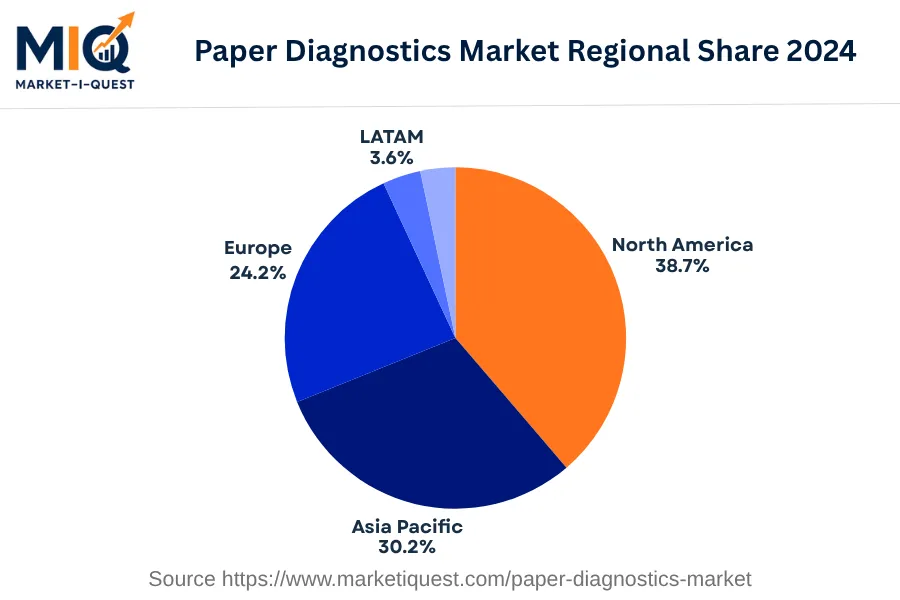
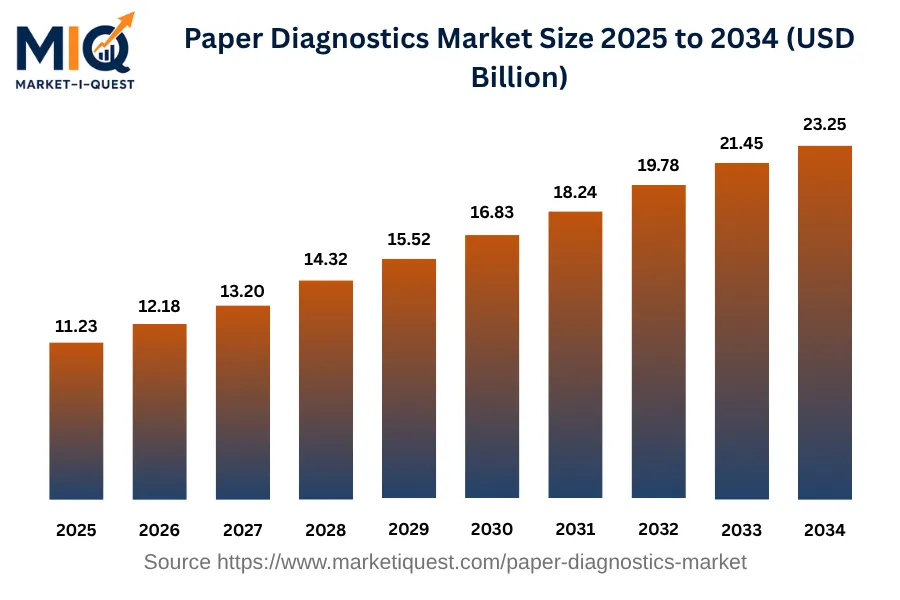
The Paper Diagnostics Market size was valued at USD 11.23 billion in 2025 and the market is projected to reach USD 23.25 billion in 2034, growing at a CAGR of 8.42%. Over the decade, there was sustained growth in this market. Considering regional share in 2024, before this growth trend started, North America dominated with a market share of 38.72%. This was followed by the Asia Pacific region at 30.18%, and Europe which held a 24.18% share in the market. The regions with the least share in the Paper Diagnostics Market were Latin America and the Middle East and Africa, commanding a share of 3.62% and 3.3% respectively.

Key Takeaways

  • By Kit Type - Lateral Flow Assays are the top-ranking subsegment holding a dominant market share in the current base year.
  • By Device Type - Diagnostic Devices emerged as the leading segment accounting for a significant majority share in the past year.
  • By End Use - Assisted Living Healthcare Facilities displayed a higher growth trajectory becoming the fastest growing subsector in recent years.
paper-diagnostics-market market size

Key Driving Factors

Emergence of Biosensors in Paper Diagnostics

The integration of biosensors in paper diagnostics significantly benefits the diagnostic activities as they provide highly sensitive and accurate results. Biosensors in paper diagnostics, which work by converting biological responses into electrical signals, allow for patient self-testing and real-time health monitoring, especially in areas such as blood glucose monitoring for diabetics. They represent an adaptation complexity from the industry that reinforces the potential of paper diagnostics tools and is increasingly being adopted by healthcare providers for their testing needs. The accuracy, rapid results, user-friendly nature, and cost efficiency of paper diagnostics with biosensors are helping fuel the market's growth.

Growth of Home Healthcare Services

The growth of home healthcare services is another energetic driver for the paper diagnostics market, as it provides the convenience of self-diagnosis and monitoring. With the rise in a health-conscious population who demand frequent health monitoring and the increase in the elderly populace requiring continuous health checkups, the need for paper diagnostic products for home healthcare is escalating. These products allow patients to monitor their health conditions conveniently at home, reducing the need for frequent hospital visits. Providers are responding by diversifying their product offerings to suit diverse user needs. This demand from the home healthcare sector is boosting the growth of the paper diagnostics market.

Market Evolution by Timeline

2019-2023
During this period, healthcare institutes and laboratories were the prominent buyers of paper diagnostics due to their applications in detecting infectious diseases and metabolic conditions. Notably, significant demands arose from regions like North America, Europe, and Asia-Pacific due to the rise in lifestyle-related diseases. On the supply side, key players like Abbott Laboratory and Siemens Healthcare GmbH introduced advanced products like the nitrocellulose-based lateral flow assay. Limitations, however, were observed in the sensitivity and quantification of the tests. The adoption of these technologies was influenced by the WHO's List of Essential In Vitro Diagnostics. Pricing was typically based on test complexity with long-term contracts being the standard agreement. Counterfeiting of paper diagnostics posed a significant risk, which led to increased focus on brand protection measures and authentication technologies.
2024
In 2024, consumers presented an increased demand for home care solutions, expanding the buyer demographic from the usual healthcare institutes and laboratories. The US and the UK reported the highest demands due to aging population dynamics. On the supply side, microfluidic paper-based devices experienced a significant increase due to their affordability and portability. Technological limitations remained somewhat similar to the previous bloc. FDA's updated guidelines on in-vitro diagnostics influenced market adoption. Given the shift towards home care solutions, pay-as-you-go contracts became common, shifting away from traditional long-term contracts. Counterfeiting remained a substantial risk, leading to an increase in the adoption of security printing and holography.
2025-2029
In this time frame, the demand side continued to see an increase in home care solutions along with environmental testing such as soil and water tests. Regions with high environmental concerns, such as China and India, saw increased demand. New products like cellulose paper-based devices were introduced by the manufacturers to cater to the evolving needs of the market. Limitations in reproducibility and large scale production were observed for these devices. The ISO 15189 standards gained prominence in determining the calibration and control of medical devices. A shift towards value-based pricing was observed with agreements typically involving volume-based discounts. The risks continued to center around counterfeit devices, driving measures like track and trace solutions.
2030-2034
During this period, the buyer segments expanded further, incorporating food and beverage industries for quality testing. Sizable demands came from developed regions like the U.S., Canada, and the EU. Key suppliers introduced devices with nanoparticle-based assays for improved sensitivity. Technological advancements, however, were stunted by high development costs and low production speed. Regionally implemented safety standards influenced market acceptance. A trend towards combined procurement and service contracts was seen through new partnerships between buyers and suppliers. As counterfeit product strategies improved, so did the responses. Risk mitigations focused on smart packaging and data matrix barcodes to ascertain product authenticity.

Future Market Outlook

Future Opportunities

The future of the paper diagnostics market presents numerous opportunities driven by current advancements and societal needs. A noteworthy area is the burgeoning interest in at-home testing solutions, particularly in response to the surge in demand for COVID-19 testing in 2020, which emphasized the practicality of accessible diagnostic tools. Companies such as Abbott and Roche have indicated plans to invest in developing more user-friendly paper diagnostic tests for various conditions by 2025, thereby expanding their product lines. Partnerships between technology firms and healthcare organizations, such as the collaboration initiated between Alphabet and the NHS in the UK in late 2022, aim to leverage data from paper diagnostics for better health outcomes. Additionally, the World Health Organization’s initiatives to enhance diagnostic capabilities in underdeveloped regions reflect a pressing need for affordable testing options, providing a fertile ground for expansion for paper diagnostics manufacturers. Furthermore, the integration of artificial intelligence into paper diagnostics is emerging as a potential game changer; for instance, ongoing research at Stanford University explores AI-based image analysis of paper tests, forecasting improved accuracy in results. The focus on personalized medicine and preventive healthcare will find support in paper diagnostics technologies that facilitate regular and easy testing. As regulatory frameworks around on-site testing evolve, companies positioned in this sector may benefit from increased adoption rates globally, particularly in low- and middle-income countries. This creates a compelling landscape for further investment and development in the paper diagnostics market.

Segmentation Analysis

By Kit Type

The market is divided into subsegments including Lateral Flow Assays, Dipstick, and Paper-Based Microfluidics, among which Lateral Flow Assays accounted for the largest revenue share while Paper-Based Microfluidics is expected to grow at the fastest CAGR during the forecast period.

Largest Revenue Share

Lateral Flow Assays

Market Share Leader

Lateral Flow Assays holds the largest revenue share in the market, and this can be attributed to a number of reasons. First, its user-friendly nature, which needs no specialized laboratory skills, attracts a wide range of customers from various fields such as medical, veterinary, food safety, environmental bio-monitoring and agriculture. Next, the wide-ranging applicability of these kits combined with their quick and accurate results has made it popular in the point-of-care testing (POCT) sector. Due to its compact design and portable nature, it can be used in remote locations. Geographically speaking, developed countries exhibit higher adoption rates, due to more advanced healthcare infrastructure and higher affordability. However, developing regions also contribute significantly to the market revenue, driven by rising health awareness and escalating government initiatives. Moreover, its affordability compared to other segments adds to its higher share.

Fastest CAGR

Paper-Based Microfluidics

Forecast Period Growth Leader

Paper-Based Microfluidics are anticipated to grow at the fastest rate during the forecast period. The growth can be attributed to breakthrough innovations in microfluidic technology that have expanded potential use-cases specifically in remote or resource-limited environments due to their lightweight, flexible, and low-cost attributes. Another growth driver is their suitability for rapid diagnostic and analytical applications, particularly in infectious diseases, where high demand is witnessed. Although adoption barriers include apprehension towards newer technology and lower market awareness, continued advancements and increasing commercial partnerships are poised to overcome these barriers. Near-term risks include stringent regulatory standards and intense competition from established technologies. The considerable investment in health tech, coupled with burgeoning partnerships for distribution and expansion, point towards a promising growth trajectory for this subsegment.

By Device Type

The market is divided into subsegments including Diagnostic Devices and Monitoring Devices. Diagnostic Devices accounted for the largest revenue share while Monitoring Devices are expected to grow at the fastest Compound Annual Growth Rate (CAGR) during the forecast period.

Largest Revenue Share

Diagnostic Devices

Market Share Leader

The Diagnostic Devices subsegment emerged as the revenue front-runner due to their indispensable role in the initial and crucial stage of disease management, diagnosis. These devices enable the detection and identification of diseases or medical conditions, particularly ones that are chronic or life-threatening. Their leading position in revenue generation is fueled by an aging global population, an increase in the prevalence of chronic diseases, and the continuous introduction of innovative diagnostic devices. The commercial success of these devices relies partly on rapid global urbanization and increasing healthcare expenditure. Regulatory support for the early diagnosis of diseases and disorders has also contributed to the growth of this subsegment. Finally, the purchasing decisions lean towards accuracy, speed of results, and ease of use, edging out higher initial costs and creating demand for these diagnostic devices.

Fastest CAGR

Monitoring Devices

Forecast Period Growth Leader

On the other hand, Monitoring Devices are projected to register the fastest CAGR. These devices, which track patient health over time, are foundational in managing chronic conditions such as heart disease, diabetes, and respiratory disorders. Strong growth drivers include an aging population, the increase in chronic disease prevalence, and the consistent technological advancements that are making these devices more efficient, reliable, and user-friendly. Consumers are increasingly adopting these devices due to the convenience, which allows for continuous health monitoring without any restrictions on location or mobility. However, challenges such as lack of reimbursement policies, data privacy concerns, and need for user education may hinder rapid adoption and possibly impact its projected high growth rate. Overall, collaborative partnerships, government initiatives, and initiatives to overcome these barriers will fuel the growth of this market subsegment.

By End Use

The market is divided into subsegments including Home Healthcare, Assisted Living Healthcare Facilities, Hospitals & Clinics, and Others. Hospitals & Clinics accounted for the largest revenue share while Assisted Living Healthcare Facilities is expected to grow at the fastest CAGR during the forecast period.

Largest Revenue Share

Hospitals & Clinics

Market Share Leader

Hospitals and clinics stand as the most profitable subsegment, primarily due to their widespread presence and wide customer base. While home healthcare and assisted living facilities cater only to a segment of the population, hospitals and clinics have a broader target, addressing the general population's medical needs. Supply factors such as the increasing establishment of healthcare facilities due to government initiatives to enhance access to healthcare contribute to its large market share. A further driver is the wide range of services offered by hospitals and clinics, from primary care to specialized treatments, which attract varied patient demographics. However, the presence of stringent regulations as per governments to ensure patient safety might sometimes impede said growth. Meanwhile, purchasing decisions are often based on the reputation, service quality, and technological advancements present in the hospital or clinic, reinforcing this segment's dominance.

Fastest CAGR

Assisted Living Healthcare Facilities

Forecast Period Growth Leader

Assisted Living Healthcare Facilities, though not contributing to as large a share as Hospitals & Clinics in past years, show a promising upward trajectory in growth. The primary growth driver stems from an aging global population. With increasing age, the need for assisted living facilities, which provide a combination of housing, personal care services, and healthcare, rises. Policy enhancements now ensure improved and increased funding, propelling market growth. In the technology realm, increased digitalization and smart device integration in these facilities have made monitoring regular activities and health conditions more efficient, attracting potential residents. Adoption barriers may include high costs associated with assisted living and the individual's preference for staying with family or at home. Nonetheless, the increased emphasis on quality of life for the elderly creates a robust market growth potential for Assisted Living Healthcare Facilities.

Competitive Analysis for Paper Diagnostics Market

Key Market Players

Manufacturers / OEMs

Bio-Rad Laboratories
US
Siemens Healthineers
Germany
Fujifilm
Japan

Key Suppliers & Raw Materials

ARKRAY
Japan
Lumos Diagnostics
US
Dipnote
Germany

Distributors, Integrators & Channel Partners

Sekisui Diagnostics
US
Axon Lab
Switzerland
Sartorius
Germany

Porter’s Five Forces Analysis

This analysis examines the competitive environment in the Paper Diagnostics Market.

Supplier Bargaining Power

Medium

Increasing raw materials price and high-quality paper substrates give suppliers moderate power.

Buyer Bargaining Power

High

Wide product availability and information accessibility enhance buyer’s bargaining power.

Threat of Substitutes

Low

Few effective substitutes exist for paper diagnostic tools, lowering substitution threat.

Threat of New Entrants

Medium

Technological advancement may encourage new entrances, yet initial investment and regulations pose barriers.

Competitive Rivalry

High

Numerous global and local players intensify the competition in the Paper Diagnostics Market.

Regional Analysis

Geographic market dynamics and growth opportunities across key regions

Global Market Outlook

paper-diagnostics-market market regional share

North America

In 2024, the North American paper diagnostics market saw significant dynamics driven by various factors. A rise in health concerns, increasing geriatric population, and surging demand for cost-effective diagnostics boosted the market. Regulations to improve healthcare outcomes in the U.S., Canada, and Mexico facilitated the widespread adoption of paper diagnostics products. Investments in R&D intensified as technology companies and healthcare institutions sought to leverage the capabilities of paper diagnostics.

Key trends observed during the year included a shift in buyer behavior towards home-based healthcare solutions, spurred by the need for cost-effective and quick diagnostics equipment. Rapid advancements in bio-sensing technology led to significant product shifts with increased acceptance of sophisticated paper-based lateral flow assays. Channel dynamics saw diagnostics manufacturers partnering with technology firms to offer advanced solutions. Enforcement of stringent policies to control disease outbreaks also played a significant role in determining market trends.

Customers ranged across sectors, but the core demand came from healthcare providers, hospitals, homecare settings followed by retail. Government backing also fuelled the demand for these products in public health departments and vaccination centers. Increased usage was also observed in the manufacturing sector, where paper diagnostics served as a tool for detecting contaminants or assessing product quality. The robust growth in the paper diagnostics market underscores the rising importance of affordable and accessible diagnostic solutions in North America.

Asia Pacific

The Asia Pacific Paper Diagnostics Market in 2024 demonstrated consistent growth driven by several key factors. Demand surged due to the influence of metastasizing health awareness, facilitated by government initiatives and burgeoning investment in the healthcare sector. As non-communicable diseases prevalence increased, governments, especially in India and China, emphasized preventive healthcare measures, fostering the adoption of paper diagnostics. Proliferation of advanced healthcare technology across establishments in Japan and South Korea stimulated market growth, while competitive pricing strategies, influenced by growing local manufacturers, also played a part.

Buyer behavior fluctuated, pivoting towards reliable, time-efficient, and minimally-invasive diagnostic solutions. Biotechnology innovations highlighted a shift to lab-on-paper technology, providing further stimulation. Notably, healthcare providers increasingly sought integrated systems capable of analyzing multiple test samples simultaneously. Partnerships and acquisitions characterized the market dynamic, with Australian and key ASEAN players seeking strategic alliances to expand their footprint. For instance, substantive policy enforcement was observed within the Chinese healthcare reform, clearly directing market trends.

Primary consumers of paper diagnostics in 2024 hailed from the healthcare sector, covering both governmental health bodies and private healthcare establishments. Other notable sectors include educational institutions and pharmaceutical industries, signifying the multifaceted, regulated utilization of paper diagnostic tools across the Asia Pacific region in the base year.

Europe

In 2024, the paper diagnostics market in Europe saw significant momentum tied to healthcare needs. Key factors included the rising prevalence of life-style related diseases and advancements in microfluidic technologies. Strict regulatory guidelines in Germany and the UK, leading to quality assurance in paper diagnostic products, also drove growth. The need for rapid, affordable diagnostics in remote and economically challenged parts of Central and Eastern Europe spurred demand. Technological adoption was robust in France and the Nordics, where digital and mobile health solutions were integrated with primary healthcare settings.

The shift towards decentralizing healthcare and enhancing patient autonomy was a remarkable trend across Europe. There was a rising preference for home-based paper diagnostics, enhancing the market expansion in the United Kingdom and Spain. Interestingly, Italy and the Nordics had a surge in partnerships between academia and industry, inventing advanced paper based diagnostic platforms. The paper diagnostics market in Benelux was shaped by stringent enforcement of European Union policies related to public health and safety. Another significant trend was the interest of pharmaceutical and biotech firms in paper diagnostics, increasingly investing in research and development, particularly for the detection of infectious diseases. These factors combined to create a robust paper diagnostics market landscape in Europe in 2024.

Latin America

In 2024, the paper diagnostics market saw significant growth in Latin America, primarily driven by several key factors in countries such as Brazil, Mexico, Argentina, Colombia, Chile, and Peru. Increasing healthcare reforms, government funding, and breakthroughs in technology adoption were primary growth drivers. Enhanced healthcare infrastructure in Mexico and Argentina led to a boost in demand for cost-effective, easy-to-use, and rapid diagnostics solutions. In Brazil and Colombia, investment in research and development for paper diagnostics significantly increased, propelling market growth.

Emerging trends in 2024 were mostly shaped by changes in buyer behavior and policy enforcement. LATAM consumers, especially in the healthcare sector, showed marked preference for portable, user-friendly, and non-invasive diagnostic tools, favoring paper-based devices. Technological innovation and migration towards digital health solutions also became prevalent, particularly in Peru and Chile. Regulatory compliance became stricter, driving the market's integrity and reliability. On the enterprise level, strategic alliances and partnerships became commonplace as firms sought to enhance their product portfolios and improve market positioning. Therefore, a wave of mergers and acquisitions in the paper diagnostics sector was observed, predominantly in Mexico and Brazil.

The diversification in sectors such as retail, manufacturing, healthcare, and government bodies in 2024 demonstrated the wide applicability of paper diagnostics across different verticals, further embedding them within LATAM's market landscape.

Recent Industry Developments

Latest market innovations, product launches, and strategic initiatives

September 2023

Gemina Labs commercialized cellulose-based (paper) test strips as a fully biodegradable, eco-friendly alternative to industry-standard nitrocellulose membranes in lateral flow assay (LFA) formats.

Frequently Asked Questions