Network Security Sandbox Market Snapshot

Key Players

  • Check Point Software Technologies (Israel)
  • Cisco Systems (United States)
  • FireEye (United States)
  • Fortinet (United States)
  • Juniper Networks (United States)
  • Palo Alto Networks (United States)
  • Sophos (United Kingdom)
  • Symantec Corporation (United States)
  • Trend Micro (Japan)
  • Zscaler (United States)

Market Size

Base Year 2024
$1.84 Bn
CAGR
15.7%
Forecast 2034
$7.91 Bn

Market Segments

By Component
  • Services
  • Solutions
By Enterprise Size
  • SMEs
  • Large Enterprises
By End Use
  • BFSI
  • IT & Telecom
  • Retail
  • Education
  • Public Sector
  • Defense
  • Others

Market Dynamics

Drivers
  • Increasing cyber threats
  • Demand for data protection
Restraints
  • High implementation costs
  • Insufficient technical expertise
Opportunities
  • Rising cyber threats
  • Emergence of IoT technology

Market Size

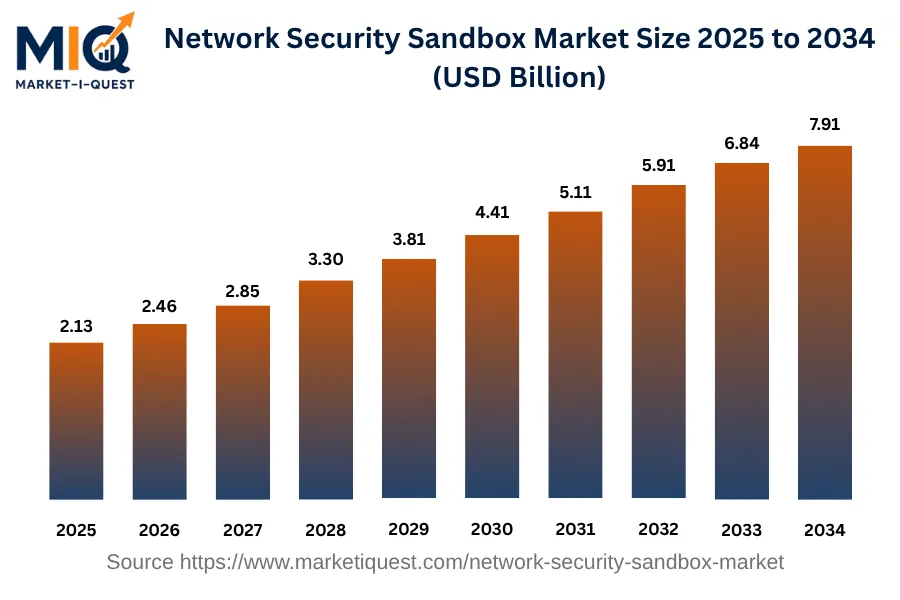
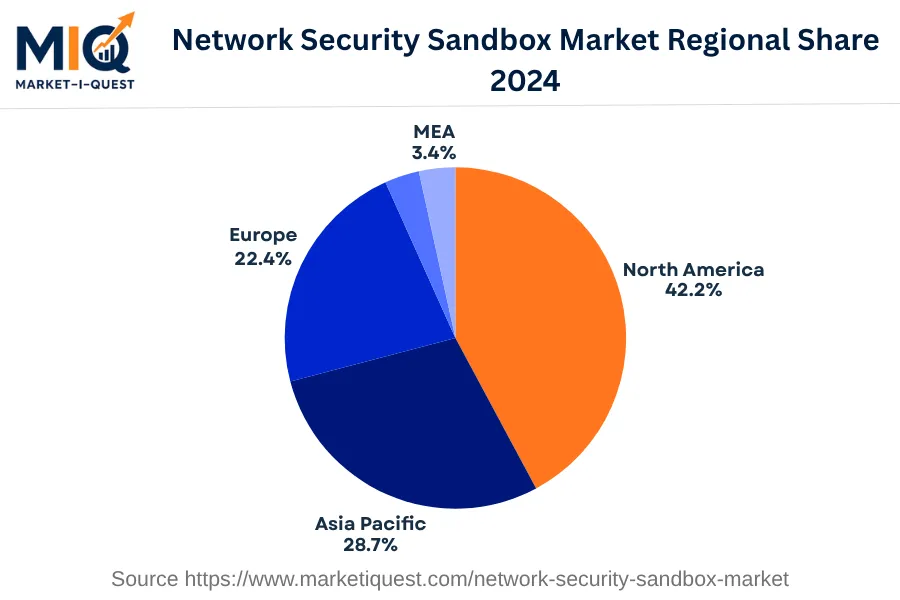
The Network Security Sandbox Market is estimated at $2.13 billion in 2025, up from $1.84 billion in 2024. Over the next nine years, the market sees substantial growth, reaching $7.91 billion by 2034, expanding at a Compound Annual Growth Rate (CAGR) of 15.7%. The growth trend follows the increase of cyber threats, demanding more security measures. Also, regulatory requirements necessitate network security, further propelling market growth. In terms of regional share in 2024, North America accounted for the most significant portion at 42.2%, closely followed by Asia Pacific at 28.7%. Europe held 22.4% of the market, while Latin America and the Middle East and Africa (MEA) accounted for the smallest pieces of the pie with 3.3% and 3.4% respectively.

Key Takeaways

  • By Component - Services accounted for the major share in 2024.
  • By Enterprise Size - Large Enterprises were the leading contributors in 2024.
  • By End Use - IT & Telecom took the top position in 2024.
network-security-sandbox-market market size

Key Driving Factors

Implementation of Strict Data Protection Regulations

Many countries are now imposing strict data protection regulations to ensure the privacy and protection of consumer data. For instance, Europe's General Data Protection Regulation (GDPR) and California's Consumer Privacy Act (CCPA) require businesses to be more transparent about how they handle user data. These regulations are causing companies to prioritize investment in advanced network security tools like sandboxing solutions. Sandboxing protects sensitive corporate data by isolating potential threats, reducing the risk of data breaches that could lead to heavy regulatory fines. Further, it satisfies the regulatory requirement of demonstrating due diligence in protecting customer information. Therefore, the need to comply with stringent data privacy regulations is significantly driving the adoption of network security sandboxing technology in current businesses' security infrastructure.
Increasing Sophistication of Cyber Threats

The cyber threat landscape has rapidly evolved due to criminals adopting advanced and sophisticated methods to target systems, including polymorphic and zero-day exploits that traditional security tools struggle to identify or mitigate. These evolving threats pose significant challenges to industries like finance, healthcare, and retail, which deal with substantial amounts of sensitive data regularly. Network security sandboxing offers a proactive security approach by examining questionable code or software in an isolated environment, allowing malicious activities to be detected before they infiltrate the actual network. This tool's ability to anticipate, react and adapt to the growing sophistication of cybersecurity threats makes it an important element in organizations' multi-layered defense strategy.

Market Evolution by Timeline

2019-2023
During 2019-2023, the primary buyers of network security sandboxing technology were large companies, such as financial institutions and healthcare organizations which require robust security to protect from sophisticated cyber threats. New threats such as ransomware were key drivers of demand. Regions with high adoption rates included North America and Western Europe due to their strong technology infrastructures. The primary focus of vendors was the integration and compatibility of sandbox solutions with existing network infrastructures. Policy-wise, the introduction of the General Data Protection Regulation (GDPR) in the European Union influenced the market as it compelled businesses to upgrade their network security systems. Competitively priced, flexible subscription models became popular. Lack of technical proficiency among end-users posed challenges in the adoption and usage of these systems.
2024
In 2024, small and medium businesses became key demand drivers due to increased awareness and more affordable pricing models. The product focus shifted towards cloud-based sandbox solutions, with new partnerships between network security vendors and cloud providers becoming common, such as the partnership between Fortinet and AWS. No significant regulations were introduced this year, but existing ones like GDPR and the California Consumer Privacy Act continued to shape the market. As vendors offered more affordable and flexible pricing solutions, the market became more accessible to smaller businesses. The main risk was the security of cloud-based solutions with vendors investing heavily in advanced encryption methods to mitigate these concerns.
2025-2029
During this period, the public sector emerged as a significant buyer group. Government programs like Cybersecurity Maturity Model Certification in the USA drove demand. Asia-Pacific region, particularly Japan and South Korea, saw considerable growth due to advancements in digital infrastructure. Deep learning-based sandbox solutions started gaining prominence. Procurement models were generally longer-term due to the reliability and consistency required in public sector usage. Risks included having systems that could scale and adjust to the different network structures prevalent in public sector organizations.
2030-2034
By 2030-2034, consumers increasingly valued data privacy, driving demand from businesses wishing to demonstrate robust security infrastructure. Demonstrated use cases highlighted breached financial data, causing a spike in demand in fintech companies worldwide. AI-driven, automated network sandboxing solutions became mainstream. Regulational pressures included the expansion of GDPR-like policies globally, causing businesses to maintain investment in high-quality network security solutions. Annual licensing models became the norm for pricing. Risks revolved around managing updates and maintaining security efficacy against increasingly sophisticated cyber threats.

Future Market Outlook

Future Opportunities

The future landscape of the network security sandbox market is being shaped by several crucial factors, reflecting current trends and regulatory changes. The 2023 announcement by the North American Electric Reliability Corporation (NERC) regarding new standards for cybersecurity in critical infrastructure presents a compelling opportunity for sandbox solutions. These standards necessitate rigorous testing of security controls, paving the way for increased adoption of sandbox environments aimed at compliance protection. Additionally, as companies across Europe and Asia implement digital transformation strategies, the demand for sophisticated sandboxing techniques is expected to grow, allowing for comprehensive security testing of new applications prior to deployment. Notably, partnerships between cybersecurity firms and cloud service providers, such as the collaboration between Microsoft and CrowdStrike in 2023, will likely enhance the scalability of sandbox solutions, enabling organizations to leverage collective intelligence for threat detection and response. Moreover, organizations with strict data protection regulations, like those in the healthcare sector under HIPAA guidelines, may increasingly rely on sandboxes for secure application development and testing. As the security landscape continues to evolve, the role of sandboxes in threat research, malware analysis, and incident response is expected to expand, enabling businesses to proactively address emerging threats. This multifaceted growth reflects a clear path forward for industry stakeholders seeking to enhance their cybersecurity posture amid a landscape of increasing regulatory demands and complex threat dynamics.

Segmentation Analysis

By Component

The market is divided into subsegments including Services and Solutions. Services accounted for the largest revenue share while Solutions is expected to grow at the fastest CAGR during the forecast period.

Largest Revenue Share

Services

Market Share Leader

Services currently dominate the component market due to several inherent advantages and industry trends. The ever-increasing complexity of operations in the digital world requires businesses to invest heavily in services over solutions. Services often come with expert knowledge and proven processes which can be a game changer for businesses seeking operational efficiency and improved business performance. Moreover, services are more adaptable to changing needs and can be personalized according to the client's requirements. They also offer continuous customer support, which bolsters customer confidence and adds value. Furthermore, the demand for professional, managed, and deployment and integration services has been witnessing consistent growth, which is expected to continue in the coming years. Services cater to a wide customer base that spans across different business sizes and industry verticals. The adaptability to regulatory changes in different geographies also aids the high revenue generation of services. Based on this industry logic, we can infer that Services will hold the greatest market share in 2024.

Fastest CAGR

Solutions

Forecast Period Growth Leader

Despite Services having the majority revenue share, Solutions is predicted to grow at a faster rate. This accelerated growth can be attributed to several factors: shifting business models, technological advancements, policy changes, and strategic partnerships. Digitization across business verticals is necessitating the adoption of comprehensive and innovative solutions that can streamline operations and facilitate effective decision-making. Technology is evolving at a rapid pace, and along with it, the solutions that harness this technology are also escalating in scope and variability. Consequently, organizations are forced to update their platforms and systems regularly to stay afloat in the competitive market. Also, policy reforms and regulations can act as catalysts for businesses to adopt new solutions. Industry collaborations and partnerships may pave the way for investments in solutions to build and upgrade infrastructure. Though challenges persist like high capital costs and resistance to change existing systems, the prominence of solutions in determining business success estimates a higher growth rate for this segment.

By Enterprise Size

By enterprise size, the market is divided into subsegments including SMEs and Large Enterprises. In the base year of 2024, Large Enterprises accounted for the largest revenue share while SMEs are expected to grow at the fastest CAGR during the forecast period.

Largest Revenue Share

Large Enterprises

Market Share Leader

Large enterprises led the way in terms of revenue in 2024 due to several factors. Their expansive operational avenues, across different countries, provides them with more opportunities to leverage the market under study. Although large enterprises have huge purchasing power, the products or services offered can be significant in their operations, contributing to the high revenue share. Geographically expansive operations often require them to abide by regulatory compliance across different regional and international standards. This dictates a substantial investment in the market segment, further boosting revenue growth. Unique purchasing criteria also come into play for large corporations. These entities tend to focus on aspects such as product quality, the reputation of the provider, and post-sale services rather than price – factors that often come with increased spending. Switching costs can also be high for such companies, making them loyal customers, while their extensive distribution channels further widen the customer base.

Fastest CAGR

SMEs

Forecast Period Growth Leader

Small and Medium Enterprises (SMEs) are slated to record the highest growth rates during the forecast period. The driving factors for this trend can be attributed to the increasing adoption of cost-effective solutions offered in the segment, breaking down previous barriers of entry due to high capital expenditure. SMEs now have increased access to partnerships and collaborative opportunities which have paved the way for greater market penetration. The proliferation of technology and supportive policies, especially in developing economies, has further facilitated the rapid expansion of SMEs in the market. Despite the promising outlook, SMEs face near-term risks such as volatile economic conditions and the challenge of keeping up with rapidly advancing technologies. Nonetheless, dynamic market trends and improving access to resources have positioned SMEs on a fast-growth track.

By End Use

The market is divided into subsegments including BFSI, IT & Telecom, Retail, Education, Public Sector, Defense, and Others. The IT & Telecom subsegment accounted for the largest revenue share, while the BFSI subsegment is expected to grow at the fastest CAGR during the forecast period.

Largest Revenue Share

IT & Telecom

Market Share Leader

In 2024, the IT & Telecom subsegment holds the fortune of the largest revenue share in the market. This significant market share can be attributed to the massive digital transformation wave which has engulfed the entire industry. Over the years, the emphasis on advanced communication networks, data security, and faster computation power has led businesses to invest notably in progressive IT & Telecom services, generating significant revenue. In the current digital era, the demand for services like cloud computing and data analytics has surged, further driving the revenue growth. Also, the rise of the remote working culture worldwide has propelled the need for capable and robust telecommunication infrastructure. Telecom companies are investing to improve their infrastructure, leading to increased revenues in this subsegment. Simultaneously, regulations favoring digitization and telecom advancements, low switching costs for services, and a global trend towards 5G also contribute to the IT & Telecom subsegment’s significant market share.

Fastest CAGR

BFSI

Forecast Period Growth Leader

Although the IT & Telecom subsegment currently dominates the market revenue-wise, the BFSI sector is set on a path to exhibit the fastest CAGR during the forecast period. There are several reasons behind this dynamic shift. Firstly, the adoption of digital banking technologies has significantly accelerated, fuelled by the evolving customer expectations and increased convenience of online transactions. Secondly, vast investments in fintech, AI, machine learning, and data analytics have catalysed this process further, as BFSI institutions strive to provide personalized, on-demand services to customers. Furthermore, policies for financial inclusion and significant capital investments into technology upgradation by banking and financial services companies also hasten this growth. However, the segment faces near-term risks like increasing cyber threats, regulatory uncertainties, and the steep costs of integrating new-age technologies, which could potentially hinder immediate adoption, but the long-term growth outlook seems promising.

Competitive Analysis

Key Market Players

Manufacturers / OEMs

Cisco Systems, Inc.
US
FireEye, Inc.
US
Trend Micro Incorporated
Japan

Key Suppliers & Raw Materials

VMware, Inc.
US
Juniper Networks, Inc.
US
Fortinet, Inc.
US

Distributors, Integrators & Channel Partners

Check Point Software Technologies Ltd.
Israel
Palo Alto Networks, Inc.
US
Sophos Ltd.
UK

Porter’s Five Forces Analysis

This analysis evaluates the competitive influences on the Network Security Sandbox Market.

Supplier Bargaining Power

Medium

Limited number of software and hardware providers increase their bargaining power.

Buyer Bargaining Power

High

Users can choose from a variety of products due to the competitive nature of the market.

Threat of Substitutes

Low

The complexity of network security offers a barrier to potential substitute products.

Threat of New Entrants

Medium

While it requires high capital investment, market profitability continues to attract new entrants.

Competitive Rivalry

High

The market exhibits high competition with multiple established players and new entrants.

Regional Analysis

Geographic market dynamics and growth opportunities across key regions

Global Market Outlook

network-security-sandbox-market market regional share

North America

In 2024, the Network Security Sandbox Market in North America displayed robust growth, reflecting the region's increased emphasis on cybersecurity protection. Driving this market were several key factors: Organizations across sectors prioritized investment in advanced security technologies due to rising cyber threats, accelerating the adoption of network security sandbox solutions. Stricter regulatory landscapes focused on data protection in the U.S., Canada, and Mexico also facilitated market growth, making cybersecurity no longer optional but a necessary business operation. Further, technological advancements and improved security services by providers have amplified the supply side dynamics. Lastly, competitive pricing of these solutions has made them affordable to a broader range of businesses, including small and medium enterprises.

Notable trends in 2024 included a shift towards integration of AI and machine learning in network security sandbox solutions, to increase their effectiveness. There was a significant rise in security partnerships and M&A activities, which were aimed at consolidating the market and enhancing the service offerings. Increased enforcement of policies like GDPR and CCPA also shaped the market trends. Industries such as government, healthcare, and retail displayed the highest demand for these solutions in their quest for robust cybersecurity mechanisms. Increased use of digital platforms prompted utilities and manufacturing sectors to invest more in network security sandbox solutions.

Asia Pacific

In 2024, the Network Security Sandbox Market in Asia Pacific experienced significant acceleration, driven by increased cyber threats, widely adopted IoT devices, and enhanced regulations. Governments and enterprises across the region - particularly in China, India, Japan, South Korea, Australia, and ASEAN markets - responded to the proliferation of advanced persistent threats (APTs) by investing heavily in innovative security solutions. Additionally, the implementation of stringent data protection laws such as China's Personal Information Protection Law (PIPL) spurred market growth by compelling businesses to deploy advanced security systems.

Parallelly, several discernable trends emerged. Customers, notably within sectors including healthcare, utilities, and manufacturing, prioritised integrated solutions offering holistic defence, leading to a surge in demand for sandboxes capable of mimicking a wide range of system environments. Shifts were also evident in distribution channels, with cloud-based delivery models growing significantly due to their scalability and cost-effectiveness. Furthermore, the market witnessed strategic partnerships and M&A activities aimed at enhancing robustness and functionality of security offerings, with Japan’s NTT Security’s acquisition of WhiteHat Security being a notable example. Regulatory enforcement too played a key role, creating a broader understanding among businesses about the importance of appropriate network security measures, thereby impacting purchase decisions and facilitating market growth.

Europe

In the base year of 2024, the Network Security Sandbox market in Europe was characterized by increasingly sophisticated cybersecurity threats requiring advanced defenses. Drivers included the widespread adoption of IoT devices across sectors like Government, Utilities and Manufacturing, increasing the need for comprehensive network threat detection and mitigation. Regulations played a significant part, with the enforcement of data protection policies such as the EU's General Data Protection Regulation (GDPR) compelling businesses to invest in advanced network security solutions. In addition, the rise in cloud-based services across the continent instigated an increased demand for cloud-centric security platforms.

Trends included a shifting focus towards adoptive security solutions that respond to threats in real-time, influenced by increasing cyber attack complexities. Companies in the UK and Germany, in particular, were seen to prioritize the integration of artificial intelligence and machine learning-based security solutions. A surge in strategic partnerships and M&A activities, such as the high-profile alliance between Spain's Telefonica and France's Thales, further fueled the market. In sectors such as healthcare and retail, there was an evident shift from traditional, infrastructure-focused security to advanced, threat-centric solutions. Penetration of these trends was particularly noticeable within the Nordics, Benelux, and Central & Eastern Europe.

Latin America

In 2024, the Network Security Sandbox market in Latin America (LATAM) experienced significant growth driven by various factors. Increasing digitalization and a surge in data breaches necessitated stronger cybersecurity measures across sectors, such as government, healthcare, manufacturing, and retail. Deregulation in markets like Brazil and Mexico allowed for increased foreign investments into network security, thereby boosting industry expansion. Furthermore, streamlined technology adoption in countries like Argentina and Colombia precipitated the increased use of advanced network security solutions.

The market saw several developments in terms of trends. A noticeable shift towards cloud-based network security sandbox solutions was particularly evident in technologically advanced nations like Chile and Peru. Alongside this trend, the year was marked by innovative partnerships and mergers & acquisitions, as companies jostled to acquire and share the best networking security technologies. This was backed by strict implementation of cybersecurity standards dictating the proper use of network security sandboxes across industries. Overall, the LATAM Network Security Sandbox market was marked by increased investments, notable shifts towards cloud-based solutions, and strategic collaborations. The active enforcement of policy and cybersecurity standards also contributed to the advancement of this vital sector. However, continuous technological progression posed challenges for companies to promptly adapt and maintain relevance in this highly competitive field.

Middle East & Africa

In 2024, the network security sandbox market in the Middle East and Africa experienced significant growth due to increasing cybersecurity threats.
Key drivers included escalating demand for advanced security solutions in sectors such as government, oil and gas, healthcare, and telecom—especially in countries like Saudi Arabia, the UAE, and Qatar known for high-tech adoption. The sophisticated cybercrimes led to nations implementing strict cybersecurity regulations, which in turn drove the enhancement and adoption of network security sandboxing. A surge in tech investment, particularly in South Africa, Nigeria, and Kenya, coupled with the rising digitalization in these nations also contributed to the market expansion.

In terms of trends, organizations in Egypt and Israel began prioritizing network security sandbox solutions to neutralize advanced persistent threats. The adoption of cloud-based sandboxing also saw a notable rise, given its cost-effectiveness and scalability. There was an increasing emphasis on partnerships and M&A activities to bolster capabilities and offerings in this sector. For instance, renowned retail and financial services sectors started partnering with sandbox solutions providers to secure their extensive digital networks. The network security sandbox market in the Middle East and Africa thus saw a significant development in 2024, bolstered by several demand factors, technological adoption, supply dynamics, and changing industry trends.

Recent Industry Developments

Latest market innovations, product launches, and strategic initiatives

June 2026

Fortinet released FortiSandbox version 5.2, introducing major advancements in malware detection, threat intelligence, investigation workflows, and platform performance with faster dynamic analysis and full multi-stage malware visibility.

April 2026

ZeroFox announced a strategic partnership with PolySwarm to launch a multi-engine malware sandbox integrated directly into the ZeroFox platform, enabling security teams to validate suspicious files, links, and QR codes across dozens of independent detection engines.

Frequently Asked Questions