Natural Gas Storage Market Snapshot

Key Players

  • Chevron Corporation (US)
  • Royal Dutch Shell (Netherlands)
  • Exxon Mobil Corporation (US)
  • Gazprom (Russia)
  • Engie (France)
  • Eni SpA (Italy)
  • Statoil ASA (Norway)
  • Total SA (France)
  • BP Plc (UK)
  • ConocoPhillips (US)

Market Size

Base Year 2024
$15.46 Bn
CAGR
5.83%
Forecast 2034
$27.25 Bn

Market Segments

By Type
  • Aboveground
  • Underground
By End User
  • Natural Gas Producers
  • Utility Companies
  • Industrial Customers
  • Power Generation Companies
  • Others

Market Dynamics

Drivers
  • Increasing global energy demand
  • Technological advancements in storage facilities
Restraints
  • High infrastructure cost
  • Regulatory emissions constraints
Opportunities
  • Rising demand for clean energy
  • Infrastructure modernization initiatives

Market Size

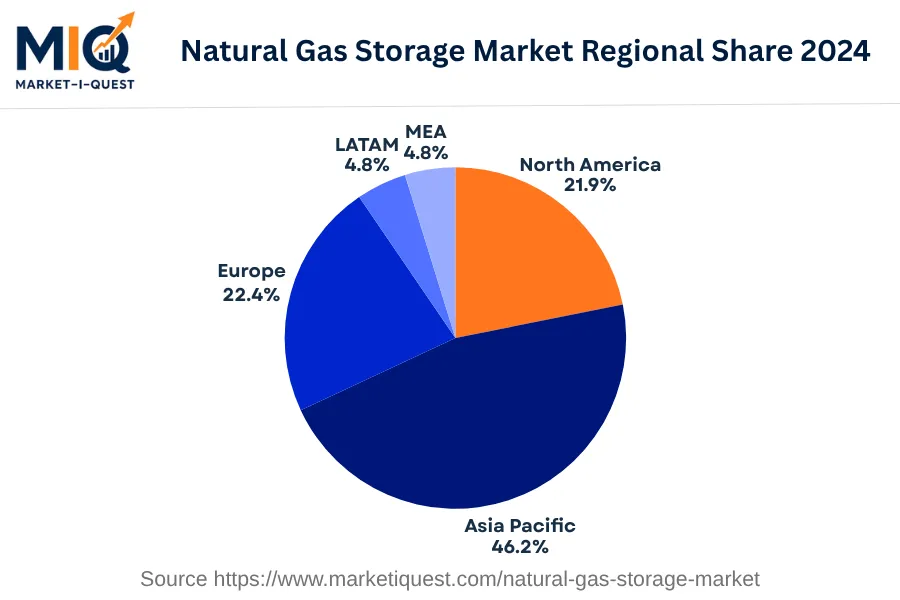
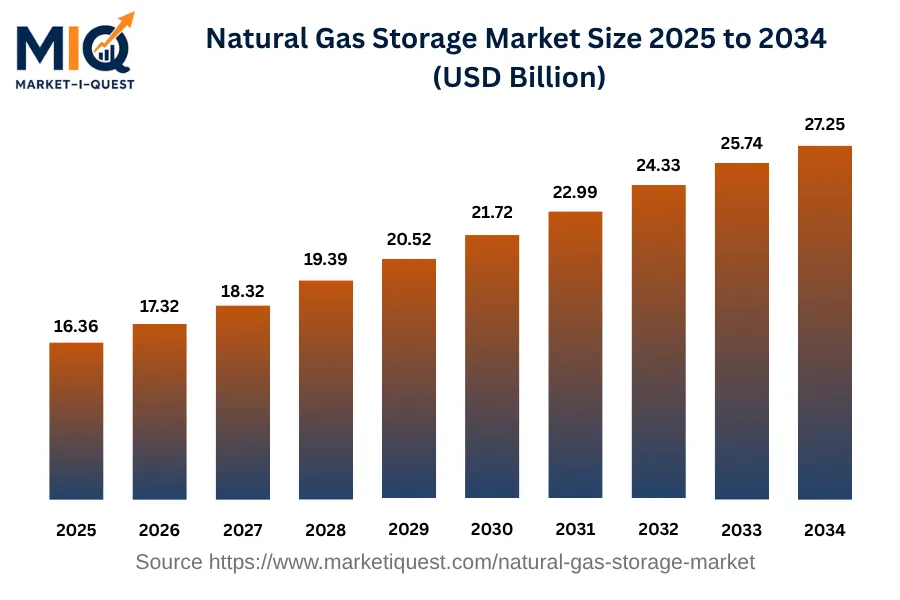
The Natural Gas Storage Market size in 2025 is projected at USD 16.36 billion, up from 2024's USD 15.46 billion. By the end of 2034, the market size will likely have expanded to USD 27.25 billion, a leap achieved through a compound annual growth rate (CAGR) of 5.83%. Over these ten years, the market's evolution will be marked by steady, significant growth, almost doubling in scale from the beginning to the end of this period. This growth can be attributed to the increased production and consumption of natural gas worldwide, coupled with a growing emphasis on securing extra storage to handle demand and supply fluctuations. Geographically, the market share will be distributed, with Asia Pacific claiming a dominant 46.2% in 2024, followed by Europe with 22.4% and North America with 21.9%. Meanwhile, Latin America and the Middle East & Africa will both have a lesser share of around 4.7%.

Key Takeaways

  • By Type - Aboveground storage led the Natural Gas Storage Market accounting for a significant market share in 2024.
  • By End User - Utility Companies held the dominant position in the market in 2024.
natural-gas-storage-market market size

Key Driving Factors

Stricter Environmental Regulations

In recent years, several countries have imposed more stringent environmental regulations, aiming to curb the harmful emissions linked to climate change. Natural gas, being a cleaner-burning alternative to coal and oil, features prominently in these initiatives. Thus, its storage becomes essential to meet the regulatory compliance, especially when the market experiences low demand. For instance, the Paris Climate Agreement enforced by several nations emphasizes the transition towards cleaner energy sources. This has accelerated the shift in energy production methods, further propelling the need for robust natural gas storage facilities.

Emergence of Unconventional Gas Reserves

The discovery and exploitation of unconventional gas reserves, such as shale gas, tight gas, and coalbed methane, have significantly augmented the global natural gas supply. With this surge in supply, the need for effective storage solutions has risen correspondingly to manage the logistics of gas distribution and to enable a steady supply in the off-peak seasons. Moreover, given the nature of these unconventional sources, the extraction to supply phase often takes longer than conventional sources. Such scenarios further highlight the crucial role of adequate storage facilities in sustaining the natural gas supply-demand dynamics.

Market Evolution by Timeline

2019-2023
During this period, industrial and residential sectors, primarily in North America and Europe, dominated the purchase of natural gas for heating and electricity purposes. High extraction rates of unconventional gas in these regions created a robust supply landscape. Projects such as the FortisBC's expansion of its Tilbury liquefied natural gas storage in Canada proved integration maturity. However, underdeveloped infrastructure in emerging economies posed constraints. Named regulations influenced the market were U.S. Pipeline and Hazardous Materials Safety Administration's rules for storage site safety. Typically, contracts were long-term nature with pricing based on seasonal and regional differentiations. Fluctuation in gas prices led to market volatility, causing uncertainties.
2024
Increasing adoption of natural gas for power generation and production processes increased the market demands. The supply fell short due to depletion of traditional reservoirs, encouraging development of unconventional reserves. Advancements such as Waterless Fracking were adopted for extracting these unconventional reserves. No significant regulatory changes occurred; however, enforcement of existing regulations grew. The pricing model continued to be influenced by seasonality, locality, and contract duration. The technological barrier to unconventional gas extraction was a key risk for suppliers.
2025-2029
A shift towards renewable energy sources reduced demand for natural gas in residential heating sector. However, the utilization of natural gas in various industrial processes, mainly in Asia-Pacific region, surged. Technological advancements enabled efficient and cost-effective extraction of unconventional gas reserves. The introduction of stringent environmental regulations, such as EU's Emission Trading System, pushed for the reduction of carbon emissions. This triggered the use of green gas storage technologies. Pricing dynamics were influenced by the adoption of these eco-friendly technologies and regulations. The main risk was the tight environmental regulatory landscape.
2030-2034
Significant decline in natural gas usage in residential sector owing to widespread adoption of renewable energy sources. The industrial sector remained a primary buyer, mainly for manufacturing and chemical processes. Gas projects like hydraulic fracturing matured, although faced regulatory scrutiny regarding environmental ramifications. Regulations like the Greenhouse Gas Emission Standards in the US drove adoption of green gas storage options. Pricing dynamics were influenced by the high penetration of these technologies coupled with carbon pricing. Main risk was the gradual depletion of conventional and unconventional gas reserves adding to the market volatility.

Future Market Outlook

Future Opportunities

The natural gas storage sector presents several avenues for development, especially in response to changing energy dynamics. The noticeable trend towards decarbonization has prompted companies to explore innovative gas storage solutions in line with policies favoring cleaner energy sources. In 2021, the European Commission introduced the Fit for 55 package, driving member states to enhance their energy resilience. This regulatory framework provides a fertile ground for businesses focusing on bio-methane and renewable natural gas storage facilities. Companies like TotalEnergies have already invested in projects addressing this demand and are participating in joint ventures to develop biogas technologies. In the North American market, regulatory support for underground natural gas storage has been bolstered by state-level initiatives that recognize the role of gas in achieving energy security. Presently, the U.S. Department of Energy is also exploring funding opportunities for innovative gas storage technologies that align with public policy objectives. Moreover, as many nations target carbon neutrality goals by 2050, partnerships between natural gas operators and renewable energy developers are likely to become commonplace. This integration is expected to bolster the capacity and reliability of energy systems, ultimately making natural gas storage a critical element in the broader energy landscape. Consequently, the intersection of regulatory frameworks and technological advancements signals a significant evolution of the natural gas storage market in the years to come.

Segmentation Analysis

By Type

The market is divided into subsegments including aboveground and underground types. The aboveground type accounted for the largest revenue share while the underground type is expected to grow at the fastest Compound Annual Growth Rate (CAGR) during the forecast period.

Largest Revenue Share

Aboveground

Market Share Leader

Aboveground types hold the largest share of the market, led primarily by their ease of installation and maintenance, and cost-effectiveness. These systems are typically cheaper to install and operate, making them an appealing choice for customers, particularly in regions where land costs are relatively low. Another factor driving the dominance of this subsegment is its accessibility for routine inspection and maintenance, reducing the likelihood of unforeseen failures and thus the associated repair costs. Additionally, geography plays a significant role. In regions with relatively flat and non-urbanized terrain, aboveground can be an obvious choice. Regulation and supply are also contributing factors. In regions where regulations permit aboveground installations and where suppliers readily provide these systems, aboveground type tends to dominate. Given these factors, customer purchasing decisions often favor aboveground types, contributing to its strong market position. As for switching costs, customers usually avoid them since transitioning from aboveground to underground is typically a costly and complex process.

Fastest CAGR

Underground

Forecast Period Growth Leader

The underground type, while currently accounting for a smaller share of the market, is projected to experience the fastest growth. This is driven largely by advancements in technology, such as more efficient and safer installation procedures. Underground system also offers improved aesthetics and space efficiency, desirable factors in urban and suburban environments. In addition, there are fewer regulatory and zoning hurdles compared to their aboveground counterparts in certain regions. Policies encouraging or requiring the use of underground systems in densely populated areas will act as a catalyst for growth in this subsegment. High upfront capital expenditure can be an entry barrier for this subsegment, but with the emergence of cost-effective solutions and potential partnerships, the adoption rate is expected to increase. However, near-term risks include more complex maintenance and repair work compared to aboveground systems, which could potentially slow down the growth rate. It's important to master these risks to fully tap into the potential of this rapidly growing market segment.

By End User

The market is divided into subsegments including Natural Gas Producers, Utility Companies, Industrial Customers, Power Generation Companies, and Others, with Utility Companies accounting for the largest revenue share while Industrial Customers are expected to grow at the fastest CAGR during the forecast period.

Largest Revenue Share

Utility Companies

Market Share Leader

In general, Utility Companies are major market players in the energy sector due to their integral roles in the transmission, distribution, and sale of electricity and natural gas. Given the crucial nature of their services, their demand rarely fluctuates, ensuring a constant revenue stream. In 2024, the base year, utility companies demonstrate rigid demand due to the constant need for energy services to maintain critical infrastructures, alongside broader structural growth in residential, commercial, and industrial demands. Battle-tested regulation provides some guarantee of revenue stability, while consumer purchasing criteria gravitates towards assured supply and service reliability. Any switching costs are substantial due to infrastructural as well as regulatory constraints, and hence, the customer retention rate is typically high. As a result, utility companies significantly lead the revenues in the energy sector.

Fastest CAGR

Industrial Customers

Forecast Period Growth Leader

Industrial Customers are projected to be the fastest growing subsegment given their increasing energy consumption due to industrialization and expansion, more so in developing economies. Demand for energy in these industries, particularly for power-intensive industries, is rising with advancements in technology, population growth, and increasing urbanization. The adoption of sustainable and renewable energy sources by industries, driven by policy regulations and commitments to reduce carbon footprints, is acting as a chief growth catalyst. High capital expenditure is a potential growth barrier, nonetheless, increasing partnerships between industry participants and energy providers are reducing capex challenges. Near-term risks might arise from economic uncertainties and fluctuations in energy prices, however, continuous technological advancements and supportive government policies are likely to mitigate these risks.

Competitive Analysis: Natural Gas Storage Market

Key Market Players

Manufacturers / OEMs

Uniper
Germany
Centrica
UK
ENGIE
France

Key Suppliers & Raw Materials

Royal Dutch Shell
Netherlands
ExxonMobil
US
Chevron
US

Distributors, Integrators & Channel Partners

UGI Corporation
US

Porter’s Five Forces Analysis

An analysis of the natural gas storage market using Porter's Five Forces framework.

Supplier Bargaining Power

Medium

Depends on availability of natural gas suppliers and their geological resources.

Buyer Bargaining Power

Medium

Influenced by varying demand and availability of alternative energy sources.

Threat of Substitutes

High

Increasing shift towards renewable energy sources poses a substantial threat.

Threat of New Entrants

Low

High capital expenditure and stringent environmental regulations deter entry.

Competitive Rivalry

High

Strong competition due to presence of numerous established gas providers.

Regional Analysis

Geographic market dynamics and growth opportunities across key regions

Global Market Outlook

natural-gas-storage-market market regional share

North America

In 2024, the North American natural gas storage market experienced notable dynamics driven by various factors. Key drivers included escalating gas demand from the power generation sector in the US, regulatory policies promoting clean energy transition in Canada, and rising infrastructure investment in Mexico’s energy sector. High adoption of advanced storage technologies like salt caverns further boosted the market. Supply dynamics mirrored seasonal and weather-dependent variances, impacting pricing strategies. Emerging trends within this year showed a strong push towards decarbonizing energy sources, underlined by consumer preference for cleaner energy. In response, industry participants like utilities and manufacturing companies shifted towards natural gas–a lower emission alternative.

Simultaneously, technological advancements, like flexible grid solutions, saw increased uptake. Partnerships and M&A activities also intensified, as companies sought to enhance their capabilities, meet standards, and conform to stringent environmental policies. In the US, heightened safety protocols following a few significant leaks mandated more stringent standards and policy enforcement in the storage sector, shaping operational norms. Canada saw a rise in government-industry collaborations seeking sustainable storage solutions. Meanwhile, in Mexico, liberalizing energy reform spurred private sector interest. Positive signals from enterprise, government, and utilities revealed this commodity’s vital role in the North American energy landscape in 2024.

Asia Pacific

In 2024, the Natural Gas Storage Market in Asia Pacific experienced a significant shift, marked by a surge in demand due to widespread usage across various sectors. The primary drivers of this expansion included heightened energy demand from populous economies like China and India, instigating a surge in demand for storage capacity. Rapid industrialization and urbanization, especially in manufacturing and utility sectors stimulated the growth. Furthermore, Japan, South Korea, and key ASEAN markets saw substantial investment for storage infrastructure, driven by policies aimed at increasing domestic natural gas supply and security.

From a trends perspective, market participants bent towards strategic partnerships and merger activities; China's state-entities and India's GAIL emerged noteworthy examples. Adoption of advanced storage technologies, such as salt cavern storage, increased in countries like Australia, credited to their higher withdrawal and injection rates. Thirdly, a noticeable shift in channel dynamics is seen where governments in Japan and South Korea took leading roles in policy enforcement and standard-setting, geared towards a robust domestic natural gas base. To conclude, intensified energy demand, investment into infrastructure, and adoption of advanced storage technologies drove the natural gas storage market in Asia Pacific during 2024. Simultaneously, an increasing inclination towards strategic alliances, technology shift, and government's active participation in policy enforcement shaped the emerging trends within the industry.

Europe

In 2024, the European natural gas storage market intensified due to demand and legislative variables. Regulatory reforms, including the European Union's Gas Market Directive, promoted competition and enhanced cross-border gas trade, driving significant growth. Escalating demand for natural gas in heating, power, and industrial sectors, particularly in Germany, the United Kingdom, and France, positively impacted storage requirements. Equally, robust investment in storage technologies was observed, particularly in Italy and Spain, based on regional needs to secure supply and effectively manage price volatility. Emerging trends included a shift towards underground storage facilities, primarily salt caverns and depleted reservoirs, driven by environmental considerations and large-scale capacity. A substantial rise in partnerships and mergers was noticed, as companies aimed to leverage synergies and increase competitiveness. For example, the collaboration between Nord Stream 2 and Gazprom was noteworthy in the Nordics.

Furthermore, stringent policy enforcement ensured maintenance of storage reserves, notably in Central & Eastern Europe and the Benelux region, as countries prepared for potential supply disruptions. Overall, the market dynamics in 2024 were shaped by escalating demand, regulatory drivers, technological adoption in storage, and policy enforcement, all of which influenced customer behaviors across the utility, manufacturing, and retail sectors.

Latin America

In 2024, the natural gas storage market in Latin America witnessed significant activity, heavily influenced by market demand, technology adoption, and regulatory changes. Central drivers included an increasing demand for energy in Brazil and Argentina, driven by escalating industrialization. Mexico and Colombia saw amplified investments in natural gas storage infrastructure to mitigate risk from supply shocks. Enhanced technology adoption across Peru and Chile boosted storage safety and efficiency, positively impacting the overall market.

Notable trends included a shift in buyer behavior as enterprise customers in Argentina and Mexico sought natural gas alternatives due to their environmental and cost benefits. Product changes were evident, particularly with the increased uptake of underground storage technologies in Brazil and Colombia. Policy enforcement played a critical role in driving the market; for example, Chile's Natural Gas Regulatory Policy was instrumental in fostering business development and setting safety standards in natural gas storage. Additionally, collaborations and M&A activities were rampant, with significant partnerships formed in the area of technology sharing between utilities, manufacturing, and retail sectors. In summary, burgeoning demand for natural gas storage, technological advancements, and changing regulations have significantly shaped the Latin American natural gas storage market in 2024.

Middle East & Africa

In 2024, the Natural Gas Storage Market in the Middle East and Africa displayed significant growth. Increased demand for clean energy sources, favorable energy policies in Saudi Arabia and the United Arab Emirates, and massive infrastructure investment from Qatar were pivotal drivers. High adoption rates of advanced storage technologies in Israel boosted market expansion, while Egypt saw the emergence of partnerships between government and private sectors to increase storage capacities. Regarded trends included an increase in buyer preferences for liquified natural gas in South Africa and Nigeria, as both countries tried to reduce their carbon footprint. Consumer behavior in Kenya also shifted towards sustainable energy consumption, contributing to market dynamics.

Lastly, policy enforcement for stricter storage regulations across the Middle East and Africa resulted in overall market stability. Commercial sectors, particularly manufacturing and retail, showed keen interest in natural gas as an operational power source, primarily in Saudi Arabia and the UAE. In the utilities sector, the Israeli and Egyptian governments were prominent consumers. These sector-specific nuances echoed the overall trend of natural gas positioning itself as a viable alternative to conventional energy resources in 2024.

Recent Industry Developments

Latest market innovations, product launches, and strategic initiatives

July 2026

Following the acquisition, I Squared Capital launched Bear River Midstream as an independent natural gas storage company. The Wyoming operations were rebranded as Stallion Gas Storage.

August 2025

PetroChina's board approved a proposal to acquire three natural gas storage companies—Xinjiang Gas Storage, Xiangguosi Gas Storage, and Liaohe Gas Storage—from state-owned controlling shareholder China National Petroleum Corporation (CNPC) for 40 billion yuan ($5.6 billion).

Frequently Asked Questions