
Nanosilica Market Snapshot

Key Players

  • AkzoNobel (Netherlands)
  • Evonik Industries (Germany)
  • Fuso Chemical Co. Ltd. (Japan)
  • Nissan Chemical Corporation (Japan)
  • Solvay (Belgium)
  • Tosoh Corporation (Japan)
  • Dupont (United States)
  • PQ Corporation (United States)
  • Industrial Nanotech Inc. (United States)

Market Size

Base Year 2024
$5.76 Bn
CAGR
7.34%
Forecast 2034
$11.70 Bn

Market Segments

By Type
Hydrophobic Nanosilica, Hydrophilic Nanosilica, Functionalized Nanosilica, Colloidal Nanosilica
By Form
Powder, Dispersion
By Application
Construction, Paints & Coatings, Electronics, Biomedical, Rubber
By End-Use Industry
Automotive, Aerospace, Healthcare, Consumer Goods, Energy, Others

Market Dynamics

Drivers
  • Rising demand in construction industry
  • Increasing use in rubber composites
Restraints
  • High production cost
  • Environmental concerns
Opportunities
  • Growing nanotechnology sector
  • Emerging environmental applications

Market Size

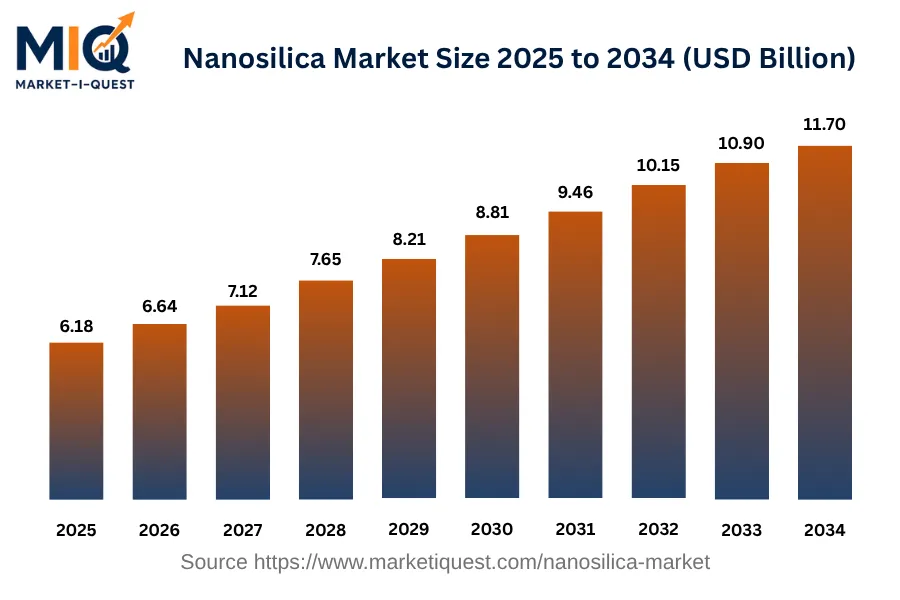
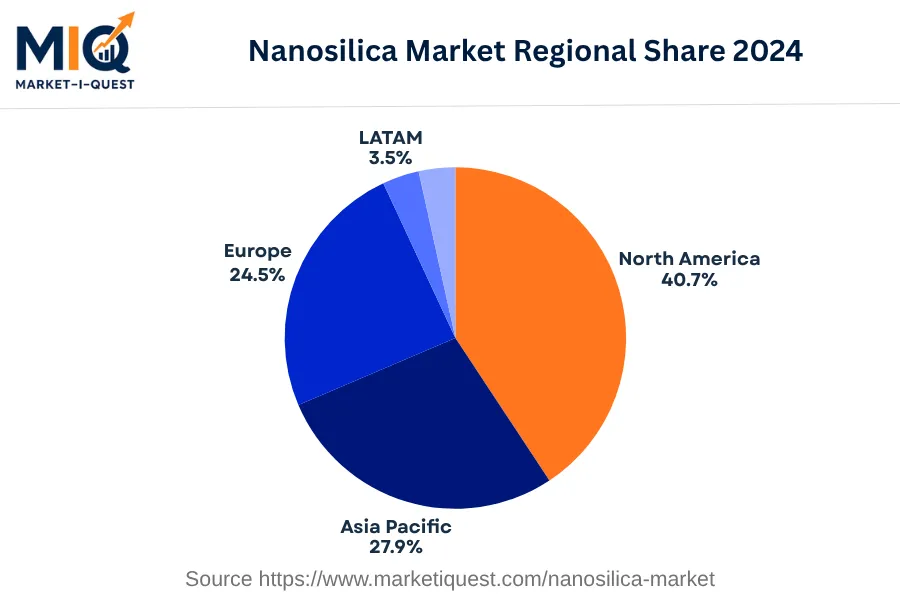
The Nanosilica Market was worth USD 6.18 billion in 2025, up slightly from USD 5.76 billion the previous year (2024). Over the next decade, by 2034, it is projected to more than double its size to USD 11.70 billion, with a compound annual growth rate (CAGR) of 7.3%. Growth from 2024 to 2034 is a substantial financial trajectory, as it notes the market size increasing consistently over the span of 10 years. This sustained expansion covers the jump from USD 5.76 billion in 2024, through USD 6.18 billion in 2025, up to the peak worth of USD 11.70 billion in 2034. In regards to the regional share for 2024, North America held the most substantial piece of the market with 40.7%, followed by the Asia Pacific with 27.9%, and Europe with 24.5%. The remaining regions, LATAM and MEA held noticeably smaller shares at 3.5% and 3.5%, respectively.

Key Takeaways

  • By Type - Functionalized Nanosilica leads in market revenue largely due to its extensive application in industrials.
  • By Form - Powder accounted for the largest share in 2024 signifying the preferred form factor for Nanosilica.
  • By Application - Construction held a dominant position in 2024 highlighting its widespread use in various coating applications.
  • By End-Use Industry - Healthcare grew fastest demonstrating the increasing incorporation of Nanosilica in industry.
nanosilica-market market size

Key Driving Factors

Adoption of Nanosilica in Sustainable Construction Materials

There is an ongoing shift towards making construction more sustainable and eco-friendly. One of the key tactics is the adoption of nanosilica in construction materials. Nanosilica-enhanced materials offer superior strength and durability, reducing the overall material consumption and associated carbon emissions. Furthermore, the improved thermal efficiency of such materials helps in energy conservation in buildings. This trend directly influences the demand for nanosilica in the construction industry, with contractors, architects, and builders incentivized by potential cost savings, energy efficiency, and environmental responsibility. The green certifications like Leadership in Energy and Environmental Design (LEED) support this trend, thereby boosting the nanosilica market.
Increasing Use of Nanosilica in the Automotive Industry

The automotive industry is witnessing a higher use of nanosilica, especially in the production of tyres. Nanosilica helps increase the durability and fuel efficiency of tyres, a critical aspect considering stringent fuel economy standards like Corporate Average Fuel Economy (CAFE) in the U.S. The compound also improves traction, particularly in wet conditions, thereby enhancing vehicle safety. Tyre manufacturers such as Bridgestone, Michelin, and Goodyear are increasingly incorporating nanosilica in their products to meet the performance standards and fuel efficiency targets. In addition, the growth of electric vehicles, which need lighter and more efficient tyres, amplifies this demand. Hence, the automotive industry's requirements serve as a significant driver for the nanosilica market.

Market Evolution by Timeline

2019-2023
During this period, the construction and rubber industries were the main buyers of nanosilica, predominantly in the Asia-Pacific region. On the supply side, suppliers mainstreamed energy-efficient production processes, though integration maturity varied. The adoption was impeded by the lack of universal standards, even as ISO began drafting nanomaterial safety guidelines. Prices remained fairly stable, and contracts were typically long-term due to the stability of demand. However, quality variance and the difficulty of ensuring consistency remained key challenges.
2024
In 2024, the automotive and coating industries notably increased their procurement of nanosilica, particularly in Eastern Europe. Manufacturers pioneered techniques for enhanced dispersion, though these were not widely adopted due to their high costs. The ISO safety guidelines were finalized, prompting wider adoption. Yet, average prices rose due to the increased production costs, which resulted in shorter contracts. The key challenge was that the strategies aimed at enhancing dispersion were not economically viable.
2025-2029
This period saw increased demand from electronic industries and an emerging trend in Latin America. Atomization became a popular production process, although availability of equipment was a constraint. Regulation around handling and safety grew stricter, though they varied by country. Collaboration between manufacturers and end-user industries became common to streamline supply and minimize the impact of price fluctuations. The need for advanced equipment to mass-produce high-quality nanosilica remained a risk.
2030-2034
Buying patterns were fairly consistent, with the energy sector in Africa and Middle East increasing their nanosilica procurement. Flame spray pyrolysis prevailed in production, although certain regions, especially those with less developed manufacturing sectors, struggled with technology acquisition. No significant changes in regulations were observed, however, collaborative programs for standards harmonization launched in several regions mitigated risks. Prices trended slightly downwards thanks to improved production methods and increased competition. Long delivery times and import restrictions posed significant supply risks.

Future Market Outlook

Future Opportunities

Nanosilica's growing relevance across industries is underscored by its potential applications in fields such as energy storage and biomedicine. In 2022, researchers from Stanford University demonstrated the use of nanosilica in lithium-ion batteries, enhancing energy density and cycle stability, pointing to future adoption by battery manufacturers. The healthcare sector is beginning to explore nanosilica in drug delivery systems, with trials reported in various countries, including China and Germany, assessing its effectiveness in targeting cancer cells. With the International Nanotechnology Initiative's ongoing initiatives to promote safe nanomaterials, opportunities for securing regulatory approvals for innovative formulations are expanding. Regulatory uncertainty remains a barrier, yet regulatory frameworks established by the European Chemicals Agency are acting as roadmaps for compliance, encouraging manufacturers to invest in nanosilica applications. The demand for sustainable materials has prompted organizations such as the American Chemical Society to advocate for environmentally friendly nanomaterials, influencing product development strategies. Additionally, prospects for advanced concrete formulations utilizing nanosilica have been bolstered by construction projects across Asia-Pacific regions, where improvements in material properties are desired. Investments in R&D aimed at discovering new applications for nanosilica will likely rise as industries increasingly recognize its potential benefits in enhancing performance and sustainability across their product lines.

Segmentation Analysis

By Type

The market is divided into subsegments including Hydrophobic Nanosilica, Hydrophilic Nanosilica, Functionalized Nanosilica, and Colloidal Nanosilica. Functionalized Nanosilica accounted for the largest revenue share while Hydrophilic Nanosilica is expected to grow at the fastest CAGR during the forecast period.

Largest Revenue Share

Functionalized Nanosilica

Market Share Leader

Functionalized Nanosilica leads in market revenue, largely due to its extensive application in industrials. These industrial applications commonly require high-performance materials that exhibit superior mechanical, thermal, and chemical properties, areas where Functionalized Nanosilica excels. Also, with growing industrial activities in regions like Asia-Pacific and North America, demand is set to rise. Customers favor it as it can offer enhanced properties at a competitive price, making it appealing. Regulatory influence is another factor that can't be ignored. In recent years, regulations around environmental sustainability have become stricter, and Functionalized Nanosilica is typically derived from renewable resources, which makes it a preferable choice. Supply consistency, cost-effectiveness and other factors such as superior performance and regulatory compliance are helping Functionalized Nanosilica secure a large share of the nanosilica market.

Fastest CAGR

Hydrophilic Nanosilica

Forecast Period Growth Leader

Hydrophilic Nanosilica is expected to be the fastest growing subsegment. Reasons contributing to its growth trajectory include technical advancements, favorable policies, and increased capital investments. There is growing interest in Hydrophilic Nanosilica owing to its distinctive properties, like increased performance and compatibility with a broad spectrum of polymers, which in turn has driven increased adoption in the coatings and adhesives industry. However, its growth is not devoid of challenges. Significant investment is required to ensure effective incorporation of Hydrophilic Nanosilica into various applications, and for some companies, this represents a considerable adoption barrier. Promisingly though, partnerships between key industry players and research institutions aimed at overcoming these barriers are on the rise. These collaborations target to optimize the integration process of Hydrophilic Nanosilica and to reduce overall costs, promoting its adoption and accelerating its growth.

By Form

The market under discussion is divided into two distinct subsegments including Powder and Dispersion. Amid these, Powder accounted for the largest revenue share, while Dispersion is predicted to display the highest growth rate in the coming years.

Largest Revenue Share

Powder

Market Share Leader

The Powder subsegment emerged as a leader in the form-based market segment due to a myriad of factors. Driving factors such as easy handling and storage, increased shelf-life, and high stability provide this subsegment an edge over others. Customers find powdered forms to be convenient and highly user-friendly, which further propels the demand for it. Geography plays a vital role in the Powder segment's dominance with regions possessing more industrial setups and factories leaning more towards the adoption of powdered forms. The purchasing decision is also heavily influenced by the reduced transportation costs and lower risks of spillage or degradation during transit. The ease of incorporating into different product forms is another significant advantage of powdered forms. Lenient regulatory framework encouraging the use of Powder in various industries also contributes to its leading revenue share.

Fastest CAGR

Dispersion

Forecast Period Growth Leader

While Powder holds the most significant share in the present market, it is the Dispersion subsegment that stands to witness the fastest Compound Annual Growth Rate (CAGR). Dispersion's potential growth can be associated with several factors such as technological advancements, strategic partnerships, and shifts in industry trends. Technological improvements enable enhanced dispersion quality, thereby increasing its demand among customers seeking premium quality products. Partnerships with end-user industries played a significant role in the expansion of the Dispersion market. Changes in the capex spending patterns are also influencing the growth of this subsegment, as companies increasingly invest in Dispersion due to its benefits. However, there are some near-term risks associated with Dispersion, including potential supply chain disruptions and market fluctuations.

By Application

The market is divided into subsegments including Construction, Paints & Coatings, Electronics, Biomedical, and Rubber. Construction accounted for the largest revenue share, while Electronics is projected to be the fastest growing subsegment.

Largest Revenue Share

Construction

Market Share Leader

In 2024, the Construction segment accounted for the largest market share. There are a number of factors driving this trend. The construction sector's growth is directly related to population growth and urbanization rates, therefore, the increasing population and urbanization are propelling growth in the construction market. Households seeking to improve their standard of living as wealth/income increases have also contributed to the growth of the construction market. Furthermore, massive infrastructure projects, both residential and non-residential, have been a considerable source of revenue in this segment. Government policies favoring infrastructure development and promoting construction activities also act as a stimulant for the construction market. The steady supply of construction materials and the standardized purchasing criteria used by major construction corporations have enabled smooth, regulated transactions that maximize profitability. Yet, the dominance of construction is not unchallenged, as subsegments with higher rates of technological innovation like electronics are expected to grow rapidly in the coming years.

Fastest CAGR

Electronics

Forecast Period Growth Leader

The Electronics segment is projected to have the highest CAGR in future years. Technology's ubiquity and rapid progress underpin this surge. A plethora of devices, ranging from personal gadgets to advanced medical equipment, require electronics. Advances in technology, particularly the trend toward Internet of Things (IoT) devices, drive further expansion. The industry is continually fueled by investments in research and development, catalyzing the implementation of new technologies. Reductions in capital expenditures have also eased the adoption of newer technologies. Partnerships between tech companies, focusing on innovation and better performance of electronic devices, provide another growth avenue. However, market growth could be hampered by ever-changing technological advancements which intensify competition and put pressure on prices, also, supply chain disruptions pose significant near-term risks. Despite this, the outlook for growth remains strong in the face of increasing demand for electronic devices.

By End-Use Industry

The market is divided into subsegments including Automotive, Aerospace, Healthcare, Consumer Goods, Energy, and Others. The Automotive sector accounted for the largest revenue share while the Healthcare sector is expected to grow at the fastest CAGR during the forecast period.

Largest Revenue Share

Automotive

Market Share Leader

The Automotive subsegment generated the most revenue in 2024, driven by the large volume of global car production and the increasing incorporation of cutting-edge technology in vehicles. This sector is characterized by a high degree of competition and rapid technological advancements, spurring growth. Additionally, changing consumer preferences and regulatory standards have encouraged manufacturers to upgrade vehicle functionalities, fueling demand for diversified products and services. Also, emerging markets, particularly in Asia, are contributing significantly to the sector's revenue generation, owing to rising middle-class populations and escalating desire for private vehicle ownership. This, in turn, leads to a substantial need for parts, systems, and high-tech features in the automotive landscape. Long-term contracts with suppliers and a solid after-sale service network further solidify the sector's revenue generation potential.

Fastest CAGR

Healthcare

Forecast Period Growth Leader

The Healthcare sector is anticipated to witness the fastest CAGR leading up to 2030. This is primarily due to the accelerating need for advanced medical technologies and the increasing global prevalence of chronic illness. Also, aging populations worldwide are causing high demand for medical devices and healthcare services. On-going technological advancements, particularly in the field of telemedicine, artificial intelligence, and robotics, act as catalysts for growth. Investment in healthcare infrastructure is surging, especially in developing countries, providing further momentum. However, systemic adoption barriers persist due to stringent regulatory norms and high capital expenditure requirements. Scalable partnerships and government policy interventions may serve to mitigate these barriers and potentially accelerate market penetration and growth.

Competitive Analysis

Key Market Players

Manufacturers / OEMs

Akzo Nobel N.V.
Netherlands
Evonik Industries AG
Germany
Wacker Chemie AG
Germany

Key Suppliers & Raw Materials

PPG Industries, Inc.
US
Cabot Corporation
US
Tosoh Silica Corporation
Japan

Distributors, Integrators & Channel Partners

Brenntag AG
Germany
3M
US
Univar Solutions Inc.
US

Porter’s Five Forces Analysis

This analysis highlights the competitive intensity and attractiveness of the nanosilica market.

Supplier Bargaining Power

Medium

Supplier power is moderate due to the dependence on limited raw material providers.

Buyer Bargaining Power

High

Buyers have high bargaining power due to the proliferation of suppliers and product standardization.

Threat of Substitutes

Medium

Relative ease of substitution with other nanoparticles puts a medium pressure from substitutes.

Threat of New Entrants

Low

High initial investments and complex production processes pose barriers to entry.

Competitive Rivalry

High

High competition exists due to the prevalence of numerous key players in the market.

Regional Analysis

Geographic market dynamics and growth opportunities across key regions

Global Market Outlook

nanosilica-market market regional share

North America

In 2024, North America's nanosilica market witnessed significant growth driven by several key factors. Technology adoption was prominent; industries like healthcare, manufacturing, and energy emerged as major consumers to enhance product durability and utility. Demand for nanosilica increased substantially, spurred by regulatory encouragement for nanotechnology in environmental sustainability. Additionally, substantial public and private investment, particularly in the United States, further stimulated supply and innovation in nanosilica products. Market trends were majorly influenced by buyer behavior, with users increasingly valuing nanosilica's role in improving product performance. Advances in nanosilica technologies led to a significant shift towards more efficient and application-specific products.

Channel dynamics also shifted notably with the emergence of digital platforms, effectively linking manufacturers directly to bulk consumers. The market witnessed strategic partnerships, with companies like Evonik Industries and Wacker Chemie playing a crucial role in shaping the region's nanosilica landscape. Sectors like government and utilities saw increased demand for nanosilica, particularly in the United States and Canada. Here, nanosilica gained popularity for its contribution to low-energy building solutions and reinforcing materials such as concrete. The Mexican market notably embraced nanosilica in its burgeoning automotive manufacturing industry, improving both product durability and user safety. Thus, the overall North American market for nanosilica demonstrated healthy expansion in 2024.

Asia Pacific

In 2024, the Nanosilica market in Asia Pacific was driven by a multitude of complex elements. Stricter environmental policies, especially in China and Japan, accelerated the adoption of nanosilica in the industrial sector; this material's propensity for reducing CO2 emissions made it viable for compliance. India's broad investment in nanotechnology R&D facilitated product availability escalation and, in tandem with technological advancements in countries like South Korea and Australia, contributed to competitive pricing. Trends in the Asia Pacific Nanosilica market were equally profound. Integrated use of nanosilica as an additive in the construction industry saw a significant rise, particularly in the ASEAN region, as customers prioritized enhanced strength and durability of construction materials. Simultaneously, a surge in e-commerce in Australia and South Korea impacted channel dynamics, making online platforms the primary route for nanosilica sales. Additionally, a notable trend was increased collaboration between enterprises and academic research institutions in Japan, which promoted the development of proprietary nanosilica applications.

Lastly, strict enforcement of 'Made in China 2025' regulations drove shifts towards nano-enhancements in manufacturing sector to establish quality assurance. Overall, the drivers and trends governing the Nanosilica market in Asia Pacific were distinctly interwoven with regulatory changes, technological advancements, novel partnerships, and shifts in buyer behavior. These elements, together, shaped the market landscape in 2024.

Europe

In 2024, the European nanosilica market exhibited robust growth propelled by various drivers and shaped by key trends. Regulatory policies favoring sustainable alternatives fueled demand, as sectors like automotive, construction, and healthcare adopted nanosilica for its eco-friendly features and performance benefits. Enhanced investment in nanotechnology research, particularly in Germany and the United Kingdom, led to emerging applications for nanosilica, subsequently driving market growth. Continual price fluctuations of raw-materials affected supply dynamics, prompting manufacturers across Europe, especially in Benelux and Central & Eastern Europe, to explore innovative cost-efficient production methods.

Buying behaviors shifted towards high-quality, durable products incorporating nanosilica, chiefly noted within Italy's luxury goods industry. Product innovation saw a noticeable uptick, with France leading in developing nanosilica-based coatings and composites in aerospace and marine sectors. A rise in strategic partnerships, as observed in Spain among nanomaterial suppliers and automotive manufacturers, supported the efficient distribution of nanosilica. The Nordics prioritized setting industry standards to ensure safe and efficient use of nanosilica that spearheaded policy enforcement efforts. Overall, these drivers and trends shaped a dynamic and evolving nanosilica market in Europe throughout 2024.

Latin America

In 2024, the Nanosilica market in Latin America, dominated by key regions such as Brazil, Mexico, Argentina, Chile, Colombia, and Peru, displayed dynamic growth steered by various factors. Increased demand emerged notably from sectors like manufacturing, utilities, and reconstruction facilities, driven by technological adoption and innovative applications of nanosilica. Rising investments in nanotechnology and product development further energized the market. Stringent environmental regulations, promoting sustainable materials, resulted in nanosilica gaining traction as an eco-friendly option. Market trends divulged a shift towards value-added applications of nanosilica across several industries, with Brazil and Mexico taking the lead. An increasing number of strategic partnerships and M&A activities were observed, shaping channel dynamics and enhancing market penetration.

Policy enforcement to ensure safe and ethical use of nanotechnology indicated the region's commitment to incorporate this frontier technology responsibly. The use of nanosilica in the retail sector further diversified, stimulated by its wide-ranging potential in products requiring controlled release properties. Overall, the LATAM Nanosilica market in 2024 was in a state of expansion and evolution, underpinned by technology adoption, environmental considerations, strategic business activities, and expanding application across industries. The transformative potential of nanosilica was increasingly acknowledged and leveraged across the region, marking a significant timeline in Latin America's nanotechnology landscape.

Middle East & Africa

In 2024, the Nanosilica market in the Middle East and Africa demonstrated strong growth dynamics. Drivers of market expansion included increasing demand from the construction sector, favorable government regulations in countries like Saudi Arabia and the United Arab Emirates, substantial investment in innovation by leading nanosilica manufacturers, and widespread adoption of technology in the oil and gas sector, particularly in Qatar and Saudi Arabia. These factors, coupled with supply dynamics from regions like South Africa and Nigeria, bolstered the market performance.

Prevailing market trends involved a shift in channel dynamics as more buyers relied on e-commerce platforms for procurement, a move that significantly increased in Egypt and Kenya. Changes in product technology shaped the market, with a clear preference for high performance nanosilica. Additionally, collaborations highlighted the landscape with numerous partnerships and M&A taking place, especially in the United Arab Emirates and Israel. Further, governments across the region consistently enforced stricter standards on nanosilica production and usage, advocating for safer and more environmentally sound practices. Key customer sectors for the nanosilica market ranged from healthcare and manufacturing to utilities and retail, with significant demand from the oil and gas sector noted in Saudi Arabia, Qatar, and Nigeria.

Recent Industry Developments

Latest market innovations, product launches, and strategic initiatives

May 2026

A new eco-friendly nanosilica production process was commercialized by a European technology firm, reducing energy consumption by 30% and CO₂ emissions by 25% compared to traditional manufacturing methods. The technology is being licensed to multiple producers.

March 2025

A global specialty chemicals company launched a new grade of surface-modified nanosilica specifically designed for high-performance coatings and adhesives. The product features improved dispersion and enhanced mechanical properties, targeting automotive and industrial applications.

Frequently Asked Questions