Metrology Services Market Snapshot

Key Players

  • Hexagon AB (Sweden)
  • Carl Zeiss AG (Germany)
  • Nikon Corporation (Japan)
  • Rolls-Royce Holdings Plc (United Kingdom)
  • Creaform Inc. (Canada)
  • Metrologic Group (France)
  • Trimble Inc. (United States)
  • Perceptron Inc. (United States)
  • FARO Technologies Inc. (United States)
  • Renishaw Plc (United Kingdom)

Market Size

Base Year 2024
$1.32 Bn
CAGR
6.8%
Forecast 2034
$2.55 Bn

Market Segments

By Product Type
  • Coordinate Measuring Machines (CMM)
  • Optical Digitizers & Scanners (ODS)
  • Form Measurement Equipment
  • Surface Measurement Equipment
  • 3D Metrology Systems
  • others
By Application
  • Dimensional Inspection
  • Surface & Form Measurement
  • Material Testing
  • Reverse Engineering
  • Quality Control & Assurance
  • Other

Market Dynamics

Drivers
  • Rising demand in manufacturing sector
  • Technological advancements in metrology services
Restraints
  • High equipment costs
  • Technical skill scarcity
Opportunities
  • Growing industrial automation
  • Rising demand for quality control

Market Size

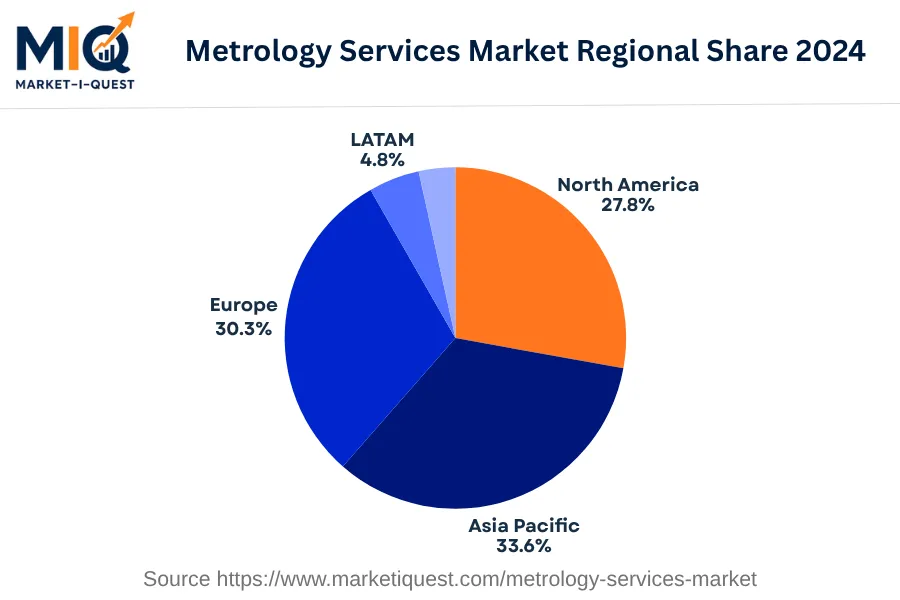
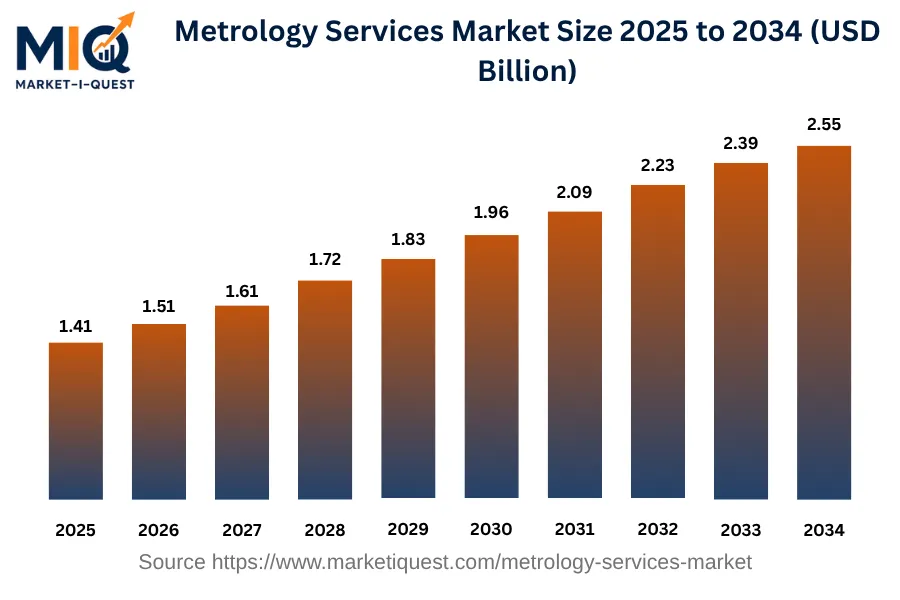
The Metrology Services Market valued at USD 1.41 billion in 2025 with projected value of USD 2.55 billion by 2034 with a growing at a CAGR of 6.8%. A key factor driving the market is the increasing reliance on precision of data and statistics for global industries, highlighting importance of accuracy in measurement services to ensure efficient operations. Whereas, the regional share distributed as the Asia Pacific region held the largest share with 33.6%, followed by Europe with 30.3% and North America with 27.8%. Latin America, Middle East and Africa market shares with 4.8% and 3.5% respectively.

Key Takeaways

  • By Product Type - Coordinate Measuring Machines (CMM) maintained a leading position in the Metrology Services Market.
  • By Application - Quality Control & Assurance held the dominant share in the market.
metrology-services-market market size

Key Driving Factors

Implementation of the International Organization for Standardization Quality Management Systems (ISO QMS)

Various companies across industries like automotive, aerospace and manufacturing implementing International Organization for Standardization Quality Management Systems. The standard provides precise measurements of materials, components and final products for maintaining enhanced quality and safety, whereas, demanding a rise in of metrology services. ISO QMS mandates periodic alignment and verification of measuring instruments adding another layer of demand for metrology services. By following ISO QMS, companies enhance their credibility in market, but increase their operational efficiency thus, promoting increased metrology services.

Emergence of Smart Factories and Industry 4.0

Rise of smart factories and Industry 4.0 boosting the market for metrology services. Smart factories lean towards advanced manufacturing procedures such as digital twin technology and additive manufacturing demanding precise measurements for effective execution. With the increasing importance of metrology services for ensuring accuracy of these technologies, significantly increasing their importance in manufacturing process. Simultaneously, transformation to Industry 4.0 demands a shift towards automated and networked production systems. These systems demand precise alignment to ensure the smooth interaction of multiple components thus, driving demand for professional metrology services.

Market Evolution by Timeline

2019-2023
North America and Europe remained the major buyers in metrology services market within this period. Automotive and aerospace industries frequently sought 3D scanning and Geometric Dimensioning & Tolerancing services. Asian automobile manufacturers demanded for 3D metrology setups while Europe preferred Coordinate Measuring Machines. Whereas, complex data processing software slightly limited widespread use. Metrology training programs, such as Certified Calibration Technician program with expansion for meeting increased demand. Providers developed 'pay-per-use' pricing models with machine purchase contracts. From initial equipment investment other substantial costs involved setting up metrology systems, like operator training. Thus, non-contact measurement technologies increased in popularity.
2024
In 2024, market demand in Asia-Pacific region rose due to rapid industrialization and need for quality control in manufacturing sectors. Customized metrology services gained momentum providing adaptable solutions. Whereas, the rising popularity for software-customized metrology products. The development of the ISO 10360-10:2024 standard influenced adoption due to offering the guidelines for acceptance and verification of Coordinate Measuring Machines. The commercial model started shifting from traditional purchasing to leasing options.
2025-2029
This period shows emergence of buyers from diverse industries like healthcare, robotics and energy. These sectors required precision measurement solutions with increased adoption of 3D scanning. Manufacturers improved software to allow smooth integration with other enterprise solutions for handling increased complexity of customers needs. AI integrated metrology for predictive analyses started shipping mid-decade. Regulatory bodies drove adoption for precision and accuracy with updates in ISO/IEC 17025 standards subsequently increasing metrology services market. Thus, providers tested 'software-as-a-service' pricing model.
2030-2034
By 2030-2034, complete adoption of AI-enhanced metrology became standard. This vastly improved metrology sensors in Internet of Things devices. Markets in Middle East and Africa started the adoption of these services for oil and gas sectors. Manufacturers extended metrology portfolio from product inspection to anticipated trend analysis. Policy reinforcement through global integration of measurement standards like ISO/IEC 17025. Quality-based performance pricing gained demand. Thus, driving an upskilling trend in workforce capabilities to handle complex metrology systems.

Future Market Outlook

Future Opportunities

The metrology services market is projected the expansion, driven by legislative and regulatory influences. The increasing complexity of manufacturing processes, particularly in sectors like aerospace and automotive, demanding for enhanced precision with creating opportunities for advanced metrology solutions. Companies like Airbus are pursuing partnerships in metrology to meet the stringent standards and quality assurance requirements by organizations like FAA and EASA. Additionally, the global drive for smart cities showed by projects in Singapore and Amsterdam with demands for high-precision measurement solutions for urban infrastructure and environmental monitoring. With regulations like ISO 9001 highlighting quality management systems, businesses are pursuing reliable metrology services to comply and maintain the operational standards. Moreover, the rapid development of Internet of Things creates new opportunities for real-time monitoring and data analysis in metrology, a trend witnessed in pilot programs from organizations like Schneider Electric. The growing focus on sustainability, particularly in Europe and North America, aligns with deployment of eco-friendly measurement technologies in collaborations between metrology service providers and renewable energy firms. Furthermore, metrology services are benefiting from education and training initiatives aiming to enhance workforce skills, adopting collaboration between universities and industry like partnerships between several technical colleges and leading metrology firms. Thus, evolving dynamics point to a robust future for metrology services highlighting current technological advancements and regulatory expectations.

Segmentation Analysis

By Product Type

The market is divided into subsegments including Coordinate Measuring Machines (CMM), Optical Digitizers & Scanners (ODS), Form Measurement Equipment, Surface Measurement Equipment, 3D Metrology Systems, and others. Among these, Coordinate Measuring Machines accounted for the largest revenue share while 3D Metrology Systems is expected to grow at the fastest CAGR during the forecast period.

Largest Revenue Share

Coordinate Measuring Machines (CMM)

Market Share Leader

The Coordinate Measuring Machines (CMM) subsegment holds the largest market share. This can be attributed to its high precision and accuracy, making it preferable in critical industries like aerospace, automotive and electronics. Due to requirement of these sectors for high-precision components and assembly with any slight deviation can lead to product failure or performance issues. Further, the need for enhanced quality control and inspection in manufacturing processes is driving the demand. Another contributing factor is the regional distribution of its customer base. Advanced economies with mature manufacturing sectors and strict quality regulations saw increased demand for CMM. Whereas, buyers purchasing criteria depends on effectiveness, reliability and accuracy. Thus, costs for switching to another technology is also substantial considering technical and equipment trainings involved subsequently establishing solid market position.

Fastest CAGR

3D Metrology Systems

Forecast Period Growth Leader

The 3D Metrology Systems is projected to grow at the fastest growth rate. Due to the increasing importance of precision engineering combined with growing trend of size reduction is boosting adoption of these systems. While technological advancements leading to faster measurement speed and increased precision are the key drivers for encouraging industries for shifting. Moreover, government policy supporting quality control and enhanced manufacturing practices will further drive its demand. Investment in R&D with potential for innovation and partnerships to develop advanced 3D measurement solutions promoting the growth. Thus, such systems also face increased adoption due to the increased demand of the market.

By Application

The application segment of the market is divided into various subsegments including Dimensional Inspection, Surface & Form Measurement, Material Testing, Reverse Engineering, Quality Control & Assurance, and Others. Quality Control & Assurance accounted for the largest revenue share whereas Reverse Engineering is anticipated to grow at the fastest CAGR during the forecast period.

Largest Revenue Share

Quality Control & Assurance

Market Share Leader

Quality Control & Assurance has lead the highest revenue share subsegment in application market segment. The major driving factors included increasing demand in various industries for quality assurance within their processes. Enhanced customer expectations and stringent regulatory standards have been key factors demanding strict quality measures. Particularly in sectors where quality of the product increasingly influence the major consumer base including the sectors manufacturing, pharma, food & beverages. Regionally, rise in global manufacturing centers, particularly in Asia-Pacific regions, has boosted growth of the segment. Regulatory bodies in these regions have been enforcing rigorous quality standards and controls, thereby promoting broad application of quality control and assurance procedures. Thus, constantly evolving technological landscape encourages consistent upgrade of quality assurance tools, creating stable demand in the market.

Fastest CAGR

Reverse Engineering

Forecast Period Growth Leader

While Quality Control & Assurance dominates in terms of revenue, the fastest growing subsegment is expected to be Reverse Engineering. This subsegment is witnessing increased traction due to the growing trend of product teardown, where businesses deconstruct competitors' products to understand their functionality, design, and technological component. Reverse engineering also reduces R&D costs and time, bringing products to market faster. One of the technological catalysts for this growth is the advent of 3D technology and software that allows for precise, easy, and affordable execution of reverse engineering processes. However, adoption barriers can be seen in legal concerns around intellectual property infringements. Partnerships and collaborations are becoming crucial to navigating through regulatory landscapes. Moreover, the advent of superior technology offers opportunities to firms to upscale their reverse engineering capacities, though they need to be wary of the risk of obsolescence and the constantly evolving technological landscape.

Competitive Analysis

Key Market Players

Manufacturers / OEMs

Hexagon Manufacturing Intelligence
Sweden
Carl Zeiss AG
Germany
FARO Technologies
US

Key Suppliers & Raw Materials

Mitutoyo America Corporation
Japan
Keyence Corporation
Japan
Renishaw plc
UK

Distributors, Integrators & Channel Partners

Precision Metrology
US
Metrology Parts
US
Test Equipment Distributors
US

Porter’s Five Forces Analysis

Analysis of the competitive intensity and attractiveness of the Metrology Services Market.

Supplier Bargaining Power

Medium

Suppliers have moderate influence due to the highly specialized nature of metrology equipment and services required.

Buyer Bargaining Power

Low

Due to the high degree of product differentiation and low substitutes, customers have limited bargaining power.

Threat of Substitutes

Low

Few substitutes exist for precision measurement tools and professional metrology services.

Threat of New Entrants

Medium

Considerable capital investment and technical knowledge needed, but potential gains may attract new players.

Competitive Rivalry

High

The market is highly competitive with several global players providing similar services.

Regional Analysis

Geographic market dynamics and growth opportunities across key regions

Global Market Outlook

metrology-services-market market regional share

North America

In 2024, metrology services market in North America shaped the demands for precision in sectors such as manufacturing, healthcare and utilities. Various major drivers accelerated the market including the increasing investment in automation and digitalization in industries, which required advanced measurement solutions. With regulatory demands from governments, mainly in healthcare, necessitated advanced dimensional analysis, boosting demand for metrology services. A growing consumer electronics industry further drove the demand due to requirement for strict compliance to quality control and standards.

In terms of trends, with a clear shift towards adopting 3D laser scanner technology in manufacturing sector due to its efficiency and accuracy. This accompanied by emergence of software-based metrology solutions that optimized data processing and interpretation in sectors like retail and enterprise. Moreover, with common partnerships and mergers in market aiming towards extended service portfolios and sharing technological expertise. Enforcement of policies like U.S. Measurement System (USMS) guided the market dynamics subsequently businesses aiming for compliance with standardized measurement practices. Customers in this space were broadly distributed across sectors. Manufacturing and utilities dominated whereas, noticeable growth was happening in healthcare and enterprise applications, marking continuous expansion of metrology services market's influence in North America.

Asia Pacific

In 2024, metrology services market in Asia Pacific showed robust growth, majorly driven by rapidly evolving manufacturing industries in China and India. Increased adoption of automated precision measurement solutions in these regions act as a major driving force with technological advancements in metrology software. Moreover, increased investments in research and development, combined with supportive government policies like China's Made in China 2025 strategy. Thus, further boosting the metrology services market.

Trends highlighted a shift towards 3D metrology services and increased integration of robotics in metrology systems. With notable advancements in artificial intelligence and machine learning technologies in metrology applications, particularly within China’s high-tech industries. Partnerships and M&A activities were seen among leading providers with a increased focus on the expansion of product portfolios and global reach within the Asia Pacific. Key customers of metrology services integrated sectors like manufacturing, automotive, aerospace and power generation. The manufacturing sector highlighted highest demand for metrology services due to demand for stringent quality and precision in their operations with key markets such as China, India, Japan, South Korea, Australia and ASEAN. Thus, government policies promoting industrial growth booted this demand.

Europe

In 2024, the expansion of European Metrology Services Market was primarily driven by industries like manufacturing, healthcare, utilities and automotive. The demand for high precision in these sectors grew demand, especially with growing regulatory analysis around product quality and safety. Technological adoption, specifically in areas like 3D metrology boosted service offerings and increased supply. Furthermore, significant public infrastructure investments, particularly in UK, Germany and France, boosted demand for accurate and reliable measurements.

The increased preference for outsourced metrology services acted as a major trend, with major regions such as Benelux and the Nordics, where focus of small and medium-sized enterprises preferred such flexible commercial models. Digital solutions for metrology also witnessed considerable increase, majorly by countries like Germany and United Kingdom with increased importance of data-driven decision-making in sectors like government and retail. Additionally, the market saw strategic partnerships and mergers which contributed to service enhancement, like innovative standards set by France's collaboration with Italy in the same year. Thus, rigorous enforcement of EU policies concerning climate change led to rapid growth of metrology services in energy sector across Central and Eastern Europe, driving measurement accuracy for renewable energy production.

Latin America

In 2024, the metrology services market in Latin America expanded simultaneously with increased demand and technological advancements. Regulatory enforcement, especially in Brazil and Mexico acted as a significant driver, aiming to maintain strict quality control standards in manufacturing industries like automotive and aerospace. Rising investments in infrastructure projects in Argentina and growing adoption of advanced metrology services in Colombia's healthcare sector drove the market expansion. Enhanced supplier capabilities in Chile, combined with competitive pricing strategies accelerated market adoption in various industries.

In terms of trends the market witnessed an advancement in buyer preferences towards automation and digitization, particularly in Peru’s retail sector, preferring metrology services with capabilities like 3D scanning and device standardization. Technological shifts towards AI-enabled metrology solutions with a notable assurance for accuracy and user convenience across the board. In enterprise sector, a rising trend for partnerships and M&A activities were seen as firms seeking to expand their service portfolios and global reach. For instance, the frequent application and enforcement of ISO/IEC 17025:2017, a general requirements standard for competence of testing and calibration laboratories, highlighting enhanced focus on quality compliance, precision and reliability in metrology services market in this region.

Middle East & Africa

In 2024, the Metrology Services Market in Middle East and Africa experienced significant demand with key markets including Saudi Arabia, United Arab Emirates, Qatar, Egypt, South Africa, Nigeria, Kenya and Israel. While growth drivers included rapid industrialization, strict government policies with requirement for precise inspection and QA and adoption of advanced technologies. Especially, expanded manufacturing sector in Saudi Arabia with subsequently increasing demand for these services. In Nigeria, expansion in oil and gas sector demanded growth in precision measurements and inspections. Moreover adoption of advanced technologies in Egypt and Israel further drove the market.

Market trends included increasing usage of 3D scanning technology in the UAE and South Africa with technological advancements in optical digital scanners in Saudi Arabia and shift from manual towards automated metrology in manufacturing sectors of Egypt and Kenya. Moreover, integration of metrology software with CAD systems were witnessed in Israel. Majorly partnership in Middle East and Africa, like collaboration between Siemens and SAP in Saudi Arabia to promote digital transformation in the industry. Compliance with ISO 17025 standard had a notable influence across all sectors, especially in healthcare, utilities, telecom and financial services, highlighting importance of accuracy in measurements. Thus, such trends and factors combined boosted the expansion of the Metrology Services Market across the Middle East and Africa in 2024.

Recent Industry Developments

Latest market innovations, product launches, and strategic initiatives

November 2025

The UK's National Physical Laboratory (NPL) published its strategic framework outlining "Future of Metrology," formally announcing the launch of a comprehensive, global foresighting exercise for 2026 (Brown, n.d.). This operational development is designed to build metrological infrastructure necessary to support digital SI traceability, AI-driven manufacturing, and complex climate systems.

March 2025

The National Institute of Metrology (NIM) of China, operating within framework of International Organization of Legal Metrology (OIML), successfully developed and proposed "OIML Remote Test" and "Remote Test Laboratory (RTL)" systems (YANG, n.d.). This allows manufacturers to undergo legal metrology certification remotely using robotics and digital integration, drastically cutting the cost and time associated with shipping physical instrument samples globally.

January 2025

While exact operational rollout month of platform update is not definitively stated, it was formally published in early 2025. The European research infrastructure METROFOOD-RI entered its implementation phase by overhauling and launching its updated pan-European metrology service chart (De Bruyn, n.d.). This development integrates core metrology services directly into interdisciplinary fields like agrifood innovation, environmental sustainability, and food safety across its 12 participating countries.

Frequently Asked Questions