Medical Holography Market Snapshot

Key Players

  • EchoPixel Inc. (USA)
  • RealView Imaging Ltd. (Israel)
  • Mach7 Technologies (Australia)
  • Ovizio Imaging systems (Belgium)
  • Holoxica Limited (UK)
  • Zebra Imaging (USA)
  • Lyncee Tec (Switzerland)
  • Eon Reality Inc. (USA)
  • NanoLive Ltd (Switzerland)
  • Phase Holographic Imaging (Sweden)

Market Size

Base Year 2024
$2.86 Bn
CAGR
26.87%
Forecast 2034
$30.90 Bn

Market Segments

By Component
Software, Hardware, Services
By Technology
Holographic Microscopy, Interference Holography, Digital Holography
By Application
Surgical Visualization, Medical Imaging, Dental Applications, Medical Education
By End Use
Hospitals, Ambulatory Surgical Centers, Research Laboratories, Dental Clinics

Market Dynamics

Drivers
  • Rising adoption of holographic displays
  • Technological advancements in medical imaging
Restraints
  • High implementation cost
  • Technological limitations
Opportunities
  • Increased VR/AR adoption
  • Advancements in holography technologies

Market Size

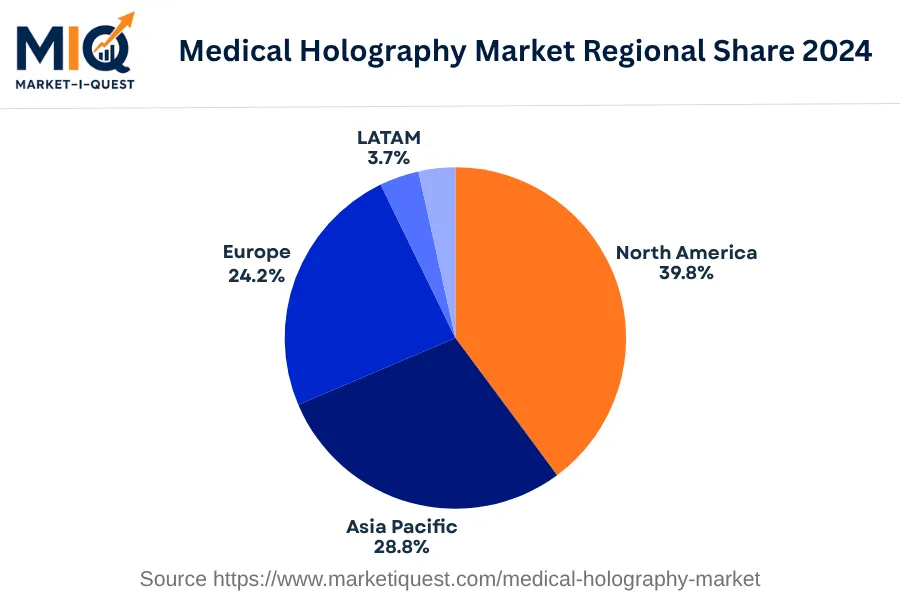
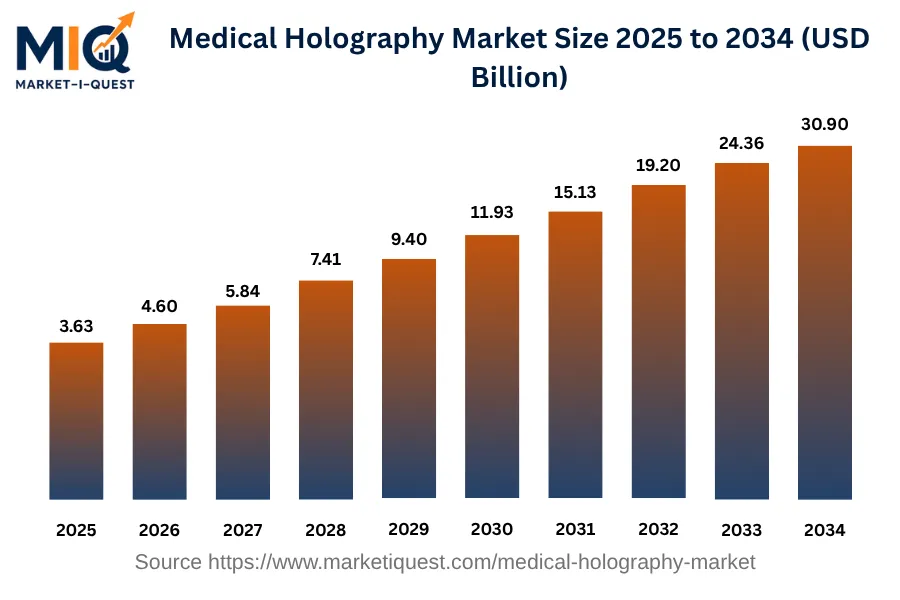
The Medical Holography Market was valued at USD 2.86 billion in 2024 and increased to USD 3.63 billion in 2025, eventually surging to USD 30.90 billion by 2034. This increase represents a compound annual growth rate (CAGR) of 26.9% over the forecast period. The sizeable growth from 2025 to 2034 can be attributed to advancements in technology making the application of holography in the medical field more widely accessible and affordable over this time frame. By region, North America held the largest share of the market in 2024, accounting for 39.8%, followed by the Asia Pacific and Europe with shares of 28.8% and 24.2% respectively. The remaining 7.2% of the market was justly split between Latin America and the Middle East and Africa, with each holding less than 4% of the total market share.

Key Takeaways

  • By Component - Hardware led the Medical Holography Market accounting for a significant share in 2024.
  • By Technology - Holographic Microscopy witnessed the fastest growth with a CAGR of high percentage during the forecast period.
  • By Application - Medical Imaging dominated contributing to a major part of the market share in 2024.
  • By End Use - Hospitals were the leading segment holding the maximum market portion in 2024.
medical-holography-market market size

Key Driving Factors

Adoption of Holography in Medical Education

The increasingly complex nature of medical education requires innovative teaching methodologies, such as using medical holography for anatomical and surgical training. Holography provides detailed, three-dimensional visualization that surpasses two-dimensional images and cadaver-based training. These capabilities enable students to understand intricate anatomical structures and enhance their surgical skills in a more practical and realistic manner. Medical schools and teaching hospitals are integrating holography simulations into their curricula, thereby accelerating the growth of the medical holography market.

Increasing Use of Holography in Patient-Diagnostic Procedures

Medical holography is becoming an integral part in diagnostic procedures and patient treatment planning, particularly in specialties such as cardiology, orthopedics, and radiology. For instance, holographic imaging allows clinicians to view patient's heart from all angles, helping in the detection of abnormalities and increasing accuracy for surgical procedures. In radiology, holography assists in much deeper understanding of complex structures. Furthermore, in the domain of orthopedics, holographic preoperative planning tools enable surgeons to visualize a patient's specific skeletal structure, identify potential issues, and map surgical procedures before even stepping into an operating room. The increasing acceptance of such utilities in practical patient care scenarios are signaling the deeper penetration of medical holography in the healthcare systems, thereby enabling significant market growth.

Market Evolution by Timeline

2019-2023
During the 2019-2023 period, North America dominated the Medical Holography Market demand due to their advanced healthcare systems. European countries also saw a noticeable demand, primarily for use in medical education and surgical preparations. As for supply, companies like EchoPixel and RealView Imaging shipped devices capable of producing 3D images. However, the integration maturity was limited by the need for specific hardware and software. Policies like FDA's medical device regulations influenced the adoption. Pricing was high due to the technology's newness and the need for specific hardware. Concerns about data security and technology's unfamiliarity were typical blockers.
2024
In 2024, the use of medical holography in minimally invasive surgeries increased, with significant adoption in Asia-Pacific countries like India and China. This growth was driven by the healthcare infrastructure development in those regions. Companies began to release products with better software and hardware integration. Few technology constraints remained, except for high costs. Similar to 2019–2023, regulations and data privacy remained a concern. The commercial model still favoured higher pricing, but some companies offered lease options to make the technology more accessible. The biggest risk was the public's unsure sentiment about the new technology.
2025-2029
Between 2025-2029, medical holography saw drastic adoption in emerging countries due to falling prices and propagating medical tourism. Companies started offering cloud-based solutions, removing the need for expensive hardware. Policy scene remained the same as before, with regulations from bodies like FDA and the European Union dominating. In this period, the market saw more partnerships between hospitals and technology companies. As the technology became more familiar, security concerns reduced, but acceptance remained a challenge.
2030-2034
In 2030-2034 period, medical holography became common in hospitals worldwide. Advancements in technology allowed any device with a camera to project 3D images. Pricing saw a considerable decrease due to widespread adoption and lower production costs. Partnerships were replaced by acquisition of smaller companies by industry giants. Ongoing support for device standards was provided by governing bodies like the FDA and the European Union. The risk of data security was managed better due to advances in quantum encryption.

Future Market Outlook

Future Opportunities

The potential for growth in the medical holography market is closely tied to ongoing collaborations between technology developers and healthcare providers. Notably, in 2023, companies like PNY Technologies engaged in partnerships with healthcare institutions to develop 3D holographic imaging techniques that can be used in diagnostics and patient education. Furthermore, the recent surge in telemedicine, accelerated by the COVID-19 pandemic, has created fertile ground for remote holographic consultations, as evidenced by companies such as Holoportation expanding their telepresence solutions. Regulatory bodies are also adapting, with the U.S. Centers for Medicare & Medicaid Services outlining new reimbursement frameworks in mid-2023 that incorporate holography-related treatments. Additionally, as educational institutions integrate holography into medical training, evidenced by the University of Illinois incorporating AR modules in their curriculum from 2022, there is an opportunity to attract a new workforce skilled in this advanced technology. Researchers are increasingly publishing studies, such as those from Stanford University in 2023, highlighting the effectiveness of holographic displays in improving surgical precision and reducing errors. By leveraging these collaborations and advancements, stakeholders can capitalize on the growing demand for enhanced medical training, improved patient engagement, and elevated surgical capabilities, potentially leading to a more widespread use of holography in healthcare practices globally.

Segmentation Analysis

By Component

The market is divided into subsegments including Software, Hardware, and Services. Hardware accounted for the largest revenue share while Services is expected to grow at the fastest CAGR during the forecast period.

Largest Revenue Share

Hardware

Market Share Leader

It's worth noting that in the Component market, the Hardware subsegment has significantly outpaced the others in terms of revenue generation. The reasons for this dominance are multi-faceted. Firstly, the industry's reliance on hardware as the foundation of its operations positions it as a crucial player. From infrastructure management to data processing and storage, hardware assumes a critical role. Its indispensability is further amplified by the rising adoption of technologies such as cloud computing, Artificial Intelligence and Big Data, which require robust hardware support. Furthermore, regulations across diverse geographies mandate certain infrastructure standards, indirectly propelling the hardware market. From a customer standpoint, decision-makers are typically more inclined to invest in tangible, long-lasting assets like hardware owing to assured ROI. In this context, the considerable purchasing power of large enterprises and the ever-increasing hardware demand by SMEs play a key role. However, the high switching costs act as a deterrent for these customers to stray away from their current suppliers. We also see that channel partnerships with OEMs and distributors have afforded massive market penetration and customer reach to the leading hardware vendors.

Fastest CAGR

Services

Forecast Period Growth Leader

While the Hardware subsegment dominates in terms of revenue shares, the Services subsegment shows the fastest growth journey. The compulsion for businesses to stay aligned with digital transformation trends can be seen as the main catalyst behind this accelerated growth. Businesses are increasingly relying on services related to their technological components to ensure efficiency, navigate complex cyber landscapes, and secure data, hence driving demand. However, barriers to adoption remain, primarily related to the perceived costs and complexity of integrating such services. Visionary tech companies are capitalizing on this opportunity by offering flexible pricing models and providing robust implementation support. Moreover, increased governmental regulations related to cybersecurity and data protection are also pushing companies towards these services. Strategic partnerships are being formed with tech giants, driving capex investment upwards and allowing the service subsegment to grow rapidly. This fast-paced growth though has its risks, with intense competition and rapidly changing technologies that could destabilize current market leaders.

By Technology

The market by technology is divided into subsegments including Holographic Microscopy, Interference Holography, and Digital Holography. In 2024, Digital Holography accounted for the largest revenue share while Holographic Microscopy is expected to grow at the fastest CAGR during the forecast period.

Largest Revenue Share

Digital Holography

Market Share Leader

Digital Holography claims the lion's share of the holography market segment due to a combination of factors. Its dominance can be attributed to the rapid advancements in technology and broader applications in industry domains, notably including healthcare and research. Versatility has contributed significantly to its popularity, with adaptability ranging from microscopic imaging to non-destructive testing. The technology proves a powerful tool in life sciences for its ability to realize 3D imaging without damaging biological samples, an advantage that has accelerated adoption. Meanwhile, sectors like automotive and aerospace see value in its capabilities to diagnose manufacturing defects non-invasively. Regulatory support, particularly in healthcare and safety-related industries, has also been a strong driver of growth for digital holography.

Fastest CAGR

Holographic Microscopy

Forecast Period Growth Leader

Holographic Microscopy is set for significant growth. The field's promising acceleration is the result of a surge in its applications in scientific, medical, and industrial sectors. Particularly in biological research and cellular studies, holographic microscopy offers unique advantages over conventional microscopy, enabling real-time 3D imaging and measurement without the need for specialized prep or damaging the sample. Industry partnerships have become a key catalyst, especially with research institutes. The relatively high initial investment cost and scarcity of skilled personnel serve as major adoption barriers making growth more difficult. However, with the gradual development of advanced and simpler systems and the increase of training programs for this technology, it's expected that these growth barriers will diminish, fostering the segment's growth.

By Application

The Application-based market segmentation includes Surgical Visualization, Medical Imaging, Dental Applications, and Medical Education. Of these, Medical Imaging accounted for the largest revenue share, while Dental Applications are expected to grow at the fastest CAGR during the forecast period.

Largest Revenue Share

Medical Imaging

Market Share Leader

Medical Imaging stands out as the subsegment with the largest revenue share in 2024. The driver behind this dominance is twofold: technological advancements and the wide-ranging clinical applications of imaging technologies. With advanced imaging technologies like MRI, CT, and PET scans, diseases can be diagnosed accurately, enabling more effective treatments. Further, the aging global population and the increasing prevalence of chronic diseases leverages the demand for these imaging technologies. These tools are crucial for addressing many health conditions, from cancer to cardiovascular diseases, thereby contributing to revenue growth. Market development is also accelerated by regulatory norms that encourage the use of non-invasive diagnostic methods, which in turn drives the demand for medical imaging technologies. However, high initial investment and maintenance costs associated with advanced medical imaging technology may deter small-scale hospitals and clinics in developing countries.

Fastest CAGR

Dental Applications

Forecast Period Growth Leader

Predicted to have the fastest growth rate is the subsegment of Dental Applications. The primary growth drivers include technological innovations, increased awareness about dental health, and growing demand for cosmetic dentistry. Dental Applications have integrated modern technologies such as CAD/CAM, 3D imaging, dental implants, and laser technology, thereby transforming the dental industry and its procedures. Cosmetic dentistry, in particular, has gained significant traction over recent years with the rise in consumer desire for aesthetic appeal. Furthermore, partnerships between dental solution providers and technology firms are creating opportunities for market expansion. However, the significant cost of advanced dental technologies may pose an obstacle to adoption, especially in developing regions where cost sensitivity is heightened. The near-term risk pertains to regulatory uncertainties, particularly pertaining to approval of new dental technologies and materials.

By End Use

The market is divided into subsegments including hospitals, ambulatory surgical centers, research laboratories, and dental clinics. In 2024, hospitals accounted for the largest revenue share while research laboratories are expected to grow at the fastest CAGR during the forecast period.

Largest Revenue Share

Hospitals

Market Share Leader

Hospitals control the largest share of revenue in 2024, and this dominance can be attributed to several factors. A primary driver of this is the sheer volume of patients that hospitals handle compared to other sub-segments. This large patient pool necessitates the purchase and use of high quantities of medical supplies and equipment. Moreover, hospitals also cater to a wider range of clinical conditions, thus demanding varied and specialized equipment, further increasing revenue generation. Additionally, hospitals tend to have larger budgets and are more likely to invest in more expensive, technologically advanced medical equipment. Geographically, this trend is observed across regions, albeit with variations due to regional healthcare infrastructure development disparities. Regulatory pressures also push hospitals to maintain certain standards of care, often requiring them to update or replace existing equipment with even more capable or efficient variants, keeping the revenue streams consistent.

Fastest CAGR

Research Laboratories

Forecast Period Growth Leader

Research laboratories are poised for the fastest compound annual growth rate during the forecast period. This predominately stems from the rapidly evolving scientific and technological advancements that necessitate ongoing research. Besides, policy changes across several countries that incentivize research and development activities act as catalysts for growth in this subsegment. While research budgets were traditionally tight, there has been a recent uptick in both government and private funding in life sciences and biotechnology sectors, leading to increased capital expenditure in research labs. Also, partnerships between research laboratories, pharmaceutical companies, and academia are aiding in driving growth in this sector. However, these laboratories also face certain near-term risks, such as regulatory changes affecting funding or the sudden emergence of new research priorities, which can disrupt their growth trajectory.

Competitive Analysis

Key Market Players

Manufacturers / OEMs

EchoPixel, Inc.
US
Holoxica Limited
UK
RealView Imaging Ltd.
Israel

Key Suppliers & Raw Materials

Walters & Wolf
US
Alcoa Corporation
US
Southwall Technologies
US

Distributors, Integrators & Channel Partners

Merge Healthcare Incorporated
US
Zebra Imaging
US
Phase Holographic Imaging (PHI)
Sweden

Porter’s Five Forces Analysis

This analysis elucidates the competitive intensity and attractiveness of the Medical Holography Market.

Supplier Bargaining Power

Medium

Controlled by a few companies with specialized technological capabilities.

Buyer Bargaining Power

Low

High switching costs and limited alternative products lower buyer power.

Threat of Substitutes

Low

Scarce substitutes owing to advanced nature of medical holography technology.

Threat of New Entrants

Low

High entry barriers due to complex patents, expensive equipment, and technical know-how.

Competitive Rivalry

High

Intense competition between existing enterprises driving innovation and product differentiation.

Regional Analysis

Geographic market dynamics and growth opportunities across key regions

Global Market Outlook

medical-holography-market market regional share

North America

In 2024, the North American medical holography market experienced considerable growth due to various significant factors. High adoption of advanced visualization systems in several healthcare sectors, rising investment in R&D for technological innovation, and increasing minimally invasive medical procedures were critical drivers in the United States, Canada, and Mexico. Governmental regulations favoring faster approvals of technologies and devices also contributed to market expansion. Changing buyer behavior showed a marked trend towards immersive 3D visualization technologies for precise and effective clinical applications. Major tech shifts were evident in partnerships and M&A activities aimed at integrating innovative holographic technology into existing systems for enhanced product utility. Policy enforcement further emphasized the need for reliable and effective medical imaging solutions, solidifying holography's role in the healthcare landscape.

Key customers and sectors driving the market included large healthcare enterprises, technological innovators, and device manufacturers. Broadening implementation was noticeable across various medical disciplines, including cardiology, orthopedics, and radiology. Retail industries showcased interest in leveraging holographic imaging technologies for advanced visualization, translation, and training applications. In summary, 2024 was a pivotal year for medical holography in North America, as technological progress and shifting demand trends promoted market growth.

Asia Pacific

In 2024, the Asia Pacific medical holography market registered significant activity, fueled by growing healthcare infrastructure and increased technological integration. The drivers of the market were rapidly expanding healthcare sectors in India and China, substantial investments for healthcare technology in Japan, Australia, and South Korea, and a surge in digitalization across key ASEAN markets. These nations witnessed a high adoption rate of medical holography, mainly due to government policies favoring technology adoption in healthcare.

Notably, the market saw a dramatic shift towards three-dimensional medical imaging, altering the traditional approaches to diagnosis and surgery. This trend was prevalent, primarily, in state-of-the-art hospitals and research facilities, emphasizing precision and patient safety. Moreover, burgeoning partnerships between local healthcare institutions and international technology companies advanced the use of holography in the medical sector. For instance, substantial collaborations in China and India were geared towards increasing the affordability and accessibility of this technology. Additionally, regulatory bodies across the region enforced stringent standards for these technologies, enhancing market trust and consumer adoption. The retail sector also showcased interest in commercial holography for marketing and engagement purposes. Meanwhile, utilities and manufacturing industries explored holography use for safety demonstrations and product design, further diversifying its application across various sectors in the Asia Pacific region.

Europe

In 2024, Europe's medical holography market witnessed significant growth due to several driving factors. Enhanced investment in the healthcare infrastructure, particularly in regions such as Germany, the UK, and France, fueled the adoption of this innovative technology. From a regulatory aspect, the European Union introduced a framework encouraging this technology integration in healthcare, contributing to the market's expansion. Moreover, the presence of leading medical holography products manufacturers incentivized partnerships across the healthcare sector, driving supply dynamics. In this context, the market saw key trends emerging. Patients' preference for non-invasive diagnostic procedures amplified, leading to an increased reliance on medical holography in Italy, Spain, and the Nordics. Shifting technology dynamics became evident in Central & Eastern Europe, where adoption of 3D/4D holography in clinical settings gained momentum. The market was also characterized by the emergence of strategic partnerships and acquisitions, especially in the Benelux region, facilitating the transfer of technology.

Among distinct sectors, healthcare has been most responsive to medical holography. Pioneering hospitals, particularly in Germany and the UK, began integrating holography for enhanced diagnosis and surgical planning. Manufacturing companies such as medical device suppliers also leveraged this technology to improve product design and production. The market's further expansion in retail was underscored by pharmacies and drugstores progressively utilizing holographic displays for information dissemination and advertising purposes.

Latin America

In 2024, the Medical Holography Market in Latin America (LATAM) experienced significant transformation due to numerous drivers and evolving trends. Increased steer towards digitization of healthcare, supportive government initiatives to augment healthcare infrastructure, and high investment in technology from nations like Brazil and Mexico fueled the market's growth. To intensify technology adoption, countries like Argentina, Chile, and Colombia streamlined regulations promoting the use of medical holography in hospitals, clinics, research centers, and academic institutions. Additionally, the escalated production of cost-effective holography devices by indigenous manufacturers stimulated the market dynamics.

Simultaneously, profound trends influenced the movement of the medical holography market. A marked shift towards non-invasive procedures redirected patient preference towards holography, noting a rise in holography-based surgeries and diagnostics. The introduction of new technology, such as the mixed reality holographic system by Microsoft, witnessed wide acceptance across the LATAM region. Phenomenon like the remote healthcare management boom in Peru, encompassing medical holography, altered the pattern of service delivery. Markets observed an increase in partnerships & mergers like the acquisition of EchoPixel by HP to broaden the holography product portfolio. Considering policy enforcement, regulatory bodies in Argentina and Chile imposed stricter guidelines ensuring the safety and effectiveness of holographic devices. Consequently, the interplay of diverse drivers and trends shaped the medical holography market in the LATAM region during 2024.

Middle East & Africa

In 2024, the Middle East and Africa Medical Holography market showed robust growth due to several factors. Increased demand for non-invasive and accurate diagnostic methods, progressive investment in healthcare infrastructure, and adoption of advanced technologies in the medical field such as holography were principal market drivers. The regulations endorsing safe and efficient medical practices further underpinned market strength. A significant trend observed was the increased application of holography for medical teaching and research, particularly in advanced healthcare countries like Saudi Arabia, United Arab Emirates, and Israel. Furthermore, partnerships between holography companies and healthcare providers have blossomed, promoting the usage of holography in surgery and radiology in leading African nations like South Africa, Nigeria, and Kenya. Enforced policy support of digital transformation in healthcare was another key trend, especially in technically progressive economies like Qatar and UAE.

Market dynamics showed significant patronization from different sectors like government-backed healthcare programs, private hospitals, medical research institutions, and medical education. For instance, the holistic implementation of Saudi Vision 2030 not only encouraged research and development in medical holography but also stimulated its application across various levels of healthcare delivery. Similarly, the syndicated efforts of the public and private sectors in Israel set an exemplary framework for harnessing the benefits of medical holography.

Recent Industry Developments

Latest market innovations, product launches, and strategic initiatives

May 2026

DePuy Synthes (Johnson & Johnson subsidiary) acquired the assets of French medtech startup SCAP Hologram, including intellectual property, software, and development capabilities related to its digital surgery and 3D visualization platform for orthopaedic procedures

November 2025

RealView Imaging demonstrated its FDA-cleared HOLOSCOPE™-i medical holography system at TCT 2025 in San Francisco, featuring real-time 4D intra-procedural visualization for structural heart interventions

Frequently Asked Questions