
Medical Automation Market Snapshot

Key Players

  • GE Healthcare (US)
  • Koninklijke Philips N.V. (Netherlands)
  • Siemens AG (Germany)
  • Medtronic Plc. (Ireland)
  • Thermo Fisher Scientific Inc. (US)
  • Becton Dickinson and Company (US)
  • Beckman Coulter Inc. (US)

Market Size

Base Year 2024
$6.91 Bn
CAGR
9.72%
Forecast 2034
$17.47 Bn

Market Segments

By Type
  • Diagnostic & Monitoring Automation
  • Therapeutic Automation
  • Lab & Pharmacy Automation
  • Medical Logistics & Training
By End User
  • Hospitals & Diagnostic Centers
  • Pharmacy
  • Research Labs & Institutes
  • Others

Market Dynamics

Drivers
  • Increasing healthcare expenditure
  • Technological advancements
Restraints
  • High implementation costs
  • Regulatory compliance challenges
Opportunities
  • Increasing healthcare expenditures
  • Technological advancements in automation

Market Size

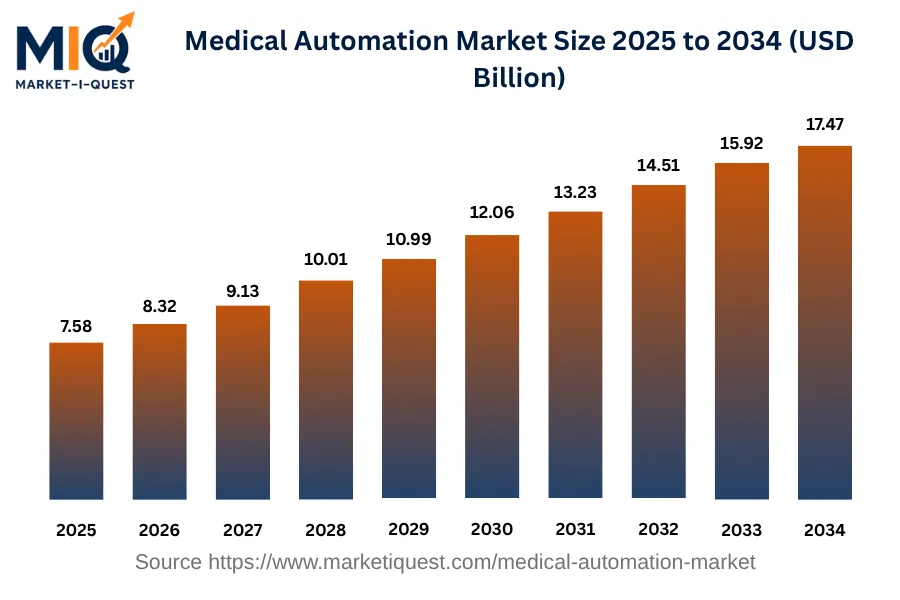
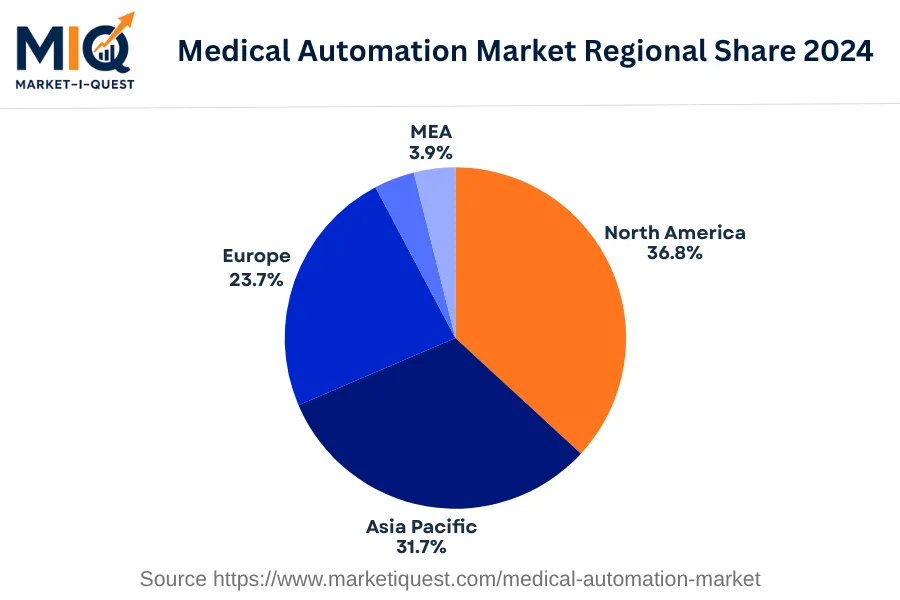
The Medical Automation Market, valued at USD 7.58 billion in 2025, is projected to grow to USD 17.47 billion by 2034. This represents a compound annual growth rate (CAGR) of 9.72%. The market's growth between 2025 and 2034 is a reflection of the 133.70% increase in market value over this period, showing a strong trend towards heightened investment and value in the field of medical automation. This growth is indicative of the rising adoption, increasing technological advancements, and growing healthcare infrastructure. As of 2024, the global market share was distributed across various regions; North America accounted for 36.84% of the market followed by Asia Pacific with 31.72%, Europe holding a 23.68% share, whilst Latin America and the Middle East and Africa held comparatively lower shares at 3.84% and 3.92% respectively.

Key Takeaways

  • By Type - Lab & Pharmacy Automation held a major share in the Medical Automation Market.
  • By End User - Hospitals & Diagnostic Centers led in market dominance accounting for notable share in the market.
medical-automation-market market size

Key Driving Factors

Enforcement of Regulatory Guidelines on Pharmaceutical Industry

In an effort to improve safety and efficiency in the pharmaceutical industry, various regulatory bodies such as the US Food & Drug Administration (FDA) and the European Medicines Agency (EMA) have enforced stringent guidelines and standards. The aim is to reduce human oversight and inconsistencies in testing protocols and trial conduct. Regulatory requirements promote the adoption of automated systems, which significantly enhance accuracy and mitigate risk of errors. These stringent policies compel pharma companies to integrate automation for activities like new drug discovery, clinical trials, batch manufacturing, and quality testing. The need to adhere with these regulations is a key driving force for the adoption of automation in the medical sector.
Population Aging and Rise in Chronic Diseases

The rise in the ageing population, particularly in developed countries, and the growing prevalence of chronic diseases worldwide, increase the demand for efficient healthcare services. This has given rise to the need for automated solutions that can help healthcare professionals handle the large inflow of patients, and ensure effective management of limited resources. Automated solutions like electronic health records (EHRs), telehealth solutions, medication management systems, and automatic appointment scheduling software become increasingly important to handle high patient volumes and to ensure quality care. Healthcare providers, thus, are actively deploying medical automation tools to handle these challenges.

Market Evolution by Timeline

2019-2023
In this period, hospital laboratories were the major buyers of medical automation technology, purchasing it primarily to improve productivity and reduce human error. Regions like North America and Europe dominated consumption due to their advanced healthcare infrastructure and higher levels of healthcare spending. Suppliers, largely medical device manufacturers, released desktop automation systems and pharmacy automation systems. However, these solutions suffered from limited integration capabilities. Policies such as the EU MDR and IVDR influenced the adoption of these technologies, directing manufacturers to enhance product safety features. The typical commercial model was the outright purchase of equipment, although some suppliers offered leasing. Major challenges included the high cost of automated systems and resistance from healthcare professionals.
2024
This year saw a shift in demand source as medical research institutes and pharmaceutical companies became significant buyers of automation equipment. They invested in these technologies for high throughput screening and compound management. Countries like China showed increased interest in automation owing to their expanding healthcare sector. Products such as automated microbial identification systems and automated cell culture systems appeared in the market from suppliers that now included tech firms. Despite increased adoption, data security emerged as a challenge, with entities like the FDA advocating for better cybersecurity measures. Contractual service agreements became more common in the commercial space, addressing pricing limitations.
2025-2029
Through these years, governments and healthcare providers prioritized automation for home healthcare services, especially in developed regions dealing with aging populations. Companies started delivering remote patient monitoring systems and medication dispenser systems. Government initiatives like Singapore's 'Smart Nation' program encouraged these developments, but concerns about the interoperability of various systems persisted. Subscription-based models appeared as feasible alternatives to buying expensive equipment. New risks associated with privacy and reliability triggered stricter regulations and the creation of standards by bodies such as ISO for medical device software.
2030-2034
In the first half of this decade, the focus shifted toward automation for preventative healthcare. Healthcare providers were the key buyers, particularly in regions like Africa and South America, which are working on improving their healthcare infrastructure. Products that became mainstream included wearable health monitoring devices and telemedicine. Data analysis automation tools also gained popularity, with artificial intelligence becoming an integral part of healthcare services. Policies endorsing digital health strategies were key motivators, with entities like the WHO launching digital health departments. The market saw the expansion of integrated solutions, as patients sought comprehensive packages covering multiple aspects of healthcare.

Future Market Outlook

Future Opportunities

As automation technology matures in the medical field, future opportunities are emerging for enhanced patient care and operational efficiency. In 2023, major hospitals, including Cleveland Clinic and Mayo Clinic, are exploring partnerships with tech companies to develop next-generation robotic surgical tools, aiming to optimize surgical outcomes. Artificial intelligence presents opportunities in predictive analytics, particularly in patient risk assessments, with initiatives like IBM Watson Health collaborating with healthcare organizations to create algorithms based on extensive patient data. Additionally, the telehealth sector continues to expand, driven by regulatory support such as the Medicare Telemedicine Access Act of 2022, which facilitates access to care for rural communities. Advanced data analytics is likely to play a pivotal role in personalized medicine, as companies like Tempus utilize genomic data to tailor treatment strategies. Cybersecurity remains a critical focus, particularly with increasing threats to healthcare data integrity, prompting organizations to invest in robust security frameworks based on NIST guidelines. Furthermore, automation in supply chain management for medical devices and pharmaceuticals presents an avenue for improving efficiency, as seen in partnerships between manufacturers and automation developers. These trends signal a transformative phase where enhanced collaboration between healthcare providers and technology developers can lead to reliability in service delivery, benefiting both patients and practitioners globally.

Segmentation Analysis

By Type

The market is divided into various subsegments including Diagnostic & Monitoring Automation, Therapeutic Automation, Lab & Pharmacy Automation, Medical Logistics & Training. Among these, Lab & Pharmacy Automation accounted for the largest revenue share while Therapeutic Automation is expected to grow at the fastest CAGR during the forecast period.

Largest Revenue Share

Lab & Pharmacy Automation

Market Share Leader

Lab & Pharmacy Automation holds the most significant revenue share in the market, primarily driven by escalating healthcare expenses and the increasing demand for precision medicine. It is observed that hospitals and pharmacies are leaning heavily into automation to improve efficiency, reduce errors, and save costs. This is due to the rising pressure to manage operational costs while adhering to stringent regulatory compliance that mandates error-free operations. In addition, Labs are automating to increase productivity, hoping to alleviate the ongoing labor shortages drastically affecting the industry. Geography also plays a significant role in this subsegment's growth, with developed regions like North America and Europe leading the way due to higher adoption rates of automated system and stringent regulations. However, with the growing healthcare infrastructure, upcoming economies like Asia-Pacific also contribute to substantial revenue generation. Further influencing this subsegment is the fact that purchasing decisions are mostly based on system reliability and regulatory compliance, leading to high switching costs.

Fastest CAGR

Therapeutic Automation

Forecast Period Growth Leader

Therapeutic Automation is expected to witness the fastest growth in the coming years. The accelerating adoption of technology in the healthcare sector, coupled with shifting healthcare practices towards customized patient-centered approaches, is playing a catalyst role in this subsegment's growth. Advances in technology, such as AI and robotics, have made way for automated therapeutic solutions, further driving market growth. However, the high cost of the advanced technology serves as a barrier to adoption, particularly in underdeveloped regions. For this to change, policy changes that encourage technological integration into healthcare tend to play a significant part, particularly around capital expenditure. Moreover, the formation of strategic partnerships between healthcare providers and software companies, targeting to provide enhanced healthcare services, is triggering the rapid adoption of therapeutic automation. However, near-term risks such as data security and the integrity of automated systems may pose a challenge. It's vital to note, this analysis assumes that the adoption of Therapeutic Automation will continue to increase at the current pace.

By End User

The market segments of end-user dominated by hospitals & diagnostic centers, pharmacy, research labs & institutes, and others. In the base year, hospitals & diagnostic centers led in revenue while research labs & institutes are poised to exhibit the fastest growth.

Largest Revenue Share

Hospitals & Diagnostic Centers

Market Share Leader

Hospitals & Diagnostic Centers represent the largest revenue segment mainly due to the comprehensive nature of care they offer, combined with the continuous patient inflow needing a broad range of diagnostic and therapeutic services. These centers have state-of-the-art equipment and enhanced infrastructure which aids in more precise diagnostics and efficient treatment. The high operational costs are covered by the increasing patient volume, thereby maintaining a steady revenue stream. Regulations favoring in-house diagnostic testing are also a contributing factor as it ensures quality control and patient convenience. In some geographies, especially densely populated urban areas, the presence of hospitals and diagnostic centers is more significant, leading to higher demand and thus revenue from these segments. Furthermore, the purchasing criteria for hospitals involve high-quality products and services due to strict quality mandates, leading to significant expenditure in this segment.

Fastest CAGR

Research Labs & Institutes

Forecast Period Growth Leader

Research Labs & Institutes are expected to record the fastest growth in the coming years. The primary growth driver is the escalating interest and investments in research activities, particularly within the medical and pharmaceutical domains. Technological advancements and improvements in research methodologies are catalyzing the rapid adoption of innovative tools and practices. Government policies supporting research and development in healthcare and high capex in the research sector provide a conducive atmosphere for growth. However, these institutions face specific adoption barriers like the need for high capital investment and skilled manpower. It's also important to note near-term risks such as the tightening of budgets in certain countries and uncertainties related to policy changes, potentially affecting the institutions' expansion and their uptake of new technologies.

Competitive Analysis: Medical Automation Market

Key Market Players

Manufacturers / OEMs

Siemens Healthineers
Germany
Swisslog Holding AG
Switzerland
Stryker Corporation
US

Key Suppliers & Raw Materials

Medtronic PLC
Ireland
Philips Healthcare
Netherlands
GE Healthcare
US

Distributors, Integrators & Channel Partners

Omnicell, Inc.
US
Beckman Coulter, Inc.
US
Stanley Black & Decker, Inc.
US

Porter’s Five Forces Analysis

Analysis of the competitive industry environment affecting the Medical Automation Market.

Supplier Bargaining Power

Medium

Suppliers' control enhanced by the specialized knowledge and advanced technology required in medical automation.

Buyer Bargaining Power

Low

Limited by highly specialized needs and high switching costs in the healthcare sector.

Threat of Substitutes

Low

Limited by the absence of efficient substitutes for accurate and precise automated medical processes.

Threat of New Entrants

Low

Restricted by massive upfront capital investments, stringent approvals, and clearances required in the healthcare sector.

Competitive Rivalry

High

Fierce due to the presence of established players and constant innovation in this technology-driven market.

Regional Analysis

Geographic market dynamics and growth opportunities across key regions

Global Market Outlook

medical-automation-market market regional share

North America

In 2024, North America's Medical Automation Market was advancing amid a competitive healthcare landscape. Among drivers, growing patient-centric healthcare, enabled by regulatory support to streamline operations, stimulated demand. This pushed medical providers in countries like the U.S., Canada, and Mexico to adopt automation technologies rapidly. Secondly, substantial investment in healthcare infrastructure, particularly in the U.S., improved supply-side dynamics. Moreover, advancements in medical imaging and diagnostics technology spurred adoption, while competitive pricing strategies by manufacturers facilitated access to automation tools.

On the trend front, a shift towards the digitization of health records became prominent, mainly in enterprise and government healthcare units. The use of artificial intelligence for predictive analyses in diagnosing diseases also gained ground. Developments in telemedicine, influenced by changing lifestyle patterns in North American societies, emerged as a disruptive channel dynamic. Additionally, partnerships and M&A activities intensified among technology companies and healthcare providers to capitalize on market potential. Lastly, stricter policy enforcement regarding patient data security, like the Health Insurance Portability and Accountability Act (HIPAA) in the U.S., shaped norms and practices in the Medical Automation Market.

Asia Pacific

In 2024, the Medical Automation Market in the Asia Pacific region was in a dynamic state of transformation, primarily driven by advancements in technology, increased healthcare spending, and rising demand for accuracy and efficiency in medical procedures. The growing geriatric population in key economies like Japan coupled with the rise in chronic disorders in India and China led to increased demand for automated medical solutions. Countries like South Korea and Australia saw regulatory initiatives pushing investments into AI-based healthcare, driving automation in diagnostics and therapeutic procedures. Furthermore, radical technology adoption trends were observed in China due to substantial public and private health-tech investments.

Prominent trends highlighted the significant shift in buyer behavior favoring digital health platforms, with greater acceptance of robotics in major surgeries in Japan and South Korea. The massive outbreak of chronic diseases across the region directed many companies and startups to forge partnerships, leading to an increase in M&A activity, primarily in the digital health sector. Governments of key ASEAN markets enforced stringent policies in 2024 to standardize the implementation of automated healthcare services, aligning them with global best practices. This was particularly noticeable in tertiary sectors like healthcare institutions and in the manufacturing of automated medical devices. Overall, it was a year of vigorous change and growth for the Medical Automation Market in the Asia Pacific region.

Europe

In 2024, the European Medical Automation Market demonstrated robust growth, driven by multiple factors. Adoption of advanced technologies, such as AI and robotics in the healthcare sector, was one significant driver. Key markets like Germany and the United Kingdom saw increased investment in digital health, contributing to the industry's marked expansion. Regulatory policies in Europe, including GDPR rules, also catalyzed the growth, prompting healthcare organizations to automate data-intensive processes. Concurrently, there was a demand increase in home-based care devices due to supplier dynamics, including new product launches and competitive pricing, particularly notable in France and Italy.

Trends shaping the market included a shift towards remote patient monitoring and telemedicine, predominantly in Spain and the Nordics due to the ongoing digitization of their healthcare systems. In addition, the growth of partnerships and mergers in the market space was observed, especially in Benelux and Central & Eastern Europe, driven by the need for integrated automated healthcare solutions. Importantly, there was an increased enforcement of medical device standards, particularly in the UK and Germany, underpinning the trend towards improved patient safety and care quality. These developments involved a wide range of actors, from governmental organizations to healthcare providers and manufacturers, effectively revolutionizing European healthcare landscape in 2024.

Latin America

In 2024, the Medical Automation Market in Latin America (LATAM) displayed notable growth, particularly in Brazil, Mexico, Argentina, Colombia, Chile, and Peru, driven by various factors. Horizontal integration and increased investment in health technology spurred this progression, while government policies like Brazil’s Digital Health Strategy encouraged telematics integration. Moreover, the region's attempt to address vacant medical positions accelerated technology adoption, further stimulating market expansion. Several distinctive trends characterized the 2024 medical automation landscape in LATAM. A shift towards patient-centric models incentivized the implementation of telemedicine and remote patient monitoring, particularly in countries like Mexico, known for robust telecom infrastructures. Mergers and acquisitions, such as Brazil's Prevent Senior's purchase of healthcare startup Memed, shaped the diffusion of innovation across markets.

Countries like Colombia issued stricter policy enforcement promoting electronic health records, driving a significant uptick in health information systems. Primary sectors impacted included healthcare facilities, government health agencies, pharmaceutical companies, and tech-focused health start-ups. The adoption of automated medical solutions remained pervasive among these key stakeholders, given the drive to improve service delivery, streamline operations, and enhance patient experiences across these six nations in LATAM in 2024.

Middle East & Africa

In 2024, the Medical Automation Market in the Middle East and Africa saw considerable growth due to increased healthcare demands and advancements in technology. Key drivers included escalating healthcare needs due to rising population and chronic disease prevalence, especially in countries like Saudi Arabia, Nigeria, and South Africa. Governments across these regions initiated regulatory frameworks promoting medical automation, with the United Arab Emirates leading in investment and technology adoption. Furthermore, developments in infrastructure and supply dynamics, such as the implementation of e-health strategies in Egypt and Kenya, created a conducive environment for market growth.

Notable trends encompassed a shift toward digitized patient records, underpinned by an increase in telecommunication capabilities. In Israel, there was a visible tendency toward partnerships and M&A activities among healthcare providers and technology firms, steering the upsurge in health-tech solutions. Enforcement of data protection policies further encouraged the secure transition to automated healthcare systems. Sectors involved primarily included the government, healthcare, telecom and the financial services sectors. The utility of these systems was seen particularly in retail pharmacies, such as the ones in Qatar, adopting technology for error-free dispensation and inventory management. These factors shaped the medical automation market landscape in the Middle East and Africa in 2024.

Recent Industry Developments

Latest market innovations, product launches, and strategic initiatives

January 2026

The FDA issued two final guidance documents: one on general wellness products and another on clinical decision support (CDS) software. The updated CDS guidance revised the definition of "automation bias" and adjusted how the agency evaluates the level of software automation and its associated risk in medical decision-making.

August 2025

Haier Biomedical established a strategic partnership with Thailand's RAM Medical Group. The partnership will first pilot pharmacy automation solutions, including outpatient pharmacy automation systems and intelligent inventory management modules.

Frequently Asked Questions