Masterbatch Market Snapshot

Key Players

  • PolyOne Corporation (US)
  • Clariant AG (Switzerland)
  • Cabot Corporation (US)
  • Tosaf Compounds Ltd. (Israel)
  • Plastika Kritis S.A. (Greece)
  • A. Schulman Inc. (US)
  • Ampacet Corporation (US)
  • Hubron International (UK)
  • Polyplast Muller GmbH (Germany)
  • Ferro Corporation (US)

Market Size

Base Year 2024
$13.58 Bn
CAGR
5.91%
Forecast 2034
$24.11 Bn

Market Segments

By Type
  • White Masterbatch
  • Filler Masterbatch
  • Color Masterbatch (Standard Color
  • Specialty Color
  • Tailor-Made Colors)
  • Black Masterbatch
  • UV Masterbatch
  • Additive Masterbatch
By Polymer
  • PP (Polypropylene)
  • PE (Polyethylene) (HDPE
  • LDPE
  • Others)
  • PVC (Polyvinyl Chloride)
  • PS (Polystyrene)
  • Others
By Application
  • Packaging
  • Construction Materials
  • Automotive Components
  • Electrical & Electronic Components
  • Agricultural Films
  • Consumer Goods
  • Others

Market Dynamics

Drivers
  • Increasing demand in plastics industry
  • Growth in packaging sector
Restraints
  • High production cost
  • Strict environmental regulations
Opportunities
  • Emerging regions' untapped potential
  • Advancement in plastic industry

Market Size

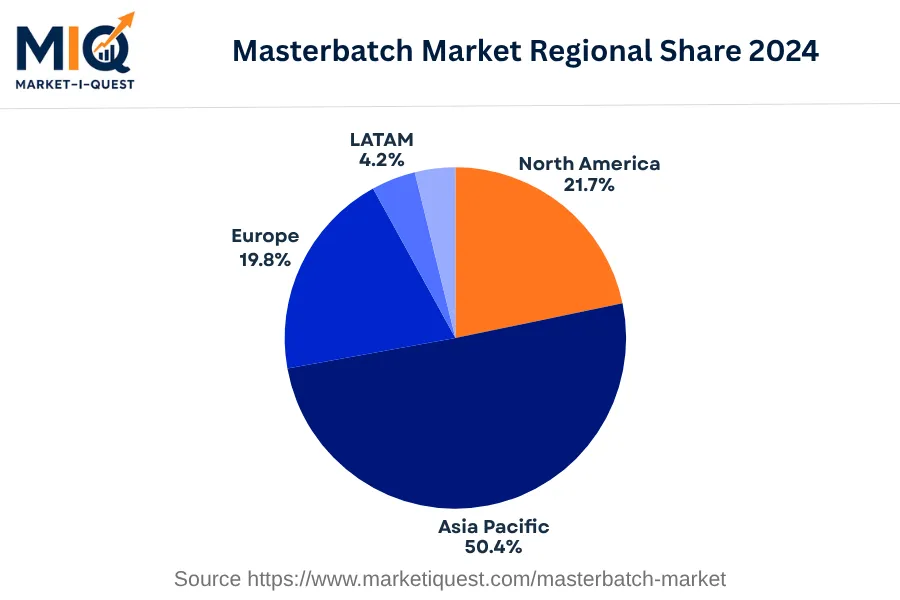
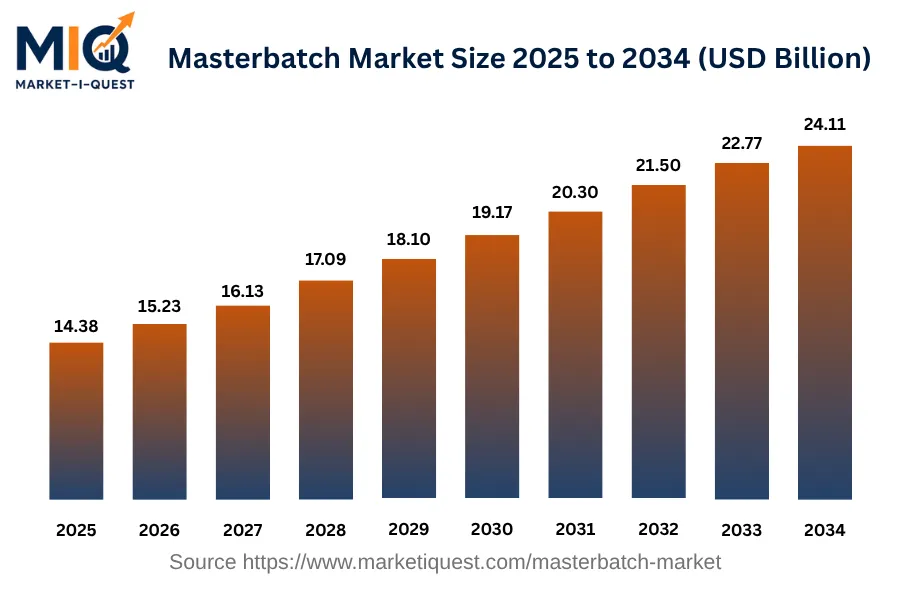
The Masterbatch Market kicked off with a value of $14.38 billion in 2025. Over the next nine years, the market demonstrated a solid trajectory, leading up to a total of $24.11 billion by 2034. This represents a compound annual growth rate (CAGR) of 5.91%, underlining a steady expansion within the sector. Several factors contributed to this upward trend; the primary being the escalating demand for plastics across various industries. Secondly, the widespread application of Masterbatch to modify the physical properties of plastic further augmented market growth over the years. Finally, plastic's popularity as a sustainable, inclusive, and affordable solution gave the Masterbatch market a significant boost. In terms of regional distribution in 2024, the Asia Pacific had the largest share at 50.42%, followed by North America with 21.73%. Europe secured 19.84% of the market whereas Latin America and the Middle East and Africa (MEA), held smaller shares with 4.18% and 3.83% respectively, indicating a more dispersed market landscape globally.

Key Takeaways

  • By Type - Color Masterbatch held the major market share in the Masterbatch Market.
  • By Polymer - PE (Polyethylene) emerged as the top used masterbatch in the market.
  • By Application - Packaging dominated the Masterbatch Market accounting for a significant share.
masterbatch-market market size

Key Driving Factors

Shift towards Sustainable Packaging

A key factor driving the Masterbatch market is the rising sector of sustainable packaging. To mitigate the environmental impact, many packaging companies are transitioning from traditional plastics to biodegradable options, increasing the demand for biodegradable masterbatches. Moreover, consumers are becoming more conscious of their environmental footprint, prompting businesses to meet these preferences with eco-friendly packaging solutions. Masterbatch manufacturers are adapting by developing new formulas that allow for the easy incorporation of masterbatches into biodegradable materials. This strategic positioning into the sustainable packaging sector is propelling the Masterbatch market forward.

Regulation Compliance in Food Industry

Stricter rules from global food regulatory bodies also drive the Masterbatch market. FDA in USA, European Food Safety Authority in Europe, and similar entities worldwide, have regulations regarding the packaging involved in food & beverage industry. This necessitates the use of safe colorants and additives for food packaging, a need that masterbatches cater to precisely. These regulatory bodies mandate the use of materials that do not transfer hazardous substances into food, which results in a higher demand for food-grade masterbatches. Therefore, to meet these safety standards in food & beverage packaging, manufacturers are increasingly using masterbatches, which in turn is pushing the growth of the Masterbatch market.

Market Evolution by Timeline

2019-2023
During this period, Asia Pacific was the leading buyer of Masterbatch products, driven primarily by its booming construction and automotive sectors. Indian and Chinese manufacturers increased their production capacity to meet this region's demand. The adoption rate was moderate due to initial integration challenges with plastic products. The EU's Restriction of Hazardous Substances Directive had a restrictive impact on certain Masterbatch elements. Suppliers primarily followed a direct pricing approach based on material cost and processing fee. A major risk was the fluctuation in raw material prices, causing cost instability across the supply chain.
2024
This year signaled a growth in demand from Europe, especially for eco-friendly Masterbatch variants in response to environmental concerns. Technological improvements bridged the integration gap with plastic solutions, but constraints were faced in scaling up production due to equipment limitations. Manufacturing standards like ISO 9001:2015 grew prevalent for quality assurance. Manufacturers adopted a mixed pricing model to accommodate cost fluctuations, including fixed-cost, variable-cost, and lump-sum contracts. The challenge was the limited supply of eco-friendly alternatives to avoid usage of restricted elements.
2025-2029
The need for advanced plastic solutions increased the Masterbatch demand in North America. Manufacturers attempted to minimize supply constraints with the introduction of more efficient production systems. EU's Single-Use Plastics Directive influenced more sustainable production methods. Hybrid pricing models became common, combining elements of time and materials contracts with fixed-price elements. One risk lay in slower adoption relative to available technologies, partly due to buyers' procurement strategies prioritizing long-term contracts to mitigate price instability.
2030-2034
This period's demand primarily came from emerging economies in Africa and Latin America. Suppliers expanded their production facilities, but the delivery logistics became more complex due to scattered buyer locations. Regulations such as Kenya's National Plastics Action Plan influenced demand for bio-based Masterbatch products. Decentralized bulk-pricing models started to dominate, giving advantage to large-scale buyers. With enhanced supply capabilities, manufacturers had to handle increased logistics and warehousing risks. Supplier response typically included investment in local distribution channels and storage facilities.

Future Market Outlook

Future Opportunities

The future of the masterbatch market is poised for substantial growth driven by initiatives aimed at sustainability and innovation in material science. The ongoing commitment of the United Nations towards achieving Sustainable Development Goals is prompting manufacturers to prioritize eco-friendly materials. Major players, including Cabot Corporation, are actively researching biocompatible masterbatches and have established collaborations with universities to explore new biomass sources. The global shift towards electrification in automotive applications presents opportunities for specialized masterbatches designed for enhanced thermal stability and electrical conductivity. In December 2022, Volkswagen announced plans to increase the use of lightweight materials, thereby increasing demand for high-performance masterbatches, particularly in their electric vehicle models. Additionally, with regulatory bodies like the U.S. Environmental Protection Agency emphasizing the reduction of hazardous substances in plastics, companies are investing in color masterbatches free from heavy metals and phthalates; for instance, the recent launch of ColorMatrix by Polyone in 2023 is a direct response to these concerns. There is also significant potential in the packaging industry, sparked by the rise of e-commerce; companies such as Tetra Pak are focusing on developing masterbatches that enhance barrier properties and extend shelf life. These sustainable innovations indicate a shift in consumer preferences and regulatory expectations, setting the stage for growth in demand for specialized masterbatches.

Segmentation Analysis

By Type

The market is divided into subsegments including White Masterbatch, Filler Masterbatch, Color Masterbatch (Standard Color, Specialty Color, Tailor-Made Colors), Black Masterbatch, UV Masterbatch, and Additive Masterbatch. Color Masterbatch accounted for the largest revenue share while the UV Masterbatch is expected to grow at the fastest CAGR during the forecast period.

Largest Revenue Share

Color Masterbatch

Market Share Leader

The Color Masterbatch subsegment boasts the largest revenue share in the market, and several factors contribute towards this. This segment particularly excels in providing a vast array of colors, offering standard, specialty, and tailor-made colors. Such versatility ensures appeal to varying customer preferences, enhancing its market share. Furthermore, the rise in disposable income and evolving consumer patterns have increased demand for plastics in various sectors, in turn promoting usage of color masterbatches. The manufacturing industry, for instance, extensively utilizes masterbatches due to their cost-effectiveness and high-quality color consistency, bolstering revenue in this segment. On the regulatory front, Masterbatches generally comply with FDA and REACH regulations, making them feasible for use in food and other sensitive applications. Additionally, innovation and technological advancements in the field are expanding customer base, with particular growth in the use of sustainable and bio-degradable masterbatches.

Fastest CAGR

UV Masterbatch

Forecast Period Growth Leader

At a fast pace, the UV Masterbatch subsegment is showing the quickest growth CAGR in the forecast period. This accelerated growth can be attributed to the increasing need for UV stabilization in various end-use industries, including packaging, agriculture, and automotive industries. The exceptional protection these materials provide against harmful UV radiation, along with the durability they offer in resistance to wear and tear, significantly contribute to their growing adoption. Furthermore, the increasing presence of masterbatches in outdoor applications has spotlighted its importance, especially in regions with high sunlight exposure. Despite initial barriers concerning cost, the advantages of superior UV protection are persuading industries to invest in UV Masterbatches. Additionally, technology advancements, ongoing research and development activities, regulatory support, increasing partnerships, and the rise of local manufacturers are all acting as catalysts to drive the growth. However, short-term risks include supply chain disruptions and potential price volatility due to fluctuating raw material costs.

By Polymer

The Polymer market is divided into subsegments including PP (Polypropylene), PE (Polyethylene) (HDPE, LDPE, Others), PVC (Polyvinyl Chloride), PS (Polystyrene), and Others. PE (Polyethylene) has accounted for the largest revenue share, while PVC (Polyvinyl Chloride) is projected to register the fastest growth during the forecast period.

Largest Revenue Share

PE (Polyethylene)

Market Share Leader

PE (Polyethylene) reigns supreme in revenue generation due to its wide array of applications across multiple industries, such as packaging, construction, agricultural, and automotive sectors. Its versatility is a key driver of this performance; the variations in density (HDPE, LDPE and others) allow for different characteristics appealing to a broad range of uses. HDPE, for example, is known for its tensile strength and is commonly used in products such as piping systems. LDPE, on the other hand, has superb flexibility, making it a choice material for film applications and flexible packaging. The demand for these products remains high globally, naturally translating into substantial revenue for the PE subsegment. Furthermore, emerging markets continue to demonstrate an escalating need for PE products due to significant industrial growth and development activities, further reinforcing the subsegment's revenue leadership.

Fastest CAGR

PVC (Polyvinyl Chloride)

Forecast Period Growth Leader

PVC (Polyvinyl Chloride) is expected to experience the fastest growth rate in the coming years. This is attributed to its cost-effectiveness, durability, and adaptability in various applications including building and construction, health care, electronics, automobile, and others. A surge in infrastructural development, particularly in developing regions, contributes greatly to the heightened demand for PVC. This material's flame resistance, a critical factor in building and construction applications, also promotes its growth in the industry. Additionally, advancements in production methods have reduced the harmful environmental effects linked with PVC manufacturing, which eliminates a significant barrier to PVC adoption. However, fluctuations in raw material prices may pose a short-term challenge to this growth trajectory. The rise in collaboration efforts between key market players for technological advancements is expected to ease this concern and catalyze the subsegment's growth.

By Application

The market is divided into subsegments including Packaging, Construction Materials, Automotive Components, Electrical & Electronic Components, Agricultural Films, Consumer Goods, and Others. Among these, Packaging accounted for the largest revenue share while Agricultural Films is expected to grow at the fastest CAGR during the forecast period.

Largest Revenue Share

Packaging

Market Share Leader

The Packaging subsegment has managed to secure the largest revenue share due to several driving factors. First is the sustained industrial growth across various sectors such as food and beverages, pharmaceuticals, and other consumer goods which are immediate users of packaging. This industrial growth has led to an increased demand for packaging materials and solutions. Another factor bolstering this subsegment's revenue is the rise of e-commerce, which demands efficient and durable packaging solutions. Geographically, rapid urbanization and increased consumer spending particularly in emerging economies have also contributed to the rise in demand for packaging. These trends point to a continuation of Packaging's revenue dominance, given no game-changing industry disruptions.

Fastest CAGR

Agricultural Films

Forecast Period Growth Leader

While it may not currently command the lion's share of the revenue, the Agricultural Films subsegment is positioned for rapid growth. The key growth driver for this subsegment is the increasing global push towards high-efficiency agricultural practices, optimizing resource use, and improving crop yield via innovative technologies, in which agricultural films play a vital role. Furthermore, regulatory policies are increasingly encouraging sustainable agricultural practices which directly benefit the growth of this subsegment. However, market players need to be wary of near-term risks such as the potential for stringent environment regulations that may impose restrictions on certain types of agricultural films. Advancements in biodegradable agricultural films and partnerships with agritech firms could serve as effective strategies to overcome these challenges and capitalise on the subsegment's growth potential.

Competitive Analysis

Key Market Players

Manufacturers / OEMs

Clariant
Switzerland
PolyOne
US
Plastika Kritis S.A.
Greece

Key Suppliers & Raw Materials

Ampacet Corporation
US
Tosaf Group
Israel
BASF SE
Germany

Distributors, Integrators & Channel Partners

RTP Company
US
Ferro Corporation
US
A. Schulman, Inc.
US

Porter’s Five Forces Analysis

This analysis provides an overview of the competitive forces affecting the Masterbatch Market.

Supplier Bargaining Power

Medium

Suppliers' power is influenced by the availability of raw materials and their pricing variability.

Buyer Bargaining Power

High

Buyers enjoy high power due to the presence of multiple suppliers and low switching costs.

Threat of Substitutes

Low

Low threat due to the specific properties and functionality of masterbatches in various applications.

Threat of New Entrants

Medium

Moderate threat due to entry barriers like heavy investments in technology and regulatory requirements.

Competitive Rivalry

High

High rivalry due to the presence of numerous international and local companies in the market.

Regional Analysis

Geographic market dynamics and growth opportunities across key regions

Global Market Outlook

masterbatch-market market regional share

North America

The Masterbatch market in North America, in the base year of 2024, was characterized by a robust development arc. On the drivers' side, demand was primarily steered by expanded plastic usage in the consumer electronics, automobile, and packaging sectors. Governmental regulations promoting sustainable, eco-friendly products, especially in the U.S and Canada, stimulated investment in biodegradable and organic masterbatches. Rapid technology integration, notably machine learning and artificial intelligence for improved production efficiency, infused dynamism into the market. However, supply was slightly restrained by periodic raw material price fluctuations. In terms of trends, a clear shift was noted in buyer preference towards customized masterbatches to match the specific color and performance needs of their products. Increasing partnerships and mergers amongst key market players facilitated significant technical developments, thereby enhancing the market's competitive landscape.

The rigorous enforcement of standardization policies to maintain quality played a pivotal role in shaping the market trends. End-user sectors such as healthcare and manufacturing significantly influenced the market. Manufacturers sought high-quality masterbatches for enhancing the appearance and performance of their products, while the healthcare sector's demand was driven by the need for effective packaging solutions. Retail, on the other hand, had been prominent with the plastic industry for packaging, implying a direct influence on masterbatch market demand in North America.

Asia Pacific

In 2024, the Masterbatch market in Asia Pacific witnessed significant dynamism driven by demand factors, technological adoption, and pricing. Increasing demand for plastics in prominent sectors such as automotive, pharmaceutical, and consumer goods propelled the market. India and China's robust growth in the manufacturing sector stimulated this surge, leading to heightened masterbatch usage. Additionally, technological enhancements in masterbatch production, particularly in Japan and South Korea, further fuelled market growth. Trends observed within this market involved changing consumer behaviors and shifts in product technology. The demand for eco-friendly masterbatches increased noticeably, powered by government initiatives towards green manufacturing in China and ASEAN countries. Widespread adoption of innovative product technologies, such as additive and filler masterbatches, was also notable. Channel dynamics revealed a growing preference for online purchasing in Australia, leading to e-commerce platforms becoming significant sale points.

In terms of partnerships and M&A, companies attempted to expand their regional footprint; for example, India's predominant masterbatch producer, Plastiblends, purchased several boutique firms. Regulatory bodies emphasized enforcement of stringent environmental policies, noticeable in Japan's efforts to curb microplastic pollution. Therefore, the Masterbatch market in 2024 was a sphere of heightened activity, fueled by rising demand, technological advancements, changing purchasing behavior, and the broader shift towards sustainable manufacturing practices.

Europe

In 2024, the European Masterbatch market witnessed a significant operational environment shaped by both market drivers and emerging trends. Key drivers included rigorous environment regulations pushing for non-toxic and biodegradable components resulting in alternative product innovation primarily in countries like Germany and the United Kingdom. A surge in investment in the manufacturing sector, especially in Central & Eastern Europe and the adoption of advanced technologies such as artificial intelligence and automation in the production process, represented another influential market dynamic. Concurrently, the market transitioned through a few notable trends as well, including a shift in buyer preference towards personalized and premium products. This was particularly evident in the retail sector in Spain and Italy. Further, increased partnerships and M&A among key players to expand their market presence was observed, with high activity levels in the Benelux region.

A heightened policy enforcement involving packaging standards in countries such as France and the Nordics also defined the market’s trajectory. In essence, the European Masterbatch market in 2024 was widely impacted by regulatory controls, technology incorporation, changes in consumer preference, corporate consolidation, and strict adherence to industry standards, with sectoral implications extending to government, manufacturing, retail, and utilities.

Latin America

In 2024, the Masterbatch market in Latin America (LATAM) demonstrated significant growth due to robust demand from industries such as packaging, agriculture, and automotive. Regulatory pushes towards environmental sustainability catalyzed increased investment in bio-based masterbatches, predominantly seen in Brazil and Mexico where plastic waste management is prioritized. Argentina's industrial growth coupled with technological adoption led to the proliferation of advanced color masterbatch. Meanwhile, in Colombia, Chile, and Peru, the dominance of local mineral resources influenced the availability of filler masterbatch significantly, impacting supply dynamics.

A key market trend was the shift towards greener alternatives, with companies across LATAM initiating the shift from petroleum-based carriers to bio-degradable ones, especially in the packaging sector. The fragmentation of the market instigated a series of partnerships and M&A activities, promoting the integration of SMEs into larger, more diverse corporations. Colombia set a regional example with its enforcement of policy dictating the mandatory use of Oxo-degradable masterbatches in packaging materials. Consumer preference leaned towards high-quality, durable products, pushing companies to innovate in durability-enhancing additives in masterbatches. Lastly, there was a noticeable incline in digital sales channels, reducing dependency on traditional distribution networks and enabling wider reach, particularly in remote locations.

Middle East & Africa

In 2024, the Masterbatch Market in the Middle East and Africa demonstrated considerable activity. Market drivers included increased demand from the packaging sector in countries like Saudi Arabia and Egypt, growing governmental regulations endorsing environmentally friendly solutions, and significant investment in technological innovation from economies like United Arab Emirates. The availability of raw materials like polymers significantly affected supply dynamics in Nigeria and Kenya, while competitive pricing strategies were operational in established markets like Israel and South Africa.

Trends within this market painted an engaging narrative. A stiff rise in bio-based masterbatch purchases, particularly in the manufacturing and retail sectors, showed a significant shift towards sustainable options across the region. A technological shift was also evident within the market, with increased adoption of digital color-matching tools in South Africa and Israel. In terms of channel dynamics, countries such as Saudi Arabia and UAE observed a growth in direct sales to the end user, bypassing the traditional distribution channels. Policy enforcement regarding plastic use and waste management in countries like Egypt and Qatar led to partnerships for waste stream management and reinforced the need for eco-friendly materials. Overall, the market was buoyed by the interplay of heightened demand, regulatory enforcement, and technological innovations in 2024.

Recent Industry Developments

Latest market innovations, product launches, and strategic initiatives

March 2026

Luk Plastcon introduced Metallocal, a patent-pending calcium carbonate-based masterbatch for multilayer blown film applications at PlastIndia 2026, priced at approximately Rs 75–80 per kg, allowing partial substitution of higher-cost resins while retaining essential mechanical properties.

June 2025

Black Swan Graphene entered into a non-exclusive distribution and sales agreement with METCO Resources, allowing METCO to supply Black Swan's graphene-enhanced masterbatches (GEM™) across polymer applications in India's industrial, packaging, automotive, and construction sectors.

Frequently Asked Questions