
Loudspeaker Market Snapshot

Key Players

  • Bose Corporation (United States)
  • Harman International Industries (United States)
  • BANG & OLUFSEN A/S (Denmark)
  • Yamaha Corporation (Japan)
  • Bowers & Wilkins (United Kingdom)
  • Sonos Inc. (United States)
  • Klipsch Audio Technologies (United States)
  • Pioneer Corporation (Japan)
  • Focal-JMLab (France)
  • Dynaudio (Denmark)

Market Size

Base Year 2024
$9.71 Bn
CAGR
6.98%
Forecast 2034
$19.07 Bn

Market Segments

By Product Type
Soundbar, Subwoofer, In-Wall Speakers, Floor-Standing Speakers, Bookshelf Speakers, Ceiling Speakers, Outdoor Speakers, Portable Speakers, Other Product Types
By Connectivity Technology
Wired, Wireless
By Driver Type
Active, Passive
By Application
Communication, Home Entertainment, Automotive, Professional Audio, Public Address, Others
By End User
Residential, Commercial, Institutional, Automotive, Others

Market Dynamics

Drivers
  • Rising consumer spending
  • Increasing home theater popularity
Restraints
  • High product substitution threat
  • Rapid technology obsolescence
Opportunities
  • Smart device integration
  • Rising Audio Visual industry

Market Size

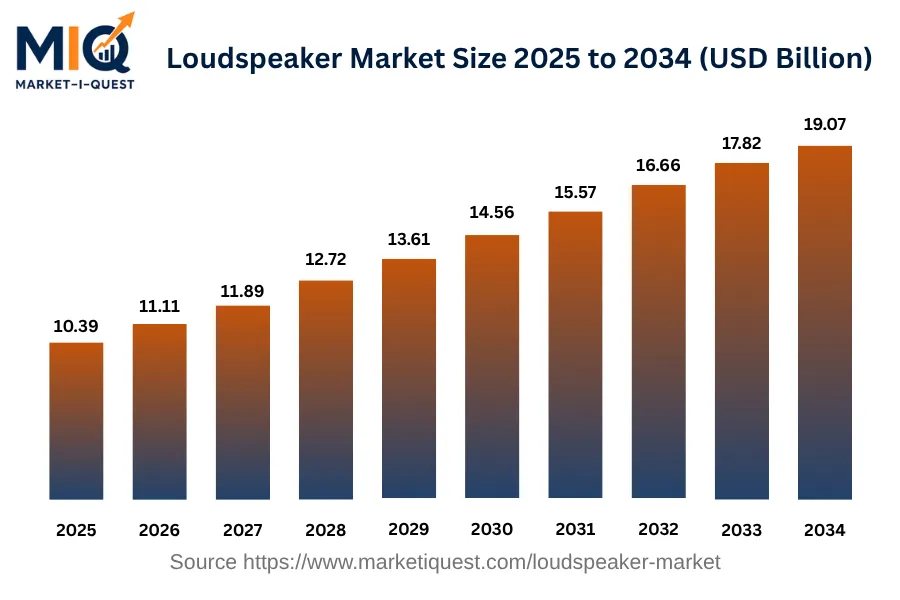
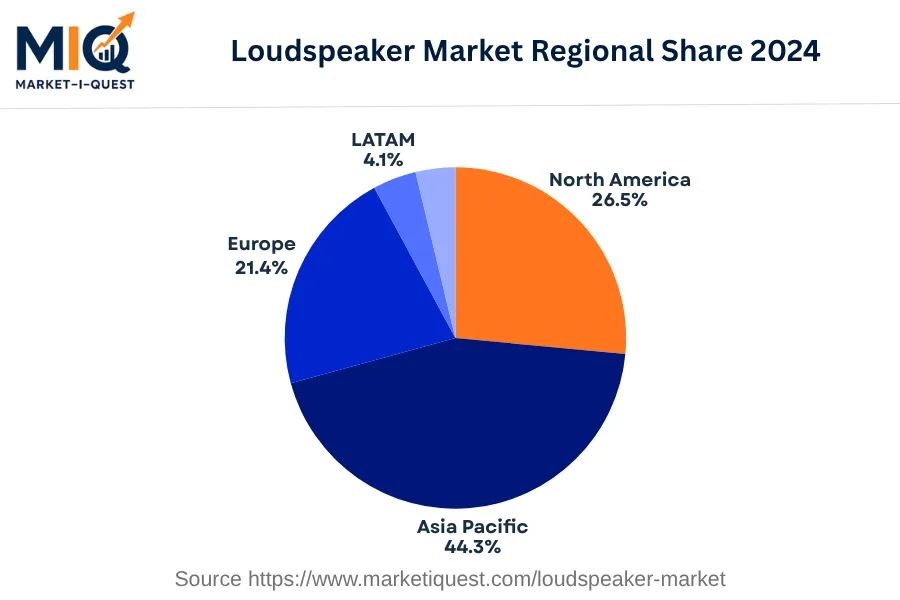
The Loudspeaker Market stood at USD 9.71 billion in 2024 and is projected to reach USD 10.39 billion in 2025. By the end of 2034, the market size is expected to increase to USD 19.07 billion, growing at a CAGR of 6.98%. The growth over this period signifies a nearly doubling of the market size, driven primarily by increased consumer spending and advancements in audio technology. These factors impersonate a steady incline in market value across the decade from 2024 to 2034, as evident from the year on year increases. As per the regional share in 2024, Asia Pacific held the largest share at 44.3%, followed by North America and Europe with 26.5% and 21.4% respectively. The Latin America and Middle East & Africa regions accounted for 4.1% and 3.8% of the market share respectively.

Key Takeaways

  • By Product Type -Portable speakers have evidently dominated the market contributing the largest share of revenue in 2024.
  • By Connectivity Technology - Wired speakers held the dominant position in 2024.
  • By driver type - Active led in the Loudspeaker Market marking a significant growth rate in 2024.
  • By Application - Professional Audio witnessed the highest consumption of loudspeakers in 2024.
  • By end user - Commercial accounted for the most significant share in the loudspeaker consumption in the same year.
loudspeaker-market market size

Key Driving Factors

Integration of Loudspeakers in Consumer Electronics

The integration of loudspeakers into consumer electronics products is a significant driver for the loudspeaker market. With increasing digitalization and connectivity, manufacturers are combining loudspeakers into various devices such as smartphones, laptops, and smart TVs. The push is primarily due to consumer preference for quality acoustics in personal and home entertainment devices. Manufacturers are actively investing in research and development efforts to fine-tune speaker design and optimize audio quality to meet consumer audio preferences. An example of this is the rise of soundbars in the home theater market, where consumers favor the minimalist form factor and superior sound quality. This increased bundling of quality speakers with consumer electronics is therefore driving growth in the loudspeaker market.
Increasing Utilization in Commercial Spaces

The expansion of commercial spaces such as shopping malls, office buildings, and hospitality establishments has led to an uptick in demand for loudspeakers. In the commercial setting, loudspeakers serve a multitude of functions beyond playing music. They are critical for public announcements, emergency situations, and creating ambiance, all of which hinge on clear and effective sound distribution. These requirements have led commercial space operators and managers to invest in high-quality loudspeaker systems to meet the diverse auditory needs. For instance, the increase in open-plan offices has created a need for sound masking technologies that rely on loudspeakers. Similarly, the rise of experiential retail emphasizes personalized in-store experiences, including sound design. This increasing commercial utilization is driving growth in the loudspeaker market.

Market Evolution by Timeline

2019-2023
During this period, a significant hike in loudspeaker demand was noticed from the consumer electronics sector, predominantly in China and India. This trend reflected the growing middle-class population's purchasing power. Automobile industries in Germany, Japan, and the US also saw an increased usage of advanced loudspeakers. Innovations in wireless technology like Bluetooth and Wi-Fi impacted the loudspeaker market. Regulatory programs, such as EU's RoHS, affected product composition to favor eco-friendly components. The commercial model inclined towards e-commerce platforms for distributing speakers due to enhanced customer reach. However, the primary risk was counterfeit products, prompting companies to secure supply chains.
2024
In 2024, smart home automation demand for loudspeakers increased, especially in US urban centers. Google's Home Mini and Amazon's Echo Dot products set the trend for smart speakers while using proprietary technology standards that were pioneering the Internet of Things. Tightened data security regulation also impacted how smart speakers were developed and marketed, causing companies to prioritize privacy compliance. Pricing models shifted towards offering premium sound quality products at a higher range. The main concern was the higher cost of data security implementation because of stringent regulations.
2025-2029
In these years, demand for professional audio equipment rose in studios, venues, and event places globally. The supply side saw cutting-edge technological advancements, such as loudest yet clear sound technologies offered by Sony's ES Series. Market constraint was the higher manufacturing cost of these advanced tech speakers. The EU introduced WEEE Directive focusing on electronic waste management that affected loudspeaker disposal practices. There has been a significant rise in long-term partnership contracts between events and loudspeaker manufacturers. Threat of recycling and waste management was a key risk factor during this period.
2030-2034
Loudspeaker demand surged during this period due to the gaming industry, primarily in South Korea and Japan. Technological advancements in spatial audio reality by Oculus Rift set a new benchmark for immersive sound experience in gaming. The EU legislated the Earable Act, enforcing higher audio quality standards for wearable devices. Due to economies of scale, costs of manufacturing reduced significantly, allowing high-end products to be marketed at a more affordable price. Nevertheless, the risk remained in catering to the varying customer tastes in terms of sound preferences.

Future Market Outlook

Future Opportunities

The future of the loudspeaker market is promising, particularly with regard to personalized audio experiences. As of 2023, many audio companies are actively developing direct-to-consumer sales channels to better understand consumer preferences and preferences for audio quality. For instance, the growing popularity of spatial audio, championed by Apple’s iPhone 15 and AirPods Pro, suggests a shift toward immersive audio experiences, pointing to future investment opportunities in this realm. Partnerships, such as that of Sonos with Amazon Music announced in 2022, hint at the potential for companies to create tailored experiences through synergy in content and technology. The increasing focus on smart home ecosystems creates opportunities for manufacturers to design loudspeakers that integrate seamlessly with home automation systems. As noted by the Consumer Technology Association in 2023, advances in voice recognition technologies present avenues for enhancing user interactions with loudspeakers. Furthermore, regulatory initiatives aimed at sound quality and low-energy consumption point to a future demand for compliance in product development. With electric vehicles gaining traction, companies like Harman are exploring loudspeaker designs for in-car audio, reflecting the broader automotive market's growing need for superior sound systems. The continuous evolution of streaming platforms also suggests opportunities for partnerships and collaborations to enhance the loudspeaker experience, particularly in specialized audio formats. Overall, firms that align their strategies with these emerging opportunities may find themselves well-positioned in the evolving landscape of the loudspeaker market.

Segmentation Analysis

By Product Type

The market is divided into subsegments including Soundbar, Subwoofer, In-Wall Speakers, Floor-Standing Speakers, Bookshelf Speakers, Ceiling Speakers, Outdoor Speakers, Portable Speakers, and Other Product Types. The Portable Speakers accounted for the largest revenue share while the Soundbar is expected to grow at the fastest CAGR during the forecast period.

Largest Revenue Share

Portable Speakers

Market Share Leader

Portable speakers have evidently dominated the market, contributing the largest share of revenue in 2024. The main driver of this is their inherent mobility, appealing to the current generation's fondness of on-the-go, convenient technologies. Consumers prefer portable speakers due to their versatile usability - they can be used indoors, outdoors, and can be carried everywhere with relative ease. Particularly favored by the younger demographic, portable speakers are being utilized in outdoor recreational activities such as camping and hikes, as well as indoor events, and social gatherings. The surge in smartphone ownership globally has also influenced the segment's revenue growth, given the seamless integration between the devices. Furthermore, technological advancements have improved not only their battery life, but also audio quality and durability, only enhancing their attractiveness in the market. It is also critical to consider the broad geographical reach of this segment, encompassing diverse markets across developed and developing countries.

Fastest CAGR

Soundbar

Forecast Period Growth Leader

The soundbar sector has demonstrated a notable growth outlook and is projected to have the fastest CAGR in the coming years. This trend has been mainly influenced by the shift in consumer preferences towards home theater experiences, fueled by the rise of streaming platforms and the increasing production of high-quality audio-visual content. Customers are becoming more inclined towards enhancing their audio experiences while watching television shows and movies, provoking higher demand for soundbar systems. The discreet, modern aesthetic of soundbars fits well into contemporary home decor, making them an attractive choice from a design perspective. Moreover, technological improvements such as wireless connectivity and smart speaker integration, are helping overcome previous adoption barriers and driving growth momentum in this segment. Partnerships with TV manufacturers for bundling soundbars with television sets further serve as a growth catalyst. However, in the near term, high pricing compared to other speaker types may pose as a risk factor for the growth of this segment.

By Connectivity Technology

The market is divided into connectivity technology subsegments including wired and wireless. In 2024, the wired technology held the largest revenue share, while wireless connectivity is expected to grow at the fastest rate during the forecast period.

Largest Revenue Share

Wired

Market Share Leader

The wired technology subsegment holds the lion's share of the market in 2024. The dominance of this subsegment is due to its reliability, speed, and security. Wired connections offer superior speed compared to wireless technology; they can deliver higher amounts of data without any disruptions, which is integral for many businesses. The high-speed internet cables such as fibre optic provide faster data transmission, which fuels their demand. Wired technology is especially prevalent in professional settings, with offices, data centres, and other business premises often dependent on these connections for high-speed, reliable, and secure transmission of data. While wireless technology is gaining traction, the transition from wired to wireless is gradual due to inherent switching costs and potential risk of data breaches. Geographically, developed regions with well-established telecommunication networks contribute significantly to the wired connectivity market. Government policies and regulations also favour the wired technology due to better security features, accelerating its adoption.

Fastest CAGR

Wireless

Forecast Period Growth Leader

Despite the dominance of wired technology, wireless connectivity is set for the fastest compound annual growth rate. The growth is driven by the worldwide trend towards digitisation and mobility. With the proliferation of smart devices and the internet of things, the demand for wireless connectivity has skyrocketed. Consumers demand seamless and uninterrupted connectivity on their mobile devices, which can be facilitated by advanced wireless networks. Technological advancements such as the rollout of 5G networks and improved Wi-Fi technology are likely to bolster the wireless subsegment's growth. However, there could be adoption barriers such as infrastructure requirement and data security concerns. Government policies and increased investments in wireless technology infrastructure will likely be catalysts for growth. At the same time, strategic partnerships between telecommunication providers and handset manufacturers can fuel the adoption of wireless technology by consumers. However, data security remains a pressing concern and potential growth inhibitor in the near term.

By Driver Type

The market is divided into subsegments including Active and Passive drivers. Active driver subsegment accounted for the largest revenue share while Passive driver subsegment is expected to grow at the fastest CAGR during the forecast period.

Largest Revenue Share

Active

Market Share Leader

The Active driver subgroup represents the largest portion of the market revenue in the base year 2024 due to its substantial uptake. Some of the key factors contributing to its high revenue include higher demand due to ease of use and greater efficiency. Consumers tend to gravitate towards active drivers as they provide an enhanced user experience, hence bolstering their demand and sales. Additionally, geographical regions with tech-savvy consumers with the purchasing power to afford the convenience of active drivers have largely propelled the growth trends in these regions. On the supply side, manufacturers have also favored the production of active drivers due to their higher profit margins and market demand. Regulatory bodies have shown leniency towards active drivers, primarily due to their beneficial impact on the overall user experience. The purchasing criteria have also leaned towards active drivers due to their superior performance. Switching costs from passive drivers and the marketing channels favoring active drivers have also played a role, shaping this segment, thus leading to its dominant market revenue.

Fastest CAGR

Passive

Forecast Period Growth Leader

While being smaller in terms of revenue, the Passive driver subgroup is predicted to experience the fastest growth in terms of CAGR. Developing markets are providing favourable conditions for the growth of passive drivers, as consumers in these regions prefer cheaper and long-lasting options. Additionally, technological advancements are making passive drivers increasingly reliable and efficient, thereby increasing their market acceptability. Some of the barriers to adoption include traditional consumer preferences and lack of awareness about the potential benefits of passive drivers. In the near term, significant investments, potential technological partnerships, regulatory changes favoring cost-effectiveness, and sustainability could help this sub-segment overcome these barriers while elevating the market's growth trajectory. However, risks such as technology obsolescence and stiff competition from active drivers could pose challenges to the fast-paced growth of the Passive driver market.

By Application

The market is divided into subsegments including Communication, Home Entertainment, Automotive, Professional Audio, Public Address, and Others. In 2024, the Professional Audio accounted for the largest revenue share while the Automotive segment is expected to grow at the fastest rate during the forecast period.

Largest Revenue Share

Professional Audio

Market Share Leader

The Professional Audio subsegment emerged as a major revenue contributor in the application market in 2024. This dominance stems from several factors. Live performances, concerts, and professional studio recordings inherently require professional audio equipment, driving its market demand. Additionally, the growing cultural and entertainment industry across the globe, with an increasing number of musical events and live performances, are fueling the demand for high-quality professional audio systems. Other crucial factors like the shift from analog to digital systems, advancements in wireless digital technology, and the increasing penetration of high-quality audio devices in commercial installations have all had a significant role to play. Furthermore, increasing emphasis on the aesthetic appeal, complemented by technical features in audio equipment, is another influential factor. These engagement channels amplify consumer reach, which, in turn, propels the sales of professional audio equipment.

Fastest CAGR

Automotive

Forecast Period Growth Leader

The Automotive subsegment is anticipated to witness the fastest CAGR growth in the forecast period. This is attributable to a number of growth drivers, primarily the rapid technological evolution in the automotive sector. Most modern vehicles now come equipped with advanced audio systems as a standard feature, demonstrating consumer demand for audio quality as an integral part of the driving experience. Additionally, the rise in the global middle-class population coupled with increased disposable income has ramped up the demand for cars integrated with premium sound systems. There is also a booming aftermarket for audio systems, where consumers of used cars upgrade to high-end audio systems. Potential near-term risks include economic downturns would lead to decreased consumer spending on vehicles and aftermarket upgrades. Overall, the trend towards better sound in vehicles of all types is driving rapid growth in this market segment.

By End User

The market is divided into subsegments including Residential, Commercial, Institutional, Automotive, and Others. In the base year of 2024, the Commercial subsegment accounted for the largest revenue share while the Automotive subsegment is expected to grow at the fastest CAGR during the forecast period.

Largest Revenue Share

Commercial

Market Share Leader

The Commercial subsegment led in revenue generation in 2024, reflecting the significant aspects of industry demand and customer behavior in that period. Several factors can be attributed to this outcome. First, commercial establishments typically encompass a wide variety of businesses including retail stores, restaurants, offices, and more. These units often require sophisticated marketing services to enhance their visibility and reach to potential consumers. Therefore, they generate a substantial demand for market research-related activities. Additionally, in the wake of rapid globalization and digitization, businesses are striving to understand and keep up with dynamic market trends and consumer preferences. This further drives up their reliance on effective market research. Large scale commercial enterprises also have the financial capacity to invest in expensive, high-quality market research. Consequently, they contribute significantly to the revenue share of the market research industry.

Fastest CAGR

Automotive

Forecast Period Growth Leader

Even though the Automotive subsegment did not accrue the largest revenue share in the base year 2024, it represents the fastest growing sub-segment in terms of CAGR. Several factors could explain this rapid growth trajectory. The global automotive industry is witnessing a revolution with the rise of electric vehicles, autonomous vehicles and connected car technologies, which is triggering a surge in research requirements. Manufacturers and suppliers are under pressure to understand shifting consumer preferences, potential markets, and suitable marketing strategies, which calls for extensive research. Stringent environmental regulations are also pushing car manufacturers to innovate and invest in market research to stay competitive. Furthermore, OEMs (Original Equipment Manufacturers) and component manufacturers are striving to collaborate and drive mutual growth. These partnerships fuel market research as companies seek insights to ensure profitable collaborations. However, this subsegment's exceptional growth does come with risks, particularly due to global economic volatility and unpredictable fluctuations in the costs of raw materials.

Competitive Analysis

Key Market Players

Manufacturers / OEMs

Bose Corporation
US
Zeppelin
Germany
Harman International Industries
US

Key Suppliers & Raw Materials

Shure Incorporated
US
Knowles Corporation
US
Samsung Electro-Mechanics
South Korea

Distributors, Integrators & Channel Partners

Best Buy Co., Inc.
US
Sonos, Inc.
US
B&H Photo Video
US

Porter’s Five Forces Analysis

A comprehensive analysis of the competitive dynamics of the loudspeaker market.

Supplier Bargaining Power

Medium

Raw material suppliers exert moderate influence due to component manufacturing options.

Buyer Bargaining Power

High

Buyers have high power due to a wealth of alternatives and low switching costs.

Threat of Substitutes

High

Powerful threat given increased usage and improvement of headphone, earbuds, and home theater systems.

Threat of New Entrants

Medium

Entry is moderately challenging due to technology, branding, and distribution barriers.

Competitive Rivalry

High

Intense rivalry due to a large number of established brands and price-based competition.

Regional Analysis

Geographic market dynamics and growth opportunities across key regions

Global Market Outlook

loudspeaker-market market regional share

North America

In 2024, the North American loudspeaker market continued expanding profoundly in the audio-visual equipment sector. Technological advancements in wireless audio devices led market growth, with demand surging due to the rise in consumer enthusiasm for superior sound quality and wireless systems. Canada and the U.S. maintained a high level of investment in smart city infrastructure upgrades, driving the need for top-notch public address systems. Regulatory standards also favored the adoption of noise cancellation technology in Mexico. However, the supply chain faced continuous strain due to the COVID-19 aftermath, affecting pricing and market dynamics. Trends in buyer behavior reflected consumers' shifting preference towards versatile, high-performing products, particularly in the U.S. and Canada. The market observed a rise in collaborations among audio equipment manufacturers to develop advanced technology and broaden their product lines.

For example, partnerships in the direction of AI-integrated loudspeakers were noteworthy. Furthermore, the enforcement of harsher trade policies affected the importation of electronic components, and by extension, loudspeaker manufacturing. The sector continued to serve a diverse range of customers including enterprise, retail, and government. Digital transformation trends in the retail sector and government agencies' need for effective public communication tools further buoyed market demand. The enterprise sector saw a significant increase in the necessity for premium quality conference room audio systems, contributing to the market's robustness.

Asia Pacific

In 2024, the Asia Pacific loudspeaker market showed robust resilience in the face of global trends. Market drivers included increased investment in home entertainment systems in countries like India and China lead to higher demand. Australian regulations favoring local manufacturers invigorated supply dynamics, while South Korea's rapid adoption of smart technology enhanced market competitiveness. In Japan, premium pricing strategies propelled the high-end speaker market, raising overall market value. Buyer behavior trends centered on preference for wireless and smart speakers, demonstrated by booming sales in China's retail sector. The shift towards Internet of Things (IoT)-enabled devices further shaped the market as manufacturers focused on integrating advanced tech capabilities into their products. Channel dynamics evolved as e-commerce became a prevalent method for loudspeaker sales across key ASEAN markets.

Partnerships involving tech giants and local manufacturers fortified the market infrastructure, particularly in India and South Korea. Stricter enforcement of acoustic standards in Australia resulted in a spur in production of compliant products. Despite governmental and enterprise usage, the consumer electronics sector remained the most influential customer sector. In line with prevailing work-from-home norms, many households in highly urbanized regions, such as Singapore, Mumbai, and Shanghai, opted for sound system upgrades contributing to the market growth. Overall, the 2024 Asia Pacific loudspeaker market maintained a sturdy trajectory, supported by technological advancements and attentive policy-making.

Europe

The Loudspeaker Market in Europe during 2024 experienced a dynamic blend of demand surges, regulatory changes, and shifts in consumer behavior. Enhanced investment in smart homes and growing popularity of wireless technology drove demand for smart speakers and wireless audio equipment, particularly in Germany and the United Kingdom. Concurrently, regulatory constraints like the EU's eco-design and energy efficiency requirements conditioned manufacturers to innovate and adjust their production process. A surge in livestream events, due to the rise in remote and work-from-home trends across countries such as France and Italy, amplified demand for high-quality audio systems.

Consumer behavior demonstrated a trend towards premium, high-quality sound systems for personal entertainment, gaming, and home theatre setups, significantly impacting the retail sector. This inclination was bolstered by collaborations and M&A activities among top manufacturers aiming to provide more sophisticated and technologically advanced products. For example, partnerships in Benelux and the Nordics promoted the integration of artificial intelligence in loudspeakers. Simultaneously, the adoption of EU standards for audio-visual technology and the enforcement of waste electronic and electrical equipment regulations influenced product design and production aspects in Central & Eastern Europe. Thus, market dynamics in 2024 evolved around the interplay of tech-savvy consumer demand, compliance with stringent regulations, and strategic alliances.

Latin America

In 2024, the loudspeaker market in Latin America witnessed significant dynamism, primarily shaped by technology adoption, increasing investment, and evolving consumer preferences. High-speed internet penetration across LATAM countries, particularly in Brazil, Mexico, Argentina, Colombia, Chile, and Peru, fostered the consumption of high-definition audio and video content, driving the demand for quality loudspeakers. Government regulations promoting local manufacturing instigated many global players to establish production facilities in LATAM, bolstering the market supply. Investment in technological advancements became the cornerstone for the market's growth in 2024. Smart home technology adoption saw an uptick, with consumers opting for wireless and smart loudspeakers for seamless connectivity and improved audio experiences.

In terms of trends, buyer behavior gravitated towards portable and wireless loudspeakers due to their convenience and adaptability, observed notably in retail sectors. The integration of AI, such as Amazon's Alexa, became more prevalent to enhance user convenience. Channel dynamics witnessed a change, as e-commerce grew to be the preferred buying platform owing to its wider product range and competitive pricing. Additionally, the year was marked by several partnerships and M&A activities among major players seeking to leverage shared resources and maximize market share. Indeed, the LATAM loudspeaker market in 2024 was characterized by rapid technological evolution and shifting consumer preferences.

Middle East & Africa

In 2024, the Loudspeaker Market in the Middle East and Africa exhibited dynamic growth fueled several driving factors. Increasing consumer disposable incomes and a burgeoning youth demographic empowered higher spending on leisure and technology products, bolstering demand for loudspeakers. Technological advancements such as the integration of smart features and Bluetooth connectivity further catalyzed market growth. Meanwhile, aggressive investment initiatives, exemplified by Saudi Arabia's Vision 2030, spurred the digitization of various sectors, presenting an expanding customer pool for the loudspeaker industry. Trends cpective, there was a notable shift towards wireless systems and soundbars, driven by a rising preference for UX simplification and space optimization, predominantly in saturated markets such as UAE and Israel.

E-commerce's growth in countries like South Africa and Nigeria significantly shifted the procurement framework for loudspeakers. Industry players were seen leveraging strategic partnerships and M&A, such as Israel's acquisition of significant stakes in leading audio tech firms to consolidate market presence and foster product innovation. Finally, enforcement of stringent import policies, like Kenya's Standards Act, influenced product quality and pricing dynamics in the region, impacting both suppliers and consumers alike. Transformed by these drivers and trends, demand notably upticked across sectors demonstating a broad technology adoption including manufacturing, financial services, telecom, and entertainment sectors.

Recent Industry Developments

Latest market innovations, product launches, and strategic initiatives

July 2026

Focal officially introduced the Scala Utopia Evo M, a major evolution of an iconic model in the Utopia range. The speaker features a PRISM tweeter, an M‑profile W midrange with sandwich structure, and Tuned Mass Damper suspension. Available beginning August 2026 in five premium finishes.

September 2025

Gettop and USound signed a strategic sales and supply agreement, marking a leap forward for the MEMS speaker consumer electronics market — from wearables to smart devices. RGB Communications partnered with FlatPanel Audio to distribute its breakthrough loudspeakers across the UK and Ireland.

Frequently Asked Questions