
Smart Speaker Market Snapshot

Key Players

  • Amazon.com Inc. (United States)
  • Apple Inc. (United States)
  • Google LLC (United States)
  • Alibaba Group Holding Limited (China)
  • Baidu
  • Inc (China)
  • Sony Corporation (Japan)
  • Panasonic Corporation (Japan)
  • Anker Innovations Limited (China)
  • Xiaomi Corporation (China)
  • Samsung Electronics Co.
  • Ltd (South Korea)

Market Size

Base Year 2024
$16.8 Bn
CAGR
14.78%
Forecast 2034
$66.68 Bn

Market Segments

By Virtual Personal Assistant
  • Amazon Alexa
  • Google Assistant
  • Apple Siri
  • Others
By Technology
  • Bluetooth/WiFi
  • Near Field Communication (NFC)
  • Others
By Application
  • Personal Use
  • Commercial Use

Market Dynamics

Drivers
  • Rising urbanization and digitalization
  • Demand for smart home automation
Restraints
  • Privacy concerns
  • Compatibility issues
Opportunities
  • Emerging economies adoption
  • Technological advancements in AI

Market Size

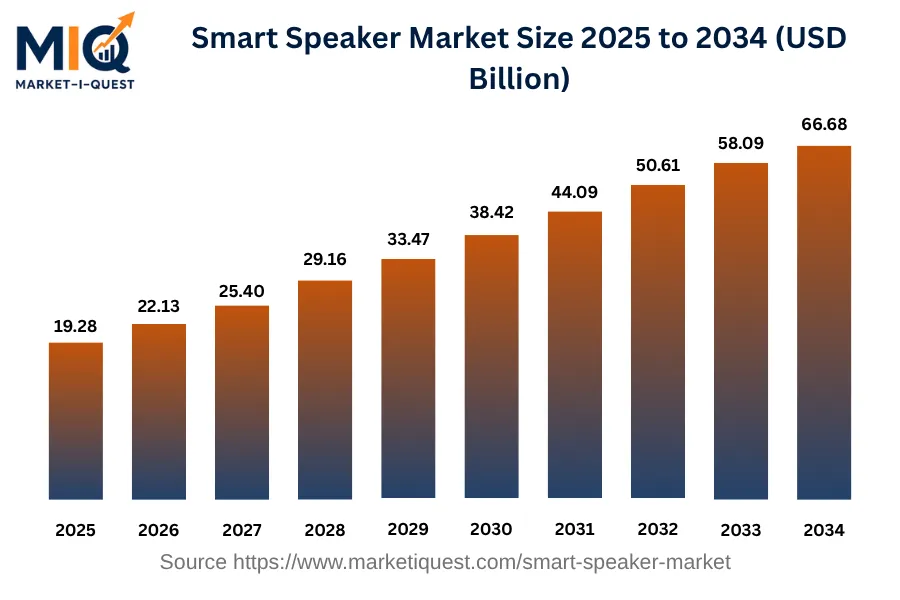
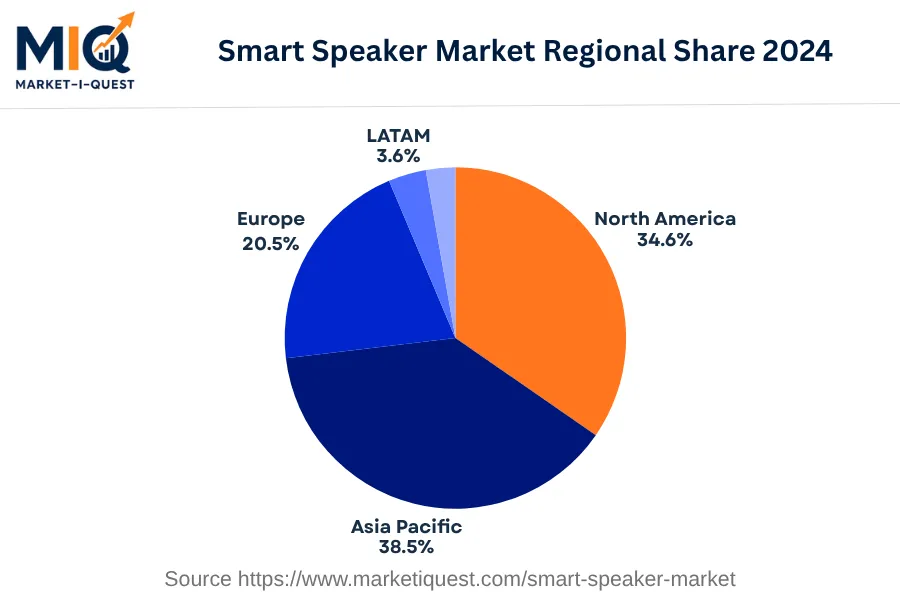
The Smart Speaker Market was valued at 19.28 billion USD in 2025, and it is expected to reach 66.68 billion USD by 2034, showcasing a CAGR of 14.78%. The market growth from 2025 to 2034 indicates a steady increase in market value over the nine-years period, profoundly driven by continual advancements and adoption of smart home technologies. Regionally, the market share in 2024 indicated a fairly dispersed distribution. Asia Pacific region held largest share with 38.47%, closely followed by North America at 34.63%. Europe accounted for 20.54% of the market, whereas less technologically advanced regions like Latin America, Middle East & Africa held minor shares at 3.58% and 2.78% respectively.

Key Takeaways

  • By Virtual Personal Assistant - Amazon Alexa held the dominant position in the Smart Speaker Market in recent years.
  • By Technology - Bluetooth/WiFi led accounting for a substantial market share in the Smart Speaker industry.
  • By Application - Commercial Use stood as the leading segment within the Smart Speaker Market showcasing significant market expansion.
smart-speaker-market market size

Key Driving Factors

Increasing Incorporation of Smart Home Automation

Integrated systems in households are becoming popular due to their effectiveness in improving convenience, security and offering real-time information. The adoption of smart home technology, including heating, lighting, and security systems, are increasingly interconnected and managed through a central control panel, often using a smart speaker as a hub. Consumers appreciate the convenience of voice control, remote access, and autonomic response patterns. Moreover, these smart devices also offer potential energy-saving benefits, making it more appealing to environmentally conscious consumers. Hence, the expanding adoption of smart home technology is driving the sales of smart speakers.
Influence of Machine Learning and Artificial Intelligence

A key driver of smart speaker market's growth is the integration of machine learning and artificial intelligence technologies into these devices. These technologies underpin voice recognition functionality, with speakers able to learn from individual voices, accents, and speech habits, hence providing a tailored, personalized user experience. Furthermore, they can now process complex commands, answer queries, and provide personalized recommendations, which adds significant value for users. The tech titans like Amazon, Google, and Apple are heavily betting on AI-based voice assistants to deliver superior user experience. Hence, advancements in machine learning and AI are propelling smart speaker market.

Market Evolution by Timeline

2019-2023
In this period, use of smart speakers expanded from early-adopter households to broader demographics, including senior citizens for medication reminders and ease of use operations. Popular regions include North America and Asia, specifically in urban cities like New York, Beijing, and Tokyo. Leading companies like Amazon and Google continued to dominate in terms of shipments, while Apple experienced growth constraints due to higher product pricing. Integration with smart home systems also increased in maturity. No specific regulations significantly impacted the market, although privacy concerns were raised. Direct sales remained primary channel, although retail partnerships with stores like Best Buy also grew. Higher-priced models faced challenges gaining consumer adoption.
2024
For this single year, automakers' integration of smart speakers in vehicles emerged as a new use case, and demand augmented from regions like Europe and Australia. Amazon and Google too, released car-compatible smart speakers, but supply constraints were observed due to novel integrating technology. There were no major industry-specific regulations, but data security discussions increased. The commercial model remained same with most sales occurring online, but partnership between tech giants and car manufacturers like Ford and BMW noted significant impact. More affordable models saw success in market due to economic impact of increasing production costs.
2025-2029
During this time, smart speakers turned into a commonplace household item globally, with buyers extensively using them for education, entertainment, and home security. Low-to-mid income markets like India gained traction, while North America and Europe maintained a strong position. Google and other major players improved their technology to include multilingual capabilities. Governments took steps to strengthen privacy regulations, impacting design of new models. Subscriptions models began to emerge alongside traditional sales, and many companies paired smart speakers with other products as bundled offers. The market encountered risks related to data breaches, triggering push for greater security measures.
2030-2034
In this period, enterprise demand for smart speakers rose notably for uses in customer service, teleconferencing and in-store experiences. Developing regions in Africa and South America, due to increased internet penetration, started to see more smart speaker adoption. On supply side, the proliferation of localized brands increased with products able to interpret multiple accent variations. This resulted from easing initial patent restrictions. Policy discussions focused on smart speakers' role in working environment and accessibility concerns. Larger contracts with business customers became more common, and hardware-as-a-service models were explored. Major risk during this period was saturation of household market leading many companies to innovate for different user scenarios.

Future Market Outlook

Future Opportunities

Growing adoption of smart speakers presents a lot of opportunities for stakeholders across technology sectors. As of 2023, over 100 million smart speakers were reported in use in the United States, demonstrating consumer willingness to integrate these devices into their daily lives. Media engagement strategies are evolving, with companies like Spotify collaborating with smart speaker manufacturers to offer enhanced audio streaming experiences directly through devices like the Sonos One. In addition, given the increasing interest in smart home technologies, partnerships between smart speaker manufacturers and home security firms could emerge, as seen with Ring's integration into smart assistants for enhanced home monitoring solutions. As digital assistants become more embedded in user routines, developers will likely explore artificial intelligence applications to deliver tailored experiences based on voice interactions and behavioral data. In regions like Europe and North America, stricter data privacy regulations will drive innovation in user consent models and transparency features. Moreover, emphasis on sustainability will lead to demand for environmentally friendly smart speaker designs, reflecting changing consumer preferences. The integration of augmented reality (AR) functionalities with voice technology suggests a new avenue for user engagement, positioning smart speakers as central to more complex ecosystems of connected devices. Hence, these trends and shifts in consumer expectations present fertile ground for advancements in smart speaker technologies and applications over the coming years.

Segmentation Analysis

By Virtual Personal Assistant

The market is divided into subsegments including Amazon Alexa, Google Assistant, Apple Siri, and Others. Amazon Alexa accounted for the largest revenue share while Google Assistant is expected to grow at the fastest CAGR during the forecast period.

Largest Revenue Share

Amazon Alexa

Market Share Leader

Amazon Alexa, the virtual assistant developed by Amazon, has proven to be a considerable source of revenue, leading virtual personal assistant market. Factors contributing to its robust revenue position can be primarily attributed to its early entry into market, widespread integration, and affiliation with Amazon ecosystem. The Alexa platform matures over time, refining its algorithm and enhancing its customer experience, attributes that largely appeal to current user base. Moreover, Alexa's alliance with Amazon e-commerce platform allows a seamless shopping experience contributing further to its revenue dominance. By establishing robust partnerships with manufacturers, Alexa is integrated into a wide variety of devices, ranging from smart speakers to automobiles, broadening its reach and penetration. Furthermore, Amazon's strong geographical footprint and trusted brand identity back Alexa’s standing in marketplace. The preponderance of Alexa is fueled by frequently updated capabilities, making it preferred choice among consumers. The assumption is made based on current market trends and typical industry logic.

Fastest CAGR

Google Assistant

Forecast Period Growth Leader

Google Assistant, another dominant player in virtual assistant market, indicates fastest growth. Driving its exponential growth is Google's expansive ecosystem, strategy of pervasive implementation, and constant technological refinement. Google Assistant experiences increasing adoption in various devices due to its deep association with Google’s vast array of services, including Gmail, Google Maps, and Google Search. Its advanced AI technology enables more natural language processing and conversation ability, enhancing user experiences. The Assistant continues to expand its language support, reducing barriers and capturing a larger global user base. Furthermore, Google's significant investment in machine learning and AI development, along with strategic partnerships with device manufacturers, accelerates growth. Risks include increasing competition and privacy concerns. Actionable strategies like focusing on expanding service capabilities and improving regional language support can be instrumental for sustained growth rate. These assumptions are based on typical market dynamics and current technology trends.

By Technology

The technology market can be segmented into Bluetooth/WiFi, Near Field Communication (NFC) and Others. In 2024, Bluetooth/WiFi held the largest revenue share while Near Field Communication (NFC) is expected to grow at the fastest Compound Annual Growth Rate (CAGR) in the forecast period.

Largest Revenue Share

Bluetooth/WiFi

Market Share Leader

Bluetooth and Wi-Fi technologies have dominated the market in terms of revenue in base year 2024 due to the widespread adoption and use across various devices and applications. These technologies are integral parts of smartphones, laptops, tablets, and smart home appliances, among other devices, which account for their significant revenue contribution. Bluetooth and Wi-Fi have become essential features for modern consumer lifestyle. They offer convenience and seamless connectivity that are crucial in personal and professional settings. For businesses, these technologies provide an efficient communication infrastructure, reducing costs and improving productivity. It stands to reason that familiarity and user-satisfaction that these technologies brought have made them prevailing choice in the market. Geographically, contribution from developed economies like North America and Europe has been predominant due to high penetration of technology in these regions.

Fastest CAGR

Near Field Communication (NFC)

Forecast Period Growth Leader

Near Field Communication (NFC) technology, despite not accounting for largest market share in 2024, is forecasted to grow at the highest CAGR in the forecast period. Factors driving this rapid growth include increasing adoption of cashless payments and incremental innovations in wireless communication technologies. NFC is a key technology underpinning contactless payment systems, which have seen heightened adoption due to need for fast, convenient, and hygienic transactions, especially amid a global pandemic. With NFC-enabled devices, users can make payments quickly and conveniently without need for physical cards or cash. Regulatory support for cashless economies and proliferation of smartphone technology are pivotal catalysts for growth within this market segment. The NFC technology market faces risks from cybersecurity threats. But increased investment in developing secure communication systems can mitigate this concern and serve as growth opportunity.

By Application

The market is divided into subsegments including Personal Use and Commercial Use. In the base year of 2024, Commercial Use accounted for the largest revenue share while Personal Use is expected to grow at the fastest CAGR during the forecast period.

Largest Revenue Share

Commercial Use

Market Share Leader

In 2024, the Commercial Use subsegment led the market in terms of revenue. This can be attributed to a few key factors. First and foremost, businesses represent a larger purchasing power compared to individual consumers, often buying in bulk for their needs. Commercial use also often entails ongoing purchase relationships, ensuring consistent revenue stream for suppliers. Regulatory compliance, particularly in sectors like healthcare and safety industries, often needs products or services to be periodically renewed or replaced, thereby maintaining steady demand. Geography-wise, developed economies with robust commercial sectors contribute significantly to this revenue. Furthermore, supply and demand dynamics favor commercial uses, given their scale of operation and bulk buying capacities. Purchasing decisions in commercial use are more rational and performance based compared to personal use, thus presenting a more stable market behavior. Along with this, switching costs for suppliers in commercial market might be high, leading to sustained customer relationships.

Fastest CAGR

Personal Use

Forecast Period Growth Leader

The Personal Use subsegment is expected to be fastest growing in terms of CAGR. The main drivers for this growth lies in continually changing consumer behaviors and adoption of new technologies. As technological barriers decrease and more consumers gain access to various products and services, personal use is expected to increase. Catalysts for growth in this subsegment could include policy shifts, like increased internet access, technological advancements allowing for new products or easier use of existing products, strategic partnerships promoting access to or use of certain products within this subsegment, and capital investments aimed at promoting or opening up new markets. But risks remain, notably in terms of fickle nature of personal consumption which can be more easily affected by near-term economic shifts or disruptions, compared to commercial use.

Competitive Analysis

Key Market Players

Manufacturers / OEMs

Amazon.com Inc.
US
Alphabet Inc. (Google)
US
Apple Inc.
US

Key Suppliers & Raw Materials

Qualcomm Inc.
US
Broadcom Inc.
US
Texas Instruments Inc.
US

Distributors, Integrators & Channel Partners

Best Buy Co. Inc.
US
JD.com
China
eBay Inc.
US

Porter’s Five Forces Analysis

This analysis explores the competitive forces affecting the Smart Speaker Market.

Supplier Bargaining Power

Medium

Key components production is dominated by few manufacturers, provoking some dependency on them.

Buyer Bargaining Power

High

Consumers enjoy wide choices and they can switch brands without significant costs.

Threat of Substitutes

High

Smartphones, smart displays, and personal computers can serve as substituting products.

Threat of New Entrants

Medium

High R&D costs and strong market incumbents may deter some potential new entrants.

Competitive Rivalry

High

Rapid tech advancements, presence of major firms like Amazon and Google spur intense competition.

Regional Analysis

Geographic market dynamics and growth opportunities across key regions

Global Market Outlook

smart-speaker-market market regional share

North America

In 2024, the North American Smart Speaker Market thrived, reflecting technological drive for interconnected, convenience-oriented living.

Drivers of this market included continued demand for smart home integration and AI-enabled personal assistants. Companies like Amazon and Google made significant investments in advancing their respective AI technologies, Alexa and Google Assistant, driving market expansion. Regulation also played a role, with updated privacy laws in United States prompting developers to prioritize security features, enhancing consumer confidence. Further, the high rate of technology adoption in U.S. and Canada stoked market growth, with Mexico emerging as growing market due to increasing digital literacy.

Trends indicated a major shift in buyer behavior, with consumers prioritizing smart speakers with multi-functional capabilities, like streaming services and home automation features. Tech giants leveraged partnerships and M&A to add functionality and increase their market footprint: Amazon’s collaboration with Spotify is one such instance. Distribution strategies evolved with online channels dominating sales, although retail outlets continued to hold significance for an older demographic. Environmentally sustainable manufacturing emerged as a key trend, a response to evolving policy enforcement and consumer sentiment.

Key customer segments encompassed residential users seeking smart home applications, retailers harnessing in-store automation, and increasingly, educational institutions integrating smart speakers for teaching aids, underlining the market's broad applicability.

Asia Pacific

In the base year of 2024, the Smart Speaker Market in Asia Pacific was characterized by considerable growth and diversified demand. Key drivers included increased investment in Internet of Things (IOT) technology, with China leading in adoption, and rise in disposable income across emerging markets like India and key ASEAN economies. Moreover, increased digitalization of household appliances and a push for smart homes fuelled market growth in developed markets like Japan and South Korea.

Trends in this period reflected a shift in buyer behavior towards wireless, hands-free devices with voice-assist features, evident in the increasing popularity of home automation systems across the region. Crucial partnerships and mergers between major tech players, like Baidu, Alibaba, Xiaomi, and Tencent, helped enhance market presence, with a surge in online sales channels. This digital shift in retail also influenced the market significantly.

Sectors most impacted included retail, manufacturing, and healthcare, with smart speakers used for operational efficiency, telemedicine, and in-store customer service respectively. For example, smart speakers became an intrinsic component in remote patient care delivery in Australia's healthcare sector, and were increasingly incorporated into smart manufacturing processes in China. Regulations governing data privacy enforced by governments across the Asia Pacific region also shaped the market landscape in 2024.

Europe

In 2024, Smart Speaker Market in Europe garnered a noteworthy amount of attention from many sectors. Key drivers include increased awareness and adoption of smart home technology, growing investment from tech companies, and rising demands in sectors like healthcare and retail, where smart speakers are used for patient communication and customer engagement respectively. Regarding technology adoption, Germany and UK spearheaded the trend, showing an elevated demand for high-tech home appliances.

Noteworthy trends influencing Smart Speaker Markets include shift in buyer behavior; consumers begun prioritizing devices enabled with smart features, consequently driving companies to innovate. This shifting demand resulted in surge of partnerships, mergers, and acquisitions among tech companies, like Amazon and Sonos, to jointly develop new smart speaker models. Increased regulatory policies, like EU General Data Protection Regulation, established to protect user data also defined the market's operations.

In specific sectors, enterprise customers leverage Smart Speakers for streamlining business operations, while government institutions utilize them for public service announcements. Central and Eastern Europe, lagging behind in technology adoption, have primarily used these devices as modern consumer electronics, showing a demand for their convenience and efficiency. Overall, the infusion of smart speakers into diverse sectors illustrates the expansive growth SSM saw in Europe during 2024.

Latin America

In 2024, the Latin American (LATAM) Smart Speaker Market showed significant expansion, predominantly catalyzed by higher technology adoption, strong investment activity, and improving internet penetration. Growth drivers included an increased penetration of IOT devices in Brazil and Mexico which consequently spurred demand for voice-assistant devices. Furthermore, large investments by tech giants in Argentina, Columbia, Chile, and Peru expanded supply dynamics, aiding in market growth. Additionally, government regulations favoring digitalization and connectivity systems promoted adoption of smart speakers in sectors like enterprise, retail, and manufacturing.

A notable trend in 2024 was an evolved buyer behavior marked by preference for smart speakers with advanced features and integrated services. Tech firms responded with product innovation, particularly focusing on sound quality and AI capabilities, which was evident through strategic partnerships and M&A activities. Retail businesses aimed at channel optimization integrated smart speakers into their customer service strategy. Strict enforcement of data security policies by LATAM countries controlled spread of smart speakers, with particular attention to ensuring user privacy and data protection. Overall, the LATAM Smart Speaker Market in 2024 demonstrated buoyant growth, driven by enhanced adoption, significant investment initiatives, and an evolving customer preference landscape.

Middle East & Africa

In 2024, Smart Speaker Market in Middle East and Africa experienced significant growth. This expansion was driven by increasing adoption of digital technologies in countries like Saudi Arabia, United Arab Emirates, and Israel, where governments' investments in infrastructure and digital transformation initiatives have spurred demand.

In Saudi Arabia and UAE, growing expansion of telecom services and integration of smart home systems have catalyzed sale of smart speakers. In Kenya and Nigeria, affordable internet connectivity has increased uptake of this technology among youth. Meanwhile in countries like Qatar and Egypt, various government-led initiatives promoted use of smart speakers in sectors like healthcare and education.

In Israel, technology trends favored by retail and financial sectors steered consumer preference for multi-functional devices, further driving sale of smart speakers. The market saw rise of partnerships in South Africa between tech firms and local retailers to boost prominence of smart speakers. But in regions like Egypt and Nigeria, privacy concerns have emerged a significant issue, affecting buyer behavior and influencing the region's regulatory policies.

These driving factors and trends highlight dynamic landscape of Smart Speaker Market in Middle East and Africa in 2024.

Recent Industry Developments

Latest market innovations, product launches, and strategic initiatives

June 2026

Retail leaks via Best Buy Canada and internal Google communications pinpointed June 25, 2026, as target release date for the new "Google Home Speaker." This launch signifies major strategy shift, as Google is abandoning its "Nest" branding to release its first new smart speaker in years, built from ground up around Gemini AI platform.

May 2026

Amazon officially launched Echo Dot Max and the 3rd-generation Echo Studio smart speakers in Indian market. These premium devices debuted Amazon's custom AZ3 and AZ3 Pro silicon chips in the region, which improved wake-word detection by nearly 50% to better handle complex smart home automation.

February 2026

Amazon made its generative AI assistant, Alexa+, fully available to all users across United States. This software rollout fundamentally altered utility of existing smart speaker market, transitioning millions of Echo devices from basic command-and-response hubs into fluid, conversational AI agents.

Frequently Asked Questions