Lithium Ion Battery Market Snapshot

Key Players

  • Panasonic Corporation (Japan)
  • Tesla Inc. (United States)
  • LG Chem Ltd. (South Korea)
  • BYD Co Ltd. (China)
  • Samsung SDI Co. Ltd. (South Korea)
  • Contemporary Amperex Technology Co. Limited (CATL) (China)
  • GS Yuasa Corporation (Japan)
  • Sony Corporation (Japan)
  • Toshiba Corporation (Japan)
  • EnerSys (United States)

Market Size

Base Year 2024
$77.95 Bn
CAGR
17.54%
Forecast 2034
$392.35 Bn

Market Segments

By Type
Lithium Nickel Manganese Cobalt (NMC), Lithium Manganese Oxide (LMO), Lithium Iron Phosphate (LFP), Lithium Cobalt Oxide (LCO), Lithium Nickel Cobalt Aluminum Oxide (NCA), Lithium Titanate Oxide (LTO)
By Capacity
0-3000 mAh, 3000-10000 mAh, 10000-60000 mAh, 60000 mAh & Above
By Voltage
Low (Below 12V), Medium (12V-36V), High (Above 36V)
By Industry
Automotive, Aerospace, Consumer Electronics, Marine, Industrial, Power, Telecommunication, Medical, Others

Market Dynamics

Drivers
  • Growing EV adoption
  • Increasing renewable energy storage demand
Restraints
  • High production cost
  • Strict government regulations
Opportunities
  • Increasing electric vehicle demand
  • Improvement in lithium extraction technologies

Market Size

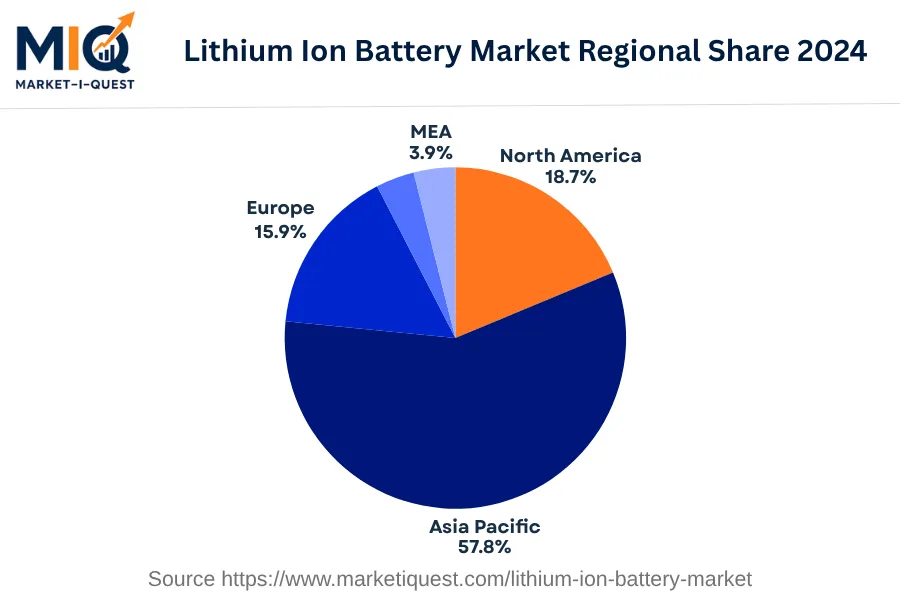
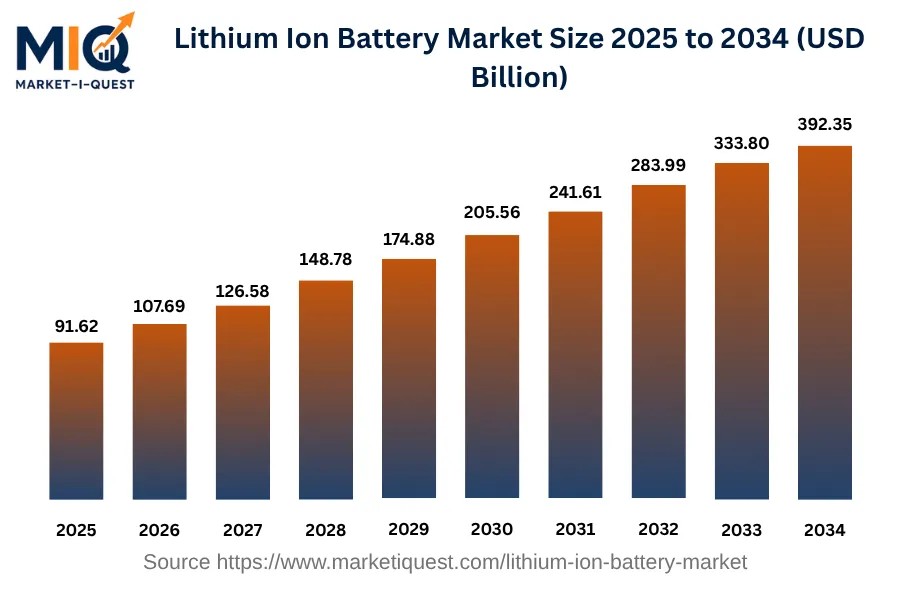
The Lithium Ion Battery Market was at 77.95 billion USD in 2024 and increased to 91.62 billion USD in 2025. By 2034, the market is estimated to grow to 392.35 billion USD, marking considerable growth over the ten year period. The Compound Annual Growth Rate (CAGR) between 2025 and 2034 is projected to be 17.54%. This significant rise over the course of the decade is largely attributable to the continual and progressive developments in technology and increasing adoption of lithium-ion batteries across a range of electrical and electronic devices. As of 2024, the regional market share was distributed with Asia Pacific accounting for 57.8%, followed by North America at 18.7% and Europe with 15.9%. The remaining global shares were held by Latin America and the Middle East and Africa, contributing 3.6% and 3.9% respectively.

Key Takeaways

  • By Type - Lithium Nickel Manganese Cobalt (NMC) held a significant share in the lithium ion battery market.
  • By Capacity - 3000-10000 mAh segment led the market in terms of demand and supply.
  • By Voltage - High (Above 36V) lithium ion batteries segment expanded rapidly in the base year.
  • By Industry - Automotive held the highest usage of Lithium Ion Batteries.
lithium-ion-battery-market market size

Key Driving Factors

Shift Towards Electric Vehicles

The global shift towards electric vehicles (EVs) is primarily driving the lithium-ion battery market. Governments worldwide are pushing for the adoption of EVs to reduce carbon emissions, triggering acute demand for lithium-ion batteries. Companies like Tesla, Nissan, and BYD, which are significantly contributing to the EV revolution, depend heavily on lithium-ion batteries for their cars. More than 50% of lithium-ion batteries produced globally are used in EVs. Hence, the increasing production of EVs and the implementation of strict emission standards by governments are intensifying the demand for lithium-ion batteries.

Expansion of Renewable Energy Projects

The rapid expansion of renewable energy projects worldwide is also a significant driving factor for the lithium-ion battery market. Renewable energy solutions such as solar and wind produce fluctuating power levels. To assure continuous power supply, energy storage systems are needed, and that's where lithium-ion batteries come into play. They store excess energy during high power periods and disburse it during low power periods. Governments and energy companies are investing heavily in renewable energy projects, which directly boost the demand for lithium-ion batteries. This trend is especially pronounced in regions like Europe, China, and the United States.

Market Evolution by Timeline

2019-2023
During this period, high demand for Lithium Ion batteries stemmed from the consumer electronics industry, particularly in regions like North America and Asia-Pacific. There was increased integration of these batteries in electric vehicles and portable consumer electronics. Industry faced supply-chain challenges such as production bottleneck, the unavailability of key raw materials. Countries such as China promoted the adoption of electric vehicles through policies and subsidies, which increased battery demand. Pricing remained aggressively competitive due to the influx of manufacturers. Typical contract types included long-term agreements with suppliers to ensure consistent supply. Risks included volatility in raw material prices and potential safety issues with the battery technology.
2024
In 2024, energy storage system applications showed increased demand, especially in regions with evolving renewable infrastructure like Europe. More mature manufacturing processes improved production efficiency, but challenges included proper waste management for used batteries. The introduction of EU's Battery Regulation aimed at enhancing sustainability across the battery value chain was a notable policy of this year. Pricing featured a general decline because of technology improvements and economies of scale. Partnerships became common as firms cooperated for shared technology development. Market risks included safety concerns and stringent international standards.
2025-2029
From 2025 to 2029, consumer electronics and electric vehicles continued as major demand drivers for Lithium Ion batteries. Developing countries with growing middle-class population like India saw an increased usage. Supply side was boosted by improved methods in battery recycling and raw material recovery. Standardization agencies launched initiatives for global harmonization of battery standards across nations, thereby influencing market behavior. Price competition intensified further due to the rise of new entrants and scale of operation. Common commercial arrangements included joint ventures for technology sharing. Constraints included coping with evolving legislation and tighter quality controls.
2030-2034
For this period, a robust demand pipeline was driven by the trend towards decarbonization and electrification of numerous sectors, including maritime transport. Supply side faced constraints due to environmental impact of battery material extraction. Major regions such as the EU and the US made legislative changes to strengthen battery recycling and circular economy models. Prices were expected to stabilize with technology improvement and stabilized raw material costs. Contracts involved tie-ups between battery manufacturers and recycling companies to directly supply recovered materials. Potential issues included geopolitical factors affecting raw material availability and evolving environmental regulations.

Future Market Outlook

Future Opportunities

The lithium-ion battery sector is positioned to capitalize on various emerging opportunities shaped by current advancements and regulatory frameworks. As of 2023, government initiatives worldwide are pushing toward sustainability, evidenced by the European Union's commitment to reducing carbon emissions by at least 55% by 2030, which propels EV adoption and subsequent battery demand. In March 2023, the U.S. Department of Energy prolonged funding for research into next-generation batteries, aiming to reduce reliance on scarce materials and improve recycling processes. Given the implementation of stricter regulations, such as the EU Battery Regulation set to be effective in 2024, companies that invest in sustainability will likely gain a competitive edge. The demand for grid energy storage solutions is also increasing, recently illustrated by a partnership between Fluence and E.ON, addressing renewable energy fluctuations through advanced battery storage systems. As awareness grows regarding sustainability and resource management, the market for second-life applications for used batteries is becoming pertinent. In 2022, Nissan and other automakers began exploring new applications for end-of-life EV batteries in stationary storage systems. Furthermore, enhanced collaboration among technology firms and research institutions is expected to lead to breakthroughs in battery technology, presenting further opportunities in the lithium-ion battery landscape that hold promise for broad applications.

Segmentation Analysis

By Type

The market is divided into subsegments including Lithium Nickel Manganese Cobalt (NMC), Lithium Manganese Oxide (LMO), Lithium Iron Phosphate (LFP), Lithium Cobalt Oxide (LCO), Lithium Nickel Cobalt Aluminum Oxide (NCA), and Lithium Titanate Oxide (LTO). The Lithium Nickel Manganese Cobalt (NMC) subsegment accounted for the largest revenue share, while the Lithium Iron Phosphate (LFP) is expected to grow at the fastest CAGR during the forecast period.

Largest Revenue Share

Lithium Nickel Manganese Cobalt (NMC)

Market Share Leader

The dominant position of the Lithium Nickel Manganese Cobalt (NMC) subsegment can be attributed to its superior performance and high energy density, factors which have led to its wide acceptance in the electric vehicle (EV) and energy storage sectors. These markets are expanding rapidly, driving demand for NMC batteries. Higher energy density means longer range for EVs, a critical purchasing criterion for consumers. Furthermore, NMC batteries’ versatility allows for usage in various applications, from electric vehicles to portable electronics and grid storage. This broad applicability allows them to tap into diverse markets, thus contributing to the significant revenue share. Geography-wise, the demand for NMC batteries is high in Asia, particularly China, which is the largest EV market in the world. Regulations encouraging EV adoption, along with available supply of raw materials, further propel this subsegment in the region. It's important to note, however, that the dominance of NMC is underpinned by the assumption that the industry continues to prioritize energy density and versatility in applications.

Fastest CAGR

Lithium Iron Phosphate (LFP)

Forecast Period Growth Leader

The Lithium Iron Phosphate (LFP) subsegment is poised for fast growth given its inherent benefits and emerging market trends. LFP batteries offer long cycle life, enhanced safety, and affordability, attributes that make them especially appealing for large-scale renewable energy storage—an area experiencing significant momentum due to global clean energy initiatives. Although upfront costs can be higher compared to other types, their longevity makes them cost-effective in the long run. The growth of this subsegment is also catalyzed by strategic partnerships between manufacturers and renewable energy companies, as well as increasing governmental support worldwide for green energy projects. The growth forecast for LFP, however, contingent on overcoming adoption barriers such as the relatively lower energy density compared to other options like NMC, which impacts their suitability for applications like electric vehicles. Nevertheless, with new advancements in technology and gradual improvements in energy density, the LFP subsegment shows considerable potential for rapid growth.

By Capacity

The market is divided into subsegments including 0-3000 mAh, 3000-10000 mAh, 10000-60000 mAh, and 60000 mAh & above. The 3000-10000 mAh subsegment accounted for the largest revenue share while the 10000-60000 mAh subsegment is expected to grow at the fastest CAGR during the forecast period.

Largest Revenue Share

3000-10000 mAh

Market Share Leader

The 3000-10000 mAh subsegment has emerged as the dominant revenue generator in the capacity range. Its prevalence can be attributed to the perfect balancing of power supply and compactness, making devices easy to carry while still providing adequate energy. This capacity range is commonly used in smartphones, tablets, laptops, and several portable electronics, which constitute a significant portion of the global market. Furthermore, improved battery quality in this range has resulted in longer lifespan, driving customer preference. Crucially, tighter regulations on the movement of high capacity (above 10000 mAh) batteries in some regions have pushed consumers towards this safer option. The price point is another factor that adds to the attractiveness of the 3000-10000 mAh subsegment. Overall, a combination of functionality, regulation, pricing, and consumer behaviour supports the dominance of this capacity range.

Fastest CAGR

10000-60000 mAh

Forecast Period Growth Leader

Despite accounting for a smaller market share in 2024, the 10000-60000 mAh subsegment is expected to grow at the fastest CAGR. One key growth driver is the rise in power-hungry devices, such as high-end laptops and gaming devices, which demand larger battery capacities. Progressions in technology, specifically the improvement in power density, have made high-capacity batteries more portable and affordable, reducing adoption barriers. Given these developments, manufacturers are partnering with battery producers to integrate high-capacity batteries into their devices. Simultaneously, legislative movements to relax restrictions on higher capacity battery transportation could further catalyse growth. However, the potential risks of overheating and battery degradation could hamper rapid growth. Despite these obstacles, considering the evolving tech landscape and user trend towards powerful devices, the 10000-60000 mAh subsegment could see remarkable growth.

By Voltage

The market is divided into subsegments including Low (Below 12V), Medium (12V-36V), and High (Above 36V) voltage ranges. In the base year 2024, the High (Above 36V) category accounted for the largest revenue share, while the Medium (12V-36V) segment is expected to grow at the fastest CAGR during the forecast period.

Largest Revenue Share

High (Above 36V)

Market Share Leader

In the base year 2024, the High voltage (Above 36V) subsegment led the market in revenue generation because of the high demand in a variety of industrial applications. Industries such as electric vehicle manufacturing, power generation and data centers require high voltage electrical systems due to the robustness and efficiency they offer. Additionally, governmental regulations and policies in several geographies are increasingly focusing on reducing carbon emissions and promoting energy-efficient solutions, further driving the demand for high voltage systems. This often leads to a growing preference for high voltage over low and medium voltage technologies. Additionally, compared to low and medium voltage, high voltage equipment is more reliable and has longer lifetimes, which results in its increased adoption. Existing customers are also reluctant to switch to low or medium-voltage solutions due to high switching costs.

Fastest CAGR

Medium (12V-36V)

Forecast Period Growth Leader

The Medium voltage (12V-36V) subsegment is projected to be the fastest-growing market segment. This is primarily driven by its wide application range across numerous consumer electronics devices which are experiencing rapid adoption rates. This technology is typically found in portable electronic devices, small and medium-sized appliances, and in portions of larger systems where lower voltage is needed. Medium voltage devices deliver the perfect balance between cost-efficiency and performance. Emerging technologies and ongoing innovations in the field of electronics and electrical appliances are acting as catalysts for this subsegment's growth. However, the segment faces challenges such as the need for large scale investments in R&D for improved product designs and the requirement of skilled operators, which can serve as barriers to growth if not properly addressed. However, despite these challenges, the demand for medium voltage devices is expected to continue growing in the near future.

By Industry

The market is divided into subsegments including Automotive, Aerospace, Consumer Electronics, Marine, Industrial, Power, Telecommunication, Medical, and Others. Of these subsegments, the Automotive industry accounted for the largest revenue share while the Telecommunication industry is expected to grow at the fastest CAGR during the forecast period.

Largest Revenue Share

Automotive

Market Share Leader

The automotive industry accounts for the largest revenue share due to several reasons. Firstly, the durable demand for automobiles persists, driven by the need for personal transportation and commercial logistics. This persists despite economic uncertainties, contributing to steady revenues. Geographically, emerging economies are observing an upward trend in automobile purchases as incomes rise, adding to the growth. Regulations favoring low-emission vehicles have set off technology and design innovations in hybrid and electric vehicles, bringing in more purchase interests and subsequently, more revenue. Automotive purchasing is also influenced by factors like fuel efficiency, brand reputation, and vehicle lifespan, creating opportunities for competitive differentiation and maintaining the market’s vibrancy. Any changes in pricing tend to have a slower impact owing to the high switching costs and lifetime value of vehicles. Hence, the automotive subsegment maintains its dominant revenue position due to a blend of demand, supply, and regulatory factors.

Fastest CAGR

Telecommunication

Forecast Period Growth Leader

The telecommunication sector is projected to grow at the highest CAGR among the subsegments. This growth is largely driven by the expansive service demands in both private and business sectors, aided by the indispensable nature of telecommunications in modern day living. Bottlenecks like expensive infrastructure investment and complex regulation procedures have not stifled growth. Instead, these challenges are stimulating innovation and collaborations, leading to the creation of competitive, efficient, and more accessible communication ecosystems. Emerging technologies such as 5G and IoT are seen as significant growth catalysts offering high-speed, reliable connections for an array of applications. These improvements could potentially accelerate adoption rates further, especially from regions with lower current penetration. However, the near-term risks such as privacy concerns and cyber security threats pose significant challenges, thereby demanding equal focus on creating secure communication channels that can ensure the consistent and safe usage of related services. The overall growth potential of the telecommunication subsegment is strongly skewed towards an upward trajectory.

Competitive Analysis

Key Market Players

Manufacturers / OEMs

Panasonic Corporation
Japan
LG Chem
South Korea
Samsung SDI Co. Ltd.
South Korea

Key Suppliers & Raw Materials

Albemarle Corporation
US
SQM
Chile
Ganfeng Lithium Co., Ltd.
China

Distributors, Integrators & Channel Partners

Umicore
Belgium
Tesla, Inc.
US
Amara Raja Batteries Ltd.
India

Porter’s Five Forces Analysis

Evaluating the competitive dynamics of the Lithium Ion Battery Market.

Supplier Bargaining Power

Medium

Dependence on a few suppliers of raw materials, like lithium, leverage their bargaining power.

Buyer Bargaining Power

High

Increasing demand and availability of multiple suppliers enhance buyer bargaining power.

Threat of Substitutes

Low

Limited feasible alternatives for lithium-ion batteries sustain their demand.

Threat of New Entrants

Medium

High R&D and capital requirements pose barriers to entry, yet opportunities exist due to growing demand.

Competitive Rivalry

High

Intense competition due to presence of established players like Tesla, LG, and Panasonic.

Regional Analysis

Geographic market dynamics and growth opportunities across key regions

Global Market Outlook

lithium-ion-battery-market market regional share

North America

In 2024, the North American lithium-ion battery market experienced significant growth due to innovation and the escalating demand for electric vehicles (EVs).

Increased consumer preference for electric vehicles in the United States, Canada, and Mexico ignited a surge in lithium-ion battery sales, providing the primary driver for the market. This demand was further accelerated by stringent environmental regulations around carbon emissions which favored electrification of transport. Furthermore, advancements in energy storage technology and renewable energy sector's momentum increased the application of lithium-ion batteries. High investment rates in the battery supply chain, particularly in the U.S., also proliferated market growth.

Trends in 2024 saw a shift from traditional power sources towards renewable energy methods, creating a demand for effective energy storage solutions. Lithium-ion batteries emerged as a preferred option for this in utilities and manufacturing sectors. Additionally, we noticed partnerships between automotive manufacturers and lithium-ion battery producers solidifying, especially in Mexico. In tech sphere, the adoption of lithium-ion batteries over traditional ones in portable consumer electronics signaled a trend, particularly due to their enhanced efficiency and durability. Lastly, strict enforcement of clean energy policies by governments triggered an accelerated transition to these batteries in multiple sectors, including healthcare and retail.

Asia Pacific

In 2024, the Asia Pacific lithium-ion battery market experienced significant growth, particularly in China, India, Japan, South Korea, Australia, and key ASEAN markets. Increase in demand from electric vehicle (EV) manufacturers, proactive government policies, and extensive R&D efforts were key drivers. In China, aggressive solar energy goals spurred demand for efficient energy storage solutions, while in India, growing EV adoption propelling significant investments. Additionally, Japan's stringent carbon neutrality targets were being met through advancements in battery technologies and increased EV penetration.

Shifts in consumer behavior towards commercial electric vehicles boosted demand in South Korea and Australia. Technological improvements led to higher capacity batteries, demonstrating a product shift towards larger energy storage solutions. The market witnessed several strategic partnerships, especially in China and Japan, aimed at expanding manufacturing capabilities. For instance, China's Contemporary Amperex Technology Co. Limited and Japan’s Panasonic Corporation emerged as dominant players, indicating aggressive channel dynamics.

Regulations pertaining to carbon emissions and renewable energy targets were enforced strictly, impacting the manufacturing, utilities, and retail sectors. Government mandates in China, Japan, and Australia significantly influenced renewable energy and energy storage solutions, stimulating the lithium-ion battery market. Consequently, these factors have positioned the Asia Pacific market as a global leader in lithium-ion battery production and deployment.

Europe

In 2024, the European lithium ion battery market witnessed significant dynamics due to various demand drivers and industry trends. Driving forces included increased demand for electric vehicles (EVs) by both consumers and enterprises across Germany, the UK, France, and Italy. This rise in demand was subsequently strengthened by EU green energy regulations, promoting investment in cleaner transportation. Furthermore, unprecedented technological advancements in Italy and Spain amplified the market, boosting the efficiency and lifespan of lithium ion batteries.

Key trends involved a shift in consumer behavior towards sustainable and energy-efficient products, particularly noticeable in the retail sectors of Nordic countries and the Benelux region. Moreover, various partnerships and M&A activities were observed, with energy giants like Total and E.ON investing in European battery manufacturers to secure their supply chain and reinforce regional self-sufficiency. Additionally, stricter policy enforcements, such as the UK's Net-Zero Carbon Plan, influenced the growth of energy storage in utilities, propagation of EV charging infrastructure and robust adoption of lithium-ion technologies in manufacturing sectors.

Central and Eastern Europe also observed an increased interest in renewable energy installations, with Lithium Ion batteries proving a key component, furthering demand. With these drivers and trends, the Lithium Ion Battery market in Europe in 2024 presented a robust and diversifying landscape.

Latin America

In 2024, the Lithium Ion Battery Market in Latin America illustrated considerable growth, driven by increased electric vehicle adoption and continuous deployment of renewable energy infrastructure. Brazil's robust automotive sector demand, coupled with Argentina's legislation encouraging electric mobility, spurred significant market expansion. Moreover, high investment in lithium mining in Chile and Argentina further boosted the supply dynamics of the market.

Rapid urbanization in Mexico and Colombia led to an uptick in portable consumer electronics usage, a principal consumer of lithium-ion batteries. Echoing the same trend, the digitalization wave in enterprises across LATAM buoyed market consolidation as power backup solutions in data centers necessitated reliable battery systems. Furthermore, cheaper pricing following economies of scale also played a crucial role in freeing the market from cost constraints.

Adoption of energy storage systems for uninterrupted power supply became a noticeable trend in LATAM utilities sector. Meanwhile, technological shift towards better battery performance embodied by high energy density, longevity, and safety also attracted customers. Channel dynamics evolved with local manufacturing firms entering partnerships and M&A activities, aiming to dominate the market landscape. Enforcement of stringent environmental policies increased, pressuring businesses to look for greener alternatives to traditional batteries.

Middle East & Africa

In the base year of 2024, the Lithium Ion Battery Market in the Middle East and Africa experienced heightened growth due to several market drivers and emerging trends. Key market drivers included increased investment in renewable energy, particularly in Saudi Arabia and UAE, and wider adoption of electric vehicles in urbanized regions of Egypt and South Africa, boosting the demand for lithium-ion batteries. Rising consumption of portable electronics among young populations, particularly in Nigeria and Kenya, was another critical driver. Regulators in these nations were also formulating policies supporting battery recycling, further invigorating the market.

Trends shaping the market included a growing shift towards renewable energy in utilities sector, especially solar power, driving the use of energy storage systems. Telecom sector showed a lean towards the adoption of lithium-ion power backups, particularly noticeable in Israel and Qatar. In the realm of partnerships, South Africa's automotive industry witnessed collaborations for local lithium-ion battery production. Strict enforcement of environmental regulation in Israel also pushed towards cleaner energy storage solutions like lithium-ion batteries. E-commerce surge, due to the penetration of internet in Egypt and Kenya, spurred online sales of lithium-ion batteries, marking a shift in channel dynamics for this market. Overall, the lithium-ion battery market thrived in multiple sectors, energized by forward-looking investments and regulatory support.

Recent Industry Developments

Latest market innovations, product launches, and strategic initiatives

July 2026

VSL PowerHive (Vikram Solar's battery and energy storage arm) expanded its VION portfolio with the launch of new LFP battery systems for residential and small commercial applications, combining advanced LFP technology with intelligent battery management.

February 2025

India's Union Budget 2025-26 proposed full exemption of Basic Customs Duty (BCD) on scrap of lithium-ion batteries and critical minerals, aiming to secure raw material availability for lithium battery manufacturing in India.

Frequently Asked Questions