
Industrial Ethernet Switch Market Snapshot

Key Players

  • Cisco Systems Inc. (US)
  • Huawei Technologies Co. Ltd. (China)
  • Siemens AG (Germany)
  • Belden Inc. (US)
  • Juniper Networks Inc. (US)
  • Alcatel-Lucent Enterprise (France)
  • ZTE Corporation (China)
  • Rockwell Automation Inc. (US)
  • Moxa Inc. (Taiwan)
  • ABB Ltd. (Switzerland)

Market Size

Base Year 2024
$3.96 Bn
CAGR
7.5%
Forecast 2034
$8.16 Bn

Market Segments

By Type
  • Managed
  • Unmanaged
By Application
  • Smart Grid
  • Security & Surveillance
By End-Use Industry
  • Aerospace and Defense
  • Oil and Gas
  • Others

Market Dynamics

Drivers
  • Increasing industrial automation
  • Rising demand for Ethernet-based solutions
Restraints
  • High procurement costs
  • Technological complexities
Opportunities
  • Rising industrial automation trends
  • Increasing IoT integration in industries

Market Size

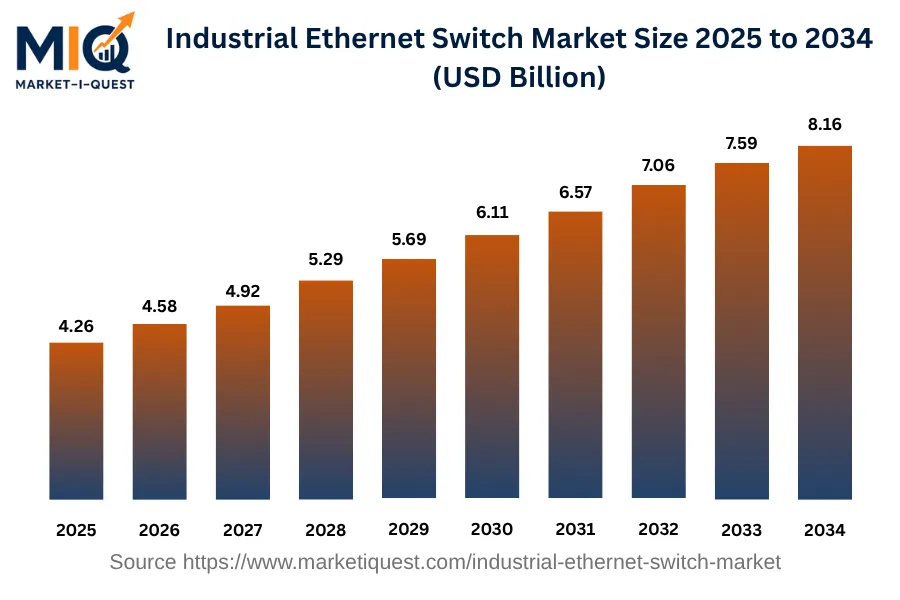
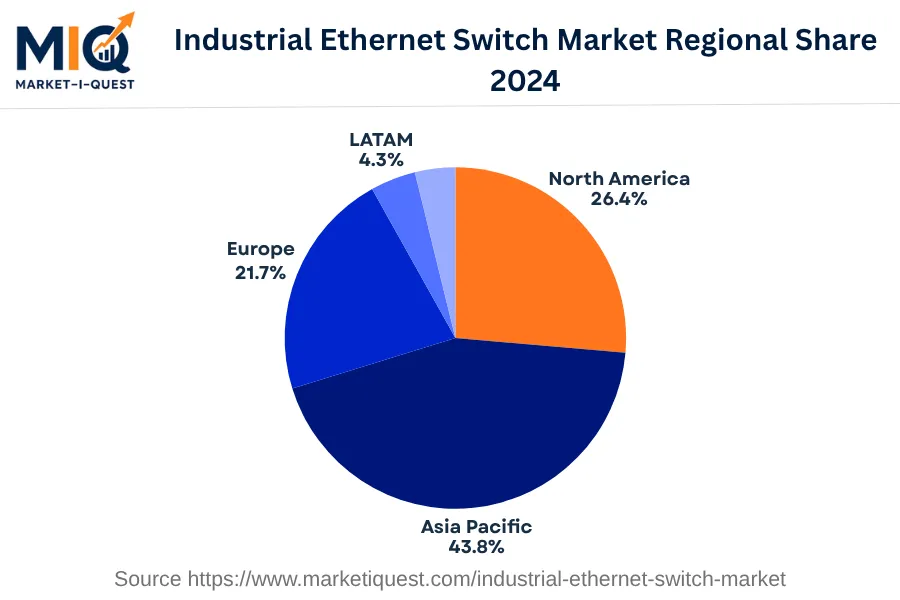
The Industrial Ethernet Switch Market size was $4.26 billion in 2025 and is expected to reach $8.16 billion by 2034. This demonstrates a compound annual growth rate (CAGR) of 7.5% over the forecast period. The market size witnessed a growth from $3.96 billion in 2024 to $4.26 billion in 2025, laying the foundation for the steady ascend observed till 2034. The growth in size over the decade can be attributed to a solid progression in the market year on year. On a regional basis in 2024, the market share mix was as follows: The Asia Pacific held the largest share at 43.8%, followed by North America at 26.4%. Europe made up 21.7% of the market, while Latin America and the Middle East and Africa held smaller shares with 4.3% and 3.8% respectively.

Key Takeaways

  • By Type - Managed subsegment held a leading position in the Industrial Ethernet Switch Market in 2024.
  • By Application -Smart Grid was the fastest-growing segment with an accelerated expansion noted.
  • By End-Use Industry - Aerospace and Defense led the market accounting for a significant share during the base year.
industrial-ethernet-switch-market market size

Key Driving Factors

Stricter Compliance with Industry 4.0 Standards

The move towards adhering to Industry 4.0 standards has been a significant driver in the industrial Ethernet switch market. This trend is due to the standard's emphasis on automation and data exchange in industrial technology environments. Network connectivity is a core aspect of Industry 4.0, necessitating reliable and efficient equipment, which is where industrial Ethernet switches come into play. They help bring about seamless communication within the industrial environment, ensuring the interoperability of numerous devices, hence facilitating processes like real-time data tracking and predictive maintenance. From the manufacturing sector to logistics, numerous industries are making the transition to conform to these guidelines, compelling suppliers to ensure their products comply with Industry 4.0 standards.
Increased Adoption of Machine-to-Machine Communication

The adoption of machine-to-machine (M2M) communication in industries such as manufacturing and logistics is significantly driving the industrial Ethernet switch market. M2M communication promotes efficiency in operations as it allows for swift data exchange and real-time responses between multiple devices in an industrial setting. Industrial Ethernet switches are instrumental in functioning such communication networks effectively, enabling fast and secure data transfer. This results in improved process control, streamlined automation, and reduced downtime. As M2M communication becomes more prevalent, the need for industrial Ethernet switches to facilitate these processes is predicted to increase, providing a considerable push to the market.

Market Evolution by Timeline

2019-2023
The main buyers of industrial Ethernet switches during this period were largely industrial sectors, including automotive, oil & gas, and power grids. The emphasis was on digitization, driving investment in IoT technologies for optimizing operational efficiency. Key switches manufacturers during this time incorporated Cisco, Siemens, and Huawei. Despite the technological potential, the integration into existing systems represented a steep learning curve for several organizations. IEEE's 802.3bt-2018 protocol, introduced in 2018, for increased power over Ethernet was in widespread use, aiding large-scale industrial installations. GDPR regulations induced greater focus on cybersecurity during the procurement process. Regarding commercial dynamics, companies often leaned towards long-term contracts with assured maintenance and software updates. Conversely, capacity constraints and incompatibilities posed significant challenges.
2024
In 2024, the demand for industrial Ethernet switches was steady, with growth in data centers, espousing the need for such switches. Automation soared in Europe & North America, increasing investments in IoT for sustainable energy sector. Developments by key players, like Rockwell Automation or Belden, involved the integration of machine learning for predictive maintenance purposes. Cybersecurity regulations further tightened, with the rollout of the NIS2 directive in the European Union. With respect to commercial models, prices were predominantly driven by bandwidth requirements, ports availability, and enhanced features such as PoE. High upfront costs remained a formidable hurdle for SMEs.
2025-2029
From 2025 to 2029, the industrial Ethernet Switch Market extended to the developing regions, specifically Southeast Asia. The highest demand came from manufacturing and process industries, exploring the realm of Industry 4.0. This period witnessed a leap in technology with ABB and Schneider Electric pioneering switches able to withstand harsh industrial environments. Technological limits, however, meant grappling with high temperatures and heavy vibrations. The IEC 61850 standard came into more prevalent use, facilitating communication in electrical substation automation systems. Despite a drop in prices, the complexity of implementing and maintaining these systems constituted the main drawback.
2030-2034
During this phase, the industry saw a surge in smaller, personalized home gadgets requiring industrial Ethernet switches. The purchase inclination was mostly towards smart home automation, primarily in North America. A major shift came from Moxa and Juniper Networks, offering energy-efficient switches contributing to the green initiative. Thermal management was still an area seeking innovation to reduce heat output. The constant evolution of IoT linked technologies led to the ITU-T's G.hnem standard becoming more dominant ensuring secure and efficient energy management in smart homes. Partnerships among hardware and software vendors facilitated integrated solutions but the risk of cyber-attacks remained a considerable concern.

Future Market Outlook

Future Opportunities

As industries increasingly adopt automation and smart technologies, the demand for industrial Ethernet switches is expected to grow significantly. A notable trend is the emphasis on edge computing, which gained momentum with the establishment of the Edge Computing Consortium in 2021. This movement encourages processing data closer to its source, allowing for faster response times and reduced latency in applications such as autonomous vehicles and smart manufacturing. Companies like Rockwell Automation are exploring partnerships to integrate artificial intelligence into their industrial Ethernet switches, enhancing decision-making capabilities at the network level. The expansion of the Internet of Things (IoT) is also creating opportunities, as Cisco reported that there would be a substantial increase in IoT devices by 2030. In line with regulatory initiatives like the European Union's GDPR, concerns about data privacy are prompting the development of more secure industrial Ethernet switches that meet compliance requirements. Additionally, with the increasing adoption of remote monitoring solutions in various regions, including North America and Europe, manufacturers are expected to seek switches that offer enhanced connectivity and cybersecurity features. Moreover, as industries strive for sustainability, energy-efficient switches are being prioritized, aligning with global efforts to reduce carbon footprints. Companies that invest in R&D to innovate products meeting these future demands will likely position themselves as leaders in the industrial Ethernet switch market.

Segmentation Analysis

By Type

The market is divided into subsegments including Managed and Unmanaged. The Managed subsegment accounted for the largest revenue share while the Unmanaged segment is expected to grow at the fastest CAGR during the forecast period.

Largest Revenue Share

Managed

Market Share Leader

The Managed subsegment emerged as the revenue leader due to multiple factors. Key among those is its feature which ensures professionals are regularly keeping the system running at optimal levels. As companies continue to place an ever-increasing value on their networks and their uptime, the managed model provides a cost-effective way for businesses to maintain their computing environment. Throughout the greater business community, we have seen a shift toward managed systems due to their seamless, hassle-free experience and comprehensive efficiency benefits. Amongst enterprise-level businesses, managed platforms benefit from being more suitable for complex network structures to increase systems and applications’ reliability. This directly contributes to the bottom line of businesses by reducing downtime and lost productivity. The growth in the number of businesses recognizing the benefits of these systems has been a significant driver of the managed market's revenue growth. However, this is an observation and the actual trend may be different based on real market data.

Fastest CAGR

Unmanaged

Forecast Period Growth Leader

The Unmanaged subsegment is anticipated to witness the fastest CAGR during the forecast period. This is likely due to its appeal to smaller businesses looking for more cost-effective networking solutions, with the flexibility and freedom to customize their own systems. This allows organizations to avoid paying for features they don’t need, or manage the network in-house, using their own IT personnel, creating potential cost reductions. However, adoption barriers include the significant technical knowledge requirement and potential lack of support compared to managed solutions. Yet, investments in advanced technologies and partnerships with tech companies could catalyze growth in this segment. IT departments can control their own destiny with unmanaged solutions, having complete control over updates, fixes and modifications, potentially reducing downtimes and increasing organization productivity, contributing to revenue growth. However, it carries near-term risks including lack of professional support in times of critical failures or system crashes, likely having more severe consequences in unmanaged systems. This interpretation is indicative and would need to be confirmed with actual market data.

By Application

The market is divided into subsegments including Smart Grid and Security & Surveillance. Among these, Security & Surveillance accounted for the largest revenue share while the Smart Grid is expected to grow at the fastest CAGR during the forecast period.

Largest Revenue Share

Security & Surveillance

Market Share Leader

Security & Surveillance is a significant revenue driver mainly due to the growing security needs worldwide. As safety and security standards become more stringent, the need for advanced technologies for surveillance increases. The higher the risk, the higher the demand for advanced security systems, driving revenue growth. Geographically, regions with high crime rates contribute to the larger share of revenues. Notably, the aftermath of the pandemic has shelved the need for enhanced security systems as businesses adapt to new normal working conditions. Regulations play a key role in this sector as governments require companies to maintain a certain level of security based on the risk assessment. With purchasing criteria, businesses and organizations are increasingly recognizing the importance of investing in efficient and elaborate security systems, which are cost and time-efficient. The switching cost, which entails the cost incurred when changing from one security system to another, is another factor that contributes to higher revenues as most organizations would be reluctant to switch due to cost implications. The channels also play a significant role, with more revenues coming from direct sales compared to resellers.

Fastest CAGR

Smart Grid

Forecast Period Growth Leader

Smart Grid, while currently trailing Security & Surveillance in revenue, is projected to grow at the highest CAGR over the forecast period. Amid the rampant technological advancements, the realization of the importance of accurate and efficient energy management is growing. The adoption of smart grids provides a solution for efficient energy use, and as sustainability becomes a key consideration across sectors, its demand will continue to increase. However, awareness and adoption rates have been slow, particularly in developing countries where the current infrastructure is insufficient. This presents a significant barrier to adoption, offset somewhat by the fact that investment in this advanced technology can lead to long-term savings and greater energy efficiency. Government policies and regulations geared towards carbon footprint reduction and climate action present a significant growth opportunity. Furthermore, investment in R&D, emerging technological breakthroughs such as the Internet of Things, and strategic partnerships between tech companies and utility providers are likely to be the key catalysts to the projected growth.

By End-Use Industry

The market is segmented into Aerospace and Defense, Oil and Gas, and Others. Of these, Aerospace and Defense contributed the highest revenue, meanwhile the Oil and Gas segment is projected to grow at the fastest CAGR during the forecast period.

Largest Revenue Share

Aerospace and Defense

Market Share Leader

Based on our base year of 2024, the Aerospace and Defense segment accounted for the largest share of revenue in the market. This can be attributed to different factors. Notably, increasing defense budgets due to political tensions and conflicts in various parts of the world have spurred demand for innovative technologies in the aerospace and defense industry. Furthermore, the growth in this sector is fueled by regular technological advancements and R&D activities related to space exploration missions. Also, the tendency for long-term defense contracts fosters a stable revenue stream. Additionally, these industries heavily rely on sophisticated technology, systems and machinery, which are typically high-value products, contributing to the large chunk of revenue. While other industries like Oil and Gas also use similar technologies, those used in the Aerospace and Defense are often considerably more expensive, maintaining its lead on the market's revenue share.

Fastest CAGR

Oil and Gas

Forecast Period Growth Leader

Though it currently lags behind Aerospace and Defense in terms of revenue generation, the Oil and Gas segment stands as the fastest growing in the market. There are several growth drivers fueling this speed. Firstly, demand for energy is increasing exponentially due to rapid industrialization and population growth, causing an uptick in the activities in this sector. Technology has also played a significant role in growth, with the advent of technologies like fracking and horizontal drilling enhancing extraction capabilities. This has transformed previously unviable resources into economically viable ones, driving expansion opportunities in the market segment. Nonetheless, there are challenges such as regulatory hurdles and environmental concerns which could slow down this high growth rate. Approaching these issues with sustainable innovations is a pivotal push factor this industry must harness in order to maintain the growth trajectory.

Competitive Analysis

Key Market Players

Manufacturers / OEMs

Cisco Systems, Inc.
US
Huawei Technologies Co., Ltd.
China
Belden Inc.
US

Key Suppliers & Raw Materials

Intel Corporation
US
Qualcomm Technologies, Inc.
US
Marvell Technology Group Ltd.
Bermuda

Distributors, Integrators & Channel Partners

Siemens AG
Germany
Rockwell Automation, Inc.
US
Schneider Electric
France

Porter’s Five Forces Analysis

This analysis comprehensively evaluates the competitive dynamics in the Industrial Ethernet Switch Market.

Supplier Bargaining Power

Medium

Suppliers have moderate influence due to the moderate number of hardware component providers.

Buyer Bargaining Power

High

Buyers dictate terms due to a wide range of product availability and low switching costs.

Threat of Substitutes

Low

Threat is low due to the specific, specialized nature of industrial ethernet switches.

Threat of New Entrants

Medium

Entry is possible, conditioned by significant capital investment and technological know-how.

Competitive Rivalry

High

Competition is intense due to presence of several global players offering similar products.

Regional Analysis

Geographic market dynamics and growth opportunities across key regions

Global Market Outlook

industrial-ethernet-switch-market market regional share

North America

In the base year 2024, North America's industrial Ethernet switch market is dynamically adapting in response to industry needs and investment in technology infrastructure. Driven primarily by manufacturing industries’ growing demand for real-time data monitoring and networking capabilities to improve operational efficiency, the market witnesses substantial growth. Intensifying regulatory pressure on industries to establish secure and reliable communication systems has also catalyzed the rise in demand for industrial Ethernet switches. High levels of investment in energy and utilities sectors aimed at modernizing infrastructure have fostered technological adoption of Ethernet switch systems to streamline data tracking and automate processes. Moreover, favorable pricing dynamics are observed due to increased supply from leading tech providers.

Growing buyer preference for integrated and scalable networking solutions is a crucial trend shaping the market, echoing the broader shift towards Industry 4.0. Advancements in Power over Ethernet (PoE) switches are attracting users by simplifying cable management and reducing installation costs. The market further experiences consolidation with a sharp increase in partnerships and M&A in tech sectors, aimed at creating robust Ethernet solutions to conquer vertical markets like healthcare and automotive. Enforcement of stringent cybersecurity policies in enterprise and government sectors heightens the demand for managed switches, asserting network control and security.

Asia Pacific

In 2024, the Asia Pacific Industrial Ethernet Switch Market witnessed noticeable expansion sparked by investments, purchases, and swift technology adoption specifically seen in countries such as China, India, Japan, South Korea, Australia, and key ASEAN markets. Regulatory pushes towards Industry 4.0 standards in countries like China and Japan drove extensive technology adoption, prompting the quick replacement of traditional switches with industrial Ethernet switches. India, propelled by its government's 'Make in India' initiative and large-scale investments in manufacturing and utilities sectors, contributed significantly to the market expansion.

Noteworthy trends included a rise in strategic partnerships and M&A activities, particularly among telecom operators and industrial switch manufacturers in Japan and South Korea, aimed at enhancing their industrial Ethernet product portfolios. There was also a clear shift towards the installation of managed switches due to their advanced features and high network security. Rapid digitization in sectors such as manufacturing, utilities, and healthcare pushed the demand higher. The surge in demand was also influenced by the retail and enterprise sectors' need for real-time data transfer, reliable and high-speed communication, resulting in the extensive deployment of industrial Ethernet switch solutions in these sectors. In conclusion, the market for industrial Ethernet switches surged in Asia Pacific in 2024 due to a range of technological, regulatory, and investment factors.

Europe

In 2024, the European Industrial Ethernet Switch market encountered a significant pivot fueled by technological advancements and regulatory shifts. The strong drive towards Industry 4.0, particularly in Germany and The United Kingdom, stimulated demand. The European Commission's stringent cybersecurity regulations also forged well-funded investment across enterprise, government and utilities sectors for efficient, secure Industrial Ethernet Switch solutions. Emerging trends in the market displayed an embrace of Artificial Intelligence (AI) and Machine Learning (ML) technologies. Indeed, France and Italy's manufacturing sectors applied advanced AI and ML-infused Industrial Ethernet Switches to optimize processes, displaying a shift in buyer behavior towards smarter, automated technologies. Channel dynamics noted a rise in strategic partnerships among key players to leverage each other's technological capabilities and market reach. For instance, numerous M&A were reported in Benelux and Spain aimed at enhancing Industrial Ethernet Switch solutions, displaying market consolidation. Central & Eastern Europe took a firm stand on policy enforcement, ensuring strict adherence to standardization rules related to Industrial Ethernet Switch use.

On a customer level, besides enterprise and government, the healthcare sector in the Nordics demonstrated substantial use of Industrial Ethernet Switches for advanced patient care solutions, underscoring its importance in the digital transformation of critical sectors. The market in 2024 was characterized by a move towards smarter, safer connectivity driven by emerging technologies, regulatory shifts, and intensified partnership efforts.

Latin America

In 2024, the Industrial Ethernet Switch market in Latin America demonstrated a steady growth, driven by various factors and trends. Primary drivers included an increased demand for secure data transmission in industrial settings, the prevalence of regulatory guidelines for efficient data transmission, and robust investments in industrial automation technologies. Countries like Brazil and Mexico led the adoption of these technologies owing to their advanced manufacturing sectors. Regarding supply dynamics, the market experienced a shift in standard industrial practices, as companies increasingly integrated industrial Ethernet switches for streamlined operations. Increasing affordability of these switches also contributed to the market growth.

The trends impacting the market comprised shifts in buyer behavior towards prioritizing advanced, more secure data transmission systems. The rapid integration of smart technologies into industrial settings led to changes in product technology. Also, significant was the rise in partnerships and mergers and acquisitions, such as those observed in Argentina, Chile, and Peru. These partnerships aimed at capitalizing on the growing demand for smart industries. The primary sectors utilizing industrial Ethernet switches included manufacturing, utilities, and enterprises, particularly in Colombia where industrial modernization efforts were robust. Likewise, the government sector also showed interest in these switches, facilitated by policies encouraging digitization and data security. Overall, the Industrial Ethernet Switch market in LATAM in 2024 was characterized by its adaptation in response to technology advancements and changing industrial dynamics.

Middle East & Africa

In 2024, the Industrial Ethernet Switch Market in the Middle East and Africa experienced substantial growth, largely driven by dynamic digitization efforts. This surge was fuelled by rapid development in tech-oriented sectors like oil and gas, telecom, as well as manufacturing in Saudi Arabia, UAE, Qatar, South Africa and Kenya; increasing demand for real-time data transmission and improved operational efficiency. Growing FDI in telecom and manufacturing sectors in countries such as Egypt and Nigeria further augmented market expansion.

Trends observed in 2024 included a shift towards smart factory operations, notably in manufacturing-intensive nations like Israel and South Africa, thereby escalating the need for high-speed and reliable data transfers. As a response, key players developed enhanced port switch models, exhibiting faster transmission capabilities. Furthermore, strengthened partnerships and M&A activities were evident among leading manufacturers eager to secure market position and reach. The imposition of data localisation regulations generated demand within the financial services sector, principally in countries like Saudi Arabia and UAE, which further amplified market growth. In the healthcare sector, the drive for digitalisation in countries like Qatar and Kenya incited increased adoption of high-efficiency Ethernet switches. In summary, the mesh of technological adoption, blossoming investments and stringent policies provided the impetus for growth in the Industrial Ethernet Switch Market in the Middle East and Africa, as observed in 2024.

Recent Industry Developments

Latest market innovations, product launches, and strategic initiatives

February 2026

NETGEAR introduced two new high-performance models to its M4350 managed switch portfolio, designed for mission-critical industrial and AV environments. The M4350-16M4V features unique Neutrik® locking connectors for secure cable retention, while the M4350-16C offers 100G connectivity for core infrastructure deployments. Both models support high-bandwidth requirements and non-stop forwarding to ensure operational continuity.

June 2026

The International Electrotechnical Commission published the WiTSnet fieldbus specification, establishing new benchmarks for deterministic industrial communication. This standard formalizes timing controls and error recovery mechanisms for Ethernet and UDP-based systems, effectively creating a global requirement for the next generation of time-sensitive industrial automation networks.

Frequently Asked Questions