
Industrial Display Market Snapshot

Key Players

  • Advantech Co. Ltd. (Taiwan)
  • Siemens AG (Germany)
  • Panasonic Corporation (Japan)
  • Planar Systems Inc. (United States)
  • Kyocera Corporation (Japan)
  • GE Healthcare (United States)
  • Axiomtek Co. Ltd. (Taiwan)
  • LG Display Co. Ltd. (South Korea)
  • Elo Touch Solutions Inc. (United States)
  • Schneider Electric SE (France)

Market Size

Base Year 2024
$6.93 Bn
CAGR
6.8%
Forecast 2034
$13.38 Bn

Market Segments

By Type
Rugged Displays, Panel-Mount Displays, Open-Frame Displays, Marine Displays, Video Walls, Others
By Technology
LED, LCD, OLED, E-Paper, Others
By Size
Small Displays (Less than 14 inches), Medium Displays (14-21 inches), Large Displays (More than 21 inches)
By End Use Industry
Healthcare, Avionics, Military, Agriculture, Transportation, Food & Beverage, Retail, Others

Market Dynamics

Drivers
  • Rising demand for HMI systems
  • Evolving industrial automation technologies
Restraints
  • High equipment cost
  • Slow technological adoption
Opportunities
  • Emerging smart factories
  • Rise in automation technology

Market Size

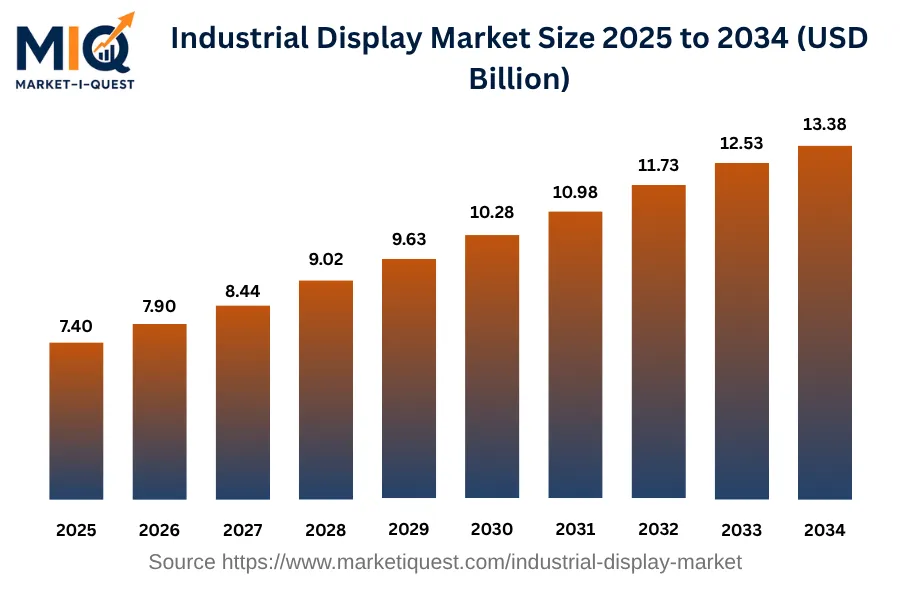
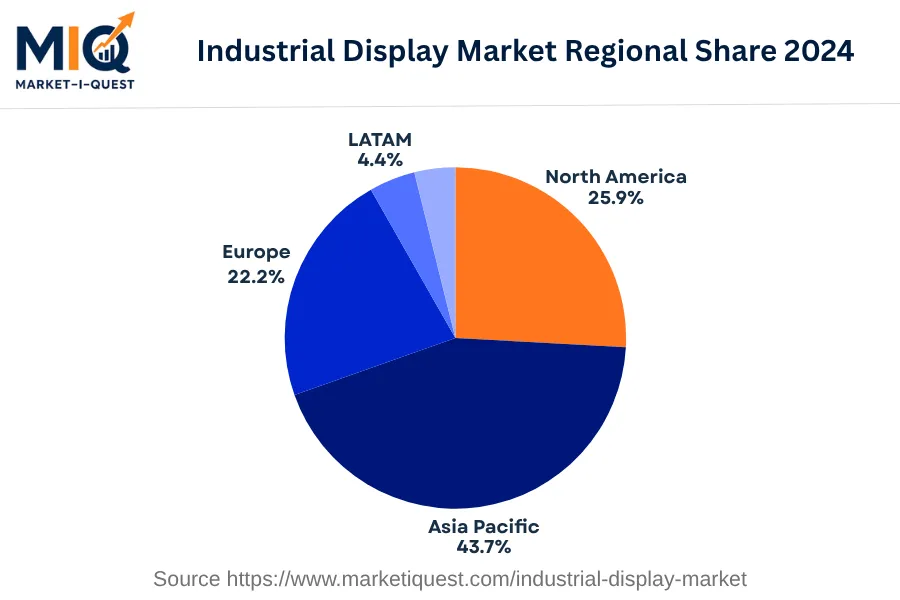
The Industrial Display Market size was valued at USD 7.40 billion in 2025, and it is expected to grow to USD 13.38 billion by 2034, with a Compound Annual Growth Rate (CAGR) of 6.8%. This increase denotes a growth of USD 5.98 billion over nearly a decade, illustrating ongoing expansion in the Industrial Display Market. One element fueling this significant enlargement is the increased purchasing and implementation of industrial displays across various industrial sectors since 2025. In 2024, the regional market share was distributed as follows: the Asia Pacific region held the majority with 43.72%, followed by North America at 25.86%, and Europe at 22.18%. The remaining portions went to Latin America and the Middle East and Africa, with 4.37% and 3.87% respectively.

Key Takeaways

  • By Type - Video Walls led the market accounting for a significant share in 2025.
  • By Technology - OLED emerged as the fastest-growing segment growing at an incredible pace.
  • By Size - Medium Displays (14-21 inches) took up a notable position in the market in 2025.
  • By End Use Industry - Healthcare held a leading position featuring a notable stake in the Industrial Display Market.
industrial-display-market market size

Key Driving Factors

Industrial Automation & Control Systems Adoption

Proliferation of industrial automation and control systems has been a significant factor driving the industrial display market. Industries are increasingly adopting automation to streamline and optimize their processes, leading to lower operating costs, increased efficiency, and improved product quality. Within these systems, industrial displays facilitate the monitoring and management of complex operations. They provide real-time data on production status, machinery efficiency, and safety alerts, among others, enabling operators to make timely and informed decisions. This increased reliance on automated systems across industries such as manufacturing, automotive, energy, and others is bolstering the need for advanced, robust, and reliable industrial displays.
Ruggedness and Adaptability Requirements in Harsh Industrial Environments

The requirement for ruggedness and adaptability in harsh industrial environments propels the growth of the industrial display market. These environments are often characterized by extreme temperatures, dust, shock, vibration, and humidity. Conventional displays used in office settings fail to withstand these factors, leading to frequent breakdowns and replacements. To meet these challenges, industries are turning towards specialized industrial displays. These displays are designed to endure severe operating conditions while maintaining functionality and clear readability. Built with robust materials and technology, these displays can resist mechanical shocks, extreme temperatures, and other strenuous conditions prevalent in industrial sites. As such, the demand for industrial displays is increasing to support seamless operations within demanding environments.

Market Evolution by Timeline

2019-2023
Manufacturing units and medical industries majorly demanded industrial displays in this period, primarily in Asia-Pacific region. Industrial display manufacturers shifted focus to LED-backlit LCD-based industrial displays offering higher efficiency. In 2019, industrial touchscreen technology matured with multi-touch interfaces, enabling complex operations. On the regulatory front, European Union's EMC Directive (2014/30/EU) posed significant challenges to adoption. Contract manufacturing emerged as a typical commercial model while pricing saw a downward trend due to intense competition and cost-effective production techniques. However, integration issues with legacy systems were common, requiring careful consideration of compatibility during procurement.
2024
This year witnessed proliferation of compact and flexible OLED displays in the industrial sector, particularly in automated production lines in European industries. Functionality and durability outweighed cost concerns, leading to stable demand. Adoption of Industrial Internet of Things (IIoT) standards influenced integration and compatibility of displays with advanced machine interfaces. Yet, sourcing quality materials for OLED production was a supply challenge. Partnerships between display manufacturers and automation solution providers started surfacing to deliver complete packages. Cybersecurity risks in connected displays meant system owners needed to consider adding security layers.
2025-2029
In this period, adoption of industrial displays expanded into warehousing and logistics, driven by North America's logistics industry growth. Technological maturity led to larger, high-resolution displays designed for better visibility in complex industrial environments. Yet, mass production logistics in times of dramatic demand shift posed challenges. Regulation on energy efficiency like the EU's ErP Directive impacted design considerations, pushing for eco-friendly models. Leasing industrial displays started as a new commercial model providing cost-effective solutions for industries. Confronting risks related to hardware damage in harsh environments, manufacturers reinforced durability.
2030-2034
Projected demand trends point towards smart city infrastructure projects, likely leading to tailored industrial display solutions for traffic and utilities management. Anticipated technological focus includes hyper-immersive 3D holographic displays. Yet, their integration into existing systems might be complicated. Future policies might focus on emission standards and e-waste management, impacting both design and disposal systems. The commercial model may likely revolve around 'Display-as-a-Service', with service contracts including maintenance and updates. With evolving display technologies, the risk of swift technological obsolescence can lead to the necessity of frequent upgrades.

Future Market Outlook

Future Opportunities

The future opportunities within the industrial display market are closely tied to current trends and technological advances. As Industry 4.0 continues to take hold, the demand for displays that integrate seamlessly with smart factory systems is expected to grow. Companies like Schneider Electric, which announced in 2022 the development of smart displays with analytics capabilities, are positioning themselves to capitalize on this shift. Furthermore, the increase in remote operations and training mandates a more flexible deployment of displays, creating opportunities for portable and multi-functional display solutions, as evidenced by the rise of portable displays from manufacturers such as Dell. The growing emphasis on augmented reality applications in industries, highlighted by Microsoft’s deployment of HoloLens in training scenarios since 2016, indicates a rising demand for displays that can support immersive technologies. Additionally, the ongoing initiatives in automation and human-machine interfaces are expected to enhance the integration of industrial displays, providing companies the ability to offer more intuitive user experiences. Workplace safety standards are also becoming more stringent, paving the way for advanced warning systems that utilize sophisticated display technologies. As sustainability remains a focal point, opportunities exist for displays utilizing renewable energy sources or reducing the carbon footprint in their lifecycle management. The alignment of these factors suggests a robust avenue for growth and innovation in the industrial display market.

Segmentation Analysis

By Type

The market is divided into subsegments including Rugged Displays, Panel-Mount Displays, Open-Frame Displays, Marine Displays, Video Walls, and others. While Video Walls accounted for the largest revenue share, Open-Frame Displays are expected to grow at the fastest CAGR during the forecast period.

Largest Revenue Share

Video Walls

Market Share Leader

Video walls have emerged as the segment with the highest revenue for a variety of reasons. First, video walls offer a visually impressive way for companies to display large volumes of information in a quickly understandable format, making them highly attractive to a wide range of industries such as advertising, entertainment, and security. This widespread applicability has driven their popularity, increasing sales and revenue. Geographically, regions with more developed technology infrastructures, like North America and Europe, contribute significantly to this high demand. Moreover, the continual advancements in display technology have allowed for video walls to offer increasingly high-definition and interactive experiences, enhancing customer experience and maintaining a constant cycle of upgrades and replacements that keep revenue streams flowing. It is important to note, however, that this segment's success relies heavily on large commercial enterprises, a point of potential vulnerability in economic downturns.

Fastest CAGR

Open-Frame Displays

Forecast Period Growth Leader

Open-Frame Displays are projected to experience the fastest growth rate among all subsegments. This is due to their growing adoption in various market sectors such as industrial automation, gaming, transportation, and healthcare. With its flexibility to be customized to suit specific applications, Open-Frame Displays directly address the increasing demand for bespoke solutions in these industries. The declining cost of display technologies is also a significant catalyst for this growth, making them more affordable for smaller businesses and thus expanding the market base. The evolution of technology policy promoting digital transformation certainly acts as another major growth driver. However, the market needs to tackle the adoption barriers including high switching costs from traditional display systems and the need for technical expertise. It must also navigate near-term risks like unpredictable technology advancements that could significantly alter market dynamics.

By Technology

The market is divided into subsegments including LED, LCD, OLED, E-Paper, and Others. As per industry trends, in the base year 2024, the LCD technology accounted for the largest revenue share, while the OLED technology is expected to grow at the fastest CAGR during the forecast period.

Largest Revenue Share

LCD

Market Share Leader

The LCD (Liquid Crystal Display) technology holds the largest market share mainly due to its widespread adoption across different electronics products such as televisions, monitors, smartphones, and other devices. Its dominance can primarily be attributed to its lower cost, higher availability, and versatility. Being a mature technology, there is an established supply chain for LCD components, which assures manufacturers of a steady supply, aiding their production plans. It's the preferred choice for majority of the electronic manufacturers owing to its longer lifespan, reliability, and low power consumption compared to other types of display technologies. Geographically, the key markets for LCDs are the Asia-Pacific region, followed by North America, considering the high concentration of electronics manufacturers in these regions. Moreover, regulatory mandates in numerous countries promoting energy-efficient technologies further boost the demand for LCDs.

Fastest CAGR

OLED

Forecast Period Growth Leader

OLED (Organic Light Emitting Diodes) technology is projected to grow at the fastest pace in the forecasted period. The major growth drivers for this subsegment are its superior characteristics such as flexible form factors, better quality pictures with true colors, faster refresh rates, and wider viewing angles. Along with this, the capacity to operate without a backlight makes an OLED display thinner and more efficient to use. Adoption barriers, on the other hand, include high manufacturing cost and shorter lifespan. However, heavy investments towards research and development activities by key market players are helping to overcome these barriers. Furthermore, strategic partnerships between key players and electronics manufacturers result in higher production capabilities, leading to a decrease in cost. Yet it’s essential to consider potential near-term risks such as supply chain disruptions or competitive pressures which may influence the speed at which the OLED technology is adopted.

By Size

The market is segmented by size into Small Displays (Less than 14 inches), Medium Displays (14-21 inches), and Large Displays (More than 21 inches). Among these, Medium Displays held the largest revenue share, whereas Large Displays are projected to experience the fastest growth rate in the upcoming years.

Largest Revenue Share

Medium Displays (14-21 inches)

Market Share Leader

Medium Displays (14-21 inches) have emerged as the leading revenue generator in the base year 2024. This can be attributed to their optimal size that fits into various environments, from homes to workplaces. Designed for a broad range of applications, these displays meet the needs of a variety of consumers. Their mass utilizability is a core driver behind this dominance in terms of size. Additionally, this subsegment harnesses the benefits of a sweet spot of affordability and utility. They are economically viable for a large portion of consumers while providing features and viewing experience of high-end large displays. Regulations favoring energy efficiency in the electronics industry have also resulted in the surge of medium-sized displays that often use less energy than larger counterparts. Contributing factors such as robust supply chain, efficient distribution channels, and purchase criteria revolving around cost-effectiveness and compact design have established Medium Displays (14-21 inches) as the segment with the highest revenue.

Fastest CAGR

Large Displays (More than 21 inches)

Forecast Period Growth Leader

The segment expected to witness the fastest Compound Annual Growth Rate (CAGR) is Large Displays (More than 21 inches). The driving factors behind this swift growth rate include advancements in technology that have made large displays more affordable and enhanced their performance quality. The entertainment industry in particular serves as a catalyst for the adoption of these displays, as more and more consumers are investing in home theater systems, given recent shifts in home entertainment consumption. Government policies aimed towards digital inclusion have also boosted the adoption of large displays in public and educational institutions. However, there are potential near-term risks such as higher initial capital expenditure and energy consumption concerns that may pose challenges to the adoption rate. Despite these potential hurdles, the proliferation of digitization, the advent of smart homes, and the need for superior visual experience significantly contribute to the potential for rapid growth of this segment.

By End Use Industry

The market is divided into subsegments including Healthcare, Avionics, Military, Agriculture, Transportation, Food & Beverage, Retail, and Others. The Healthcare subsegment accounted for the largest revenue share, while the Retail subsegment is expected to grow at the fastest CAGR during the forecast period.

Largest Revenue Share

Healthcare

Market Share Leader

The Healthcare subsegment emerged as the most lucrative in 2024. Key driving forces behind this leadership include increasing digitalization, rising awareness about health, and the prevalence of chronic diseases. Digital solutions in Healthcare have been paving the way for improved diagnostics, patient care, and clinical operations. Regulatory changes encouraging data sharing, privacy concerns related to patient's health data, and initiatives promoting Healthcare IT are influencing revenues positively. Furthermore, increased spending in Healthcare IT, particularly in developed regions like North America and Europe, combined with growing demand for efficient and cost-effective solutions for healthcare service delivery are driving revenues. The maturity of the Healthcare subsegment, the high purchasing power of this industry, and technological advancements in medical equipment also contribute to its dominant market share.

Fastest CAGR

Retail

Forecast Period Growth Leader

The Retail subsegment is predicted to be the fastest-growing during the forecast period. This growth is driven primarily by the adoption of digital technologies, accelerating e-commerce trends, and evolving consumer behavior towards online shopping, all catalyzed by the impacts of the recent global pandemic. Technological innovation in Retail, including the implementation of Artificial Intelligence (AI), Machine Learning, and Data Analytics for personalized marketing, inventory management, and customer service, will further fuel this growth. Barriers to its adoption such as the heavy upfront cost of investment and concerns about data security and privacy need to be addressed for faster adoption. Potential risks include the changing dynamics of technology and the potential of cyber threats. Despite these hurdles, rising partnerships and collaborations between technology providers and retailers are expected to positively impact this subsegment's growth rate.

Competitive Analysis

Key Market Players

Manufacturers / OEMs

LG Display
South Korea
Panasonic Corporation
Japan
Sharp Corporation
Japan

Key Suppliers & Raw Materials

Corning Incorporated
US
Applied Materials
US
Chemours Company
US

Distributors, Integrators & Channel Partners

Avnet
US
Schneider Electric
France
Siemens
Germany

Porter’s Five Forces Analysis

A comprehensive analysis of the business strategies and structure of the Industrial Display Market.

Supplier Bargaining Power

Medium

Limited number of suppliers leads to moderate pricing control, offset by potential for vertical integration.

Buyer Bargaining Power

Low

Industrial buyers have low power due to specialised products and high switching costs.

Threat of Substitutes

Low

Specialized applications and standards in industrial settings lower the threat of substitutions.

Threat of New Entrants

Medium

High CapEx and regulatory hurdles moderate the risk of new competitors entering the market.

Competitive Rivalry

High

Intense competition among established players due to technological advancements and range of product offerings.

Regional Analysis

Geographic market dynamics and growth opportunities across key regions

Global Market Outlook

industrial-display-market market regional share

North America

In 2024, North America's Industrial Display Market experienced a considerable increase in demand across various sectors. This growth was primarily fueled by higher adoption rates of advanced technology in industries, increased investment in automation, and stringent regulatory norms promoting safety in complex industrial tasks. The U.S., specifically, witnessed elevated demand due to extensive utilization of display technology in healthcare and manufacturing sectors, whereas in Canada, factors like pricing and supply dynamics significantly impacted the market.

Trends shaping the Industrial Display Market included a shift in buyer behavior towards energy-efficient and advanced display technologies, influencing product developing strategies of key players. Numerous partnerships and M&A activities strengthened the market presence of several leading organizations. Enhanced policy enforcement in the U.S. led to the implementation of standard practices, emphasizing the importance of reliable and quality display systems in government and utility sectors. The adoption of intelligent and touch screen displays in the retail sector was also notable, particularly in Mexico, transforming the traditional shopping experience into an interactive one. In conclusion, the North American Industrial Display Market in 2024 witnessed progressive growth due to combined factors such as investment in technology, demand from various sectors, and a synchronized policy environment.

Asia Pacific

In 2024, the industrial display market in Asia Pacific proved a pivotal scene for technological growth and application versatility. Drivers for this surge included increasing industrial automation across countries like China and Japan, which spurred demand for innovative display technologies such as high-performance Human Machine Interface (HMI). Additionally, robust investment in technologies like IoT and AI, particularly in Indian and South Korean markets, led to enhanced industrial displays that optimized operational efficiency. Moreover, the growth of smart factories, especially in key ASEAN markets, necessitated the use of industrial displays for real-time monitoring and control.

Key trends were shaped by shifts in buyer behavior and technology adoption. The rising preference for energy-efficient and advanced display technologies stimulated the adoption of OLED and e-paper displays in sectors like manufacturing and utilities. Digital transformation initiatives by governments, notably in Australia, encouraged the integration of industrial displays in public infrastructure, enhancing monitoring and control capacities. A marked increase in partnerships and M&A activities, such as between display manufacturers and software solution providers, aimed to deliver comprehensive industrial display solutions unique to each customer's needs. Lastly, the enforcement of industrial safety standards across the Asia Pacific further regulated the deployment of industrial displays, underlining the market's critical role in industrial processes.

Europe

In 2024, the Industrial Display Market in Europe demonstrated a robust demand profile, prompted by key drivers and notable trends. Disruptive technological adoption, stringent regulatory standards, and significant investment across various sectors spurred the market's momentum. Industry 4.0 implementation, particularly in manufacturing-heavy economies like Germany and Italy, accelerated the need for advanced industrial display solutions. Automation and digital transformation initiatives across key sectors including manufacturing, utilities, and healthcare, elevated demand for high-resolution, rugged, and interactive displays. The maturing 5G infrastructure in the UK and Nordics saw the proliferation of IoT devices in industrial settings, intensifying need for integrated display systems. With the enforcement of enhanced safety and efficiency standards by EU policy-makers, industrial display technology that complies with such norms gained traction.

Concurrently, observable market trends reciprocated to this dynamic landscape. Due to the transitioning buyer behaviour towards sustainable and energy-efficient solutions, LED and OLED displays gained popularity in enterprises and government sectors. Innovative technology infusion in the wake of channel partnerships and M&A activities changed product offerings significantly, with companies such as Siemens and Schneider Electric leading the way. Simultaneously, the shift towards 'Made in Europe' policy encouraged local sourcing, altering supply chain strategies across the continent. Thus, the Industrial Display Market of Europe in 2024 stood at the intersection of transformative technology adoption and stringent policy enforcements.

Latin America

In 2024, the Latin American Industrial Display Market experienced significant growth, majorly driven by the accelerating industrialization and rapid digitization. Increasing demand for Human Machine Interface (HMI) technologies spurred growth, stimulated by industries such as manufacturing, retail, and utilities wanting to boost productivity and efficiency. Government initiatives in countries like Brazil and Mexico also propelled technology implementation in the industrial sector, either through direct investment or policy. Consumer preferences shifted towards high resolution and energy-efficient displays, while technological advancements – specifically in Organic Light Emitting Diodes (OLED) – became the centerpiece of product development strategies. In terms of distribution, the surge in partnerships between local and international players extended market reach, particularly noticeable in Argentina and Peru.

Within the healthcare sector, the adoption of advanced imaging technologies necessitated high-quality industrial displays, creating a prominent customer base. Manufacturing industries in Mexico and Chile showed a similar adoption trend, significantly contributing to the dynamic demand. It's important to note that while several enterprises and government sectors heavily invested in technology adoption, pricing remained a substantial determinant in buyers' decisions. Simultaneously, regulatory enforcement around energy use and electronic waste in LATAM countries impacted the market dynamics. A trend visibly reflected in strategies of companies, accentuating the development of energy-efficient and recyclable display panels.

Middle East & Africa

In 2024, the Industrial Display Market in the Middle East and Africa (MEA) experienced noteworthy developments. Rapid urbanization and industrialization, primarily in Saudi Arabia, UAE, and Qatar, spurred significant demand for advanced industrial display systems. Moreover, progressive government regulations promoting digitization in sectors like oil and gas, manufacturing, and telecom enabled comprehensive technology adoption. Furthermore, heightened investments in healthcare and utilities sectors in South Africa, Nigeria, and Egypt enhanced accessibility to high-end industrial display technology, while competitive pricing galvanized supply dynamics.

Several key trends were observed in the market. A proclivity towards smart manufacturing practices underwrote the increasing shift from traditional display systems to technologically advanced alternatives. This evolution was prominently observed in Israel's thriving tech sector. Additionally, partnerships and M&A activities were prevalent in all regions, thereby bolstering channel dynamics. In parallel, changes in buyer behavior were discernible, particularly in retail and financial service sectors in Kenya, where preferences veered towards user-friendly and energy-efficient display options. Moreover, stringent policy enforcement, chiefly in Saudi Arabia and UAE, championed sustainability standards, further influencing the market trends. Overall, the MEA Industrial Display Market in 2024 exhibited a productive interplay of market drivers and shifting trends.

Recent Industry Developments

Latest market innovations, product launches, and strategic initiatives

April 2026

Kontron introduced its "K-Display" series, which incorporates integrated AI-driven edge processing modules. These monitors allow for real-time video analytics and status reporting directly at the display level, reducing the need for separate industrial PC (IPC) overhead and lowering cabling complexity in modular factory setups.

May 2026

Advantech launched its new "UTC-500" series, a line of industrial panel PCs featuring advanced sunlight-readable technology and an IP65-rated front panel. These displays are specifically engineered for outdoor industrial kiosks and harsh-environment manufacturing plants, addressing the growing demand for visibility in variable lighting conditions.

Frequently Asked Questions