
Industrial Adhesive Market Snapshot

Key Players

  • 3M (United States)
  • Henkel AG (Germany)
  • H.B. Fuller (United States)
  • Sika AG (Switzerland)
  • Arkema Group (France)
  • Dow Inc. (United States)
  • Jowat SE (Germany)
  • Mapei SpA (Italy)
  • Asian Paints (India)
  • Avery Dennison Corporation (United States)

Market Size

Base Year 2024
$63.75 Bn
CAGR
6.53%
Forecast 2034
$120.01 Bn

Market Segments

By Type
  • Acrylic
  • Polyvinyl Acetate
  • Epoxy
  • Polyurethane
  • Ethyl Vinyl Acetate
By Application
  • Automotive
  • Construction
  • Electronics & Electrical
  • Medical Devices
  • Others

Market Dynamics

Drivers
  • Rapid industrialization growth
  • Increased product demand in packaging sector
Restraints
  • Stringent environmental regulations
  • Fluctuating raw material prices
Opportunities
  • Growing manufacturing sectors
  • Adoption of bio-based adhesives

Market Size

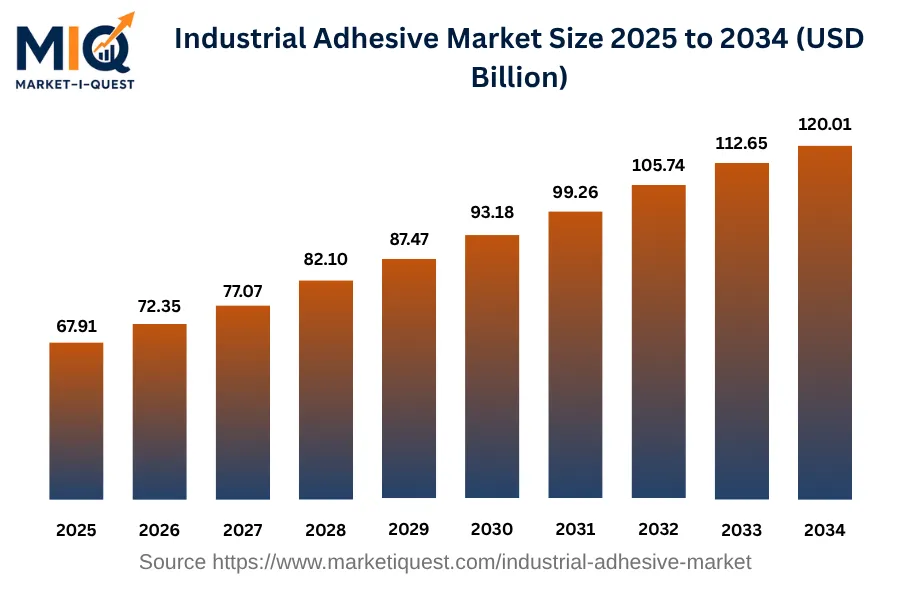
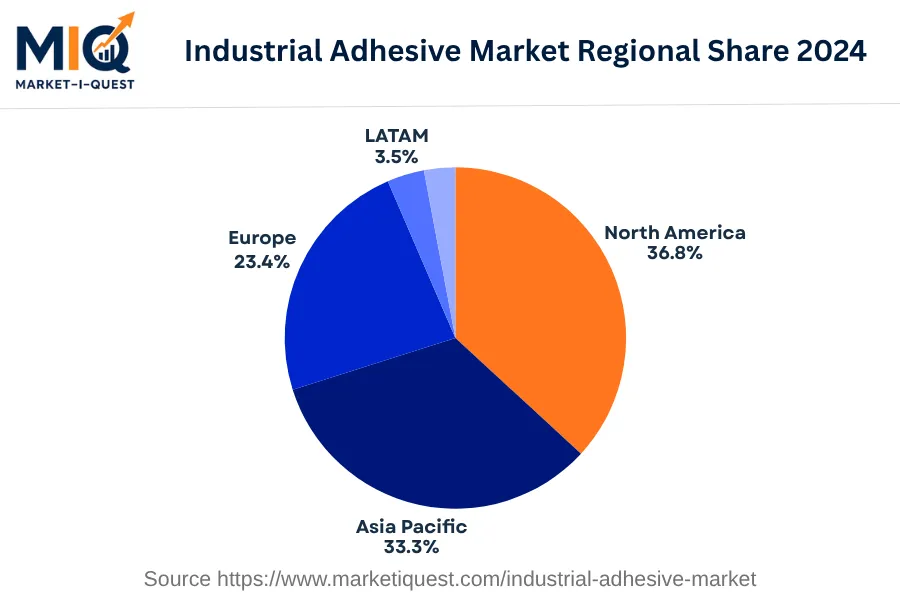
The Industrial Adhesive Market size is expected to grow from $67.91 billion in 2025 to $120.01 billion in 2034, registering a CAGR of 6.53%. This journey from 2025 to 2034 demonstrates a steadily increasing trend in market growth. For example, the market size was at $63.75 billion in 2024. This subsequent increase is attributed to a variety of factors, among them the growth and sophistication of manufacturing industries, the diversification and expansion of product applications, and advancements in adhesive technology contributing to product improvement. In regard to regional market share in 2024, the largest share belonged to the Asia Pacific region with 46.7%, followed by North America at 23.5% and Europe at 21.6%. The regions with the smallest shares were Latin America at 4.2% and Middle East and Africa at 4.0%.

Key Takeaways

  • By Type - Polyurethane led the Industrial Adhesive Market accounting for a remarkable market share in the base year.
  • By Application - Automotive sector held a dominating position in the Industrial Adhesive Market in the specified time frame.
industrial-adhesive-market market size

Key Driving Factors

Increasing Compliance with Strict Environmental Regulations

A significant factor driving the industrial adhesive market is increased adherence to strict environmental regulations globally. Industries from automotive to packaging are required to comply with stringent environmental laws, particularly about reducing volatile organic compound (VOC) emissions. These regulations necessitate the application of eco-friendly adhesives, leading to an augmented demand for such products. Manufacturers in the industrial adhesive market have been quick to respond, investing in research and development efforts directed towards creating adhesives that are not only high-performing but also conform to environmental standards. For instance, water-based or solvent-free adhesives that cause minimal environmental damage have become favored alternatives. This heightened focus on sustainability and environmental responsibility has led to an elevated demand in the industrial adhesive market.
Application Innovation in End-use Industries

Another driving factor for the industrial adhesive market is innovative applications in end-use industries, notably the automotive and construction sectors. In the automotive industry, there is a growing trend towards lightweighting vehicles to enhance fuel efficiency. This requires high-strength adhesives capable of replacing traditional joining practices, such as mechanical fastening or welding. Similarly, in the construction industry, modern building designs are increasingly complex, necessitating the use of adhesives that offer superior bonding, sealing, and joint strength. These application-driven changes and custom requirements in end-use industries compel adhesive manufacturers to continually innovate and stay competitive. Consequently, these innovations are resulting in increased demand for versatile and reliable industrial adhesives, further driving the market growth.

Market Evolution by Timeline

2019-2023
During this period, the demand for adhesives surged in the automobile and construction industries, particularly in Asia-Pacific region. The adhesives industry saw several mergers, acquisitions, and partnerships between adhesive manufacturers and raw material suppliers, ensuring sustainability. Technologies like adhesive bonding came to the forefront, although full-scale integration remained a challenge. Policies like Europe's REACH regulation introduced restrictions on chemical substances, impacting adhesive formulation. Reflecting these changes, price points became more competitive. However, raw materials shortages presented supply risks that were somewhat mitigated through strategic industry partnerships.
2024
In this year, adhesive use grew strongly in electronics and renewable energy industries worldwide. Manufacturers launched new adhesive lines specifically for electronic assembly and solar panel mounting. A fully integrated adhesive bonding technology became industry norm, effectively replacing traditional joining techniques. The European Union's Eco-Design Directive impacted the adhesive market, enforcing energy and resource-efficiency measures. Pricing strategies saw manufacturers offering premium pricing for specialized applications, while procurement moved towards longer-term contracts. The risk of tight raw material supply persisted.
2025-2029
This period saw adhesives playing a critical role in light-weighting efforts, especially in the automobile, aerospace, and defense sectors, primarily in the U.S and Europe. Innovations in bio-based adhesives saw wider market adoption, but supply chain issues and the high price of biological raw materials were ongoing concerns. The introduction of a global standard for environmentally sustainable adhesives encouraged industry-wide adoption of greener processes. Subject to increasingly strict environmental regulations, manufacturers began exploring new business models, including leasing of adhesives. Prices for bio-based adhesives remained higher, reflecting the premium placed on sustainability.
2030-2034
During these years, demand for adhesives in 3D-printing and composite manufacturing began to surge, especially in emerging economies. The market witnessed the successful commercialization of smart adhesives, assessed and guided by IoT technology, but integration into older infrastructures was a challenge. Government-backed standards, such as ASTM's new series on adhesive performance, became the norm. Dynamic pricing models, based on performance and sustainability metrics, became prevalent. Possible disruption to raw material supply, due to environmental factors, remained a critical risk, affecting procurement strategies and accelerating a shift to bio-based alternatives.

Future Market Outlook

Future Opportunities

Future opportunities in the global industrial adhesive market are emerging as environmental regulations evolve and industries seek sustainable solutions. In recent discussions, regulatory bodies such as the Environmental Protection Agency have highlighted initiatives aimed at reducing volatile organic compounds in adhesive formulations. This trend suggests that manufacturers will increasingly focus on developing water-based and low-VOC adhesives to comply with upcoming standards, creating opportunities for companies specializing in eco-friendly formulations. Moreover, the increasing use of automation and robotics in manufacturing processes provides numerous opportunities for adhesive innovation. As companies like Siemens and Bosch integrate smart manufacturing solutions, the requirement for adhesives that can withstand rigorous operational conditions is expected to rise significantly. The expected growth of renewable energy sectors, particularly solar and wind, is also driving demand for adhesives that are compatible with various substrates used in these applications. As witnessed with the collaboration between DuPont and several solar technology companies in 2023, the need for reliable bonding solutions will be critical in enhancing the durability and efficiency of renewable energy systems. These proactive industry shifts showcase that future advancements in the industrial adhesive market will likely center on sustainable formulations, automation capabilities, and applications within the clean energy sector, mirroring current demands for efficiency and environmental stewardship.

Segmentation Analysis

By Type

The market is divided into subsegments including Acrylic, Polyvinyl Acetate, Epoxy, Polyurethane, Ethyl Vinyl Acetate. Polyurethane accounted for the largest revenue share while Epoxy is expected to grow at the fastest CAGR during the forecast period.

Largest Revenue Share

Polyurethane

Market Share Leader

In base year 2024, Polyurethane holds the largest revenue share in the market. The premium positioning of this subsegment is mostly attributed to its superior properties over its counterparts such as durability and resistance to abrasion, which makes Polyurethane a preferred choice across multiple applications such as insulation, automotive interiors, and furniture. Furthermore, it holds a significant share in industrial markets where it is used as coatings and sealants because of its strong adhesive properties. The demand is especially high in developed nations where high expendable income allows for a larger share of premium products. Another driver is the regulatory environment pushing industries towards greener solutions; Polyurethane often meets the stricter environmental regulations due to less environmental impact in manufacturing processes compared to other materials. Given these factors, the Polyurethane segment is expected to continue its leadership in the revenue generation.

Fastest CAGR

Epoxy

Forecast Period Growth Leader

Although not the revenue leader, Epoxy is projected to grow at the fastest CAGR during the forecast period. Its growth can be attributed to the numerous advantages it offers. Epoxy resins are known for their excellent electrical properties and chemical resistance, making them ideal for use in the electrical & electronics industry in the creation of motors, generators, switchgears, etc. The increasing digitization and the current trend towards miniaturization in the electronics sector will thus significantly drive demand. Furthermore, factors such as urbanization and economic development are causing a rise in construction activities, where Epoxy often finds utilization due to its resistance to heat and chemicals. It is important to note that adoption barriers such as higher cost relative to tradition materials could pose challenges to the growth speed. Thus, partnerships and policy support will be critical in overcoming these barriers and achieving the fastest growth in this subsegment.

By Application

The market is divided into subsegments including Automotive, Construction, Electronics & Electrical, Medical Devices, Others. In 2024, the Automotive sector accounted for the largest revenue share while the Medical Devices sector is expected to grow at the fastest CAGR during the forecast period.

Largest Revenue Share

Automotive

Market Share Leader

The high revenue from the automotive sector is driven by a combination of several factors. Stark demand for personalized and technologically advanced vehicles has propelled this industry forward. Consumers increasingly prefer vehicles integrated with advanced technologies, elevating demand for electronic components in the automotive industry. Additionally, the shift towards electric vehicles has contributed significantly to this surge, demanding more advanced electronic systems for improved performances. The supportive regulatory framework around the world for environmental friendliness enforces the production of electric vehicles, further increasing the demand for electrical components within the automotive sector. Geographically, Asia-Pacific has been a dominant region due to the robust automotive manufacturing sector, particularly in countries like China and Japan. Potential customers such as automotive manufacturers, suppliers, and vehicle OEMs have continually invigorated the growth in this segment.

Fastest CAGR

Medical Devices

Forecast Period Growth Leader

The Medical Devices sector is expected to grow at the fastest rate, thanks to a handful of key catalysts. The most significant of these is the rapid advancement in medical technology. As technology continues to innovate at an unprecedented pace, medical devices are becoming more sophisticated, efficient, and effective, leading to higher demand. Concurrently, an aging global population is also driving higher healthcare demand, including the need for advanced medical devices. Emerging markets represent another area of potential growth, as rising income levels and improved access to healthcare services are expected to fuel demand for medical devices. However, factors such as stringent regulatory policies and the high cost of devices may impede growth in the short term. In spite of potential hurdles, the long-term outlook for the medical devices subsegment remains robust.

Competitive Analysis

Key Market Players

Manufacturers / OEMs

3M Company
US
Henkel AG
Germany
H.B. Fuller
US

Key Suppliers & Raw Materials

BASF SE
Germany
Ashland Inc.
US
Eastman Chemical Company
US

Distributors, Integrators & Channel Partners

Dow Chemical Company
US
DIC Corporation
Japan
Avery Dennison Corporation
US

Porter’s Five Forces Analysis

This analysis explores the competitive dynamics within the industrial adhesive market.

Supplier Bargaining Power

Medium

Suppliers possess power due to the unique composition of industrial adhesives and their manufacturing complexity.

Buyer Bargaining Power

Low

Customers face high switching costs due to the specialized nature of adhesives and their industrial applications.

Threat of Substitutes

Medium

The threat of substitutes is moderate given the evolving technology and the emergence of alternative bonding methods.

Threat of New Entrants

Low

High startup cost, legislation and technological barriers reduce the threat of new entrants.

Competitive Rivalry

High

Intense competition exists due to the presence of many large, established firms in the industrial adhesive market.

Regional Analysis

Geographic market dynamics and growth opportunities across key regions

Global Market Outlook

industrial-adhesive-market market regional share

North America

In 2024, North America's industrial adhesive market saw significant dynamism due to various drivers and trends. Key motivators included increased demand from major sectors like automotive and electronics, with companies investing in the latest adhesive technologies to boost production efficiencies. Regulatory standards demanding better quality and enhanced durability also catalyzed market growth, alongside rising pricing stability influencing procurement strategies. Evolving consumer preferences instigated a shift towards bio-based adhesives, creating an overarching trend in the market. Digitalization significantly influenced buyer behavior as industries increasingly purchased adhesives through e-commerce platforms. Additionally, a noteworthy trend was the growing prominence of strategic partnerships and mergers, promoting innovation and expanding the product portfolio. The enforcement of stringent environmental policies led to the rise of eco-friendly adhesives conforming to U.S.' Low-Emitting Materials (LEM) and Canada's Environmental Choice Program. Industries such as healthcare, manufacturing, and utilities routinely used these sustainably manufactured adhesives, reflecting customer behavior towards sustainability and quality.

From large-scale manufacturing enterprises to government projects, the use of industrial adhesives penetrated numerous sectors. U.S. and Mexican manufacturers, in particular, incorporated adhesives in their operations to enhance product performance and durability. The industrial adhesive market in North America in 2024 thus exhibited a complex interplay of demand-supply dynamics, digital transition, policy enforcement, and a growing wave of sustainability.

Asia Pacific

In 2024, the Asia Pacific industrial adhesive market experienced a robust expansion, driven by an increasing demand from various sectors, evolution in technology, and favorable policies instituted by governments across the region. Rise in manufacturing activities, particularly in China and India, spurred demand as large-scale enterprises increasingly depended on high-strength adhesives for varied applications. Regulatory support through green manufacturing policies in South Korea and Japan fueled a shift towards environmentally sustainable adhesives, while enhanced technological adoption - as exemplified by Australia's growing utilization of bio-based adhesives - energized market dynamics. Simultaneously, the market witnessed key trends shaping buyer behavior and influencing product development. Majorly, the surge in e-commerce across the region triggered the need for efficient packaging solutions, thereby driving adhesive consumption. Additionally, advancing partnerships, particularly in the ASEAN markets, amplified production capabilities while the enforcement of quality standards across countries intensified product innovation.

In terms of sectors, government-driven infrastructural projects, healthcare industries due to growing demand for surgical adhesives, and utilities needing adhesives for maintenance and restoring operations were significant contributors to the market's growth. Thus, subsidiaries of demand, evolving technologies, and supportive policies have set the tone for an expanding industrial adhesive market in the Asia Pacific region in 2024.

Europe

In 2024, Europe's Industrial Adhesive Market demonstrated robust performance primarily driven by automotive, construction, and packaging sectors. Increased demand for superior bonding and sealing solutions in these industries complemented market growth. Green regulations prompted the adoption of eco-friendly adhesives, while substantial R&D investments bolstered innovation in adhesive technologies, thus amplifying supply dynamics. Fluctuating raw material costs, however, indirectly influenced adhesive pricing and market stability.

Emerging trends manifested clearly in purchase behavior, with a notable shift towards high-performance and sustainable adhesives, especially in manufacturing-heavy zones like Germany and Italy. Technological advances like the adoption of bio-based and hybrid adhesives widened product choices. Distribution increasingly leaned towards online channels, reciprocating the digital boom across Europe, notably in the UK and Nordic regions. Additionally, strategic partnerships and M&As surfaced within market players striving for expansion, like seen in the Benelux region. Stricter policy enforcement concerning VOC emissions in countries like France and Spain also guided market trends. Ultimately, the year 2024 captivated a thriving Industrial Adhesive Market in Europe, characterized by cross-sector integration, adherence to green protocols, technological embracement, strategic consolidations, and customer-driven product up-gradation.

Latin America

In 2024, the Industrial Adhesive Market in Latin America (LATAM) was shaped by several influential factors. Drivers included increased demand in manufacturing sectors (particularly automotive and packaging in Mexico and Brazil), greater investment in technological innovation in Argentina, and strengthening environmental regulations in Chile that diverted the market towards eco-friendly adhesives. Additionally, pricing was sensitive to raw material supply dynamics with Colombia and Peru's mining outputs influencing regional costs.

Trends indicated a shift in buyer behavior where quality and durability overpowered price as the key determinant in purchasing decisions, signaling a mature market. Product variations were observed to cater to this, with heat-resistant and water-resistant adhesives gaining prominence. Industrial digitization in Brazil and Mexico allowed for enhanced online sales channels, fostering e-commerce for industrial adhesives. There was also a visible uptick in partnerships between local adhesive manufacturers and international chemical giants designed to gain a technological edge. Policies in Argentina and Colombia focused on promoting industrial sustainability inspired enterprises to seek adhesives with a lesser environmental footprint. The LATAM adhesive industry, serving sectors like manufacturing, construction, and retail, thus experienced a transformative year in 2024.

Middle East & Africa

In 2024, the industrial adhesive market in the Middle East and Africa saw robust growth driven by diverse demand dynamics, escalating digital transformation, and regulatory shifts. Primary drivers included soaring demand from key sectors such as the oil and gas industry in Saudi Arabia, the construction industry in Qatar, and the manufacturing sector in South Africa and Nigeria, which were triggered by increased government investments. The adoption of adhesives technology also ramped up significantly in the manufacturing sectors of the United Arab Emirates and Israel, spurred on by the need for operational efficiency and robust product output.

Market trends illuminated a shift towards technologically advanced, eco-friendly adhesives, predominantly driven by regulatory mandates in countries like Egypt and Saudi Arabia, aiming to curb environmental impact. Customer preferences have also showcased a growing inclination towards easy-to-handle, high-performance industrial adhesives while the healthcare sector in Kenya showed a significant uptick in the use of biomedical adhesives. Another notable trend was the strategic partnerships, especially in the UAE and South Africa. For instance, prominent adhesive manufacturers partnered with regional industrial firms to expand their footprints and meet the escalating demand for adhesives in diverse applications. Thus, with these drivers and trends, the industrial adhesive market has witnessed a remarkable transformation in the region in 2024.

Recent Industry Developments

Latest market innovations, product launches, and strategic initiatives

July 2026

Kerakoll introduced H40 Extreme and H40 Tech to the Indian market, expanding its H40 family of tile adhesives alongside the established H40 Gel. The new products are engineered to address the increasing complexity of contemporary construction, from large-format installations to high-performance, heavy-duty applications.

September 2025

Sun Chemical acquired SAPICI, a global leader in high-performance polyurethanes for coatings, flexible packaging, and industrial adhesives. The acquisition transformed Sun Chemical into an integrated player in the lamination adhesives market.

Frequently Asked Questions