
In-Vitro Fertilization Market Snapshot

Key Players

  • Vitrolife AB (Sweden)
  • Cook Medical Inc. (United States)
  • Merck KGaA (Germany)
  • Thermo Fisher Scientific Inc. (United States)
  • Irvine Scientific (United States)
  • Esco Micro Pte. Ltd. (Singapore)
  • Igenomix (Spain)
  • Genea Biomedx (Australia)
  • Boston IVF (United States)
  • Origio (Denmark)

Market Size

Base Year 2024
$25.85 Bn
CAGR
9.15%
Forecast 2034
$62.04 Bn

Market Segments

By Technique
Intra-Cytoplasmic Sperm Injection (ICSI), Traditional IVF, Preimplantation Genetic Testing (PGT), Cryopreservation, Embryo Culture
By Product Type
Instruments, Media, Consumables
By Patient Type
Male Infertility, Female Infertility, Unexplained Infertilit
By End User
Fertility Clinics, Hospitals, Research Laboratories

Market Dynamics

Drivers
  • Increasing infertility rates
  • Advancements in IVF technology
Restraints
  • High treatment costs
  • Ethical and religious controversies
Opportunities
  • Increasing infertility rates
  • Advancement in reproductive technologies

Market Size

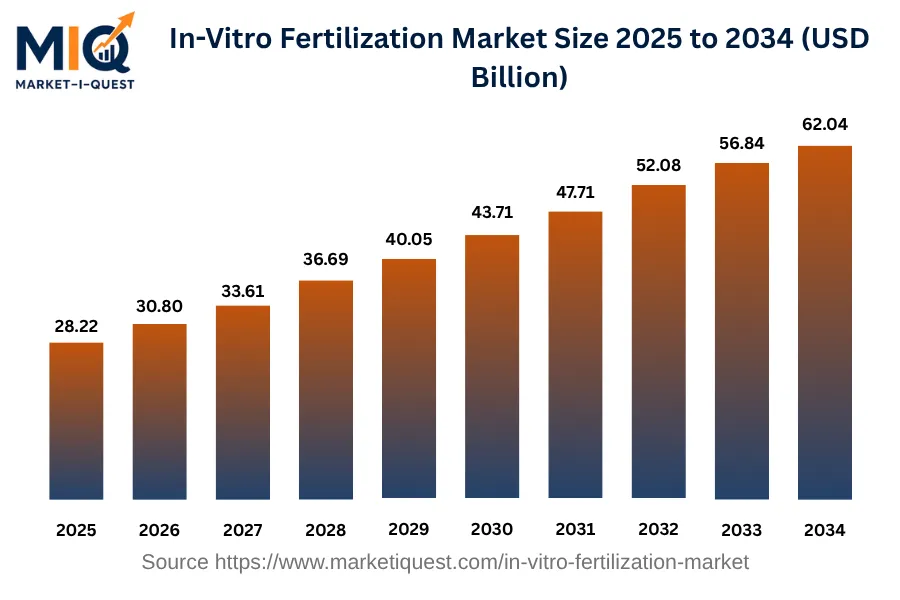
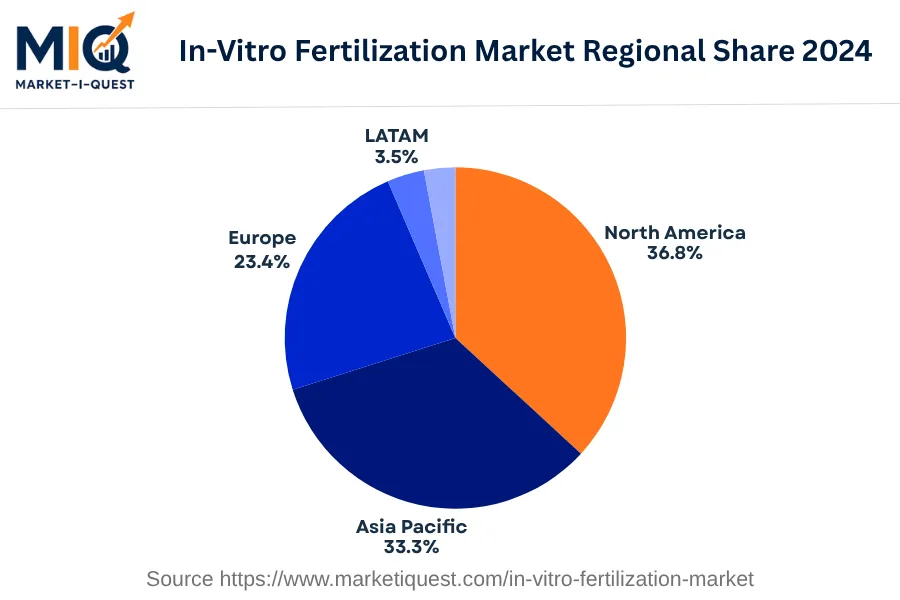
The In-Vitro Fertilization market stood at 25.85 billion USD in 2024 and is predicted to increase to 28.22 billion in 2025. Over the next ten years, the market is slated to grow exponentially, reaching a substantial 62.04 billion USD by the year 2034 with a compound annual growth rate (CAGR) of 9.15%. The positive trajectory of this market between 2025 to 2034 can be attributed to a consistent upward growth trend observed over this particular period. This significant increase reflects the burgeoning demand for IVF (In-Vitro Fertilization) and the rapid advancement and adoption of this technology in the medical sphere. In 2024, the distribution of the market share was as follows: North America held the largest share at 36.7%, followed by Asia Pacific at 32.2%, Europe at 23.9%, Latin America at 3.7%, and the Middle East and Africa at 3.5%.

Key Takeaways

  • By Technique - Traditional IVF held the highest share in 2024.
  • By Product Type - Instruments dominated accounting for majority of the market share in 2024.
  • By Patient Type - Female Infertility was the leading segment in 2024.
  • By End User - Hospitals represented the largest segment in 2024.
in-vitro-fertilization-market market size

Key Driving Factors

Increasing Prevalence of Infertility

The in-vitro fertilization market is being significantly impacted by the growing prevalence of infertility around the world. Infertility, defined as the inability to conceive after a year of unprotected intercourse, affects a significant proportion of couples worldwide. The causes of infertility are numerous, ranging from physiological factors like age to medical conditions like Polycystic Ovary Syndrome (PCOS) or even lifestyle choices like smoking and excessive alcohol consumption. As the prevalence of these conditions increases, so too does the demand for in-vitro fertilization procedures, as they offer a viable alternative for couples who have trouble conceiving naturally. This pushes the growth of the market, especially in developed regions where infertility is more commonly diagnosed and the treatment options are more readily available.
Flexible IVF Policies across Different Nations

The growth of the in-vitro fertilization market is largely facilitated by global policies that ease IVF processes and activities for both medical practitioners and patients. In many parts of the world, notably in Europe and North America, regulatory bodies have established lenient rules and regulations supporting IVF treatments. For example, multiple nations offer provisions for insurance coverage for IVF procedures, making such treatments financially accessible to a larger population. Additionally, the removal of legal and ethical obstacles to IVF in certain countries also contributes to accelerating the market growth in these regions. Hence, the geographical regions with flexible legislation greatly contribute to the expansion of the in-vitro fertilization market.

Market Evolution by Timeline

2019-2023
Demand for In-Vitro Fertilization (IVF) during this period emanated predominantly from metropolitan regions, due to increasing infertility issues and higher awareness. In terms of supply technology, IVF clinics witnessed adoption of technologically advanced embryoscopes for embryo monitoring. However, high procedure costs posed a constraint. On the regulatory front, US saw the introduction of 'Fair Access to Fertility Treatment Act', facilitating insurance coverage for IVF procedures. The commercial model was predominantly service-based with high charges for individual procedures. Patients typically contributed out-of-pocket or via limited insurance coverage. High costs and low success rates were seen as practical impediments.
2024
The year 2024 saw an increased uptake of IVF in Middle-East countries like UAE and Saudi Arabia. Supply was augmented by newer IVF clinics adopting 3D imaging technology for improved embryo selection. In China, the abolition of 'one-child' policy in 2020 increased demand for IVF, spurring more government regulation. In terms of commercial models, traditional pay per procedure was still dominant with slight trend towards fixed fee unlimited cycle models. The issue of accessibility for low-income couples remained a risk with many seeking cheaper, less reliable alternatives.
2025-2029
In this period, demand for IVF shifted towards emerging economies, particularly in Asia where child bearing age was increasing. AI integration in embryo selection and automated labs formations were typical supply side evolutions, although their maturity remained in nascent stages. Regulatory landscape varied, from India's 'Assisted Reproductive Technology (Regulation) Bill' to Brazil's relaxed laws, enabling commercial gestation. IVF costs remained constant on an inflation-adjusted basis but new financial models began to emerge like guarantee programs, shared-risk agreements and loans. The key risk stayed in the form of ethical concerns and potential overuse without adequate counseling.
2030-2034
Demand in this period was driven by an aging global population causing fertility issues. Supply technology improved with genetic screening becoming commonplace, improving success rates. Australian and Canadian policies towards family building encouraged adoption of IVF by providing insurance cover. There was a shift towards inclusive pricing models covering multiple cycles. Partnerships between IVF providers and fintech companies facilitated easier financing options. However, the issue of 'designer babies' emerged as an ethical and practical risk.

Future Market Outlook

Future Opportunities

As the IVF market progresses, future opportunities are evident in several key areas influenced by current industry dynamics. Ongoing clinical trials, such as those conducted by the American Society for Reproductive Medicine in 2023, are exploring novel pharmacological approaches to optimize ovarian stimulation protocols, promising greater patient customization. Furthermore, the rising trend of egg freezing for fertility preservation is gaining momentum, especially in developed regions like North America and Europe, as women continue to prioritize career planning and personal choices. Legal frameworks, particularly restrictive policies around IVF in countries such as Hungary and Poland, may spark demand for services in neighboring countries, highlighting cross-border reproductive care as an emerging segment. Collaborations between technology companies and reproductive health clinics are likely to expand, as seen in the partnership between eIVF and LifeCell in 2022, aiming to provide integrated services. Investment in training and education for healthcare professionals in countries like India and Brazil is anticipated to enhance service delivery quality, supporting the increasing IVF patient population. Additionally, community outreach programs focusing on awareness and accessibility are expected to grow, particularly in regions with cultural resistance to assisted reproductive technology. As stakeholders navigate these opportunities, the landscape of IVF is anticipated to diversify and adapt, reflecting the changing perceptions and needs of prospective parents worldwide.

Segmentation Analysis

By Technique

The market is divided into subsegments including Intra-Cytoplasmic Sperm Injection (ICSI), Traditional IVF, Preimplantation Genetic Testing (PGT), Cryopreservation, and Embryo Culture. Among these, Traditional IVF accounted for the largest revenue share while Preimplantation Genetic Testing (PGT) is expected to grow at the fastest CAGR during the forecast period.

Largest Revenue Share

Traditional IVF

Market Share Leader

Traditional IVF leads the market in terms of revenue generation due to its widespread adoption and higher success rates compared to alternative techniques. IVF has become a standard procedure for people experiencing infertility problems, allowing it to dominate the market and bring in the largest revenue share. Additionally, the existence of a robust medical infrastructure and experienced practitioners significantly contribute to the high technology adoption rate in the developed geographies. Furthermore, IVF is a well-regulated procedure with clear guidelines and protocols that add to its trust factor, ensuring the safety aspect that influences the purchasing decision of the patients. Increasing awareness and the growing prevalence of infertility across the globe have greatly increased the demand for IVF, further driving its dominance in the market. Its long-established presence in the market also results in lower switching costs, pushing more clinics and hospitals to stick to this reliable technique.

Fastest CAGR

Preimplantation Genetic Testing (PGT)

Forecast Period Growth Leader

Preimplantation Genetic Testing (PGT) is projected to witness the fastest growth in the coming years. Technological advancements in genetic testing and an increased focus on reducing the risk of genetic disorders are major contributors to the high growth rate of the PGT sub-segment. The ability of PGT to identify embryos with genetic disorders prior to implantation has increased its popularity among prospective parents, specifically those with a higher risk of transmitting genetic disorders. However, high costs and potential ethical and regulatory hurdles may pose challenges to market growth. Policies that encourage genetic testing and partnerships that facilitate technological advancements are acting as catalysts for market growth. Despite the promise of high CAGR, near-term risks related to the complex nature of genetic testing and regulatory uncertainties need to be cautiously navigated.

By Product Type

The market is divided into subsegments including Instruments, Media, and Consumables. For the base year of 2024, Instruments account for the largest revenue share, while Consumables is projected to exhibit the highest CAGR during the forecast period.

Largest Revenue Share

Instruments

Market Share Leader

The Instruments subsegment commands the largest revenue share in 2024 due to several key factors. From a supply perspective, Instruments are a primary investment for players in the market, given their pivotal role in operations. Organizations invest heavily in high-quality, durable instruments, given their longevity and integral function in operations. Technological advancements not only improve operational efficiency but also command higher price points, further driving revenue. From the demand perspective, customers prioritize reliable, cutting-edge Instruments for their operational needs. This is particularly true in mature markets where technical specifications, rather than pricing, rightly influence purchasing decisions. Geographically, this subsegment thrives in high-income regions where purchasing power is robust. This dominance in revenue is expected to continue barring any game-changing regulatory interventions or major supply chain disruptions.

Fastest CAGR

Consumables

Forecast Period Growth Leader

The Consumables subsegment envisions the steepest growth trajectory. Its rapid growth can be largely attributed to its inherent nature of being repeatedly used and replaced, leading to continuous demand. Technological advancements, while equally affecting all subsegments, particularly catalyze Consumables. Enhanced product functionality and evolving industry standards can prompt frequent updating or upgrading of Consumable products. Furthermore, partnerships with suppliers - aimed at improving supply chain efficiency, reducing costs or jointly developing uniquely tailored Consumable solutions - can markedly spur growth. Possible adoption barriers could include price sensitivity in cost-conscious markets, or resistance to switching Consumable suppliers due to previously established relationships. Nevertheless, with evolving technology and increased capital expenditure the foreseeable future holds robust growth potential for this subsegment.

By Patient Type

The market is divided into subsegments including male infertility, female infertility, and unexplained infertility. As of 2024, female infertility accounted for the largest revenue share while male infertility is expected to grow at the fastest CAGR during the forecast period.

Largest Revenue Share

Female Infertility

Market Share Leader

In 2024, the female infertility subsegment dominated the market in terms of revenue, driven largely by an increasing number of women reporting infertility issues. Several factors contribute to this market dynamic, including rising maternal age, lifestyle changes, and increasing stress levels among women. Proactive fertility measures and treatments have gained increasing acceptance and adoption, demonstrating women's willingness to address these problems. In many countries, fertility preservation and treatment services have received increasing support from healthcare policies, further boosting this subsegment's revenue. Furthermore, the female infertility market's growth is propelled by the expansion of fertility clinics and technological advancements in fertility treatment procedures. It's also critical to remember the high level of personal and financial commitment tied to fertility treatments, which acts as a retention factor, keeping women engaged with treatments for an extended period.

Fastest CAGR

Male Infertility

Forecast Period Growth Leader

Despite the high revenue share of female infertility, the male infertility subsegment is poised to grow at the fastest CAGR. Factors driving this growth include an increased awareness and understanding of male infertility, technological advancements, and a growing body of research focusing on male reproductive health. Pharmacological interventions, coupled with assisted reproductive technologies, have proven successful in treating male infertility, leading to higher adoption rates. In addition, partnerships between fertility clinics and pharmaceutical companies have emerged as a key catalyst, facilitating advancements in treatment protocols and drug development. However, the stigma associated with male infertility serves as a significant barrier to growth, alongside the high treatment costs. Therefore, market players must focus on patient education and affordability to ensure sustained market growth.

By End User

The market is divided into subsegments including Fertility Clinics, Hospitals, and Research Laboratories. In the base year, 2024, Hospitals accounted for the largest revenue share while Fertility Clinics are expected to grow at the fastest CAGR during the forecast period.

Largest Revenue Share

Hospitals

Market Share Leader

In the base year 2024, Hospitals accounted for the largest share of revenue in the market. This high revenue share is largely driven by the ubiquity and higher patient footfall in hospitals compared to other end users. Hospitals not only have a wide reach but also a diverse set of services, making them a key player in this segment. They cater to a significant population who seek healthcare services and are a primary element in the provision and management of numerous health conditions. Their substantial role in healthcare delivery, patient care, and medical research helps drive revenue. Another major driver is the regulatory push from governments to equip hospitals with advanced healthcare technologies to improve patient care. Particular purchasing criteria such as reliability, effectiveness, and cost-efficiency are commonly opted for in hospitals. However, a potential challenge could be the increasing trend of standalone specialty clinics which might sway revenue.

Fastest CAGR

Fertility Clinics

Forecast Period Growth Leader

Fertility Clinics is the fastest-growing subsegment in the market. This is primarily due to increasing awareness of fertility issues and the availability of advanced fertility treatments. A rise in the number of couples seeking fertility treatments and growing knowledge about the availability and advancements in these treatments have led to the substantial growth of this subsegment. Additionally, societal and lifestyle changes have contributed to a rise in fertility issues, creating a surge in demand for these clinics. Advances in technology, with the development of innovative medical devices and techniques, aid fertility clinics in providing comprehensive and effective treatments, thus driving growth. Partnerships in technology capabilities, with notable healthcare tech companies, are a major catalyst for growth. Despite the promising overview, potential adoption barriers such as high cost of treatments, cultural stigma, and regulatory constraints remain as risks that need to be navigated carefully.

Competitive Analysis

Key Market Players

Manufacturers / OEMs

Cook Medical
US
Vitrolife
Sweden
Thermo Fisher Scientific
US

Key Suppliers & Raw Materials

Merck KGaA
Germany
CooperSurgical
US
Fujifilm Irvine Scientific
US

Distributors, Integrators & Channel Partners

IVFtech ApS
Denmark
Esco Micro Pte Ltd
Singapore
Genea Biomedx
Australia

Porter’s Five Forces Analysis

Assessing the dynamics of competition and bargaining in the In-Vitro Fertilization Market.

Supplier Bargaining Power

Medium

Limited number of quality suppliers, high differentiation in inputs, and high switching costs.

Buyer Bargaining Power

Low

Specialized procedures and high switching costs lead to reduced buyer power.

Threat of Substitutes

Low

Few alternative fertility treatments can match the effectiveness of in-vitro fertilization.

Threat of New Entrants

Medium

High initial cost, regulatory hurdles but growth in healthcare technology and fertility clinics.

Competitive Rivalry

High

Numerous competitors with equally effective procedures create high competitive rivalry.

Regional Analysis

Geographic market dynamics and growth opportunities across key regions

Global Market Outlook

in-vitro-fertilization-market market regional share

North America

In 2024, North America's in-vitro fertilization (IVF) market experienced substantial growth primarily due to increased infertility rates, advanced age of maternity, and supportive insurance policies. High-demand drivers included the increase in cases of male and female infertility, often associated with lifestyle changes and rapidly increasing age of maternity. Technological adoption surged with improvements in IVF procedures, making it an appealing choice for many couples. Furthermore, insurance companies broadened their coverage policies, mitigating exorbitant IVF costs and stimulating service demand. Predominant trends included the spike in single women and LGBTQ+ couples seeking IVF treatments, pushing fertility clinics to broaden their services. Technological advances led to the adoption of preimplantation genetic diagnosis, ensuring successful pregnancy rates. The market also saw increased partnerships, bolstering IVF accessibility and affordability. Specifically, fertility clinics formed alliances with payment solutions companies, facilitating manageable financing for patients.

The sectors primarily engaged with IVF treatments encompassed healthcare providers like hospitals and fertility clinics, along with insurance and financial service companies. Governmental involvement also became evident through the enforcement of inclusive health insurance policies supporting IVF treatments. In essence, the IVF market in North America in 2024 witnessed significant growth and change, driven equally by demand, technological advancement, and strategic collaborations.

Asia Pacific

In 2024, the Asia Pacific in-vitro fertilization (IVF) market witnessed significant demand driven by increasing infertility rates, supportive governmental policies, and advancements in technology. Driving the market, the heightened frequency of infertility due to lifestyle-induced factors, notably in India and China, led to marked demand for IVF procedures. In tandem, governments, especially in Australia and Japan, implemented favorable policies, assuring subsidies and grants for fertility treatments, invigorating the regional market. Further, investment in the healthcare sector, notably in technologically advanced solutions in South Korea and key ASEAN markets, amplified the adoption of IVF procedures, remarkably improving procedural efficacy and success rates.

Constituting the trends, the improved awareness and changing perception towards IVF treatments became prominent, particularly in traditional societies of China and India. Simultaneously, a shift towards personalized reproductive medicine technologies, predominantly in developed markets like Japan and Australia, underscored the departure from 'one-size-fits-all' approach. An uptick in partnerships and mergers was spotted among market players, aiming to capitalize on technological advancements and increase in IVF demand. Lastly, policy enforcement in healthcare, ensuring ethical and transparent practices in IVF procedures, shaped buyer confidence across the region, encompassing sectors from healthcare providers to private enterprises. The 2024 Asia Pacific IVF market, hence, presented a calibrated blend of influence from demand drivers, governmental backing, technological strides, and evolving patient sentiments.

Europe

In 2024, the European market for In-Vitro Fertilization (IVF) demonstrated dynamic growth influenced by critical drivers and trends. Key drivers included growing infertility rates, escalating government and private investments in healthcare, advancements in fertility treatment technologies, leading to a rise in IVF procedures. Germany and the United Kingdom experienced particularly pronounced increases due to a combination of higher infertility rates and robust healthcare systems with adequate funding. IVF procedures were also popularized by improved success rates, courtesy of real-time monitoring technology. Legal reforms, such as France lifting restrictions on assisted reproductive technologies for single women and lesbian couples, provided further impetus. The introduction of next-generation sequencing in IVF in countries like Italy improved procedure outcomes, thus catalyzing adoption.

On the trend front, a shift was seen toward specialist fertility clinics over general hospitals. Similarly, mergers and acquisitions in the market were also notable, for instance, the merger of two major fertility companies in Spain, aimed at consolidating the fragmented IVF market. Moreover, a significant trend was public health initiatives, such as the ‘Fertility Check’ program in the Nordics, aimed at educating individuals about fertility issues, which underscored the importance and potential of IVF treatments in Europe. These factors underscored a rapidly evolving European IVF market in 2024, with significant growth indicators across countries, especially in healthcare sectors.

Latin America

In 2024, the In-Vitro Fertilization (IVF) market witnessed substantial growth in key Latin American countries, shaped by several determinants and trends. Critical market propellers included increased infertility rates in countries like Brazil and Mexico, robust healthcare investments in IVF technologies, and significant adoption of assisted reproduction techniques across the region. However, high procedural costs and limited insurance coverage remained deterrents in countries like Colombia, Chile, and Peru, affecting market expansion. The trend of couples postponing parenthood until their 30s, coupled with a rising prevalence of Polycystic Ovary Syndrome (PCOS), amplified the demand for IVF services. Particularly in Brazil and Argentina, improved healthcare infrastructure and an evolving consumer mindset towards unconventional conception methods meant that more individuals were seeking IVF procedures. Newer technology integrations streamlined the process for both healthcare providers and patients, making IVF increasingly accessible.

Consolidations, encapsulated by partnerships and tie-ups between IVF clinics and healthcare facilities, strengthened the market's service delivery capabilities. Regulatory policies in countries like Mexico, which enhanced reimbursement scenarios and introduced stricter guidelines to maintain quality standards in IVF procedures, further shaped market behavior. However, the commercial sector remained largely untapped, with primary consumption limited to healthcare institutions and independent clinics.

Middle East & Africa

In 2024, the Middle East and Africa's in-vitro fertilization (IVF) market experienced enhanced growth, reflecting increased healthcare investments and technological adoption. Saudi Arabia and UAE, driven by improved legal frameworks and religious accommodations, saw a rise in IVF demand. South Africa and Israel, stimulated by technological advancements and robust healthcare systems, exhibited high adoption of IVF procedures. Drivers for this growth included elevated infertility rates across the region, governmental investments in healthcare infrastructure, and a noticeable shift towards acceptance of fertility treatments in traditionally conservative societies like Saudi Arabia and Qatar. For instance, the Eshraqa IVF Funding Program in Saudi Arabia substantially increased accessibility to fertility treatments.

Noteworthy trends in 2024 were a rise in medical tourism for IVF procedures in countries like UAE and Israel, increased collaboration between government and private clinics to enhance service coverage, and the implementation of state-backed IVF insurance schemes in South Africa and Nigeria. The normalization of IVF in popular cultures, as seen in Egypt and Kenya, also contributed to the increased acceptance and demand. The regional IVF industry was impacted significantly by sectors including healthcare and tourism. Demand from these sectors, particularly private healthcare entities in the UAE and government-funded healthcare systems in Israel, propelled the IVF market forward in the base year.

Recent Industry Developments

Latest market innovations, product launches, and strategic initiatives

June 2026

India's Central Drugs Standard Control Organisation (CDSCO) issued a regulatory directive obliging all fertility clinics and sperm banks to secure registration under the Assisted Reproductive Technology and Surrogacy Acts before they are permitted to obtain essential IVF laboratory consumables such as specialised culture media, reagents, and related materials.

February 2025

U.S. President Donald Trump issued an executive order to expand IVF access. In May 2025, the U.S. Departments of Labor, Health and Human Services, and Treasury announced a proposed regulation to implement the order by establishing a new category of limited excepted benefits for IVF coverage.

Frequently Asked Questions