
In-Situ Hybridization Market Snapshot

Key Players

  • BioGenex Laboratories Inc. (United States)
  • Leica Biosystems Nussloch GmbH (Germany)
  • Thermo Fisher Scientific Inc. (United States)
  • Merck KGaA (Germany)
  • Bio-Techne Corporation (United States)
  • Danaher Corporation (United States)
  • Advanced Cell Diagnostics (United States)
  • PerkinElmer
  • Inc. (United States)
  • Abnova Corporation (Taiwan)
  • F. Hoffmann-La Roche Ltd. (Switzerland)

Market Size

Base Year 2024
$2.36 Bn
CAGR
8.46%
Forecast 2034
$5.32 Bn

Market Segments

By Technology
Fluorescence In Situ Hybridization (FISH), Chromogenic In Situ Hybridization (CISH), Dual-Color In Situ Hybridization (DISH)
By Probe Type
DNA Probes, RNA Probes, Chromosomal Probes
By Application
Cancer Diagnosis, Genetic Research, Microbiology
By End Use
Hospitals, Research Laboratories, Pharmaceutical Companies

Market Dynamics

Drivers
  • Rising Incidence of Cancer
  • Technological Advancements in ISH
Restraints
  • High equipment costs
  • Complex technology implementation
Opportunities
  • Emerging diagnostic technologies
  • Increasing prevalence of cancer

Market Size

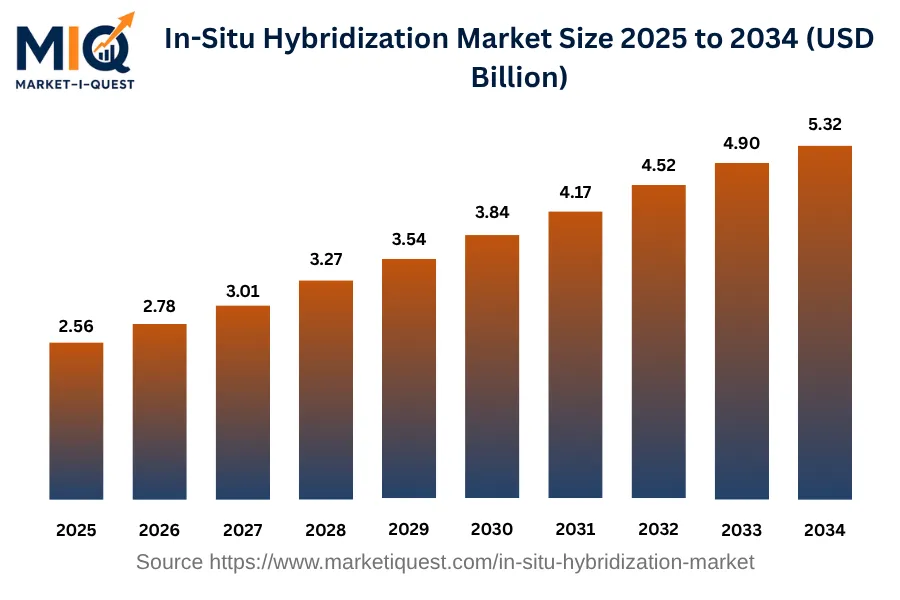
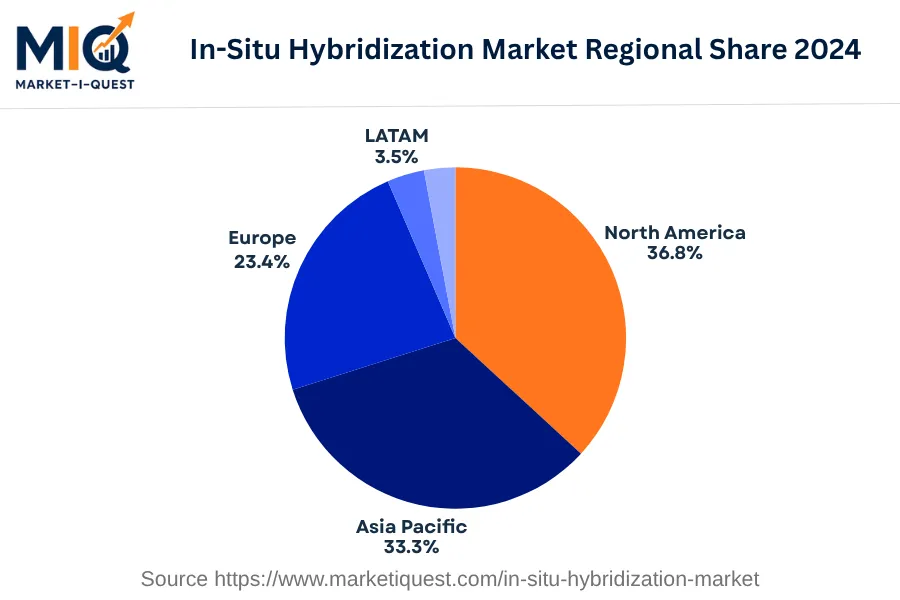
The In-Situ Hybridization Market had a size of 2.56 billion USD in 2025 and will reach a value of 5.32 billion USD by 2034, growing at a CAGR of 8.46%. In 2024, preceding the period under consideration, the market stood at 2.36 billion USD. Consequently, the market has been growing consistently over a span of 10 years. This growth can be attributed to advancements in technology and an increasing demand for more precise diagnostics across sectors. On a regional split in 2024, North America held the dominant market share with 39.7%, followed by Asia Pacific at 28.6%, and Europe at 24.7%. The remaining global market share was held by Latin America and Middle East & Africa, at 3.6% and 3.3% respectively.

Key Takeaways

  • By Technology - Fluorescence In Situ Hybridization (FISH) subsegment dominates the market
  • By Probe Type - DNA Probes dominated the market accounting for a high percentage share in 2024.
  • By application - Cancer Diagnosis was the main segment commanding a considerable market share in 2024.
  • By End Use - Hospitals held the largest share of the market in 2024.
in-situ-hybridization-market market size

Key Driving Factors

Implementation of Precision Medicine

The global In-Situ Hybridization market is being fueled by the increasing implementation of precision medicine in the healthcare industry. Having specific genetic data about a patient's disease is often crucial in choosing the optimal treatment strategy. In-situ hybridization allows for the precise localization of specific segments of DNA or RNA within tissue or cells, providing valuable information about genetic aberrations in disease states. Healthcare providers worldwide are recognizing this technique's value, leading to increased adoption in diagnostic settings. Furthermore, governments are encouraging the use of precision medicine, contributing to the expansion of the In-Situ Hybridization market.
Adoption in Drug Development Processes

The adoption of in-situ hybridization techniques in drug development processes is a second key driver. Pharmaceutical companies are continuously exploring innovative mechanisms of action for drug development. In-situ hybridization plays a pivotal role in understanding gene expression patterns at cellular resolution, providing insights into the spatial-temporal dynamics of disease progression. It enables drug developers to pinpoint the changes at the genetic level that their drugs can target, increasing the probability of developing effective therapies. As a result, pharmaceutical companies are integrating in-situ hybridization techniques more prominently in their drug discovery pipelines, propelling the market's growth.

Market Evolution by Timeline

2019-2023
The primary buyers here were healthcare institutions and research and development organizations, especially in North America and Europe. The technology's essential use was in detecting specific DNA sequences in cells and tissues and is seen as crucial for cancer research. Unfortunately, the high cost of the technology and the lack of skilled professionals acted as constraints. The European Union's new medical device regulation increased scrutiny, further affecting the market. Contracts were predominately long-term and involved partnerships with research institutions. The main risks included improper handling and sample contamination.
2024
The demand for the technology was likely to remain stable due to its constant requirements in medical and genetic research. Still, stagnation was present since it was a mature technology. Policy updates were not significant, but the global supply chain disruptions due to COVID-19 impacted the market. Commercial models remained stable with few new partnerships announced. Long-term contracts dominated due to the technology's long lifecycle. The critical risk of mishandling research samples continued, and organizations started to invest in staff training to mitigate this impact.
2025-2029
The buyers again were medical research institutions, but the Asia Pacific region saw growth due to increased investment in healthcare. As the technology matured, its integration with other platforms started to emerge, offering time and cost efficiency. No significant policy updates were observed. As a result of the market maturing, prices were likely to stabilize, and long-term partnerships with new providers were expected. The main concern was quality control, especially in areas with less development and lack of trained personnel.
2030-2034
The demand was projected to increase, with technological advancements making in-situ hybridization more accessible, especially in developing nations. The integration of the technology into everyday hospital procedures was seen by some as a possible future. Regulations were expected to remain consistent with no significant changes. Companies were expected to explore shorter contract durations to adapt to the rapidly changing landscape. The main risk was still improper handling of samples, especially in countries with less expertise in the field.

Future Market Outlook

Future Opportunities

As the in-situ hybridization market continues to grow, several compelling opportunities present themselves. The increasing prevalence of cancer globally, with an estimated 19.3 million new cases reported by the International Agency for Research on Cancer in 2020, positions in-situ hybridization as a vital tool for cancer diagnostics. Concurrently, advancements in CRISPR technology have opened avenues for its integration with in-situ hybridization, allowing for innovative applications in gene editing research. Specific to Europe, as of 2023, there is a heightened demand for personalized medicine approaches which leverage in-situ technologies for tailored treatments, particularly in the context of rare diseases. Collaborations between pharmaceutical companies and biotechnology firms are expected to intensify, especially in the Asia-Pacific region, where an increasing number of start-ups are developing novel in-situ hybridization solutions aimed at specific applications, such as infectious disease detection. Furthermore, regulatory support for personalized genomics could facilitate faster adoption of these technologies in clinical settings. By focusing on partnerships and utilizing existing regulatory frameworks, stakeholders can capitalize on these emerging opportunities, ultimately driving advancements in diagnostics and personalized therapeutics. As a result, the interplay between innovation and regulation will be critical in shaping the future trajectory of the in-situ hybridization market.

Segmentation Analysis

By Technology

The market is segmented by technology into Fluorescence In Situ Hybridization (FISH), Chromogenic In Situ Hybridization (CISH), and Dual-Color In Situ Hybridization (DISH). Among these, FISH accounted for the largest revenue share while DISH is slated to be the fastest-growing subsegment.

Largest Revenue Share

Fluorescence In Situ Hybridization (FISH)

Market Share Leader

The Fluorescence In Situ Hybridization (FISH) subsegment dominates the market due to its high sensitivity and specificity, which makes it widely utilized in clinical practice. FISH is an essential tool for mapping the genes and chromosomes, which explains its robust demand in the healthcare sector. Medical laboratories worldwide continually seek FISH technology for genetic conditions such as cancer, owing to its ability to visualize complex genetic abnormalities. This further boosts its revenue-generating potential. Additionally, increased use in environmental testing for microbial populations and the detection of pesticide and toxin effects propels its market standing. FISH is also extensively used in food testing for the identification of genetic modifications, providing another avenue for revenue. Lastly, FISH's popularity in forensic science, where it helps in personal identification and paternity testing, solidifies it not only as a leader in revenue generation but also as the choice technology across multiple sectors.

Fastest CAGR

Dual-Color In Situ Hybridization (DISH)

Forecast Period Growth Leader

Dual-Color In Situ Hybridization (DISH) is projected to have the fastest Compound Annual Growth Rate (CAGR) in this market segment. DISH outshines FISH and CISH due to its ability to analyse two genes simultaneously, which opens up numerous advantages and applications. The healthcare sector's ongoing search for cost-effective and efficient gene analytics solutions could play a crucial role in DISH's accelerated adoption. Moreover, research and development of DISH in determining gene amplification in tumors shows a lot of potential, which propels its demand in oncology. However, broader global adoption could face hurdles due to lack of awareness and the need for highly skilled professionals who can interpret DISH results. The market is also country-specific, with developed countries showing a relatively higher adoption rate compared with developing economies. This differential could be leveled by the increasing investments in healthcare infrastructure across emerging markets coupled with the partnership with the established players in the segment.

By Probe Type

The market is divided into subsegments including DNA Probes, RNA Probes, and Chromosomal Probes, with DNA Probes accounting for the largest revenue share, while RNA Probes is expected to grow at the fastest CAGR during the forecast period.

Largest Revenue Share

DNA Probes

Market Share Leader

As of the base year 2024, DNA Probes have emerged as the market's highest revenue generating segment. This can be attributed to the integral part they play in genetic and biological research and their extensive application in medical diagnostics. Universal methods such as PCR, genotyping, and DNA sequencing significantly rely on the successful use of DNA Probes. Also, the trend of customizing DNA probes for specific research has popularized their usage, thereby driving revenue growth. Furthermore, DNA Probes have a wider geographical penetration due to increased funding in genetic research and cancers across developed nations and increasing partnerships for advancing diagnostics. Regulations have also played a role in the growth and dominance of this subsegment, with standardization and validation of techniques being in favor of DNA Probes. The purchasing criteria revolve around probe accuracy, reproducibility, and cost-effectiveness which are found notable in DNA Probes. The shift towards other probe types has been minimal due to the high switching costs and technical convenience.

Fastest CAGR

RNA Probes

Forecast Period Growth Leader

Despite DNA Probes commanding the largest market share in terms of revenue, RNA Probes are anticipated to register the fastest CAGR in the coming years. This prediction is based on the surge in the demand for RNA probes in RNA related research areas, including RNA evolution and structure, RNA modification, and RNA-protein interactions. Advancements in technology, such as the development of RNA FISH (Fluorescence In Situ Hybridization) technology, which allows for the effective visualization and location of RNA in cells, has accelerated the acceptance and adoption of these probes. These advancements are lowering the adoption barriers and supporting growth. Partnership programs between companies and academic institutions for further exploration and improvement of RNA sequencing techniques serve as an impetus for growth. However, there are short-term risks related to implementation costs and limited knowledge among users which could affect the rate of adoption. Assumption: growth is inferred from the increase in RNA based tools adoption and partnership activity.

By Application

The market is divided into subsegments including Cancer Diagnosis, Genetic Research, and Microbiology. Cancer Diagnosis accounted for the largest revenue share while Genetic Research is expected to grow at the fastest CAGR during the forecast period.

Largest Revenue Share

Cancer Diagnosis

Market Share Leader

Cancer diagnosis has the highest revenue generation in 2024 due to the globally increasing prevalence of cancer and the consequent need for its early detection. The growth is primarily driven by factors such as higher patient awareness, continuing investment in cancer research, and advancements in diagnostic techniques. Large-scale adoption of cancer diagnosis procedures by hospitals and diagnostic centers fuels the demand. Higher purchasing power in developed countries and rising demand for personalized treatment contribute too. Increasing healthcare expenditure, combined with the growing focus on early diagnosis for effective cancer treatment, is accelerating the revenue growth. Market participants such as hospitals, diagnostic centers, research institutes are heavily involved in driving the demand. Regulatory policies pushing for effective cancer diagnosis procedures are also incredibly important. While the cost related to cancer diagnosis can be a restraint, the clear benefits, and demonstrated effectiveness compound its demand leading to high revenue generation.

Fastest CAGR

Genetic Research

Forecast Period Growth Leader

Genetic Research is touted to record the fastest growth. The field has witnessed significant advancements and a massive influx of investments. The urgency to understand genetic components of diseases, especially in the wake of pandemics, acts as a major driver. Apart from that, policy support for genetic research is stronger than ever, as governments, organizations, and stakeholders have recognized its potential in enhancing health care. However, adoption barriers exist, primarily in terms of cost, technology understanding and ethical considerations. Digital partnerships and advancing technology including AI and machine learning are lowering these barriers and aiding the rise of this segment. Increased capital expenditure towards infrastructure, coupled with technological partnerships and collaborations, are all factors contributing to the rapid growth of this sector. Progress in understanding genetic diseases and research in gene therapy present substantial growth opportunities in the near future. However, regulations on genetic testing and ethical concerns remain a downside risk.

By End Use

By the end of 2024, the market is divided into subsegments including Hospitals, Research Laboratories, and Pharmaceutical Companies. Hospitals accounted for the largest revenue share, while Research Laboratories is expected to grow at the fastest CAGR during the forecast period.

Largest Revenue Share

Hospitals

Market Share Leader

Hospitals generated the most revenue in 2024. This concentrate of revenue can be attributed to several factors. Hospitals generally serve a large population and have an extensive and diverse range of services that necessitates a broad spectrum of medical and support equipment. This equipment requires constant replacement due to use, updates, and safety regulations, contributing to the high revenue generation in this segment. Moreover, hospitals are often under strict regulations which necessitates the frequent replacement and upgrading of equipment to comply with new or revised standards. They are also marked by their critical role in providing immediate and comprehensive care, which necessitates the availability of modern medical equipment. Furthermore, many hospitals are supported by government funding, allowing for higher purchasing power and the ability to obtain state-of-the-art equipment. This not only increases the efficiency and effectiveness of care but also impacts patient safety and outcomes.

Fastest CAGR

Research Laboratories

Forecast Period Growth Leader

Research laboratories are forecast to experience the most rapid growth in the coming years. Several key factors drive this growth. One is the increasing emphasis on research and development in the healthcare field. As medical technology and treatments continue to evolve, laboratories are seen as critical in pushing these advancements. Additionally, the ongoing pandemic has highlighted the importance of research laboratories and has led to a surge in funding for these facilities. Through the proliferation of both equipment and human capital, research laboratories are increasingly able to drive innovation and development in the healthcare space. Moreover, partnerships between research laboratories and pharmaceutical companies are becoming more common, often resulting in increased resources and support for the laboratories. Despite these promising indicators, the high cost of equipment and the complexity of regulatory compliance pose potential challenges to this growth. Nonetheless, as long as the focus on healthcare innovation remains and is even intensified, the growth trajectory of research laboratories will continue to be upward.

Competitive Analysis

Key Market Players

Manufacturers / OEMs

Agilent Technologies
US
Danaher Corporation
US
Thermo Fisher Scientific Inc.
US

Key Suppliers & Raw Materials

Sigma-Aldrich Co.
US
Merck KGaA
Germany
F. Hoffmann-La Roche Ltd.
Switzerland

Distributors, Integrators & Channel Partners

BioGenex
US
Leica Biosystems Nussloch GmbH
Germany
Bio-Techne Corp
US

Porter’s Five Forces Analysis

A comprehensive study on competitive environment of the In-Situ Hybridization Market.

Supplier Bargaining Power

Medium

Dependence on few suppliers for specialized reagents reinforces their bargaining power.

Buyer Bargaining Power

High

Diverse range of end users facilitates high bargaining power for buyers.

Threat of Substitutes

Low

Unique detection capabilities of the technique lowly limits substitution possibilities.

Threat of New Entrants

Medium

High development costs and technical complexities balance the threat of new entrants.

Competitive Rivalry

High

Presence of major biotechnological firms escalates competitive intensity in the market.

Regional Analysis

Geographic market dynamics and growth opportunities across key regions

Global Market Outlook

in-situ-hybridization-market market regional share

North America

In 2024, North America's In-Situ Hybridization (ISH) market staged significant growth due to key drivers and trends across the U.S., Canada, and Mexico. Technology adoption and regulations played a major role in driving the market. The increased investment in healthcare research and diagnostics, particularly in the U.S., led to a heightened demand for ISH technology in laboratories and research centers. Stricter regulations in genetic testing and diagnosis, especially in Canada, necessitated widespread use of ISH techniques. Simultaneously, the emergence of new ISH methodologies, spurred on by continued technology innovation, encouraged broader adoption in North American markets.

Several trends shaped the market dynamics in 2024. A shift towards digital pathology saw a rise in demand for ISH in telepathology. Further, the expansion of personalized medicine in healthcare facilities prompted the use of ISH in customizing patient treatment. Meanwhile, a growing number of partnerships and M&As between North American healthcare providers and genetic testing companies suggested increased integration of ISH technologies into healthcare systems. Compliance with genomic data policy standards also influenced the prevalent use of ISH in the biotechnology sector, reflecting its importance in genetic data generation and analysis. North America's ISH market in 2024 thus exhibited a distinctive growth driven by persistent technological development and a deepening interaction between the healthcare and genetic sectors.

Asia Pacific

In 2024, the Asia Pacific In-Situ Hybridization (ISH) Market thrived due to increased demand, technological advances, and favorable regulations. Greater urbanization and industrialization in countries like China, India, and Japan led to increased pollution, in turn driving demand for ISH techniques to study the consequent healthcare issues, particularly in cancer research. Governments across the region provided investment in healthcare, facilitating the adoption of advanced molecular diagnostic techniques. Moreover, regulatory approvals of ISH tests in Australia further stimulated market growth.

The market also witnessed various trends that fed into its vitality in 2024. Education digitization propelled research, with webinars providing the necessary training for ISH technology usage. In China and India, telehealth adoption rates soared, increasing the demand for ISH in remote patient monitoring. Collaborations and M&A activities were rampant, especially in Japan and South Korea, solidifying the supply chain and fostering technology transfer. Additionally, policy changes in key ASEAN markets, mandating ISH in certain types of genetic diagnoses, resulted in a boost for the sector. Significantly, high utilization occurred in healthcare and enterprise sectors, with companies like Roche and Leica Biosystems dominating. Evidently, 2024 was a transformational year for the ISH market across the Asia Pacific, guided by these diverse drivers and trends.

Europe

In 2024, the In-Situ Hybridization (ISH) Market in Europe exhibited robust growth due to several key drivers and trends. Government investments in health care and biosciences research, particularly in Germany and the UK, stimulated demand for ISH technologies for diagnostic and research purposes. Further, increasing incidence of cancer across countries like France and Italy necessitated advancements in cytogenetic techniques, catalyzing adoption of ISH. Meanwhile, innovative supply dynamics emerged in Spain and Benelux, spearheaded by pharmaceutical manufacturers capitalizing on reduced ISH production costs, leading to competitive pricing.

Trend-wise, customer preference leaned towards fluorescence ISH (FISH) for its higher resolution and speed, transforming the product landscape. Digitization waves in Central & Eastern Europe healthcare systems fostered adoption of automation in ISH testing procedures. Major market players engaged in strategic M&As resulting in wider service offerings, evidenced by illumina's acquisition of Oxford Nanopore. Policy enforcement, such as the EU's 'Europe's Beating Cancer Plan', necessitated high-standard cancer diagnosis, reinforcing ISH market growth. The growing integration of ISH technology was notable across the enterprise sector, as well as in government-backed healthcare institutes. Manufacturers utilized the technology to improve their product quality, while retail sectors construed it as an innovative way to build upon certain types of merchandise. The overall perception of ISH usage has considerably shifted from niche healthcare technology to a versatile, cross-industry tool.

Latin America

In 2024, the In-Situ Hybridization (ISH) market in Latin America showed steady growth, spurred by escalating demand for high-precision diagnostic tests and investment in healthcare research. Advanced health infrastructure in countries like Brazil and Argentina coupled with increased government funding, stimulated the adoption of this diagnostic technology. Supply dynamics also favored market expansion as international manufacturers penetrated LATAM, despite pricing being an inhibitory factor for the less affluent markets such as Peru. Trends illustrating the market behavior include an escalating demand for digital pathology and telepathology, heeding to the accelerated shift towards remote diagnostic solutions. The expanded use of fluorescence ISH in the detection of genetic abnormalities signaled another significant trend. Partnership agreements marked the market landscape, with Mexico and Colombia witnessing noteworthy deals between local pathology labs and global ISH providers. Investments in standard-setting also marked this year, including advances like standardized testing protocols for ISH in cancer diagnosis.

The healthcare sector remained the dominant customer base, although the emergence of ISH applications in environmental studies and agriculture indicates an expanding customer base beyond health. Governments and research institutions remained significant customers but to a lesser extent. Overall, the year saw a resilient ISH market in LATAM, navigated by technology stride, policy movements, and diversified consumer demand.

Middle East & Africa

In 2024, the In-Situ Hybridization Market in the Middle East and Africa displayed a mix of growth and areas for potential expansion. Drivers of this market included increased demand from the healthcare sector, particularly hospitals across Egypt and Nigeria that saw an uptick in the use of in-situ hybridization in diagnostic procedures. In Saudi Arabia, robust government support and high levels of investment in biotechnological research further facilitated market growth. Technological advances, notably in South Africa and Israel, played a crucial role as modernized clinical labs adopted advanced in-situ hybridization techniques leading to improved testing accuracy.

Among the clear market trends, a shift in buyer behavior was noted with UAE and Kenya displaying a preference for automated in-situ hybridization techniques, promoting efficiency and reducing timelines. There was also growing interest in partnerships and collaborations, demonstrated by Qatari healthcare providers engaging with regional firms to enhance their clinical capabilities. In Israel, rigorous policy enforcement was observed with a focus on quality standards in genetic testing, influencing other markets like Egypt to adopt more stringent norms for in-situ hybridization tests. These interactions between market drivers and trends have underpinned the evolution of the in-situ hybridization market across the Middle East and Africa in 2024.

Recent Industry Developments

Latest market innovations, product launches, and strategic initiatives

July 2026

IMS and SUM Hospital in Odisha, India, launched the state's first in-house genomics laboratory equipped with advanced genomic technology platforms including Fluorescence In Situ Hybridization (FISH), next-generation sequencing (NGS), and PCR for diagnosis, subtyping, and monitoring of cancers, hematological disorders, and hereditary diseases.

February 2025

Bio-Techne (ACD) expanded its RNAscope probe portfolio to over 70,000 unique probes covering more than 450 species, strengthening its position in spatial transcriptomics and high-plex tissue analysis.

Frequently Asked Questions