Image Guided Therapy Systems Market Snapshot

Key Players

  • General Electric Company (United States)
  • Siemens Healthineers (Germany)
  • Philips Healthcare (Netherlands)
  • Hitachi Ltd. (Japan)
  • Canon Medical Systems Corporation (Japan)
  • St. Jude Medical (United States)
  • Medtronic (Ireland)
  • Fujifilm Holdings Corporation (Japan)
  • Koninklijke Philips N.V. (Netherlands)
  • Mindray Medical International Limited (China)

Market Size

Base Year 2024
$5.38 Bn
CAGR
6.8%
Forecast 2034
$10.39 Bn

Market Segments

By Product
  • Ultrasound Systems
  • Computed Tomography (CT) Scanners
  • Endoscopes
  • Positron Emission Tomography (PET)
  • Magnetic Resonance Imaging (MRI)
  • X-ray Fluoroscopy
  • Others
By Application
  • Cardiac Surgery
  • Neurosurgery
  • Gastroenterology
  • Orthopedic Surgery
  • Urology
  • Oncology Surgery
  • Others
By End Use
  • Hospitals
  • Specialty Clinics
  • Ambulatory Surgical Centers
  • Research & Academic Institutions
  • Others

Market Dynamics

Drivers
  • Rising prevalence of chronic diseases
  • Technological advancements in imaging systems
Restraints
  • High equipment costs
  • Regulatory approval challenges
Opportunities
  • Technological advancements
  • Healthcare industry growth

Market Size

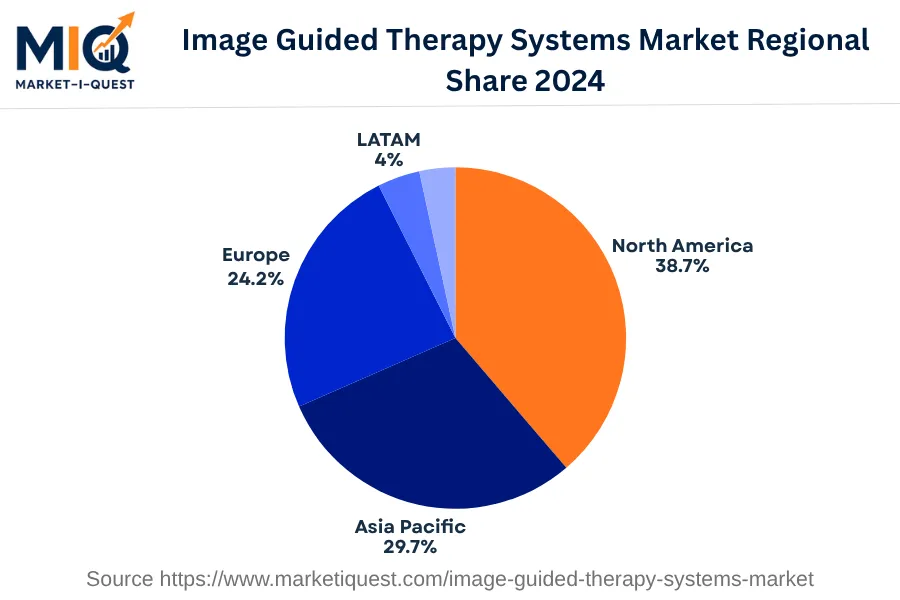
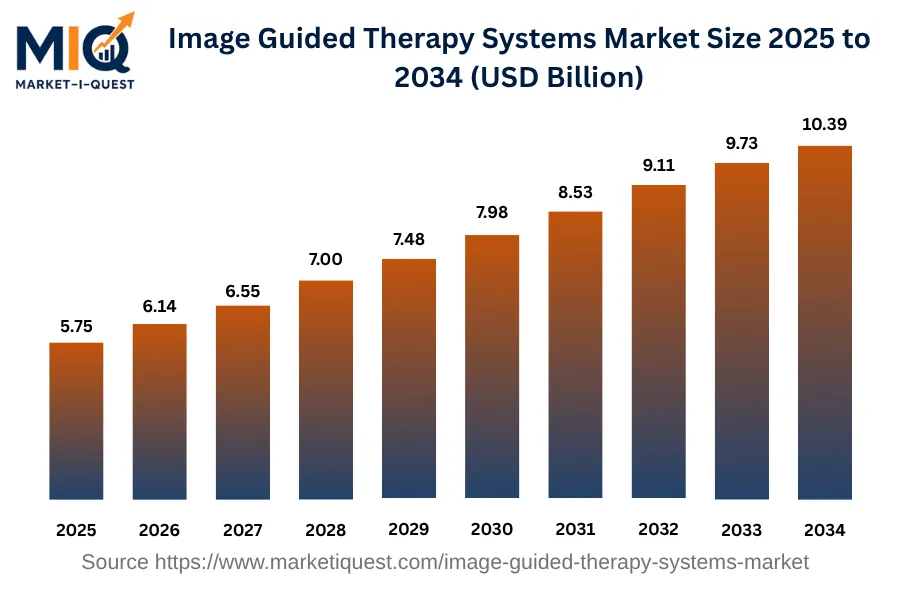
The Image Guided Therapy Systems market was valued at $5.75 billion in 2025 and is projected to reach $10.39 billion by 2034, expanding at a CAGR of 6.8%. The market steadily grew from $5.38 billion in 2024 to the estimated value in 2025. Over the next nine years, the market is expected to nearly double in size, indicating the increasing adoption and reliance on Image Guided Therapy Systems in the healthcare sector. The growth is attributed to the wide application range of these systems in diagnosis and treatment, coupled with advancements in medical technology, which are expected to enhance the precision of these systems. Regionally in 2024, North America accounted for 38.7% of the market share, followed by the Asia Pacific region with 29.6%. Europe held a 24.2% share while LATAM and MEA accounted for smaller shares of 4.02% and 3.4% respectively.

Key Takeaways

  • By Product - Magnetic Resonance Imaging held a substantial share in the base year.
  • By Application - Oncology Surgery held a notable position in the corresponding period.
  • By End Use - Hospitals held the major share of the subsegment.
image-guided-therapy-systems-market market size

Key Driving Factors

Increasing Prevalence of Chronic Diseases

The rise in chronic diseases such as cancer, heart diseases, and diabetes among global populations is a key driving factor for the Image Guided Therapy Systems Market. Chronic diseases often require advanced diagnosis and intervention techniques. Image-guided therapy systems are highly considered in such cases due to their precise, non-invasive nature that allows for targeted treatment, reducing complications and improving patient outcomes. The growing cases of chronic diseases worldwide demand more efficient healthcare infrastructure and advanced tools like image-guided therapy systems, thereby leading to significant growth in the market.

Adoption of Minimally Invasive Surgery Techniques

The transition from traditional open surgeries to minimally invasive procedures in the medical sector acts as another driver for the Image Guided Therapy Systems Market. Surgeons are increasingly adopting minimally invasive surgeries due to their benefits of reduced scarring, less pain, faster recovery, and decreased hospital stay. Image-guided therapy system plays a crucial role in these surgeries, offering the surgeon a detailed view of the interior body structures and guiding the precise positioning of instruments. As the acceptance of minimally invasive surgeries continues to rise among medical professionals and patients, the reliance on image-guided therapy system grows, thereby propelling the market forward.

Market Evolution by Timeline

2019-2023
In this period, Image Guided Therapy Systems saw increased use in hospitals and diagnostic centers, especially in North America due to higher investment and adoption of latest technology. Typical buyers were health institutions engaged in minimally invasive surgical procedures. Increasing incidence of chronic diseases was a significant driver. Shipments witnessed inclusion of AI technology to bolster precision. Yet, the high cost of these systems remained a constraint. Regulatory scenario saw FDA oversight with certain systems securing approval. Pricing models were mostly outright purchases. Partnerships were seen with tech companies to amalgamate AI into these systems. Some blockers were high installation costs and requirement of skilled professionals.
2024
In 2024, demand from APAC region increased due to improving healthcare facilities and rising patient pool. The systems available shipped higher functionalities such as real time imaging. However, high costs were still a deterrent for large scale adoption in emerging markets. On the regulatory front, approvals from corresponding authorities in emerging markets were slow in coming, slowing down market spread. The acquisition model was still dominant in terms of commercial exchange. Risk factors remained high costs, requirement of trained professionals and pace of regulatory approvals.
2025-2029
In this phase, demand for image guided therapy systems significantly increased globally due to an aging population and rise in chronic diseases. Technological advancements facilitated integration of cloud computing and big data analytics into these systems. Yet, the industry had to deal with data security issues arising from these integrations. Global regulatory standards took shape impacting manufacturers and use. The 'pay-per-procedure' pricing model gained acceptance gradually, easing adoption constraints. Risks included data thefts, technological obsolescence and a deficit of skilled practitioners.
2030-2034
By this period, global demand was driven by widespread adoption across developed and developing nations. Technological advancements introduced robotics and machine learning capabilities into the supply. Also, the maturity of integration technologies helped the industry overcome the issues of data security. A typical contract model was 'pay-per-procedure' coupled with maintenance. While improved regulatory framework expedited product approvals, disparate global standards posed a challenge. Still, cost challenges, quickly evolving technology and generating value from big data remained major risks.

Future Market Outlook

Future Opportunities

Future opportunities in the image guided therapy systems market are likely to emerge from robust research into personalized medicine and telemedicine applications. In March 2022, the World Health Organization launched a global initiative to leverage telemedicine, emphasizing the importance of remote diagnostics, which is expected to be a driving factor in the expansion of image guided systems. Companies such as Siemens Healthineers are already investing in research to create solutions that provide remote access to imaging technologies, which can enhance patient outcomes in rural areas. Additionally, the increasing prevalence of chronic diseases is necessitating the development of innovative image guided therapies. For instance, Philips announced collaborations with hospitals in North America to develop tools tailored for interventional cardiology. Furthermore, as regulatory frameworks evolve, with the U.S. FDA easing guidelines for digital health applications in 2023, companies are encouraged to explore new market segments, including mobile and portable imaging solutions. The ongoing trend toward personalized treatments further suggests that customized imaging tools capable of addressing individual patient needs will be vital. As healthcare stakeholders prioritize cost-effective and efficient treatments, partnerships between medical technology firms, telehealth providers, and healthcare systems are likely to become indispensable for navigating this evolving landscape.

Segmentation Analysis

By Product

The market is divided into subsegments including Ultrasound Systems, Computed Tomography (CT) Scanners, Endoscopes, Positron Emission Tomography (PET), Magnetic Resonance Imaging (MRI), X-ray Fluoroscopy, among others. Magnetic Resonance Imaging (MRI) accounted for the largest revenue share while Ultrasound Systems is expected to grow at the fastest CAGR during the forecast period.

Largest Revenue Share

Magnetic Resonance Imaging (MRI)

Market Share Leader

The dominant position of Magnetic Resonance Imaging (MRI) in the market revenue stream can be attributed to several factors. First, MRIs are a fundamental tool in medical imaging and diagnostic procedures, serving a broad patient base from various medical conditions and injuries. Second, the demand for MRI machines is higher due to their ability to provide highly detailed images, non-invasiveness, and wide range of applications from neurology to oncology, which drives their usage in hospitals and diagnostic centers. Geographically, developed markets such as North America and Europe contribute the largest share due to their advanced healthcare infrastructure and high spending on medical technology. Regulatory policies also favor MRI usage due to their proven efficacy and high safety standards compared to other radiology methods. Purchasing criteria for MRI machines often include resolution quality, speed, and technological advancement which innovating vendors are continuously improving upon, furthering their market lead. High switching costs also contribute to MRI's dominant position, as these machines are capital-intensive investments for healthcare providers.

Fastest CAGR

Ultrasound Systems

Forecast Period Growth Leader

Although MRI leads in the revenue share, Ultrasound Systems are projected to grow at the fastest CAGR within the forecast period. This growth can be traced back to several factors, primary of which is technological advancements. Enhanced imaging software, portable devices, and 3D and 4D ultrasound systems cater to various medical fields, expanding its applications. Coupled with its non-ionizing properties that decrease health risks associated with radiation exposure, ultrasound systems provide a safer, more convenient alternative to other imaging systems. While initial capital expenditure for advanced systems could act as a hurdle for some providers, the lower operational costs and risks compared to other imaging technologies act as catalysts for increased adoption. Furthermore, strategic partnerships with healthcare providers and governments in emerging markets can not only boost the adoption rate, but also mitigate risks associated with policy changes or geopolitical tensions, positioning Ultrasound Systems for rapid growth. As we make this assumption on the market structure, we should also consider potential risks including the pace of technological innovation and regulatory changes.

By Application

The market is divided into subsegments including Cardiac Surgery, Neurosurgery, Gastroenterology, Orthopedic Surgery, Urology, Oncology Surgery, and Others, among which Oncology Surgery accounted for the largest revenue share while Orthopedic Surgery is expected to grow at the fastest CAGR during the forecast period.

Largest Revenue Share

Oncology Surgery

Market Share Leader

Oncology surgery has emerged as the segment with the largest revenue in the base year 2024, mainly driven by the rising prevalence of different types of cancer worldwide. Cancer cases have been increasing due to factors such as aging population, lifestyle changes, and genetic disorders, which in return is propelling the demand for surgical interventions. Additionally, technological advancements have transformed the oncological landscape, allowing for more screening and early detection of cancers. This has led to a surge in the number of surgeries conducted, and consequently, revenues have soared. Moreover, developed nations have well-established healthcare infrastructure and are more capable of performing oncological surgeries, significantly contributing to the revenue generation. However, the cost of these surgeries is high and they are often needed over prolonged periods, contributing to the increase in overall expenditure by patients. These factors have been pivotal in driving the oncology surgery segment's revenue.

Fastest CAGR

Orthopedic Surgery

Forecast Period Growth Leader

Orthopedic Surgery is projected to witness the fastest growth rate, driven by several factors. The surge in the elderly population and increasing prevalence of bone-related conditions such as osteoporosis and arthritis are heightening the demand for orthopedic surgeries. Moreover, an active lifestyle and sports participation has also increased the incidence of injuries, further propelling the need for these surgeries. Technological advancements are another major catalyst for growth in this segment. Innovations such as minimally invasive surgeries, robotic-assisted procedures, and introduction of advanced implants are easing the complications and recovery process associated with orthopedic surgeries, therefore driving the adoption rate. However, the high cost of these procedures and the need for trained professionals may pose as barriers. In the future, partnerships between healthcare providers and device manufacturers can potentially overcome these challenges and continue to drive growth at a high rate.

By End Use

The market is divided into subsegments including Hospitals, Specialty Clinics, Ambulatory Surgical Centers, Research & Academic Institutions, and Others. Of these, Hospitals account for the largest revenue share, while Specialty Clinics are projected to grow at the fastest Compound Annual Growth Rate (CAGR) during the forecast period.

Largest Revenue Share

Hospitals

Market Share Leader

Hospitals command the largest share of revenue in the market, attributed largely to the sheer size and volume of procedures and treatments that they cater to. Hospitals, being a primary care center, serve a broad spectrum of health conditions, hence, demand a diverse and extensive range of medical supplies and equipment. Many hospitals also have specialized departments, multiplying the requirement for specific equipment and technology. Increased public and private investments in healthcare infrastructure, particularly in developing economies, have spurred the expansion of hospitals, leading to a surge in the demand for hospital supplies. Enhanced patient reach, coupled with recurrent patient visits, contributes to the continuous revenue generation for this segment. Governments worldwide focus on improving healthcare infrastructure, which also fortifies the growth of hospitals regarding market revenue. Moreover, hospitals are often better equipped to invest in advanced technologies than smaller healthcare institutions due to more robust financial backing and higher patient inflow.

Fastest CAGR

Specialty Clinics

Forecast Period Growth Leader

Specialty Clinics are predicted to witness the fastest CAGR during the forecast period. The proliferation of these clinics is mainly due to the rising inclination towards specialized care services, particularly in regions with an aging population suffering from chronic diseases. Unlike hospitals, these clinics offer specialized care for specific ailments, leading to increased patient trust and better treatment outcomes, thus proliferating their demand. Advances in medical technology have enabled the provision of many advanced procedures at these clinics. Furthermore, the escalating cost of hospital care has driven patients towards these clinics, which often provide services at comparatively lower prices. Other factors like technological advancements, partnership and collaboration between clinics and healthcare technology providers play a critical role in catalyzing the growth of this segment. However, the high capital expenditure could pose a risk to high-paced growth, especially in developing regions.

Competitive Analysis: Image Guided Therapy Systems Market

Key Market Players

Manufacturers / OEMs

GE Healthcare
US
Siemens Healthineers
Germany
Philips Healthcare
Netherlands

Key Suppliers & Raw Materials

Fujifilm Holdings Corporation
Japan
Canon Medical Systems Corporation
Japan
Hitachi Medical Systems
Japan

Distributors, Integrators & Channel Partners

Cardinal Health Inc.
US
Medtronic Plc.
Ireland
Baxter International Inc.
US

Porter’s Five Forces Analysis

Analysis of the competitive forces that shape the image guided therapy systems market.

Supplier Bargaining Power

Medium

Driven by the necessity of sophisticated components and limited supplier options.

Buyer Bargaining Power

High

Buyers, usually hospitals and clinics, have choices and demand effective, cost-efficient systems.

Threat of Substitutes

Medium

The potential for alternative therapies and non-invasive procedures exists.

Threat of New Entrants

Low

High entry barriers due to regulatory landscape, technological complexities and significant capital investments.

Competitive Rivalry

High

Several established players heavily compete on innovation and technological advances in the market.

Regional Analysis

Geographic market dynamics and growth opportunities across key regions

Global Market Outlook

image-guided-therapy-systems-market market regional share

North America

In 2024, the North American image-guided therapy systems market was largely driven by rising prevalence of chronic diseases and enhanced healthcare infrastructure across the region. Key factors stimulating demand included advancements in imaging technology, improved treatment efficacy, surgeons' preference for minimally invasive surgeries and increased access to high-quality healthcare in the U.S., Canada, and Mexico. Growing adoption was further spurred by government investments into cutting-edge healthcare technology and medical devices regulation updates.

Key market trends that shaped 2024 were the rapid incorporation of Artificial Intelligence and Machine Learning to offer unparalleled precision in surgeries, adoption of hybrid operating rooms, and the rise of portable and handheld image-guided therapy devices. Significant dynamics included partnerships between tech firms and health institutions to develop next-generation imaging systems, as seen with Philips and Microsoft's joint operation. The push for contactless therapies due to COVID-19 also significantly shifted buyer behavior towards non-invasive image-guided therapies. The principal customers of these systems were healthcare providers, academic research institutions, and government facilities involved in complex surgeries and treatments within the oncology, neurology, and cardiology fields. From small private clinics to large hospitals, the demand for these systems was uniformly distributed across North America, with increased adoption driven by the equipment's efficiency, precision, and reduced post-operation complications.

Asia Pacific

In 2024, the Image Guided Therapy Systems Market in Asia Pacific experienced significant growth. Major driving factors included increased investment in healthcare infrastructure and demand for minimally invasive procedures across China, India, Japan, South Korea, Australia, and key ASEAN markets. Adoption of advanced technologies by healthcare institutions and enhanced government regulations in favor of patient safety also propelled the market. In India and China, the growth was complemented by demand-side dynamics spurred by an aging demographic and a spike in chronic diseases.

The marked trend toward partnerships and M&A's was evident, particularly among healthcare providers aiming to expand their portfolio and harness advanced technologies. Health-tech enterprises engaged in strategic alliances to amplify their market footprints across Asia Pacific. In Japan and South Korea, growing adoption of customized, precision medicine pushed the demand for image-guided therapies. The tech-market shift within the retail sector was evident, with the increasing availability of image-guided therapy systems through digital sales channels. China witnessed a surge in policy enforcement regarding medical device standards, accelerating the market pace. Overall, the year witnessed heightened activity within the Image Guided Therapy Systems Market, pointing towards an increased need for this technology in the healthcare sector across Asia Pacific.

Europe

In 2024, the European market for Image-Guided Therapy Systems (IGTS) exhibited flourish throughout key regions including Germany, the United Kingdom, France, Italy, Spain, the Nordics, Benelux, and Central & Eastern Europe. Key market drivers included increased adoption of minimally invasive surgeries reducing patient recovery times, generous government funding into healthcare infrastructure advancement, and technological innovations improving precision and accuracy. For instance, Germany's significant investment into healthcare technology drove demand for IGTS, while France's strict medical regulations inadvertently stimulated the need for higher surgical precision.

Market trends were largely dictated by altered buyer behaviors and significant technological shifts. The pervasiveness of chronic diseases among Europeans prompted substantial reliance on healthcare technology, lifting IGTS adoption rates. Concurrently, a technological shift towards AI-enabled IGTS presented unique opportunities for healthcare providers, enhancing accuracy and efficiency while reducing human error. In terms of channel dynamics, increased partnerships and merger & acquisition activities has been observed: for instance, major healthcare enterprises have been partnering with tech firms to integrate cutting-edge technology into their IGTS offerings. The growing standardization and policy enforcement have also shaped the market landscape, assuring the quality and safety of these systems. Hospitals and healthcare institutes formed the customer base, with a significant share also noted from research institutions leveraging IGTS for studies and clinical trials.

Latin America

In the base year 2024, the market for Image Guided Therapy Systems in Latin America (LATAM) exhibited robust growth with healthcare providers increasingly recognizing their clinical efficacy. An ageing population and the consequent increase in chronic diseases drove demand for minimally invasive procedures that deploy these systems. The influx of private and public investments in healthcare infrastructure, particularly in Brazil, Mexico and Argentina, fueled the adoption of cutting-edge technologies like Image Guided Therapy Systems. The favorable regulatory environment in countries such as Colombia and Peru further streamlined market uptake.

On the trend front, customer preference for safer and effective treatments compelled healthcare providers and manufacturers to collaborate, stimulating innovation in the sector. Hospitals and clinics widely adopted these systems to increase procedure accuracy and patient comfort, subsequently impacting usage patterns. Telemedicine introduced new growth avenues by integrating Image Guided Therapy Systems in remote patient monitoring, particularly in Chile’s remote areas. The effective integration of artificial intelligence (AI) in these systems improved their accuracy and functionality, forcing a technical shift in how procedures are performed. Simultaneously, policy enforcement ensuring the uniformity of medical practices across LATAM countries encouraged standardization of Image Guided Therapy Systems in line with international benchmarks, fostering market penetration and regional harmonization.

Middle East & Africa

In 2024, the market for Image Guided Therapy Systems in the Middle East and Africa experienced significant growth. High demand factors from sectors such as healthcare, manufacturing and oil and gas drive this growth. Technological advancements, particularly in countries like Saudi Arabia and Israel, enhanced system precision, efficiency and user experience. Greater investments in advanced healthcare technologies, by UAE and Qatar, increased system accessibility and adoption, thereby spurring market growth. Government regulations, focused on improving health services, notably in Egypt and South Africa, also fueled the market's expansion.

Technological advancements permeated buyer behavior, creating preference for systems with robust functionalities and detailed imaging. Israel and UAE showed signs of high-end product shifts, prominently adopting AI and IoT facilities, to improve clinical outcomes. Cross-sector partnerships, as seen between Nigerian healthcare providers and manufacturing corporations, gradually became a norm, strengthening the supply chain. Moreover, there was an increased presence of Standardization, especially in Saudi Arabian market, conforming to the global guidelines on Image Guided Therapy Systems use. Several countries including South Africa and Kenya showed willingness to participate in M&A, to improve their local technological landscape and deliver better healthcare services. Enforcement of healthcare regulations was quite conspicuous, especially focusing on patient safety and data privacy across the region.

Recent Industry Developments

Latest market innovations, product launches, and strategic initiatives

June 2026

The Canadian government-backed network, INOVAIT, officially committed $1.35 million to fund 10 new pilot projects. These projects specifically pair artificial intelligence with image-guided therapy to develop new diagnostic and treatment tools, including solutions aimed at reducing re-operation rates in breast cancer surgeries and managing chronic pelvic pain.

May 2026

The FDA officially cleared six new systems in the Siemens Artis portfolio. These systems integrate new artificial intelligence software designed to instantly reduce image noise, allowing doctors to see much clearer pictures during minimally invasive procedures while simultaneously keeping radiation doses low.

March 2026

Philips officially launched its IntraSight Plus platform and secured FDA clearance for a new AI-guided software tool called DeviceGuide. This software automatically tracks and displays a real-time, 3D view of the medical tools being used inside a patient's beating heart, specifically aiming to help surgeons repair leaky heart valves with much less guesswork.

Frequently Asked Questions