Hydrophobic Coatings Market Snapshot

Key Players

  • AkzoNobel N.V. (Netherlands)
  • BASF SE (Germany)
  • 3M (United States)
  • PPG Industries Inc. (United States)
  • NEI Corporation (United States)
  • NeverWet LLC (United States)
  • Nanex Company (Belgium)
  • Aculon Inc. (United States)
  • DryWired (United States)
  • NAGASE & CO. LTD. (Japan)

Market Size

Base Year 2024
$2.95 Bn
CAGR
5.31%
Forecast 2034
$4.94 Bn

Market Segments

By Property
  • Anti-microbial
  • Anti-icing/wetting
  • Anti-fouling
  • Anti-corrosion
  • Self-cleaning
  • Others
By Application
  • Aerospace
  • Automotive
  • Construction
  • Medical
  • Optical
  • Others

Market Dynamics

Drivers
  • Rising automotive industry demand
  • Increasing electronic gadgets production
Restraints
  • Stringent environmental regulations
  • High production cost
Opportunities
  • Growing aircraft industry
  • Increased demand in automotive sector

Market Size

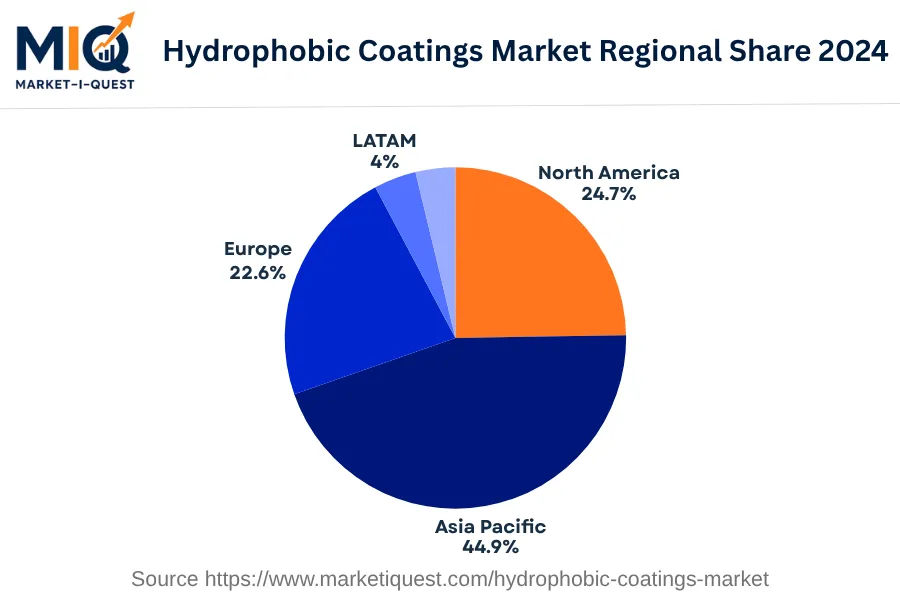
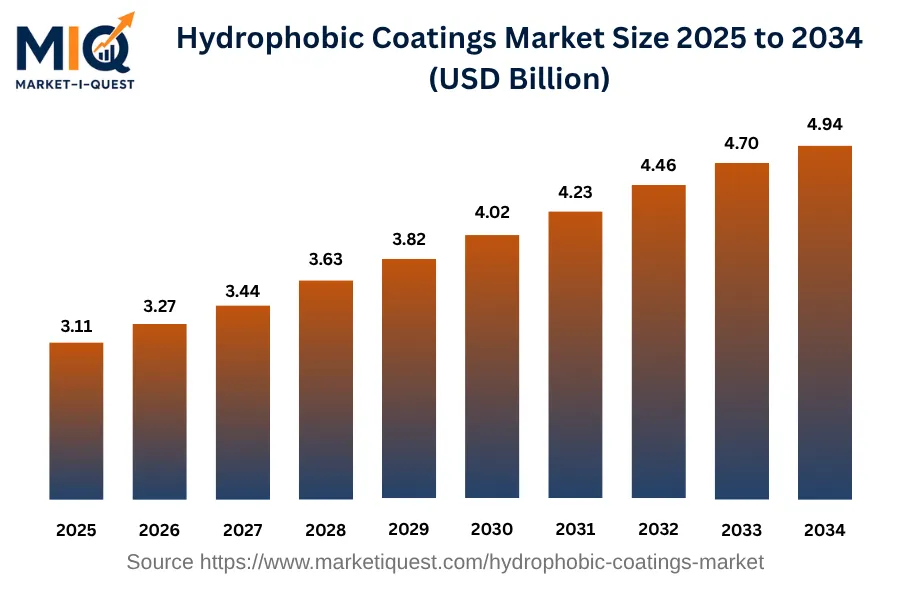
The Hydrophobic Coatings Market had a size of 3.11 billion USD in 2025. By 2034, the market size is projected to reach 4.94 billion USD, growing at a CAGR of 5.3%. The path of this growth showcases a gradual and consistent increase from the 2024 figure of 2.95 billion USD, moving up to 3.11 billion USD by 2025 and culminating at 4.94 billion USD by 2034. The surge in market size is connected to an increase in the demand for these particular coatings across multiple industrial sectors during this ten-year period. A look at the regional share in 2024 shows that Asia Pacific led the market, holding 44.9% of the market share, followed by North America with a share of 24.7%. Europe held the next significant share in the market at 22.6%, with Latin America and Middle-East and Africa (MEA) holding the smallest shares at 4.01% and 3.76% respectively.

Key Takeaways

  • By Property - Anti-corrosion led the Hydrophobic Coatings Market accounting for a substantial share in the base year.
  • By Application - Automotive sector held a dominant position in the Hydrophobic Coatings Market showing significant growth.
hydrophobic-coatings-market market size

Key Driving Factors

Emerging Regulatory Compliance in Automotive Industry

In the automotive industry, stringent regulations and guidelines on CO2 emissions are being rolled out in different regions. These measures underscore the need for fuel-efficient vehicles. Hydrophobic coatings play a key role in achieving this objective as they reduce air-resistance (drag) by ensuring streamlined interaction between the vehicle's surface and air. This results in improved fuel efficiency. Automotive manufacturers, striving to meet these new standards and achieve sustainability goals, are therefore integrating hydrophobic coatings in their production processes, driving the market.

Robust Growth of Global Construction Industry

The world's construction industry is witnessing a growth spurt with increasing urbanization and population density. Along with this expansion, customers are now demanding more durable, weather-proof, and maintenance-friendly buildings. Hydrophobic coatings are an effective solution to these requirements as they offer protection against water damage, thereby increasing the longevity of the buildings. The construction industry's need to meet this customer demand is therefore strongly propelling the spending on hydrophobic coatings.

Market Evolution by Timeline

2019-2023
In this period, demand from the automotive industry marked hydrophobic coating market's growth mainly because of its rust-preventing properties. Regions, such as North America and Asia-Pacific, saw a significant uptake due to their large auto industries. Technology-wise, most companies focused on silicon-based products, but the environmental impact posed supply constraints. Regulation-wise, environmental standards like Europe's REACH (Registration, Evaluation, Authorization, and Restriction of Chemicals) pushed manufacturers to look for environmentally-friendly options. Commercially, suppliers tended to partner with local dealers for distribution, non-exclusivity contracts were common. Risks such as dependency on raw material availability, particularly silicon, affected pricing strategies, leading to cost-plus pricing models.
2024
In this year, demand was driven primarily from utilities industry thanks to hydrophobic coatings' efficiencies in minimizing moisture-related damages to electrical equipment. Major buyers were from Europe. Technologically, manufacturers focused more on fluoropolymer-based coatings, expectedly because of their better hydrophobic properties. Efforts to comply with strict environmental regulations were typical, especially under EU's Restriction of Hazardous Substances directive. The commercial model was influenced by direct sales to industry users, typically negotiated contracts based on volumes. The risk of seeing high costs for acquiring fluoropolymers affected the market, initiating procurement strategies to ensure steady supplies.
2025-2029
The dominant buyer in this period was likely the electronics industry, which used hydrophobic coatings to keep device screens smudge and moisture-free. Countries with high smartphone usage, such as China, the USA, and India were key markets. Development of nanotechnology and smart coatings was typical in this period, despite production cost restraints. Despite industry players developed self-cleaning glass based on hydrophobic coatings, lack of global standards impeded adoption rates.Visibility pricing started to gain traction, where pricing was based on the visibility provided by the coating on electronic devices. Supply risk, namely high production costs, prompted strategic alliances among suppliers for technology sharing and joint production.
2030-2034
Here, aerospace industry became a major buyer. Use-cases including corrosion protection and ice prevention on aircraft surfaces increased demand. Regions with a large aerospace industry, such as the United States, were primary market influences. Technologically, attempts to create long-lasting coatings gained momentum despite high R&D expenses. Regulatory-wise, the International Civil Aviation Organization (ICAO) standards likely impacted the market. The commercial model started favoring long-term contracts with industry players for constant supply. Volatility in raw material prices influenced cost considerations, creating a potential risk, leading to manufacturers seeking hedge contracts to manage raw material price risks.

Future Market Outlook

Future Opportunities

The future of the hydrophobic coatings market is poised for growth, with existing trends laying the foundation for emerging opportunities. In March 2023, a collaboration between BASF and a major automotive manufacturer was announced, focusing on developing advanced hydrophobic coatings for vehicle exteriors, indicating a shift towards partnerships that enhance material performance. Furthermore, the construction sector's emphasis on sustainability is leading to an increased adoption of hydrophobic coatings to enhance the lifespan of materials, particularly in regions like North America and Europe, where environmental awareness is prevalent. In September 2022, the International Energy Agency set standards encouraging the usage of advanced materials in renewable energy technologies, thereby promoting hydrophobic coatings applications in solar panels and wind turbines. The increased interest in smart technologies has also opened new markets; for instance, in December 2022, MIT researchers unveiled a hydrophobic coating technology integrated into sensors that can effectively function in wet environments. The aerospace industry is increasingly seeking innovative solutions for weight reduction and enhanced safety, thereby presenting opportunities for specialized coatings that reduce water accumulation on surfaces. Efforts to improve manufacturing processes and address cost-effectiveness are likely to drive collaboration among research institutions and industry leaders, paving the way for innovative applications and materials development, which are critical for maintaining competitive advantages in the evolving market landscape.

Segmentation Analysis

By Property

The market is divided into subsegments including Anti-microbial, Anti-icing/wetting, Anti-fouling, Anti-corrosion, Self-cleaning, and Others. The Anti-corrosion subsegment accounted for the largest revenue share while the Anti-microbial subsegment is expected to grow at the fastest CAGR during the forecast period.

Largest Revenue Share

Anti-corrosion

Market Share Leader

The Anti-corrosion subsegment currently leads in terms of revenue generation. This can be largely attributed to the extensive use of anti-corrosion coatings in numerous sectors such as infrastructure, transportation, and energy, where the long-term effects of rust and corrosion can be highly damaging and expensive. Anti-corrosion coatings are also instrumental in the marine industry to protect ships and underwater equipment from harsh marine conditions. Geographically, regions with high exposure to salinity and humidity significantly contribute to the demand for these solutions. The strict regulations enforced by authorities concerning structure and asset maintenance, reinforces the necessity for anti-corrosion measures. Purchasing decision is often driven by the efficiency and durability of the product along with cost considerations. High switching cost associated with change of coatings and the existing relationships between suppliers and end-users, ensure a steady demand for these products.

Fastest CAGR

Anti-microbial

Forecast Period Growth Leader

The Anti-microbial subsegment is projected to witness the fastest growth. Growing awareness regarding health, hygiene and advanced healthcare practices, primarily drives this growth. High prevalence of infectious diseases is prompting the increasing adoption of anti-microbial coatings especially in healthcare facilities, food & beverage industry and residential settings. Technological advancements, innovative product development, and strategic partnerships are important catalysts for this growth. Capital investments in research & development and product commercialization initiatives also stimulate the market expansion. Key barriers to the adoption include potential toxicity of certain anti-microbial agents and regulatory scrutiny. There is a heightened risk associated with dependence on raw material availability and the implications of geopolitical factors on their supply chain. Despite these challenges, Anti-microbial subsegment growth is poised to significantly outpace other subsegments, facilitated by the rising emphasis on sanitation and cleanliness.

By Application

The market is divided into subsegments including Aerospace, Automotive, Construction, Medical, Optical, and Others. Among these, the Automotive subsegment accounted for the largest revenue share, while the Medical subsegment is expected to grow at the fastest CAGR during the forecast period.

Largest Revenue Share

Automotive

Market Share Leader

The Automotive subsegment commands the largest piece of the revenue pie in the base year 2024, driven by multiple factors. Car production on a global scale is high, and this peak demand propels steady growth in the segment. It's spurred by the consumer inclination towards high-quality, technologically advanced vehicles and the demand for eco-friendly electric cars. Additionally, companies in this sector are increasingly adopting advanced technologies for production efficiency and driving down costs which spur consumption. Regulatory measures taken by government bodies worldwide, promoting the use of safe and efficient vehicles also plays a significant role in enhancing the purchasing rate. The high switching cost associated with these vehicle manufacturing process technologies makes the customers adhere to one product, thus ensuring a continual revenue stream. Also, the global expansion of automobile companies into emerging countries, considering the increasing purchasing power, adds up to the potential customer base.

Fastest CAGR

Medical

Forecast Period Growth Leader

The Medical subsegment promises a high growth trajectory with the fastest compound annual growth rate (CAGR). This uplift is primarily due to the increasing global health awareness and the rapid advancements in medical technology. As technology burgeons, so too does the demand for advanced and specialised medical equipment and devices made with top-tier materials and parts. The rising expenditure in the healthcare sector by governments and private entities drives this unprecedented growth. However, stringent government regulations and technical challenges can slow down the adoption. Nevertheless, increased investment in research and development, strategic partnerships, and capital expenditure on advanced technologies are acting as catalysts for growth. While the near-term risks include the variability in material costs and potential supply chain disruptions, the overall outlook remains positive due to the pressing demand for healthcare services.

Competitive Analysis

Key Market Players

Manufacturers / OEMs

PPG Industries Inc.
US
Akzo Nobel N.V.
Netherlands
RPM International Inc.
US

Key Suppliers & Raw Materials

BASF SE
Germany
Nippon Paint Holding Co., Ltd.
Japan
Arkema Group
France

Distributors, Integrators & Channel Partners

Sherwin-Williams
US
Wacker Chemie AG
Germany
Valspar
US

Porter’s Five Forces Analysis

This analysis delves into the competitive landscape of the Hydrophobic Coatings Market.

Supplier Bargaining Power

Medium

Suppliers' power is average due to the range of potential raw material sources.

Buyer Bargaining Power

High

Buyers, often large industries, have high bargaining power due to multiple providers.

Threat of Substitutes

Low

Limited comparable substitute products result in low threat of substitutes.

Threat of New Entrants

Medium

Capital expenditure and regulatory barriers moderate the risk of new entrants.

Competitive Rivalry

High

The presence of high-profile companies induces a high level of competitive rivalry.

Regional Analysis

Geographic market dynamics and growth opportunities across key regions

Global Market Outlook

hydrophobic-coatings-market market regional share

North America

In 2024, the North American Hydrophobic Coatings market significantly gained momentum due to several driving factors and trends. Key drivers included rising demands in industries such as automotive, aerospace, and construction. Government regulations promoting the use of environment-friendly hydrophobic coatings spurred growth, as did substantial investments by manufacturers and the increasing adoption of advanced coating technologies. Consumer demand soared specifically for hydrophobic coatings providing value addition in terms of self-cleaning, anti-fouling, and anti-corrosion properties. The trend of using nano-coatings in automotive and consumer electronics industries for better durability led to higher market demand. Furthermore, companies' strategic partnerships, mergers, and acquisitions expanded their coating product portfolio and boosted their market presence. Importantly, increased focus on quality standards and strict adherence to regulatory policies reinforced market stability and credibility.

In the U.S., aerospace was a dominant sector, while the automotive industry significantly drove the coating market in Mexico due to the region's booming automobile production. Meanwhile, Canada experienced a surge in demand for hydrophobic coatings in its construction and oil and gas industries due to unique weather-related needs and various protection initiatives. Throughout North America, the hydrophobic coatings market capitalized on shifting purchasing behaviors and smart, sustainable solutions, resulting in considerable overall growth in 2024.

Asia Pacific

In 2024, the Hydrophobic Coatings Market in the Asia Pacific marked a period of substantial growth due to various intrinsic and external drivers. The adoption of novel technologies and government-induced regulations, especially in leading markets like China, India, and Japan, propelled the growth. The demand for hydrophobic coatings amplified in sectors like automotive, construction, and electronics, which sought enhanced durability and longevity of their products. Notably, investments in healthcare and manufacturing sectors surged in South Korea and Australia due to the coatings' ability to provide anti-microbial and anti-corrosion benefits. Simultaneously, market trends saw shifts towards environmentally friendly, low VOC hydrophobic coatings, majorly driven by rigorous environmental policies in the region. Moreover, an increase in partnerships and M&A's was seen, especially in key ASEAN markets, to meet escalating demands efficiently. Digitization also influenced the market dynamics with e-commerce emerging as a dominant sales channel, reflecting changes in consumer buying behavior.

The enterprise customers, particularly in China, increasingly leaned towards hydrophobic coatings for building protection and maintenance, sparked by government renovation initiatives. Additionally, Australia's mining sector adopted hydrophobic coatings for machinery protection, augmenting the demand. The consistent evolution of the Asia Pacific Hydrophobic Coatings Market in 2024 epitomized the region's progressive innovation approach and commitment to quality standards.

Europe

In 2024, Europe's Hydrophobic Coatings Market saw dynamic movements influenced by several drivers and trends. Principal drivers included demand for water-repellent materials in key sectors like automotive, electronics, and construction. This heightened demand aligns with Germany and France's progressive policies promoting sustenance of resources and stringent regulations that governed material production. In the United Kingdom, substantial investments by big players elevated technology adoption, pushing advanced hydrophobic coatings into the mainstream. Italy and Spain also introduced attractive pricing mechanisms, causing substantial supply dynamics in Southern Europe.

A shift in buyer behavior was another important trend, with customers, particularly from automotive and manufacturing sectors in Benelux and the Nordics, opting for more durable solutions. Central & Eastern Europe saw an uptick in partnerships and M&A, with companies seeking to enter or expand in the local market. This trend was reinforced by policy enforcement from governments emphasizing low Volatile Organic Compounds (VOC) solutions. Tech shifts towards nano-layering allowed products to be more weather-resistant and longer-lasting, significantly altering channel dynamics and limiting traditional retail opportunities. Standardization across the region was also crucial in 2024, echoing the need for high-performing materials in various industries. Thus, Europe's Hydrophobic Coatings Market of 2024 was marked by energetic demand, innovative technology and crucial policy enforcement.

Latin America

In 2024, the Hydrophobic Coatings Market in Latin America exhibited notable activity. Demand drivers included an increased need for anticorrosion treatments due to high levels of humidity in countries such as Brazil and Peru. In Mexico and Chile, regulations favoring cleaner technology adoption to combat pollution fueled growth. Argentina exemplified capital investment into new coating technologies to bolster its manufacturing sector, whilst Colombia saw a rise in local supply dynamics due to the adoption of hydrophobic coatings in its flourishing construction industry.

Changing market trends reflected shifts in consumer behavior and product developments. As sustainability concerns heightened, buyers across LATAM began favoring hydrophobic coatings that demonstrated minimal environmental impact. This shift prompted manufacturers to invest in research and development towards greener product solutions. Additionally, an increasing number of partnerships and mergers amplified market competition and innovation within Argentina and Chile. Government initiatives, particularly in Brazil and Colombia, enforced stricter standards for the adoption of this technology, pushing the industry towards greater transparency and quality control. The main sectors utilizing hydrophobic coatings encompassed manufacturing, construction, and healthcare, with retail markets growing in popularity due to residential utilizations. Notably, utilities providers in Peru started adopting these coatings to extend equipment lifespan, and enterprise applications were observed in Mexico, aiding data center protection.

Middle East & Africa

In 2024, the Hydrophobic Coatings market in the Middle East and Africa (MEA) noted a visible surge due to several conducive factors. The escalating demand was fueled by the increasing usage in the oil and gas industry, particularly in Saudi Arabia, Qatar, and the United Arab Emirates where these coatings were used to prevent corrosion of infrastructure. The healthcare sector in South Africa and Israel also contributed to the rising uptake, utilizing hydrophobic coatings for sanitary purposes. There was a noticeable trend towards technology adoption in Egypt and Kenya, driven by governmental efforts in these nations to modernize their manufacturing sectors. Enhanced import policies in Nigeria also steered supply dynamics favorably, trimming the cost of raw materials. However, the pricing factor was two-pronged as elevated pricing of these coatings in specific markets like the United Arab Emirates and South Africa slightly curtailed market growth.

Buyer behavior leaned distinctly towards hydrophobic coatings with advanced performance characteristics in extreme weather conditions. The telecom sector in Israel and utilities sector in Saudi Arabia, for instance, increased their investment in these high-performance coatings. Cross-border partnerships grew as local manufacturers in Saudi Arabia and United Arab Emirates collaborated with international suppliers to meet the rising demand. The market also adapted to new standards enforced in various regions, especially in environmental policy adherence in Kenya and Qatar, underpinning the shift towards more eco-friendly hydrophobic coatings.

Recent Industry Developments

Latest market innovations, product launches, and strategic initiatives

June 2026

Toray Industries announced a significant breakthrough in hydrophilic coating technology, unveiling a new polymer design that enhances the wettability of silicone surfaces by more than 20 times. This innovation, developed for contact lenses and catheters, utilizes self-assembly properties to form a durable, 20-nanometer-thick layer. The coating reduces the coefficient of friction by approximately 90%, addressing critical challenges in device maneuverability and patient comfort during long-term wear.

May 2026

Formacoat launched its HydroMark™ hydrophilic coating platform, explicitly positioning it as an independent alternative to large-scale conglomerate offerings. This move is a strategic response to market consolidation, aiming to provide start-ups and mid-sized medical device OEMs with cost-effective, high-performance coating options. The platform focuses on supply-chain resilience and application flexibility, allowing manufacturers to tailor thermal-cured coatings to specific device geometries and production workflows.

Frequently Asked Questions