Hydrogen Peroxide Market Snapshot

Key Players

  • Solvay S.A. (Belgium)
  • Evonik Industries AG (Germany)
  • Mitsubishi Gas Chemical Company (Japan)
  • PeroxyChem LLC (US)
  • Arkema Group (France)
  • Kemira Oyj (Finland)
  • NPL (Naldeo Peroxide Ltd) (India)
  • Aditya Birla Chemicals (India)
  • FMC Corporation (US)

Market Size

Base Year 2024
$4.28 Bn
CAGR
5.6%
Forecast 2034
$7.38 Bn

Market Segments

By Grade
  • Standard
  • Chemicals
  • Aseptic
  • Semiconductor
By Application
  • Bleaching
  • Oxidation
  • Environmental
By End Use Industry
  • Pulp & Paper
  • Chemicals
  • Textile
  • Food & Beverage
  • Others

Market Dynamics

Drivers
  • Increasing hygiene awareness
  • Rising healthcare sector demands
Restraints
  • Stringent environmental regulations
  • High production costs
Opportunities
  • Increased industrial applications
  • Rising demand in healthcare sector

Market Size

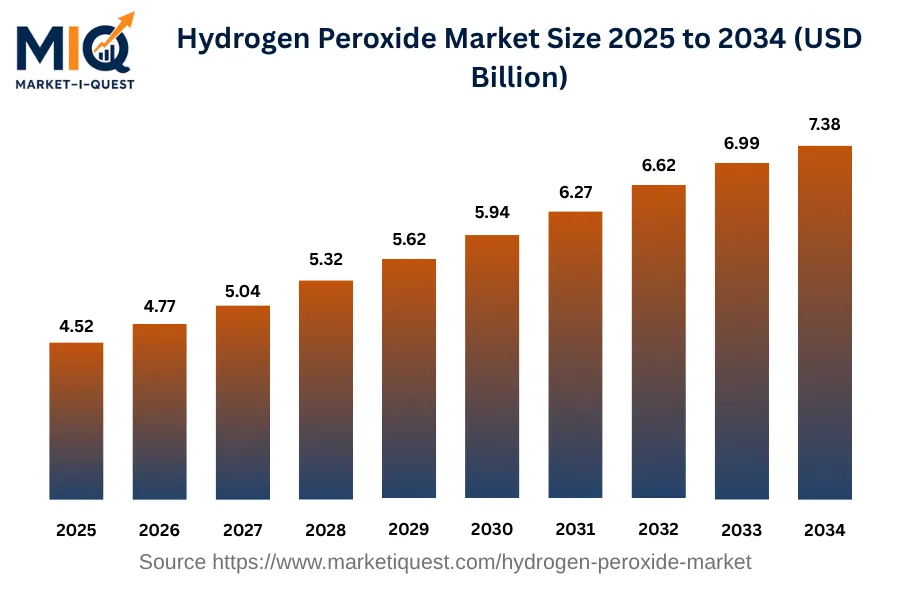
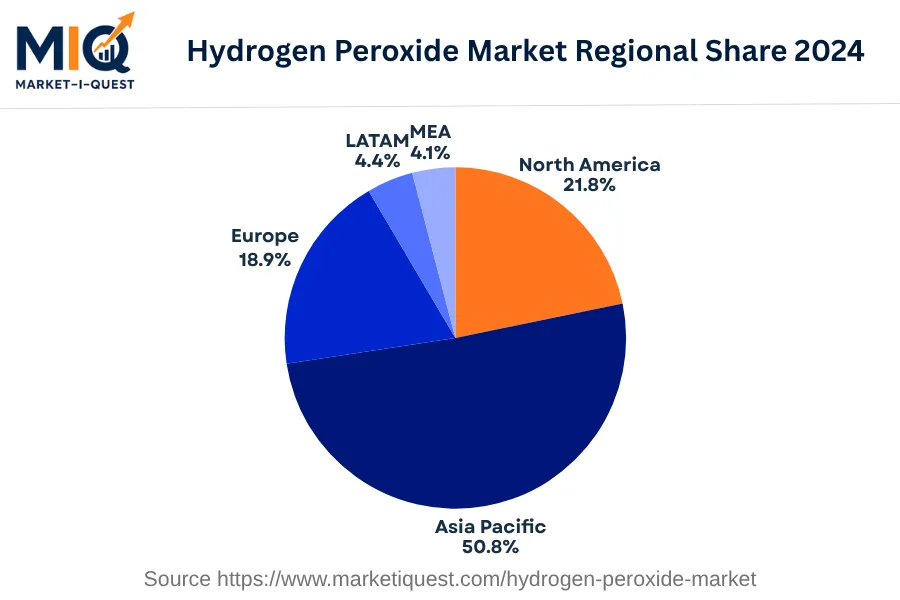
The Hydrogen Peroxide Market size in 2025 is foreseen to be $4.52 billion, up from $4.28 billion in 2024. The market is anticipated to rise to $7.38 billion by 2034, signifying a CAGR of 5.6% from 2025 to 2034. This growth trajectory reflects an upward trend in market value across ten years. The regional market shares in 2024 were characterized by a dominantly high share of the Asia Pacific at 50.8%, followed by North America at 21.8%, then Europe at 18.9%. The regions with less significant shares in the Hydrogen Peroxide Market were LATAM and MEA, accounting for only 4.4% and 4.1% respectively.

Key Takeaways

  • By Grade - Semiconductor held a top position in the Hydrogen Peroxide Market with the highest consumption.
  • By Application - Bleaching emerged as the leading application contributing significantly to market growth.
  • By End Use Industry - Chemicals sector led the market in terms of consumption of Hydrogen Peroxide.
hydrogen-peroxide-market market size

Key Driving Factors

Compliance with increasing international environmental regulations

The Hydrogen Peroxide market is being driven by stringent environmental regulations across the world. For instance, the 'European Water Framework Directive 2000/60/EC' sets water quality targets, which necessitates water treatment. Hydrogen peroxide is frequently used in such applications due to its environmentally friendly attributes – it decomposes into water and oxygen, leaving no residual contaminants. Therefore, it meets the demands of environmental friendliness imposed by this directive. This regulatory pressure for cleaner water solutions has led centralised water treaters, industry-managed wastewater installations, and municipal water departments to increasingly use hydrogen peroxide, pushing the market forward.
Shifting consumer preference towards non-chlorine bleaches in the paper and pulp industry

A key driving factor for the Hydrogen Peroxide market is a market shift in the paper and pulp industry towards non-chlorine bleaches. Oxygen-based bleaches, particularly hydrogen peroxide, are considered safer than chlorine-based alternatives as they do not contribute to creating dioxins, a class of toxic organic pollutants. Many manufacturers are increasingly adopting hydrogen peroxide as it improves the brightness and appearance of paper, while significantly reducing the environmental impact. Moreover, public sentiment against chlorine bleaches due to environmental concerns is reinforcing this trend. This is causing major paper producers and smaller local outfits alike to switch to hydrogen peroxide, boosting the demand in the market.

Market Evolution by Timeline

2019-2023
Between 2019-2023, the primary buyers of hydrogen peroxide were from the paper and pulp industries followed by the healthcare industry, mainly in North America and Asia Pacific. Major suppliers from Europe, with increasing production capacities, were shipping higher amounts of the product due to lower costs and advancements in production technology. Commercially, prices remained relatively stable with contract lengths typically spanning 1-2 years. Regulatory influences included environmental regulations aiming to reduce the chlorine usage in paper and pulp industries. One of the key risks during this period was the safety concerns during transportation and storage.
2024
In 2024, the demand for hydrogen peroxide increased in the electronics sector for chip making, predominantly in East Asia. Simultaneously, new production plants were established in China and India, and production became more efficient due to advancements in catalyst technologies. Prices saw slight increases due to higher demand but continued to follow multi-year contract approaches. Regulatory considerations like REACH in Europe started impacting market strategies, driving firms towards more sustainable production methods. Vendors increasingly moved towards forming partnerships with end-user industries to ensure continuous demand.
2025-2029
During the 2025-2029 period, hydrogen peroxide is expected to find extensive use in wastewater treatment and soil remediation, primarily in developing countries where environmental legislation got stricter. Suppliers increasingly might provide proprietary technology to optimize production and reduce costs. Typically, pricing will likely revolve around long-term agreements, with partnerships being the preferred procurement model. Regulatory compliance will likely become a priority, moving the market towards low-concentration hydrogen peroxide to meet safety standards.
2030-2034
Between 2030-2034, demand from the renewable energy sector will likely be present due to usage as a source of hydrogen for fuel cells. Technological advancements might help in reducing production costs and increasing shelf-life. Commercial models might witness the emergence of flexible, region-specific pricing strategies for maintaining competitive edge. Regulatory scenarios like the Clean Air Act in the USA will likely place constraints on transport and storage of concentrated hydrogen peroxide. Risks during this period might swap for including increased competition from alternative products like peracetic acid and potential negative impact on future demand.

Future Market Outlook

Future Opportunities

The hydrogen peroxide market presents a multitude of future opportunities driven by growing applications across various industries. In 2022, Henkel reported its use of hydrogen peroxide in its cleaning products, highlighting a trend toward utilizing this compound in domestic and professional cleaning solutions, which is expected to gain momentum as hygiene awareness rises post-pandemic. The trend of adopting hydrogen peroxide as an eco-friendly bleaching agent in textiles and paper production is particularly notable; various manufacturers in China are pivoting towards this sustainable alternative to chlorine-based chemicals due to government incentives promoting pollution reduction. Furthermore, investments in hydrogen peroxide as a propellant in aerospace applications are surging; in August 2023, a collaboration between NASA and specific aerospace companies aimed to explore its potential for environmentally friendly propulsion systems, tapping into the increasing push towards greener technologies in aviation. Additionally, the energy sector is also exploring hydrogen peroxide's role in fuel cell technologies, with companies in Japan conducting trials to use the compound as a clean energy carrier. Innovation in packaging technology, especially in the food and beverage sector, is creating new avenues for hydrogen peroxide utilization as a sterilization and preservation agent. Together, these developments illustrate a trend where existing market players are seeking continuous improvements and novel applications of hydrogen peroxide, indicating a long-term growth trajectory for this versatile chemical.

Segmentation Analysis

By Grade

The market by grade subsegments includes Standard, Chemicals, Aseptic, and Semiconductor. The Semiconductor subsegment accounted for the largest revenue share, while the Aseptic subsegment is expected to grow at the fastest CAGR during the forecast period.

Largest Revenue Share

Semiconductor

Market Share Leader

The Semiconductor subsegment leads the market in terms of revenue due to the exponential growth of the electronics and IT industries. Semiconductors play a vital role in almost every electronic equipment, helping increase efficiencies and reduce energy usage. They are used extensively in devices that we use daily such as smartphones, computers, radios, and televisions, among other things. Furthermore, they're used widely in heavy industrial applications including renewable energy technology and electric vehicles, signaling a strong revenue footprint across diverse end-use sectors. Regulatory support for promoting energy-efficient appliances has also played a role in driving the semiconductor market. The chip industry’s reliance on precisely engineered materials extends across geographies, thus contributing to its large share in revenue generation. Proximity to key suppliers and customers also brings sales advantages. However, the semiconductor market's volatile nature, with fluctuating supply and demand, is a challenge that needs to be navigated strategically.

Fastest CAGR

Aseptic

Forecast Period Growth Leader

The Aseptic subsegment is expected to register high growth over the forecast period. The driving force behind this rapid progression is increased consumer demand for healthier and safer food products, which has led to significant investments in sterilizing machinery and equipment. The process preserves the nutritional and functional characteristics of food, resulting in a higher quality product with extended shelf life. With the global health trends leaning towards natural and additive-free food & beverages, the adoption of aseptic processes is projected to gain traction. Furthermore, there's a noticeable shift in the adoption of newer packaging formats and decentralization of production sites in this segment, influenced by regulatory policies and upgraded industrial-capex. However, stringent health and safety regulations, coupled with the high cost of aseptic packaging machinery, might pose near-term risks and limit market penetration, especially in developing regions.

By Application

The market is divided into subsegments including Bleaching, Oxidation and Environmental. In 2024, Bleaching accounted for the largest revenue share while Environmental is expected to grow at the fastest CAGR during the forecast period.

Largest Revenue Share

Bleaching

Market Share Leader

The Bleaching subsegment has shown significant revenue in the year 2024. The demand is high due to its extensive need in various industry sectors like textiles, pulp and paper industries, and chemical production. The driving factors for this trend include a substantial rise in the textile and fashion industry, increasing demand for whitening agents in the laundry and cleaning sector, production of colorless compounds in the chemical industry, and stringent regulations compelling the pulp industry to use eco-friendly bleaching agents. Diversified applications coupled with the requirement for maintaining hygiene and appearance across sectors have been the primary consumer preferences. Infrastructural advancements and the rise in disposable income have also increased the consumption of bleaching applications, further boosting the subsegment's market revenue.

Fastest CAGR

Environmental

Forecast Period Growth Leader

Environmental application has the projection to grow with the fastest CAGR. This growth can be attributed to a surge in ecological concerns and an elevated emphasis on sustainable and eco-friendly solutions. The ongoing technological developments aiming to reduce the hazardous impacts of chemical applications on the environment act as effective catalysts for this subsegment's growth. Increasing government regulations and stringent policies to ensure environmental safety also play a role in driving the market for Environmental application. However, the high capital expenses associated with environmental-friendly technologies and the potential partnership or consolidation among the market players present unique opportunities and risks. The application’s growth can be hindered by the initial high cost and adoption barriers related to these green solutions.

By End Use Industry

The market is divided into subsegments including Pulp & Paper, Chemicals, Textile, Food & Beverage, and Others. The Chemicals subsegment accounted for the largest revenue share while the Food & Beverage subsegment is expected to grow at the fastest CAGR during the forecast period.

Largest Revenue Share

Chemicals

Market Share Leader

The Chemicals subsegment leads today's market due to its wide-ranging applications across various industries. As base materials, chemicals form an integral part of a multitude of industrial processes, thereby ensuring a sustained demand. Consumer product industries, automotive, construction, and healthcare are few of the key end-users. Furthermore, geographical zones with heavy industrial activity are characterized by a high demand for chemicals. Regulatory frameworks worldwide also allow the smooth functioning of this subsegment, thus adding to its revenue stream. The purchasing decision is often influenced by the quality and price competitiveness, as in most industries. The existence of both big players and smaller regional ones ensures a balanced supply chain.

Fastest CAGR

Food & Beverage

Forecast Period Growth Leader

The Food & Beverage subsegment is primed for the fastest growth, benefiting from a myriad of growth drivers and catalysts. As the global population and purchasing power increase, so does the demand for food and beverages. Moreover, shifting consumer preferences towards healthier and more diverse food options have opened up new business avenues for industries in this subsegment. Technological advancements have facilitated better preservation, packaging, and distribution ensuring high-quality products reach every corner of the globe. Challenges facing this subsegment include catering to the exacting standards of food safety regulations, managing logistical complexities, and addressing mounting concerns over environmental sustainability. Strategic partnerships, technology-enabled process enhancements, and agile capex deployment could present opportunities to accelerate this growth further and mitigate near-term risks.

Competitive Analysis

Key Market Players

Manufacturers / OEMs

Solvay S.A.
Belgium
Evonik Industries AG
Germany
Arkema S.A.
France

Key Suppliers & Raw Materials

BASF SE
Germany
Air Liquide S.A.
France
Linde PLC
UK

Distributors, Integrators & Channel Partners

Univar Inc.
US
Brenntag AG
Germany
Air Products and Chemicals, Inc.
US

Porter’s Five Forces Analysis

This analysis evaluates the competitiveness and attractiveness of the Hydrogen Peroxide Market.

Supplier Bargaining Power

Medium

Supplier power is moderated due to the presence of multiple global manufacturers.

Buyer Bargaining Power

High

Buyers have high power due to accessibility to various suppliers and non-significant switching costs.

Threat of Substitutes

Low

Low threat because of the unique properties and wide applications of hydrogen peroxide.

Threat of New Entrants

Medium

Barriers such as stringent regulations and high setup costs hinder the entry of new players.

Competitive Rivalry

High

Intense competition exists among established firms, driven by product innovation and price wars.

Regional Analysis

Geographic market dynamics and growth opportunities across key regions

Global Market Outlook

hydrogen-peroxide-market market regional share

North America

In the base year 2024, the North American hydrogen peroxide market was significantly driven by increasing demand across various sectors along with advancements in technology. The need for efficient and eco-friendly cleaning solutions in industries like healthcare, retail, and manufacturing drove the demand for hydrogen peroxide. Tightening regulations on wastewater treatment stimulated further need, as hydrogen peroxide proves crucial in enabling safe, cost-effective, and sustainable solutions. Technological adoption, primarily artificial intelligence and robotics, ignited investment in automated hydrogen peroxide production, reducing operational costs and bolstering supply.

Emergence of green initiatives pushed buyer behavior towards environmentally-friendly products, making hydrogen peroxide a preferred choice due to its biodegradability. As digital channels in procurement and distribution gained momentum, companies increasingly formed strategic partnerships to ensure a streamlined and cost-effective supply chain. In terms of policies, a stricter enforcement of environment protection regulations prompted industries to seek hydrogen peroxide for its potential in reducing their environmental footprint. The emphasis on healthcare hygiene standards expanded the usage of hydrogen peroxide as a preferred disinfectant in several facilities across North America. The market growth was especially noticeable within the U.S. due to its established manufacturing sector and comprehensive regulatory system, although notable adoption was observed in Canada and Mexico as well. The 2024 hydrogen peroxide market was thus shaped by a combination of dynamic demand, technology advancements, and green initiatives.

Asia Pacific

In 2024, the Hydrogen Peroxide Market in Asia Pacific showcased notable growth influenced by a variety of drivers and trends. The escalating demand for it in the pulp and paper sector, stringent environmental regulations promoting sustainable chemicals, and increased FDI in chemical industries were key drivers of the market. For instance, India's burgeoning textile industry witnessed an upsurge in hydrogen peroxide use due to its eco-friendly disinfection and bleaching properties. Furthermore, technological advancements in China, such as the implementation of the 'non-anthraquinone oxidation process', led to cleaner and more efficient hydrogen peroxide production.

Conversely, the market saw certain evolving trends as well. A change in buyer behavior was observed as industries, such as healthcare and utilities, began adopting hydrogen peroxide-based sanitizing solutions owing to its effectiveness against a diverse range of microorganisms. In Japan, there was a rise in e-commerce sales of hydrogen peroxide, primarily driven by its increased use in personal care products. Additionally, South Korea saw partnerships and M&A activity amongst local and international players, whereas, in Australia, stricter enforcement of safety standards towards storage and handling of hydrogen peroxide was noted. Lastly, SMEs in the key ASEAN markets started shifting towards the use of hydrogen peroxide owing to its cost-effectiveness and versatile applications.

Europe

The Hydrogen Peroxide market in Europe showed comprehensive growth in 2024. Drivers included increased demand in sectors such as healthcare, pulp and paper, and wastewater treatment, largely due to the compound's environmentally friendly attributes. Specifically, Germany's strict environmental standards led to significant adoption within its manufacturing industry, increasing national consumption. Further, Europe's Hydrogen Peroxide sterilization regulations influenced its growing use in healthcare facilities across the United Kingdom, France, and Benelux region. Significantly, increased investments in Italy's textile industry, leveraging Hydrogen Peroxide’s bleaching properties, impacted supply dynamics.

Market trends in 2024 reflected technological shifts and strategic partnerships. With the roll-out of digital distribution channels in Spain and Central & Eastern Europe, buyer behavior showed a preference for convenient and quick online purchases of Hydrogen Peroxide. A trend of mergers and acquisitions, for instance between prominent Nordics and German chemical companies, consolidated the industry and enhanced production capabilities. Product shifts were noted in the France and Italy markets, with increased consumer preference for low concentration Hydrogen Peroxide. Policy enforcement added influence, particularly in the United Kingdom, with stringent regulation on Hydrogen Peroxide in personal care products, due to safety concerns. The Hydrogen Peroxide market in Europe in 2024 was primarily guided by this interplay of demand, regulation, and policy shifts.

Latin America

In 2024, the Hydrogen Peroxide market in Latin America exhibited robust growth due to intensified demand and enhanced technological adoption. Stricter environmental regulations across LATAM countries, especially Brazil and Mexico, which mandated industries to opt for eco-friendly bleach across utilities and manufacturing sectors, drove the demand. Increased foreign investment in Argentina's pulp and paper industry amplified the use of hydrogen peroxide, as industries sought to meet the surging global demand for sustainable packaging solutions. Transformative technology adoption, specifically in Colombia's aquaculture sector, further energized the hydrogen peroxide market with its heavy usage as oxygenator for fish farming. Inflation-induced cost surge in conventional disinfectants led healthcare facilities in Chile and Peru toward adopting hydrogen peroxide, significantly affecting its price dynamics.

The market witnessed a behavioral shift among buyers, leaning toward products that contained hydrogen peroxide due to their perceived efficacy against the new strains of bacteria and viruses. Likewise, there was an upward trend in the adoption of wastewater treatment systems utilizing hydrogen peroxide in Mexico due to revised wastewater management standards. Lastly, increased partnership activities were seen between hydrogen peroxide suppliers and consumer goods manufacturers to ensure steady supply chain management. These market collaborations were particularly visible in Brazil, with heightened interest observed in the beauty and personal care segment.

Middle East & Africa

In the base year 2024, the hydrogen peroxide market in the Middle East and Africa showcased interesting dynamics influenced by several factors. Driving forces behind the market included increasing demand in sectors such as healthcare, manufacturing, and oil and gas. In Saudi Arabia and the UAE, legislative regulations supporting industry-scale use of hydrogen peroxide for environmental cleanliness further boosted demand. Significant investments in Israel and Egypt in innovative technologies for cost-effective production contributed to improving supply dynamics. Additionally, competitive pricing, especially in Nigeria and Kenya, amplified the market drive.

Trends in 2024 reflected progressive changes. A major shift was noticed in buyer behavior, with increased preference for hydrogen peroxide due to its environmentally-friendly nature. The healthcare sector in South Africa displayed a keen inclination towards adopting hydrogen peroxide for sterilization and purification purposes. Noteworthy is the strategic partnership between major suppliers in Saudi Arabia and Qatar, aimed at ensuring a stable supply-chain. Policy enforcement was prominent in the United Arab Emirates with the introduction of standards specifying the permissible limits of hydrogen peroxide in water and wastewater treatments. Moreover, with the rise of digitalization, online sales channels started to play an important role across the region. The collective influences of these drivers and trends shaped the market for hydrogen peroxide in the Middle East and Africa in 2024.

Recent Industry Developments

Latest market innovations, product launches, and strategic initiatives

April 2026

Evonik and Fuhua successfully completed the construction of a new specialty-grade hydrogen peroxide plant in Leshan, China. The facility is designed to produce high-purity hydrogen peroxide specifically for the photovoltaic and semiconductor industries. Following the completion of construction in April, the plant entered trial production with an annual capacity of 20,000 tons, signaling a strategic focus on the high-growth electronics-grade chemical segment.

October 2025

Peróxidos do Brasil (a joint venture between Solvay and its partners) announced the construction of a new myH₂O₂® satellite plant in Inocência, Brazil, dedicated to supporting Arauco's Sucuriú pulp mill. This on-site unit, scheduled to be operational by 2028 with a capacity of 25,000 tons annually, utilizes proprietary technology to enable sustainable pulp bleaching directly at the mill, thereby significantly reducing transport-related carbon emissions.

Frequently Asked Questions