Hydrogen Generation Market Snapshot

Key Players

  • Air Liquide (France)
  • Cummins Inc. (US)
  • Weichai Power Co. Ltd. (China)
  • Linde Group (Germany)
  • Air Products and Chemicals Inc. (US)
  • Iwatani Corporation (Japan)
  • Hydrogenics Corporation (Canada)
  • Ballard Power Systems (Canada)
  • Plug Power Inc. (US)

Market Size

Base Year 2024
$167.52 Bn
CAGR
7.6%
Forecast 2034
$348.49 Bn

Market Segments

By Source
  • Blue Hydrogen
  • Green Hydrogen
  • Grey Hydrogen
By Technology
  • Steam Methane Reforming (SMR)
  • Partial Oxidation (POX)
  • Coal Gasification
  • Electrolysis
By Application
  • Petroleum Refinery
  • Ammonia Production
  • Methanol Production
  • Transportation
  • Power Generation
  • Others

Market Dynamics

Drivers
  • Rising demand for cleaner fuels
  • Increasing hydrogen applications in refineries
Restraints
  • High initial investment costs
  • Regulatory challenges
Opportunities
  • Increasing hydrogen fuel demand
  • Growth in industrial sector

Market Size

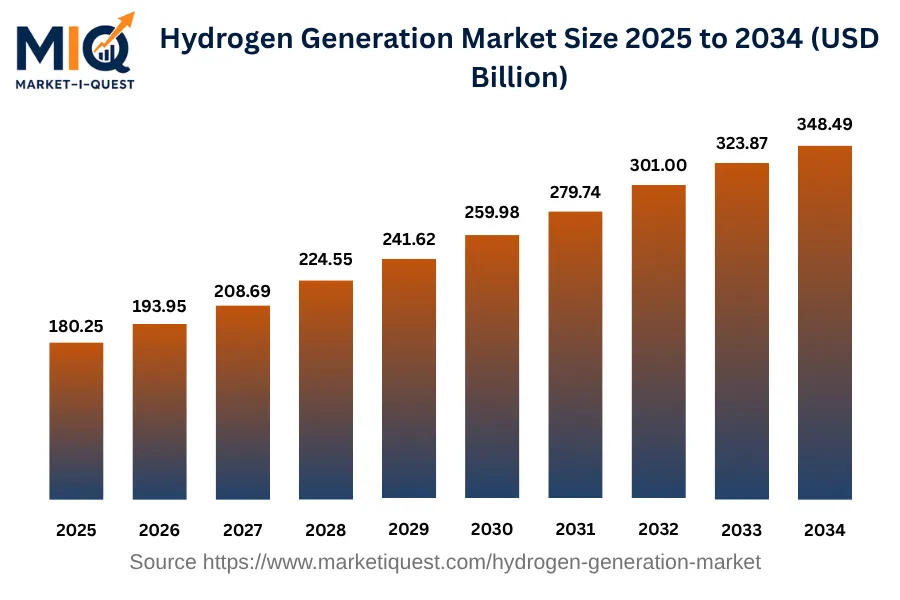
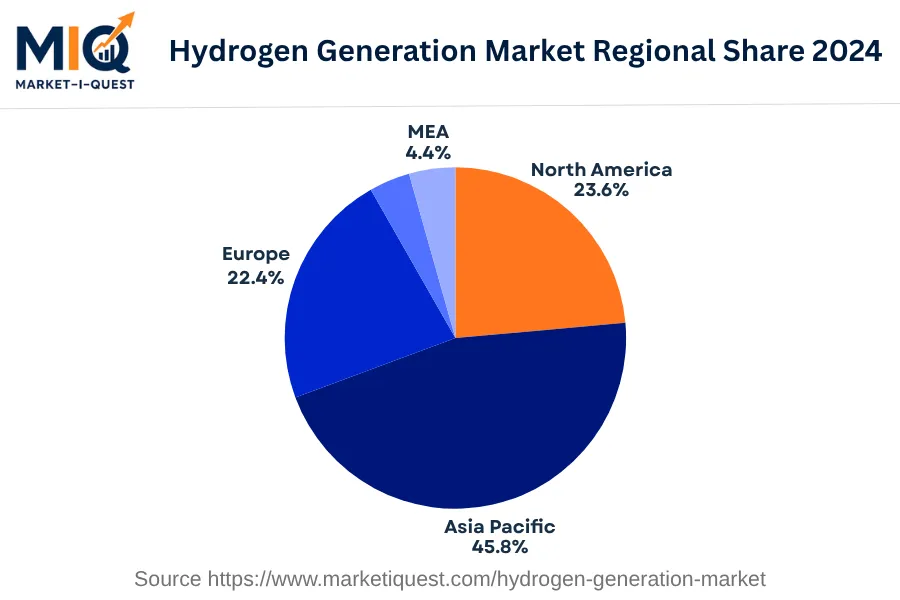
The Hydrogen Generation Market was valued at $180.25 billion in 2025, witnessing an increase from its 2024 size of $167.52 billion. This market is projected to reach a size of $348.49 billion by the end of 2034, expanding at a compound annual growth rate (CAGR) of 7.6% over the period from 2025 to 2034. The growth in the Hydrogen Generation Market between these years indicates a consistent expansion in demand for hydrogen generation. The primary reason driving this growth could be an increasing need for renewable energy sources and the requirement for hydrogen in various industrial applications. In terms of regional share in 2024, Asia Pacific constituted the highest percentage, with 45.8%, followed by North America and Europe with shares of 23.6% and 22.4% respectively. Latin America and Middle East & Africa (MEA) recorded smaller shares, at 3.9% and 4.4% each in the same year.

Key Takeaways

  • By Source - Grey Hydrogen held the dominant position in terms of market share.
  • By Technology - Steam Methane Reforming (SMR) is projected to grow the fastest from 2025 to 2034.
  • By Application - Petroleum Refinery accounted for the majority share in 2024.
hydrogen-generation-market market size

Key Driving Factors

Decarbonization Goals and Policies

Among the primary driving factors for the hydrogen generation market is the global push for decarbonization and the strict legislation set by different countries to cut down on their carbon dioxide emissions. Hydrogen is anticipated to play a vital role in reducing the world's carbon emissions, being a clean energy alternative. For instance, the European Union has issued its European Green Deal, aiming for a carbon-free EU by 2050. It relies heavily on hydrogen as part of the solution. These decarbonization goals and policies create a massive demand for hydrogen, pushing industries to make significant investments in hydrogen generation plants.

Shift Towards Decentralized Energy Generation

Another major driver is the ongoing shift towards decentralized power generation. Many industries are looking to produce their energy locally, avoiding reliance on grid power. Hydrogen presents an effective off-grid alternative because of its ability to store and transport energy. Consequently, there's a growing demand for onsite hydrogen generators as they provide a reliable and more autonomous power supply. For instance, the automotive industry is adopting hydrogen fuel cells for electric vehicles as decentralized energy solutions. These industry trends indicate an upward momentum in the hydrogen generation market.

Market Evolution by Timeline

2019-2023
During this period, heavy industry and utility buyers in Europe and Asia pushed for hydrogen generation due to sustainability goals and energy transition policies, leading to an increase in both steam methane reforming and electrolysis technologies. Budgets redirected from fossil fuel industries fuelled many new projects. Technology integration, however, was immature and constrained by infrastructure limitations. European Union regulations like the Renewable Energy Directive II encouraged the adoption, and partnerships were mainly public-private, with feed-in tariffs shaping the price structures. Raw water scarcity posed risks causing some projects to deploy wastewater instead.
2024
In 2024, adoption of hydrogen generation grew further with the US and Canada joining in. Europe remained a leader due to comprehensive green hydrogen strategies. Electrolysis technology became more utilized, but initial high upfront costs still posed a challenge. The amended US American Clean Energy and Security Act provided legislative support and the EU furthered regulation for excess electricity utilization. Commercial models saw shifts towards leasing contracts while power purchase agreements (PPAs) gained popularity. The practical hurdle was transporting hydrogen to urban end-users.
2025-2029
During this span, the Middle East, South Africa, and Australia became key players due to their solar abundance which favors green hydrogen. Many planned projects reached operation stage boosting supply. Technology-wise, solid oxide electrolysis cells started emerging. Use of surplus renewable energy was optimized under updated regulations like the EU's Clean hydrogen Alliance strategy. Commercial models evolved towards joint ventures for risk-sharing. Digital platforms for hydrogen trading started to emerge. One key challenge during this period was balancing intermediate storage of hydrogen with grid reliability needs.
2030-2034
Towards 2034, hydrogen generation was increasing globally with green hydrogen outperforming grey hydrogen. More mature markets included hydrogen in their power and heat sector. A wider variety of technologies were under trial, including plasmalysis and photoelectrochemical water splitting. Various nations introduced stricter carbon policies, favoring the hydrogen industry. Various utilities and oil & gas companies joined forces, bundling their purchasing power. With rising demand, pricing shifted towards market-based dynamics. The risk became more around the execution of large scale green hydrogen projects and contract disputes.

Future Market Outlook

Future Opportunities

The hydrogen generation market presents future opportunities as regulatory frameworks evolve globally, indicating a notable shift towards hydrogen as a sustainable energy source. In 2023, the United States announced the Inflation Reduction Act, which includes tax incentives for green hydrogen projects, fostering interest among investors and developers. Additionally, collaborations are evident, with companies like Cummins partnering with universities to enhance research in hydrogen technology, pointing to a growing emphasis on innovation. The role of hydrogen in decarbonizing sectors such as transportation and industrial processes has been highlighted by transport initiatives in Germany, where hydrogen fuel cell buses are being integrated into public transit systems. Furthermore, the Asian Development Bank initiated efforts in late 2022 to fund hydrogen infrastructure developments in Southeast Asia, creating a regional focus on energy transition. The interest from oil and gas companies transitioning towards cleaner energy solutions is notable, with firms like Shell exploring hydrogen production alongside traditional energy sources. The potential for hydrogen in energy storage solutions remains vast, especially considering the increasing demand for renewable energy integration. As technology advances, the increased focus on creating green hydrogen to replace fossil fuel use will drive R&D efforts. Overall, collaborative efforts across different industries, combined with supportive policies, highlight a substantial future potential for expanding hydrogen generation technologies.

Segmentation Analysis

By Source

The market is divided into subsegments including Blue Hydrogen, Green Hydrogen, and Grey Hydrogen. Among these, Grey Hydrogen accounted for the largest revenue share while Green Hydrogen is expected to grow at the fastest CAGR during the forecast period.

Largest Revenue Share

Grey Hydrogen

Market Share Leader

Today, Grey Hydrogen holds the lion's share in the hydrogen market, backed by a range of factors. It's primarily because of the cost-effectiveness of the production process of Grey Hydrogen through the steam methane reforming (SMR) process. This method is the most established and financially viable, thereby leading to its superior market position. The source intensity makes grey hydrogen highly feasible for industrial feedstocks, particularly in segments such as fertilizers and refinery processing. Its availability is widespread; the production infrastructure is mature and enjoys considerable political and regulatory support. Although grey hydrogen production emits CO2, markets like China, driven by heavy industries, show a marked preference for this variant due to cost and productivity considerations. The biggest factor influencing purchasing decisions is the established pipeline network for transportation and distribution, reducing the cost and complexity associated with storage and supply logistics.

Fastest CAGR

Green Hydrogen

Forecast Period Growth Leader

Green Hydrogen, on the other hand, is expected to grow at the fastest CAGR in the upcoming years. This marked growth can be attributed to its production method using renewable energy sources, making it a sustainable alternative in the transition towards cleaner energy. Policy supports in terms of subsidies and incentives for renewable hydrogen production also act as a significant catalyst driving its growth. The declining cost of renewable electricity and advancements in electrolyser technologies have considerably reduced the capex, leading to better adoption. The growing partnerships among major industry players aiming to capitalize on the green hydrogen economy also contribute to its faster growth. However, this subsegment faces challenges related to the current lack of industrial scale-up and storage technology. A breakthrough in these areas could significantly influence the adoption of green hydrogen, overcoming current hurdles.

By Technology

The market is divided into subsegments including Steam Methane Reforming (SMR), Partial Oxidation (POX), Coal Gasification, and Electrolysis, with SMR accounting for the largest revenue share currently while Electrolysis is expected to grow at the fastest CAGR during the forecast period.

Largest Revenue Share

Steam Methane Reforming (SMR)

Market Share Leader

Steam Methane Reforming (SMR) dominates the technology segment in terms of revenue. Traditional SMR technology has proven its efficiency in producing hydrogen on a large scale. Its appeal lies in its proven track record and the reliability it offers to end-users, specifically in industries like oil refineries and petrochemicals. This technology process utilizes natural gas, a relatively inexpensive and widely available feedstock, providing cost advantages to the manufacturers. Moreover, due to the strong presence of existing infrastructure and the lack of immediate or cheaper alternatives, businesses find it cost-prohibitive to switch from SMR. Regulations that favor existing technologies also provide SMR additional advantages. Significant investments in this technology from key geographic markets, such as North America and Asia, further solidify the leading position of SMR.

Fastest CAGR

Electrolysis

Forecast Period Growth Leader

Electrolysis is poised to be the fastest-growing technology within the market. The growth of this subsegment can be attributed to the increase in preference for green and clean technology, and the advancing energy transition towards lower carbon pathways. As more regions regulate for lower carbon emissions and develop goals to achieve carbon neutrality, industries are slated to consider electrolysis for its zero direct emission hydrogen production capabilities. Additionally, advancements in renewable energy create opportunities for electrolysis to become economically viable. Investment in renewable energy infrastructure, like wind and solar, can produce the electricity needed for electrolysis, lowering the cost over time. Partnerships between electrolysis technology providers and renewable energy firms, along with supportive government policies, will act as significant catalysts for growth. However, uncertainties around regulatory framework and technology maturation could pose near-term risks.

By Application

The market is divided into subsegments including Petroleum Refinery, Ammonia Production, Methanol Production, Transportation, Power Generation, and Others, among which Petroleum Refinery accounted for the largest revenue share while Power Generation is expected to grow at the fastest CAGR during the forecast period.

Largest Revenue Share

Petroleum Refinery

Market Share Leader

The Petroleum Refinery subsegment dominates the market primarily due to the constant global demand for petroleum products. With established infrastructure and a broad-based global client base, petroleum refineries form a significant portion of the industrial sector. They contribute a substantial share of the revenue in the energy production market due to the omnipresent demand for energy sources primarily derived from petroleum. Leveraging efficient refining methods, petroleum refineries are positioned to garner robust revenue margins. Geographically, global powerhouses in oil production such as the Middle East, North America, and parts of Europe primarily contribute to petroleum refinery revenues. Additionally, regulations and policies around petroleum extraction and refining, demand and supply dynamics, purchasing criteria based on the quality and efficiency of the refined product, contribute to the commanding revenue share of this sector. Another factor that cites the revenue lead of this subsegment is the global dependency on fossil fuels which induces steady demand and relatively moderate switching costs.

Fastest CAGR

Power Generation

Forecast Period Growth Leader

Power Generation is anticipated to register the fastest growth over the specified period. This growth is projected with respect to advancements in technology such as renewable energy and nuclear power. A significant catalyst to this growth is the global shift towards green energy to reduce carbon emissions. Government policies encouraging sustainable energy practices and large-scale capex in renewable and nuclear energy production are primed to exponentially drive this sector. On the same note, increased partnerships between private entities and governments across the globe are pushing the frontier for expansion in power generation activities. However, adoption barriers such as transitioning costs from fossil-based generation to cleaner energy sources, regulatory hurdles, and technical challenges, can influence the short-term growth trajectory of the industry. Regardless, given the long-term sustainability objectives globally, these barriers are likely to be overcome, enabling the faster CAGR of this subsegment.

Competitive Analysis

Key Market Players

Manufacturers / OEMs

Air Products & Chemicals Inc.
US
Siemens
Germany
Linde plc
Ireland

Key Suppliers & Raw Materials

Royal Dutch Shell
Netherlands
Praxair, Inc.
US
Air Liquide
France

Distributors, Integrators & Channel Partners

Messer Group
Germany
KOHLER CO.
US
ENGIE
France

Porter’s Five Forces Analysis

This is an examination of the competitive forces impacting the hydrogen generation market.

Supplier Bargaining Power

Medium

Limited suppliers of raw materials cause fluctuation in prices impacting bargaining power.

Buyer Bargaining Power

Low

Limited alternatives make it difficult for buyers to negotiate prices.

Threat of Substitutes

Low

The uniqueness of hydrogen as an energy source limits substitutes.

Threat of New Entrants

Medium

High development costs prevent a rush of new entrants, but interest in renewable energy is increasing.

Competitive Rivalry

High

Fierce competition exists among major players in the developing market.

Regional Analysis

Geographic market dynamics and growth opportunities across key regions

Global Market Outlook

hydrogen-generation-market market regional share

North America

In 2024, the Hydrogen Generation Market in North America experienced substantial pace due to profound industrial and environmental dynamics. This growth trajectory was driven by several factors. Firstly, regulatory encouragement supported the adoption of clean energy solutions, notably in the U.S. and Canada, where rigorous measures were enforced to minimize carbon footprint. Secondly, heightened demand from utilities and manufacturing sectors pressured supply chains, prompting increased investment in technology and infrastructure for efficient hydrogen production. Lastly, steady pricing of hydrogen and its derivatives impelled stable market growth.

Several trends further shaped the contours of this market. Notably, the enterprise sector showed a propensity for adoption of hydrogen-based energy systems, marking a significant shift in energy management strategies. Additionally, shifts in channel dynamics occurred, as partnerships and M&A activities proliferated to ensure energy sustainability and increased generation efficiencies. Furthermore, intensifying policy enforcement in the U.S. and Mexico deepened the commitment to hydrogen as a prime renewable energy source, thereby reinforcing market stability. Various sectors, notably utilities and manufacturing, have emerged as major consumers of hydrogen due to its low carbon emission properties. The changing landscape fostered growth, pushing North America's Hydrogen Generation Market to an unprecedented scale of operation in 2024.

Asia Pacific

In 2024, Asia Pacific's hydrogen generation market surfaced as a vibrant sector, pushed by increased demand for clean energy and stringent environmental regulations. Drivers included China and India's escalating energy requirements, propelled by rapid industrialization and urban development, necessitating advanced hydrogen technologies. In addition, significant investments from South Korea and Japan in fuel cell technology adoption were reshaping supply dynamics. Government commitment to mitigating climate change, evident in policies like China's 13th Five-Year Plan, underpinned pricing premiums for green hydrogen.

Trend-wise, customer preference swung towards distributed hydrogen production due to decarbonization targets set by enterprise and government sectors, thereby intensifying technology shifts. In sectors such as utilities, manufacturing, and healthcare, small-scale hydrogen generation gained traction. Concurrently, Australia witnessed a surge in strategic partnerships and M&A activities aimed at increasing hydrogen supply chain resilience, while key ASEAN markets saw increased adoption prompted by policy enforcement. Meanwhile, standardization in hydrogen systems advanced, led by government-driven mandates, indicative of the region's aggressive shift towards a hydrogen economy. As such, 2024 marked a significant year for the hydrogen generation market in the Asia Pacific region.

Europe

In 2024, the Hydrogen Generation Market in Europe saw significant growth and diversification. Demand surged due to heightened environmental consciousness and the implementation of stringent emission regulations, pressing industrial sectors, like utilities and manufacturing, to reduce carbon footprints by turning to hydrogen as a clean energy alternative, particularly in Germany and the UK. Substantial investments from both government and enterprise sectors in renewable energy infrastructure, including hydrogen production, further drove the market growth, with notable investments reported in France.

The market also experienced shifting trends, with an incline in decentralized hydrogen production, facilitated by the adoption of advanced electrolysers, particularly in Italy and Spain. Technological advances allowed for cost-effective localised production, disrupting traditional channel dynamics and contributing to increased commercial and residential usage. Furthermore, partnership and merger activities were on the rise, particularly within the Benelux region, as companies aimed to consolidate market share and leverage shared technological innovations. Increasing policy enforcements supporting the transition to low-carbon economies in the Nordics and Central & Eastern Europe encouraged the proliferation of hydrogen technologies. For instance, the incorporation of hydrogen fuel within the public and private transportation sector gained momentum, underpinned by supportive government policies. The Hydrogen Generation Market in 2024 was thus driven by regulatory pressure, technological advancements and evolving end-user behavior, with distinct regional contributions and trends defining the European landscape.

Latin America

In 2024, the Hydrogen Generation Market in Latin America experienced significant growth due to various factors. Driven by increased demand for clean energy, countries like Brazil and Mexico led the hydrogen revolution with progressive regulations and substantial investments. Policies such as Brazil's National Biofuel Policy (RenovaBio), spurred the adoption of hydrogen-based technologies. Furthermore, advancements in electrolysis technology and a steady supply of renewable electricity increased hydrogen production notably in Argentina. Trends in the Hydrogen Generation Market also evolved. Amid increased global pressure for sustainability, many industrial enterprises turned to hydrogen as an alternative energy source. For instance, Chilean mining companies utilized hydrogen-based solutions for their operations. Also, governmental organizations in Colombia engaged in research collaborations and policy enforcement around hydrogen technologies, indicating a shift toward its acceptance.

The market saw significant partner integrations and mergers, such as the case in Peru, where public utilities collaborated with private enterprises to supply hydrogen for power generation. This trend extended to manufacturing sectors, particularly in Mexico and Brazil, indicating a shift towards cleaner production means. However, the retail sector remained largely untouched by these advances in hydrogen generation in the highlighted year. Overall, the Hydrogen Generation Market in Latin America in 2024 was characterized by strategic investments, policy changes, and technological adoption, driven mainly by a rising demand for eco-friendly energy solutions.

Middle East & Africa

In 2024, the Hydrogen Generation Market in the Middle East and Africa is characterized by strategic investments and increased demand for clean energy. The main drivers include stringent environmental regulations across Saudi Arabia and United Arab Emirates, leading to higher adoption of hydrogen-based power generation in sectors like manufacturing and utilities. Increasing investment in technology, particularly in Qatar and Israel, supports the growth of advanced electrolysis techniques for efficient hydrogen generation. Additionally, the need to reduce dependency on fossil fuels drives the hydrogen market in oil-abundant countries such as Nigeria.

Trends shaping this market include consumer inclination towards cleaner energy, especially in South Africa, where environmental awareness is high. Deployment of advanced technology for hydrogen generation, observed in Egypt, leads to efficient and cost-effective generation. The formation of strategic partnerships and joint ventures, particularly in Saudi Arabia and United Arab Emirates, enhances capacity while promoting technology transfer. These partnerships ensure affordable hydrogen for utilities and manufacturing sectors. Enforcement of strict hydrogen generation standards in Kenya ensures dictated safety requirements are met and aligns production to global best practices. Finally, increased policy enforcement, particularly in Nigeria, necessitates the adoption of emission-reduction technologies in the oil and gas sector.

Recent Industry Developments

Latest market innovations, product launches, and strategic initiatives

April 2026

H2SITE signed a strategic agreement with Petronor to deploy its advanced high-efficiency hydrogen separation technology at Petronor's refinery. This partnership focuses on implementing specialized membrane technology to pioneer the production of high-purity hydrogen, directly addressing the demand for decarbonizing refinery processes.

March 2026

The Ministry of New and Renewable Energy (MNRE), India, officially notified the Green Ammonia and Green Methanol Standards. These regulations establish strict non-biogenic greenhouse gas emission thresholds (0.38 kg $CO_2$ eq/kg for ammonia and 0.44 kg $CO_2$ eq/kg for methanol), providing the regulatory clarity necessary for investors to scale up green hydrogen derivative production.

Frequently Asked Questions