Hearing Amplifiers Market Snapshot

Key Players

  • Sonova Holding AG (Switzerland)
  • William Demant Holding A/S (Denmark)
  • Sivantos Pte. Ltd. (Singapore)
  • GN Store Nord A/S (Denmark)
  • Starkey Hearing Technologies (United States)
  • Phonak AG (Switzerland)
  • Widex A/S (Denmark)
  • Cochlear Ltd. (Australia)
  • Rion Co. Ltd. (Japan)
  • MED-EL (Austria)

Market Size

Base Year 2024
$0.895 Bn
CAGR
5.74%
Forecast 2034
$1.56 Bn

Market Segments

By Product Type
Behind-the-Ear (BTE) Hearing Aids, In-the-Ear (ITE) Hearing Aids, Completely-in-the-Canal (CIC) Hearing Aids, Invisible-in-the-Canal (IIC) Hearing Aids, Bone-Anchored Hearing Systems (BAHS)
By Technology
Analog Hearing Aids, Digital Hearing Aids, Wireless Hearing Aids, Bluetooth Hearing Aids, Rechargeable Hearing Aids
By User Demographics
Children, Adults, Senior Citizens, Individuals with Speech Disabilities, Individuals with Cognitive Impairments
By Application
Mild Hearing Loss, Moderate Hearing Loss, Severe Hearing Loss, Profound Hearing Loss, Age-Related Hearing Loss, Noise-Induced Hearing Loss, Others

Market Dynamics

Drivers
  • Aging global population
  • Technological advancements in amplifiers
Restraints
  • Stigma associated with amplifiers
  • High product costs
Opportunities
  • Emerging technologies in healthcare
  • Untapped potential in developing countries

Market Size

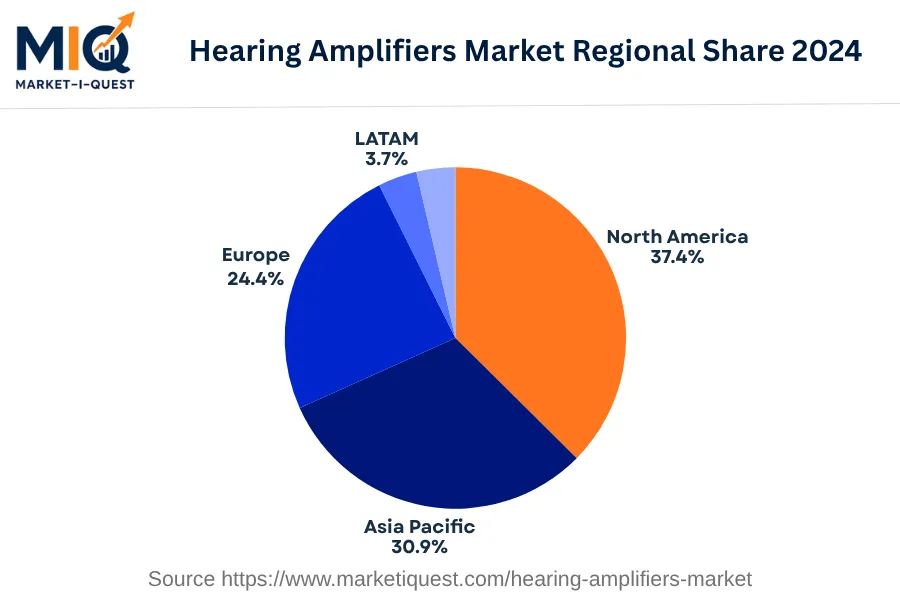
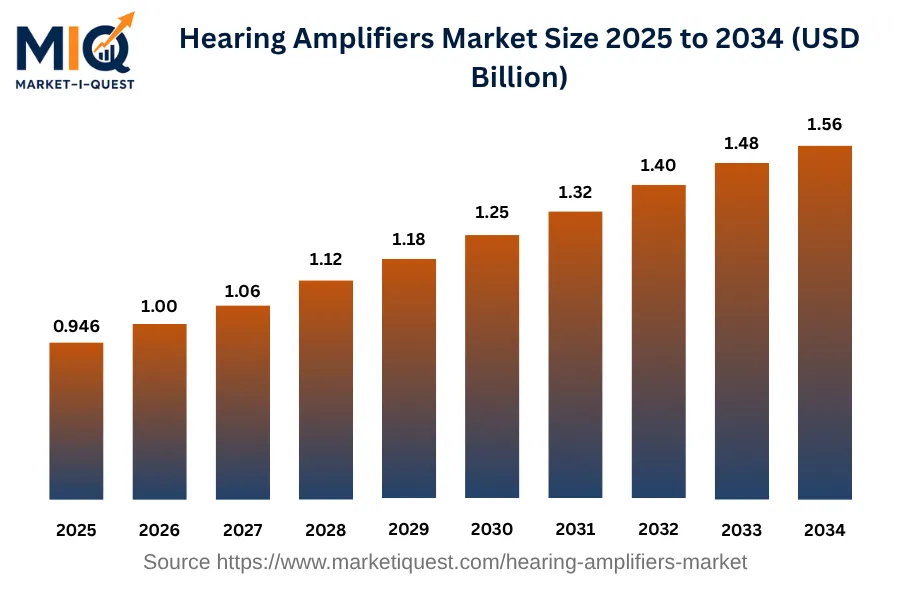
The Hearing Amplifiers Market stood at USD 0.90 billion in 2024, before expanding to a size of USD 0.95 billion in 2025. Continuing the growth trajectory, the market escalated to a value of USD 1.56 billion by 2034, marking a CAGR of 5.7% from 2025 to 2034. A recognition of the essentiality of this technology, paired with growing accessibility, contributed to the market's expansion. As of 2024, North America held the largest regional share of the Hearing Amplifiers Market at 37.4%, followed by Asia Pacific with a 30.8% stake. Europe claimed a 24.4% share, while Latin American and Middle East & African regions both held smaller slices of the pie at 3.7% each. The market division points at North America's leading role in this sector and the advancing footprint in the Asia Pacific and European regions.

Key Takeaways

  • By Product Type - Behind-the-Ear (BTE) Hearing Aids held the major share in the hearing amplifiers market.
  • By Technology - Digital Hearing Aids dominated the market accounting for the largest share.
  • By User Demographics - Adults were the leading users of hearing amplifiers substantially leading the segment.
  • By Application - Age-Related Hearing Loss was the predominant sector accounting for a significant market proportion.
hearing-amplifiers-market market size

Key Driving Factors

Regulatory Shift towards Over-the-Counter Devices

A significant driver for the hearing amplifiers market is a regulatory shift that has made hearing aids accessible as over-the-counter (OTC) products. For instance, in the United States, the FDA Reauthorization Act of 2017 included a provision for creation of a category for OTC hearing aids. These new rules mean that more companies can make products so there is competition and people have more choices. Not needing a doctors note makes it easier for people to buy these hearing aids so they are more available to people who have some trouble hearing. This change in the rules is helping more people to buy hearing solutions. It will probably keep helping the market grow.

Public Health Initiatives for Better Hearing Health

The hearing amplifiers market is also being stimulated by an array of public health initiatives aimed at improving hearing health among aging and noise-exposed populations globally. Governments and non-profit organizations are forcing people to catch hearing problems and work on them. This shows that we need to make hearing solutions affordable. The World Health Organization wrote a report called 'World Report on Hearing'. It says that hearing amplifiers are helping people with hearing loss especially in places where they do not have a enough resources for hearing solutions. The World Health Organization is pushing for the use of hearing amplifiers to help people with hearing loss. These initiatives not only increase awareness but also provide a procurement trigger for buyers, as they increase screening, identification, and intervention rates for hearing loss, ultimately fueling the demand for affordable hearing amplifiers.

Market Evolution by Timeline

2019-2023
Primarily, the demand from elderly population and people with hearing impairment, particularly in the regions of North America and Europe, drove the hearing amplifiers market. Major manufacturers like Williams Sound and Bellman & Symfon expanded their product. And lineup them with enhanced sound clarity devices. However, high cost of devices and low accessibility remained barriers to entry. Pricing mostly followed a premium model. Predominantly due to the advanced technology involved. Medical device regulations, specifically FDA guidelines in the U.S., strongly influenced their adoption.
2024
The year 2024 was marked by a rise in demand from emerging economies like India and China as awareness regarding hearing health increased. New entries in the marketplace, with affordable and efficient devices, began to challenge established players. Connectivity features with smartphones and IoT devices became a common feature, signaling integration maturity. Regulatory bodies began to enforce strict standards to limit fake products. Service-oriented models started to appear involving consultations and post-purchase services. However, the high development cost for innovative and tech-integrated devices remained a significant risk.
2025-2029
During this period, globally the primary buyer segment will begin to include people exposed to high noise environments apart from the elderly. Particularly in rapidly industrializing regions, like South-East Asia, hearing amplifiers will be more common. Innovations such as in-device AI for sound filters will be the norm. Despite ongoing challenges with high device costs, group purchasing organizations' cooperative purchasing contracts will start to offer economies of scale. Policies such as WHO's 'Make Listening Safe' initiative will drive adoption.
2030-2034
The predominant demand will continue from workers in high-noise industries, especially in developing countries with stronger industrial growth. Device manufacturing will see wider and cheaper use of AI and machine learning, making devices more advanced yet cost-effective. Procurement models will see integration of hearing amplifiers with corporate health packages in various industries. Environmental concerns led to strict policies on disposable battery usage in devices.

Future Market Outlook

Future Opportunities

Opportunities within the hearing amplifiers market are expanding due to shifting consumer needs influenced by regulatory changes and technological developments. After the FDA’s approval of OTC hearing aids in 2022, the hearing amplification sector is projected to see greater technology company participation, enhancing the availability of options and potentially fostering more competitive conditions. Artificial intelligence is expected to become more integrated across manufacturers, as prominent hearing amplifier brands such as Oticon and Phonak leverage innovations in personalization that can change the user experience with hearing amplifiers. With aging populations in the region, like those of Europe and North America, expected to grow during 2023, the market for hearing devices customized for seniors should grow significantly. The wider acceptance of telemedicine following the 2020 pandemic, will likely also encourage tech companies to integrate advanced features for virtual fitting and support, further lowering costs of standard hearing amplifiers. Joint ventures between tech companies and audiology specialists are anticipated to further develop more beneficial hearing devices. The rising trends towards increased health awareness among consumers and a greater inclination towards self-care will likely encourage the development of at-home test options to assess a user’s hearing. These trends signal opportunity to develop affordable, and easy to use, highly technologically advanced hearing amplifiers suited for use in a global consumer landscape addressing hearing issues.

Segmentation Analysis

By Product Type

The market is divided into subsegments including Behind-the-Ear (BTE) Hearing Aids, In-the-Ear (ITE) Hearing Aids, Completely-in-the-Canal (CIC) Hearing Aids, Invisible-in-the-Canal (IIC) Hearing Aids, and Bone-Anchored Hearing Systems (BAHS). Behind-the-Ear (BTE) Hearing Aids accounted for the largest revenue share while Bone-Anchored Hearing Systems are expected to grow at the fastest CAGR during the forecast period.

Largest Revenue Share

Behind-the-Ear (BTE) Hearing Aids

Market Share Leader

Behind-the-Ear (BTE) hearing aids stand as the subsegment with the largest market share for a variety of reasons. BTE hearing aids are great for people with a lot of types of hearing loss from a little bit to a lot. The way they are made with most of the parts, behind the ear helps them make sounds louder. BTE hearing aids are also stronger and easier to clean than kinds. People used to think it was bad that BTE hearing aids are easy to see. BTE hearing aids are helping to make hearing loss seem normal. Moreover, updates in design and technological beautification are making BTE products visually appealing, while continual technical advancements are ensuring improvement in sound quality and noise reduction capabilities. Nonetheless, saturation and strong competition might restrain the ongoing superiority of this segment.

Fastest CAGR

Bone-Anchored Hearing Systems (BAHS)

Forecast Period Growth Leader

Bone-Anchored Hearing Systems (BAHS) subsegment is expected to grow at the fastest CAGR during the forecast period. This swift growth can be ascribed to several factors. Bone-Anchored Hearing Systems are significantly different from hearing aids As they send sound to the bones in the ear. This is helpful for people who cannot use hearing aids because they have bad ear infections were born with ear problems or are deaf in one ear. So a special group of people who're willing to pay more for Bone-Anchored Hearing Systems has been formed. New technology making this group of people grow, with products that have better sound can get wet and can connect to other things, like phones or music players. Partnerships between manufacturers and healthcare institutions contribute to the adoption of BAHS. However, the higher cost compared to traditional hearing aids, along with the necessity of a surgical procedure, may hinder the adoption rate to a certain extent, hence influencing the growth curve for this market subsegment.

By Technology

The market is divided into subsegments including Analog Hearing Aids, Digital Hearing Aids, Wireless Hearing Aids, Bluetooth Hearing Aids, and Rechargeable Hearing Aids. In 2024, Digital Hearing Aids accounted for the largest revenue share while Bluetooth Hearing Aids is expected to grow at the fastest CAGR during the forecast period.

Largest Revenue Share

Digital Hearing Aids

Market Share Leader

In the base year of 2024, Digital Hearing Aids held the major market share in terms of revenue. This segment's dominance can be attributed to numerous factors. First, the widespread prevalence of hearing loss and the high acceptance of digital technology in medical devices are primarily driving the segment. Digital hearing aids allow for sophisticated speech enhancement algorithms, help suppress background noise, and offer improved sound quality, making them the preferred choice for many consumers. Additionally, regulatory bodies approve the majority of digital devices due to their superior performance and increased safety features. Major geographies have contributed to this segment's significant share, such as North America and Europe, where there is higher health awareness, sound healthcare infrastructure, and strong support for technological advancements. Efficient distribution channels, including online sales and hearing care clinics, have significantly aided in the extension of digital hearing aids.

Fastest CAGR

Bluetooth Hearing Aids

Forecast Period Growth Leader

On the other hand, Bluetooth Hearing Aids promises to be the fastest-growing subsegment during the forecast period. The strong CAGR growth can be attributed to the increasing integration of smart technologies in healthcare devices, and the demand for wireless connectivity for better functionality. Bluetooth technology in hearing aids allows seamless connection to various devices such as smartphones, televisions, and smart speakers, significantly enhancing user experience. Additionally, increasing partnerships between hearing aid manufacturers and tech companies are further spurring growth in this subsegment. Despite its promising growth, the adoption of Bluetooth Hearing Aids faces resistance because of high capital expenditure associated with these high-end products, especially in developing regions. However, initiatives to improve hearing aid affordability and the introduction of cost-effective bluetooth hearing aids may catalyze adoption in the near future.

By User Demographics

The market is divided into subsegments including Children, Adults, Senior Citizens, Individuals with Speech Disabilities, Individuals with Cognitive Impairments, with Adults accounting for the largest revenue share whereas Individuals with Cognitive Impairments are expected to grow at the fastest CAGR during the forecast period.

Largest Revenue Share

Adults

Market Share Leader

The Adult demographic has garnered the most revenue in the base year 2024. This is primarily because the adult population represents a significant portion of the overall population, therefore presenting a sizeable market for brands to tap into. Adults are major buyer than others like kids and seniors As they are the ones who earn the money in most homes. They buy things from different kinds of businesses as they like to spend their money on all sorts of things. Adults have a lot of needs and they like different things so they spend their money in various ways. This is why adults play crucial role when it comes to companies making money from the things they sell. Their wide accessibility through various channels, receptive nature to market changes, and substantial influence on consumption trends further consolidate their leading position in revenue attribution.

Fastest CAGR

Individuals with Cognitive Impairments

Forecast Period Growth Leader

On the contrary, the fastest growth is expected to be seen in the segment of Individuals with Cognitive Impairments. Despite the fact that this is a smaller group than the others, it's driving factors for CAGR can be connected to advancements in technology in the health and medical sector, increased awareness, and improved access to assistive equipment. In recent years, cognitive impairments have been better recognized and understood, leading to a significant increase in diagnosis rates. This, coupled with more politically pressing topics addressing inclusivity, diversity, and healthcare access, has spurred growth in industries catering specifically to individuals with cognitive impairments. Moreover, companies are investing in this space due to social responsibility mandates, thereby fuelling potential growth. However, despite promising growth projections, challenges such as affordability and stigmatization need to be addressed to tap into the full potential of this segment.

By Application

The market is divided into subsegments including Mild Hearing Loss, Moderate Hearing Loss, Severe Hearing Loss, Profound Hearing Loss, Age-Related Hearing Loss, Noise-Induced Hearing Loss, and Others. Among these segments, Age-Related Hearing Loss accounted for the largest revenue share while Noise-Induced Hearing Loss is expected to grow at the fastest CAGR during the forecast period.

Largest Revenue Share

Age-Related Hearing Loss

Market Share Leader

Age-Related Hearing Loss segment holds the largest market share mainly due to the increase in ageing population globally. Hearing impairment, for instance, happens to be the most widely diagnosed disorders in old individuals, where it affects a significant percentage of seniors due to a chronic condition referred to as presbycusis or aging related hearing loss. Apart from this, an ever improving design, as well as enhancement in personalization options for hearing aids and their ease of use in an increasingly wide range for the aged population, which, are some of the significant contributors towards segment expansion. There are numerous govt schemes focusing on the provision of more accessible and better care amenities for the old. Better awareness towards available remedies and also other treatments in conjunction with the wide availability of choices among products also drives segment expansion. Nonetheless, high cost and limited access to hearing aids in developing countries remain as challenges that the market faces.

Fastest CAGR

Noise-Induced Hearing Loss

Forecast Period Growth Leader

The Noise-Induced Hearing Loss subsegment is expected to register the fastest growth compared to other subsegments. This can be mainly attributed to the rising noise pollution levels in urban areas as well as increasing occupational exposure to loud noise. Moreover, increased use of headphones and earbuds at high volumes for prolonged periods, especially amongst the younger population, forms another significant factor contributing to the increase in the incidences of Noise-Induced Hearing Loss. Technological advancements in hearing aid devices and growth in disposable income further provide an impetus to the market growth. However, lack of awareness regarding the impact of loud noise on hearing and high product costs remain as growth barriers. Increased efforts by manufacturers to develop affordable devices and awareness campaigns may counter these barriers in the future.

Competitive Analysis

Key Market Players

Manufacturers / OEMs

Sonova
Switzerland
Sivantos Pte. Ltd.
Singapore
Phonak
Switzerland

Key Suppliers & Raw Materials

Emerson Electric Co.
US
Microson
Spain
MED-EL Medical Electronics
Austria

Distributors, Integrators & Channel Partners

Amplisound
US
Beltone
US
Miracle-Ear, Inc.
US

Porter’s Five Forces Analysis

An analysis of the competitive dynamics within the Hearing Amplifiers Market.

Supplier Bargaining Power

Low

Most parts are generic, reducing suppliers' influence.

Buyer Bargaining Power

Medium

Customers have various brands to choose from but lack in-depth technical knowledge.

Threat of Substitutes

High

Rapid advances in related tech (e.g., hearing aids) present high substitution risk.

Threat of New Entrants

Medium

Initial investment and regulatory barrier are moderate; evolving tech attracts new players.

Competitive Rivalry

High

Numerous well-established players, technological innovation, and price wars create intense competition.

Regional Analysis

Geographic market dynamics and growth opportunities across key regions

Global Market Outlook

hearing-amplifiers-market market regional share

North America

In 2024, the North American hearing amplifiers market emerged dynamic due to various driving factors and notable trends. The market was primarily driven by increased consumer awareness around hearing health, strict regulatory measures set forth by the Federal Trade Communication, and an advanced technological landscape prompting investment and widespread adoption of these hearing aids. In terms of trends, the rise in telehealth services, specifically in the U.S, influenced an uptick in remote consultations and online purchases of hearing amplifiers. Further, the increasing prevalence of strategic partnerships among leading manufacturers like Medtronic and GN Store Nord benefitted the market substantially. These alliances aimed to enhance product portfolios and expand retail presence. Product development in 2024 emphasised on wireless and smart hearing amplifiers, marking a shift towards tech-centric solutions in the healthcare sector.

The customer base spanned across diverse sectors, primarily healthcare and retail. Healthcare institutions increasingly integrated these aids to enhance patient care, while e-retailers and physical stores made them readily available for direct consumer purchases. The U.S witnessed substantial growth, followed by Canada and Mexico, owing to the aforementioned drivers and trends impacting the North American hearing amplifiers market in 2024.

Asia Pacific

In 2024, the Hearing Amplifiers market in the Asia Pacific witnessed sustained growth, largely driven by factors like population aging, increased healthcare expenditure, and an expanding middle class demanding better quality of life. China and India, due to their large geriatric populations, provided impetus to the demand side, supported by domestic production capacities and favorable healthcare policies. South Korea and Japan saw progressive adoption of digital and AI-based hearing amplifiers, primarily driven by advanced technological infrastructure and high consumer purchasing power. Key trends included a noticeable shift towards online sales channels, triggered by the impact of the COVID-19 pandemic and the increased connectivity in all the markets under consideration, particularly Australia and key ASEAN markets. Consumer preferences veered towards smart, miniaturized, and nearly invisible devices with advanced features, driving manufacturers to innovate. Increased partnerships were witnessed among local manufacturers, tech firms, and international players to address the expanding market.

In Australia, the demand was fueled by government-backed services for senior citizens under the National Disability Insurance Scheme (NDIS). On the policy enforcement side, stringent regulations spearheaded by Consumer Affairs agencies across Asia Pacific were implemented, ensuring fair pricing and quality standards for these medical devices. Furthermore, this market experienced increased demand from sectors like healthcare, elderly care institutions, and the retail sector, largely owing to increased consumer awareness.

Europe

In 2024, Europe's hearing amplifiers market demonstrated substantial activity, underpinned by the intersection of demand dynamics, regulatory measures, and technological advancements. Among the motivating factors, an aging population in countries like Germany, UK, and Italy, escalated the demand for hearing aids, given the higher incidence of age-related hearing disorders. Furthermore, enhanced investment in R&D, particularly in the UK and Benelux, bolstered the adoption of advanced hearing aid technology, which combined bioengineering with digital capabilities. Meanwhile, legislation such as France’s 2021 Decree on the Accessibility of Goods and Services honed the focus on inclusivity, propelling market growth.

On the trends front, buyer behavior witnessed a shift toward online purchasing, necessitated by the pandemic and maintained by the convenience it offered. Manufacturers like Denmark's Widex and Swiss firm Sonova reconfigured their distribution channels, catering to this increasingly digital customer base. In parallel, the market experienced strategic partnerships such as the collaboration between Germany's Sivantos Group and Italy's Amplifon, aimed at consolidating market share. Notably, teleaudiology emerged as a disruptor, with healthcare providers across Spain and Central & Eastern Europe employing remote consultations for diagnosis and treatment, hailing a new era in consumer-centric service delivery. These factors altogether defined the continent's hearing amplifier industry in 2024.

Latin America

In 2024, the hearing amplifiers market in Latin America (LATAM) exhibited vigorous dynamics driven by different factors. People in Brazil and Mexico are getting older. This is causing more of them to have trouble hearing. In Argentina the government is spending money on making healthcare easier for people to get so they are investing in places that help people with hearing problems. In Colombia new digital technologies are being used a lot, which is making it possible for people to get hearing aids that're affordable and work well. Many people in Chile and Peru who have cholesterol or other medical problems that affect their hearing are now going to see doctors, which shows that they are more aware of the health problems that can happen if they do not take care of their hearing. In the American region people are switching from old style hearing aids to new digital ones because they sound better and can be adjusted to fit each persons needs. In Brazil the government is making sure that all hearing aids have a part called a telecoil, which is changing how these devices are made. Hearing aid companies are working with hospitals and other medical places in Mexico to teach people more about how to take care of their hearing, which is helping a lot of people. Hearing aids are very important for people in Latin America. Hearing aids are helping them to hear better. Latin America is seeing a lot of changes in the way people use hearing aids and hearing aids are becoming more popular in Latin America in countries, like Brazil and Mexico where hearing aids are needed by many people who have hearing loss.

These pivotal market shifts were most apparent in the healthcare sector, particularly among senior patients who exhibited the highest demand for these hearing solutions. The retail sector also experienced relevant impacts, as digital hearing amplifiers became a prevalent product in pharmacies and specialized healthcare outlets, driven by the enhanced understanding of managing hearing health across LATAM.

Middle East & Africa

In 2024, the Hearing Amplifiers Market in the Middle East and Africa reflects a combination of technological evolution and regional healthcare demands. Drivers include increased health awareness in countries such as Saudi Arabia, UAE, Qatar, and Egypt, leading to growth in demand for hearing aids. The use of technology in healthcare is important in countries like Israel and South Africa. These countries have healthcare systems. People, in these countries use products that help them hear better and have less noise. In Nigeria and Kenya the government has made rules to help people who're blind to get hearing aids. People prefer hearing aids that go inside the ear.

This is because the inside the ear kind looks better and is more comfortable. Now that the healthcare industry is using computers and the internet people like to buy these products. Because of this the companies that make these products are working together to make more of them and sell them in places like Saudi Arabia and the UAE. They want to make sure they can sell their hearing aids in these countries. The companies that make hearing aids are focusing on hearing aids. Lastly, enforcement of standardization policies by governments to ensure the production of high-quality aids has been noticeable, particularly in South Africa and Israel, enhancing customer trust and product reliability. The chief customer sectors include healthcare, telecom for connectivity augmented devices, and retail for sales and distribution.

Recent Industry Developments

Latest market innovations, product launches, and strategic initiatives

July 2026

Cearvol announced the upcoming Japanese market launch of the Cearvol Nano 2, an ultra-compact, high-performance in-the-canal (ITC) hearing amplifier featuring next-generation AI 2.0, environmental adaptation, innovative case control, and tinnitus care functionality .

April 2025

Trihear launched the Neco neckband hearing amplifier featuring a 2-in-1 remote microphone, Bluetooth 5.4, 9 volume levels per ear, 5 tone adjustments, 16dB digital noise reduction, and ultra-low 12ms latency .

Frequently Asked Questions