
Healthcare Payer Services Market Snapshot

Key Players

  • UnitedHealth Group (United States)
  • Anthem
  • Inc. (United States)
  • Aetna Inc. (United States)
  • Cigna (United States)
  • Humana Inc. (United States)
  • Allianz Care (Germany)
  • BUPA (United Kingdom)
  • Sun Life Financial (Canada)
  • Medibank (Australia)
  • AXA (France)

Market Size

Base Year 2024
$85.43 Bn
CAGR
8.75%
Forecast 2034
$197.65 Bn

Market Segments

By Service Type
Claims Management, Billing & Payment Processing, Member Management, Fraud Detection & Prevention
By Deployment Mode
On-Premises, Cloud-Based, Hybrid
By Functionality
Administrative Services, Technology Support Services, Consulting Services
By End User
Health Insurance Companies, Government Healthcare Programs, Managed Care Organizations, Third-Party Administrators

Market Dynamics

Drivers
  • Rising healthcare costs
  • Increasing regulatory compliance requirements
Restraints
  • Regulatory uncertainties
  • High operational costs
Opportunities
  • Popularity in telehealth services
  • Rising healthcare expenditure

Market Size

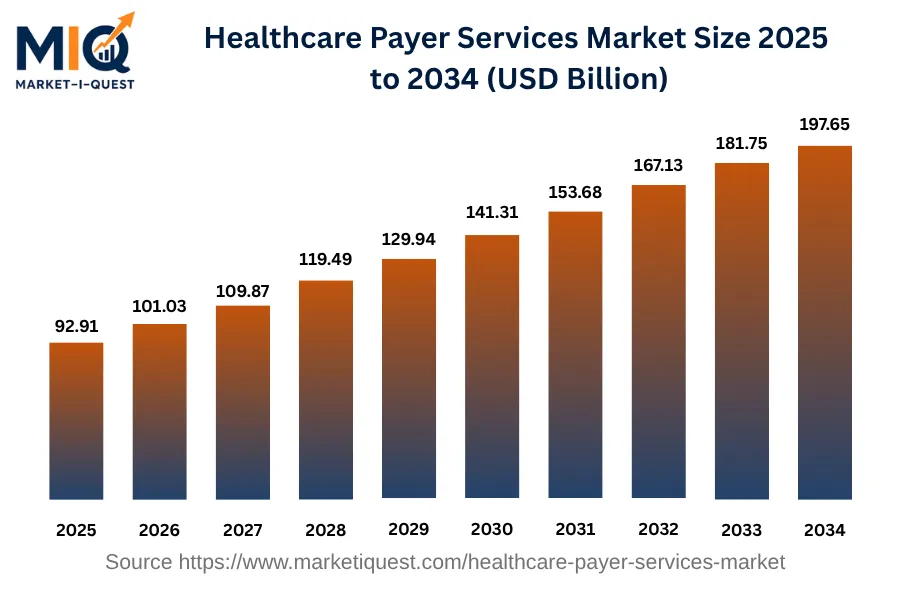
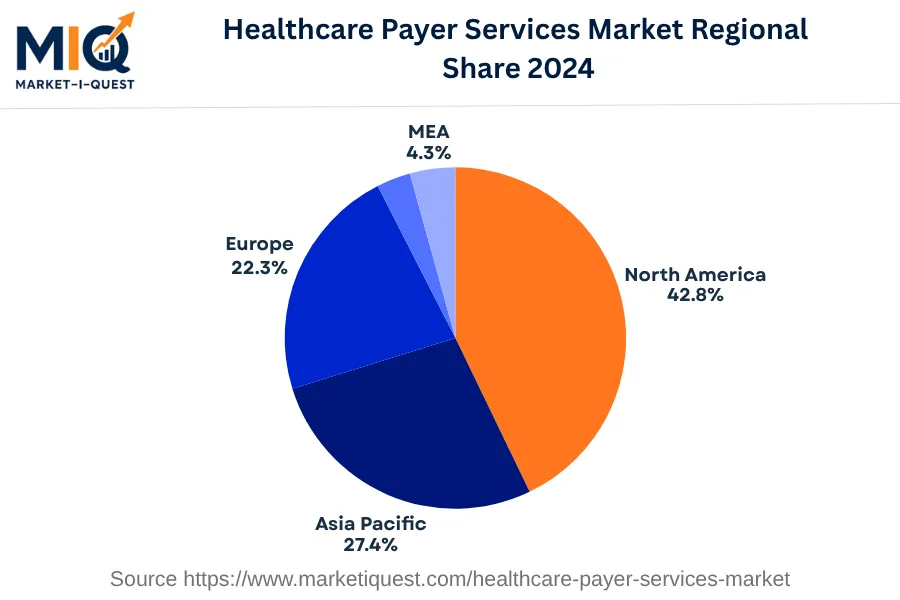
The Healthcare Payer Services Market, sized at 92.91 billion USD in 2025, escalated to 197.65 billion USD by 2034, expanding at a CAGR of 8.75% throughout this period. This consistent growth in the market began in 2024, when the market was valued at 85.43 billion USD, continuing to thrive annually till it almost more than doubled over the span of a decade by 2034. The market trajectory is substantiated by concomitant regional distribution data from 2024, revealing North America as the market leader housing 42.8% of the regional share. This was followed by the Asia-Pacific and European regions, contributing 27.3% and 22.3% respectively to the Healthcare Payer Services Market. The remaining two regions, LATAM and MEA, held smaller shares at 3.2% and 4.3% respectively.

Key Takeaways

  • By Service Type - Billing & Payment Processing led the pack having the highest utilization in Market.
  • By Deployment Mode - On-Premises expanded rapidly becoming a preference for many institutions and companies.
  • By Functionality - Administrative Services were accounting for significant operational efficiency in healthcare management.
  • By End User category - Government Healthcare Programs held a dominant role providing the largest segment in industry.
healthcare-payer-services-market market size

Key Driving Factors

Implementation of ICD-10 Codes

One of the foremost factors driving the healthcare payer services market is the implementation of the International Classification of Diseases, 10th Revision (ICD-10). This complex coding system has been adopted worldwide, including in the United States by the Centers for Medicare & Medicaid Services (CMS), creating a substantial need for healthcare payer services. Compliance with ICD-10 requires specialized knowledge and expertise, and many healthcare providers find it more cost-effective to outsource these tasks rather than training their own staff. In addition, the potential for errors and non-compliance - including significant financial penalties - also encourages providers to utilize specialized payer services. Thus, the implementation of ICD-10 codes is propelling the uptake of healthcare payer services both in the US and globally.
Shift Towards Value-based Payments

Another significant driver for the surge in demand in the healthcare payer services market is the shift towards value-based payments. Performance-based or outcome-driven payment models are gaining traction, led by CMS's push for value over volume in healthcare delivery. These payment models require sophisticated data analysis and predictive modeling to establish individual patient risk profiles, monitor patient health outcomes, and determine suitable compensation for providers. Navigating this shift towards value-based care necessitates specialized expertise, resources and investment. Accordingly, health care providers are increasingly relying on the services of dedicated healthcare payer service enterprises. This shift in policy and practice is providing a significant impetus for the growth of the healthcare payer services market.

Market Evolution by Timeline

2019-2023
During this period, an aging population increased the demand for healthcare payer services in the US and Europe. Providers responded with offerings like advanced analytics and digital engagement tools. However, integration with existing systems posed a challenge. The Health Information Technology for Economic and Clinical Health Act influenced supply by promoting the adoption of health IT. Typically, contracts were risk-sharing agreements, and there was a rise in partnerships between healthcare facilities and technology companies. High security risks due to sensitive patient data were encountered.
2024
In 2024, the demand for payer services expanded to developing countries like China and India due to improvements in their healthcare systems. Providers rolled out AI-based solutions for claims management as well. However, lack of technical expertise became a significant constraint. The adoption increased due to the tightening of health data privacy regulations worldwide. There was a noticeable shift towards pay-per-use pricing models. Cybersecurity remained a significant risk, with firms investing heavily in secure IT infrastructure.
2025-2029
In this timeframe, the need for payer services spiked globally following major events like the adoption of universal healthcare in several countries. Companies started offering cloud-based solutions for ease of access and scalability. Interoperability between different health IT systems was still a challenge. Policies like GDPR and the US HIPAA ruled the regulation side, and we can see a widespread adoption of value-based contracts. Data breaches posed a risk, leading to an emphasis on privacy protection technologies.
2030-2034
Healthcare payer services saw increased demand from a broader demographic set, including younger populations keen on preventive care. Advanced technologies like machine learning and blockchain gained traction in the supply side. Integrating these technologies became efficient with standardized health IT protocols. The policies that effected were mainly focused on data integrity and transaction transparency. We saw partnerships between health facilities and fintech companies to simplify transactions. Increasing sophistication of cyber threats was a key risk during this period.

Future Market Outlook

Future Opportunities

The current healthcare payer services market landscape presents numerous opportunities for future growth and innovation. One significant opportunity lies in the expansion of value-based care models, as payers and providers increasingly collaborate to optimize patient outcomes rather than traditional fee-for-service paradigms. This shift is supported by initiatives from the Centers for Medicare & Medicaid Services, which launched the Comprehensive Primary Care Plus program in 2017, aimed at incentivizing value over volume. Moreover, the rising demand for personalized medicine offers payers a chance to invest in targeted therapies, with organizations like CVS Health exploring unique partnerships with biotech firms for personalized drug programs. Additionally, the increasing importance of mental health services is notable, especially following the mental health crisis exacerbated by the pandemic, prompting payers to incorporate behavioral health into their offerings. The integration of mental health services is already evident through programs implemented by Aetna as part of its holistic healthcare approach. Furthermore, the growing emphasis on social determinants of health is likely to shape payer strategies, urging them to address factors influencing health equity. The implementation of programs targeting social factors, as seen in initiatives like those launched by WellCare in 2020, showcases the directions in which payer services may evolve. By capitalizing on these emerging opportunities, healthcare payers can play a crucial role in enhancing overall care delivery and patient outcomes.

Segmentation Analysis

By Service Type

The market is divided into subsegments including Claims Management, Billing & Payment Processing, Member Management, and Fraud Detection & Prevention. Billing & Payment Processing accounted for the largest revenue share while Fraud Detection & Prevention is expected to grow at the fastest CAGR during the forecast period.

Largest Revenue Share

Billing & Payment Processing

Market Share Leader

Billing & Payment Processing subsegment leads in revenue generation due to its critical role in smooth financial operations of businesses across industries. This class of service is an integral part of companies’ revenue cycle, easing the transaction process between customers and businesses and reducing discrepancies, therefore, ensuring uninterrupted cash flow. The demand for this quartered subsegment is also amplified by the rise of e-commerce and digital payment solutions globally which requires a robust and secure billing and payment processing system in place. Its importance is accentuated in sectors like healthcare and insurance where there are multiple parties involved in financial transactions and require an efficient billing and payment processing system. Additionally, the regulation and compliance requirements, especially on the global level, increase the reliance on this subsegment as service providers have to ensure compliance with diverse and often complex international financial regulations. The convenience it offers to both businesses and customers, the growing digitization of financial transactions, and complex regulatory environment together make Billing & Payment Processing the largest revenue-generating subsegment of 2024.

Fastest CAGR

Fraud Detection & Prevention

Forecast Period Growth Leader

Fraud Detection and Prevention is predicted to be the fastest growing subsegment. Generally, an increased incidence of financial fraud and the growing digital footprint across businesses are the key drivers for the growth of this subsegment. The rise of e-commerce and digital transactions are leaving businesses exposed to greater fraud risks, pushing them to invest in advanced fraud detection and prevention services. These services use sophisticated technologies like machine learning and artificial intelligence to identify and prevent potential fraud, providing security to companies across sectors. It is worth noting the potential adoption barrier lies in the deployment cost of these sophisticated systems, but as businesses increasingly appreciate the cost of fraud both financially and reputationally, they are more willing to invest in mitigating these risks. Furthermore, regulatory policies requiring stringent measures to shield consumers against financial fraud and data breach, technical advancements, capital investments in fintech startups, and strategic partnerships are catalyzing the growth. In context, there might be short-term growth moderation due to economic uncertainties and budget constraints, but the solution's high demand is expected to continue.

By Deployment Mode

The market is divided into subsegments including On-Premises, Cloud-Based, and Hybrid deployment modes. In 2024, the On-Premises subsegment accounted for the largest revenue share while the Cloud-Based deployment is expected to grow at the fastest CAGR during the forecast period.

Largest Revenue Share

On-Premises

Market Share Leader

The On-Premises subsegment brings in the largest revenue in the market. The subsegment's substantial market share can be attributed to its widespread adoption across industries, as organizations, particularly those dealing with high-value or sensitive data, want total control over their infrastructure for security reasons. Despite the Cloud's increasing influence, On-Premises solutions continue to offer unparalleled data security and privacy, as the organization retains the data within its firewall. Its capacity to work offline also contributes to its prevalence, especially in areas where internet connectivity is unreliable. The ability to customize the installation to meet unique business needs further enhances the appeal of On-Premises solutions. However, it's important to note that this segment's growth may be restrained by the inherent high upfront costs, the need for in-house servers, and the requirement for ongoing maintenance.

Fastest CAGR

Cloud-Based

Forecast Period Growth Leader

The Cloud-Based deployment subsegment is projected to proliferate at the fastest CAGR during the forecast period. The scalability, flexibility, and cost efficiency associated with Cloud-Based solutions make them an attractive option for businesses, especially small and medium-sized enterprises. As businesses embrace digital transformation, the need for an infrastructure that can adjust to changing requirements has become essential; cloud solutions fulfill these needs seamlessly. Reduced capital expenditure as there is no need for in-house servers, shorter implementation time, and accessibility from any location are other factors catalyzing the rapid adoption. Additionally, improvement in cloud technologies, supportive government policies promoting digitalization, and increasing partnerships between tech companies are contributing to the growth. Risks could include potential data security concerns and reliance on the internet for operation.

By Functionality

The market is segmented by functionality including Administrative Services, Technology Support Services, and Consulting Services. In 2024, Administrative Services accounted for the largest revenue share while Technology Support Services is expected to grow at the fastest CAGR during the forecast period.

Largest Revenue Share

Administrative Services

Market Share Leader

The Administrative Services segment is leading in terms of revenue due to the increasing trend of outsourcing non-core functions. More and more companies are seeking third-party providers to handle administrative tasks, such as human resources, customer service, and general management. This shifting business strategy frees up resources for companies to focus on their key competencies while also reducing operating costs. Regions with booming industries, such as North America and Asia Pacific, contribute heavily to this segment's revenue due to high demand for administrative services. Regulatory and supply dynamics also play a significant role. In various sectors, companies must comply with complex regulatory requirements that require a high degree of expertise in administrative functions. Meanwhile, supply-side dynamics, including labour force availability and cost competitiveness, are driving the market towards outsourcing administrative services.

Fastest CAGR

Technology Support Services

Forecast Period Growth Leader

Technology Support Services is expected to be the fastest growing segment in the market. Drivers for this growth include the increasing dependence on technology for everyday business operations and the constant evolution of that technology. Businesses need support to enable seamless digital transformation, manage the maintenance and security of their IT infrastructure, and navigate the complexities of various software applications. However, barriers including initial cost of investment and a lack of in-house expertise may limit adoption. In the near term, we can expect to see growth catalyzed by developments in cloud-based services and automation technologies. Strategic partnerships between businesses and technology support providers will also play a key role. While potential risks may arise from regulatory changes and cyber threats, the growing business reliance on technology supports a positive outlook for this segment.

By End User

The market is divided into subsegments including Health Insurance Companies, Government Healthcare Programs, Managed Care Organizations, and Third-Party Administrators. In 2024, Government Healthcare Programs accounted for the largest revenue share, while Managed Care Organizations is expected to grow at the fastest CAGR during the forecast period.

Largest Revenue Share

Government Healthcare Programs

Market Share Leader

Government Healthcare Programs represents the largest revenue subsegment. This can be attributed to the significant role government plays in health care financing and provision, especially in developing regions where private health coverage may be lacking. Government programs like Medicare and Medicaid in the U.S. are expansive in reach and provide coverage for millions of people. These programs usually subscribe to the majority of health services, which creates a substantial revenue stream. Furthermore, government interventions in public health emergencies such as pandemics often result in additional funding streams. Health care providers depend heavily on these programs as reliable sources of revenue. Another key reason for this larger revenue share is the sheer population size catered to by these programs. For instance, Medicaid alone covers more than 70 million individuals. Notably, the aging population is also a significant factor, with more individuals subscribing to government health schemes post-retirement.

Fastest CAGR

Managed Care Organizations

Forecast Period Growth Leader

Managed Care Organizations (MCOs) represent the fastest-growing subsegment during the forecast period. MCOs' growth stems from the ongoing push for cost efficiency and value-based care. Managed care models aim to provide quality health services at lower costs while improving patient outcomes. This paradigm shift toward value-based approaches can greatly reduce healthcare costs, a critical factor in times of rising health care expenditure. Furthermore, technological advancements and a focus on personalized care are potential catalysts for growth. For example, data analytics is being adopted by MCOs to strategize their health programs by identifying care gaps and preventive services. However, barriers still exist, including potential resistance from healthcare providers due to perceived lower reimbursement rates. Regulatory changes could also potentially impact MCOs' operations. Despite this, partnerships with health tech companies and shifts in policy towards value-based care push the market's growth.

Competitive Analysis

Key Market Players

Healthcare Payer Service Providers

UnitedHealth Group
US
Anthem, Inc
US
Aetna Inc.
US

Healthcare Technology Suppliers

Cerner Corporation
US
McKesson Corporation
US
Epic Systems Corporation
US

Business Service Providers

Accenture plc
Ireland
IBM Corporation
US
Capgemini SE
France

Porter’s Five Forces Analysis

An analysis of the competitive forces affecting the healthcare payer services market.

Supplier Bargaining Power

Medium

Limited suppliers and inevitable demand for healthcare equipment drive supplier power.

Buyer Bargaining Power

Low

High switching costs and diverse offerings limit the bargaining power of payers.

Threat of Substitutes

Low

The critical nature of healthcare reduces the threat of substitute services.

Threat of New Entrants

Medium

Regulatory requirements and capital-intensive nature pose challenges for new entrants.

Competitive Rivalry

High

Numerous service providers with varying service quality intensify market competition.

Regional Analysis

Geographic market dynamics and growth opportunities across key regions

Global Market Outlook

healthcare-payer-services-market market regional share

North America

In 2024, the North American Healthcare Payer Services Market offers solutions to streamline healthcare services while managing costs. A major driver for growth is rising healthcare costs which drives demand for efficient payer services. The Affordable Care Act's regulatory requirements further put a spotlight on efficient healthcare expenditure. Also, technology adoption in healthcare has revolutionized care delivery, and this extends to payer services, with AI and digital payment platforms becoming increasingly integral. Notably, the market has seen a surge in integrated payer services, with larger healthcare entities in the U.S. seeking partnerships or acquisitions, indicating a trend towards market consolidation. In terms of buyer behavior, there's a noticeable shift towards demand for personalized services, facilitated by advancements in data analytics. As the healthcare industry moves towards value-based care, healthcare payer services in U.S., Canada, and to a lesser extent, Mexico, have become pivotal in managing risk and reducing fraudulent claims.

While the enterprise sector largely dominates the customer pool, government and healthcare sectors are crucial markets, with regulations encouraging the use of payer services for efficient healthcare delivery. In Mexico, where universal healthcare is still gaining ground, the demand stems more from private healthcare providers and enterprises. With tech advancements changing the face of healthcare, payer services form a critical bridge between care delivery and cost management across North America.

Asia Pacific

In 2024, the Asia Pacific healthcare payer services market saw dynamic shifts driven by various interplay factors. Demand was fueled by an ageing population and increase in chronic disease cases, prompting governments in China, India and ASEAN markets to invest heavily in healthcare infrastructure expansion. Regulations favoring digitization of health records in Japan and Australia spurred the adoption of advanced payer services. Moreover, the influx of health-tech startups in India and South Korea disrupted the supply dynamics, intensifying competition and driving down prices. Trends revealed a marked shift towards remote patient monitoring and telehealth solutions, accelerating integration of artificial intelligence and machine learning in healthcare payer services. Partnerships and mergers, such as those observed in China's corporate sector, bolstered the streamlining and automation of claim management processes. The ASEAN region began to enforce patient-centric policies, altering the way payer services were traditionally provided.

Government and enterprise customers in the region oriented their healthcare strategies towards improved patient engagement solutions. With the emergence of new policies, the retail sector became a key player in offering value-based healthcare services. Thus, the transformation of the healthcare payer services market in 2024 was largely driven by progressive governmental policies and significant technological shifts towards digitization and automation.

Europe

In 2024, Europe's healthcare payer services market was shaped by regulatory elements, digital technology adoption, and consumer-focused strategies, particularly in key regions: Germany, the UK, France, Italy, Spain, the Nordics, Benelux, and Central & Eastern Europe. Market drivers for the year include the rising demands for streamlined healthcare operations across institutions, government policies mandating digitalization in healthcare, and significant investments in healthcare IT infrastructure. For example, the NHSX initiative in the UK enhanced digital capability in the public health sector. Similarly, Germany pushed digitization through the Digital Healthcare Act (DVG).

Market trends observed in 2024 were largely influenced by evolving consumer behavior and tech shifts. There was a pervasive shift towards patient-centric models, causing healthcare payers to adopt solutions offering personalized experiences. The use of health tech, especially artificial intelligence, marked a significant trend with payers leveraging AI for risk assessment, fraud detection, and customer service improvement. Consolidation was another trend, with a number of strategic partnerships and mergers reported, improving service efficiency and market expansion. Enforcement of stringent data privacy regulations like GDPR also shaped the market, compelling payers to prioritize data security. Main clients included government agencies, healthcare institutions, and private enterprises investing in healthcare IT. New partnerships with tech companies played an important role in upscaling healthcare payer services.

Latin America

In 2024, the healthcare payer services market in Latin America (LATAM) exhibited multifaceted dynamism. A surge in investment in healthcare technology, especially in Brazil and Mexico, drove the adoption of digital health solutions such as telemedicine and electronic health records, tailoring healthcare services to individual needs. Additionally, regulatory changes in Argentina and Colombia necessitating quality assurance in healthcare provoked major insurers to outsource payer services, aiding market growth. Prime influences were also exacerbated healthcare costs, propelling demand for cost-effective third-party payer services. Evident market trends included an acceleration in strategic mergers and acquisitions among key players, extending their service reach and customer base. An example was Chile’s adoption of multinational insurances collaborating with local partners to ensure regulatory compliance. Evolving consumer behavior, mainly in urbanized areas of Peru and Mexico, fostered the trend of subscribing to personalized healthcare plans, transforming service offerings.

Strict policy enforcement for data privacy and security in digital health, particularly in Brazil and Argentina, catalyzed the development of robust IT frameworks within the industry. Key consumers encapsulating this market were large-scale enterprises and government sectors, amid growing trends of employer-sponsored health insurance. The expanding private healthcare sector across LATAM, primarily in Colombia and Chile, further imbued the demand for payer services.

Middle East & Africa

In 2024, the Healthcare Payer Services Market in the Middle East and Africa functioned within a dynamic set of circumstances. This was driven by increased demands for healthcare access coupled with implementation of digital technologies to streamline health services. Technological literacy in countries like Saudi Arabia and Israel led to rapid adoption of telemedicine, further compounding demand. In Saudi Arabia, factors such as the Saudi Vision 2030 regulations further stimulated market growth by encouraging private sector healthcare investment. On the supply side, service provider expansion across UAE, Egypt and Kenya led to competitive pricing and enhanced service delivery. In South Africa and Nigeria, government intervention aimed at streamlining healthcare access inadvertently transformed the payer services market.

Trends observed in 2024 showed considerable shifts towards digitalization of health services, led by Israel and UAE. Emerging partnerships between technology and healthcare firms, as witnessed in Qatar, indicated a move towards leveraging data analytics in payer services. On the customer front, there was a noticeable rise in consumer preference for personalized, comprehensive healthcare plans, especially among the growing middle class in Egypt and South Africa. Increased scrutiny and enforcement of health policies in Kenya and Nigeria underscored the need for transparency and accountability in the payer services market. As a result, sectors such as telecom and financial services played key roles in shaping the healthcare payer services market in these regions.

Recent Industry Developments

Latest market innovations, product launches, and strategic initiatives

April 2026

Simplify Group launched Simplify Alpha™, a Solutions-as-a-Service (SolaaS) company delivering managed outcomes across payer operations through a connected AI platform, agentic automation, and the operational infrastructure of a 17-year payer ecosystem. The model addresses the industry's "complexity tax"—where the average health plan relies on 15 different systems, with benefits data replicated across as many as 11 disconnected systems.

March 2025

Infosys Helix, an AI-powered SaaS platform providing healthcare payer solutions, became available on the Microsoft Azure Marketplace. The platform enables payers to streamline core administrative functions including enrollment, eligibility, provider data management, plan configuration, and claims processing through built-in AI/ML features and configurable workflows. Customers procuring through Azure Marketplace benefit from simplified procurement, consolidated billing, and reduced onboarding time.

Frequently Asked Questions