
Healthcare Information Systems Market Snapshot

Key Players

  • Epic Systems Corporation (US)
  • Allscripts Healthcare Solutions (US)
  • Siemens Healthineers (Germany)
  • McKesson Corporation (US)
  • Cerner Corporation (US)
  • Medidata Solutions (US)
  • Philips Healthcare (Netherlands)
  • GE Healthcare (US)
  • Agfa HealthCare (Belgium)
  • Fujifilm Holdings (Japan)

Market Size

Base Year 2024
$76.54 Bn
CAGR
10.35%
Forecast 2034
$204.93 Bn

Market Segments

By Component
Software, Hardware, Services
By Application
Electronic Health Records (EHR), Laboratory Information Systems (LIS), Radiology Information Systems (RIS), Pharmacy Information Systems (PIS)
By Deployment
On-Premises, Cloud-Based, Web-Based
By End Use
Hospitals, Ambulatory Care Centers, Diagnostic Laboratories, Pharmaceutical Companies

Market Dynamics

Drivers
  • Increasing digitization in healthcare
  • Growing patient data volume
Restraints
  • High implementation costs
  • Stringent regulatory guidelines
Opportunities
  • Emerging telemedicine services
  • Increasing adoption of EHR systems

Market Size

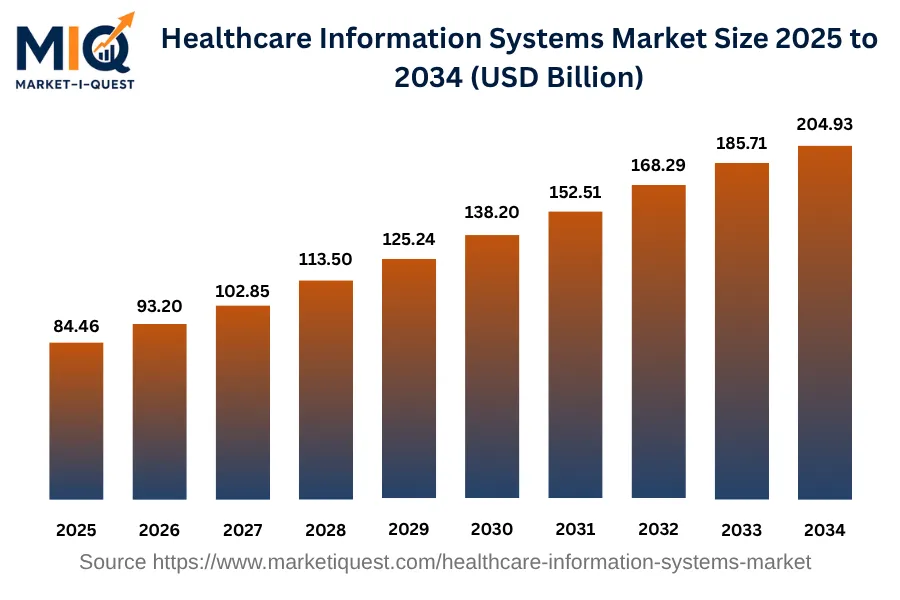
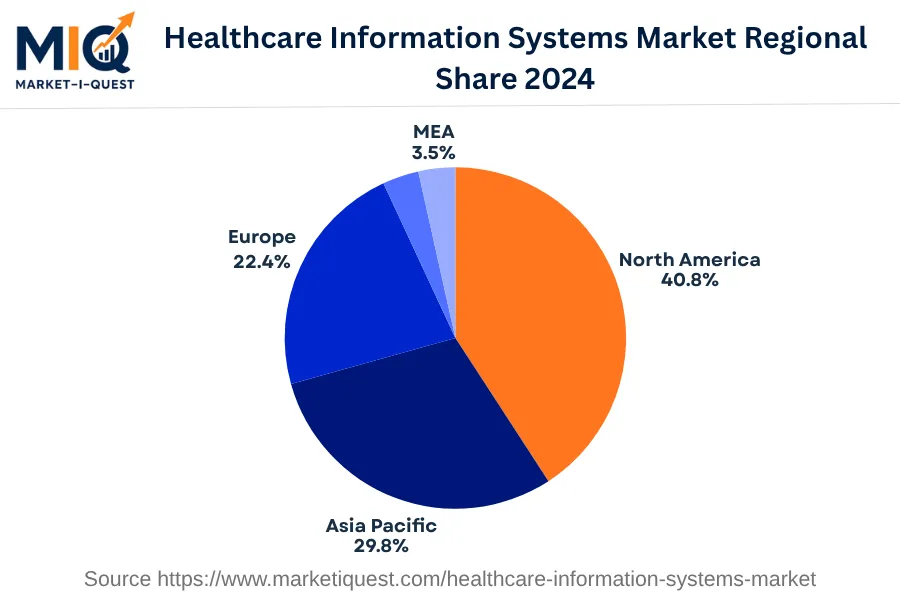
The Healthcare Information Systems Market was valued at USD 76.54 billion in 2024, grew to USD 84.46 billion in 2025, and is projected to reach USD 204.93 billion by 2034, expanding at a compound annual growth rate (CAGR) of 10.35%. This steady growth over the decade is attributed to technological advancements within the industry and a universal increase in demand for better, more efficient health information systems. The market's growth path from 2024 to 2034 is characterized by consistent expansion, catalyzed by a digital transformation in the healthcare sector and greater emphasis on patient-centric care models. In terms of regional market shares in 2024, North America held the largest share at 40.82%, followed by Asia Pacific at 29.84%, Europe at 22.41%, while LATAM and MEA held 3.44% and 3.49% respectively.

Key Takeaways

  • By Component - Hardware led the market with a dominating share.
  • By Application - Electronic Health Records(EHR) held the largest market share in 2024.
  • By Deployment - web-based solutions experienced the fastest growth with a notable expansion rate.
  • By End Use - Hospitals accounted for the largest market share in 2024.
healthcare-information-systems-market market size

Key Driving Factors

Implementation of Strict Regulatory Standards for Patient Data Security

Healthcare information systems are benefitting from a push toward more stringent data security regulations pertaining to patient information. Laws such as the Health Insurance Portability and Accountability Act (HIPAA) in the U.S., requiring the secure handling of protected health information, are encouraging healthcare providers to shift toward advanced information systems. These systems often offer enhanced data security features, helping establishments regularly comply with these legislations, while simultaneously improving the overall quality of patient care. Healthcare centers can avoid hefty fines linked with data breaches by properly using these systems. The necessity to meet regulatory compliance, thus, stands as a significant driving factor in the adoption of these products.
Integration of AI and Machine Learning in Healthcare Systems

The integration of artificial intelligence (AI) and machine learning (ML) algorithms into healthcare information systems is becoming increasingly prevalent. AI and ML improve the efficiency and accuracy of patient data analysis, enabling healthcare professionals to make quicker, better-informed clinical decisions. Specifically, AI-equipped healthcare systems can predict patient health outcomes, aid in diagnosing diseases, and optimize treatment plans. Furthermore, ML algorithms can analyze large volumes of health data to identify patterns, trends and correlations, offering meaningful insights for boosting patient care. Therefore, the growing integration of AI and ML in healthcare systems is a discernible driving factor in the healthcare information systems market.

Market Evolution by Timeline

2019-2023
Public & private hospitals were primary buyers in North America & Europe due to compulsory electronic health record implementation and HIPAA requirements. On the supply side, cloud-based solutions & AI-powered analytics software witnessed increased adoption. Healthcare systems like AthenaHealth & Epic Systems saw growing integrations with hospitals. Regulating policies, such as Meaningful Use and MACRA, were driving factors for adoption. A trend of pricing based on patient volume cropped up. Typical contracts involved long-term partnerships with vendors such as agreements between Cerner & DHHS. Challenges such as data security & interoperability issues arose, but major vendors addressed them by strengthening security measures & advocating for the adoption of FHIR standards.
2024
In 2024, Asian markets, specifically India & China started using healthcare information systems to improve patient care & hospital administration. The supplies saw an expansion to include IoT devices. A standard framework called Fast Healthcare Interoperability Resources (FHIR) was being adopted for better interoperability. Government regulations requiring digital healthcare records increased. Partnerships between hospitals & vendors were common, with a standard procedure of profit-sharing. Data security risks still remained a key area of concern, even though many developers were using HIPAA-compliant hosting providers to mitigate the risks.
2025-2029
Demand for healthcare information systems surged in Africa & South America driven by a need for improved healthcare delivery systems. Touchless systems & blockchain in health information systems have seen significant developments. The World Health Organization started the 'Global Digital Health Initiative' to regulate & harmonize digital healthcare systems globally. Value-based pricing model grew in popularity, fostering more partnerships with organizations like Partners HealthCare and Meditech. Challenges such as setting up robust infrastructure & training healthcare staff were identified, but were typically addressed through government-funded projects & partnerships.
2030-2034
Internet Hospitals i.e. online healthcare service providers became primary buyers, especially in China. The industry saw adoption & shipment of predictive healthcare systems powered by Machine Learning & Big Data. With regards to regulation, by 2034, the 'Global Digital Health Initiative' standards were largely adopted globally. Fee-for-service model saw resurgence. Major healthcare providers saw benefits in forming consortiums for procuring healthcare information systems. The prime area of concern that surfaced was AI & ML's transparency & ethical issues. To handle this, there was a concerted effort towards creating AI ethics frameworks.

Future Market Outlook

Future Opportunities

Future opportunities in the Healthcare Information Systems Market are closely linked to ongoing advancements in artificial intelligence (AI) and machine learning applications. In 2023, companies like IBM have been advancing AI-driven analytics platforms designed to improve diagnostic accuracy and operational efficiency within clinical settings. The urgency for remote patient monitoring solutions has surged following the COVID-19 pandemic, with firms like Philips expanding their connected health technologies to address chronic disease management. Furthermore, interoperability initiatives spearheaded by organizations such as the Health Level Seven International (HL7) are paving the way for enhanced data sharing across platforms and improving continuity of care. As cyber threats remain a concern, regulatory bodies like the National Institute of Standards and Technology (NIST) are developing cybersecurity frameworks specifically tailored for healthcare, prompting investments in secure healthcare systems. Additionally, the growing emphasis on patient-centered care is driving the need for user-friendly interfaces within healthcare information systems, spurring opportunities for companies that innovate in user experience design. As healthcare organizations increasingly adopt value-based care models, the integration of data analytics into decision-making processes is anticipated to expand, providing further opportunities for system providers. In summary, these trends indicate a conducive environment for technological enhancements, driven by regulatory frameworks, patient needs, and emerging technologies.

Segmentation Analysis

By Component

The market is divided into subsegments including Software, Hardware, and Services. Of these, Hardware accounted for the largest revenue share while Services is expected to grow at the fastest CAGR during the forecast period.

Largest Revenue Share

Hardware

Market Share Leader

Rising at the forefront of revenue generation in this segment is Hardware, driven by its inherent nature as a veritable cornerstone of operations across industries. Hardware - be it in the form of physical servers, workstations, networking devices, or storage equipment - forms the backbone of information technology. As a critical foundation for both Software and Services, it enjoys demand in direct proportion to the proliferation of technological infrastructure. It is propelled by a mix of end-user demand, chiefly from data centers, telecommunications, and consumer electronics sectors, each competitively advancing in response to growing consumer and business digital needs. Geographically, the robust growth markets like APAC and North America contribute significantly due to their fast-paced urbanization and keen technology adoption trends. Another key driver is the regulatory push towards digitalization across sectors and the consequent rise in organizational IT budgets. Buyers prioritize reliability, scalability, and interoperability of hardware while making purchasing decisions, prompting vendors to invest in research and improvement of product offerings. With limited scope for switching due to substantial initial investments and compatibility issues, channels leverage long-term contracts, strengthening the revenue landscape.

Fastest CAGR

Services

Forecast Period Growth Leader

Whilst Hardware leads in terms of sheer revenue, Services is projected to be the fastest growing segment. Key drivers stem from a global shift towards digitalization, coupled with the inherent complexity of IT, which fuels demand for technical support, consulting, training, and installation Services. Businesses increasingly favor outsourcing these requirements to specialist service providers to enhance operational efficiency and glean strategic advantage. Reliance on advanced technologies such as AI and automation further fuels this trend. On the obstacles front, adoption barriers could arise from issues like data security concerns and a hesitation to externalize key processes, especially pertinent for sectors dealing with sensitive data. However, green shoots of partnerships seen in the landscape, between service providers and organizations, can potentially address these issues. Moreover, policy-induced pushes towards digitalization, increased capital expenditure on IT, and the rising prevalence of tech solutions like cloud computing are set to catalyze the segment's growth. It's pertinent to note the risk of an economic downturn or a tightening of organizational IT budgets could impact growth trends in the near term.

By Application

In terms of application, the market is subdivided into Electronic Health Records (EHR), Laboratory Information Systems (LIS), Radiology Information Systems (RIS), and Pharmacy Information Systems (PIS). Of these, EHR accounts for the largest revenue share, while LIS is projected to grow at the fastest rate during the forecast period.

Largest Revenue Share

Electronic Health Records (EHR)

Market Share Leader

Electronic Health Records (EHR) claims the largest share of the revenue in the base year 2024. Driving this is the increasing need for streamlined and efficient patient care. EHR systems digitally store patient information such as medical history, diagnoses, medications, treatment plans, allergy information, and more. This allows for enhanced coordination and management of patient care. Additional support comes from government regulations that advocate for the adoption of digital records within healthcare institutions to improve patient outcomes. In recent years, the Affordable Care Act has incentivized the use of EHR, pushing healthcare providers to adopt these systems. Moreover, EHRs contribute significantly to cost savings by reducing redundancy of tests, improving the accuracy of diagnosis, and reducing medical errors. The high switching costs associated with implementing a new health record system solidify the position of EHRs.

Fastest CAGR

Laboratory Information Systems (LIS)

Forecast Period Growth Leader

Laboratory Information Systems (LIS) is forecasted to grow at the fastest CAGR during the projected period. The primary growth drivers for LIS are the increasing demand for high-quality diagnostic services, the rising prevalence of chronic diseases, and the mounting pressure on healthcare organizations to improve operational efficiency. LIS offers automation and streamlining of complex processes within the diagnostic laboratories, reducing the potential for human error, enhancing productivity, facilitating regulatory compliance, and ultimately, leading to better patient outcomes. However, challenges such as high costs of implementation and a lack of skilled IT professionals in the healthcare sector may hinder adoption rates. Despite these potential barriers, strategic partnerships and increased capital expenditure within healthcare IT are anticipated to improve the prospects for LIS adoption and drive its rapid growth.

By Deployment

The market is divided into subsegments including On-Premises, Cloud-Based, and Web-Based solutions. In 2024, Cloud-Based solutions accounted for the largest revenue share, while Web-Based solutions are expected to grow at the fastest CAGR during the forecast period.

Largest Revenue Share

Cloud-Based

Market Share Leader

Cloud-based solutions have emerged as the dominant revenue contributors due to a myriad of factors. The growth is largely driven by enterprises' need to lower physical infrastructure costs, enhance scalability, and improve business agility. These solutions enable businesses to avoid expenditure on hardware, setup, and maintenance, proving to be cost-effective in the long run and leading to high adoption rates among both SMEs and large corporations. Geographic location becomes irrelevant as these services provide remote access to data, enhancing convenience for multinational companies and remote workers. A spurt in digital transformation strategies across various industries has also augmented the demand for cloud-based solutions. Regulatory compliance regarding data security and privacy management is another vital factor contributing towards their revenue dominance, as these solutions typically adhere to stringent security measures, alleviating concerns of data breaches.

Fastest CAGR

Web-Based

Forecast Period Growth Leader

Web-based solutions are slated for accelerated growth in the upcoming years, underlined by several driving forces. These solutions are platform-independent and offer accessible user interfaces, requiring no software installation, subsequently lowering the entry barriers with minimal upfront costs. These attributes, combined with the ease of updates and scalability, make them particularly attractive to start-ups and SMEs. Advancements and investments in web technologies and broadband capacities are creating a conducive environment for increased adoption. Strategic partnerships and collaborations between solution providers and businesses are expected to amplify the growth pace as these cater to specific industry needs. Despite this, there remain risk factors relating to data security and internet dependency which developers will need to assuage for sustained momentum in this subsegment's growth.

By End Use

The market is divided into subsegments including Hospitals, Ambulatory Care Centers, Diagnostic Laboratories, and Pharmaceutical Companies. Hospitals accounted for the largest revenue share while Diagnostic Laboratories are expected to grow at the fastest CAGR during the forecast period.

Largest Revenue Share

Hospitals

Market Share Leader

The 'Hospitals' subsegment of our market reports the highest revenue share. One crucial driver of this trend is the consistent, round-the-clock patient intake and demand for various services offered by hospitals — expanding their revenue sources. As they cater to a wider demographic and multispeciality needs, these institutions are naturally privy to more substantial financial turnover. The regulatory environment also encourages revenues for this subsegment, with government and private insurance payments for hospital treatments compensating on a larger scale. The geographic location further influences revenue, as hospitals located in populous areas tend to have higher patient influx thereby directly contributing to increased income. Lastly, hospitals traditionally have greater purchasing capacity due to their size, enabling them to buy in bulk and negotiate better deals from suppliers. Switching costs are also high for hospitals as changing suppliers or products involves significant cost and effort, thus stabilizing their revenue stream.

Fastest CAGR

Diagnostic Laboratories

Forecast Period Growth Leader

Among other subsegments, Diagnostic Laboratories are expected to witness the fastest growth in terms of CAGR. The primary drivers for this growth include an increase in awareness and need for early diagnosis, advancements in diagnostic technology, and greater focus on preventive healthcare. Despite such potential, adoption barriers exist in the form of stringent regulatory policies and capital expenses required for advanced equipment. Yet, the advent of novel diagnostic technologies has substantially catalyzed the growth of this subsegment by offering more accurate, reliable, and quicker results. Similarly, partnerships between diagnostic labs and hospitals or ambulatory care centers have also aided in overcoming adoption hurdles by sharing resources and expertise in a mutually beneficial arrangement. However, one must consider near-term risks such as any changes to regulations or insurance claim policies that could temporarily stall the growth of this fast-paced subsegment.

Competitive Analysis

Key Market Players

Manufacturers / OEMs

Cerner Corporation
US
McKesson Corporation
US
GE Healthcare
US

Key Suppliers & Raw Materials

IBM
US
Epic Systems Corporation
US
Allscripts Healthcare Solutions, Inc.
US

Distributors, Integrators & Channel Partners

Siemens Healthineers
Germany
Oracle Corporation
US
Philips Healthcare
Netherlands

Porter’s Five Forces Analysis

Analysis of the competitive dynamics within the Healthcare Information Systems Market.

Supplier Bargaining Power

Medium

Balance exists due to the specialized nature of products but high number of potential suppliers.

Buyer Bargaining Power

High

Buyers, mainly healthcare providers, demand high-quality and reliable systems creating competitive pressure.

Threat of Substitutes

Low

The complexity and regulatory requirements limit the availability of substitute products.

Threat of New Entrants

Low

High entry barriers due to regulation, R&D costs, and complex technology.

Competitive Rivalry

High

Intense competition among established firms focused on technological innovation and service quality.

Regional Analysis

Geographic market dynamics and growth opportunities across key regions

Global Market Outlook

healthcare-information-systems-market market regional share

North America

The Healthcare Information Systems market in North America in 2024 demonstrated a remarkable development, driven by various factors and reflecting evolving trends. Digital adoption acceleration in the healthcare sectors comprising hospitals, private practices and government health agencies was spurred by supportive policies such as the American EHR Incentive Program. Telehealth advancements further enhanced the system’s demand, catering to remote patient monitoring needs. Additionally, burgeoning private investment in health technology start-ups significantly propelled market growth. Market trends illuminated a shift towards cloud-based systems, driven by the need for cost-effectiveness and efficient data management. There was an evident rise in strategic partnerships among major players like Epic Systems, aimed at integrating diverse information systems for seamless data exchange. Patient-centric complemented by regulatory compliance such as Health Insurance Portability and Accountability Act (HIPAA) emerged as priority areas, influencing system design and functionality.

In terms of sectors, enterprise clients like hospital networks dominated the market, underpinned by a surge in the adoption of integrated systems. However, public health agencies also actively implemented these systems, empowered by federal and state-level digitization drives. Lastly, an increased focus on personalized patient engagement strategies marked a significant change in buyer behaviour, with more demand for systems offering advanced patient portal functionalities.

Asia Pacific

In 2024, the Asia Pacific Healthcare Information Systems (HIS) market charted significant growth as key stakeholders digitized their infrastructures. Drivers for this expansion included government regulations such as China's New Medical Reform which urged healthcare providers to embrace digital health solutions, increased investment in healthcare by India and ASEAN markets, and the rapid adoption of technology in Japan and South Korea. Reduced supply chain inefficiencies and cost-effective pricing also propelled HIS's popularity. Simultaneously, buyer behavior shifted towards digital-first services with a focus on Electronic Health Records and telemedicine. Telemedicine platforms emerged as key channels in Australia due to remote areas' healthcare delivery, while Japan witnessed increased partnerships between tech giants and healthcare providers to offer comprehensive HIS solutions. South Korea enforced stringent data protection policies, hence providers aimed to adhere to these standards, influencing the market's trend.

The HIS market implementation spanned across government hospitals, private healthcare providers, and healthcare-focused tech enterprises. Despite its broad scope, individual market characteristics influenced each country. For instance, an enterprise-driven market was observed in China and India, while government-led HIS adoption was prevalent in Japan and Australia. This dynamic market scenario underscored the crucial role of country-specific regulations and initiatives in shaping the healthcare digitization narrative of the Asia Pacific region in 2024.

Europe

In 2024, the Healthcare Information Systems (HIS) market in Europe continued to be a significant sector of the region's healthcare industry. Bolstered by a confluence of drivers, including robust investment in digital health infrastructure by countries like Germany and the United Kingdom, increased digitization in healthcare across France and Italy, and stricter patient data protection regulations, such as the General Data Protection Regulation (GDPR), the HIS market further expanded. Alongside, the rapid adoption of cloud-based systems and telemedicine, compelled by the urgency of integrated care, became an essential feature of this growth.

The key trend defining the market in 2024 was the heightened demand for electronic health record (EHR) systems from enterprise sectors, with healthcare providers increasingly prioritizing efficient, digitized patient care. Additionally, a surge in partnerships and mergers among major HIS companies in the Benelux and Nordic regions — aimed at enhancing their data analysis capabilities — began to transform market dynamics. Furthermore, governmental policy enforcement supporting digital health transformation took center stage in Spain and Central & Eastern Europe, reinforcing the shift towards more efficient healthcare. Thus, investment, regulation enforcement, and technology adoption clearly emerged as the primary drivers of the HIS market in Europe in 2024, reshaping the landscape with an emphasis on digital health solutions.

Latin America

In 2024, the Healthcare Information Systems market in Latin America was characterized by a strengthening digital infrastructure and rising healthcare awareness. Key market drivers included the surge of telemedicine adoption in Brazil due to the COVID-19 pandemic, Argentina's increased investment in healthcare digitalization, and Mexican medical organizations' prioritization of transforming legacy systems into Electronic Health Records (EHR). Moreover, Colombia's proactive policy enforcement for data protection in digital healthcare has amplified market demand. Trends in the region encompassed a shift towards cloud-based solutions in Chile owing to their affordability and scalability. Additionally, Peru's healthcare industry exhibited a significant trend toward data analytics usage to improve patient care outcomes. Partnerships and Mergers & Acquisitions were also prominent, with multinational healthcare technology companies partnering with local enterprises for better market penetration. An example of this was seen in Brazil, where local hospitals collaborated with foreign tech enterprises to modernize their systems.

The customer base was primarily made up of government health departments, private hospitals, clinics, and healthcare-focused tech companies. These sectors sought to improve patient-care quality, data accessibility, and operational efficiency through the adoption of advanced Healthcare Information Systems. Consequently, the LATAM Healthcare Information Systems market in 2024 was fundamentally driven by technological innovation and emphasis on better healthcare provisions.

Middle East & Africa

In 2024, the Healthcare Information Systems Market in the Middle East and Africa exhibited significant expansion. Drivers included increased investment in healthcare infrastructure in countries like Saudi Arabia and UAE, prolific adoption of advanced technologies such as Electronic Health Records (EHR) in Israel, South Africa, and Nigeria, and stringent healthcare regulations in Egypt and Qatar, demanding more sophisticated data management systems. Availability of cost-effective solutions provided by local vendors, coupled with government support, boosted supply dynamics across the region.

Trend wise, buyer behavior demonstrated a shift towards integrated systems offering end-to-end healthcare management. This was particularly visible in the large-scale hospitals and clinics in the major cities of these countries. The adoption of cloud-based healthcare systems also saw a significant increase due to its accessibility and cost-effectiveness. Furthermore, strategic partnerships and acquisitions became prominent, as exemplified by the increased venture capital involvements in the Kenyan and South African healthcare tech sector. Policy enforcement on data privacy and interoperability standards also shaped the landscape, with governments in Saudi Arabia and UAE implementing robust cybersecurity regulations. The markets in these geographies showed progressive openness to technological integration, a prospect promising beneficial transformations in their healthcare sectors.

Recent Industry Developments

Latest market innovations, product launches, and strategic initiatives

July 2026

Frazier Healthcare Partners entered into a definitive agreement to acquire MatrixCare, Inc., a provider of EHR systems to the long-term post-acute care industry. MatrixCare serves more than 15,000 providers across skilled nursing, senior living, home health, and hospice care. The transaction is expected to close during Q3 2026.

August 2025

Oracle Health launched its next-generation AI-powered EHR designed as a voice-first solution with embedded AI agents. The platform leverages Oracle Cloud Infrastructure and integrates multimodal voice and screen interactions, enabling clinicians to dictate commands, retrieve patient data, summarize notes, and receive AI-assisted clinical recommendations.

Frequently Asked Questions