Healthcare Analytics Market Snapshot

Key Players

  • Cerner Corporation (US)
  • McKesson Corporation (US)
  • IBM Watson Health (US)
  • Optum Inc. (United States)
  • Oracle Corporation (US)
  • Siemens Healthineers AG (Germany)
  • Philips Healthcare (Netherlands)
  • MedeAnalytics Inc. (US)
  • Change Healthcare (US)

Market Size

Base Year 2024
$43.96 Bn
CAGR
20.85%
Forecast 2034
$292.10 Bn

Market Segments

By Component
  • Software
  • Hardware
  • Services
By Application
  • Predictive Analytics
  • Descriptive Analytics
  • Prescriptive Analytics
  • Mobile Health Analytics
By End Use
  • Healthcare Providers
  • Payer Organizations
  • Pharmaceutical Companies
  • Research Institutions

Market Dynamics

Drivers
  • Rising chronic disease prevalence
  • Increasing digital healthcare adoption
Restraints
  • High cost of implementation
  • Data privacy concerns
Opportunities
  • Increasing patient data volume
  • Advancements in healthcare IT technology

Market Size

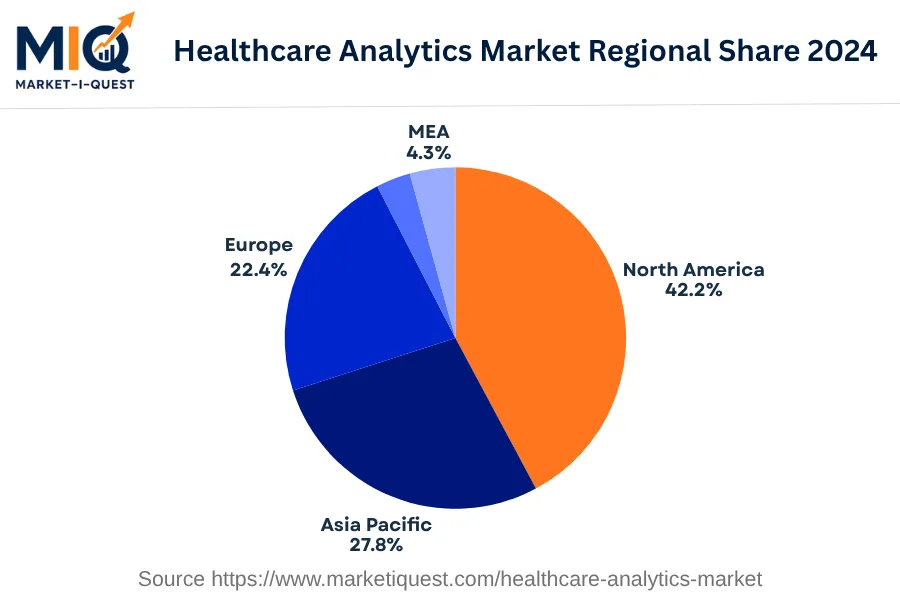
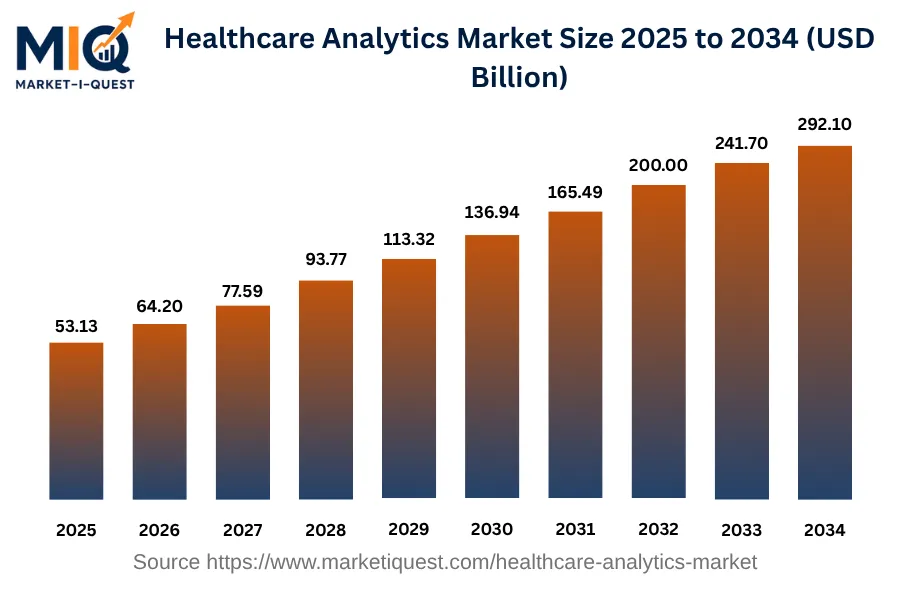
The Healthcare Analytics Market size is projected to increase from USD 53.13 billion in 2025 to USD 292.10 billion by 2034, growing at a Compound Annual Growth Rate (CAGR) of 20.85%. This expansion denotes a remarkable surge in the market from the USD 43.96 billion reported in 2024. A series of steps or milestones illustrate this growth path. In particular, the generous market size of USD 53.13 billion in 2025 shows the solid starting point, which then leaps significantly over the period to the large scale of USD 292.10 billion in 2034, an indicator of consistent, steep growth. In terms of regional share, North America accounted for the largest segment with 42.18% in 2024, followed by Asia Pacific with 27.84%, Europe with 22.41%, the Middle East & Africa (MEA) with 4.31%, and finally, Latin America (LATAM) with 3.26%.

Key Takeaways

  • By Component - Hardware held a dominant position in the Healthcare Analytics Market in 2024.
  • By Application - Mobile Health Analytics emerged as the fastest growing segment with a in the forecast period of 2025-2034.
  • By End Use - Healthcare Providers led the market accounting for a significant share in 2024.
healthcare-analytics-market market size

Key Driving Factors

Implementation of Value-Based Care Models

Value-based care models are gaining significant momentum in the healthcare industry as a way to enhance patient satisfaction and reduce costs. These models necessitate measuring and monitoring patient outcomes, driven by meticulous data analysis. As a result, healthcare organizations, from small clinics to large hospital systems, are looking to healthcare analytics to generate actionable insights. The application of analytics helps in predicting health outcomes, identifying high-risk patient cohorts, and understanding the effectiveness of various treatments. Thus, the widespread adoption of value-based care models is contributing to the expansion of the healthcare analytics market.

Adoption of Electronic Health Records

The move towards digital transformation in the healthcare sector has been a major driver for the use of healthcare analytics. A critical component of this is the adoption of Electronic Health Records (EHRs). EHRs contain a wealth of data about patients, including their medical history, medications, allergies, and test results. The increasingly widespread use of EHRs has generated large volumes of structured and unstructured data that can be analyzed to improve patient care and operational efficiency. However, effectively leveraging this data requires sophisticated analytical tools. Therefore, the pervasive use of EHRs is stimulating the demand for healthcare analytics, leading to the growth of the market.

Market Evolution by Timeline

2019-2023
During this period, the demand for analytics in healthcare increased globally with developed countries like USA, Canada and Germany leading the market. There was increased use of analytics to predict health trends, improve patient care and enhance operational efficiency. The healthcare sector integrated analytics with electronic health records (EHRs) and wearable gadgets. The impediment was that the technology was not yet mature, and there were concerns about data security. Policy-wise, HIPAA standards regulated data mobility, affecting the adaptation of analytics in the USA. Commercially, upfront investment pricing model was the norm. Acquisitions and collaborations were common; for instance, Microsoft's purchase of Health Catalyst. The risk was patient data breaching leading to heavy penalties.
2024
Digital transformation was at the core of healthcare analytics. Machine learning (ML) helped in developing disease prevention models and improving diagnostics. China and India, sprouting in digital health technology, significantly contributed to the market with government programs like the 'National Digital Health Blueprint' (NDHB) in India facilitating the adaptation. In the US, interoperability rules affected data sharing among healthcare providers. Flat fee pricing model trended in the industry. Partnership between traditional healthcare providers and tech companies were reported; such as the partnership between IBM and Pfizer. Data privacy still remained a risk.
2025-2029
In these five years, healthcare analytics was utilized to track the prevalence and trends of diseases like cancer and diabetes. It was also used for clinical decision support systems. African region also adopted healthcare analytics driven by the increased internet penetration. Advanced analytics integration in EHR became standard. Policy-wise, GDPR influenced adoption of analytics in European region. Pay-as-you-go pricing model became popular. Alliances formed to promote information sharing like the 'Interoperability Alliance' formed by Cerner and Epic. Cyber-attacks on health data emerged as the significant risk.
2030-2034
Predictive analytics took the center stage with genomics and personalized medicine driving the demand. There is likely an increase in adoption by middle-income countries like Brazil and Indonesia. Artificial Intelligence (AI) was fully integrated into healthcare. Typically, restrictions on AI usage regulated by programs like 'AI in Health Act' in US and AI regulations in EU affected the commercialization of healthcare analytics. More organizations followed the subscription pricing model. Big tech giants dominated the market by acquiring startup analytics companies. The main risk was AI misuse or bias leading to unfair treatment or diagnosis.

Future Market Outlook

Future Opportunities

As healthcare systems worldwide grapple with the surge in data, the demand for advanced analytics solutions is set to grow, particularly in regions facing resource constraints. For instance, the World Health Organization has indicated that low- and middle-income countries in Africa will need robust data analytics tools to manage public health crises effectively, as evidenced by the analytics-driven response to the Ebola outbreak in West Africa in 2014. Moreover, the increasing focus on value-based care in the U.S. incentivizes providers to harness analytics for improving patient outcomes while controlling costs, spurred by the Centers for Medicare & Medicaid Services' initiatives since 2020. The rising prevalence of chronic diseases creates a further need for patient monitoring solutions, highlighted by Philips' launch of its remote patient monitoring platform in 2023. Furthermore, the ongoing integration of telehealth is driving the growth of analytics applications that assess patient engagement and treatment adherence; for example, Teladoc Health's analytics capabilities have expanded since 2021 to accommodate large-scale remote consultations. Finally, regulatory frameworks, such as the European Union's General Data Protection Regulation enacted in 2018, continue to shape data usage in healthcare, prompting the development of tools that comply with privacy standards while enabling insightful analytics.

Segmentation Analysis

By Component

The market is divided into subsegments including software, hardware, and services. Hardware accounted for the largest revenue share while services are expected to grow at the fastest CAGR during the forecast period.

Largest Revenue Share

Hardware

Market Share Leader

In the base year 2024, the hardware subsegment led in terms of revenue share, corroborating common industry logic. This prominence can be attributed to various factors. Hardware forms the backbone of the segment as it comprises tangible parts of any system, hence emerging as a significant revenue generator. End-users, including businesses and consumers, frequently update and replace their hardware components based on technological advancements, ensuring constant demand. Regulations governing the sector typically do not present significant barriers to the hardware trade, further cementing its pivotal position in the market. Moreover, a higher purchasing capacity owing to extensive geographical reach and the necessity factor among a broader range of customers foster the growth of hardware sales. Switching costs also contribute to the substantial revenue share as end-users are often reluctant to shift to alternative products after investing significantly in specific hardware. All these factors combined suggest a solid reason for the hardware subsegment securing the top position in terms of revenue.

Fastest CAGR

Services

Forecast Period Growth Leader

While the hardware subsegment leads in terms of revenue, the services subsegment is expected to register the fastest CAGR in the coming years. The rising demand for implementation, maintenance, and support services due to increasing complexity in software and hardware is the key driver of this growth. The industry's growth also faces barriers, notably the technological proficiency required to avail such services and the initial high capital expenditure, which may deter small and medium enterprises. However, strategic partnerships and evolving technologies present promising growth catalysts. For instance, collaborations with tech giants for cloud-based services provide small businesses with a cost-effective alternative. Technological advancements further open up the potential for new services such as AI, blockchain, or cloud computing. The journey will not be without its bumps. A potential near-term risk is data and cybersecurity threats. Overall, the expansion of the market and the imperative need for different services place them on a faster growth trajectory.

By Application

The market is divided into subsegments including Predictive Analytics, Descriptive Analytics, Prescriptive Analytics, and Mobile Health Analytics. Descriptive Analytics accounted for the largest revenue share while Mobile Health Analytics is expected to grow at the fastest CAGR during the forecast period.

Largest Revenue Share

Descriptive Analytics

Market Share Leader

Descriptive Analytics is the principle subsegment in terms of revenue. This can be attributed to its broad adoption across industries. Descriptive Analytics tools play a crucial role in helping organizations understand past behaviors and learn how these might influence future outcomes. The need to make data-driven decisions has never been more pressing as more companies are implementing analytics into their operations. Meanwhile, geographical regions with mature markets like North America and Europe constitute the primary revenue contributors owing to the high concentration of businesses that heavily rely on data analysis for their operations. In addition, regulation and policies pertaining to data governance also stimulate the demand for Descriptive Analytics. Customers tend to prefer these analytics solutions due to their comprehensive insights, easy interpretability, and cost-effectiveness. Furthermore, the switching cost to other forms of analytics is substantial, making deselection unlikely.

Fastest CAGR

Mobile Health Analytics

Forecast Period Growth Leader

Mobile Health Analytics is poised to be the fastest-growing segment. This is driven by an increasing focus on personalized healthcare and the growing penetration of smartphones and wearable devices. The technology acts as a catalyst, enabling real-time health monitoring and efficient decision-making. Despite the promising growth, adoption barriers exist, such as data security concerns and lack of technical expertise. However, strategic partnerships among health organizations and tech giants, along with significant capital expenditures in health tech, offer a positive outlook for the sub-segment. In addition, government policies favoring digital health initiatives can further drive adoption more rapidly. Thus, while near-term risks such as privacy concerns and uneven tech accessibility might pose challenges, the sector's overall growth prospects appear robust.

By End Use

The end use market is divided into subsegments including Healthcare Providers, Payer Organizations, Pharmaceutical Companies, and Research Institutions, among which Healthcare Providers accounted for the largest revenue share and Pharmaceutical Companies is expected to grow at the fastest CAGR during the forecast period.

Largest Revenue Share

Healthcare Providers

Market Share Leader

In 2024, Healthcare Providers held the largest revenue share in end use segment. The dominant position of this subsegment can be attributed to several factors. First, the critical need for effective and efficient health services leads to a surge in demand for advanced solutions, which directly generates revenue. Second, healthcare providers are the primary care centres, and thus, the primary purchasers of various goods and services. Locally, these providers are spread across urban and rural regions, increasing their footprint and, consequently, consumption. Additionally, in developed countries and regions investing heavily in health infrastructure and digital healthcare, these providers are turning to leading-edge technology and equipment to bolster medical processes, driving up expenditures. Finally, government regulations often necessitate updates and improvements in medical facilities and capabilities, making spending in this sector somewhat mandatory, thus ensuring a steady revenue stream.

Fastest CAGR

Pharmaceutical Companies

Forecast Period Growth Leader

The subsegment set to register the fastest growth in the forecast period is Pharmaceutical Companies. This can be ascribed to the increasing impetus on research and development activities in the pharmaceutical industry. Companies are racing to create novel drugs and therapies to meet the demand from an ever-growing array of health challenges. Advances in technology are enabling faster and more efficient drug discovery and testing processes, hence encouraging more investments. Moreover, pharmaceutical companies are becoming more involved in precision medicine, necessitating them to upgrade their tools and technologies to support genomics, proteomics, and bioinformatics. Regulatory bodies are promoting this growth by fast-tracking approval processes for new drugs, thereby incentivizing higher spending in the sector. However, it is imperative to note the potential risks. Any changes to regulatory compliance or sudden technological disruptions might affect the growth trajectory.

Competitive Analysis for Healthcare Analytics Market

Key Market Players

Core Manufacturers / OEMs

IBM
US
Oracle Corporation
US
Microsoft
US

Key Suppliers & Raw Materials

Google Cloud
US
Amazon Web Services
US
Salesforce
US

Distributors, Integrators & Channel Partners

Epic Systems Corporation
US
Cerner Corporation
US
McKesson Corporation
US

Porter’s Five Forces Analysis

This analysis uncovers the competitive intensity and attractiveness of the Healthcare Analytics Market.

Supplier Bargaining Power

Medium

There is substantial technological competency required, creating moderate supplier power.

Buyer Bargaining Power

Medium

Buyers have moderate power due to the increasing need for healthcare analytics in decision-making.

Threat of Substitutes

Low

Low threat as healthcare analytics solutions are unique and hard to substitute.

Threat of New Entrants

Medium

Entrance barriers exist due to data privacy regulations and high initial investment.

Competitive Rivalry

High

High market growth rates and numerous competitors create intense rivalry.

Regional Analysis

Geographic market dynamics and growth opportunities across key regions

Global Market Outlook

healthcare-analytics-market market regional share

North America

In 2024, the North American healthcare analytics market experienced significant evolution due to the intertwined effects of technological advancement, policy changes, and healthcare demands. The market was primarily driven by the growing need for improved patient outcomes, cost reduction initiatives, and healthcare regulatory requirements. The increased adoption of electronic health records (EHRs) in the U.S., Canada, and Mexico was instrumental in propelling engagement with healthcare analytics. Rapid technological advancements in big data and artificial intelligence significantly contributed to improved efficiency in healthcare services, propelling demand. Investment in healthcare analytics technologies saw a substantial increase, primarily fueled by the need for real-time data analysis to inform healthcare decisions.

Emerging trends included the heightened use of predictive analytics by healthcare providers for personalized treatment plans. The market saw a shift towards cloud-based analytics solutions attributable to their scalability and cost-effectiveness. Mergers and acquisitions were a significant trend, with companies aiming to broaden their capabilities and geographical reach. Increased policy enforcement around patient data confidentiality and cybersecurity was noted, paralleling the rise in digital solutions. Sectors primarily engaged with healthcare analytics included government-led health initiatives, healthcare providers, insurance providers, and pharmaceutical companies, reflecting the broad spectrum of need for data-driven insights in health management initiatives.

Asia Pacific

In 2024, the Healthcare Analytics market in Asia Pacific experienced notable growth, particularly in China, India, Japan, South Korea, Australia, and key ASEAN markets. Drivers such as rising demand for improved patient outcomes, increased regulation favoring digitization and data transparency in healthcare, and expanding investment in health IT infrastructure contributed. Additionally, widespread adoption of advanced technologies like AI and machine learning, alongside affordable pricing, significantly boosted the market. Market trends were primarily shaped by shifts in buyer behavior, due to increased data-driven decision making within healthcare enterprises and government initiatives encouraging such practices.

Emergence of collaborative, data sharing partnerships between companies, along with a sharp increase in M&A activities were observed. This was largely fueled by the recognition of analytics as a key driver of competitive advantage in service delivery, drug discovery, patient care, and in thwarting healthcare fraud. The prevalence of analytics in retail too was significant, improving operational efficiencies and consumer engagement. Stringent policy enforcement spotted, with governments pushing for robust health data governance models ensuring data integrity, privacy, and security. Moreover, new health policies in countries like China and Australia chiefly focused in digitizing their healthcare systems, catalyzing the growth of healthcare analytics market in 2024.

Europe

The Healthcare Analytics Market in Europe in the base year 2024 represented a significant and evolving sector impacted by numerous driving factors and trends. In predominantly centralized healthcare systems like Germany, the UK, France, Italy, Spain, the Nordics, Benelux, and Central & Eastern Europe, demand was driven by increasing patient populations and the necessity for cost-effective healthcare solutions. Accelerating technological adoption, notably in predictive and prescriptive analytics, further stimulated growth. Regulatory impetus, such as the General Data Protection Regulation (GDPR) and increased investment in healthcare infrastructure also catalyzed market expansion.

Trends within this period show an increase in strategic partnerships and M&A for expanding product portfolios and geographic reach; for instance, Siemens Healthineers acquiring Varian Medical Systems to strengthen its oncology portfolio. There was a marked shift towards cloud-based analytics platforms allowing real-time access to health data. Increased emphasis on patient-oriented care and privacy concerns shaped policy enforcement, affecting how data was used and shared. In sectors like retail, improving demand forecasting and inventory management were key applications of healthcare analytics. The influence of these drivers and trends paints a picture of a dynamic Healthcare Analytics Market in Europe in 2024, powered by advanced technology, regulatory support, and shifting healthcare dynamics.

Latin America

In the base year 2024, the healthcare analytics market in Latin America exhibits robust growth, fueled by various demand factors and increased technological adoption. Key drivers include escalating healthcare costs in countries like Brazil and Mexico, necessitating the use of analytics to streamline operations and reduce expenses. Regulatory mandates in Argentina and Colombia advocating the use of electronic health records further propelled the market, making data more accessible and actionable. Braided with significant investments in digital infrastructure, especially in Chile and Peru, the circulation of cloud-based healthcare analytics solutions has markedly amplified.

Prevailing trends in the market encompass evolving buyer behaviors and significant shifts towards big data analytics. Providers, especially healthcare enterprises, have been gravitating towards predictive analytics to curtail readmission rates and enhance patient care. Mergers and acquisitions emerged as a norm for expanding product portfolios, for instance, the significant partnerships among healthcare providers, payers, and pharmaceutical companies. There was a strong move towards interoperability to facilitate seamless data exchange among health organizations leading to rigorous policy enforcement. Amidst all sectors, government use of healthcare analytics, for public health management, stood out, along with enterprises using analytics for risk management and fraud detection.

Middle East & Africa

In the base year of 2024, the healthcare analytics market displayed significant growth throughout the Middle East and Africa, driven by demand factors, regulatory frameworks, investment flows, and increased technology adoption. A rising demand for superior healthcare services triggered market expansion, especially in countries like Saudi Arabia and the UAE, backed by robust government support and heightened investment in healthcare infrastructure and technology. Strict regulations, particularly in Israel and South Africa, boosted the compliance with health data standards and privacy, emphasizing the importance of analytics in achieving this. Noteworthy market trends included a shift towards innovative technologies like Artificial Intelligence (AI) and Machine Learning (ML) in healthcare analytics, seen prominently in Egypt and Nigeria. This technology shift stirred up partnerships and merger and acquisition activities, heightening the overall market dynamics.

In line with this, substantial policy enforcement, including the adoption of the National eHealth Strategy in Kenya and Qatar, was instrumental in supporting digitization in the healthcare sector. This policy enforcement impacted the buyer behavior, resulting in an increased willingness to adopt healthcare analytics solutions from service sectors like government, oil and gas, utilities, telecom, healthcare, manufacturing, retail, and financial services. Conclusively, healthcare analytics in the Middle East and Africa showed a promising landscape in 2024, marked by rippling effects of dynamic regulatory environments and evolving technology trends.
Recent Industry Developments

Latest market innovations, product launches, and strategic initiatives

June 2026

Clarify Health acquired patient activation platform Loyal Health Holdings, creating a closed-loop network intelligence platform that identifies patient care needs, connects them with providers, and measures outcomes.

January 2025

Clarivate launched DRG Fusion, a modular analytics platform to support commercial analytics in life sciences by integrating payer, provider, and patient data for real-time decision-making.

Frequently Asked Questions