
Electronic Health Records Market Snapshot

Key Players

  • Cerner Corporation (United States)
  • Epic Systems Corporation (United States)
  • Allscripts Healthcare Solutions (United States)
  • NextGen Healthcare (United States)
  • McKesson Corporation (United States)
  • Ge Healthcare (United Kingdom)
  • Siemens Healthineers (Germany)
  • CureMD (United States)
  • Eclinicalworks (United States)
  • Agfa Healthcare (Belgium)

Market Size

Base Year 2024
$54.82 Bn
CAGR
3.46%
Forecast 2034
$77.03 Bn

Market Segments

By Product
On-premise, Web & Cloud-based EHR
By Type
Acute, Outpatient, Post-Acute
By Business Model
Licensed Software, Technology Resale, Subscriptions, Professional Services, Others
By End Use
Hospital, Ambulatory Surgery Centers, Others

Market Dynamics

Drivers
  • Increasing healthcare digitalization
  • Government regulations and incentives
Restraints
  • High initial implementation cost
  • Data privacy concerns
Opportunities
  • Rising healthcare digitization
  • Increasing data breach incidents

Market Size

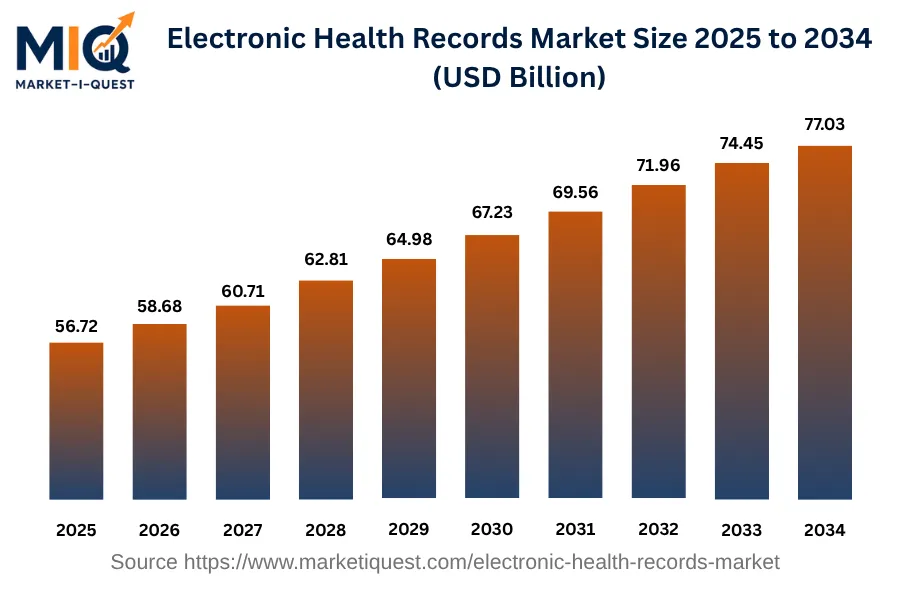
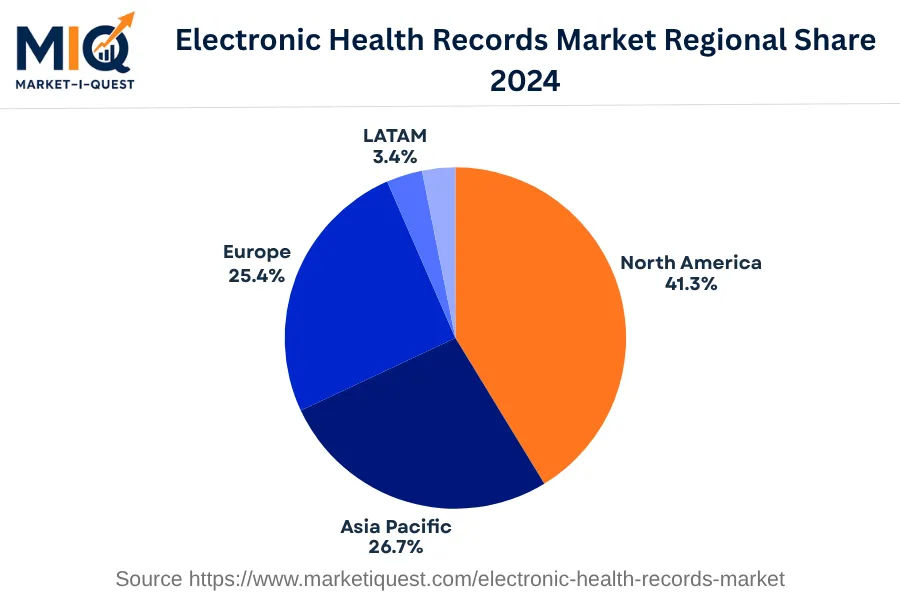
The Electronic Health Records Market was valued at 56.72 billion USD in 2025 and is predicted to reach a value of 77.03 billion USD by 2034, growing at a compound annual growth rate (CAGR) of 3.46%. This consistent growth can be observed in the journey from the market's size of 54.82 billion USD in 2024, incrementing steadily year over year, to its projected value about a decade later. Several factors could be contributing to this escalating growth, but no specific attributions can be made with the current set of data. Nevertheless, it's worth noting that regional market share varies. In 2024, North America held the largest share at 41.3%, followed by Asia Pacific with 26.7%, and Europe with 25.4%. The remaining regions, Latin America, and the Middle East and Africa, held lower shares of 3.4% and 3.1% respectively in the same year.

Key Takeaways

  • By Product - On-Premise EHR expanded with holding the significant share.
  • By Type - Acute led the market accounting for the highest share in the Electronic Health Records market.
  • By Business Model - Licensed Software held the majority share.
  • By End Use - Hospitals dominated accounting for the leading share.
electronic-health-records-market market size

Key Driving Factors

Implementation of Health Information Technology (HIT) Regulations in the U.S.

One pivotal driver for the Electronic Health Records (EHR) market is the enforcement of Health Information Technology (HIT) regulations in the U.S. Specifically, the Centers for Medicare & Medicaid Services (CMS) have proclaimed guidelines for 'Meaningful Use' of electronic health records, which aim to enhance health care quality, safety, and efficiency. Medical facilities must follow these standards to qualify for incentive payments. The drive to comply with these stringent regulations pushes health institutions to adopt EHR systems, contributing significantly to the market's expansion. By proving 'Meaningful Use,' providers demonstrate their commitment to improving quality, reducing disparaties, and enhancing patient engagement.
Proliferation of Chronic Diseases and Need for Streamlined Data Management

Another specific driving factor is the growing prevalence of chronic diseases worldwide and the subsequent need for successful data management. As more patients face long-term illnesses like diabetes and heart disease, the need for efficient, accurate, and quick access to patient records escalates. Using EHRs, health professionals can track patients' medical history, medications, and test results with a few mouse clicks, facilitating continuity of care across various settings. Therefore, the increase in chronic diseases and the inherent necessity for efficient patient data handling are driving the growth of the Electronic Health Records market.

Market Evolution by Timeline

2019-2023
During this period, hospitals were the largest buyer segment in the global Electronic Health Records Market, predominantly driven by the need to streamline health data record keeping and enhance patient care. North America dominated the market due to significant governmental investments such as the HITECH Act in the US, promoting the adoption of electronic health systems. The primary technological constraint was the difficulty in integrating disparate EHR systems. Policy-wise, The Office of the National Coordinator for Health Information Technology (ONC) introduced interoperability standards which companies had to adhere to. The commercial model was largely based on license-based purchases with annual or multi-year contracts. While data breaches posed risks, providers started implementing stringent encryption practices to counter them.
2024
In 2024, the adoption of EHR continued to surge globally, especially in North America and Europe, largely driven by hospitals and physicians' offices. The introduction of cloud-based EHR systems was widely acclaimed during this year, though concerns about data security and privacy remained. Advancements such as artificial intelligence and machine learning started to be integrated into EHR systems, improving functionalities and streamlining work processes. New rules under the 21st Century Cures Act began guiding vendor-consumer contracts to ensure increased interoperability and limit data blocking. Risks included hacking attempts and stringent GDPR regulations in Europe.
2025-2029
During this period, the Asia-Pacific region showed tremendous growth in the EHR market due to increased healthcare spending and advancements in healthcare IT infrastructure. There was a significant increase in adoption from clinics and outpatient facilities. The advanced EHR systems of this period offered improved functionalities and interoperability capabilities, with innovations such as predictive analytics that improved patient care. Regulatory changes included the introduction of stricter data protection and privacy laws. The EHR providers adopted new commercial models, shifting from a licensed-based model to a service-based model. The main risks during this period included issues of seamless data exchange among EHR systems.
2030-2034
The ubiquity of EHR in healthcare institutions was widely evident during this period. Seamless data integration was a reality with the rise of unified health IT ecosystem, facilitated by advanced compatibility standards. The Department of Health and Human Service's HIPAA compliance review was a typical policy directed towards maintaining data privacy and security. The standard commercial model now included both subscription and on-demand services with customized add-on services. Risks consisted of constant cybersecurity threats and the challenge of upgrading to new EHR versions alongside ensuring patient data safety.

Future Market Outlook

Future Opportunities

The ongoing emphasis on interoperability presents considerable future opportunities in the electronic health records market, especially following efforts such as the U.S. Office of the National Coordinator for Health Information Technology's 2022 Interoperability Standards Advisory. This initiative aims to push EHR vendors and healthcare providers towards systems that can seamlessly exchange data, facilitating better healthcare outcomes. As health data management continues to evolve, blockchain technology has emerged as a potential solution for ensuring secure and tamper-proof data sharing, with pilot projects being explored in countries like Estonia and the United Kingdom. Additionally, the recent push for personalized medicine has driven demand for EHR systems that can integrate genomic data, with significant work being done by companies like 23andMe in partnership with healthcare organizations. Furthermore, the increasing focus on patient engagement and self-management tools presents additional avenues for EHR systems to evolve; initiatives such as the Patient Empowerment program launched by the World Health Organization in 2022 set the stage for greater patient involvement. Mental health integration into EHRs is another area of growth, underscored by legislation such as the Mental Health Parity and Addiction Equity Act of 2008 in the U.S., which entails the inclusion of mental health data in standardized health records. These avenues illustrate potential pathways for innovation and development in the EHR market.

Segmentation Analysis

By Product

The market for product is divided into subsegments including On-premise, Web and Cloud-based EHR. Of them, On-premise accounted for the largest revenue share while Cloud-based EHR is expected to grow at the fastest CAGR during the forecast period.

Largest Revenue Share

On-premise

Market Share Leader

The On-premise segment is leading the market due to some key drivers. The healthcare industry has traditionally been cautious when it comes to changes, hence the inertia in adopting cloud-based solutions, consequently resulting in the higher revenues for On-premise solution. These solutions carry a perception of greater control over data and system as the data is located on devices within the organization. Moreover, the On-premise segment retains the significant share of revenue due to the higher expenditure associated with it. This includes capital expenditure of infrastructure, licensing costs, and in-house IT department costs. This is further reinforced by established relationships with existing On-premise vendors, making it difficult for institutions to migrate to cloud services due to potential switching costs and disruptions involved during transition. Lastly, healthcare regulations mandating high standards of data security also bolster this pattern, as organizations often feel on-premise solutions provide a better framework for compliance.

Fastest CAGR

Cloud-based EHR

Forecast Period Growth Leader

While the On-premise option secures the largest revenue slice, the growth leader is the Cloud-based EHR subsegment. This is powered by multiple factors, primarily the affordability of these options. Cloud-based solutions usually follow a subscription-based model which obviates the need for hefty upfront capital expenditure, making it an attractive proposition for healthcare institutions working under budget constraints. Additionally, the potential for scalability and flexibility offered by the cloud technology means it can accommodate growth and changing needs, further buttressing its robust growth outlook. The last few years have also seen significant improvements in cloud data security, partially allaying concerns about data breaches. However, the near-term adoption could meet resistance from staff unaccustomed to new technology, altering customer relationships, or regulatory hosepipes not adapted to cloud-based tecchnologies yet. Despite these potential barriers, the overall outlook for Cloud-based EHR is one of robust growth.

By Type

The market is divided into subsegments including Acute, Outpatient, and Post-Acute care, with the Acute care segment accounting for the largest revenue share while the Post-Acute care sector is expected to grow at the fastest CAGR during the forecast period.

Largest Revenue Share

Acute

Market Share Leader

The Acute care sector is the largest revenue-generator due to the sheer volume and urgency of services it offers. It often deals with patients experiencing severe illness or injury, escalating its operational importance within the healthcare ecosystem. Major drivers include a rising global geriatric population requiring immediate care, an uptick in chronic conditions, and increasing surgical interventions. Additionally, the regulatory environment encourages immediate, lifesaving undertakings, making this segment a priority for many healthcare organizations. Since acute care services usually require immediate attention, the purchasing criteria are based more on necessity and quality rather than price, contributing to robust revenue. Moreover, the high switching costs and need for specialized equipment fortify the substantial revenue stream. Although this sector is influenced by fluctuations in health policy, the constant demand for immediate medical attention solidifies its revenue leadership.

Fastest CAGR

Post-Acute

Forecast Period Growth Leader

The Post-Acute care sector gains traction due to increasing demand for long-term care, especially amidst the aging population across the globe. This trend acts as a growth driver, with people living longer needing extended care. The adoption of Post-Acute care has been catalyzed by increasing partnerships between primary care providers and Post-Acute care facilities, allowing streamlined transitions for patients between healthcare systems. The development of technology-enabled care models, with telehealth and remote patient monitoring, foster accessibility and increase utilization. Investment in care infrastructure and workforce training also contributes to sector growth. However, near-term risks, such as regulatory changes, reimbursement rate adjustments, and the ongoing impact of the pandemic could present hurdles, requiring vigilance and proactive management to maintain the high growth rate expected in this subsegment.

By Business Model

The market structure is divided into subsegments such as Licensed Software, Technology Resale, Subscriptions, Professional Services, and Others. In 2024, the Licensed Software subsegment accounted for the largest revenue share while Subscriptions is expected to grow at the fastest CAGR in the forecast period.

Largest Revenue Share

Licensed Software

Market Share Leader

The Licensed Software subsegment garners the highest revenue mainly due to its extensive utilization across a wide range of industries, from healthcare and finance to manufacturing and retail. The popularity of licensed software is driven by its numerous business benefits like customization, reliability, scalability and advanced features, as well as support and maintenance provisions included in the licensing agreement. The global business landscape has seen a significant digitization in recent years, facilitated even more by the COVID-19 pandemic, which led to the adoption of digitized operations and remote working solutions that require licensed software. Additionally, as businesses continue to expand and tackle increasing amounts of data, the need for robust, dependable, and licensed software solutions becomes inescapable. Countries continents such as North America, Europe, and Asia-Pacific contribute significantly to the largest revenue share due to their flourishing business landscapes and maturity in IT adoption. Regulations favoring data privacy and security also compel organizations to opt for reliable licensed software solutions.

Fastest CAGR

Subscriptions

Forecast Period Growth Leader

Subscriptions is forecasted to be the fastest-growing segment in the market largely due to the increasing preference for SaaS (Software as a Service) solutions, which are based on subscription models. Successful and consistent experiences with subscription models in consumer sectors have boosted trust and acceptance of the same in the professional space. This allows businesses to leverage comprehensive software solutions in a more cost-effective, scalable way, reducing the upfront cost burden and allowing easier scalability. Furthermore, the shift to remote work has boosted the need for flexible, cloud-based solutions, which are often offered via subscription models. Factors like ongoing digital transformation initiatives, the advent of emerging technologies - AI, IoT, machine learning, and partnerships between tech giants and startups make this subsegment’s outlook promising. Risks lie in data security concerns and regulatory changes, particularly in data privacy rights and cross-border data flows, that could affect adoption rates and market growth.

By End Use

The market is divided into subsegments including Hospital, Ambulatory Surgery Centers, and Others. The Hospital subsegment accounted for the largest revenue share while Ambulatory Surgery Centers is expected to grow at the fastest CAGR during the forecast period.

Largest Revenue Share

Hospital

Market Share Leader

In the base year 2024, the hospital segment held the largest market share, primarily due to its vast scope of operations and the extensive utilization of supplies and services. Hospitals typically represent the primary point of care for many patients, facilitating the demand for a wide diverse range of services. The expanded patient-base offers a significant market opportunity for supplies and services. Moreover, hospitals are often equipped with advanced technologies and facilities that enhance the quality of services provided, fostering the trust and preference of patients. Reimbursement policies often favor hospital procedures, serving as a revenue driver for this segment. Additionally, the continuing increase in hospital admissions owing to chronic diseases and emergencies further strengthens the hospital subsegment's market position.

Fastest CAGR

Ambulatory Surgery Centers

Forecast Period Growth Leader

Ambulatory Surgery Centers (ASCs) are projected to be the fastest-growing subsegment. This growth may be attributed to their ability to provide same-day surgical care, including diagnostic and preventive procedures. As healthcare consumers demand fast, convenient, and cost-effective alternatives to hospital care, ASCs offer a viable solution. Reduction in healthcare spending by minimization of hospital stays and the convenience of outpatient procedures support the subsegment's growth. Furthermore, technological advancements enabling minimally invasive surgeries and the rise in partnerships between hospitals and ASCs contribute to its rapid development. However, potential risks include the uncertainty of regulatory changes and the dependence on third-party reimbursements which could affect the growth rate.

Competitive Analysis

Key Market Players

Manufacturers / OEMs

Cerner Corporation
US
Epic Systems Corporation
US
Allscripts Healthcare Solutions
US

Key Suppliers & Raw Materials

Microsoft Corporation
US
Dell Technologies
US
Oracle Corporation
US

Distributors, Integrators & Channel Partners

IBM Corporation
US
GE Healthcare
US
Siemens Healthineers
Germany

Porter’s Five Forces Analysis

This is a five forces analysis of the Electronic Health Records Market.

Supplier Bargaining Power

Medium

Suppliers' power is moderate due to the requirement of specialized knowledge and proprietary systems.

Buyer Bargaining Power

High

Buyers are health entities having many options leading to high bargaining power.

Threat of Substitutes

Low

Substitution threat is low due to the vital role of EHR in health care digitization.

Threat of New Entrants

Medium

Cloud-based solutions lower the barrier to entry, presenting a moderate threat.

Competitive Rivalry

High

Market has intense competitive rivalry due to presence of several key players.

Regional Analysis

Geographic market dynamics and growth opportunities across key regions

Global Market Outlook

electronic-health-records-market market regional share

North America

In 2024, the North American EHR market has manifested substantial growth as a critical component of the healthcare technology landscape. Key drivers of this growth include Health Information Technology for Economic and Clinical Health (HITECH) Act mandates, stimulating adoption across healthcare providers. The Patient Protection and Affordable Care Act also enhances demand, as EHR use facilitates compliance. Additionally, increased investment in healthcare IT —particularly from large enterprises in both private and public sectors— bolsters market expansion.

A notable trend is the shift toward interoperable EHR systems. United States' The Office of the National Coordinator for Health Information Technology's (ONC) Interoperability Standards Advisory plays a significant role in this development. Additionally, a rise in strategic partnerships and mergers & acquisitions, such as the CVS Health-Aetna merger, further defines the market trends, aligning business operations with technological infrastructure.

Meanwhile, Canada prioritizes pan-Canadian health data strategy, emphasizing secure EHR systems, while in Mexico, the government’s Seguro Popular program has driven strong demand for EHR solutions in public hospitals. Customer behavior across these markets shows inclinations towards cloud-based solutions, indicating a notable shift from on-premise EHR systems due to flexibility and cost-effectiveness. Lastly, strict enforcement of data privacy regulations, like HIPAA in the U.S., shapes the market dynamics, thereby enforcing rigorous standards for data protection in the EHR marketplace.

Asia Pacific

In 2024, the Electronic Health Records (EHR) market enjoyed robust growth in the Asia Pacific, propelled by pivotal factors in targeted countries—China, India, Japan, South Korea, and Australia—as well as key ASEAN markets. Regulatory reforms favoring digital health, coupled with escalating investments in healthTech, drove a high demand for EHR in government, healthcare, and enterprise sectors. For instance, the National Digital Health Mission (NDHM), an initiative by the government of India, pushed for nationwide adoption of EHR. In China, the government's thrust towards digital health under its 13th Five-Year Plan bolstered EHR procurement. Furthermore, the surge in telemedicine and remote patient monitoring increased the adoption of EHR in Australia.

Concurrently, several trends marked the EHR landscape in 2024. Growing awareness about data security led to an emphasis on stringent encryption standards, as evidenced by Japan's Act on the Protection of Personal Information. Incidences of strategic partnerships and mergers also punctuated the market, contributing to the consolidation of EHR providers—this was especially prevalent in South Korea. Finally, the increasing predilection for cloud-based EHR solutions, propelled by their cost-effectiveness and scalability, redefined the procurement dynamics in retail and manufacturing sectors of the Asia Pacific, particularly in China and key ASEAN markets.

Europe

In 2024, the European Electronic Health Records (EHR) market witnessed significant growth facilitated by various factors and trends. Regulatory mandates, such as the European Union's General Data Protection Regulation (GDPR), enhanced the need for secure and centralized patient data management, driving the adoption of EHR systems. Investment in healthcare IT infrastructure, particularly in countries like Germany and the United Kingdom, further propelled market growth. Additionally, the broadening penetration of high-speed internet connection across Europe, including in Benelux and the Nordics, expanded the reach of cloud-based EHR solutions.

Market trends indicated a decisive shift towards patient-centric care. Healthcare providers across Europe, especially in France, Italy, and Spain, sought to optimize their processes and ensure continuous patient engagement, embracing EHR as a tool. EHR vendors responded to this change, focusing on developing interoperable solutions to enhance data sharing across healthcare networks. Mergers and acquisitions increased amongst EHR vendors, as companies aimed to expand their footprint and offer better-integrated services. Finally, enforcement of stringent healthcare data management policies in Central and Eastern Europe altered vendors' strategies and product offerings to ensure compliance. Thus, the European EHR market in 2024 was shaped by a complex interplay of regulatory, technological, and business trends, offering vendors and healthcare providers alike numerous opportunities and challenges.

Latin America

In 2024, the Latin American (LATAM) electronic health records (EHR) market illustrated a significant uptake across sectors such as enterprise, government, and healthcare.

Increased investment in healthcare solutions improved EHR technology adoption in LATAM. Brazil and Mexico, for instance, directed substantial funds towards modernizing healthcare infrastructure, which incited local demand. Moreover, regulatory emphasis on enhancing healthcare service efficiency across LATAM nations prompted increased EHR use. Argentina’s National Digital Health Strategy, focusing on record digitalization, served as an exemplar.

Stimulated by these drivers, LATAM healthcare providers showed an affinity for cloud-based EHR solutions, a prominent trend in 2024. Enabling remote access to medical records, these solutions catered to the mobilization demand within regional healthcare practices. This shift was particularly evident in digital-forward LATAM regions like Chile and Mexico. Argentina followed suit, with M&A activities observed between local tech companies and international healthcare solution providers to aid in national EHR technology transition.

Stricter policy enforcement further molded EHR trends in Colombia and Peru. With the Colombian government’s adoption of Snomed CT as the healthcare terminology standard, the nation endorsed semantic interoperability in EHR applications. Meanwhile, Peru saw increased EHR reliance as the government reinforced health information exchange regulations to assure secure, effective patient data handling.

Such drivers and trends presented a dynamic EHR market scene for LATAM in 2024, promoting a comprehensive uptake.

Middle East & Africa

In 2024, the Electronic Health Records (EHR) market in the Middle East and Africa played a significant role in reshaping healthcare systems. Increasing demands for efficient healthcare management protocols were driven by the growing acceptance of new technologies in countries like Saudi Arabia and the United Arab Emirates. Countries such as South Africa and Nigeria, fueled by government initiatives and investments, experienced substantial growth in the adoption of EHR. Due to stringent regulatory policies in Israel and Qatar, there was a rise in compliance and adoption of these systems.

Significant trends influenced the EHR market, including the rapid digitization within the healthcare sector in Egypt and Kenya, which encouraged the adoption of EHR technologies. The increase in public-private partnerships in Saudi Arabia and UAE aimed at driving technological advancement led to a higher acceptance of EHR in healthcare institutions. Meanwhile, in countries like South Africa and Nigeria, policy enforcement focusing on data security considerations in healthcare drove the EHR adoption. This transformation significantly impacted sectors such as government healthcare institutions, private hospitals, and healthcare manufacturing companies. These entities strived to adapt and implement EHR technologies, thus highlighting the growing importance of digitization in revolutionizing the healthcare sector in the Middle East and Africa in 2024.

Recent Industry Developments

Latest market innovations, product launches, and strategic initiatives

December 2025

Saint Peter’s Healthcare System officially transitioned to Epic Systems as its sole centralized cloud EHR partner. The unified integration combines previously fractured inpatient, outpatient, emergency, and physician practice networks under a singular longitudinal record. This project mirrors an industry-wide push toward multi-facility infrastructure centralization to reduce administrative overhead and mitigate medical documentation errors.

March 2025

The European Union began full enforcement of Regulation (EU) 2025/327, establishing the structural framework for the European Health Data Space (EHDS). This regulatory landmark mandates that all EHR platforms operating within EU member states utilize standardized, cross-border data formats. The law aims to guarantee secure, patient-controlled data portability across international lines to streamline care continuity and medical research.

Frequently Asked Questions