
Health Intelligent Virtual Assistant Market Snapshot

Key Players

  • Nuance Communications (US)
  • Microsoft Corporation (US)
  • Verbio Technologies (Spain)
  • Kognito Solutions LLC (US)
  • Sensely Inc. (United States)
  • MedRespond (US)
  • iDAvatars (US)
  • eGain Corporation (US)
  • True Image Interactive Inc. (US)
  • CSS Corporation (India)

Market Size

Base Year 2024
$1.85 Bn
CAGR
23.65%
Forecast 2034
$15.46 Bn

Market Segments

By AI Technology
  • Natural Language Processing (NLP)
  • Machine Learning
  • Deep Learning
  • Rule-Based Systems
By Deployment Mode
  • Cloud-Based
  • On-Premises
  • Hybrid
By Application Area
  • Patient Engagement
  • Administrative Assistance
  • Symptom Checking
  • Telehealth Support
  • Others

Market Dynamics

Drivers
  • Increasing health awareness
  • Growing tech-savvy population
Restraints
  • Data privacy concerns
  • Limited user trust in AI technology
Opportunities
  • Increased healthcare digitization
  • Growing AI advancements

Market Size

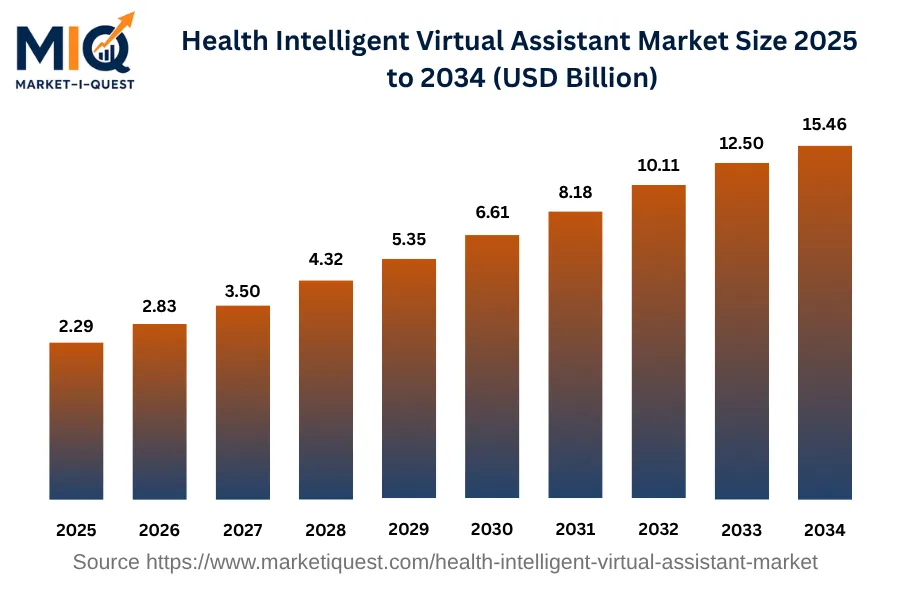
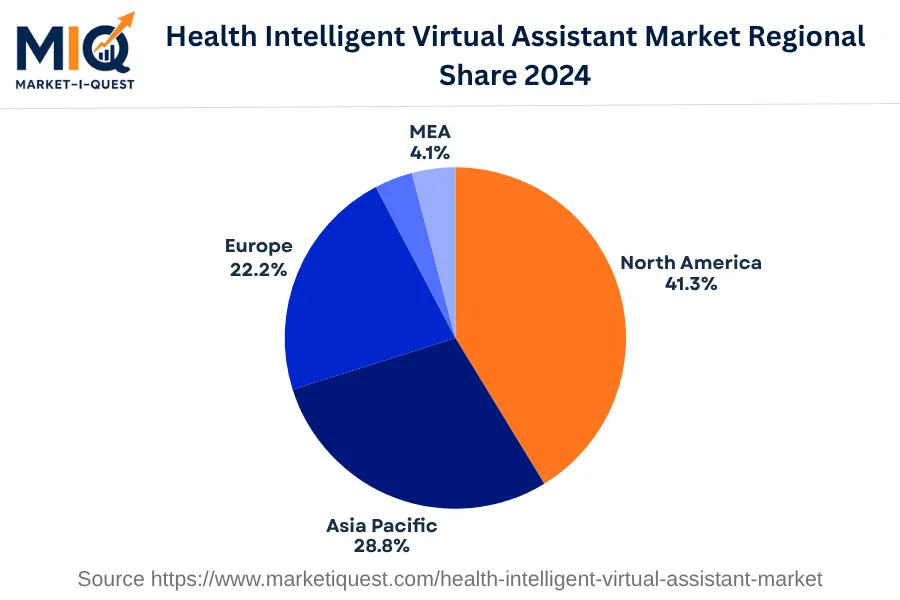
The Health Intelligent Virtual Assistant Market size in 2025 stood at USD 2.29 billion, rising from USD 1.85 billion in 2024. Over the following decade, the market value markedly increased, reaching USD 15.46 billion by 2034. This expansion trajectory represents a CAGR of 23.65% from 2025 to 2034. Driving this growing shift in market size was the progressive adoption and application of Health Intelligent Virtual Assistants across the healthcare ecosystem. These tech-enabled tools evidently changed the patient care model, providing seamless, personalized and efficient care. Furthermore, their increased utilization was focused towards enhancing healthcare delivery, especially in extending operational efficiency, effective communication and strategic decision making. Whereas, the regional market share mix demonstrated that North America held 41.3% of the total, followed by the Asia Pacific at 28.8%, Europe at 22.2%, the Middle East and Africa at 4.1%, and Latin America constituted 3.6%.

Key Takeaways

  • By AI Technology - Machine Learning held the majority share in 2024.
  • By Deployment Mode - Cloud-Based led the market in 2024.
  • By Application Area - Telehealth Support expanded the fastest in the period leading up to 2024.
health-intelligent-virtual-assistant-market market size

Key Driving Factors

Increasing Pressure on Healthcare Providers For Efficient Patient Engagement

Healthcare providers are facing increasing expectations to deliver more efficient and personalized patient interactions. In response, these institutions are leaning increasingly on Intelligent Virtual Assistants (IVAs). These virtual assistants can improve the management of appointments, offer automated patient reminders and provide personalized healthcare information. These functions assist healthcare providers in improving patient engagement, reducing missed appointments and enhancing overall patient satisfaction. As these pressures rises, the demand for solutions like IVAs becomes more emphasized. This is driving adoption of Health IVAs across hospitals and healthcare institutions worldwide.
Adherence to Data Protection Regulations and Compliance Requirements

Healthcare providers are expected for complying to stringent data protection regulations such as the Health Insurance Portability and Accountability Act (HIPAA) in the U.S. and the General Data Protection Regulation (GDPR) in Europe. IVAs can ensure that meetings and consultations are kept private with storing and managing patient data securely to comply with these regulations. Whereas, integrating effective patient interactions with secure data protection, Health IVAs increasingly become a safer and more favorable alternative. This focus on maintaining data security while providing healthcare services is driving the adoption of the Health IVA market development.

Market Evolution by Timeline

2019-2023
Within this period, health providers and insurers in North America and Western Europe began purchasing Health Intelligent Virtual Assistants (HIVA) to increase their telemedicine services. Small health tech companies and medical institutions partnered to introduce HIVA applications such as patient support and health updates. Cloud-based platforms surfaced as a looming trend. However, no universal standards for performance and security limited widespread adoption. Commercially, many agreements involved monthly subscription pricing and third-party development contracts. Thus. this period made significant advancements and growth in the market.
2024
In 2024, large tech corporations like Google and Apple launched their HIVA solutions. This surge in supply was aided by matured APIs and standardised health data interoperability, which lowered integration barriers. Policy-wise, the US government's 'Artificial Intelligence in Healthcare Act' helped ensure data security and privacy, boosting buyer confidence. The commercial model remained largely the same, but collaborations between tech giants and healthcare bodies became more frequent. Thus, combining this factors 2024 emerged as a major year for the growth of the market.
2025-2029
From 2025 to 2029, HIVA demand will likely grow steadily among hospitals and clinics in densely-populated Asia-Pacific regions. Mobile-based HIVA will likely become popular and highlight as effective in remote areas with limited medical facilities. Technologically, enhancements in Natural Language Processing (NLP) and Machine Learning algorithms may be serve to the growing demands. Furthermore, the 'Global Digital Health Standards Initiative' by the World Health Organisation (WHO) might helpful in shaping regulation for using HIVA worldwide. Thus, as per the projections these significant factors might make significant growth in the market.
2030-2034
Entering the 2030s, HIVA adoption expected to become common in public health programs of developed and developing nations. Use-cases Hope to broaden beyond patient support to include disease detection and management. Medical drones will likely integrate with HIVA witness field tests in humanitarian. Various regions might be struggled with fragmentary digital health infrastructures that constrained smooth integration. With standardized security protocols, pricing for advanced capabilities tended to increase buoyed by demand, posing a challenge for resource-limited buyers.

Future Market Outlook

Future Opportunities

The landscape of health intelligent virtual assistants is poised for considerable growth driven by increasing acceptance of AI in healthcare settings and a rising demand for personalized patient engagement. With the ongoing shift toward value-based care, companies like IBM Watson Health are exploring partnerships to integrate AI into clinical decision support systems, thereby enhancing clinical outcomes. In 2024, the World Health Organization is expected to release a framework for AI deployment in health systems, which will create new guidelines for safe and effective use of IVAs in patient care. Additionally, as chronic diseases become more prevalent globally, health IVAs can play a vital role in monitoring patient adherence to treatment plans and providing tailored support. The digital divide in healthcare is also being addressed; initiatives in the United Kingdom aim to improve digital literacy among underserved populations, thus expanding access to intelligent virtual assistants. Furthermore, the integration of blockchain technology is anticipated to enhance data security and patient confidence when interacting with health IVAs. As healthcare stakeholders recognize the potential of IVAs to optimize operational efficiencies and patient interactions, future opportunities arise for collaboration and innovation, significantly advancing the integration of AI-driven solutions in everyday health practices.

Segmentation Analysis

By AI Technology

The AI technology market segment is divided into several subsegments including Natural Language Processing (NLP), Machine Learning, Deep Learning, and Rule-Based Systems. Machine Learning accounted for the largest revenue share while Deep Learning is expected to grow at the fastest CAGR during the forecast period.

Largest Revenue Share

Machine Learning

Market Share Leader

The Machine Learning (ML) subsegment has been driving the AI technology market primarily due to its wide application across numerous sectors, such as healthcare, finance, and retail, among others. Organizations utilize ML algorithms to handle vast quantities of data, predict future trends, and improve decision-making processes. The ability of ML to learn and adapt from data inputs increases operational efficiency and offers businesses a competitive edge. Geographically, North America accounts for the vast majority of the revenue generated from this subsegment due to the prevalence of tech giants investing heavily in ML projects. The primary purchasing criteria involve system accuracy, efficiency, and the ability to integrate seamlessly into existing workflows.

Fastest CAGR

Deep Learning

Forecast Period Growth Leader

The subsegment expected to grow at the fastest rate is Deep Learning. The key growth drivers for this sector include advancements in technology that allow for more data processing and the adoption of AI in various industries. Drivers such as the evolution of hardware technology and policy changes promoting AI integration in public and private sectors are driving growth. Partnerships between AI technology firms and other sectors such as healthcare and automotive are expected to increase the adoption rate.

By Deployment Mode

The market is divided into subsegments including Cloud-Based, On-Premises, and Hybrid deployment modes. In 2024, the Cloud-Based mode accounted for the largest revenue share while the Hybrid mode is expected to grow at the fastest CAGR during the forecast period.

Largest Revenue Share

Cloud-Based

Market Share Leader

In 2024, Cloud-Based deployment mode generated the largest revenue share. This is primarily attributed to its various benefits such as scalability, flexibility, and reduced operational costs. The Cloud-Based deployment mode allows firms to quickly scale based on requirements. Moreover, businesses in various industries are transitioning from traditional infrastructure to cloud-based platforms to increase their operational efficiency and reduce cost. These offerings have seen a surge in popularity with remote work protocols being established worldwide, further fueling the growth of this market segment. Regulation has also played its part with GDPR compliance pushing companies away from on-premise solutions. Therefore, anticipating a continued increase in adoption due to the initial driving factors, Cloud-Based is the subsegment with the largest revenue.

Fastest CAGR

Hybrid

Forecast Period Growth Leader

Hybrid is set to display the fastest CAGR over the forecast period. The introduction of hybrid mode combines the benefits of both cloud-based and on-premise systems, providing both security over sensitive data and the flexibility of remote access. Companies are increasingly recognize the balance of security, accessibility and cost-effectiveness provided by the Hybrid approach. Technological advancements and capital expenditure deployment towards IT infrastructure improvements are key drivers for its growth. Partnerships within the tech space, consolidating resources and expertise for better hybrid solutions are expected to provide further momentum.

By Application Area

The market is divided into subsegments including Patient Engagement, Administrative Assistance, Symptom Checking, Telehealth Support, and Others. In 2024, Administrative Assistance accounted for the largest revenue share while Telehealth Support is expected to grow at the fastest CAGR during the forecast period.

Largest Revenue Share

Administrative Assistance

Market Share Leader

The Administrative Assistance subsegment has emerged as a frontrunner in terms of revenue, due to the persistent demand for efficient operational management in the healthcare industry. Increasing complexities in hospital and clinic management models and the need for streamlining workflows have resulted in increasing adoption of technology-driven administrative support. This segment has been further fueled by the growing frequency of chronic conditions which necessitate complex treatment protocols, demanding robust administrative support. Furthermore, in developed regions with mature healthcare infrastructure, the strict regulatory scenarios have necessitated hospitals and healthcare institutions to employ robust administrative tools to ensure regulatory compliance.

Fastest CAGR

Telehealth Support

Forecast Period Growth Leader

Telehealth Support is expected to witness the fastest growth during the forecast period. The recent accelerators for this tremendous growth trajectory have been the global health emergencies like the Covid-19 pandemic which drives the demand for remote patient management and monitoring. Besides, the legislative support for telemedicine in many regions, combined with favorable reimbursement policies, has acted as a driver for growth. Advances in technology have made telehealth services more efficient and user-friendly driving higher acceptance among patients. Many hospitals and clinics are expected to expand their telehealth capabilities in the near-term due to benefits it offers such as reduced hospital readmissions, improved patient satisfaction, and better chronic disease management.

Competitive Analysis

Key Market Players

Manufacturers / OEMs

Microsoft Corporation
US
Verint Systems Inc.
US
Nuance Communications Inc.
US

Key Suppliers & Raw Materials

IBM Corporation
US
Google LLC
US
Oracle Corporation
US

Distributors, Integrators & Channel Partners

CSS Corp
India
DXC Technology
US
eGain Corporation
US

Porter’s Five Forces Analysis

An evaluation of the Health Intelligent Virtual Assistant market's competitive dynamics.

Supplier Bargaining Power

Low

Technology vendors' high fragmentation keeps supplier power at bay.

Buyer Bargaining Power

High

Diverse options and software interoperability fortified healthcare providers' negotiation power.

Threat of Substitutes

Medium

Adoption of traditional care practice and data security concerns pose a moderate substitute risk.

Threat of New Entrants

Medium

High technological barrier, but increased demand and investment make market entry viable.

Competitive Rivalry

High

Strong competition from existing tech giants like Google and Microsoft intensifies rivalry.

Regional Analysis

Geographic market dynamics and growth opportunities across key regions

Global Market Outlook

health-intelligent-virtual-assistant-market market regional share

North America

In 2024, the North American Health Intelligent Virtual Assistant market emerged as a thriving sector due to increased healthcare tech adoption. Key drivers included heightened demand for streamlined health services across the U.S., Canada, and Mexico. Patients desired enhanced interactions with healthcare providers; prompting organizations towards Intelligent Virtual Assistants (IVAs). This saw extensive investment into AI technology, forging advanced, patient-friendly Health IVAs. Increased regulations to improve healthcare accessibility compelled the market to innovate, offering extensive services maintaining affordability.

Trends primarily revolved around shifts in patient engagement strategies. Active users favored Health IVAs for instant, accurate information retrieval and response, influencing tech adaptation in government and enterprise sectors. Partnerships flourished between tech companies and healthcare providers, focusing on developing sophisticated, easy-to-use IVAs, enunciating a growth in M&A within the healthtech sector. Stringent policy enforcement ensured transparency and accountability, augmenting trust amongst users. From healthcare providers to retail pharmacies, there was a noticeable shift towards AI-assisted services. Thus, the Health IVA market in North America marked a significant standing in 2024 due to augmented demand, tech advancements, regulations, investment flow, as well as shifts in stakeholders' perspective towards health technology.

Asia Pacific

In 2024, the market in Asia Pacific was majorly driven by significant developments in technology adoption and health management strategies. Rising smartphone penetration and the increased adoption of mHealth technologies in China and Japan have fueled the demand for intelligent virtual assistants in the healthcare sector. In India and South Korea, advancements in speech recognition systems have contributed to the growth, while in Australia, the government's supportive regulatory environment has it easier for healthcare providers to integrate virtual assistants into their practices.

Major trends during the year included a shift in patient attitudes towards mobile health applications and an uptick in M&A activity in the digital healthcare space. In China and South Korea, consumers indicated a preference for virtual assistants that could offer personalized health recommendations with a trend that drove many tech companies for investing in AI technologies. Moreover, ASEAN nations witnessed a rise in partnerships within tech giants and local healthcare providers aiming to capitalize on the burgeoning demand for efficient health monitoring systems. The aforementioned market drivers and trends were evident across a range of sectors, particularly in enterprise and retail settings, where consumers' demand for convenient healthcare solutions instigated shifts in product offerings and channel dynamics. Healthcare providers in these markets have been proactive in adopting these technologies, indicating the penetration of intelligent virtual assistants in the healthcare industry in 2024.

Europe

In 2024, the European Health Intelligent Virtual Assistant Market was influenced by a number of key factors. Driving this market were progressive healthcare regulations like the EU’s General Data Protection Regulation (GDPR), accelerating digitalization, increased investments in healthcare technology, and a growing demand for efficient patient management tools. Particularly dominant in countries like Germany and the UK, the demand was driven by a combination of technology adoption, supply dynamics, and competitive pricing.

Uber Health in the UK and France, for example, offered a ride-hailing platform tailored for healthcare providers, indicating a noticeable shift towards digital health services. Meanwhile, Italy and Spain saw the rise in national eHealth strategies and policies, demonstrating a strong governmental commitment to digital healthcare services. Meanwhile, in countries like Benelux and the Nordics, there was a gradual trend of technology companies partnering with healthcare providers to integrate virtual health assistants in smartphones, resulting in an increased application of such tools in daily routines. Simultaneously, Central and Eastern Europe showed potential for growth facilitated by local government initiatives encouraging digital innovation in the healthcare sector.

Latin America

In 2024, the Health Intelligent Virtual Assistant Market in Latin America was at an inflection point. Investment into AI technology saw a significant rise across countries like Brazil and Mexico, driven largely by mounting demand for efficient and accurate healthcare processes. Regulatory support in Argentina, especially, bolstered market growth as the government implemented policies favoring telehealth and AI advancements. Furthermore, the surge in 5G adoption across the region enhanced the operational efficacy of these AI-based solutions. Customer behavior witnessed a notable shift towards virtual health assistants, especially within Chile's enterprise sector, as they sought to leverage AI for personalized patient care.

Additionally, partnerships and M&A activities were on the rise, primarily in Peru's healthcare industry, aiming at integrating AI-driven solutions into their systems. However, uneven technology adoption across various sectors, notably in retail and utilities, somewhat restricted the market's full potential. And despite supportive policies, stringent regulatory and data privacy norms continued to pose challenges for the widespread application of health intelligent virtual assistants. Nonetheless, the LATAM market, in 2024, showed an optimistic trend towards AI adoption in healthcare, paving the way for a more digitized and efficient health infrastructure.

Middle East & Africa

In 2024, the Health Intelligent Virtual Assistant Market witnessed significant growth in the Middle East and Africa regions. The key drivers for this development included extensive technological adoption across sectors, increased healthcare investment, and evolving regulatory frameworks promoting digital health solutions. Saudi Arabia, United Arab Emirates, and Israel led in technology adoption, bringing virtual health assistants into several health institutions, while South Africa and Nigeria witnessed considerable healthcare investment aimed at digitalization.

The trend of integrating AI-driven solutions into healthcare had been gradually adopted by the majority of the healthcare institutions and insurance companies, particularly in Egypt and Kenya, contributing to the market expansion. An increased partnership between technology and healthcare firms was identified, primarily in Saudi Arabia and Israel, due to policy enforcement on digital health solutions. Concurrently, the customer behavior was significantly oriented towards virtual health assistance in most countries like the UAE and Qatar, reinforcing market trends significantly. The Health Intelligent Virtual Assistant Market, thus, saw a considerable landscape shift in 2024, primarily due to technology adoption, healthcare investments, and policy reforms across key sectors such as government initiatives, healthcare institutions, and insurance companies.

Recent Industry Developments

Latest market innovations, product launches, and strategic initiatives

January 2026

Anthropic officially opened Claude for healthcare services on January 12, 2026. The company had previously launched Claude for Life Science. The healthcare offering allows premium paid users to access personal health and diagnostic data, while enterprise applications focus on insurance review, claims processing, and clinical documentation automation with specialized optimization for medical tasks.

November 2025

China's central government issued the "Opinions on Promoting and Regulating the Application Development of 'AI + Healthcare'," establishing a roadmap to develop a mature vertical healthcare large model application system by 2027 and achieve AI coverage in primary healthcare institutions by 2030.

Frequently Asked Questions