Graphene Nanoplatelets Market Snapshot

Key Players

  • XG Sciences (United States)
  • Directa Plus (Italy)
  • Nanoinnova Technologies (Spain)
  • Elcora Advanced Materials Corp (Canada)
  • Grupo Antolin (Spain)
  • Cambridge Nanosystems (United Kingdom)
  • NanoXplore (Canada)
  • Graphenano (Spain)
  • Applied Graphene Materials (United Kingdom)
  • Thomas Swan (United Kingdom)

Market Size

Base Year 2024
$0.383 Bn
CAGR
38.5%
Forecast 2034
$9.95 Bn

Market Segments

By Grade
  • M Grade
  • C Grade
  • H Grade
By Application
  • Composites
  • Energy & Power
  • Conductive Inks & Coatings
  • Others

Market Dynamics

Drivers
  • Rising demand for efficient electronics
  • Increasing graphene-based research activities
Restraints
  • High production cost
  • Limited commercial production
Opportunities
  • Increased nanotechnology applications
  • Demand in Electronics industry

Market Size

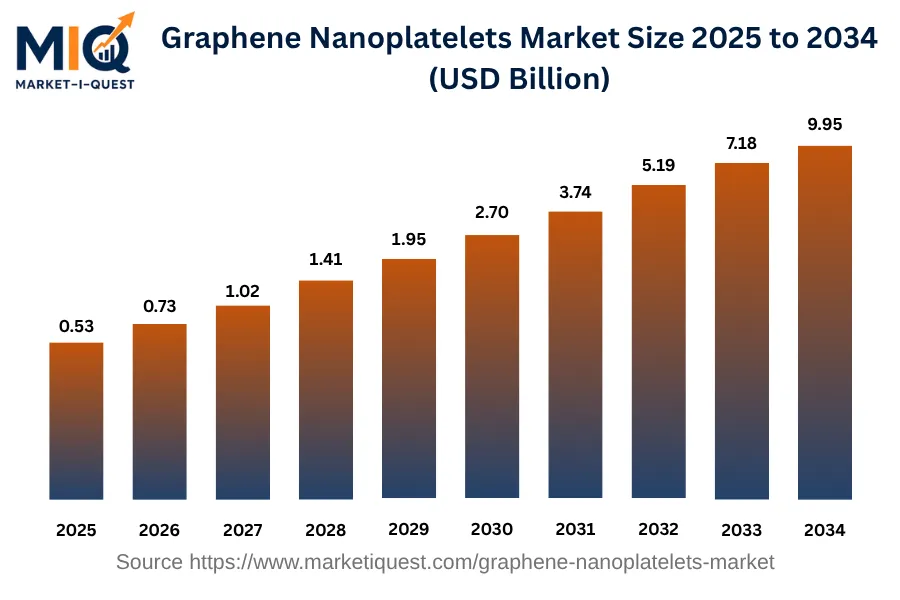
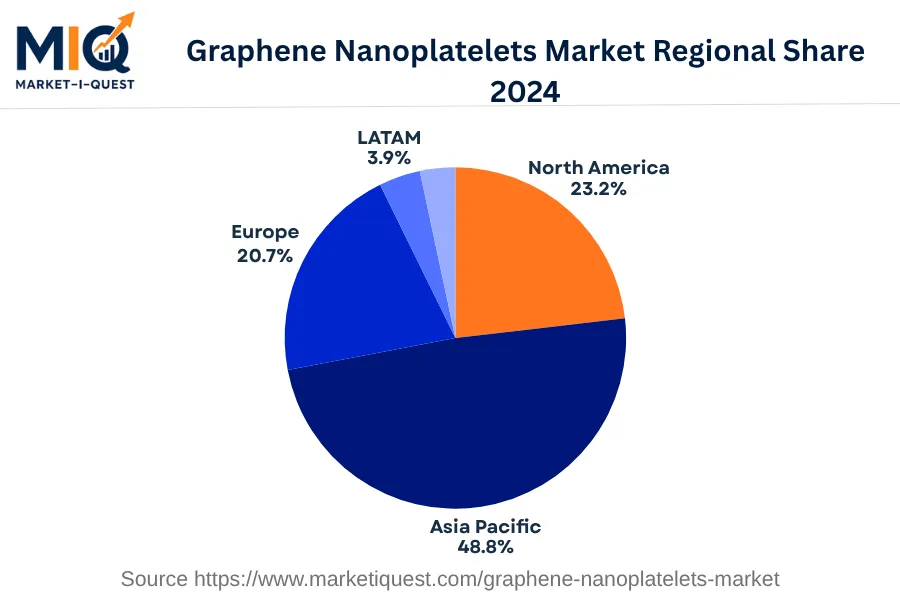
The Graphene Nanoplatelets Market size in 2025 is projected to be worth 0.53 billion USD, a noticeable increase from 0.38 billion USD in 2024. This positive trend is anticipated to persist, and by 2034, the market size is predicted to reach 9.95 billion USD, recording a CAGR of 38.5%. The market's steady expansion from 2024 to 2034 indicates that the demand for graphene nanoplatelets is increasing and this commodity is becoming increasingly valuable within diverse industrial applications. The regional share of the market in 2024 was distributed as follows: North America had a share of 23.2%, followed by Europe at 20.7%, while Latin America and the Middle East and Africa had smaller shares of 3.9% and 3.35%, respectively. The Asia Pacific region held the majority share of 48.8%, indicating its substantial involvement in the Graphene Nanoplatelets market.

Key Takeaways

  • By Grade - M Grade held a significant portion of the Graphene Nanoplatelets Market in the base year.
  • By Application - Energy & Power category led the market performance in terms of value and volume.
graphene-nanoplatelets-market market size

Key Driving Factors

Adoption in Energy Storage Applications

The graphene nanoplatelets market is heavily influenced by the increasing need for energy storage applications. Graphene nanoplatelets, due to their outstanding thermal and electrical conductivity, are being progressively used to enhance the efficiency of batteries and capacitors. This availability of better-performing and cost-effective materials is leading to enhanced adoption by manufacturers within the energy storage sector. The increasing global focus on renewable energy sources and minimizing greenhouse gas emissions has also increased the demand for more effective storage solutions, further influencing the graphene nanoplatelets market.

Use in Automotive Composites

The growing appeal of graphene nanoplatelets in the automotive industry, specifically in vehicle manufacturing, is another distinct driving factor. Manufacturing lightweight vehicles has been of substantial importance for automotive companies as it directly links to fuel efficiency and reductions in CO2 emissions. Graphene nanoplatelets, incorporated into automotive composites, provide significant weight reduction, increased strength, and improved heat management. This gives manufacturers a means to meet the emissions standards such as the 'Corporate Average Fuel Economy' (CAFE) standards in the USA, which are pushing automotive companies to reduce the weight of their vehicle models. This is boosting the utilization of graphene nanoplatelets in the automotive industry, driving the market growth.

Market Evolution by Timeline

2019-2023
During this period, the primary buyers for Graphene Nanoplatelets were industries involved in energy storage, composites, and electronics, particularly in North America and Europe due to high-tech industrialization. Suppliers introduced pilot programs designed to enhance production processes, yet faced challenges associated with high manufacturing costs and technical complexities. The U.S. patented Graphene Nanoplatelets production processes driving further development. Prices remained relatively high due to the intricacies of manufacturing. Key risks during this phase included the lack of broad-scale production methods and clarity on environmental impact, though more research was commissioned to assess these drawbacks.
2024
In 2024, Graphene Nanoplatelets' demand is likely to expand into coatings and printing ink industries. Supply side is forecasted to improve thanks to newly optimized and streamlined production procedures, and the constraints of high manufacturing costs will likely lessen but remain a challenge. The ISO developed a standard ISO/TR 19733 for the health and safety of nanotechnologies, including Graphene Nanoplatelets, stimulating more responsible adoption. Cost structures started to stabilize, though still remained comparatively high. A notable risk was the potential decline in investment in nanotechnologies due to economic fluctuations.
2025-2029
During this stage, increased adoption from the automotive and aerospace industries, particularly in Asian markets is expected. By this time, Graphene Nanoplatelets technology integration became more mature, boosting production capabilities. As the sector experienced an influx of investment, pricing patterns began a downward trend favoring smaller scale business models. Government regulatory body initiatives, such as India's Mission on Nano Science and Technology (Nano Mission), had a positive effect on adoption rates. Nevertheless, risks included the potential for an oversaturated market and tightened regulations on nanomaterials.
2030-2034
In this period, it is typical for Graphene Nanoplatelets to find application in biomedical industries. Suppliers, now capable of larger scale production, began diversifying their offerings and venturing into multi-layer graphene. The integration into various applications had matured considerably. Under the EU's Graphene Flagship program, commercialization of Graphene Nanoplatelets had seen active promotion. Prices are likely to become more competitive. Risks involved ongoing environmental concerns and uncertainty around the long-term health effects of nanomaterials, prompting further examination.

Future Market Outlook

Future Opportunities

The ongoing global interest in sustainable and efficient materials presents numerous opportunities for the graphene nanoplatelets market. As decisions are made in late 2023 regarding the European Union’s Green Deal, industries are exploring graphene-based solutions to meet stringent environmental standards. For instance, a partnership between graphene developers and packaging companies is being assessed to create biodegradable materials that reduce plastic waste. In North America, the U.S. Department of Energy is funding projects that explore graphene nanoplatelets for use in energy storage technologies, which indicates a trend toward integrating advanced materials in sustainable energy systems. Additionally, in the automotive sector, major manufacturers such as Tesla are investing in research to explore the use of graphene nanoplatelets to enhance battery performance while reducing weight. As regulations evolve, companies will focus on developing safe and compliant graphene products to meet international standards. In the aerospace industry, collaborations are also increasing, exemplified by Boeing's exploration of graphene composites for parts that require high strength and low weight. Furthermore, the push towards advanced healthcare solutions sees opportunities for graphene in biosensors and drug delivery systems, driven by research from institutions like MIT, which emphasizes the capabilities of graphene in medical applications. This convergence of industries and regulatory support creates a fertile ground for the future development of graphene nanoplatelets.

Segmentation Analysis

By Grade

The market is divided into subsegments including M Grade, C Grade, and H Grade; with M Grade accounting for the largest revenue share, while H Grade is expected to grow at the fastest CAGR during the forecast period.

Largest Revenue Share

M Grade

Market Share Leader

m Grade dominates the market in terms of revenue generation. This situation can be attributed predominantly to its wide range of applications across various industries. The subsegment's impressive performance is driven largely by its superior quality and higher profit margin relative to other grades. M Grade products are widely utilized in industries, including automotive, aerospace, medical, and manufacturing; featuring prominently in high-end, value-driven applications that require durability, strength, and reliability. Market demand for M Grade is particularly robust in geographies with advanced industries, owing to increasing industrialization and technology adaptation. Regulatory dynamics and resource availability also favor the M Grade subsegment. This grade is produced with a highly regulated and closely overseen process, ensuring that M Grade products meet strict quality and performance standards. The purchasing criteria typically revolve around product quality, durability and the credibility of the manufacturer. Additionally, customer retention is high in this subsegment due to the significant switching costs associated with changes in product specifications and supply chain reconfiguration.

Fastest CAGR

H Grade

Forecast Period Growth Leader

Even though H Grade constitutes a smaller share of the market currently, it is forecasted to grow at the highest CAGR in the future. The growth is driven by various catalysts, including technological advancements in core industries, policy support, the need for capital expenditure reduction, and strategic partnerships. Tech improvements enable H Grade to fit into applications that were once monopolized by higher grades, therefore helping to drive its adoption despite initial barriers. Government policies are promoting the use of less expensive alternatives, leading to increased market adoption of H Grade. Industries that were once reluctant to switch are now seeking ways to reduce capital expenditure; the lower cost of H Grade clearly resides within their interests. Strategic partnerships between key players in the industry are accelerating the integration of H Grade into various industrial applications. These factors might pose some short-term risk, as the market structure changes, but the long-term outlook for H Grade remains strong. We believe these are the principal drivers that will influence the market growth for H Grade in the near future.

By Application

The application-based market segments include composites, energy & power, conductive inks & coatings, and others. Among these, Energy & Power commanded the highest revenue in 2024, while composites is projected to experience the most robust growth during the forecast period.

Largest Revenue Share

Energy & Power

Market Share Leader

The Energy & Power segment experienced the highest revenue in the base year 2024. The expansion in energy-sector technology and the mounting demand for robust and more efficient power systems played a significant role in this substantial revenue share. The global pressure to reduce carbon emissions has increased the need for unconventional energy sources, beneficially impacting this segment. Geographic locations where conventional electricity grid solutions are not feasible have shown a high adoption of these power solutions alternatively. Purchasing decisions often revolve around efficiency, cost, and reliability, which are all contributing factors to this segment's dominance. Interoperability and the adaptability of these energy systems across various applications have rendered them a preferred choice, boosting the overall segment revenue.

Fastest CAGR

Composites

Forecast Period Growth Leader

The composites subsegment is forecasted to grow at the fastest rate. This segment's growth can be linked to its innate advantages such as lightweight, superior strength, and stability, making it a popular choice across various applications, including automotive, aerospace, and construction. These industries face constant pressure to improve fuel efficiency and decrease carbon emissions, leading to increased use of composites. Besides, technological advancements, policy support, and strategic partnerships within industries are acting as significant growth catalysts. However, the high cost of composite production remains an adoption barrier. The capital expenditure required for these technologies is relatively high, posing a risk to the segment's growth. Nonetheless, the ongoing development to streamline composite production and the exploration of new applications can provide optimum growth opportunities, driving this segment's growth.

Competitive Analysis

Key Market Players

Manufacturers / OEMs

XG Sciences
US
Directa Plus
Italy
Graphenea
Spain

Key Suppliers & Raw Materials

Global Graphene Group
US
Thomas Swan & Co. Ltd.
UK
Haydale Graphene Industries
UK

Distributors, Integrators & Channel Partners

ACS Material, LLC
US
Cheap Tubes Inc.
US
Graphene Supermarket
US

Porter’s Five Forces Analysis

This analysis evaluates the competitive intensity and attractiveness of the Graphene Nanoplatelets Market.

Supplier Bargaining Power

Medium

Limited suppliers and high production cost of graphene nanoplatelets balance the bargaining power.

Buyer Bargaining Power

Low

Unique properties of graphene nanoplatelets and lack of comparable alternatives limit buyer power.

Threat of Substitutes

Low

High performance specifications of graphene nanoplatelets reduce the threat of substitutes.

Threat of New Entrants

High

Increasing commercialization and diverse application areas attract new market entrants.

Competitive Rivalry

High

Numerous players and constant technological advancements lead to high competitive rivalry.

Regional Analysis

Geographic market dynamics and growth opportunities across key regions

Global Market Outlook

graphene-nanoplatelets-market market regional share

North America

In 2024, the graphene nanoplatelets market in North America exhibits significant growth, centered in the U.S., Canada, and Mexico. Market drivers include increased demand in sectors such as electronics and aerospace, where graphene nanoplatelets’ superior thermal conductivity is highly valued. A rise in government investment, particularly from the U.S. Department of Defense, has stimulated research and technology adoption in military and civil applications. Additionally, environmental regulations are pushing organizations towards adopting lightweight, sustainable materials like graphene, augmenting the market. However, supply chain complexities in obtaining high-quality graphite, the precursor for graphene, poses a challenge.

Market trends unveiled a shift towards buyer preference for high-quality graphene, influencing product and technological innovations. This is abundantly evident in the electronics sector which utilizes graphene's unique properties for advanced device fabrication. Furthermore, distribution channels evolve, with partnerships and mergers between raw material suppliers and distributors becoming commonplace. This is exemplified by the collaboration between GrafTech International and NeoGraf Solutions to expand their product offerings. In the automotive sector, increasing adoption of graphene nanoplatelets for production of lightweight and strong material is observed. Lastly, the enforcement of the EPA's Advanced Clean Cars Program has led to the increased use of graphene nanoplatelets in vehicle manufacturing.

Asia Pacific

In 2024, the Asia-Pacific graphene nanoplatelets market surged due to strong demand across multiple application sectors. Driver one revolved around escalating demand from the energy storage industry, particularly in China and India where expanding electric vehicle production required high-performance batteries. The second driver was the proactive innovation in the electronics sector in countries such as Japan and South Korea. They adopted graphene nanoplatelets to enhance thermal management and electromagnetic interference shielding. The final driver was increased government investments in graphene research and development projects, notably in Australia, a nation prioritizing advanced material technologies.

Market trends emphasized shifting buyer behavior. An uptick was observed in preference for high-quality graphene nanoplatelets among key buyers like electronics manufacturers, pushing suppliers to prioritize product purity and consistency. Technology shifts saw a growth in magnetic data storage applications, specifically in ASEAN IT industries. China led a trend in channel dynamics with an integrated vertical model directly linking graphene producers and use-case industries. Partnerships were on the rise, with particular emphasis on joint R&D ventures among product manufacturers and research institutions. Enforcement of stringent environmental standards across the region, especially concerning the reduction of carbon emissions, also influenced the graphene nanoplatelets market landscape. Overall, 2024 evidenced a robust graphene nanoplatelets market growth in the Asia-Pacific region.

Europe

In 2024, the Graphene Nanoplatelets Market in Europe exhibited robust growth due to rising demand from various sectors. The surge in demand was driven by growing utility of the product in electronics, due to superior thermal conductivity, and in aerospace & defense applications, for its lightweight yet strong structural properties. Policies promoting the shift from traditional to sustainable products further stimulated market dynamics in countries like the United Kingdom, Germany, and France.

Notable trends underpinning the market progression consisted of growing partnerships and M&A activities to build effective supply chains. In particular, Italy and Spain saw a surge in local collaborations between manufacturers and end-user industries to ensure consistent supplies for automotive and renewable energy sectors. The expanding base of digitally skilled professionals in the Nordics and Benelux region fostered a change in channel dynamics, with B2B e-commerce platforms becoming a preferred choice for buying graphene nanoplatelets.

Consumer behavior reflected a growing trust in graphene-enhanced products, leading to increased demand in consumer electronics and wearables. Manufacturing and healthcare sectors across Central and Eastern Europe ramped up investment in graphene-based innovations, pointing to a maturing appreciation for the product’s versatility. Germany's commitment to environmental standards compelled industries to adopt these nano-carbon structures, underscoring the role of policy enforcement in market evolution.

Latin America

In 2024, the Graphene Nanoplatelets Market in Latin America demonstrated significant growth, influenced largely by factors within the region. Investments in technological research, especially in Brazil and Mexico, boosted the production capability of this nanomaterial. Further, regulatory support from governments in these countries helped fuel the market growth. In Argentina and Colombia, increased automotive sector demand for lightweight and durable materials caused greater adoption of graphene nanoplatelets.

The market also experienced several prominent trends in buying behaviour and product shifts. The electronics industry in Peru and Chile saw a rise in the use of graphene nanoplatelets due to their properties such as high electrical conductivity. Meanwhile, a notable shift came from the renewable energy sector in Colombia and Argentina, where demand increased for efficient storage systems, leading to higher use of the nanomaterial in manufacturing supercapacitors.

Partnerships and M&A also influenced the market. Brazil’s leading nanomaterial manufacturer formed a strategic alliance with a Mexican tech firm to enhance the graphene nanoplatelet production quality, signalling a trend of partnerships aimed at better product manufacturing. Moreover, heightened enforcement of environmental regulations prompted businesses in the region to seek greener alternatives, bolstering graphene nanoplatelet adoption, particularly within the manufacturing sector. The LATAM Graphene Nanoplatelets Market in 2024 was shaped by a combination of regulatory impacts, technological investments, industry-specific demands, and strategic collaborations.

Middle East & Africa

In 2024, the Graphene Nanoplatelets Market in the Middle East and Africa was primarily driven by rising demand across a range of sectors. Particularly, industries such as energy, electronics, aerospace, and telecommunications saw increased investments in nanotechnology. Governments in countries like Saudi Arabia, UAE, and Israel were taking pro-active initiatives to promote adoption of advanced materials, bolstering the supply dynamics of the industry. Nano-optimized devices in the telecommunication sector, primarily driven by technology adoption in countries like South Africa and Nigeria, were significant contributors to demand.

Around the same period, a pressing trend was the synergy between nanotechnology companies and research institutions across the region, enabling product innovation and increased competency. Esteemed universities in Egypt and Kenya had become pivotal partners in developing Graphene Nanoplatelets applications in healthcare. Another conspicuous trend was the strong regulatory focus on safety standards, particularly in the manufacturing of nano-enhanced products. Lastly, the emergence of the online channel witnessed in consumer retailing of nanotech products, mainly in the UAE and Saudi Arabia, reshaped the traditional supply chain, steering the market dynamics. Overall, the Graphene Nanoplatelets Market in the Middle East and Africa in 2024 demonstrated considerable growth opportunities fuelled by sectoral demand and evolving market trends.

Recent Industry Developments

Latest market innovations, product launches, and strategic initiatives

March 2026

Black Swan expanded its UK facility's production capacity for graphene nanoplatelets from 40 tonnes to over 140 tonnes annually. This marks a major transition for the company from pilot-scale testing to full industrial manufacturing to meet rising commercial demand.

March 2026

Black Swan Graphene entered an agreement to acquire the plastic injection molding company Falpaco for C$12.6 million. This acquisition is a strategic move to control its own supply chain, allowing the company to directly manufacture graphene-enhanced products instead of relying solely on selling the raw nanoplatelets.

Frequently Asked Questions