
Gesture Recognition Market Snapshot

Key Players

  • Microsoft Corporation (US)
  • Apple Inc. (US)
  • Google LLC (US)
  • Intel Corporation (US)
  • Qualcomm Technologies Inc. (US)
  • Softkinetic SA (Belgium)
  • Microchip Technology Inc. (US)
  • Elliptic Laboratories AS (Norway)
  • Sony Interactive Entertainment Inc. (Japan)
  • Samsung Electronics Co. Ltd. (South Korea)

Market Size

Base Year 2024
$27.85 Bn
CAGR
18.7%
Forecast 2034
$154.64 Bn

Market Segments

By Technology
Touch-Based Gesture Recognition, Touchless Gesture Recognition
By Component
Hardware, Software
By Gesture Type
Dynamic Gestures (Online), Static Gestures (Offline)
By Authentication
Biometric, Non-Biometric
By End User Industry
Consumer Electronics, Automotive, Healthcare, Aerospace & Defense, Others

Market Dynamics

Drivers
  • Increasing use of wearable devices
  • Advanced gaming applications
Restraints
  • High hardware requirement costs
  • Performance issues in low-light conditions
Opportunities
  • Technological advancements in AI
  • Rising popularity of smart devices

Market Size

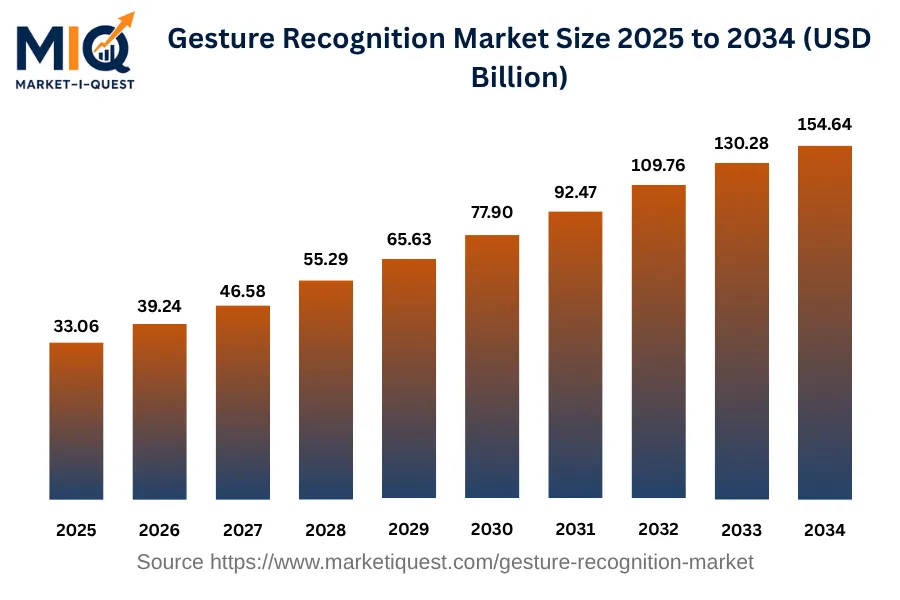
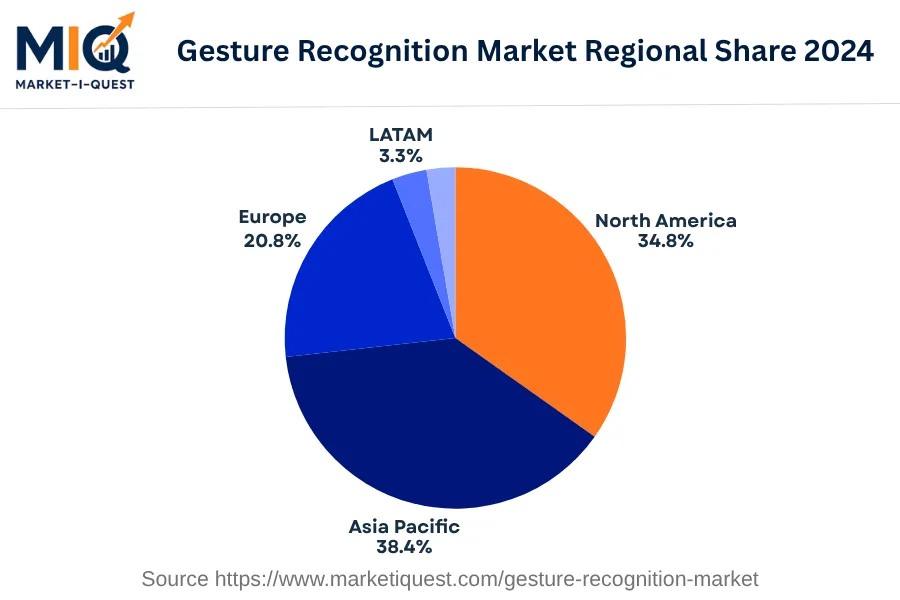
The Gesture Recognition Market in 2025 is expected to be valued at $33.06 billion, up from $27.85 billion in 2024. By 2034, the market size anticipates a rise to $154.64 billion, growing at a compound annual growth rate (CAGR) of 18.7%. This expansion plot traces a journey where market value moves upward from $33.06 billion in 2025 towards the projection of $154.64 billion by the year 2034. As for the regional market share in 2024, Asia Pacific held the largest portion with 38.4%, followed by North America with 34.8%. Europe, with 20.8%, held the third-largest share of the market. LATAM and MEA accounted for smaller shares of 3.3% and 2.7% respectively. With the provided values, no trend inferences regarding regional shares can be drawn beyond the mentioned percentages.

Key Takeaways

  • By Technology - Touch-Based Gesture Recognition held a prominent position in the Gesture Recognition Market.
  • By Component - Hardware segment led the way with dominant performance in the base year.
  • By Gesture Type - Static Gestures (Offline) captured the market's majority share in recent years.
  • By Authentication - Biometric systems achieved a significant rank in the market reflecting the growing demand for security.
  • By End User Industry - Automotive held the top spot showing a high demand for Gesture Recognition technology.
gesture-recognition-market market size

Key Driving Factors

Implementation of Gesture Recognition in Automotive Industry

One substantial driving factor in the gesture recognition market is its implementation in the automotive industry. Car manufacturers are increasingly incorporating gesture recognition technology into their vehicle models, with a particular focus on enhancing interactive experiences of the infotainment systems and bolstering driver safety. For instance, certain high-end cars now allow drivers and passengers to control features such as air conditioning, lighting, or the entertainment system with simple gestures, minimizing driver distraction. Even more, with autonomous driving on the horizon, an increase in gesture-driven interfaces is expected to allow seamless human-to-vehicle communication. The rapidly developing automotive industry's adoption of gesture recognition technology establishes it as a significant driver in the gesture recognition market.
Incorporation of Gesture Recognition in Consumer Electronics

Another core driving factor for the gesture recognition market is its incorporation into consumer electronics, particularly home automation devices and gaming consoles. Home automation devices that incorporate gesture recognition provide users with a more intuitive and seamless approach to controlling smart home functions. A simple wave can turn on lights or adjust thermostats, enhancing the user convenience factor. Moreover, gaming consoles leveraging gesture recognition technology offer immersive experiences for users, which directly drives sales of such devices. Leading consumer electronics brands are continuously innovating to refine gesture recognition capabilities in their products, which, in turn, fuels growth in the gesture recognition market.

Market Evolution by Timeline

2019-2023
By 2019, early adopters of gesture recognition technology included automotive, game, and healthcare industries in Europe and North America. The supply was dominated by 2D gesture recognition software from companies like Google and Apple, integrated into Android and iOS platforms respectively. However, the technology faced constraints in accuracy and robustness in different lighting and background scenarios. The European Union's General Data Protection Regulation (GDPR) began influencing adoption patterns, demanding explicit user consent for data collection. Prices for gesture recognition software were generally based on a subscription model, usually annual, with industry-specific pricing for targeted solutions. Risks during this period centered around user acceptance, deeply influenced by privacy concerns.
2024
In 2024, the demand for gesture recognition technology significantly rose in home automation and VR aside from major buyers in automotive, gaming, and healthcare sectors. Companies like Intel introduced RealSense 3D cameras with improved gesture recognition capabilities, showing superior functionality in tougher scenarios. That year, ISO released ISO/IEC 24769 standard for performance testing of gesture recognition systems, boosting the adoption. A trend developed towards partnering with hardware providers to offer integrated solutions for VR and home automation devices. A major challenge was achieving compatibility with the wide range of hardware used in these sectors.
2025-2029
The period of 2025–2029 saw a diversified demand scenario for gesture recognition. Smarter homes, self-driving cars, robot-assisted surgery, and augmented reality education are typical buyers. Microsoft's AI-enabled Kinect camera and Leap Motion's optical hand tracking module added momentum in the supply side. This helped fill prior technology gaps and supply more ubiquitous solutions. The California Consumer Privacy Act (CCPA) mandated additional considerations for developers in terms of user data privacy. Sharing economy influenced pricing models, moving towards cost per use. The integration of gesture recognition in safety-critical applications amplified the risks concerning system failure and necessitated rigorous testing and validation.
2030-2034
By 2030, gesture recognition technology became crucial in areas where touch-free control was needed, such as space exploration and hazardous material handling. Companies like Facebook Reality Labs shipped AI-driven wristband controllers for enhanced gesture recognition. The updated ISO/IEC 27569 standard catered to the significant advancements in the technology. Commercial models shifted towards customized pricing for individual needs. The rising trend of ethical AI requirements posed a risk to the ubiquity of gesture recognition technology, as accuracy was sometimes compromised due to regulations forbidding certain data collection. This period required businesses to balance data-driven efficiency and regulatory compliance.

Future Market Outlook

Future Opportunities

The current landscape of gesture recognition technologies provides a fertile ground for future opportunities, particularly in healthcare and education. In May 2023, several universities, including Stanford, began pilot programs integrating gesture-based systems in classrooms to facilitate interactive learning experiences, demonstrating positive engagement levels among students. Similarly, gesture recognition can improve remote healthcare services, as evidenced by the advancements made by companies like Touchless Health, which introduced a remote patient monitoring system that utilizes gesture control in March 2023. As the integration of gesture recognition in augmented reality systems becomes more prevalent, it presents new avenues for applications in training and simulation environments, particularly for industries such as aviation, where companies like Boeing are already exploring these technologies for pilot training programs. Additionally, with ongoing global concerns about hygiene post-pandemic, the demand for touchless interfaces continues to rise, especially in retail and hospitality settings. Companies such as Amazon have already tested gesture-based checkout options, launching pilot programs in several smart stores as of November 2023. Moreover, the increased focus on smart city initiatives paves the way for gesture-controlled public applications, enhancing user experience in urban spaces while providing contactless interactions. The groundwork laid by current deployments will likely accelerate innovation and investment in gesture recognition applications across diverse sectors.

Segmentation Analysis

By Technology

The market is divided into subsegments including Touch-Based Gesture Recognition and Touchless Gesture Recognition. Touch-Based Gesture Recognition accounted for the largest revenue share, while Touchless Gesture Recognition is expected to grow at the fastest CAGR during the forecast period.

Largest Revenue Share

Touch-Based Gesture Recognition

Market Share Leader

Touch-Based Gesture Recognition leads today largely because of its current widespread application in multiple top-end industries, chiefly among consumer electronics. The adoption of this technology for smartphone interactions, gaming consoles, and PCs have significantly driven increased revenue generation. Its application in accessibility and assistance technologies has also seen growth in recent years, which has further expanded its market. The technology is matured and therefore trusted by consumers. Long-term relationships with equipment manufacturers, due to high switching costs, have ensured a steady revenue stream. Additionally, the presence of a highly diversified global supply chain has allowed for the expansion of the technology across various geographies. However, it is necessary to draw attention to the likelihood of market saturation, with a potential plateau in revenue growth due to the maturity of the touch-based gesture technology market.

Fastest CAGR

Touchless Gesture Recognition

Forecast Period Growth Leader

Touchless Gesture Recognition technology is predicted to grow at the fastest CAGR mainly due to a rising interest in contactless interactions spurred by both the increased demand for innovative user interface solutions and heightened hygiene concerns amidst the global pandemic. It is emerging as a significant catalyst in fields like AR/VR, Automotive, and Healthcare. Technological advancements along with capital investment from tech giants to improve gesture recognition accuracy and reduce latency further drive this growth. While partnerships between key players and technology developers are accelerating market penetration, adoption barriers, such as high development costs and the need for user habituation to non-touch interactions, act as near-term risks. The market's response to these challenges will determine the technology's growth trajectory.

By Component

The market is divided into subsegments including Hardware and Software. As of 2024, Hardware accounted for the largest revenue share while Software is expected to grow at the fastest CAGR during the forecast period.

Largest Revenue Share

Hardware

Market Share Leader

The Hardware subsegment holds the most significant revenue share in the market. This can be attributed to a variety of factors. Firstly, hardware's core role in any technical operation provides a fundamental necessity in the market. Be it telecommunications, computing, or automotive, hardware forms the backbone of the operation. This universal requirement across sectors creates a huge, diversified customer base thereby driving revenue. Secondly, geographically, regions with advanced tech industries like North America and Europe have high purchasing power and increasing tech infrastructure. These areas contribute to major global hardware sales. Additionally, strict regulations mandating certain hardware requirements, like safety or communication standards, in specific industries further maintain steady demand. Also, high switching costs coupled with the complex process of integration and compatibility prevent customers from changing their hardware components frequently, thereby leading to customer loyalty. Lastly, both online and brick-and-mortar retailers have made it easy for consumers to purchase hardware components, facilitating sales and driving revenue.

Fastest CAGR

Software

Forecast Period Growth Leader

In stark contrast to the established Hardware sector, the Software subsegment is forecasted to expand at the most rapid pace. The most significant drivers include technology evolution, capital investments, policy support, and strategic partnerships. Advancements in technology are transforming software into a service, leading to sustained adoption across various industries and driving growth. Barriers to adoption like interoperability and security are being addressed with continuous updates and improvements, further spurring growth. The positive investment outlook is another key factor, as high potential returns attract significant capital expenditure into the software sector. Governments are also pushing for digital transformation in multiple sectors which stimulates the demand for software solutions. In addition, partnerships between software companies and other stakeholders are catalyzing growth, as it drives innovation and product development. However, a vulnerability to cyber-threats and a dependency on highly skilled human capital are few of the near-term risks that can impact the rapid growth scenario.

By Gesture Type

The market is divided into subsegments including Dynamic Gestures (Online) and Static Gestures (Offline), with Static Gestures (Offline) accounting for the largest revenue share while Dynamic Gestures (Online) is expected to grow at the fastest CAGR during the forecast period.

Largest Revenue Share

Static Gestures (Offline)

Market Share Leader

Static Gestures (Offline) holds the largest share of the market revenue. This can be attributed to its widespread use across a multitude of industries, including but not limited to, media, gaming, and healthcare. Especially in healthcare, there is a growing emphasis on gesture recognition for assistive technologies designed for the elderly and differently-abled populations. Additionally, its prevalent use in consumer electronics such as smartphones, smart TVs, and tablets which has a wide consumer base globally contributes to its significant revenue share. Regulations mandating its incorporation in safety critical sectors like automotive for distraction-free driving also played a part. Moreover, the offline nature of these static gestures means they don't require constant internet connectivity, which is particularly appealing in regions with unreliable internet connections.

Fastest CAGR

Dynamic Gestures (Online)

Forecast Period Growth Leader

The subsegment, Dynamic Gestures (Online), is projected to witness the fastest growth. This can be primarily credited to the growth of smart homes and IoT devices which extensively utilize online dynamic gestures for their operation. The rapid digitization and increased internet connectivity across the globe provides a favorable environment for online dynamic gesture recognition to flourish. Technology advancements like 5G provide an impetus, enhancing the performance of online gesture recognition systems. The partnering of tech giants with gesture recognition start-ups is also a significant catalyst for this subsegment's rapid growth. However, potential challenges could arise from users' privacy concerns and the technical complexities involved in implementing and standardizing such technologies at a large scale.

By Authentication

Authentication market is divided into subsegments including Biometric and Non-Biometric types. Of these, Biometric type accounted for the largest revenue share while Non-Biometric type is expected to grow at the fastest CAGR during the forecast period.

Largest Revenue Share

Biometric

Market Share Leader

Biometric technology has been the leading revenue generator in the Authentication market due to several factors. The primary driving force of its wide adoption is the increasing need for high security in both public and private sectors. Enhanced security protocols coupled with technological advancements are pushing the boundaries of traditional security systems to provide higher levels of authorization access. Biometric technologies, including facial, fingerprint, iris, and voice recognition, offer unique and complex identifiers for each individual guaranteeing a higher level of security and proprietary access. Another driver is its decreasing hardware costs, which, coupled with the scalability and flexibility of biometric systems, is leading to higher adoption by businesses of all sizes. Geographically, it has strong presence in developed nations where the availability of technology infrastructure is abundant and the awareness and willingness to implement biometric technologies are high. This segment is predominantly used in industries such as banking, healthcare, law enforcement where secure access to sensitive information is paramount.

Fastest CAGR

Non-Biometric

Forecast Period Growth Leader

Conversely, the Non-biometric segment, although smaller in revenue size in comparison to Biometric, is projected to grow at a faster pace. This is largely due to its ease of implementation, lower costs and user-friendly technology which promotes quick adoption. Non-biometric authentication mechanisms including passwords, cards or keys remain highly used due to their relative simplicity, affordability, and ease of replacement in case of loss or theft. Emerging technology trends like multi-factor authentication which mingle both biometric and non-biometric methods are also driving the growth of this segment pushing businesses to revamp their traditional non-biometric systems. However, while adoption grows, risks including security breaches and impersonation due to simpler technology persist for the non-biometric segment. These vulnerabilities could potentially hinder the growth rate of this segment in the future.

By End User Industry

The market is divided into subsegments including Consumer Electronics, Automotive, Healthcare, Aerospace & Defense, and Others. Amongst these, the Automotive subsegment held the largest revenue share in 2024, while the Healthcare subsegment is anticipated to experience the fastest CAGR during the forecast period.

Largest Revenue Share

Automotive

Market Share Leader

In the base year of 2024, the Automotive sector dominated the market in terms of generated revenue. Several factors can be attributed to this. Firstly, the sector's increasing inclination towards technology integration in vehicular components for improving safety, comfort, and performance - making this industry a significant user of the market. In addition, the rise in the adoption of electric and self-driving vehicles is further pushing technology integration. Strict emission regulations and standards globally are also prompting automakers to invest in advanced technologies to meet them. Furthermore, the evolving automotive environments and rising demand for sophisticated and reliable solutions are expected to continue driving the Automotive sector's domination of market revenues. All the above-mentioned factors make the Automotive segment a lucrative market for key players, thereby pushing its revenue generation capabilities.

Fastest CAGR

Healthcare

Forecast Period Growth Leader

Despite not being the largest market holder in 2024, the Healthcare segment is projected to grow at the fastest pace in the following years. The acceleration in this sector is primarily driven by the rapid digital transformation in healthcare, with increased investments in telehealth, electronic health records, and mobile health technologies. In addition, the emerging healthtech scene is fueling partnerships between technology developers and healthcare providers. The ongoing pandemic situation has also acted as a catalyst, leading to a rapid adoption of digital tools to accelerate patient care while minimizing person-to-person contact. Furthermore, regulations and policies emphasizing quality care and patient safety will continue driving the adoption of technology in this sector in the coming years. While the outlook is robust, potential short-term risks could emerge from cybersecurity threats and resistance to technological adaptation in certain healthcare settings.

Competitive Analysis - Gesture Recognition Market

Key Market Players

Leading Manufacturers / OEMs

Microsoft Corporation
US
Apple Inc.
US
Google LLC
US

Important Suppliers & Raw Material Providers

Intel Corporation
US
Qualcomm Technologies, Inc.
US
Sony Corporation
Japan

Key Distributors, Integrators & Channel Partners

IBM Corporation
US
Samsung Electronics Co., Ltd.
South Korea
LG Electronics Inc.
South Korea

Porter’s Five Forces Analysis

This analysis provides an overview of the competitive landscape of the Gesture Recognition Market.

Supplier Bargaining Power

Medium

Suppliers have moderate leverage due to the specialized nature of gesture recognition technology components.

Buyer Bargaining Power

High

Consumers have high bargaining power due to the presence of several gesture recognition technology providers.

Threat of Substitutes

Medium

The threat from substitutes is moderate as other interaction technologies are available.

Threat of New Entrants

Low

High technical expertise and significant capital investment form barriers to entry.

Competitive Rivalry

High

The market is highly competitive with several established players constantly innovating.

Regional Analysis

Geographic market dynamics and growth opportunities across key regions

Global Market Outlook

gesture-recognition-market market regional share

North America

In 2024, the North American Gesture Recognition Market demonstrated notable expansion due to various driving forces. Increased investment in advanced technology adoption, particularly by U.S. enterprises and the Canadian healthcare sector, promoted market growth. In Mexico, new government regulations encouraging the use of high-tech solutions in utilities and manufacturing spurred the increased uptake of gesture recognition technology. Enhanced supply dynamics in the region, coupled with competitive pricing, further fueled this growth.

Regarding trends, a shift in buyer behavior was evident as retail and technology enterprises across the U.S., Canada, and Mexico increasingly favored gesture recognition systems. The popularity of these systems was due to product advancements which ensured intuitive technology interaction. Partnering strategies were also observed, involving M&A between key technology firms in North America, aiming to consolidate resources and offer superior gesture recognition solutions. Moreover, policy enforcement in the government sectors of these countries necessitated the use of advanced recognition systems, adding to the trend shift. Despite the widespread adoption of this technology across numerous sectors including government, healthcare, utilities and retail, the market showed particular growth industries such as enterprise and manufacturing, indicating a pronounced pivot towards technology and digital solutions. Demonstrating this shift, in 2024, the Gesture Recognition market in North America indeed confirmed its critical role in the region's technological evolution.

Asia Pacific

In 2024, the Gesture Recognition Market in Asia Pacific demonstrated significant consumer adoption and technological developments. Its growth drivers included increasing smartphone penetration in populous nations such as India and China where hand gesture recognition has become a key feature. Government initiatives, like China's Internet Plus strategy, have stimulated technology adoption, propelling market expansion into sectors like retail and healthcare. Investment in advanced tech industries by Japan and South Korea further supplied cutting-edge gesture recognition technologies to the market.

Trends shaping the market were varied. The proliferation of smart home systems among Asian consumers, notably in Australia and affluent ASEAN markets, amplified the demand for gesture recognition-enabled appliances and devices. Shifts in product technology saw enhancements in gesture recognition software for gaming platforms, notably Sony's PlayStation in Japan. In terms of channel dynamics, the strengthening e-commerce sector provided an effective platform for distribution, particularly in China and Korea. Partnerships between tech companies increased, as seen between India's Tech Mahindra and Australian firm Seeing Machines, intending to develop advanced driver monitoring systems. Lastly, stricter enforcement of data privacy policies, such as China's Personal Information Protection Law, affected how gesture recognition technology was utilized and marketed, fostering the growth of more privacy-conscious applications.

Europe

In 2024, the Gesture Recognition Market in Europe showed stable growth, driven by several key factors. Demand was primarily propelled by the increasing integration of gesture technology in consumer electronics including smartphones and wearable devices. Regulatory measures encouraging the use of touchless solutions across several sectors such as healthcare, industry, and utilities also spurred development. Investment in technology innovation expanded market capacity, promoting adoption across key European economies such as Germany, the UK, and France.

The market showcased changing trends over time. Customers increasingly prioritized gesture technology to enhance user experiences. This shift in buyer behavior was observed strongly in retail and manufacturing sectors, with players like BMW having adopted gesture controls in their product range. Device manufacturers and software providers established strategic partnerships to leverage respective strengths, with notable collaborations like the one between Apple and PrimeSense. Meanwhile, regulators in Benelux and the Nordics enforced policies for seamless and standardized deployment of gesture technology. The interface technology garnered increased interest from government bodies and enterprises across Italy, Spain, and Central & Eastern Europe, recognizing its application in improving process efficiency, interacting with public services, and enabling complex, data-intensive tasks. The Gesture Recognition market in Europe is notably oriented towards these sectors, amidst growing consumer demand and evolving industry trends.

Latin America

In 2024, the gesture recognition market in Latin America saw significant growth, driven predominantly by advancements in technology adoption and increased investment. Technological improvements, particularly in artificial intelligence and sensor technologies, heightened the gesture recognition capabilities across sectors such as healthcare, retail, and enterprise. Increased investment from both public and private sectors further fueled market growth. For example, key countries like Brazil and Mexico committed substantial resources to integrate gesture recognition in public security and transportation systems.

Trends in the market included a shift towards user-friendly interfaces with the proliferation of touchless devices in enterprise and retail sectors propelling this change. There was increased collaboration between technology providers and industry-specific companies, such as Chilean utilities and Argentine manufacturing firms, aiming to incorporate gesture recognition into their operations. Regulatory standards proliferated, especially in Colombia and Peru, accentuating data security and privacy concerns related to the use of gesture recognition technologies. Despite these challenges, the adoption of gesture recognition technology remained robust, reflecting a growing recognition of its potential to streamline operations and enhance user experiences across a variety of sectors in Latin America.

Middle East & Africa

In 2024, the Gesture Recognition Market in the Middle East and Africa exhibited significant growth, buoyed notably by factors like heightened demand, technological adoption, and strategic investments. Countries like Saudi Arabia, UAE, Qatar, and Egypt experienced a substantial uptick in the use of gesture recognition technologies across sectors including government, healthcare, and telecommunication due to stringent security measures and the growing need for touchless controls. Increasing regulations, as seen in South Africa and Nigeria, played a pivotal role in encouraging technological providers to adhere to international standards, thereby fostering market advancement. Investment in innovation was also significant; for instance, Israel, renowned for its tech prowess, continued to invest heavily in sophisticated gesture recognition applications in retail and financial services.

Market trends in 2024 underscored a shift towards enhanced user-experience. Customers prefer devices equipped with advanced gesture recognition capabilities, a preference keenly observed across UAE and Saudi Arabia’s tech-savvy population. This demand has impelled major companies to engage in partnerships and M&A activities to capitalize on consumer trends. Furthermore, the adoption of these technologies in healthcare, particularly in patient monitoring systems in Egypt and Kenya, also surfaced as a significant trend. Lastly, enforced policy measures drove tech providers to consider ethical data handling procedures, strengthening consumer trust in gesture recognition applications.

Recent Industry Developments

Latest market innovations, product launches, and strategic initiatives

May 2026

The 20th IEEE International Conference on Automatic Face and Gesture Recognition (FG 2026) concluded in May, marking a pivotal shift in the integration of "foundation models" into gesture recognition. Researchers and industry leaders showcased new paradigms for 3D digital human modeling, focusing on how large-scale generative AI can be used to improve the accuracy of real-time body motion and gesture synthesis in immersive environments like the metaverse.

February 2026

The German government announced a series of urgent policy measures to accelerate the integration of AI across public administration and industrial sectors. As part of this initiative, the government is incentivizing startups to develop AI-driven human-machine interface (HMI) solutions—including touchless gesture control—to modernize workflow automation and digital kiosk infrastructure, effectively formalizing gesture recognition as a key pillar of the national AI strategy.

Frequently Asked Questions