Gastrointestinal Endoscopic Devices Market Snapshot

Key Players

  • Boston Scientific Corporation (United States)
  • Olympus Corporation (Japan)
  • Medtronic plc (Ireland)
  • Fujifilm Holdings Corporation (Japan)
  • Pentax Medical Company (Japan)
  • Conmed Corporation (United States)
  • Richard Wolf GmbH (Germany)
  • Hoya Corporation (Japan)

Market Size

Base Year 2024
$11.73 Bn
CAGR
5.3%
Forecast 2034
$19.66 Bn

Market Segments

By Type
  • Rigid GI Endoscopes
  • Flexible GI Endoscopes
  • Disposable GI Endoscopes
By End Use
  • Hospitals
  • Outpatient Facilities

Market Dynamics

Drivers
  • Rising gastrointestinal disorders
  • Advancements in endoscopic technologies
Restraints
  • High device cost
  • Lack of trained professionals
Opportunities
  • Technological advancements in endoscopy
  • Rising prevalence of gastrointestinal disorders

Market Size

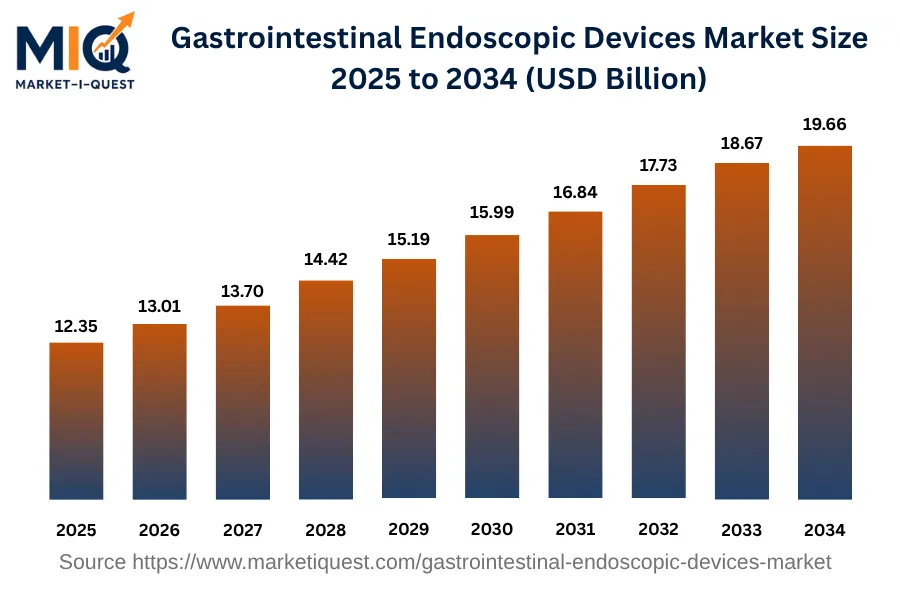
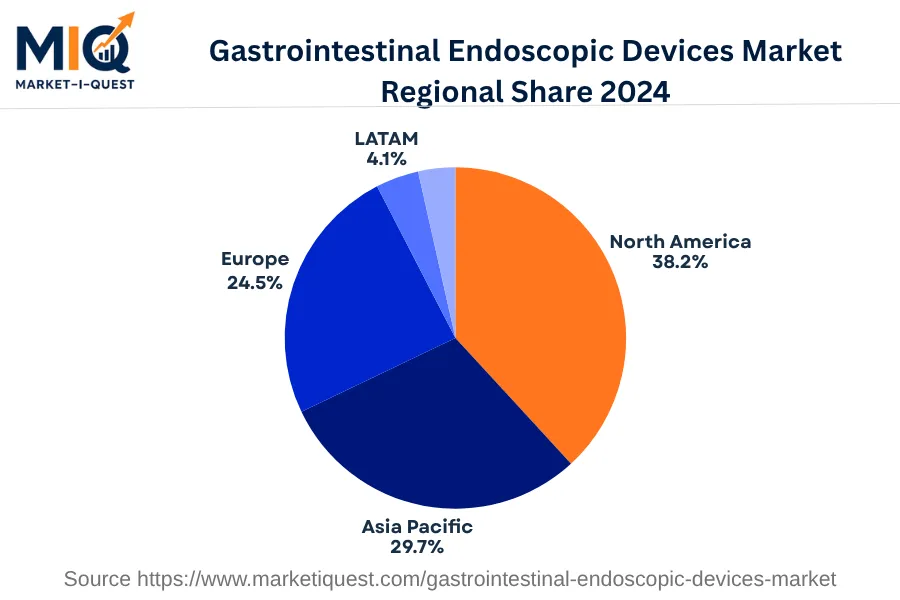
The Gastrointestinal Endoscopic Devices Market stood at 12.35 Billion USD by 2025 and is projected to grow to 19.66 Billion USD by 2034, indicating a CAGR of 5.3%. The continuous increase in the market size from the base year indicates a steady rise in the demand and application of these devices over the years. Factors such as technological advancements in the field and increased number of gastrointestinal procedures due to a higher prevalence of gut diseases significantly contributed to the expansion of this market. The market share distribution in 2024 indicated North America accounted for 38.2%, followed by Asia Pacific with 29.7%, Europe with 24.5%, LATAM with 4.1%, and MEA with 3.5% of the total share.

Key Takeaways

  • By Type - Flexible GI Endoscopes led the Gastrointestinal Endoscopic Devices Market in terms of popularity and use.
  • By End Use - Hospitals held the dominant position in Gastrointestinal Endoscopic Devices in the market.
gastrointestinal-endoscopic-devices-market market size

Key Driving Factors

Adoption of Minimally Invasive Procedures

The healthcare sector witnessed a prominent shift towards minimally invasive procedures, driving a higher demand for gastrointestinal endoscopic devices. This procedures offer several advantages over the traditional surgery methods including early recovery periods, reduced risk of complications such as infections and mitigated pain in the patients. Gastrointestinal endoscopy, specifically, is a key tool in diagnosis and therapeutics, thus gaining preference with healthcare providers globally. This shift in preference among medical professionals is a significant non-generic driver pushing demand and adoption of these endoscopic devices.

Compliance with Healthcare Regulations

Strict compliance to safety healthcare regulations and mandates is witnessed as a significant driving factor for the gastroenterology endoscopic devices market. Regulatory bodies such as the Food and Drug Administration (FDA) in the U.S. and the European Medicines Agency (EMA) in Europe significantly introduced stringency for approving medical devices to ensure safety and effectiveness. Such regulations drive manufacturers for developing superior quality endoscopic devices that meet both needs and regulatory standards of the consumers. Thus, the pressure to comply by healthcare regulations is a distinct influencer on the market growth of gastrointestinal endoscopic devices.

Market Evolution by Timeline

2019-2023
In this period, hospitals and diagnostic centers were seen as the major buyers of the devices required for essential screenings and complex surgeries. Majorly in areas such as North America and Europe saw high adoption due to increasing cases of colorectal cancer. Suppliers delivered innovations such as AI-integrated devices improving detection rate. Regulatory authorities enforced stringent regulations demanding device sterility for minimizing infections, with FDA's Unique Device Identification (UDI) system impacting device supply. Various companies began engaging in partnerships for enhancing device production and distribution. Thus, this period made significant contribution towards the growth of the market.
2024
In 2024, a key market development was the rise of ambulatory surgical centers across the Asia-Pacific region significantly expanding the buyer base. Rising geriatric population fueled the demand. Technologically, companies introduced advanced features such as disposable gastroscopes aiming for reducing cross-contamination risks. Regulations remained consistent with previous periods, while a shift in pricing model was noticed with companies offering flexible payment options. Thus, combined this significant factors within the market is subsequently led the market within this year.
2025-2029
This period will likely see increased demand from emerging economies such as India and Brazil due to growing healthcare investments. Aging population and prevalence of gastrointestinal (GI) diseases will likely remain major demand drivers. Suppliers will likely introduce devices with enhanced imaging capabilities. Regulatory will likely shift attention towards ensuring data security with the integration of AI. Pay-per-use commercial models will likely be observed, with partnerships likely form between device manufacturers and AI companies. Thus, this period will likely be significant growing period for the market.
2030-2034
The market in this period will likely see a stable rise in demand from Africa and Middle-East majorly due to improving healthcare facilities. Chronic inflammation issues will become major demand drivers. Companies focus will likely shift towards tele-endoscopy that enabled distance consultations, in certain regions limited technology roll-out. Policy regulations focused on environmental impact, recycling, and reducing device waste. A trend towards long-term leasing contracts was evident as a preferred commercial model. Thus, this period will likely be a major contributor of the market.

Future Market Outlook

Future Opportunities

As the gastrointestinal endoscopic devices market evolves, several future opportunities are emerging based on current trends and advancements in technology. The demand for early diagnosis and treatment of gastrointestinal disorders has been underscored by public health initiatives, including the World Health Organization's drive for endoscopic screening programs established in various regions. This momentum opens channels for manufacturers for developing next-generation endoscopic tools that incorporate enhanced imaging and diagnostic capabilities. Additionally, the rise in outpatient surgeries and the preference for minimally invasive procedures witnessed through the increasing usage of laparoscopic and endoscopic techniques in hospitals across Europe and North America. Companies such as Stryker are strategically positioning themselves to capitalize on these trends by expanding their portfolios with innovative products tailored for outpatient settings. Moreover, as telehealth continues to integrate into healthcare delivery, with higher possibilities of opportunities for remote monitoring solutions and connected devices that support gastrointestinal health management. The continued focus on reducing procedural risks also highlights growth potential in training and simulation tools, evidenced by the partnership between academic institutions and industry leaders to develop immersive training environments.

Segmentation Analysis

By Type

The market is divided into subsegments including Rigid GI Endoscopes, Flexible GI Endoscopes, and Disposable GI Endoscopes. Rigid GI Endoscopes accounted for the largest revenue share while Flexible GI Endoscopes are expected to grow at the fastest CAGR during the forecast period.

Largest Revenue Share

Rigid GI Endoscopes

Market Share Leader

Rigid GI Endoscopes held the largest revenue share of the market, majorly due to high durability, long lifespan and wide application field. They can be used for different types of procedures, ranging from basic to complex surgeries, making them a favorable choice by a increased number of physicians. Whereas, these scopes are widely used in hospitals across various developed countries due to the availability of advanced healthcare infrastructure. Technological advancements in rigid GI endoscopes significantly provides higher clarity and resolution in images, with early and accurate diagnosis acted as a key factors, have also contributed significantly to their revenue growth.

Fastest CAGR

Flexible GI Endoscopes

Forecast Period Growth Leader

Flexible GI Endoscopes are projected to grow at fastest growth rate segment. Majorly attributable to increasing adaptability due to advancements in technology and the benefits combined with their usage. Whereas, with offering improved comfort for patients and easier navigation for physicians as compared to other alternatives. However, partnerships between manufacturers and healthcare providers, along with capital investments towards advanced equipment, are expected to reduce this factor. The drive towards minimally invasive procedures is likely to provide substantial opportunities for this growth.

By End Use

This market's end use is divided into two critical subsegments: Hospitals and Outpatient Facilities. In 2024, Hospitals held the highest market share by revenue, while Outpatient Facilities subsegment is expected to grow at the fastest CAGR during the forecast period.

Largest Revenue Share

Hospitals

Market Share Leader

Hospitals subsegment held the largest revenue share of the market. This influence can be attributed to the constant requirement for a wide range of products and services, and a increased patient flow compared to other healthcare settings. Hospitals are the primary points of care for critical and acute patients. With focused budgets for procurement of new technologies and services, supported by government funding or private investment. The purchasing decision is primarily driven by factors such as product quality, supplier reputation and post-sales service. Whereas, the geographical distribution of hospitals is extensive, reaching even rural regions, thereby driving the demand further. Thus, the regular and high volume of purchases combined with the necessity for various products and services makes Hospitals the subsegment with the highest revenue.

Fastest CAGR

Outpatient Facilities

Forecast Period Growth Leader

The Outpatient Facilities subsegment is forecasted to witness the fastest growth rate. The growth drivers for Outpatient Facilities included the rising adoption of preventive care, increase in minimally invasive surgical procedures, and the cost-effectiveness of outpatient care. The shift from inpatient to outpatient settings is facilitated by technological advancements that enables complex procedures to occur beyond the traditional hospital setting. This shift reduces the cost of procedures, making healthcare more accessible to a larger patient population. The anticipated changes in healthcare policies and increasing partnerships between health systems and outpatient facilities will also contribute to growth.

Competitive Analysis

Key Market Players

Manufacturers & OEMs

Boston Scientific Corporation
US
Medtronic Plc
Ireland
Olympus Corporation
Japan

Key Suppliers & Raw Materials

Johnson & Johnson
US
CONMED Corporation
US
STERIS Corporation
US

Distributors, Integrators & Channel Partners

Fujifilm Holdings America Corporation
US
Pentax Medical
Japan
Stryker Corporation
US

Porter’s Five Forces Analysis

A comprehensive study of strategic factors shaping the Gastrointestinal Endoscopic Devices market landscape.

Supplier Bargaining Power

Medium

Dominance by key suppliers but technology advancements invite new players.

Buyer Bargaining Power

High

Many alternative devices and procedures available; hospitals' integrated supply chains.

Threat of Substitutes

Medium

Possible alternatives exist, but efficacy and safety of endoscopic devices remain unchallenged.

Threat of New Entrants

Low

Major market players, high R&D costs, and strict regulatory obstacles deter new entries.

Competitive Rivalry

High

Battle amongst established manufacturers; innovation-driven, with strong emphasis on technology and efficacy.

Regional Analysis

Geographic market dynamics and growth opportunities across key regions

Global Market Outlook

gastrointestinal-endoscopic-devices-market market regional share

North America

In 2024, the Gastrointestinal Endoscopic Devices market in North America experienced significant evolution driven by key factors and trends. Technological advances in minimally invasive procedures spurred demand from health providers, particularly in the United States, Canada, and Mexico. Substantial investment by manufacturers in research and development contributed to this growing trajectory. However, The Affordable Care Act and Canada's universal healthcare system encouraged greater patient accessibility to endoscopic procedures.

Simultaneously, widespread clinical trends emerged across the region. An acceleration in digital adoption was witnessed with telehealth and remote monitoring systems enhancing patient outcomes. Providers seek partnerships and M&A activities, majorly in the US, aiming to improve care delivery and broaden their market reach. Standardization became a priority, with compliance to FDA and Health Canada regulations essential for ensuring device safety and performance. These trends were seen largely within the healthcare sector and primarily targeted towards hospitals, clinics and diagnostic centers. Whereas, 2024 indicated a dynamic landscape for the market within North America, shaped by technological innovation, healthcare policies and evolving clinical practices.

Asia Pacific

In 2024, the Asia Pacific market for gastrointestinal endoscopic devices was witnessed by a rise in frequency of gastrointestinal diseases, regulatory advancements and increased healthcare investments. The ongoing pandemic highlighted the demand for efficient endoscopic devices, driving considerable demand in countries such as China, India, and Japan. Governments aimed for upgrading healthcare infrastructure, leading to a rise in the procurement of advanced endoscopic devices. Trends in technological began, including artificial intelligence and robotics, were adopted in several regions including South Korea, Australia and ASEAN markets, fostering market growth.

Consumer preference shifted towards minimally invasive procedures, indicating a shift in medical practices favoring endoscopic devices. Channel dynamics highlighted an increasing trajectory in online sales, accelerated by pandemic-induced restrictions. Including key market players, both multinational and domestic, shaped strategic partnerships enhancing their offerings and expanding their presence. Whereas, the Japanese government's drive towards standardize medical devices drove manufacturers to comply strictly to quality and safety standards. Revelatory policies implemented by Chinese and Indian governments enforced broader access to endoscopic solutions across urban and rural healthcare centers. High investments by private entities and government in healthcare in these major markets led to a notable growth in demand for gastrointestinal endoscopic devices.

Europe

In 2024, the European market for gastrointestinal endoscopic devices witnessed robust developments. Drivers such as an aging population and the frequency of gastrointestinal diseases fueled demand for these advanced medical instruments. Particularly in countries including Germany and the United Kingdom, increased investment in healthcare technology supported the adoption of recent endoscopic devices featuring enhanced operability and imaging quality. Moreover, strict regulatory protocols across Europe, such as the Medical Devices Regulation (MDR), imposed stringent standards, indirectly driving the market by demanding upgraded and compliant devices.

The shift toward minimally invasive procedures gained acceleration among healthcare institutions due to benefits such as quicker recovery and reduced complications. Such changes in medical philosophy were indicated by advancements in the technology of gastrointestinal endoscopic devices, with a rising focus on AI-enhanced instruments observed in countries such as France and Spain. There was also an increased focus on partnerships and mergers & acquisitions, with significant players pursuing to strengthen their market presence and expand their portfolio of innovative solutions. With noticeable trends in relatively less-saturated markets such as Benelux and Central & Eastern Europe, indicating significant growth opportunities for manufacturers. These market dynamics in 2024 underscore the evolving landscape of the European gastrointestinal endoscopic devices market.

Latin America

In 2024, the gastrointestinal endoscopic devices market in Latin America experienced notable growth, driven by several key factors. The significant increase in healthcare investment in countries such as Brazil, Mexico and Argentina boosted the demand for advanced endoscopic devices. Furthermore, progressive technological adoption in the medical sector, particularly in Chile and Colombia, led to the expansion of this market. Additionally, stringent health regulations prompted device improvements, contributing to market growth.

A major trend witnessed in the market was the shifting consumer behaviour, with medical facilities prioritizing minimally invasive procedures. As a result, the demand for endoscopic devices significantly increased. Technological advancements played a crucial role in paving market trends. For instance, the integration of AI in endoscopy devices adopted widely across medical institutions in Peru, changing the market landscape. Furthermore, major international companies made strategic partnerships with local companies, accelerating the distribution of endoscopic devices in LATAM. In terms of policy enforcement, the adoption of strict standards for device manufacturing and usage was seen across the region, ensuring patient safety and enhancing the quality of medical procedures.

Middle East & Africa

In 2024, the market in the Middle East and Africa experienced significant growth and increased investments. Drivers for this market surge included the rising prevalence of gastrointestinal disorders such as colon cancer, particularly in Egypt and Saudi Arabia. Furthermore, a favorable regulatory environment in countries such as United Arab Emirates and Qatar supported the adoption of advanced medical technologies, increasing the demand for these devices.

Emerging trends in this sector included a significant shift towards minimally invasive endoscopic procedures in healthcare institutions across the region, primarily in Israel, South Africa, and Kenya. There was also increased focus from the region's healthcare sector towards patient safety and clinical efficacy, fostering the adoption of high-end devices among end-users. Growing partnerships in distribution were witnessed, highlighted by medical device manufacturer Medtronic's arrangement with the United Arab Emirates and Saudi Arabia. Implementation and enforcement of stringent quality standards, particularly in the United Arab Emirates, also played a significant role in this market's growth, adding to the demand for top-tier endoscopic device providers in the healthcare sector. In Nigeria, improving infrastructure in the healthcare sector facilitated the supply and availability of these advanced medical devices.

Recent Industry Developments

Latest market innovations, product launches, and strategic initiatives

June 2026

The FDA officially issued a final rule classifying ingestible blood detection capsules into a simpler regulatory category. This structural change will make it much easier and faster for companies to get swallowable pill cameras approved and into hospitals by lowering administrative hurdles.

October 2025

Fujifilm launched its new ELUXEO 8000 Endoscopic Imaging System. This development physically combined the video processor and the light source into a single machine, cutting down the equipment needed in the operating room while giving doctors much clearer, uninterrupted video.

Frequently Asked Questions