
Flow Cytometry Market Snapshot

Key Players

  • BD Biosciences (United States)
  • Thermo Fisher Scientific (United States)
  • Miltenyi Biotec (Germany)
  • Agilent Technologies (United States)
  • Sysmex Partec (Germany)
  • Luminex Corporation (United States)
  • Merck KGaA (Germany)
  • Enzo Biochem (United States)
  • Bio-Techne (United States)
  • Beckman Coulter (United States)

Market Size

Base Year 2024
$7.86 Bn
CAGR
8.38%
Forecast 2034
$17.58 Bn

Market Segments

By Type
  • Instruments
  • Reagents
  • Software
  • Accessories
  • Services
By Technology
  • Cell Sorting
  • Cell Analyzers
  • High-Throughput Screening
  • Multicolor Analysis
By Application
  • Cell Biology
  • Immunology
  • Cancer Research
  • Pharmaceutical Development
  • Diagnostics
  • Others

Market Dynamics

Drivers
  • Increasing prevalence of diseases
  • Technological advancements in flow cytometry
Restraints
  • High Equipment Costs
  • Lack of Trained Professionals
Opportunities
  • Increasing research activities
  • Rising pharmaceutical industry demand

Market Size

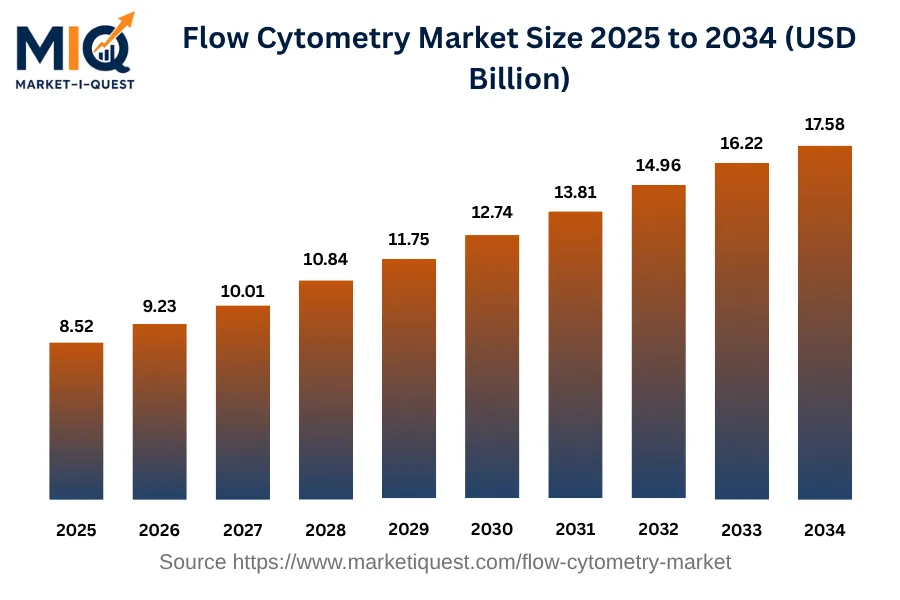
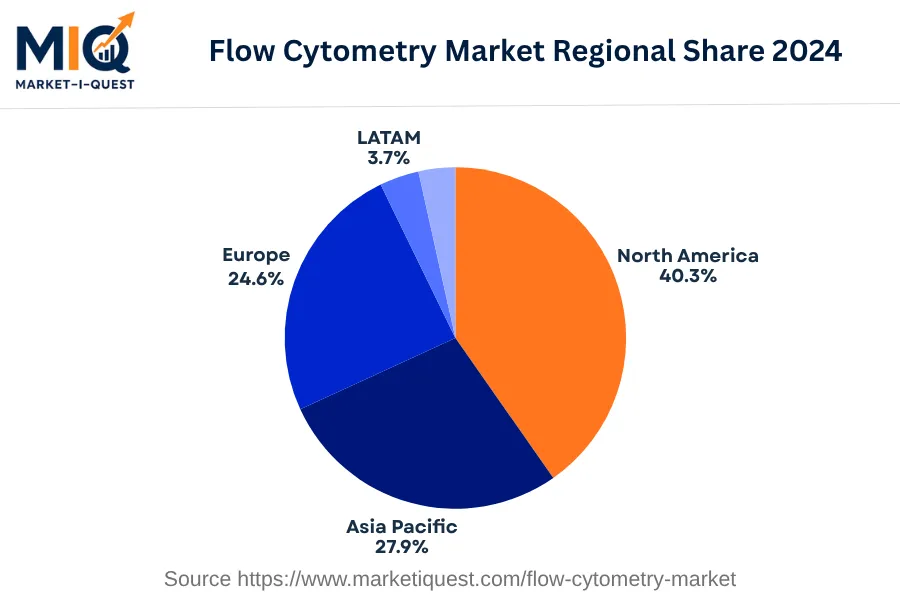
The Flow Cytometry Market was worth USD 7.86 billion in 2024 and grew to USD 8.52 billion in 2025. By 2034, the market size is expected to reach USD 17.58 billion, growing at a CAGR of 8.38%. The growth journey from 2025 to 2034 indicates a consistent rise, driven by progressing years of increasing value. This expansion results from the steady CAGR throughout the period, reflecting the market's consistent development. Discussing the 2024 regional share distribution, North America comprised the greatest portion, representing 40.28% of the market. It was followed by Asia Pacific, which held 27.86%, and Europe, which made up 24.64%. On a smaller scale, Latin America and the Middle East & Africa contributed to the rest of the market, with respective shares of 3.74% and 3.48%.

Key Takeaways

  • By Type - Services led the Flow Cytometry Market accounting for the majority market share.
  • By Technology - High-Throughput Screening is projected to expand the fastest within the forecast period of 2025–2034.
  • By Application - Cancer Research in Flow Cytometry Market dominated recording a significant share.
flow-cytometry-market market size

Key Driving Factors

Regulatory requirements in pharmaceutical quality control

One key driving factor for the Flow Cytometry Market is specific regulatory requirements in pharmaceutical quality control. Both the FDA in the US and the EMA in Europe have stringent guidelines regarding the quality of pharmaceutical products. One area they particularly focus on is cell count and cell health, parameters which flow cytometry excels at analyzing. The regulatory pressure on pharmaceutical companies to perform complex cell analysis over multiple parameters is pushing them to adopt flow cytometry, which directly influences the market's expansion in the pharmaceutical industry. Despite the high cost of these instruments, the risk of non-compliance and the associated penalties make the investment in flow cytometry worthwhile for drug makers.
The need for fast, accurate diagnosis in hematology

Another key driver for the Flow Cytometry Market is the need for rapid, accurate diagnosis in the hematology sector of healthcare, especially in relation to leukemia and lymphoma. These diseases require the differentiation of white blood cells, a task for which flow cytometry is especially well-suited. Patent Flow cytometry systems have the advantage of providing quick results - often within hours - which aids in the prompt initiation of treatment. The urgency associated with these life-threatening diseases is a strong driving factor behind the adoption of flow cytometry in hematology laboratories worldwide. While the technology has been around for several years, its relevance is ever-increasing due to rising global incidence of blood cancers.

Market Evolution by Timeline

2019-2023
In the period 2019-2023, Flow Cytometry Market saw increased demand largely from healthcare and research institutions, primarily in North America and Europe, due to higher incidence of diseases such as cancer and HIV. The market observed shipments of automatic sample preparatory systems and high-throughput flow cytometers. However, the integration of these technologies remained a challenge due to high equipment costs. Notable policy influence was the implementation of the European Union's General Data Protection Regulation (GDPR), which affected data management in cytometry. Typically, the market operated on the model of outright purchase with lesser leasing options. Overpricing of antibodies posed a risk of procurement, which suppliers attempted to mitigate with bulk purchase offerings.
2024
Throughout 2024, the Flow Cytometry Market had increased adoption in Asia, specifically India and China, driven by growth in healthcare infrastructure. Portable flow cytometers and imaging systems were the key technology pilot projects. Fragmentation of supply chains due to global economic uncertainties proved a constraint to technology distribution. Regulatory changes included the introduction of China's Personal Information Protection Law (PIPL) that affected data handling practices. The commercial model evolved to payment plans and partnerships with local distributors to increase accessibility. The dilemma for the period was handling price hikes in raw materials, which industry addressed by sourcing alternatives.
2025-2029
In 2025-2029, research in stem cells and immunology boosted Flow Cytometry Market demand, with substantial off-take in United States and United Kingdom. Advanced technologies like spectral flow cytometry and multiparameter systems became more prevalent, despite challenges in standardizing new protocols. On the regulatory front, the adoption of ISO 20387:2018 for biobanking standards influenced cytometry procedures. The trend toward third-party service agreements became prominent in the commercial model. Risks included lack of skilled professionals which companies started to counteract by investing in workforce training programs.
2030-2034
During 2030-2034, applications in drug discovery led to aggregation of Flow Cytometry Market demand in the pharmaceutical sector, noticeably in countries like Germany and Japan. Time delay integration (TDI) flow cytometry and benchtop instruments were the foremost technologies delivered. The major constraints lay in energy consumption of the devices. Notably, the Global Harmonization Task Force's (GHTF) guidance on medical devices shaped public policy and regulation. A show of commercial flexibility was burgeoning subscription and service-based models. The persistent issue of biohazardous waste management posed a risk, calling for development of sustainable disposal solutions.

Future Market Outlook

Future Opportunities

The flow cytometry market holds promising opportunities driven by evolving healthcare needs and technological integration. As of 2022, the demand for personalized medicine has intensified, prompting a focus on advanced hematological diagnostics. Major companies, like Beckman Coulter, are actively developing flow cytometry solutions tailored to monitor treatment responses in oncology, presenting a clear trajectory for growth in clinical applications. Regulatory support for precision medicine is also increasing, as evidenced by the FDA’s recent initiatives to streamline approval processes for innovative diagnostic technologies. Additionally, the rising prevalence of autoimmune diseases in countries like the United States and Germany is expected to encourage further investments in diagnostic tools. Collaborations between academia and industry, such as the partnership between National Institutes of Health and various biotech firms, are facilitating innovative R&D that could bolster the use of flow cytometry in detecting rare diseases. Furthermore, heightened awareness about cellular therapies is driving interest in flow cytometry as researchers investigate new therapeutic modalities. The adoption of user-friendly software by companies such as Sony Biotechnology offers opportunities for laboratories to increase their operational efficiency while managing complex datasets. Together, these factors underscore the potential for significant advancements in flow cytometry applications, paving the way for innovations that address unmet medical needs and improve patient outcomes.

Segmentation Analysis

By Type

The market is divided into subsegments including Instruments, Reagents, Software, Accessories, and Services. Services accounted for the largest revenue share while Software is expected to grow at the fastest CAGR during the forecast period.

Largest Revenue Share

Services

Market Share Leader

In this industry, the Services sector frequently secures the largest revenue stream, for a number of considerable reasons. Firstly, these services often play a critical role in the ongoing maintenance, repair, and optimization of instruments, which are essential to the functional logistics of the industry. Moreover, in many cases, the optimization they offer improves productivity and reduces long-term costs for customers. The services rendered also often require specialized expertise, which contributes to the higher cost hence higher revenue generation. Services are typically seen as integral to the operations across all geographies, thereby increasing their prevalent and almost omnipresent demand. Additionally, regulatory requirements often necessitate certain services to ensure compliance, further contributing to the high revenue generation. Lastly, the significant switching costs associated with transferring between service providers enhance customer loyalty and thus steady and large-scale revenue.

Fastest CAGR

Software

Forecast Period Growth Leader

Software, while not representing the largest segment by revenue, is the subsegment expected to exhibit the highest CAGR in the forecast period. The driving forces behind this fast growth can be attributed to an increasing dependence on digitization and data analysis. With the evolution of technology, processes are becoming more automated, increasing the reliance on software for efficient workflow management. Innovations in information technology are expected to act as catalysts, fostering growth in this segment. The perceived barriers to adoption, such as high initial capex or technical challenges, are progressively being eliminated through industry partnerships and collaborative solutions, thus accelerating uptake. However, near-term risks such as stringent data regulations and cyber-security threats might impede the swift growth rate in certain regions. Nevertheless, the long-term outlook appears strong, and the adoption of software is expected to grow at a higher pace than other subsegments.

By Technology

The technology segment is categorized into subsegments: Cell Sorting, Cell Analyzers, High-Throughput Screening, and Multicolor Analysis. Among these, Cell Analyzers has the largest revenue share whereas High-Throughput Screening is anticipated to record the most rapid CAGR during the forecast period.

Largest Revenue Share

Cell Analyzers

Market Share Leader

Cell Analyzers made the most significant contribution to revenue in 2024, driven by their widespread adoption in various fields such as hematologic research, immunology, molecular biology, oncology, and microbiology. The key drivers for this segment expansion are the increasing prevalence of diseases requiring cell analysis, like cancer, and the demand for faster, efficient, and effective technologies for disease detection. Dominance in lucrative regions such as North America and Europe, where high-tech medical facilities are extensively adopting these devices, can't be overlooked. Additionally, regulations governing cell analysis in critical areas like stem cell research have prompted increased usage of cell analyzers. The purchasing criteria sway towards these analyzers due to their advanced capabilities in cell counting, protein detection, and other vital analyses, making them indispensable in diagnostics and research. The relatively high switching costs limit the shift towards other technologies, providing a stable customer base for this subsegment.

Fastest CAGR

High-Throughput Screening

Forecast Period Growth Leader

High-Throughput Screening is predicted to have the fastest CAGR outlook, driven by evolving technology and its immense potential in drug discovery, genomics, and proteomics. Technological catalysis plays a significant role in its growth, where the continual miniaturization and automation of the screening processes facilitate increased throughput and efficiency. However, adoption barriers such as high initial setup costs and the need for skilled personnel may challenge its growth. Partnerships with tech companies or academic institutions are considered a pivotal strategy to overcome these hurdles and accelerate the transition from traditional methods. Meanwhile, anticipated, supportive policy changes and increasing capital expenditures on research and development areas present immense future potential. However, near-term risks include limited applicability in certain areas of research and evolving regulatory protocols which could temporarily hinder the subsegment's growth at its current pace.

By Application

The market is divided into subsegments including Cell Biology, Immunology, Cancer Research, Pharmaceutical Development, Diagnostics, and others. Cancer Research accounted for the largest revenue share while Diagnostics is expected to grow at the fastest compound annual growth rate during the forecast period.

Largest Revenue Share

Cancer Research

Market Share Leader

Cancer Research is the most prominent player in this segment due to the high prevalence of chronic diseases worldwide. In addition to this, advancements in personalized treatments, early diagnosis, and the demand for oncology drugs have been vital in driving revenue. Customers for this segment include hospitals, clinics, pharmaceutical companies, and research institutions. Regulation is also a key factor affecting this market. Numerous government and non-government organizations are taking initiatives that support cancer research and demand innovative therapies. The purchasing criteria include efficiency, therapeutic benefits, and safety of the drugs. The patient demand for personalized treatment combined with high switching costs adds to the robust nature of the Cancer Research market. Sales are mostly done through direct channels or partnerships with hospitals and clinics.

Fastest CAGR

Diagnostics

Forecast Period Growth Leader

Diagnostics is expected to grow at the fastest rate among the subsegments. The main levers for growth in this area include the integration of advanced technologies, high incidence of chronic diseases, and increasing awareness regarding early diagnosis. Still, there are barriers to adoption that temper rate of expansion, such as high costs and regulatory complexities. However, capital investments and partnerships with healthcare institutions are encouraging growth. Furthermore, artificial intelligence and machine learning are acting as catalysts in this field by introducing new diagnostic tools with quicker and more accurate results. However, the risk lies in the rapidly evolving technology and the pressure to keep up with it without compromising accuracy and reliability.

Competitive Analysis

Key Market Players

Manufacturers / OEMs

Becton, Dickinson and Company
US
Thermo Fisher Scientific Inc.
US
Beckman Coulter, Inc.
US

Key Suppliers & Raw Materials

Bio-Rad Laboratories, Inc.
US
Miltenyi Biotec
Germany
Agilent Technologies, Inc.
US

Distributors, Integrators & Channel Partners

Sysmex Partec GmbH
Germany
Fluidigm Corporation
US
Stratedigm, Inc.
US

Porter’s Five Forces Analysis

This analysis explores the competitive forces within the Flow Cytometry Market.

Supplier Bargaining Power

Medium

Suppliers have power due to the specialized nature of cytometry equipment and components.

Buyer Bargaining Power

High

Buyers, often large research and healthcare institutions, have significant leverage over pricing and terms.

Threat of Substitutes

Low

Few alternative technologies can match the specificity and throughput of flow cytometry.

Threat of New Entrants

Medium

High capital expenditure is required, but technological innovation may allow new entrants.

Competitive Rivalry

High

Intense competition exists, with several major biotechnological firms dominating the market.

Regional Analysis

Geographic market dynamics and growth opportunities across key regions

Global Market Outlook

flow-cytometry-market market regional share

North America

In 2024, the North American Flow Cytometry Market experienced a significant dynamic shift. Contributing drivers included the escalating incidence of diseases such as cancer that require cytometry for diagnosis and treatment, particularly in the United States. Regulatory reforms in healthcare, notably in Canada, spurred further adoption of flow cytometry technologies across medical institutions. Largely consistent investment in biotechnology research, with Mexico notably increasing its funding, also played a key role in market growth. Key trends reshaping the market landscape were the growing consumer preference for flow cytometry in clinical research and the shift towards advanced detection techniques. Pharmaceutical enterprises and academic institutions majorly drove these preferences with their collaborative partnerships.

The advent of technologically advanced products, such as compact flow cytometers and spectral flow cytometers, further intensified market competition. Additionally, a notable trend was the intensified policy enforcement by bodies like the FDA to monitor the standardization and quality of flow cytometry products. Patient groups, healthcare providers, and drug developers were the primary customers. In the retail sector, a rise was observable in direct-to-consumer sales from biotech manufacturers. Utilities companies increased their usage of flow cytometry for water quality testing. The growing use in utilities and retail accompanied the long-established flow cytometry demand in healthcare and research sectors, signaling a diversified customer base for this market in North America in 2024.

Asia Pacific

In 2024, the Asia Pacific Flow Cytometry market witnessed substantial growth, primarily driven by increased demand for advanced diagnostic techniques within the healthcare sector. Rapid urbanization and escalating prevalence of diseases like cancer in China, India, and Japan enhanced the requirement for flow cytometry, thereby strengthening its market position. Regulative support from government bodies in Australia, China, and key ASEAN markets contributed to substantial market expansion, particularly in biotechnological and pharmaceutical research. The increased healthcare funding and technological adoption across South Korea and Japan also fuelled this dynamic market.

Concurrently, the trend for personalized medicine and immunology studies in India and China evidently shaped the market. A significant shift towards compact flow cytometry equipment was palpable in Japan and Australia due to the mounting need for point-of-care testing. Channel dynamics were shaped by several partnerships and M&As, especially in pharmaceutical manufacturing and academic institutions, to expedite drug discovery processes. While novel product launches dominated the market in South Korea and various ASEAN countries, the widespread enforcement of quality standards and policies in Australia guaranteed reliable and safe flow cytometry practices. These drivers and trends stimulated the flow cytometry market across different sectors, including healthcare, manufacturing, and academia in the Asia Pacific region.

Europe

In 2024, the European flow cytometry market experienced significant growth due to diversified application across sectors. Increased demand for flow cytometry in diagnosing diseases such as cancer, HIV, and hematological disorders emerged as key drivers. Furthermore, investment in research & development, particularly in the healthcare sectors of Germany, the United Kingdom, and France, led to progressive technology adoption, thereby propelling market growth. Sustainable pricing in the Nordics and Benelux also increased market accessibility.

New trends were noticeable in buyer behavior, with the healthcare industry's preference shifting towards innovative flow cytometry products that deliver more accurate and efficient results. Product technological advancements, such as the rise of more compact, user-friendly cytometers, significantly reshaped the market landscape. An increase in partnerships and M&As, mainly in Italy, Spain, and Central & Eastern Europe, stimulated sector expansion and strengthened competitive dynamics. Furthermore, the implementation of standardization policies within the EU facilitated quality assurance and product safety, fostering trust among consumers. The robust presence of enterprise customers, particularly from the pharmaceutical, biotechnology sectors, and diagnostic laboratories, augmented the market's potential in Europe.

Latin America

In 2024, the Latin American (LATAM) flow cytometry market truthfully manifested its potential, majorly influenced by economic advances and surges in healthcare investments. The demand for flow cytometry dramatically escalated due to its pivotal role in disease diagnosis, notably in countries including Mexico, Brazil, Colombia, and Argentina where healthcare infrastructure significantly improved. Concurrently, Chile and Peru saw significant regulatory reforms promoting technological adoption in the healthcare sector, augmenting the market's supply side favorably. Moreover, a clear trend confirmed that healthcare institutions were transitioning towards digital platforms, enhancing the accessibility to flow cytometry, mirrored across sectors from government-run hospitals to private healthcare providers. This shift towards digitalization facilitated an upswing in strategic partnerships between local institutions and international biotechnology firms, primarily observed in Argentina and Mexico. Brazil displayed another trend where the enforcement of stringent quality control policies led to a rise in flow cytometry market standards.

Furthermore, the LATAM region noted a rise in cell research activities within universities and research institutes, delightfully expanding the customer base beyond traditional healthcare providers. These research activities primarily revolved around immunology, cell biology, and hematology, strengthening LATAM's position in the global flow cytometry market. These activities were more visible in countries such as Brazil and Colombia, where investment in research and development has been strong. Simultaneously, the adoption of flow cytometry stretched to other sectors like pharmaceutical manufacturing, endorsing a multi-faceted application spectrum.

Middle East & Africa

In the base year 2024, the Flow Cytometry market in the Middle East and Africa demonstrated notable growth due to increasing adoption in healthcare facilities. Drivers behind this growth include increasing investments in healthcare infrastructure especially in countries like Saudi Arabia, UAE, and South Africa. Countries like Qatar and Egypt saw regulations becoming more favorable for advanced medical devices, encouraging adoption of flow cytometry in cancer research, genetic testing, and drug discovery. Furthermore, technological advancements, particularly in Israel, drove up the supply and adoption of modern, more efficient flow cytometry units. Market trends observed in the region involve shifts in purchasing behaviors. Healthcare facilities in regions such as Nigeria and Kenya shifted towards more cost and efficiency effective units. A rise in partnerships and mergers was observed, particularly in the UAE where healthcare giants formed alliances with local distributors to support product availability. Standards and regulations were strictly enforced in Israel, pushing manufacturers to provide high-quality cytometry units.

Sector-specific details reveal that the majority of clients for Flow Cytometry market were healthcare service providers, pharmaceutical and biomedical research institutes. In the base year, primary customers included governmental and private hospitals, diagnostic labs, and academic institutions. Essentially, these trends and drivers underscore the shifting dynamics of the Flow Cytometry Market across the Middle East and Africa in 2024.

Recent Industry Developments

Latest market innovations, product launches, and strategic initiatives

June 2026

Beckman Coulter Life Sciences (a Danaher company) acquired the flow cytometry business assets of Bangalore-based ReaMetrix India Pvt Ltd for an undisclosed amount. The deal helps Beckman Coulter expand its reach in HIV monitoring and clinical research, with ReaMetrix products complementing Beckman's portfolio with room temperature-stable, unitized flow reagents.

July 2025

Waters Corporation announced a definitive agreement to acquire BD's Biosciences & Diagnostic Solutions business in a deal valued at **$17.5 billion**. The transaction is expected to close around the end of the first quarter of 2026. The acquisition combines Waters' expertise in analytical instruments with BD's strong flow cytometry portfolio, doubling Waters' total addressable market to approximately $40 billion.

Frequently Asked Questions