Flow Chemistry Market Snapshot

Key Players

  • ThalesNano Inc. (Hungary)
  • Cambridge Reactor Design Ltd (UK)
  • Vapourtec Ltd (United Kingdom)
  • Chemtrix BV (Netherlands)
  • AM Technology (UK)
  • FutureChemistry Holding BV (Netherlands)
  • Syrris Ltd (United Kingdom)
  • Corning Incorporated (US)
  • Lonza Group Ltd (Switzerland)

Market Size

Base Year 2024
$2.48 Bn
CAGR
10.67%
Forecast 2034
$6.84 Bn

Market Segments

By Reactor Type
  • CSTR (Continuous Stirred-Tank Reactor)
  • Plug Flow Reactor
  • Microreactor
  • Microwave Systems
  • Others
By Application
  • Pharmaceuticals
  • Chemicals
  • Academia & Research
  • Petrochemicals
  • Others

Market Dynamics

Drivers
  • Increasing pharmaceutical industry growth
  • Advancements in flow chemistry technologies
Restraints
  • High equipment costs
  • Lack of awareness in developing regions
Opportunities
  • Pharmaceutical Industry Expansion
  • Increasing Research Activities

Market Size

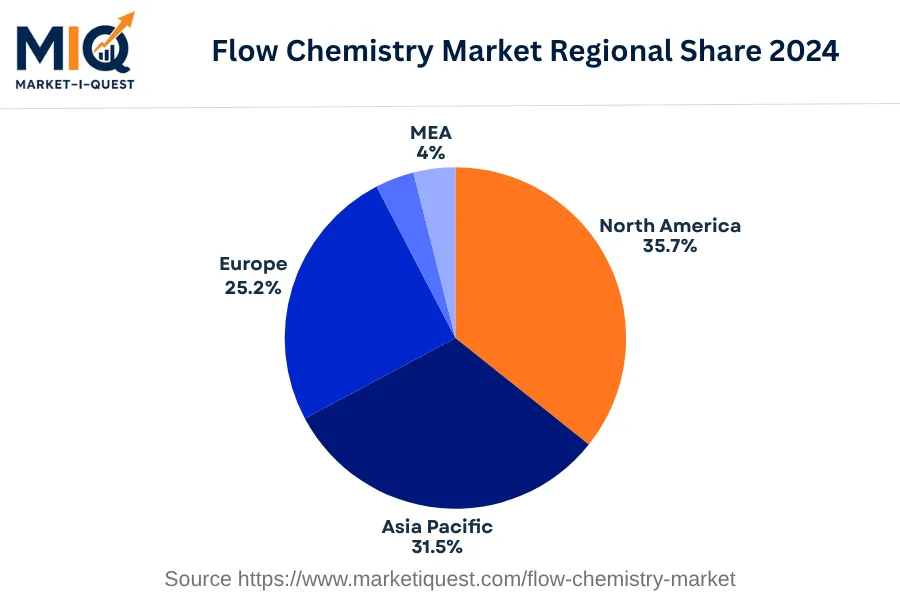
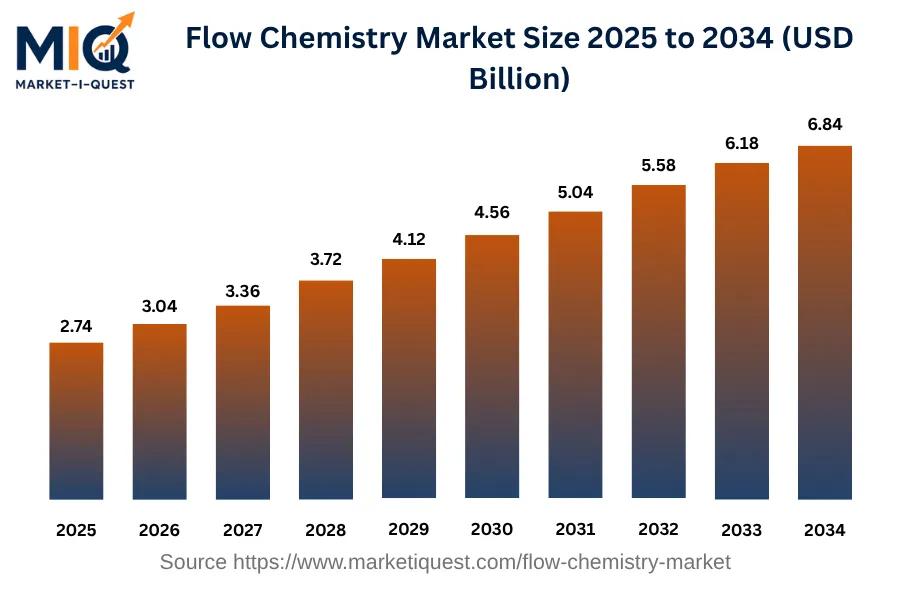
The Flow Chemistry Market will expand from a value of USD 2.74 Billion in 2025 to reach USD 6.84 Billion by 2034, with a compound annual growth rate (CAGR) of 10.67%. This growth depicts a significant expansion of the industry over the course of a decade. The growth trajectory of the market is such that it increases by over double from the pre-established market size of USD 2.48 Billion in 2024. The progression indicates an undeniable growth in the demand for this sector. In 2024, the regional share for North America was 35.72%, followed by Asia Pacific at 31.46% and Europe at 25.18%. These three regions held the majority of the market share, while LATAM and MEA accounted for a smaller portion with 3.68% and 3.96% respectively. This distribution portrays region-wise consumption and demand patterns in the Flow Chemistry Market industry.

Key Takeaways

  • By Reactor Type - CSTR (Continuous Stirred-Tank Reactor) led the Flow Chemistry Market share in 2024.
  • By Application - Pharmaceuticals held top position in the Flow Chemistry Market in 2024.
flow-chemistry-market market size

Key Driving Factors

Implementation of Green Manufacturing Processes

Many industries, including pharmaceuticals, are shifting their focus to eco-friendly procedures in line with global environmental goals. Flow chemistry fits this need; its continuous flow processes significantly reduce the level of waste generated. It's also more energy-efficient as the heat transfer is more effective in a flow reactor. The result is a decrease in energy usage, which minimally contributes to greenhouse gases. This shift towards sustainable industrial procedures also aligns with many corporate social responsibility initiatives, thereby driving the adoption of flow chemistry in multiple sectors.

Safety Considerations in Chemical Reactions

Flow chemistry is preferred for reactions that are hazardous in batch processes. Unlike traditional batch reactions, flow chemistry allows the reactions to occur in a confined space, which controls the release of hazardous intermediate chemicals. Additionally, exothermic reactions can be regulated more efficiently, reducing the chances of explosive reactions. Industries that depend heavily on chemical reactions, such as petrochemical and chemical manufacturing, are therefore adopting flow chemistry methods to ensure safety. By alleviating safety risks and potential hazards, flow chemistry increases its value in the market.

Market Evolution by Timeline

2019-2023
During this period, the primary buyers of flow chemistry were pharmaceutical companies looking to enhance drug manufacturing and chemical industries aiming to boost production efficiency. Region-wise, North America led this trend, followed by Europe. Meanwhile, suppliers shipped complete and integrated continuous flow reactors, although device adoption encountered constraints related to scalability and high upfront investment. Regulatory wise, the US Food and Drug Administration's Process Analytical Technology (PAT) framework shaped adoption, encouraging real-time quality assurance in pharmaceutical production. Typical contracts involved suppliers providing both equipment and customization services, with primary partnerships within the industrial sector. A significant risk was the need for substantial training, addressed by providers offering comprehensive user training.
2024
In 2024, the flow chemistry market observed an increased adoption from academic research institutions, especially in the Asia-Pacific region, exploring sustainable chemistry applications. Supplier-wise, there was an emphasis on automation and miniaturization with pilot plants investing in microreactors, although the capital cost remained a hindrance for small-scale industries. Regulations remained aligned with environmental sustainability, exemplified by China's Green Manufacturing 2025 initiative prompting cleaner industrial processes, including flow chemistry. Commercially, long-term contracts became more common, with mutual benefit partnerships between suppliers and institutions. Skill shortage was identified as an ongoing risk, typically mitigated by supplier-conducted seminars and training sessions.
2025-2029
Over these years, the scope of flow chemistry expanded to components for renewable energy devices, notably in Europe and Middle East. Suppliers began offering modular reactors, eased integration challenges but supply chain disruptions caused complications due to geopolitically focused technology walls. Policies like European Union's Horizon 2020 program funded projects promoting green chemistry and sustainability, indirectly benefiting flow chemistry. There was a shift towards Pay-Per-Use models and contracts included maintenance and servicing clauses. Potential supply-chain risks were common, reduced by constructing local manufacturing units and establishing multiple supplier relations.
2030-2034
From 2030 to 2034, chemical production for electric vehicle battery was a significant demand driver, particularly in North America and Asia. Suppliers provided intelligent flow reactors with better computing capabilities, but high energy consumption remained a major constraint. The United Nations Industrial Development Organization's environment-friendly industry standard indirectly propagated flow chemistry. The market saw increasing subscription-based pricing models, with contracts prioritizing data security due to the intelligent nature of these devices. The primary risk, energy inefficiency, was typically controlled by implementing energy-saving best practices.

Future Market Outlook

Future Opportunities

The ongoing evolution of flow chemistry presents substantial future opportunities, particularly in the pharmaceutical and specialty chemicals sectors, where continuous reactions can improve production processes. Companies like Merck have already begun to explore the integration of flow chemistry into their manufacturing techniques, enhancing their ability to produce complex molecules more efficiently. As regulations such as the REACH (Registration, Evaluation, Authorisation, and Restriction of Chemicals) framework in Europe strengthen the emphasis on sustainable practices, there is increased pressure on manufacturers to adopt more eco-friendly methods. The global shift toward personalized medicine offers pathways for flow chemistry as well, as this technology allows for more flexible production schedules and rapid reactions needed for tailored therapies. Commercialization efforts are intensifying, as evidenced by Chemtrix's partnerships with various biotech firms to develop customized continuous flow processes, addressing unique synthesis challenges. Furthermore, the increasing collaboration between technology firms and chemical manufacturers, like the partnership between Chemtrix and DSM, is fostering innovation in process efficiency and material use. Additionally, emerging markets in Asia, particularly China and India, show great potential due to their expanding pharmaceutical sectors and commitment to adopting modern manufacturing technologies. As environmental concerns continue to influence policies worldwide, flow chemistry's ability to conform to these demands will likely drive its adoption and development in various sectors, creating new avenues for growth.

Segmentation Analysis

By Reactor Type

The market delineates into subsegments including CSTR (Continuous Stirred-Tank Reactor), Plug Flow Reactor, Microreactor, Microwave Systems, and others. Out of these, the CSTR constitutes the majority of the market revenue while the Microreactor subsegment shows the fastest growth.

Largest Revenue Share

CSTR (Continuous Stirred-Tank Reactor)

Market Share Leader

CSTRs have dominated the reactor market due to their unique characteristics and diverse applicability in the chemical industry. These Continuous Stirred-Tank Reactors provide superior control over reaction parameters such as temperature and pressure, enabling businesses to calibrate their chemical processes for optimized production. Additionally, the flexibility offered by CSTRs in conducting a broad spectrum of reactions, including exothermic, endothermic, and autocatalytic reactions, contributes to their high demand. In terms of customer base, industries ranging from pharmaceuticals and petrochemicals to food processing utilize these reactor types, thus driving the higher revenue share. Their popularity across various geographies also stems from their scalability that allows large volume production, integral to industrial operations. The regulatory environment and supply dynamics are also favorable, as the components used are generally standard and compliant with process safety regulations in many countries. Lastly, switching costs are relatively high due to the specialized nature of chemical reactors, providing CSTRs with a steady market presence.

Fastest CAGR

Microreactor

Forecast Period Growth Leader

The Microreactor segment is poised for rapid expansion, bolstered by its inherent capabilities and an evolving landscape of chemical processing. The trend is accelerating towards process intensification, miniaturization, and safer manufacturing procedures, which is exactly where Microreactors hold a strong edge. They reduce the risk associated with chemical processes by minimizing the inventory of dangerous substances, while their implementation often leads to more efficient conversions and higher selectivity. Adoption barriers, though present, are outweighed by these benefits and are likely to diminish as technological advancements make Microreactors more accessible. Policy support, targeted for greener and safer production processes, acts as a key catalyst, too. Furthermore, capital expenditure, though substantial initially, is offset in the longer term due to lower operational costs and resource efficiency. Current market players are actively engaging in strategic partnerships to leverage this burgeoning technology, while the risk from competitors entering late into the market is minimal and predictable in the near term.

By Application

The market is divided into subsegments including Pharmaceuticals, Chemicals, Academia & Research, Petrochemicals, and Others. Among these, Pharmaceuticals account for the largest revenue share whereas Academia & Research is projected to exhibit the fastest growth during the forecast period.

Largest Revenue Share

Pharmaceuticals

Market Share Leader

Pharmaceuticals, as a sub-segment, is leading the market in terms of revenue generation. This dominance is primarily attributable to factors such as the constant need for extensive drug discovery and development processes, and the numerous clinical trials conducted in this sector. This industry utilizes a wide range of products and services which further contributes to its large market share. Additionally, this sub-segment is driven by favorable regulatory policies that encourage pharmaceutical research and development. High purchasing power in this industry also contributes significantly to the revenue share. The market in high-income countries is characterized by the active presence of several global pharmaceutical companies, thus providing a steady customer base. This sector is relatively resistant to switching costs due to the critical nature of its operations. Lastly, the reliance on a variety of channels, including direct sales and distributors, ensures consistent market coverage.

Fastest CAGR

Academia & Research

Forecast Period Growth Leader

The Academia & Research segment is estimated to witness the fastest growth in comparison to other subsegments. This growth will be stimulated by the increasing investments in research and development, partnerships between academic institutions and industries, and the surge of government funding for scientific research. Progress in technology, which enables more efficient and accurate data collection and analysis, also serves as a catalyst for growth in this sector. However, challenges such as the high capital expenditure required to establish research laboratories and the barrier of institutional adoption may slow down the growth. Despite these challenges, the increasing demand for innovative solutions and the adoption of novel research methodologies provide a favorable growth outlook for this subsegment. As we move forward, it's imperative to pay close attention to these trends, and understand the potential risks including regulatory changes and economic instabilities that might disrupt the projected growth trajectory.

Competitive Analysis

Key Market Players

Manufacturers / OEMs

Chemtrix
Netherlands
Corning Incorporated
US
ThalesNano Energy
Hungary

Key Suppliers & Raw Materials

Eastman Chemical Company
US
Solvay
Belgium
CCP (Nanjing) Chemicals
China

Distributors, Integrators & Channel Partners

International Labmate
UK
Zaiput Flow Technologies
US
Uniqsis Ltd
UK

Porter’s Five Forces Analysis

This analysis outlines the competitive pressures in the Flow Chemistry market.

Supplier Bargaining Power

Medium

Limited number of suppliers can control equipment prices, however, commodity chemical inputs limit their power.

Buyer Bargaining Power

High

Buyers have various suppliers to choose from, fostering price competition.

Threat of Substitutes

Low

Unique benefits and efficiency of flow chemistry minimize threat of substitutes.

Threat of New Entrants

Medium

Technical adeptness required but low regulatory barriers and growing market appeal to new entrants.

Competitive Rivalry

High

Several established firms aggressively compete with innovations and pricing strategies.

Regional Analysis

Geographic market dynamics and growth opportunities across key regions

Global Market Outlook

flow-chemistry-market market regional share

North America

In 2024, the North American market for flow chemistry, a technology used in a variety of industries including pharmaceuticals and petrochemicals, experienced notable changes. Major drivers of this market included increasing research and development budgets in the pharmaceutical industry, heightened demand for cost-efficient and sustainable industrial processes, and stringent environmental regulations requiring cleaner production methods. For instance, the US Environmental Protection Agency's regulations enforced in the chemical manufacturing sector prompted many businesses to adopt flow chemistry. Simultaneously, trends that shaped the North American flow chemistry market encompassed a shift towards continuous processing in the chemical sector, the rising popularity of flow chemistry courses in academic institutions, and a marked increase in joint ventures and strategic alliances amongst key players.

In particular, partnerships between technology providers and pharmaceutical companies were evident, such as the collaboration between Velocys, a key flow chemistry equipment provider, and British Petroleum in the US. The healthcare sector, primarily pharmaceuticals, and the manufacturing sector, notably petrochemicals and agrochemicals, emerged as significant customers. Additionally, governmental bodies participated in the market indirectly through policy enforcement and funding support, thereby influencing market dynamics in 2024.

Asia Pacific

In 2024, the Asia Pacific Flow Chemistry Market exhibited robust growth due to increasing demand, regulations, technology adoption, and favorable investment. A rising demand for energy-efficient manufacturing processes, primarily in China and India, contributed to the growth. South Korean government regulations promoting the use of cleaner and safer chemical processes spurred adoption of flow chemistry in pharmaceutical and chemical industries. Investment by major players like Australia’s CSIRO and Japan’s JFE Engineering, who have prioritized sustainable and cost-effective production methods, amplified the market dynamics. Market trends revealed an increased inclination towards adoption of microreactor systems for chemical synthesis, alluding to a shift from batch reactors to continuous reactors, particularly in key ASEAN manufacturing markets.

A surge in strategic partnerships like the one between India's Piramal Pharma and China's WuXi AppTec aimed at enhancing flow chemistry applications in pharma was observed. Initiatives like South Korea's Eco-Innovation policy enforcement increased focus on utilizing flow chemistry for waste reduction in chemical processes. Customers primarily came from the pharmaceutical, petrochemical, and agrochemical sectors, with a spike in demand from enterprise-scale manufacturers in India and Japan. The utilities sector in Australia and retail markets in China also showed robust adoption rates. The market dynamics in 2024 demonstrated Asia Pacific’s commitment to adopting greener and safer chemical processes.

Europe

In 2024, the European Flow Chemistry Market witnessed significant growth due to various drivers and unfolding trends. Investment in pharmaceutical and chemical industries skyrocketed in key European countries such as Germany, France, and the United Kingdom, fueling the demand for flow chemistry. This was further propelled by stringent environmental regulations across Europe that necessitated adoption of greener and efficient technologies like flow chemistry. Additionally, rapid technology adoption in Central & Eastern Europe contributed to the expansion of this market.

Shoppers leaned towards chemical manufacturers who championed sustainable practices, causing a notable shift towards flow chemistry technology. This trend was most pronounced in Italy and Spain, where consumer awareness about eco-friendly processes was particularly high. Synergistic partnerships flourished across the region, especially within the Nordics and Benelux, where collaborations between pharmaceutical manufacturers and distributors intensified, thereby harmonizing the distribution channels. Increased policy enforcement in these regions ensured compliance with sustainable practices, driving the transition from batch production to flow chemistry systems. Key sectors that significantly adopted flow chemistry included pharmaceuticals, chemicals, academia, and petrochemicals. These industries, particularly within Germany and the United Kingdom, showed a heightened inclination towards flow chemistry due to its advantages in safety and efficiency.

Latin America

In 2024, the Flow Chemistry market in Latin America exhibited dynamic advancements, primarily propelled by the pharmaceutical, petrochemical, and agrochemical sectors. The market's growth was driven by an increased need for cost-effective and sustainable manufacturing processes, leading countries like Brazil and Argentina to invest in flow chemistry technology. In Mexico and Colombia, stricter environmental regulations necessitated the adoption of efficient systems like flow chemistry that reduce waste and hazardous emissions. A rising demand for high-quality pharmaceutical products in Chile and Peru resulted in a higher implementation of flow chemistry to enhance process control and increase scalability.

Market trends included a noticeable shift towards continuous processing in the pharmaceutical sector, exemplified by leading companies in Brazil and Argentina. In Mexico and Colombia, there was an increased emphasis on collaborations between educational institutions and industries to foster innovation in this field. Moreover, safety standards and policies were strictly enforced, particularly in petrochemical industries across the region, encouraging the adoption of safer processes like flow chemistry. In 2024, the LATAM Flow Chemistry Market's activity was closely linked to sectors such as petrochemicals, pharmaceuticals, and agrochemicals, each playing a decisive role in the technology's integration into traditional manufacturing practices.

Middle East & Africa

In 2024, the Flow Chemistry market created substantial traction in the Middle East and Africa, particularly in the pharmaceutical, petrochemical, and chemical industries. Regulatory policies favoring greener production methods drove the market, with countries like South Africa and Israel leading in environmental consciousness. Moreover, strategic investments in infrastructure from the governments of Saudi Arabia and UAE to support flow chemistry applications manifested heightened demand. The adoption of advanced technology in flow chemistry by Egypt was also a key market driver, triggered by its robust chemical manufacturing sector.

Overall market trends illustrated a shift towards the integration of flow chemistry in production processes, largely for its efficiency and cost-effectiveness. For instance, numerous pharmaceutical companies in key markets like Israel and South Africa displayed a tendency to pivot from batch production to flow chemistry methods. There was an increase in partnerships and collaborations amongst industry players, notably in the UAE and Qatar, to develop and optimize flow chemistry technology. The strict enforcement of environmental policies across the region, particularly in Kenya and Nigeria, further underpinned the shift towards flow chemistry, given its inherent eco-friendliness. These compelling trends displayed a promising shift towards greener and more efficient industrial practices in both the Middle East and Africa.

Recent Industry Developments

Latest market innovations, product launches, and strategic initiatives

January 2026

ICH Q13 continuous manufacturing guidelines continued to shape regulatory compliance, with pharmaceutical manufacturers reviewing validation timelines and feedstock substitution requirements

September 2025

Hovione and Microinnova Engineering announced a partnership to advance the development of multi-purpose, plug-and-play modular equipment for flow chemistry. The companies will work together to test Microinnova’s modular manufacturing equipment in an industrial setting.

Frequently Asked Questions