Flexible Battery Market Snapshot

Key Players

  • Panasonic Corporation (Japan)
  • Samsung SDI (South Korea)
  • Apple Inc. (United States)
  • LG Chem (South Korea)
  • STMicroelectronics (Switzerland)
  • Blue Spark Technologies (United States)
  • Enfucell Oy (Finland)
  • Imprint Energy (United States)
  • BrightVolt (United States)
  • ProLogium Technology (Taiwan)

Market Size

Base Year 2024
$0.684 Bn
CAGR
21.7%
Forecast 2034
$4.875 Bn

Market Segments

By Battery Type
  • Lithium-ion batteries
  • Lithium-polymer batteries
  • Thin-film batteries
  • Supercapacitors
By Form Factor
  • Roll-up
  • Foldable
  • Stretchable
  • Conformable
By Application
  • Portable Electronics
  • Automotive
  • Aerospace and Defense
  • Medical Devices
  • Industrial
  • Others

Market Dynamics

Drivers
  • Growing consumer electronics industry
  • Rising demand for wearable devices
Restraints
  • High development cost
  • Limited energy density
Opportunities
  • Growing wearable tech adoption
  • Advancements in flexible electronics

Market Size

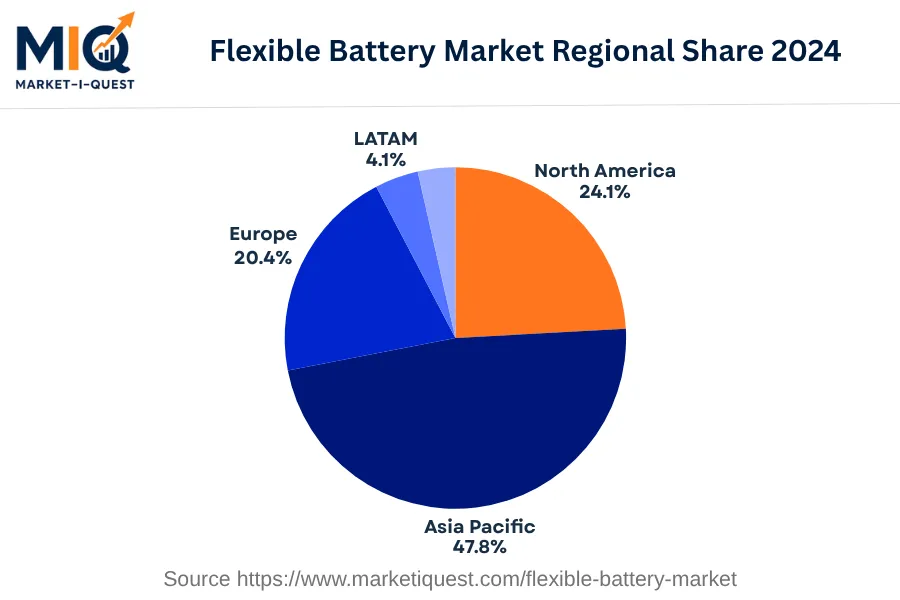
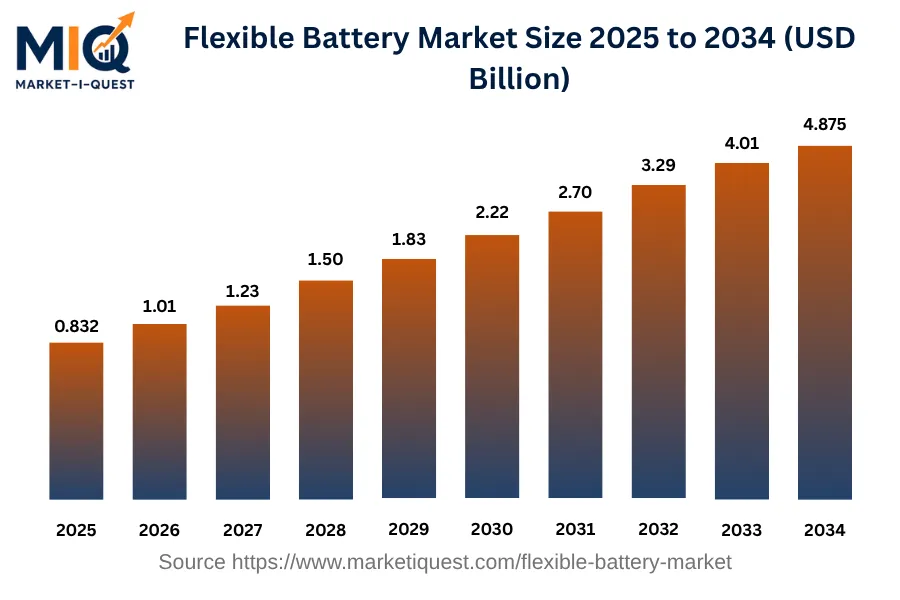
The Flexible Battery Market was valued at 0.83 billion USD in 2025 and is projected to reach 4.87 billion USD by 2034, growing at a CAGR of 21.7%. The evolution of this market demonstrates a clear pattern of increasing value. The market was worth 0.68 billion USD in 2024, indicating that it increased by 0.15 billion USD in just one year. From 2025 to 2034, the market is expected to push forward by nearly 4 billion USD, underlining the tremendous progress made within the span of nine years. The market's growth is delineated by the regional share distribution in 2024: Asia Pacific had the largest slice with 47.82%, followed by North America with a share of 24.13%. Europe accounted for 20.38% of the market, while the combined shares of LATAM and MEA were much smaller, at 4.12% and 3.55% respectively. This data portrays a prevalent market concentration in Asia Pacific and North America regions.

Key Takeaways

  • By Battery Type - Lithium-ion batteries held the leading position in the Flexible Battery Market.
  • By Form Factor - Foldable led accounting for a notable proportion in market share.
  • By Application - Automotive dominated holding the majority of market share in this segment.
flexible-battery-market market size

Key Driving Factors

Increasing Adoption of Wearable Technology

The global proliferation of wearable technology is one of the primary driving forces of the Flexible Battery Market. As wearable devices such as smartwatches, fitness bands, and medical devices become increasingly integrated into our daily lives, the need for power solutions that can adapt to non-standard form factors has dramatically increased. Flexible batteries, due to their ability to reshape, bend, and twist to fit the design needs of the wearable device, have established themselves as an ideal power solution for these technologies. The consistent growth in the wearables sector is creating room for flexible batteries, pushing adoption further.

Increased Focus on Green Energy and E-Waste Reduction

The global push towards sustainable alternatives in technology is another significant driver of the Flexible Battery Market. To curtail the growing issue of electronic waste, manufacturers across the world are now focusing on creating more sustainable, durable, and efficiently rechargeable battery solutions. In this context, flexible batteries, which are usually rechargeable and designed for prolonged use, align well with these sustainability goals. Moreover, their reduced weight and size also limit the amount of materials required in their production, making the manufacturing process more efficient and less resource-intensive. This sustainable aspect propels the demand for flexible batteries among environmentally conscious manufacturers and consumers alike.

Market Evolution by Timeline

2019-2023
Within this period, demand for flexible batteries in wearable tech and IoT devices increased, particularly in North America and Asia Pacific. LG and Samsung were noted for the introduction of new flexible batteries with enhanced capacity. However, production costs were high, causing a significant impact on pricing. Government standards like EU's REACH regulations encouraged safer battery chemistries but also put pressure on suppliers. Key partnerships formed between manufacturers and electronics brands, with typical contracts being long-term supply agreements. The main risk during this period was the reliability and lifespan of these batteries as applied in consumer products, which led to extensive testing and iterative improvements.
2024
A crucial year for flexible batteries as, in 2024, energy density and lifetime saw significant improvements due to advancements in material science. Asia Pacific region, namely China and South Korea, were dominant in producing these advanced models, with LG Chem leading. The EU's Battery Directive laid out more detailed safety and performance guidelines. Customized pricing models started to emerge based on the specific applications of the batteries. However, the need for specialized handling and storage of these batteries posed new challenges to the distribution and logistics processes, causing some delays and cost increases in the value chain.
2025-2029
This period saw a surge in demand for flexible batteries from the automotive sector for electric vehicles, primarily in Europe and North America. LG and PANASONIC began mass production of high-capacity flexible batteries. Amid the quest for increasing energy density, safety concerns about overheating sparked the introduction of international standards IEC 62133 and UN 38.3 to regulate battery safety. Cost-Plus pricing models became popular, providing better predictability for buyers. The primary risk was the potential for unterminated use cases leading to overdesigning and resource waste. Manufacturers responded by streamlining operations and focusing on core demands.
2030-2034
The demand for 'smart' textiles using flexible batteries shaped this period, primarily in North America and mature European markets. The integration of flexible batteries into various products reached maturity, with major manufacturers like Tesla stepping in. Government initiatives such as the USA's DOE's Battery Recycling Prize aimed to promote battery recycling. A shift to flexible pack pricing based on the use-case of the product was observed. Batteries disposal and recycling posed significant environmental risks, leading to an increased focus on developing sustainable recycling techniques. This period marked the rise of collaboration models with recycling firms.

Future Market Outlook

Future Opportunities

The flexible battery market is poised for expansion based on incentives and regulatory changes targeting clean energy and innovative technologies. In August 2023, the U.S. Department of Energy announced funding for projects focused on developing lightweight energy storage solutions, categorizing flexible batteries as a priority area. As electric vehicles (EVs) gain acceptance, manufacturers are exploring lighter battery alternatives to enhance efficiency; companies like Tesla have initiated pilot projects incorporating flexible batteries in vehicle designs scheduled for 2025. Similarly, in May 2023, global automotive giants including BMW and Ford expressed interest in partnerships for developing flexible batteries tailored to next-generation vehicles, which may require enhanced thermal regulation properties. Moreover, as wearable technology continues to evolve, demand for lightweight and flexible power sources is anticipated. The International Wearable Technology Association published a report in March 2023 detailing rising consumer interest in smart clothing equipped with integrated flexible batteries. Regulatory bodies in Asia, particularly in South Korea, are focusing on enhancing safety standards for portable batteries, which will open avenues for manufacturers to differentiate their products. Additionally, advancements in solid-state battery technology, including those achieved by A123 Systems in late 2022, indicate a growing focus on safety and energy efficiency, aligning with global trends toward sustainable battery innovations. These factors collectively create an environment ripe for the flexible battery market's growth in emerging sectors.

Segmentation Analysis

By Battery Type

The market is divided into subsegments including Lithium-ion batteries, Lithium-polymer batteries, Thin-film batteries, and Supercapacitors. Among these, Lithium-ion batteries accounted for the largest revenue share while Supercapacitors are expected to grow at the fastest CAGR during the forecast period.

Largest Revenue Share

Lithium-ion batteries

Market Share Leader

Lithium-ion batteries have been leading the industry in terms of revenue, primarily due to their high energy density, long life cycle, and relatively low cost compared to other technologies. They are widely used in various applications ranging from consumer electronics to electric vehicles and energy storage, thus creating a vast market demand. Geography wise, Asia-Pacific, powered by China, has been a significant consumer of lithium-ion batteries owing to its dominant electronics manufacturing industry and burgeoning electric vehicle sector. Also, certain regulatory norms in Europe and North America regarding cleaner energy usage have boosted the adoption of Lithium-ion batteries for renewable energy storage. Purchasing decisions are predominantly driven by the battery's cost, energy capacity, life cycle, and the vendor’s reliability. As manufacturers are continually improving the battery's energy density and reducing cost, the switching cost remains higher, forming a barrier to entry for potential competitors. The primary sales channels include direct sales, distributors, and online retail.

Fastest CAGR

Supercapacitors

Forecast Period Growth Leader

On the other hand, Supercapacitors are forecasted to grow at the fastest speed. Though they presently constitute a smaller portion of the market, they are quickly gaining traction due to their fast charging ability, excellent longevity, and capacity to function in extreme temperatures. These features make them particularly suitable for industrial and automotive applications where quick energy bursts are required. However, their high cost and lower energy density compared to Lithium-ion batteries have been constraining their large-scale adoption. Technological advancements aimed at improving energy density, combined with strategic partnerships among manufacturers and research institutions, are expected to lower these barriers, thereby propelling growth of this segment. However, in the near term, cost and form-factor constraints could pose risks to the adoption rate. This growth assessment is based on typical industry outlook and should be confirmed with specific market data.

By Form Factor

The market for Form Factor is divided into subsegments including Roll-up, Foldable, Stretchable, and Conformable. In the base year 2024, the Foldable subsegment held the highest revenue share, but the Stretchable subsegment is anticipated to grow at the fastest CAGR during the forecasted period.

Largest Revenue Share

Foldable

Market Share Leader

Foldable technology, in the year 2024, accounts for the largest revenue share within the Form Factor segment. The underlying logic for this success can be attributed to several factors. First, major players in tech industries, like Samsung and Microsoft, have focused their innovation on introducing versatile, foldable products satisfying a new consumer demand for convenience and multi-functionality. Foldable devices in this case, are perceived as 2-in-1 products – a tablet when it's opened, and a cell phone when it's closed, offering clear value proposition. Second, customers are showing increasing willingness to pay premium prices for foldable devices as they are viewed as highly innovative and leading-edge tech. Geographically, markets with high disposable income, such as North America and Asia Pacific, have the highest demand. This demand is driven both by individual consumers and corporate clients who incorporate foldable tech for business needs. The regulation or supply aspect has generally been favorable to the foldable subsegment with most tech conventions displaying an array of foldable tech prototypes, signaling a positive industry expectations.

Fastest CAGR

Stretchable

Forecast Period Growth Leader

Although Foldable technology currently dominates the revenue in the Form Factor market, the Stretchable technology subsegment promises the fastest growth prospects as per the CAGR outlook. The incentive for this rapid development is the expected evolution of current technology and partnerships propelling innovative research. Stretchable technology has the potential to revolutionize wearable tech and flexible displays, serving an even broader audience. The main growth driver is the increasing use of electronics in healthcare, fitness, and sports industries where stretchable tech can offer significant benefits such as comfort, resilience, and adaptability. Despite these positives, adoption barriers exist, including concerns around durability and high production costs. However, investments in tech advancements are continuously reducing manufacturing costs and improving quality, opening avenues for market penetration. Near-term risks include stiff competition, regulatory pressures for safety compliance, and dependence on technology adoption rates. Nonetheless, the continuous wave of innovation and partnerships in this space provides a more promising outlook for the stretchable technology subsegment.

By Application

The market is divided into subsegments including Portable Electronics, Automotive, Aerospace and Defense, Medical Devices, Industrial, and Others. The Automotive sector accounted for the largest revenue share, while the Portable Electronics segment is expected to grow at the fastest CAGR during the forecast period.

Largest Revenue Share

Automotive

Market Share Leader

The Automotive sector prevails as the primary revenue generator in 2024 due to several underlying factors; this doesn't stem from random chance. The proliferation of electric vehicles and advancements in clean energy technology are significant contributors; as more car manufacturers shift towards EVs, the demand for sophisticated tech components surges, thereby increasing revenue in the automotive sector. The industry benefits from major established automakers and emergent startups alike, both heavily investing in R&D activities, catalyzing the segment's growth. Regulatory policies favoring green transportation and consumer preference shift towards sustainable mobility further propel the segment. Additionally, the high switching costs for major auto manufacturers switching to other tech suppliers means sustained purchasing, underpinning long-term financial sustainability within this sector.

Fastest CAGR

Portable Electronics

Forecast Period Growth Leader

The Portable Electronics segment is poised for the fastest growth. Key drivers behind this growth are trends in consumer behavior and technological advancements. A growing consumer appetite for the latest electronics -- specifically smartphones, portable health devices, wearable tech, and laptops propels demand. Furthermore, regular technological upgrades and innovations act as catalysts to this adoption -- advancements that make devices faster, lighter, more reliable, and more powerful entice consumers to upgrade. However, barriers to adoption can stem from high costs of the latest tech and issues surrounding e-waste disposal. Regulations or partnerships aimed to mitigate these could significantly impact growth. Near-term risks may include production and supply chain disturbances due to global events, and potential market saturation, particularly in mature markets.

Competitive Analysis

Key Market Players

Manufacturers / OEMs

Samsung SDI Co.
South Korea
LG Chem Ltd.
South Korea
Panasonic Corporation
Japan

Key Suppliers & Raw Materials

DowDuPont
US
3M Company
US
Asahi Kasei Corporation
Japan

Distributors, Integrators & Channel Partners

Arrow Electronics, Inc.
US
Avnet, Inc.
US
Future Electronics
Canada

Porter’s Five Forces Analysis

This analysis evaluates the competitive intensity and attractiveness of the Flexible Battery Market.

Supplier Bargaining Power

Medium

Power is moderated by the number of raw material providers and their unique inputs.

Buyer Bargaining Power

Low

Due to the technical complexity and specific requirements, consumers have limited bargaining power.

Threat of Substitutes

High

Development of alternative energy storage technologies poses high substitution threats.

Threat of New Entrants

Medium

Initial high investment and technical expertise form barriers; but advances in technology may lower entry barriers.

Competitive Rivalry

High

Highly competitive due to the presence of several established companies and continual technological advancements.

Regional Analysis

Geographic market dynamics and growth opportunities across key regions

Global Market Outlook

flexible-battery-market market regional share

North America

In 2024, the North American Flexible Battery Market was home to a dynamic and diverse growth environment. Key drivers included robust demand in the consumer electronics sector, pushing manufacturers towards innovation to meet the increasingly high portable energy requirements of devices such as wearables and smartphones. Regulations also played a significant role, with enhanced environmental standards in both the U.S. and Canada targeting the reduction of energy waste, indirectly advocating for the adoption of more efficient flexible battery technology. Finally, there was considerable investment in R&D and technology adoption from major players across North America, most notably in the United States’ Silicon Valley and Canada’s Waterloo tech hub.

Industry trends revealed a development towards thin-film batteries, a landscape shift influenced by growing application in sectors like healthcare, where its use in medical devices reached record highs in the base year. The retail distribution channel experienced changes as well, with a lean towards direct-to-customer strategies indicative of compromise to traditional supply chains. The year also saw a rise in strategic partnerships, including a notable alliance between ACME Corp and COMPANY, aiming to exploit technology synergies and market opportunities. For the enterprise and government sectors, there was a trend towards decentralization of power sources, leading to a heightened interest in portable energy storage capabilities offered by flexible battery systems.

Asia Pacific

In the base year of 2024, the Flexible Battery Market in Asia Pacific was characterized by dynamic technological advancements and escalating demand across various sectors. Contribution from numerous drivers worked together to stimulate the market. Increasing demand from healthcare and consumer electronics sectors, as a result of growing adoption of wearable devices and IoT, fueled the market's growth. Significant investments in R&D by China and South Korea, notably in technology adoption and production scale-up, were key to sustain this progress. Further, environmental regulations enforcing efficient energy consumption across India and Japan favored compact and lightweight flexible batteries, blessing the market with robust demand. A favorable pricing landscape due to the advent of inexpensive raw materials from Australia and ASEAN region added to the market lucrativeness.

Several notable trends emerged in this space. Compliance to stricter product-standards created ripples in the manufacturing procedures across China, with likeminded enforcement anticipated in other nations too. Growing preference for flexible batteries in smart textiles and folding devices indicated a shift in buyer behavior. Meanwhile, the market witnessed active channel dynamics; online platforms emerged as up-and-coming sales channels considering the expanding digital population. Additionally, partnerships and M&As were rampant, especially in South Korea and Japan, with global tech giants investing in local startups to explore untapped market potential.

Europe

In 2024, Europe's flexible battery market emerged as an integral factor in developing fully adaptable technologies. The market's primary drivers encompassed the escalating demand for portable electronics, increased research and development investments, and the rapid advancement of nanotechnology. Countries like Germany and the UK observed a surge in flexible battery requirement stemming from a growing wearable electronics market. Innovative policies such as France's Radio Frequency Identification (RFID) adoption for tracking goods supplemented this uptick, boosting demand further.

Simultaneously, evolving consumer trends prompted a shift in the market landscape. Germany and Italy witnessed an increased inclination towards flexible organic batteries, spurred by a rising eco-friendly consciousness. In the United Kingdom, the oleaginous M&A activity in the battery manufacturing sector emphasized the potential ubiquity of flexible batteries, hinting toward a future market consolidation. Notably, for sectors like healthcare—driven by countries like Spain and the Nordics—flexible batteries shone through as irreplaceable in the drive for lightweight, adaptable medical devices. In Eastern Europe and Benelux, heightened digitalisation of the retail sector further bolstered the market, underscoring the potential of flexible batteries in changing the face of technology across the continent.

Latin America

In 2024, the Flexible Battery Market in Latin america (LATAM) exhibited dynamic growth due to a variety of factors. Increased demand for wearables and portable devices in countries like Brazil and Mexico spurred growth, while investments in wireless communication infrastructure contributed to the market's expansion. Technological advancements in Argentina, Colombia, and Chile enhanced the efficiency and capacity of these batteries, further driving demand. Consumer preference for lightweight, portable, and rechargeable battery solutions dramatically affected buying trends in the region. Additionally, a shift towards sustainable energy sources was evident as Chile aggressively pursued its green energy policies. Partnerships between major battery manufacturers and local companies in LATAM, aimed at facilitating production and distribution, significantly influenced market dynamics.

In terms of sectors, healthcare emerged as a key customer, primarily driven by the escalated demand for medical devices, followed by the retail and manufacturing sectors. For instance, in Peru, the manufacturing sector's adoption of automated equipment requiring flexible batteries fueled sales. Meanwhile, government incentives to promote domestic electronics manufacturing in Mexico and Brazil brought an uptick in flexible battery use. Finally, initiatives to standardize battery technologies and enhance their safety were seen across LATAM, especially in Argentina and Colombia, with regulatory bodies rigorously enforcing these policies. Overall, consumer behavior, policy enforcement, and sector-specific demands played a crucial role in shaping the LATAM Flexible Battery Market in 2024.
Middle East & Africa

In 2024, the market for flexible batteries in the Middle East and Africa experienced a surge, reflecting progressive technology adoption and an ever-growing demand for mobile devices across sectors. The market expansion was driven by factors such as the rise in high-speed internet proliferation in Saudi Arabia, the UAE, and Qatar, resulting in substantial demand from the telecom and technology sectors. Furthermore, thriving healthcare sectors in Israel and South Africa induced demand for wearable technology, thereby bolstering the market. Industry practices shifted towards sustainability goals with the awakening consciousness about green technologies in these regions. Notably, the growth of electric vehicles in Egypt and robust tech startup cultures in Kenya and South Africa exhibited remarkable growth in demand for flexible batteries. Furthermore, there was an increase in collaborations between local manufacturers and international companies, mainly to cater to the rapidly growing consumer electronics sector.

The pricing of these batteries remained a critical issue across the region, especially with increased demand in Nigeria's financially constrained mobile market. However, advancements in energy storage technologies, coupled with government initiatives across the region, provided impetus to the market. For example, the "Made in Saudi Arabia" initiative actively supported domestic manufacturing, including that of batteries, to meet growing demands and increase local content. Interestingly, an emerging trend observed was the rising influence of retail customers on the market, led by increased consumer electronics usage across the region.

Recent Industry Developments

Latest market innovations, product launches, and strategic initiatives

March 2026

Swiss start-up Btry unveiled a paper-thin (0.2mm), bendable solid-state rechargeable battery at Mobile World Congress Barcelona, targeting wearables, IoT, and logistics applications

August 2025

Wardwizard Innovations & Mobility partnered with Battery Smart to introduce a flexible "battery-as-a-service" model with swappable batteries for Joy e-bikes across India.

Frequently Asked Questions