Flame Retardants for Aerospace Plastics Market Snapshot

Key Players

  • Dow Chemical Company (United States)
  • Solvay S.A. (Belgium)
  • BASF SE (Germany)
  • Clariant AG (Switzerland)
  • Nabaltec AG (Germany)
  • Huber Engineered Materials (United States)
  • Israel Chemicals Ltd. (Israel)
  • Italmatch Chemicals S.p.A. (Italy)
  • RTP Company (United States)
  • Lanxess AG (Germany)

Market Size

Base Year 2024
$0.874 Bn
CAGR
7.85%
Forecast 2034
$1.86 Bn

Market Segments

By Product
  • Antimony Oxide
  • Aluminum Trihydrate
  • Organophosphates/Phosphorous Compounds
  • Boron Compounds
  • Others
By Application
  • Carbon Fiber Reinforced Plastic (CFRP)
  • Glass Reinforced Plastic (GRP)
  • Polycarbonate
  • Thermoset Polyimide
  • Acrylonitrile Butadiene Styrene (ABS)
  • Acetal/Polyoxymethylene (POM)
  • Epoxies
  • Others

Market Dynamics

Drivers
  • Increasing safety concerns in aerospace industry
  • Rapid growth in aerospace plastics demand
Restraints
  • High production costs
  • Stringent safety regulations
Opportunities
  • Increasing aerospace industry demand
  • New flame retardant technologies

Market Size

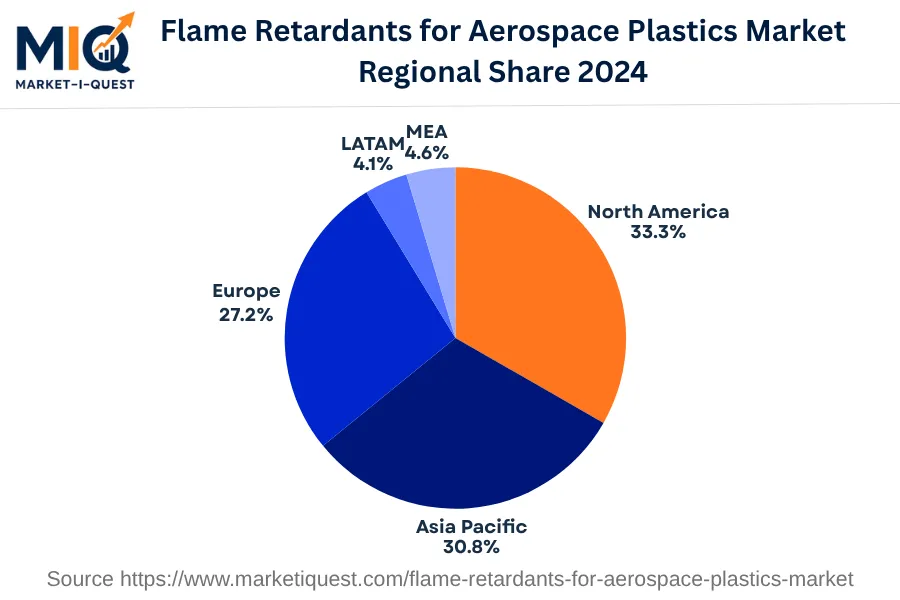
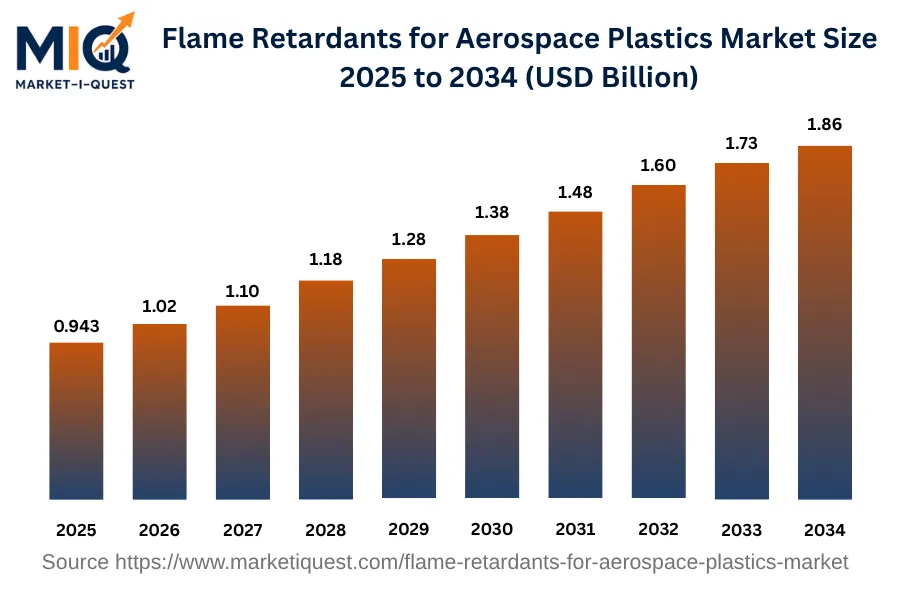
The Flame Retardants for Aerospace Plastics Market stood at USD 0.87 billion in 2024, before expanding to USD 0.94 billion in 2025. By 2034, the market is expected to grow to USD 1.86 billion, corresponding to a Compound Annual Growth Rate of 7.85%. The growth trajectory indicates a consistent increase and sizeable expansion of the market over the decade. The expansion of this market can be attributed to the steady increases year on year. As of 2024, the regional shares in the Flame Retardants for Aerospace Plastics Market were as follows: North America at 33.3%, closely followed by the Asia Pacific at 30.8%, Europe at 27.2%, Latin America at 4.1%, and Middle East and Africa at 4.6%. These figures suggest a fairly distributed global market share, with North America leading by a slight margin.

Key Takeaways

  • By Product -Aluminum Trihydrate held the top position accounting for a significant market share.
  • By Application - Acrylonitrile Butadiene Styrene (ABS) has clinched the largest market share in terms OF revenue.
flame-retardants-for-aerospace-plastics-market market size

Key Driving Factors

Stringent Fire Safety Regulations in Aerospace Industry

In the aerospace industry, fire safety is a top priority. Regulatory bodies like the Federal Aviation Administration (FAA) and the European Aviation Safety Agency (EASA) enforce strict regulations concerning flammability, heat release, and smoke emissions in aircraft cabin interiors. These regulations are constantly evolving and becoming more stringent to ensure passenger safety. As a result, aerospace industry players are continuously seeking flame retardants for plastics used in aircraft components. These include interiors like seating, wall panels, and overhead compartments, where high performance and flame-resistant plastic materials are a requirement due to the high risk of fire outbreaks during flights.

Lightweight Material Transition in Aerospace

The aerospace industry is increasingly shifting towards lightweight materials to enhance fuel efficiency and reduce environmental impact. Plastics and composites are replacing conventional materials like metal in aircraft design due to their lower weight, strong resilience, and ease of molding. However, these replacements must comply with high safety standards, including fire resistance, achieved chiefly through the use of flame retardants. Furthermore, the need for materials with high durability, resistance to harsh environmental conditions, and the ability to withhold increased pressure variations makes flame retardants for aerospace plastics not just a choice, but a necessity.

Market Evolution by Timeline

2019-2023
During this period, the demand for flame retardants in aerospace plastics was primarily driven by North American and European regions due to the presence of major aerospace manufacturers. Various plastic grades with flame retardants like polyetheretherketone were needed. Manufacturers faced the challenge of integrating flame-retardant functionality without compromising strength, a key consideration for aerospace use. Regulation-wise, the key influence was the stringent safety standards imposed by FAA and EASA. A common commercial model involved long-term supply contracts between plastic manufacturers and aerospace companies. Risks during this period included supply chain disruptions possibly tied to political instabilities or raw material shortages.
2024
In 2024, growth in the Asia-Pacific region, especially China and India, led a boost in demand due to increased investments in their aerospace industries. Improved flame-retardant technology, which offered enhanced heat resistance, was introduced. The challenging regulatory environment continued from prior years and manufacturers aimed to meet EN 45545-2 standard for fire safety. Companies were more inclined to vertically integrate their supply chain to avoid risks associated with reliance on third-party suppliers. Partnerships between flame retardant suppliers and aerospace companies were formed to ensure a steady supply.
2025-2029
This period saw a balanced global demand due to expansion in the aerospace industry worldwide. Halogen-free flame retardants began to dominate due to environmental considerations. However, formulating these effectively with plastics posed technical challenges. Regulatory bodies, including the FAA, increasingly prioritized environmental impact, favoring the adoption of halogen-free varieties. Flexible pricing models evolved, reflecting the variation in raw material costs. Risks during this period likely surfaced from potential environmental constraints and supply chain anomalies resulting from increased global trade restrictions.
2030-2034
Advanced AI-integrated manufacturing facilities are projected to meet the demand for flame retardants in this period. The need to balance flame retardancy and weight in aerospace plastics prompts manufacturers for innovative solutions. Standards for flame retardants emphasize low smoke and toxicity, catalyzing the transition to more eco-friendly materials. The market likely leaned towards contractual agreements with dynamic pricing, accommodating raw material cost fluctuations. Potential risks included volatile raw material pricing affecting the supply stability and cost of flame retardant-enhanced aerospace plastics.

Future Market Outlook

Future Opportunities

As the demand for passenger safety and environmental sustainability grows within the aerospace sector, opportunities for advanced flame retardants in plastics are expected to blossom. The continued implementation of regulations like the UK’s Civil Aviation Authority’s Airworthiness Directive mandates that manufacturers enforce higher safety standards, enhancing the role of flame retardant materials. Companies like DuPont and BASF are currently investing in the research and development of bio-based flame retardants to align with both safety standards and market demand for greener products. The implementation of automated manufacturing processes in 2023 can allow for more cost-effective production of these specialized materials, opening up new avenues for development and innovation. Furthermore, as the global market increasingly emphasizes lightweight materials for improved fuel efficiency, the integration of flame retardants into composites that reduce overall aircraft weight is likely to gain traction. Collaborative research partnerships established between academic institutions and private companies, such as the initiatives seen in France’s aerospace sectors, are enhancing the R&D capacity for more sophisticated flame retardants. Collaboration at this level can lead to innovative solutions that can easily meet stringent regulatory requirements. Future advancements in material science are expected to yield novel fire-proof plastics that challenge traditional limitations, thus paving the way for significant developments in the aerospace materials landscape.

Segmentation Analysis

By Product

The market is partitioned into subsegments that include Antimony Oxide, Aluminum Trihydrate, Organophosphates/Phosphorous Compounds, Boron Compounds and Others. Aluminum Trihydrate leads the revenue generation, while Organophosphates/Phosphorous Compounds is projected to have the fastest growth rate in the coming years.

Largest Revenue Share

Aluminum Trihydrate

Market Share Leader

Aluminum Trihydrate leads in revenue generation due to its extensive use in various industries, including construction and pharmaceuticals. Its properties, including thermal stability and low toxicity, have popularized this compound. Being a major component in producing flame retardants, it has found a booming market in construction industry as safety norms and regulations become stricter. The rising construction activities globally have compounded the growth of Aluminum Trihydrate. Geographically, regions with significant construction booms, such as Asia-Pacific regions due to rapid urbanization, are the main consumers. The increasing demand for flame retardants in the pharmaceutical industry is another significant driver as Aluminum Trihydrate is used in creating medications and antacids. Despite mounting competition from newer, technologically-advanced compounds, Aluminum Trihydrate's consistent demand, owed to its characteristics and multi-industrial use, helps it maintain a high revenue rate.

Fastest CAGR

Organophosphates/Phosphorous Compounds

Forecast Period Growth Leader

The market for Organophosphates/Phosphorous Compounds is forecasted to grow exponentially due to its extensive demand in agriculture as pesticide compounds. Increasing necessity for high crop yield to meet the global food demand, resulting from escalating population growth, is a key driving force for its adoption. Its use is not just limited to agriculture; it's also an important flame retardant, which puts it in high demand in the manufacturing sector. They also play a significant role in water treatment solutions, cleaning agents, and chemical synthesis, broadening the market scope. However, the stringent regulations regarding its use, owing to its high toxicity, can pose growth challenges. Technological advancements in its safe usage and increased focus on less toxic variants of Organophosphates, catalyzed by partnerships within the industry, are expected to maintain a robust growth trajectory despite the potential hurdles.

By Application

The market is divided into subsegments including Carbon Fiber Reinforced Plastic (CFRP), Glass Reinforced Plastic (GRP), Polycarbonate, Thermoset Polyimide, Acrylonitrile Butadiene Styrene (ABS), Acetal/Polyoxymethylene (POM), Epoxies, and others. In 2024, the Acrylonitrile Butadiene Styrene (ABS) accounted for the largest revenue share while the Polycarbonate subsegment is expected to grow at the fastest CAGR during the forecast period.

Largest Revenue Share

Acrylonitrile Butadiene Styrene (ABS)

Market Share Leader

Acrylonitrile Butadiene Styrene (ABS) has clinched the largest market share in revenue terms due to its array of desirable properties such as high strength, toughness, and stiffness. The wide application of ABS in sectors such as automotive, electronics, and consumer goods explains its market dominance. Essentially, the ability of ABS to be easily molded into a variety of shapes makes it a popular choice in manufacturing equipment parts, especially in the booming automobile industry. The continued demand for lighter and more efficient materials in vehicle manufacturing solidifies the ABS subsegment's position. The easy processing of ABS, paired with its high-quality surface finish, is widely desirable in the production of electronics and consumer goods. Furthermore, regionally, markets with a robust manufacturing base, for instance, Asia Pacific, strongly contribute to the ABS market.

Fastest CAGR

Polycarbonate

Forecast Period Growth Leader

The Polycarbonate subsegment is projected to register the fastest growth rate. This can be attributed to the increasing adoption of Polycarbonate in industries such as automotive, construction, and electronics due to its incredible strength and lightweight characteristics. A shift towards sustainable and energy-efficient products is driving the usage of Polycarbonate in the construction industry for insulation, roofing, and glazing. The high impact resistance and transparency of Polycarbonate make it an ideal material for automotive and electronics applications, stimulating its demand and growth in these sectors. Technological advancements and ongoing research in the material sciences arena are further catalyzing the adoption of Polycarbonate. Despite the accelerated growth, certain factors such as volatility in raw material prices could pose risks to the outlook. Policies favoring environmentally friendly materials also play a significant role in stimulating polycarbonate growth.

Competitive Analysis

Key Market Players

Manufacturers / OEMs

BASF SE
Germany
Nabaltec AG
Germany
Clariant
Switzerland

Key Suppliers & Raw Materials

Albemarle Corporation
US
Dow Inc.
US
LANXESS
Germany

Distributors, Integrators & Channel Partners

Chemtura Corporation
US
Akzo Nobel N.V.
Netherlands
DuPont
US

Porter’s Five Forces Analysis

The analysis provides a viewpoint on the competitive environment within the Flame Retardants for Aerospace Plastics Market.

Supplier Bargaining Power

Medium

Limited suppliers and specialized products increase supplier power.

Buyer Bargaining Power

Low

High switching costs and highly specific requirements reduce buyer power.

Threat of Substitutes

Low

Owing to stringent safety regulations, the threat of substitutes is minimal.

Threat of New Entrants

Low

High capital expenditure and strict regulatory barriers protect incumbent companies.

Competitive Rivalry

High

Large key players and stagnant growth intensify competitive rivalry.

Regional Analysis

Geographic market dynamics and growth opportunities across key regions

Global Market Outlook

flame-retardants-for-aerospace-plastics-market market regional share

North America

In 2024, the North American market for flame retardants in aerospace plastics witnessed significant momentum. The demand rose due to regulatory guidelines prescribed by Federal Aviation Administration (FAA) in the U.S. and Transport Canada requiring flame-retardant plastics in aircraft construction. Meanwhile, substantial investments in new aircraft manufacturing and renovation projects in both civil and defense sectors across U.S., Canada, and Mexico enhanced market growth. Innovation in flame-retardant compositions and technology adoption, such as nanocomposites and phosphorus-based retardants, revolutionized market offerings. However, the increase in raw material costs impacted the pricing dynamics of the market, causing mild fluctuations.

The trend of utilizing eco-friendly flame retardants surged due to environmental concerns and policy enforcement by Environment Canada and US Environmental Protection Agency. Partnerships between flame retardant suppliers and plastic manufacturing giants were marked, aiming for improved performance and safety standards in aerospace plastics. Digital sales channels proliferated, expanding product accessibility. However, customer inclination towards established brands remained pronounced, appreciating trusted quality. The principal consumers were aircraft manufacturers in both private and defense sectors. Interior aircraft component manufacturers also generated substantial demand due to safety regulations. Flame retardants for aerospace plastics grabbed the attention of government and commercial enterprises alike, focusing on building safety-centric, durable aircraft in North America.

Asia Pacific

In 2024, Flame Retardants for Aerospace Plastics market in Asia Pacific demonstrated intensified activity. Drivers included stringent safety regulations from aviation authorities in prominent markets- China’s CAAC and Australia’s CASA, which enforced adoption of flame retardants in aerospace plastics. Rapid modernization and expansion of aircraft fleet among countries like India and China heightened demand. Technological advancements, notably in Japan and South Korea, stimulated development of high-performance flame retardants, bolstering supply dynamics. Consumer behavior trend favored products ensuring superior fire safety, further propelling the market. Significant product shifts were observed towards halogen-free retardants, spurred by environmental consciousness and government regulations in ASEAN countries.

Japan's Toray Industries and China's Sinopec were witnessed forming partnerships and engaging in M&A activities to consolidate their market positions. The enforcement of safety standards became more rigorous, highlighting the influence of policy on market trends. Notable customers spanned across the manufacturing sector, particularly companies engaged in aerospace manufacturing. Key examples included China’s COMAC, India’s HAL, and Japan's Mitsubishi Heavy Industries. The role of government bodies in procurement, regulation, and endorsing safety policies was recognized crucial, making them important customers as well. The Flame Retardants for Aerospace Plastics market in 2024 in Asia Pacific was thus shaped by regulatory compliance, customer safety priorities, and industry consolidation.

Europe

In 2024, the Flame Retardants for Aerospace Plastics Market in Europe substantiated a crucial sector in the aerospace industry. Drivers behind this engrossing market included the proliferating demand for advanced, effective flame-retardant solutions in aerospace plastic components, triggered by the stringent safety regulations in countries such as Germany, the United Kingdom, France, Italy, and Spain. Apprehensions over the combustibility of plastics, along with the expanding aerospace sector in the Nordics, Benelux, and Central & Eastern Europe, gave impetus to the market. Trends shaping the market included a shift towards eco-friendly, halogen-free flame retardants, spurred by the adoption of green protocols in the aerospace sector. Emphasis on weight reduction in aerospace components led to an increased application of flame-retardants in lightweight aerospace plastics, particularly in Germany and the UK.

Strategic partnerships and acquisitions amongst key market players predominated, with the aim of innovative technology development and expansion of product lines. Enforcement of European Union's safety regulations in aerospace industry compelled enterprises to opt for high-performance flame-retardants, fostering market growth. Sectors primarily influencing this demand comprised enterprise and government, evidenced by their investments in advanced technological adaptations in aircraft manufacturing. Additionally, the healthcare sector, involved in the production of medical aircraft, also emerged as a significant contributor to the market dynamic. For safety purposes, utilities and manufacturing sectors too, adopted flame-retardants effectively in 2024.

Latin America

In 2024, the Flame Retardants for Aerospace Plastics Market in Latin America experienced significant developments. Generous investments by governments in countries such as Mexico and Brazil drove the proliferation of the aerospace sector, stimulating demand for flame retardants. Regulatory norms tightening fire safety standards further escalated this demand, especially in Argentina and Colombia. Additionally, advancements in technology catalyzed the manufacturing of superior quality flame retardants. The year saw increased preference for halogen-free flame retardants, indicating a shift in buyer behavior towards environmentally friendly products, notably in Chile and Peru. Partnerships between flame retardant and plastic manufacturers flourished, enhancing the supply chain efficiency, particularly conspicuous in Brazil's thriving plastic industry.

Enforcement of stringent policies regarding flame retardant standardization underscored the year’s trends. Key customers of the market included the manufacturing sector, particularly those involved in aerospace manufacturing, and the government-driven aerospace projects. There was also noticeable patronage from the healthcare sector – evident from extensive usage of flame retardants for manufacturing healthcare components in the aerospace vehicles. The optimized pricing of the flame retardants promoted their adoption across a broader spectrum of industries, thus influencing the market dynamics decisively.

Middle East & Africa

In 2024, the Middle East and Africa (MEA) exhibited a robust market for flame retardants in aerospace plastics due to substantial drivers and evolving trends. Technological adoption led the market drivers, as the region's aerospace industry incorporated advanced fire protection navigational and in-flight entertainment systems, necessitating flame-resistant plastics. In tandem with this, rising awareness around passenger safety issues fuelled by increased air travel in Saudi Arabia, UAE, and Qatar instituted stricter aviation regulations, indirectly boosting demand for flame retardants. Furthermore, investment in the aerospace sector, notably in Egypt's newly established high-tech aerospace city, underscored the demand for quality flame-retardant materials.

In terms of trends, a shift in customer preference was noted as manufacturers gravitated towards more eco-friendly flame retardants in response to stringent environmental regulations, particularly in South Africa and Nigeria. While Israel exhibited a surge in collaborative initiatives between major flame-retardant producers and regional airlines to ensure customized product offerings. Finally, supply dynamics displayed a shift as Kenya, known for its large-scale manufacturing sector, increased local production of flame retardants to meet demand. Overall, the MEA's flame retardants for aerospace plastics market was keenly driven by technological advancements, regulatory compliance, environmental considerations, and strategic partnerships in 2024.

Recent Industry Developments

Latest market innovations, product launches, and strategic initiatives

January 2025

A collaborative research team from Wichita State University and Turkish Aerospace Industries achieved a major breakthrough in the development of aerospace-grade flame-retardant laminate composites, meeting Federal Aviation Regulations (FAR) standards for composite materials.

January 2026

The Flame Retardants for Aerospace Plastics market entered 2026 under a fundamentally different risk and qualification framework than terrestrial plastics markets, operating under zero-tolerance fire safety requirements with strict flammability, smoke density, and toxicity standards under aviation certification regimes.

Frequently Asked Questions