
Fixed Satellite Services Market Snapshot

Key Players

  • Intelsat (Luxembourg)
  • SES S.A. (Luxembourg)
  • Eutelsat Communications (France)
  • Telesat (Canada)
  • Inmarsat (UK)
  • Viasat Inc. (USA)
  • EchoStar Corporation (USA)
  • Arabsat (Saudi Arabia)
  • Sky Perfect JSAT Corporation (Japan)

Market Size

Base Year 2024
$30.95 Bn
CAGR
7.34%
Forecast 2034
$62.85 Bn

Market Segments

By Service Type
  • Managed Services
  • Leased Services
  • Teleports
  • Direct-to-Home (DTH) Services
By Frequency Band
  • C Band
  • Ku Band
  • Ka Band
  • L Band
By Application
  • Telecommunication
  • Broadcasting
  • Data Transmission
  • Internet Access
  • Others

Market Dynamics

Drivers
  • Increasing demand for broadband connectivity
  • Rapid technological advancements
Restraints
  • High infrastructure cost
  • Limited spectrum availability
Opportunities
  • Emerging digital communication requirements
  • Increasing demand in broadcasting services

Market Size

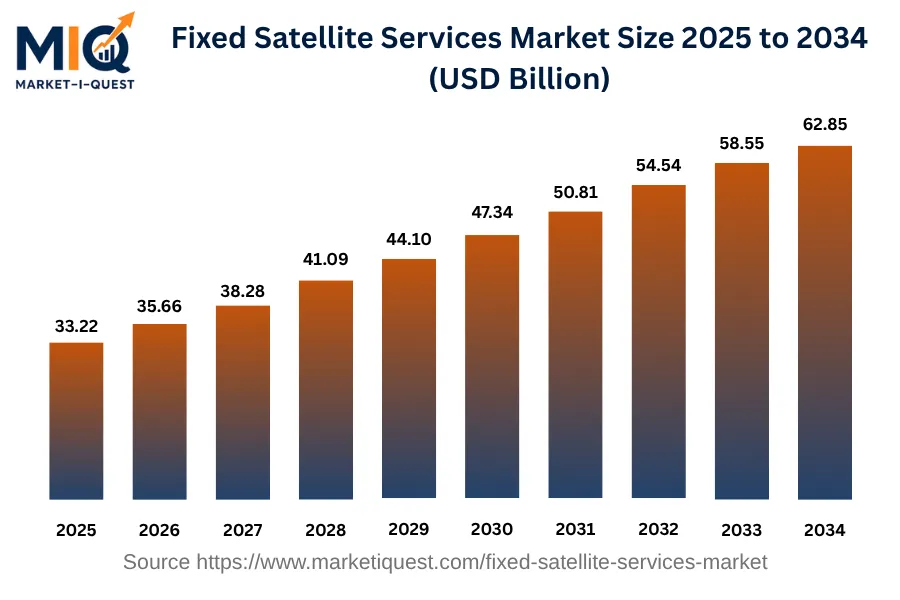
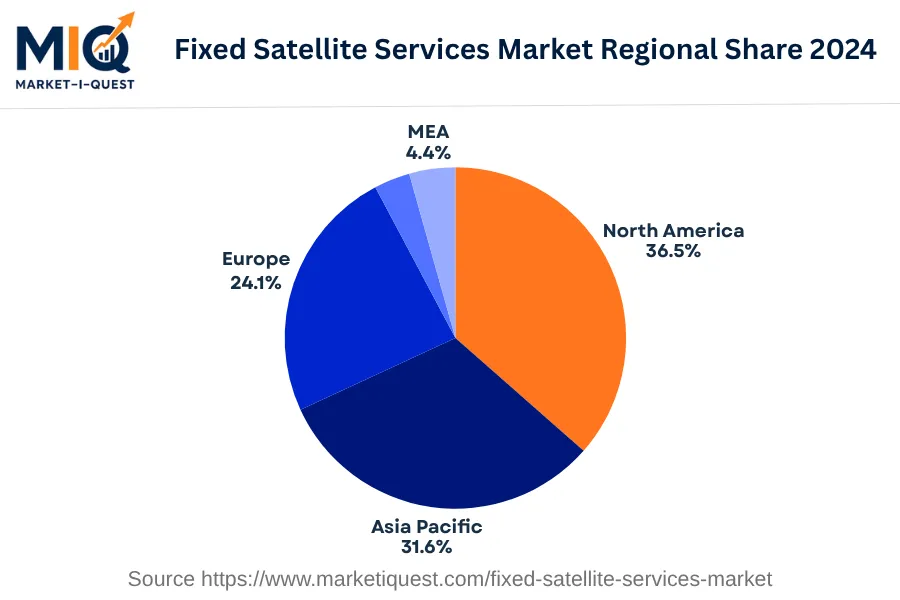
The Fixed Satellite Services market was valued at $33.22 billion in 2025 and is projected to reach a size of $62.85 billion by the end of 2034, growing with a CAGR of 7.34%. The market exhibited a consistent growth trajectory, steering from $30.95 billion in 2024 to cross the $33 billion mark in 2025. By 2034, the market is anticipated to nearly double from its 2025 value. This appreciable growth is a result of widespread adoption and exponential advancements in satellite technology, enabling diverse industries to leverage high-speed communication services across remote locations. As of 2024, the market share distribution by region instantly draws attention to North America's lead with 36.5%, closely followed by Asia Pacific at 31.6%, Europe at 24.1%, while LATAM and MEA regions accounted for 3.4% and 4.4% respectively.

Key Takeaways

  • By Service Type - Leased Services commanded the market with significant share in 2024.
  • By Frequency Band - Ku Band held the majority stake with significant market share in 2024.
  • By Application - Telecommunication segment led the market with a major share in 2024.
fixed-satellite-services-market market size

Key Driving Factors

Increasing Need for Disaster Management Communication

Natural disasters often result in severe damage to the terrestrial communication infrastructure. Fixed Satellite Services (FSS) are relied upon for creating emergency communication channels during such events. These services deliver critical communication links, enabling emergency response teams to coordinate rescue operations effectively and efficiently. Whether it's timely deployment of resources, relaying information about casualties or managing evacuations, FSS plays a vital role. Governments across the globe are recognizing this, increasing their reliance on FSS for robust disaster management communication strategies. Additionally, non-governmental organizations involved in disaster response activities are making use of FSS to communicate when other links fail. This escalating reliance on FSS as a primary communication channel in calamitous times has become a significant driver for the market.
Surge in Remote Work and Learning

The recent global shift to remote working and learning due to the COVID-19 pandemic has largely contributed to the demand for reliable and uninterrupted communication services. Reliable internet connectivity is essential in these scenarios, where people are heavily dependent on virtual meetings, online classrooms, and digital collaborative tools. In many remote locations, traditional fibre optic or wireless connectivity services are unable to deliver the required robustness and speed. Here, Fixed Satellite Services become a preferred and sometimes the only option due to their ability to provide high-speed internet connectivity over vast geographic areas. This surge in remote work and e-learning is thus driving the demand for the Fixed Satellite Services market worldwide.

Market Evolution by Timeline

2019-2023
During this period, major telecommunications and cable television companies were the primary consumers of fixed satellite services in regions such as North America and Western Europe. A shift was noticed towards integrated satellite-terrestrial networks due to the promise of high-capacity satellite deliveries and increasing demand for internet connectivity. The rigidity in spectrum allotments and the increased regulatory process, however, posed challenges. Contracts often involved long-term lease agreements for transponders. The scarcity of orbital slots was a significant constraint, leading to increased pricing for transponder leases. The industry faced potential risk from emerging low earth orbit satellite services.
2024
In 2024, the demand for fixed satellite services saw a rise in Asia-Pacific region due to expanding telecommunication networks. Technology maturation led to the successful demonstration of flexible bandwidth satellite services introduced by companies like Intelsat. Despite this, the long-lead time for satellite manufacturing and launch continued to be a barrier. New rules on spectrum allotments by the International Telecommunication Union were introduced. Reduced pricing for bandwidth contracts was observed due to increased competition, putting pressure on the traditional transponder lease model. Threat from cyber-attacks started to become a pertinent risk.
2025-2029
During this period, governments across various regions notably North America, Europe and Asia-Pacific increased their dependency on fixed satellite services for defense operations. The advent of next-generation satellite services like High-Throughput Satellite (HTS) systems enhanced capacity offerings. Regulatory complexities were further increased with the integration of terrestrial and space-based systems. Providers started to offer managed services, moving away from the traditional bandwidth sale model. Cybersecurity measures significantly affected the functionality and pricing of services. Additionally, the risk of satellite collision became increasingly significant due to the dense congesting of specific orbital paths.
2030-2034
The demand shifted to emerging markets in Africa and Latin America for the years 2030-2034. These markets saw increased adoption of integrated satellite networks for internet connectivity. However, the lack of a robust space policy in these regions impeded the fast deployment of these services. Fully integrated satellite-terrestrial systems were the norm, although the high cost limited their accessibility. Commercial contracts leaned towards pay-per-service models. A broad trend of satellite operators partnering with local service providers avoiding regulatory hurdles was noticed. The challenge of space debris management became increasingly critical due to crowded orbits.

Future Market Outlook

Future Opportunities

The future of fixed satellite services is poised for growth due to increased demand for connectivity and advancements in satellite technology. As evidenced by SpaceX's successful launches of Starlink satellites beginning in 2019, there is significant interest in deploying low Earth orbit systems for broadband internet access in remote locations. Partnerships between satellite operators and cloud service providers, like Microsoft Azure's collaboration with SES in 2023, reveal opportunities to enhance data transfer speeds and lower latency. Furthermore, the ongoing transition within the telecommunications sector towards 5G technologies opens up new applications for fixed satellite services. The U.S. government's initiatives, such as the Broadband Equity, Access, and Development (BEAD) program announced in 2022, aim to expand broadband access, presenting opportunities for satellite companies to fill gaps in connectivity. Moreover, the recent International Telecommunication Union's space technology recommendations indicate a push towards sustainable satellite deployments, paving the way for green initiatives in the sector. As more industries recognize the criticality of uninterrupted connectivity, operators can leverage these trends by increasingly focusing on hybrid solutions combining fiber and satellite technologies. The evolution of regulatory frameworks also points to more widespread acceptance of satellite solutions in diverse sectors, including transportation, healthcare, and agriculture, which signifies an expanding role for fixed satellite services in fulfilling global connectivity needs.

Segmentation Analysis

By Service Type

The market is divided into subsegments including Managed Services, Leased Services, Teleports, and Direct-to-Home (DTH) Services. Leased Services accounted for the largest revenue share while Managed Services is expected to grow at the fastest CAGR during the forecast period.

Largest Revenue Share

Leased Services

Market Share Leader

Leased Services stand out as the subsegment with the highest revenue in the market. This is primarily attributed to its widespread use and flexibility in application. Leased services are adopted by a broad spectrum of clients ranging from the large corporations to the small and medium enterprises, this drives its market reach and in turn revenue. Leased services also allow customers to use the technology without the excessive financial commitment of purchasing, maintaining, and upgrading the technology. The technological diversity and flexibility offered by these services address a global client base's widely disparate needs. The regulatory landscape has also contributed to this subsegment's growth as rules targeting improved connectivity have fueled the demand for leased services. Additionally, new businesses are often more comfortable adopting leased services due to lower switching costs and significant technological advantages over traditional in-house solutions. Underserved geographies present a significant opportunity for leased services to expand, increasing their market presence and revenue generation.

Fastest CAGR

Managed Services

Forecast Period Growth Leader

Despite not being the largest market segment in terms of revenue, the Managed Services subsegment is projected to grow at the fastest CAGR in the forecast period. The primary growth drivers for this subsegment include growing complexities in business processes, the rise in demand for end-to-end IT infrastructure management, and swift technology adoption amongst various industry verticals. As businesses grow dependent on technology and data, they seek strategic partners who can manage and maintain their IT infrastructure effectively and efficiently. This significant need has led to the rapid adoption of managed services. The implementation of technologies like cloud, Artificial Intelligence (AI), and machine learning has amplified the growth further. However, data security concerns and reluctance to showcase full trust in third-party vendors create barriers for its growth. Therefore, technology and policy development, partnerships, and capital expenditure (capex) in securing client-data, guaranteeing seamless transitions and operational efficiency are key catalysts to overcome these barriers. Despite the risks related to privacy and data security, the potential for growth in this subsegment is enormous.

By Frequency Band

The market is divided into subsegments including C Band, Ku Band, Ka Band, and L Band. In 2024, the Ku Band accounted for the largest revenue share, while the Ka Band is expected to grow at the fastest CAGR during the forecast period.

Largest Revenue Share

Ku Band

Market Share Leader

The Ku Band holds the largest share in the frequency band market, primarily driven by the wide range of uses it offers across multiple sectors, such as satellite communications, broadcasting, and radar systems. Its modulated frequency providing high-quality transmission and efficient coverage makes it a popular choice for television broadcasting, making it a stable revenue source. Furthermore, the Ku Band holds significance in the aviation industry for in-flight communications, weather monitoring, and navigation, lending it an edge in terms of demand. Its comprehensive implementation in GEO satellites further solidifies its market hold. The ability of the Ku Band to penetrate through adverse weather conditions further serves as an incentive for industries located in regions characterized by unfavorable weather patterns, thereby boosting its market position.

Fastest CAGR

Ka Band

Forecast Period Growth Leader

The Ka Band is projected to be the fastest-growing subsegment in the frequency band market, driven by the continual advancements in satellite and communication technology. The adoption of Ka Band is fast picking up among industries thanks to its ability to offer higher bandwidth communication. Higher frequencies mean larger bandwidth, which, in turn, leads to faster data rates, a feature much sought after in this age of digital and rapid communication. However, some barriers need addressing for its optimal growth, including the ability to manage communication during adverse weather conditions. Recent advancements in technology are addressing these issues, and collaborations among players are expected to be the catalyst for its rapid growth, making the subsegment a dark horse with immense potential.

By Application

The market, with respect to the application, is split into distinct subsegments counting Telecommunication, Broadcasting, Data Transmission, Internet Access and Others. Telecommunication has held the most substantial revenue portion out of the other subsegments while Internet Access is predicted to be on the path of fastest evolution as per the forecast.

Largest Revenue Share

Telecommunication

Market Share Leader

The Telecommunication subsegment has been leading the revenue field in the industry due to several reasons. First, there's an increasing need for effective and accessible communication tools given our globalized world and the ubiquity of smartphones. The advancement of mobile network technology to 5G is also driving this dominance, as better connectivity paves the way for wider and more sophisticated applications. High dependence on telecommunications for operations in several other industries is another key driver. For instance, many sectors like Banking, Healthcare, and others rely heavily on telecommunications for smooth operations. In terms of geography, the Asia Pacific region - especially countries like China and India due to their huge population and increasing technology usage - contributes significantly to the revenue growth of this subsegment.

Fastest CAGR

Internet Access

Forecast Period Growth Leader

On the other hand, the Internet Access subsegment is reckoned to be the one with the fastest growth prospects. This is primarily due to the escalating global demand for internet connectivity, an outcome of digitalization wave sweeping businesses and homes alike. With the advent of smart home devices and IoT, the demand for stable internet access is soaring. Governments across the globe are promoting digitalization, facilitating the deeper penetration of the internet in rural and underdeveloped regions. Additionally, partnerships between internet service providers and content creators - like streaming services - are burgeoning, catalyzing further growth. However, the high capital expenditure (CapEx) required in infrastructure could pose a challenge to this growth, especially in regions with underdeveloped Internet structures. This includes a vast range of aspects, from large-scale projects like undersea cables to localized efforts such as laying Last-Mile connections.

Competitive Analysis

Key Market Players

Manufacturers / OEMs

Emirates Telecommunications Corporation
UAE
Space Exploration Technologies Corp.
US
Intelsat SA
Luxembourg

Key Suppliers & Raw Materials

Boeing Company
US
Airbus SE
Netherlands
Lockheed Martin Corporation
US

Distributors, Integrators & Channel Partners

SES SA
Luxembourg
Eutelsat Communications SA
France
Viasat, Inc.
US

Porter’s Five Forces Analysis

This report analyzes the competitive dynamics within the Fixed Satellite Services Market.

Supplier Bargaining Power

High

Few companies dominate the supply of satellite technology, leading to high bargaining power.

Buyer Bargaining Power

Medium

Buyers have moderate power due to the considerable initial investment and switching costs.

Threat of Substitutes

Low

Low threat due to lack of effective substitutes with similar global coverage and robustness.

Threat of New Entrants

Low

High barriers to entry due to technical complexities and significant capital expenditure.

Competitive Rivalry

Medium

Balanced competition due to established players, with rivalry affected by technology innovation and service quality.

Regional Analysis

Geographic market dynamics and growth opportunities across key regions

Global Market Outlook

fixed-satellite-services-market market regional share

North America

In 2024, the Fixed Satellite Services (FSS) Market in North America was characterized by a diverse and expanding demand base. This growth was driven in part by strong governmental interest in ensuring secure satellite communication services. For instance, an increased demand from the US Department of Defense, as well as other sectors cited cybersecurity and next-generation communication needs as critical. There was also noticeable investment in satellite technology in Canada, especially in the public sector, characterized by sustainable and efficient services. The adoption of novel Ku-band and Ka-band services in Mexico further exemplified the network expansion in response to evolving service demands.

Simultaneously, radical shifts in buying behavior became evident. The healthcare sector showed a growing inclination towards FSS due to its efficiency in remote patient monitoring. This trend was paralleled in retail, where FSS facilitated greater operational efficiency. There was also a surge in partnerships between technology and satellite companies, such as deals between telecom giants and FSS providers for the provision of broadband services. Changes in policy enforcement, dictated to a larger extent by cybersecurity and data privacy regulations, significantly impacted the market context. Thus, the North American FSS market in 2024 revolved around technological upgradation, policy restructuring, and changing sectoral requirements.

Asia Pacific

In 2024, the Fixed Satellite Services (FSS) market in the Asia Pacific region experienced remarkable progress, driven predominantly by China, India, Japan, South Korea, Australia, and key ASEAN markets. Increased demand for high-speed internet services, advancements in digital technology, and rising government investments in improving connectivity defined growth drivers. Specifically, China's aggressive policy for digital infrastructure accelerated technology adoption, while India experienced growth due to relaxed FSS regulations that promoted investment. Trends observed in 2024 predominantly included changes in buyer behaviour, technology shifts, and partnerships. The heightened need for remote work and teleconferencing across the enterprise sector induced a shift from traditional cable services to FSS, increasing the demand further. Technology advancements in Japan and South Korea, particularly in satellite miniaturization and increased payload, altered service offerings. Increased collaborations among regional players, such as the partnership between Australia's NBN and India's ISRO, pushed market dynamics towards integrated service solutions.

In terms of sectoral utility, government initiatives for digitalization, particularly in China and India, drastically increased FSS uptake. Additionally, remote healthcare services uptake in the light of the pandemic and smart grid adoption within utilities centered around reliable satellite connectivity further invigorated market growth. Thus, 2024 marked a period of significant development and adoption for the FSS market in the Asia Pacific region.

Europe

In 2024, the Fixed Satellite Services (FSS) market in Europe was dynamic, driven by a mix of technology adoption and policy enforcement. Rising demand for improved communication services particularly from sectors like healthcare, utilities and government sparked significant growth. France and Germany led the investment in this technology, recognising the ability of FSS to deliver reliable and efficient data transmission. On the other hand, the United Kingdom saw stringent regulatory changes in its satellite communication sector that consequently stimulated wider FSS adoption. Spain and Italy noted a shift in supply dynamics due to the introduction of high-throughput satellites, with this advanced technology offering competitive pricing and stronger performance capabilities. This trend was mirrored in Central & Eastern Europe.

Meanwhile, buyer behaviour across the region changed in response to the increased prevalence of remote work environments, driving the growth in the retail and enterprise sectors. The Nordics saw significant M&A activity, further consolidating the market. Adoption of common technological standards was prevalent in Benelux, where policy enforcements set the ground rules for service quality and interoperability. In sum, the European FSS market in 2024 was marked by accelerated technology adoption, regulatory changes and evolving buyer behaviours, predominantly within sectors seeking efficient communication solutions.

Latin America

In 2024, the Fixed Satellite Services (FSS) market demonstrated notable traction in Latin America due to increased demands for immediate and reliable communication. Enhanced investment in satellite technology and changing regulations in countries like Brazil and Mexico, focused on expanding the digital landscape, drove this vibrant market. Argentine enterprises increased the adoption of Internet of Things (IoT), thus bolstering the FSS market, while increased government spending in space programs in Chile propagated telecommunications augmentation. Concurrent with these drivers, major trends emerged within the LATAM FSS market.

Sectors like hospital care in Mexico and utilities in Peru showed growing preference for fast, yet efficient communication systems, thus fuelling the adoption of FSS for remote patient monitoring or swift utilities operation. Advancements in High-Throughput Satellite (HTS) technology adoption in Brazil and Colombia's retail sector amplified market dynamism. In addition, significant partnerships, such as the one between Mexico's government and international satellite corporations, aimed to boost national communication networks were observed. Conclusively, the LATAM FSS market in 2024 was driven by both increased investment, and demand from enterprise, government, health care, and utilities sectors. Simultaneously, trends such as advanced technology adoption, buyer behavior shift towards high-speed communications, and crucial partnerships greatly influenced the FSS landscape.

Middle East & Africa

The Fixed Satellite Services (FSS) Market in the Middle East and Africa in 2024 saw significant growth due to various driving factors and evolving trends. Particularly, notable demand came from the government, utilities, telecom and oil and gas sectors predominantly in Saudi Arabia, the United Arab Emirates, and Nigeria. Critical drivers included technology adoption and investment, primarily in Saudi Arabia and the UAE where advances in technology significantly drove the expansion. Regulatory frameworks in countries such as Egypt also fostered growth by enabling conducive environments for FSS operations. Furthermore, robust demand for FSS in the telecom sector and oil and gas industry, particularly in Qatar and Nigeria respectively, contributed to market growth.

Regarding trends, a shift towards High-Throughput Satellites (HTS) was observed, notably in Kenya, to meet accelerated data requirements. Israel saw substantial M&A activity, tightening market competition. There was also a significant shift in buyer behavior across the region, with a keen focus on enhanced communication, particularly in harsh terrains, observed in South Africa. Governments have imposed policies, particularly in Egypt, to enforce local security standards and ensure data safety in FSS operations. Overall, the FSS market saw vibrant activity in the Middle East and Africa region in 2024, with a favorable mix of technology, regulatory support, and shifting market trends.

Recent Industry Developments

Latest market innovations, product launches, and strategic initiatives

June 2026

Rocket Lab agreed to acquire Iridium Communications for approximately $8 billion in a cash-and-stock transaction valued at $54 per share. The acquisition would give Rocket Lab Iridium's 66-satellite LEO constellation, 2.55 million subscribers, L-band spectrum, and 2025 revenue of $872 million.

May 2025

India's Telecom Regulatory Authority (TRAI) recommended that NGSO-based fixed satellite services (including Starlink) pay 4% spectrum usage fees on adjusted gross revenue, plus a ₹500 annual fee per urban subscriber. Rural subscribers remain exempt. TRAI also designated Ku, Ka, and Q/V bands for NGSO-based FSS and reiterated that satellite spectrum should be allocated administratively rather than auctioned.

Frequently Asked Questions