
Fire Truck Market Snapshot

Key Players

  • Rosenbauer International AG (Austria)
  • Pierce Manufacturing (United States)
  • REV Group (United States)
  • MAGIRUS GmbH (Germany)
  • Oshkosh Corporation (United States)
  • Ziegler Group (Germany)
  • Morita Holdings Corporation (Japan)
  • Bronto Skylift (Finland)
  • KME Fire Apparatus (United States)
  • Volvo Group (Sweden)

Market Size

Base Year 2024
$9.75 Bn
CAGR
5.85%
Forecast 2034
$17.22 Bn

Market Segments

By Type
  • Pumper Trucks
  • Aerial Trucks
  • Tender Trucks
  • Aircraft Rescue and Firefighting (ARFF) Trucks
  • Hazmat Trucks
By Propulsion
  • Internal Combustion Engine (ICE)
  • Electric Vehicle (EV)
By Application
  • Municipal
  • Military
  • Airport & Industrial

Market Dynamics

Drivers
  • Increasing urbanization
  • Advancement in firefighting technologies
Restraints
  • High acquisition costs
  • Limited market growth
Opportunities
  • Advanced firefighting technologies
  • Growing urbanization

Market Size

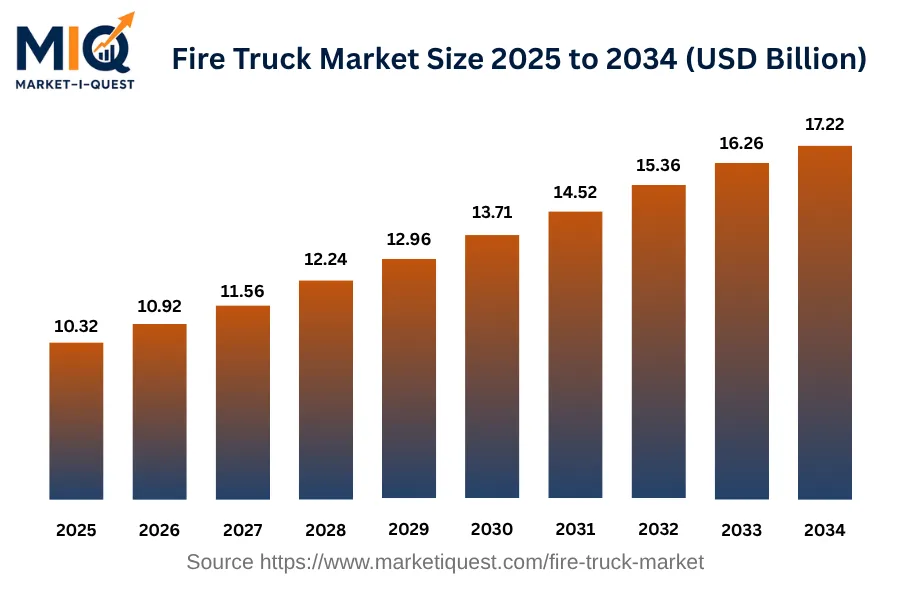
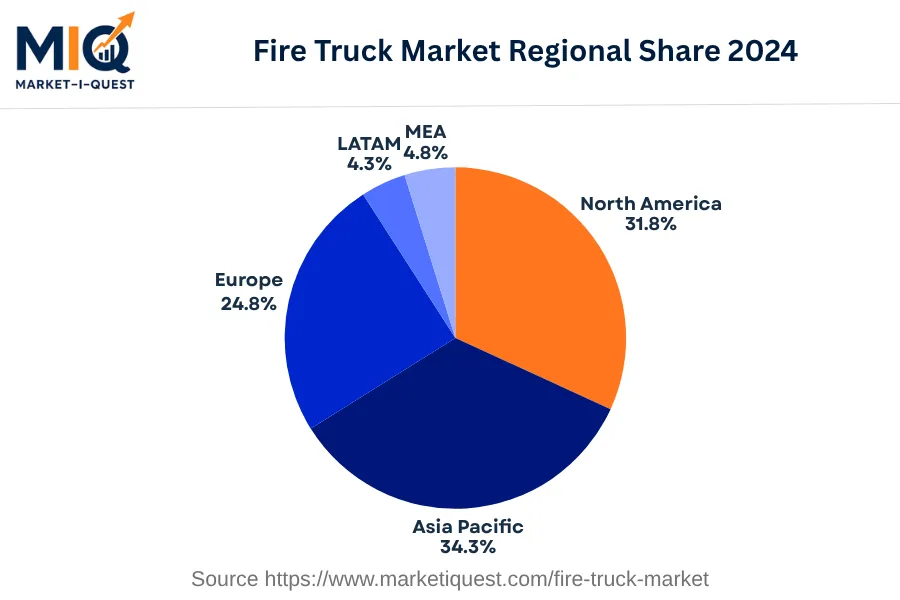
The Fire Truck Market, valued at USD 10.32 billion in 2025, is projected to grow to USD 17.22 billion by the end of 2034, boasting a CAGR of 5.9%. This steady rise emphasizes a consistent expansion of the Fire Trucks industry in the ten-year span between 2025 and 2034, reflecting an increase in demand and subsequent production of these utility vehicles. Numerous contributing economic factors and emerging markets could be responsible for the observed upturn in the market trend. Regional shares expose a diverse distribution of the Fire Truck Market in 2024; North America held a 31.8% share of the global market, while the Asia Pacific slightly exceeded this with 34.3%. Europeans, with 24.8%, also demonstrated a significant uptake. The remaining shares were divided between Latin America and the Middle East and Africa, at 4.3% and 4.8% respectively. These numbers underline a strong global demand, with the most significant shares within North America and the Asia Pacific region buoying the overall growth of the sector.

Key Takeaways

  • By Type - Pumper Trucks emerged as the leading subsegment in the Fire Truck Market in 2025.
  • By Propulsion - Internal Combustion Engine (ICE) held the major share accounting for a notable position in the year 2026.
  • By Application - Municipal segment led the Fire Truck Market with a significant market share in the year 2027.
fire-truck-market market size

Key Driving Factors

Mandatory Replacement Cycles in Developed Countries

In developed countries like the United States, the National Fire Protection Association (NFPA) has established standards like NFPA 1901 for fire apparatus, which outlines mandatory replacement cycles for fire trucks. This regulation ensures that fire trucks are not used beyond a certain age to ensure safety and functionality. Specifically, these standards require replacement of fire trucks typically after 15-20 years of service. This requirement necessitates continuous replacement of fire trucks, underpinning stable demand in developed countries following a regular cyclic pattern. These mandatory replacement cycles directly affect the purchasing decisions of city councils and fire departments, leading them to allocate funds periodically towards the procurement of new fire trucks, underpinning consistent demand, and driving growth in the fire truck market.
Population Growth and Expanding Urban Areas

The population growth in developing countries and expanding urban areas contribute significantly to the demand for fire trucks. As cities grow and populations increase, the requirement for vital urban services like fire protection also rises. And, as urban areas become denser, the complexity and frequency of emergency situations also increase, necessitating more advanced and diversified firefighting equipment. Thus, fire departments must continually update their fleet numbers and technology. Simultaneously, burgeoning cities necessitate the development of new fire stations to cover the expanded service areas, requiring more fire trucks to equip them. As such, the expansion of urban areas, coupled with population growth, is a solid driver for the fire truck market, pushing for additional units and advanced functionalities.

Market Evolution by Timeline

2019-2023
Demand from densely populated urban areas and industrial zones majorly drove the Fire Truck Market from 2019 to 2023. Major supply came from established manufacturers in US and Europe with emerging players from China starting to make their presence felt. Technology-wise, hybrid and electric engine models were piloted but lacked large-scale adoption. Standard adaptation to NFPA's 1901 led to enhanced safety measures being incorporated across the supply pool. Pricing remained competitive with public tenders forming the bulk of procurement models. A vital risk during this period was budgetary constraints at local government levels affecting supply contracts, a challenge which was addressed through leasing models.
2024
In 2024, there was a typical uptick in demand from areas prone to wildfires like California, Australia and parts of South America as a response to increased bush fire incidents. Production saw a shift with electric engine models becoming more prevalent due to climate control legislations with US manufacturers like Pierce featuring prominently. These trucks complied with EPA's emissions standards which were tightened further this year. Contract structures, however, remained traditional despite changing tech, with term contracts and purchase orders staying popular. Delays in delivery due to supply chain disruptions caused by pandemic-related lockdowns posed a challenge.
2025-2029
Between 2025 and 2029, demand patterns showcased an inclination towards specialized vehicles for search-rescue and hazardous materials handling due to increased industrial accidents in developing nations. Robotics and AI became a significant technology inclusion this period and this was visibly reflected in advanced models from suppliers like Rosenbauer. Nevertheless, the integration maturity remained a challenge due to lack of trained manpower to operate these features. The introduction of EU's Strategic Rescue Framework in 2027 affected the market by favoring suppliers compliant with these new guidelines. The typically growing cost of these high-tech trucks led to a rise in leasing contracts.
2030-2034
By 2030 to 2034, an exponential increase in demand was seen in flood-prone regions like South Asia, calling for amphibious fire trucks. The supply range expanded with local players in these regions starting to manufacture trucks to meet this demand. Drones and autonomous functions were incorporated into designs with companies like E-ONE leading the market, but implementation still faced roadblocks due to regulatory issues. New guidelines from International Code Council (ICC) played a key role in shaping the vehicle design. Given the rising manufacturing costs, equipment sharing, and collaborative procurement models became a coping strategy during this era.

Future Market Outlook

Future Opportunities

The ongoing urbanization trend, particularly in developing regions, presents significant opportunities for the fire truck market to adapt to the unique challenges posed by densely populated environments. As of 2023, the United Nations reports that more than half of the world's population lives in urban areas, prompting a need for more agile and compact fire response vehicles capable of navigating narrow streets. Furthermore, countries in Southeast Asia, such as Indonesia and the Philippines, are increasingly investing in fire safety infrastructure to address the rising incidence of urban fires, leading to potential demand for specialized fire trucks in these regions. The adoption of intelligent transport systems, advocated by the European Commission as part of its Smart Cities initiative, may also serve as a key driver for modernizing fire truck fleets, enhancing response times, and improving resource allocation. Additionally, there is increased emphasis on training and development programs for firefighters, as indicated by joint initiatives between local governments and fire service organizations, ensuring crews are well-equipped to handle advanced firefighting technologies. In areas like Australia, the government is focusing on climate-resilient fire management strategies, suggesting that fire truck manufacturers may explore collaboration with governmental agencies. Overall, as urban environments evolve, the fire truck market is poised to align its offerings with new safety standards and infrastructural needs, creating fertile ground for innovation and development.

Segmentation Analysis

By Type

The market is divided into subsegments including Pumper Trucks, Aerial Trucks, Tender Trucks, Aircraft Rescue and Firefighting (ARFF) Trucks, and Hazmat Trucks. Of these, Pumper Trucks accounted for the largest revenue share while Aircraft Rescue and Firefighting (ARFF) Trucks is expected to grow at the fastest CAGR during the forecast period.

Largest Revenue Share

Pumper Trucks

Market Share Leader

Pumper Trucks, also known as firefighting engine or fire truck, hold the largest revenue share in Fire Trucks Market primarily owing to its wide-scale application in the fire service industry. Pumper trucks are the most common type of fire apparatus, often the first on the scene, regardless the nature of fire. They deploy water, foam and other fire suppressing substances. The purchasing criteria of fire departments typically prioritize versatile functionality and lengthy service life, which are characteristics inherent in the design of Pumper Trucks. Geographically, the trend is deeply-rooted in areas with high-density build-up such as urban residential and commercial zones. Switching costs from Pumper Trucks to other types of firefighting vehicles could be high due to retraining and efficiency loss while adapting to new equipment. Traditional sales channels such as direct sales and tenders remain the main source of distribution in this segment. It is assumed that the drivers and factors mentioned above will continue to propel Pumper Trucks as the segment with the highest revenue.

Fastest CAGR

Aircraft Rescue and Firefighting (ARFF) Trucks

Forecast Period Growth Leader

The growth forecast indicates that Aircraft Rescue and Firefighting (ARFF) Trucks will demand the fastest CAGR. This prediction is married with the global expansion of the aviation industry and the requirement for more advanced and efficient airport firefighting capabilities. Airports worldwide have been working towards enhancing their firefighting fleet primarily due to increasing awareness about safety regulations and standards. ARFF Trucks are highly specialized vehicles designed to assist in airplane emergencies at airports, their unique capability to manouver around aircrafts and dispense large quantities of foam and dry chemical powder set them apart. With technological advancements, adoption barriers that were prevalent in the past due to high capital expenditure, are relatively diminishing now. Partnerships between firefighting vehicle manufacturers and airport authorities could potentially accelerate the growth of this segment. However, one should be cautious of near-term risks such as disruption in supply chains due to global events and fluctuating raw materials costs, which potentially could impact the growth rate.

By Propulsion

The market is divided into subsegments including Internal Combustion Engine (ICE) and Electric Vehicle (EV). In the base year of 2024, the ICE segment accounted for the largest revenue share while the EV is expected to grow at the fastest Compound Annual Growth Rate (CAGR) during the forecast period.

Largest Revenue Share

Internal Combustion Engine (ICE)

Market Share Leader

In 2024, the Internal Combustion Engine (ICE) dominantly commanded the largest share of the market revenue. The key drivers for this can be attributed to factors such as long-established infrastructure, widespread consumer acceptance, and extensive range of product options. The utility of ICE vehicles spans across all types of consumers, from personal users to commercial industries, which further fuels its market share. From a geographic perspective, countries with more established vehicle markets such as the United States, Europe, and China have a significant number of consumers who prefer ICE vehicles primarily due to the convenience of refueling and the longer driving range. Also, current regulatory standards are based around ICE vehicles, even though this is slowly changing. The purchasing decisions are mainly driven by factors such as vehicle performance, fuel economy, and cost with ICE vehicles continuing to lead in these areas. Although the global preference for ICE vehicles is dwindling in response to climate change, it is still the more dominant technology for the base year of 2024.

Fastest CAGR

Electric Vehicle (EV)

Forecast Period Growth Leader

While not the largest revenue contributor in 2024, Electric Vehicles (EVs) was the fastest-growing subsegment. Increased consumer environmental awareness and the urgent need to address climate change have served as catalysts for the shift to EVs. Furthermore, governmental policies advocating for sustainable and green transportation and providing incentives for EV purchases boost their adoption. Technological advancements play a pivotal role, particularly the ongoing improvements in battery technology, enhancing EVs' range and reducing their cost. The high capital expenditure initially associated with EVs has been a significant barrier to growth. However, industry partnerships among automakers, battery manufacturers, charging infrastructure companies and even governments are effectively tackling this challenge. The main risks to the segment's growth trajectory lie in the realm of policy changes, regulatory landscapes, and technological advancements that need to keep pace with the growing consumer demands.

By Application

The market is divided into subsegments including Municipal, Military, Airport, and Industrial segments. The Municipal subsegment accounted for the largest revenue share in 2024, while the Industrial subsegment is expected to grow at the fastest CAGR during the forecast period.

Largest Revenue Share

Municipal

Market Share Leader

The Municipal subsegment leading in the base year 2024 is driven by a combination of elements. In most geographies, municipal applications form the backbone of everyday functioning and thus demand a significant share of the market revenue. These cover a broad range of infrastructural facilities where our product is a necessity, contributing extensively to their revenue lead. Stringent regulations and public-sensitive decisions tend to make municipalities less price-sensitive, which also drives up revenues in this subsegment. The regular purchasing requirements, high switching costs due to entwined processes and budgetary allocations, further solidify the lead. Dispersed across vast geographies, municipalities usually have a fixed and recurring expenditure budget for these applications, ensuring a sustained revenue stream. Moreover, their direct channels to suppliers ensure efficient procurement, minimal disruptions, and consequently, steady revenue trends.

Fastest CAGR

Industrial

Forecast Period Growth Leader

Forecasted to grow at the fastest CAGR, the Industrial subsegment promises future potential with a string of drivers and catalysts. Rapid industrialization in emerging economies coupled with investments in innovative technologies and automation form key growth drivers for this subsegment. Companies in this space are continually exploring ways to reduce operational costs and increase efficiency, leading to a higher adoption rate of the product in the industrial sector. However, key adoption barriers like high initial capital expenditure and limited skilled workforce are area of concerns. Technological advancements, increasing capex in R&D by key players and strategic partnerships with tech firms align as key catalysts for growth in this sector. Certain near-term risks such as economic volatility and policy changes could affect the speedy growth, yet the dynamic industrial boom heralds a future of increasing revenues and growth in this fastest-growing subsegment.

Competitive Analysis

Key Market Players

Manufacturers / OEMs

Rosenbauer International AG
Austria
Pierce Manufacturing Inc.
US
Oshkosh Corporation
US

Key Suppliers & Raw Materials

ArcelorMittal
Luxembourg
Miba AG
Austria
Alcoa Corporation
US

Distributors, Integrators & Channel Partners

REV Group
US
Brindlee Mountain Fire Apparatus
US
Fire Line Equipment
US

Porter’s Five Forces Analysis

This analysis provides a comprehensive market segmentation of the Fire Truck Manufacturing Industry.

Supplier Bargaining Power

Medium

OEM lock-ins and specialized component requirements give moderate power to suppliers.

Buyer Bargaining Power

Low

High switching costs and technical specifications restrict the bargaining power of buyers.

Threat of Substitutes

Low

Given the unique functionalities of fire trucks, there are limited substitutes available.

Threat of New Entrants

Low

High capital investments and certification barriers deter new entrants.

Competitive Rivalry

High

The market is highly competitive with several established manufacturers commanding significant shares.

Regional Analysis

Geographic market dynamics and growth opportunities across key regions

Global Market Outlook

fire-truck-market market regional share

North America

In 2024, North America's Fire Truck Market experienced a significant progression due to various demand factors, technological adoption, and supply dynamics. Increased government expenditure on public safety measures in the United States, Canada, and Mexico drove the demand for state-of-the-art fire trucks. Also, the rise in industrial development and stringent fire safety regulations propelled the need for these specialized vehicles. The adoption of new technology such as remote monitoring systems and advanced communication equipment brought a fresh impetus to the market.

Changing purchasing trends and customer preferences influenced the dynamics of the Fire Truck Market. A trend towards multi-functional fire trucks equipped with enhanced rescue capabilities and water pumping systems could be observed. Technological advancements led to a shift towards electric fire trucks, particularly in the U.S, reducing operating costs and environmental impact. Also, online sales channels emerged as a preferred mode of procurement, especially among government entities. Partnerships and mergers between manufacturers were common, aimed to increase their market presence and to leverage technical expertise. Standardization of fire safety norms in North America further streamlined the operations in the market. Notably, customers ranged from utility companies, manufacturing establishments to retail sectors, each necessitating fire safety protocols and equipment at varying levels.

Asia Pacific

In 2024, the Fire Truck Market in Asia Pacific presented a significant demand surge, prompted by essential drivers and trends across the region. China, India, and ASEAN countries increased urban development projects, driving a pronounced need for advanced fire safety solutions. Stringent regulations to maintain a high level of fire safety in Japan and South Korea prompted an uptick in investment in new fire apparatus. Additionally, the rise in technology adoption in Australia, particularly in autonomous and electric fire trucks, boosted the market competitiveness. Simultaneously, evident trends shaped the market landscape. Buyers in China and India showed interest in multi-functional vehicles capable of handling varied emergencies beyond fire, while Japan observed a surge in retrofitting outdated fleets with fire suppression technology.

Channel dynamics shifted as governments across ASEAN markets procured revolutionary fire trucks directly for municipal use instead of relying on international aid. Notably, an increase in the strategic partnerships, especially in the manufacturing sectors – with South Korean manufacturers leading in the production of electric fire trucks – further fuelled market expansion. Served sectors included large scale enterprises, governments, utilities, and manufacturing industries, each demonstrating increasing awareness towards robust fire safety measures. However, the retail sector's relatively slow adoption rate stood as an outlier in the otherwise energized Fire Truck Market in 2024.

Europe

In 2024, Europe saw a significant development in its Fire Truck Market, shaped by a myriad of drivers and discernible trends. Government regulations insisting on upgraded safety standards propeled the demand for advanced fire trucks. Rapid urbanization and increased investment in public safety by countries like Germany, France and the United Kingdom further bolstered demand. Additionally, technological adoption trend led by Italy and Spain, where they incorporated AI and telematics in fire trucks for smarter and efficient operations, influenced market dynamics. Buyer behavior gravitated towards vehicles with enhanced capabilities such as high-pump capacity and longer truck ladders. A major shift was observed in the product technology as manufacturers increasingly turned to electric fire trucks, significantly reducing the sector's carbon footprint.

Central & Eastern Europe, especially, saw a surge in channel dynamics with fire trucks now being procured directly from manufacturers rather than third-party sellers, indicating a shift towards vertical integration. Notably, the Nordics showed a predilection for partnerships and M&As, with governments and manufacturers collaborating to ensure the adoption of advanced security systems. Lastly, enforcement of EU emissions policy structured the market, pushing manufacturers like Benelux to produce low-emission vehicles to meet government contracts needs.

Latin America

In 2024, the Fire Truck market in Latin America (LATAM) continues to grow bolstered by several factors. Market drivers include enhanced fire safety norms by governments across Brazil, Mexico, Argentina, Colombia, Chile, and Peru demanding advanced firefighting vehicles. Simultaneously, significant investments in infrastructure development projects added fuel to the market. Adoption of new, technologically advanced fire trucks like those equipped with telematics and connected technologies also significantly contributed to the market expansion. Trends followed a similar path. A shift in buyer behavior leaned towards robust, efficient, and technologically advanced vehicles that serve multiple needs, from fire response to EMS support.

This has been seen across all sectors, from governmental to industrial to various utilities. Significant policy enforcement by local governments enforced stricter fire safety regulations, opting for more advanced firefighting equipment and vehicles. There was an evident rise in partnerships and M&A activity among the major players in the market to take advantage of the growing demand and expand product offerings in the region. In terms of product shifts, there's been a substantial inclination towards multi-functional trucks that encompass water supply, aerial operations, and rescue services in the fire service sector.

Middle East & Africa

In 2024, the Fire Truck Market in the Middle East and Africa stood out due to strong demand and increasing investments. Drivers of this growth included increased expenditure by governments such as Saudi Arabia, UAE, Qatar, and Israel in fire safety measures, promoting the adoption of advanced fire trucks. The escalating construction activities in regions like UAE and Qatar necessitated enhanced fire safety protocols, further pushing the demand. Technological advancements in fire trucks were adopted in nations like Israel, significantly influencing the market dynamics. Conversely, the most discernable trends in the market were the surges in buyer preference for technologically advanced fire trucks and the increased tendency for partnerships and M&A activities.

For example, the UAE government partnered with leading manufacturers to supply advanced fire trucks to their civil defense department. Policymaking in the fire safety sector became more stringent, with governments in Egypt, South Africa, and Nigeria enforcing rigorous fire safety standards for public and private establishments, prompting a pivot towards higher quality fire trucks. Notably, sectors such as oil and gas, manufacturing, and utilities drove the demand, as the need for specialized, robust fire safety measures surged in these high-risk industries.

Recent Industry Developments

Latest market innovations, product launches, and strategic initiatives

January 2026

The fire truck market is expected to grow from $10.17 billion in 2025 to $10.94 billion in 2026, forecast to reach $15.74 billion by 2031 at a 7.56% CAGR. Fleet replacement cycles, electrification momentum, and climate-driven wildfire risk are lifting procurement budgets.

October 2025

Mutares-backed Magirus signed a takeover agreement for Achleitner Fahrzeugbau, an Austrian manufacturer specializing in customized offroad, security, and defense vehicles with expertise in all-wheel-drive technology. The acquisition was completed in November 2025. Magirus is a manufacturer of firefighting and emergency response vehicles expanding into defense and security vehicles.

Frequently Asked Questions