Thermal Imaging Market Snapshot

Key Players

  • FLIR Systems Inc. (United States)
  • Axis Communications AB (Sweden)
  • Leonardo DRS (United States)
  • L3Harris Technologies (United States)
  • Bosch Security Systems (Germany)
  • Hikvision (China)
  • DALI Technology (China)
  • Testo SE & Co. KGaA (Germany)
  • Seek Thermal (United States)

Market Size

Base Year 2024
$5.38 Bn
CAGR
7.6%
Forecast 2034
$11.19 Bn

Market Segments

By Technology
  • Cooled Thermal Imaging
  • Uncooled Thermal Imaging
  • Long Wave Infrared Imaging
By Application
  • Military and Defense
  • Industrial
  • Healthcare
  • Building Inspection
  • Surveillance

Market Dynamics

Drivers
  • Increased security concerns
  • Advancements in infrared technology
Restraints
  • High equipment costs
  • Regulatory constraints
Opportunities
  • Increasing safety concerns
  • Smart home integration potential

Market Size

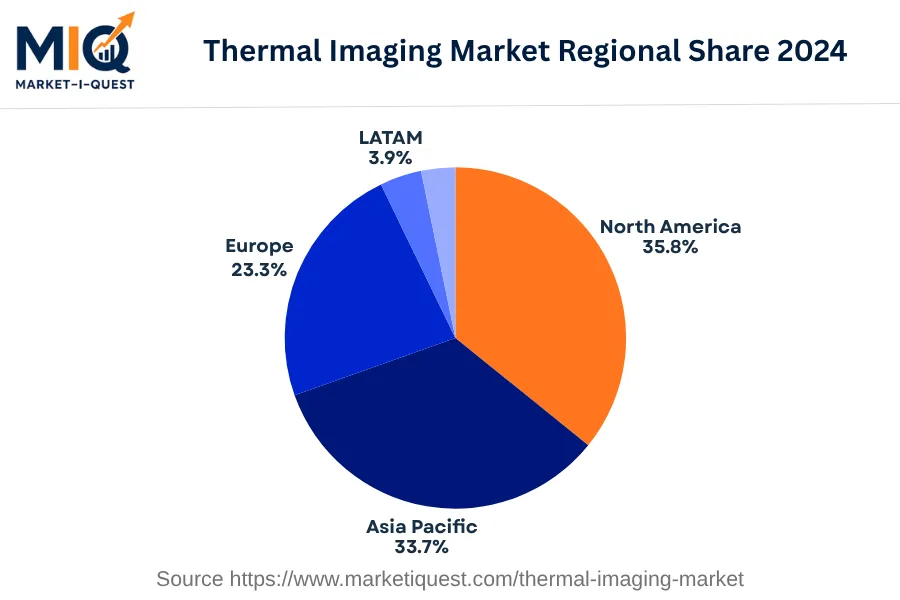
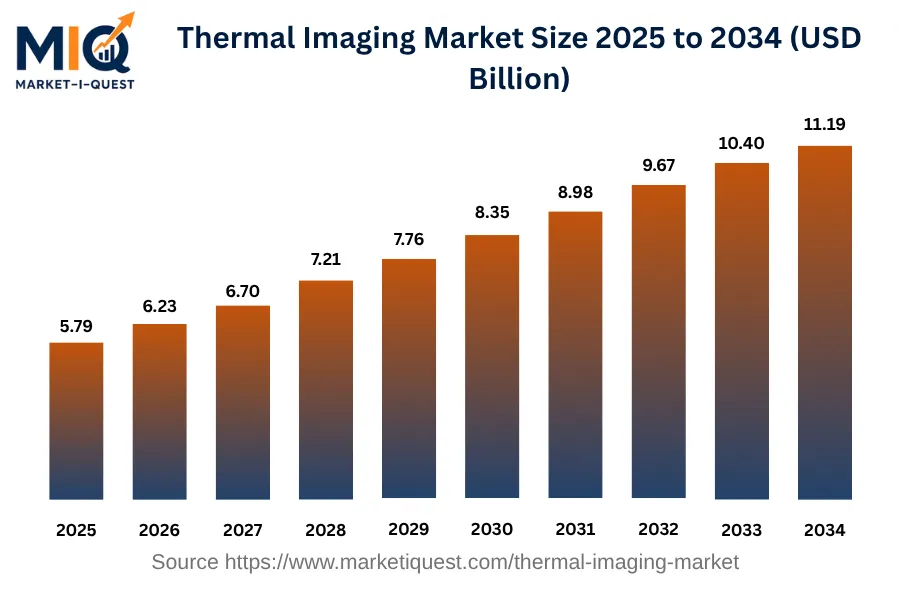
The Thermal Imaging Market is projected to grow from a size of $5.79 billion in 2025 to $11.19 billion by 2034, with an annual growth rate of 7.6%. This substantial increase within a nine-year span highlights a steady progressive growth. In the time frame from 2025 to 2034, it demonstrates a consistent upward trend in market value, almost doubling by the end year. Several factors contribute to this progression including more widespread use, advancements in thermal imaging technologies, and increased demand across different sectors that utilize these systems. In terms of regional shares in 2024, North America contributed a significant portion with 35.81%, closely followed by the Asia Pacific at 33.74%, and Europe at 23.27%. Lesser contributions were recorded from Latin America and the Middle East & Africa, which held shares of 3.95% and 3.23% respectively. The geographical distribution illustrates a global demand for thermal imaging, with prominent shares in both Western and Eastern hemispheres.

Key Takeaways

  • By Technology - Cooled Thermal Imaging held largest share of the segment in 2024.
  • By Application - Military and Defense led the segment of the market.
thermal-imaging-market market size

Key Driving Factors

Adoption of Thermal Imaging in Preventive Maintenance

Companies in a range of sectors, including facility management and manufacturing, are adopting thermal imaging devices to streamline their preventive maintenance protocols. Thermal imaging technology can non-invasively visualize and measure thermal energy emitted from an object or system, making it a valuable tool for detecting potential issues before they lead to system failure. For instance, in mechanical equipment, unusual heat patterns can indicate friction, misalignment, or wear. Spotting these issues early can help companies avoid costly downtime, enhance operational efficiency, and improve safety. As this approach to maintenance becomes more widespread, the demand for thermal imaging technology is climbing.

Integration of Thermal Imaging in Smartphones

Leading smartphone manufacturers are integrating thermal imaging capabilities into their products. This feature allows users to measure surface temperatures directly from their handheld devices and opens an array of applications ranging from home improvement to outdoor recreation. Developers can even build thermal imaging into mobile apps for things like heat loss detection in a home, identifying the source of HVAC issues, or observing wildlife at night. As smartphone capabilities broaden to include thermal imaging, this unique feature is driving the growth of thermal imaging market, attracting new vendors and resulting in a wider diversity of product designs and features. This expansion is not only increasing competition but also enhancing innovation within the global thermal imaging market.

Market Evolution by Timeline

2019-2023
In this period, defense and security sector remained the major market for thermal imaging, especially within North America and Europe. Commonly integrated within surveillance equipment, these thermal imaging units provided nighttime visibility. Surveillance drones also started using this technology. Supply side faced restrictions due to complex manufacturing process and the requirement of rare earth elements. Stricter environmental regulations affected the procurement of these materials, pushing many companies to explore recycling options. Commercial engagements mostly revolved around long-term contracts with defense contractors. The primary challenge faced was the high cost of thermal image units preventing its wider adoption in commercial sectors.
2024
The year was marked by a significant increase in the use of thermal imaging in the healthcare sector. Countries like the U.S., Germany, and Japan led this adoption shift primarily for diagnostics and disease management. Miniature thermal imaging chips that fit into handheld diagnosis devices became a popular product. Regulations around patient privacy were a crucial consideration within product design and ethos. Predominantly, these were sold under flat-fee licensing models, with manufacturers partnering with healthcare providers for service delivery. As a risk, misdiagnosis due to unclear thermal images was a concern that led to greater investments in improving image clarity.
2025-2029
The emergence of smart buildings drew thermal imaging into the architectural and construction markets. Regions with high-energy efficiency standards like Scandinavia and California were the early adopters. These thermal scanners checked insulation efficiency. While integration within building inspection tools was still maturing, stand-alone scanners were the primary product. Procurement often happened as part of larger inspection service contracts or through regulation-induced purchases. There were instances of certain thermal imaging brands being mandated by local building codes. The risk of incorrect readings leading to ineffective resource allocation led to strong quality control measures by providers.
2030-2034
The continued progression of autonomous vehicles witnessed the incorporation of thermal imaging for enhancing visibility under various conditions. Regions with active autonomous vehicle programs like China and the EU primarily drove this adoption. Say 'Goodbye' to sensor-based systems as companies introduced thermal imaging software directly integrated into the vehicle systems. Strong vehicle safety regulations played a massive role in this shift. Contract types typically reflected strategic partnerships between vehicle manufacturers and thermal imaging companies. The key risk emerged from the need for these systems to flawlessly integrate with other vehicular systems to avoid safety compromise.

Future Market Outlook

Future Opportunities

The expansion of thermal imaging technology is expected to create diverse opportunities in several emerging sectors. With the increasing focus on smart city initiatives across Asia, cities in countries like Singapore are implementing thermal imaging systems for monitoring energy efficiency in public buildings. The partnership between thermal imaging firms and Internet of Things (IoT) providers looks promising, evidenced by collaborations such as the one between Teledyne FLIR and Microsoft announced in 2022 to integrate thermal data analytics into building management systems. Furthermore, regulatory bodies are mandating the installation of thermal sensors for safety inspections in industries such as manufacturing and construction, where the need for surveillance and predictive maintenance is growing. The agricultural sector is also evolving, with companies like DJI producing drones equipped with thermal imaging capabilities for crop health monitoring, enhancing precision farming techniques. Additionally, as environmental awareness rises, industries may increasingly employ thermal imaging for monitoring emissions and energy waste, aligning with initiatives such as the Paris Agreement goals set in 2015. Next-generation applications in wildlife monitoring and search-and-rescue operations are gaining traction due to partnerships such as those between NGOs and thermal imaging tech companies. Consequently, the synergy between current technology and industry needs suggests that thermal imaging will play a crucial role in addressing safety, efficiency, and sustainability challenges moving forward.

Segmentation Analysis

By Technology

The market is divided into subsegments including Cooled Thermal Imaging, Uncooled Thermal Imaging, and Long Wave Infrared Imaging. Cooled Thermal Imaging accounted for the largest revenue share while Uncooled Thermal Imaging is expected to grow at the fastest CAGR during the forecast period.

Largest Revenue Share

Cooled Thermal Imaging

Market Share Leader

Cooled Thermal Imaging sector is leading the market primarily due to its superior image quality and high sensitivity. The military and defense sector, alongside aerospace, dominates its customer base. Despite a higher purchasing price, these sectors prioritize precision performance over cost, driving significant revenue for Cooled Thermal Imaging. Geographically, countries with advanced military capabilities like the USA and China have higher penetration of this technology, providing a substantial impetus to the revenue. Additionally, regulations favoring improved standard of tactical systems for national security have steered demand towards high-performance technologies, benefitting the Cooled Thermal Imaging segment. The advantage of high resolution under extreme conditions reduces the chances of switching to alternatives, reinforcing its market position.

Fastest CAGR

Uncooled Thermal Imaging

Forecast Period Growth Leader

Uncooled Thermal Imaging is projected to grow at the most rapid pace due to its affordability and wide application scope. The technology, while less sensitive than Cooled Thermal Imaging, provides sufficient precision for most industrial, commercial, and some lower-intensity defense applications. Adoption barriers such as lower sensitivity are being tackled with ongoing technological advancements which make it a robust growth segment. Furthermore, policy initiatives aimed at energy efficiency and safety regulations in sectors like construction and automotive act as significant catalysts. However, in the near term, the challenge lies in managing the trade-off between affordability and improved sensitivity. Strategic partnerships focussing on technology enhancement can bolster growth further, as well as prudent capital allocation towards process efficiency and scaling production.

By Application

The market is divided into subsegments including Military and Defense, Industrial, Healthcare, Building Inspection, and Surveillance. Among these, the Military and Defense subsegment accounted for the largest revenue share while the Healthcare subsegment is expected to grow at the fastest CAGR during the forecast period.

Largest Revenue Share

Military and Defense

Market Share Leader

The Military and Defense sector marks the highest revenue flow for 2024 due to several factors. The prime driver is the ever-increasing global defense expenditure catalyzing advancements in tactical communication systems, surveillance equipment, and unmanned aerial vehicles. Besides, the pivot towards the modernization of military hardware, coupled with the adoption of cutting-edge technologies, has been paramount in revenue generation. Moreover, a high degree of regulation and state support incentivize innovation within this subsegment. Geographically, defense giants such as the US, China, and Russia contribute substantially to this subsegment’s revenue. Furthermore, the guarding against switching costs through long-term contract arrangements and strong relationship equity with governments has bolstered the sector’s income. Lastly, via various procurement channels, the military's large-scale purchases have led to a significant revenue influx.

Fastest CAGR

Healthcare

Forecast Period Growth Leader

The Healthcare subsegment shows the highest growth potential due to a confluence of factors. A significant driver is the rise of digital health, telemedicine, and remote patient monitoring catalyzed by the COVID-19 pandemic. Technological advancements in artificial intelligence and machine learning are bolstering the adoption rate within the healthcare industry. Furthermore, investing in healthcare technologies has been recognized as a priority due to its role in improving patient outcomes, reducing healthcare costs, and improving the overall health management workflow, increasing its growth rate. However, barriers including regulatory hurdles, privacy concerns, and data security risks might affect the adoption rate. Despite these challenges, partnerships between technology firms and healthcare providers are paving the way for accelerated adoption.

Competitive Analysis

Key Market Players

Manufacturers / OEMs

FLIR Systems, Inc.
US
Thermoteknix Systems Ltd.
UK
Leonardo DRS
US

Key Suppliers & Raw Materials

ULIS
France
Sofradir
France
Teledyne Technologies
US

Distributors, Integrators & Channel Partners

Infrared Cameras Inc.
US
Infratec GmbH
Germany
Jenoptik AG
Germany

Porter’s Five Forces Analysis

A comprehensive analysis of the thermal imaging market centered around Porter's Five Forces framework.

Supplier Bargaining Power

Low

Supplier power is low due to the broad range of thermal imaging component providers.

Buyer Bargaining Power

Medium

Buyers have moderate power due to abundant product offerings and relatively low switching costs.

Threat of Substitutes

Medium

Technologies such as infrared sensing can provide alternatives but lack in some application areas.

Threat of New Entrants

High

Low entry barriers and high market growth make it attractive for new companies.

Competitive Rivalry

High

Intense competition among established players due to technological advancements and product differentiation.

Regional Analysis

Geographic market dynamics and growth opportunities across key regions

Global Market Outlook

thermal-imaging-market market regional share

North America

In 2024, the North American Thermal Imaging Market was stimulated by numerous factors that shaped its dynamic sphere within the U.S., Canada, and Mexico. Increased demand by businesses, government, healthcare, and manufacturers for real-time data and maintenance monitoring led to significant growth. A surge in government investments for surveillance, coupled with tighter regulations regarding safety standards in industries like manufacturing and construction, allowed for broader adoption of thermal imaging technologies. Strong advancements in AI incorporation spurred the market as well, diversifying supply dynamics and escalating competition.

Paralleling these drivers, several defining trends influenced buyer behaviors and the broader market direction. For instance, a noticeable shift towards integrated thermal imaging systems in smartphones and vehicles indicated increased user interest in portable, user-friendly applications. Concurrently, a rise in strategic partnerships and M&As, particularly within tech-centric sectors in the U.S., underscored a focus on enhancing product capability and market reach. Furthermore, expanding commercial uses in retail and utilities, coupled with stricter enforcement of safety policies in the industrial sector, highlighted a rising dependency on thermal imaging not only for security but also for operational efficiency and risk management. Consequently, these drivers and trends translated into a significant momentum for the North American Thermal Imaging Market in 2024.

Asia Pacific

In 2024, the Asia Pacific thermal imaging market experienced substantial growth. Drivers of this growth included the region's rapid urbanization and industrial development, which led to increased demand for advanced surveillance and security solutions. Specifically, governments in China, India, and South Korea significantly invested in modernizing their defense sectors, driving the adoption of thermal imaging technologies for military and surveillance applications. Additionally, the region's expanding manufacturing sector, particularly in Japan and China, embraced thermal imaging for quality control and predictive maintenance, further fueling market demand.

Several noteworthy trends emerged as well. There was a consistent shift towards uncooled thermal imaging technology, considered more lightweight and cost-effective. E-commerce also became a significant channel for thermal imaging products, following the rise of online shopping in Asia-Pacific. Corporate partnerships and mergers gained traction, particularly in China and Australia, while South Korea enforced strict safety standards for thermal imaging technologies. Significant users of thermal imaging in 2024 included government entities, manufacturing plants, utilities, and healthcare providers. In healthcare, specifically in India and ASEAN markets, thermal imaging was widely adopted for body temperature monitoring amid public health emergencies. Military and security sectors remained the largest consumers of thermal imaging technology across Asia-Pacific. The retail sector, particularly in Japan and China, showed increased interest, utilizing thermal imaging to enhance in-store security.

Europe

In 2024, the European Thermal Imaging market experienced significant growth due to several driving factors. Heightened demand, originating from sectors such as healthcare, utilities, and manufacturing, aligned with the increased need for efficient diagnostics and monitoring applications. Regulation also played a crucial role, with European Union standards pushing for energy-efficient applications, driving demand up. Investment flowed furiously into technological advancement, with countries like Germany, the United Kingdom, and France leading in the adoption of sophisticated thermal imaging tools.

In line with these market drivers, certain trends became apparent. Buyers, specifically from the enterprise and government sectors, increasingly prioritized the integration of thermal imaging in their operations for improved efficiency and safety measures. Technological shifts were profound, with Italy and Spain accentuating the trend towards handheld thermal imaging devices. The expanding channel dynamics became clear, evidenced by strategic partnerships and M&A activity among thermal imaging companies in the Benelux region and Central & Eastern Europe. There was a substantial emphasis on policy enforcement, ensuring consistency in quality and performance of products across the region. Thus, the European Thermal Imaging Market in 2024 was marked by strengthened demand due to regulations and technology adoption, supported by evolving buyer behavior and policy enforcement.

Latin America

In 2024, the thermal imaging market in Latin America (LATAM) witnessed significant growth, propelled by diverse factors. Governments across the region, including Brazil, Mexico, Argentina, Colombia, Chile, and Peru, have adopted thermal imaging technologies for security purpose, which was a primary driver. Investment in thermal imaging equipment increased as manufacturing businesses incorporated it for predictive maintenance. Moreover, high demand from utilities for infrastructure inspection drove the market.

Simultaneously, trends emerged reflecting shifts in product adoption and buyer behavior. For example, the healthcare sector in countries like Argentina and Chile started to utilize thermal imaging for diagnostics, and it became popular in retail for theft prevention. There was a notable increase in the adoption of mobile thermal imaging systems, driven primarily by utilities and enterprise customers. Meanwhile, product offerings tailored to different sectors started to dominate the market, highlighting the shift in manufacturers' strategies. Compliance enforcement, particularly in Brazil and Mexico, reinforced safety and security regulations necessitating thermal imaging systems. They became part of the standard equipment in key sectors such as utilities, manufacturing, retail, and healthcare. Partnerships and M&A activities were also prevalent, especially in Colombia's enterprise sector, signaling industry consolidation and boosting local players' growth. Overall, the LATAM thermal imaging market in 2024 was characterized by strong growth, broad-based adoption across sectors, and industry consolidation.

Middle East & Africa

In 2024, the Middle East and Africa's thermal imaging market was shaped largely by factors related to security, safety, and technology adoption. Increased investment in military and surveillance sectors by countries like Saudi Arabia, United Arab Emirates, and Israel implied higher demand for thermal imaging solutions. Moreover, stricter safety regulations enforced in industries such as oil and gas in Qatar and Nigeria led to a growth in use of thermal imaging tools for infrastructure inspection and maintenance.

The shift towards digitization and adoption of IoT technologies in utilities and telecom sectors, notably in South Africa and Egypt, fostered the integration of thermal imaging in system monitoring and fault detection processes. Furthermore, the healthcare sector in UAE and Israel saw a trend towards using thermal imaging in diagnostic procedures, revealing it as a prevalent non-invasive technique. A significant trend involved industries collaborating with thermal imaging solution providers to customize applications for specific needs, such as in manufacturing process control in Saudi Arabia. A clear policy enforcement was evident in Egypt, owing to the adoption of thermal imaging in law enforcement and border security. Lastly, the rise of start-ups in Kenya focusing on thermal imaging technologies signified a changing dynamic in the market's supply side, reflecting the rising regional interest in this field.

Recent Industry Developments

Latest market innovations, product launches, and strategic initiatives

June 2026

THEON International PLC entered an initial agreement to acquire HGH Systèmes Infrarouges for approximately 300 million Euros. This business acquisition expands the company's existing thermal imaging portfolio to include systems built specifically to detect and track drones.

Frequently Asked Questions