Enteric Disease Testing Market Snapshot

Key Players

  • bioMérieux SA (France)
  • DiaSorin S.p.A. (Italy)
  • BD (Becton Dickinson and Company) (United States)
  • Meridian Bioscience Inc. (United States)
  • Quidel Corporation (United States)
  • Biocartis Group NV (Belgium)
  • Thermo Fisher Scientific Inc. (United States)
  • Alere Inc. (United States)
  • Bio-Rad Laboratories Inc. (United States)
  • Cepheid Inc. (United States)

Market Size

Base Year 2024
$4.68 Bn
CAGR
6.29%
Forecast 2034
$8.61 Bn

Market Segments

By Test Type
  • Immunoassay
  • Molecular
  • Conventional
  • Chromatography & Spectrometry
  • Others
By Disease
  • Bacterial Enteric Disease
  • Viral Enteric Disease
  • Parasitic Enteric Disease
By End Use
  • Hospitals
  • Diagnostic Laboratories
  • Research & Academic Institutes
  • Others

Market Dynamics

Drivers
  • Increasing prevalence of enteric diseases
  • Advancements in testing technologies
Restraints
  • High cost of testing
  • Lack of awareness
Opportunities
  • Emerging diagnostic technologies
  • Unmet medical needs

Market Size

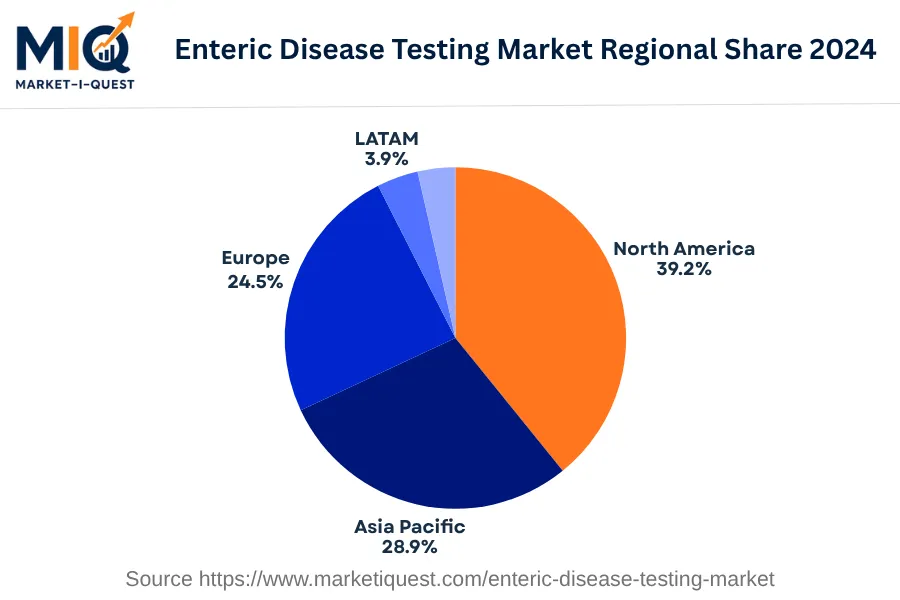
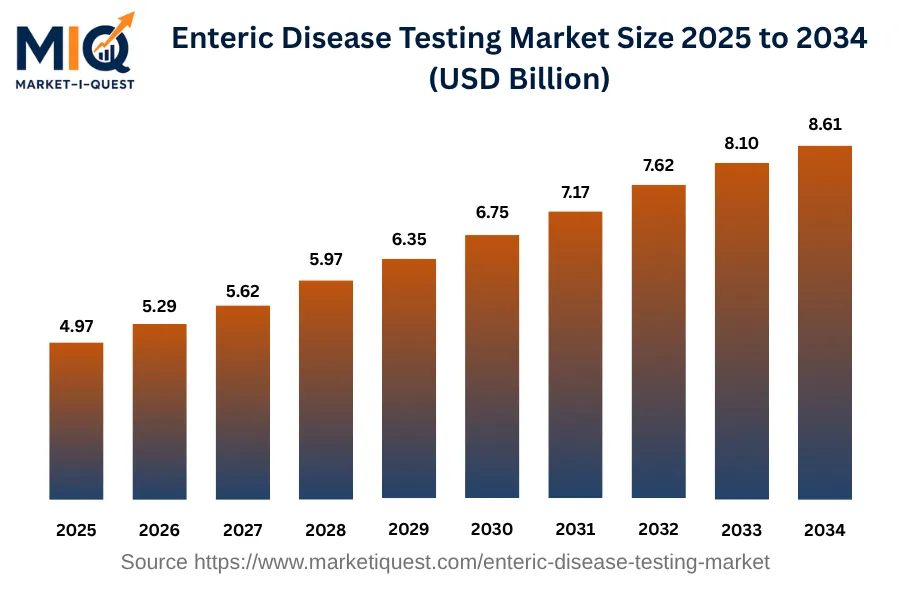
The Enteric Disease Testing Market size was at 4.68 Billion in 2024 and saw a surge to 4.97 Billion in 2025. By 2034, this market is projected to reach a value of 8.61 Billion, growing at a compound annual growth rate (CAGR) of 6.29%. This increase indicates a steady growth path over the next decade. The rise in market size is due to an increase in the prevalence of enteric diseases, which has resulted in a higher demand for testing solutions. With more cases being diagnosed, the need for these tests has escalated, thereby propelling the market size. The regional share mix in 2024 indicated that North America had the highest contribution to the market with a share of 39.18%, followed by Asia Pacific which held 28.86%. Europe also accounted for a sizeable proportion at 24.48%, while LATAM and MEA were responsible for 3.92% and 3.56% respectively.

Key Takeaways

  • By Test Type - Immunoassay held a strong lead accounting for the largest market share in 2024.
  • By Disease - Bacterial Enteric Disease was the top segment accounting for a major market portion in 2024.
  • By End Use - Hospitals led the market holding the majority share in 2024.
enteric-disease-testing-market market size

Key Driving Factors

Increased Incorporation of Point-of-care (PoC) Testing

The Enteric Disease Testing Market is benefitting significantly from the growing deployment of Point-of-care (PoC) testing in healthcare institutions. PoC tests offer immediate results, enabling quick decision-making and timely treatment. This immediacy is crucial in detecting enteric diseases, which, if undiagnosed, can lead to dangerous health complications. Healthcare providers globally understand the potential that lies in these tests and have taken initiatives to incorporate PoC testing in their clinical practice, which in turn, is fueling the growth of the Enteric Disease Testing market.

Surge in International Travel and Migration

The increased volume of international travel and migration constitutes a key driver for the Enteric Disease Testing Market. People traveling to locales with unsanitary conditions and improper hygiene practices face higher risk of contracting enteric diseases. Such contagions are often brought back to the travelers' home countries, where they can spread if not detected and treated promptly. Testing becomes critical in curbing the spread of such diseases and safeguarding public health. Therefore, healthcare authorities in several countries are incorporating advanced testing procedures for enteric diseases in their routine check-ups for international travelers and immigrants, thereby propelling the growth of this market.

Market Evolution by Timeline

2019-2023
Healthcare providers and regulatory bodies emerge as the main buyers of enteric disease testing products in this period, driven largely by increased pathogens spread incidences due to climate change especially in Asia and Africa. Enzyme-Linked Immunosorbent Assay (ELISA) and Polymerase Chain Reaction (PCR) dominate the market, but lack in local vendor capacities limit wider supply. Regulation around product quality and safety get hardened by the European Union's In-Vitro Diagnostics Directive (IVDD), affecting global market access. Pricing leans towards a per-test model, with many companies forming alliances to pool resources and bid on larger contracts. However, the principal risk is patent litigacy, creating uncertainties in supply chains due to disputes around ELISA and PCR technology patents.
2024
This year sees a demand surge in the United States due to a rise in foodborne diseases. Supply-wise, PCR-based fecal occult blood tests dominate; however, chip-based biosensor technology starts emerging as a disruptive direction. An increasing emphasis on transparent pricing models begins, initiated by the Health Care Cost Transparency Act passed in the US. Market competition increases due to the flood of cheaper, locally-produced testing kits from Asia leading to an overall reduction in prices. The risk heightens around decentralized test procuring, making quality assurance difficult to maintain.
2025-2029
Global health organizations and disease control centers increase purchases during this period due to rising global waterborne illnesses. Chip-based biosensor technology takes over with high integration maturity, as multiple successful pilot projects are completed in Europe. The World Health Organization's regulation on point-of-care enteric disease testing influences adoption. A shift towards a subscription pricing model is witnessed, paired with multi-year contracts for large hospitals and health systems. Major risk revolves around securing raw materials required for test kit manufacturing due to geopolitical trade tensions.
2030-2034
Pharmacies and retail outlets emerge as buyer segments with their increased capability for enteric disease testing, particularly in populous countries like China and India. Genomic sequencing technology replaces others for disease detection, but infrastructure limitations pose constraints in developing countries. New standards introduced by the International Organization for Standardization (ISO) for enteric disease testing devices influence their adoption rate. Competitive pricing across brands forms the commercial model, but a rise in quality concerns results in strict contracts regarding liability. Risks revolve around the misuse of self-test kits by untrained individuals leading to inaccurate results and misinterpretations.

Future Market Outlook

Future Opportunities

The expanding focus on food safety and public health initiatives presents considerable opportunities within the enteric disease testing market. In 2023, the U.S. Food and Drug Administration (FDA) proposed a new framework for improving food safety systems, which encourages the adoption of more sophisticated testing approaches to identify pathogens in food products. This regulatory shift is likely to incentivize manufacturers to invest in advanced detection technologies, including biosensors and molecular diagnostics. Geographically, emerging economies in Southeast Asia, such as Vietnam and Indonesia, have seen governmental organizations establishing partnerships with private enterprises to enhance food testing capabilities, creating a robust demand for localized testing solutions. Furthermore, the increasing prevalence of antibiotic-resistant pathogens, as reported in the 2022 WHO Global Antimicrobial Resistance and Use Surveillance System (GLASS) report, underscores the necessity for more accurate and rapid diagnostic methods to inform treatment decisions effectively. Companies like BioMérieux are actively expanding their R&D efforts in these areas, indicating a promising trajectory for novel diagnostic products. Additionally, advancements in artificial intelligence and machine learning are poised to enhance the analytical capabilities of testing laboratories, enabling better predictive models for outbreak management and prevention. This aligns with the 2021 WHO Global Strategy for Food Safety, which advocates for leveraging technology to ensure food security and public health.

Segmentation Analysis

By Test Type

The market is divided into subsegments including Immunoassay, Molecular, Conventional, Chromatography & Spectrometry, and Others. Immunoassay accounted for the largest revenue share while Chromatography & Spectrometry is expected to grow at the fastest CAGR during the forecast period.

Largest Revenue Share

Immunoassay

Market Share Leader

Immunoassays continue to be a leading source of revenue in the diagnostics market, owing to their wide range of applications in detecting and measuring the presence and concentration of specific antigens or antibodies in patient samples. Immunoassays are commonly used in clinical laboratories and are indispensable in diagnosing and monitoring infectious diseases, cardiac conditions, endocrine disorders, and cancers. The revenue dominance of this subsegment is due to high-volume repeat-sales for consumables and reagents, which are necessary for the routine tests performed. This subsegment also witnesses robust demand across varied geographies, given the global nature of the conditions they address. The purchasing criterion heavily leans toward the accuracy and reliability of Immunoassay tests and their affordability, hence, sustains the sales volume. The presence of significant switching costs for clinical laboratories further fortifies segment's stronghold. Immunoassay's distribution channel primarily involves direct sales to hospitals and laboratories and partnerships with diagnostic service providers.

Fastest CAGR

Chromatography & Spectrometry

Forecast Period Growth Leader

The Chromatography & Spectrometry segment is anticipated to witness the fastest growth rate. This growth is propelled by the increasing adoption of these techniques in precision medicine and complex molecular diagnostics, offering higher sensitivity and specificity compared to conventional methods. Growth catalysts for this segment include technological advancements, enabling faster and more accurate analyses. Moreover, increasing policy initiatives and funding towards biomedical research create a favorable environment for market expansion. Challenges exist in the form of high capital investment, which acts as a barrier to adoption, particularly in emerging markets. Potential risks involve regulatory complexities in different countries and a steep learning curve for users, which may slow down the widespread adoption. However, these hurdles are expected to weaken with ongoing advancements and increased familiarity with the technology.

By Disease

The market is divided into subsegments including Bacterial Enteric Disease, Viral Enteric Disease, and Parasitic Enteric Disease. Bacterial Enteric Disease accounted for the largest revenue share while Parasitic Enteric Disease is expected to grow at the fastest CAGR during the forecast period.

Largest Revenue Share

Bacterial Enteric Disease

Market Share Leader

Bacterial Enteric Disease holds the largest revenue share due to multiple factors. Firstly, its prevalence is high worldwide, attracting significant attention from the healthcare industry. Factors such as bad sanitation conditions, improper hand hygiene, and consumption of unhygienic food provide an ideal environment for bacterial diseases to thrive, increasing the prevalence of bacterial enteric diseases. Secondly, available treatment options are broad based and widespread, ranging from antibiotics to anti-diarrheal medicines and this augments its share in revenues. Increased government awareness campaigns about bacterial diseases also contribute to this subsegment’s large market share, guiding populations towards proper preventative and treatment measures. Future revenue stability is expected to be driven by efforts to enhance diagnostic techniques and drug-efficacy studies, keeping this subsegment at the forefront.

Fastest CAGR

Parasitic Enteric Disease

Forecast Period Growth Leader

The Parasitic Enteric Disease subsegment is projected to have the fastest growth rate. While it starts from a relatively small revenue base, several factors drive its growth outlook. The occurrence of parasite-related diseases is increasing in underdeveloped and developing regions due to poor sanitary conditions, minimal access to clean water, and climatic changes favoring parasite growth. Furthermore, the efficacy of existing treatments for parasitic diseases is often low, which creates an urgent need for more research and development for innovative solutions. While adoption barriers like low awareness of these diseases exist, advancements in technology and potential policy initiatives that promote universal healthcare are likely to catalyze growth in this subsegment. However, complicated regulation procedures and high development costs of new treatments present near-term risks.

By End Use

The market is divided into subsegments including Hospitals, Diagnostic Laboratories, Research & Academic Institutes, and Others. In the base year of 2024, Hospitals accounted for the largest revenue share while Research & Academic Institutes is expected to grow at the fastest CAGR during the forecast period.

Largest Revenue Share

Hospitals

Market Share Leader

The hospital subsegment accounted for the largest revenue in 2024. This is largely due to the fact that hospitals typically have the most significant utilization rates of medical facilities. As they often offer a wide range of services from outpatient care to critical care and surgeries, hospitals tend to require a wide range of testing and diagnostic procedures. Hospitals also benefit from a robust and consistent patient flow, which contributes to a steady demand for medical services. Additionally, hospitals are often supported by government funding or private endowments which allows for considerable purchasing capacity for updated technology and equipment. Finally, due to their size and high demand for accurate and quick diagnosis, hospitals often have in-house diagnostic laboratories for quicker turnaround times hence increasing revenue in this sector.

Fastest CAGR

Research & Academic Institutes

Forecast Period Growth Leader

The Research & Academic Institutes subsegment is projected to grow at the fastest CAGR during the forecast period. The primary drivers of this rapid growth are advancements in technology and an increasing focus on research and development (R&D) initiatives. These organizations tend to be early adopters of advanced analytical technologies, providing further impetus for market growth. Another significant factor driving growth is the increasing amount of partnerships between research institutes and industry participants focused on innovative testing and diagnostic solutions, fueled by substantial investments in R&D. However, challenges for this subsegment could include budget constraints, which can limit the purchasing capacity for expensive equipment, as well as regulatory barriers that could slow down the adoption process. These organizations typically need to navigate through complex approval processes before any newly developed solution can reach the market.

Competitive Analysis

Key Market Players

Manufacturers / OEMs

BioMerieux
France
Beckman Coulter
US
Cepheid
US

Key Suppliers & Raw Materials

Thermo Fisher Scientific
US
Abbott Laboratories
US
Alere
US

Distributors, Integrators & Channel Partners

Cardinal Health
US
BD
US
QIAGEN
Germany

Porter’s Five Forces Analysis

An examination of the competitive environment and influential factors within the Enteric Disease Testing Market.

Supplier Bargaining Power

Medium

Suppliers' control is strong due to the high reliance on technological advancements and specialized inputs.

Buyer Bargaining Power

Low

Buyers' bargaining power is limited due to the specific nature and critical importance of enteric disease tests.

Threat of Substitutes

Low

Few, if any, alternatives exist for accurate detection and diagnosis of enteric diseases.

Threat of New Entrants

Medium

Regulatory trials and initial investment costs pose hurdles, but emerging companies can still enter the market.

Competitive Rivalry

High

Strong competition exists as firms strive to discover and implement innovative testing techniques.

Regional Analysis

Geographic market dynamics and growth opportunities across key regions

Global Market Outlook

enteric-disease-testing-market market regional share

North America

In 2024, the North American Enteric Disease Testing Market showed significant growth due to advancements in healthcare technology and increased health consciousness among the population. Drivers of this market included an increase in investment in healthcare infrastructure, particularly in the U.S. and Canada, which resulted in the implementation of more sophisticated testing methods. Regulations also played a role, as governing bodies prioritized early diagnosis to control the spread of enteric diseases, endorsing advanced point-of-care diagnostics. In Mexico, rising living standards increased accessibility to healthcare services, stimulating demand for enteric disease tests.

The year's market trends were characterized by a shift towards rapid detection tests among healthcare providers due to their efficiency and accuracy. Buyer behavior showed a proclivity toward easier, non-invasive testing methods. Notably, there were significant advancements in molecular diagnostics, which greatly improved the sensitivity and specificity of enteric disease testing. Partnerships between large diagnostic companies and healthcare institutes emerged as a trend, enhancing the variety and quality of services the latter could offer while expanding the former’s reach. The primary market sectors involved were government health bodies, private healthcare institutions, and testing laboratories, with key customers being general residents, healthcare providers, and institutions involved in public health and safety.

Asia Pacific

In 2024, the Asia Pacific Enteric Disease Testing Market was notable for its diagnostic drive in response to high disease prevalence. Increasing population density and lacking sanitation across areas in China and India spurred a demand for innovative, quick disease testing strategies. Governments across the region, such as Japan and South Korea, advocated for robust investment in public healthcare infrastructure, encouraging the adoption of advanced testing technologies. Australia's strict testing policy enforcement skewed market supply dynamics, leading to a competitive pricing environment. From a trend perspective, patient behavioral patterns underlined the necessity for outpatient disease testing methods. There was a notable shift towards rapid diagnostic tests offering quick and accurate enteric disease detection in healthcare sectors of China, Australia, and key ASEAN markets.

Online healthcare services gained traction in India, influencing the market into adopting digital portals for disease testing. Partnerships and M&A activities took place, particularly in Japan and South Korea, consolidating market entities and diversifying service portfolios. The overall market maintained stringent standards, with majority of the products attaining approvals from regional FDA counterparts. Lastly, policy enforcements, such as stringent disease testing standards imposed by the Chinese government in utility and manufacturing sectors, led to adjustments in market strategies.

Europe

In 2024, the Enteric Disease Testing Market in Europe underwent substantial developments with regards to its demand factors, technological adoption, and pricing dynamics. Germany, France, and the United Kingdom experienced increased demands due to an uptick in gastrointestinal disorders. Key drivers were expansion in healthcare infrastructure, improving patient awareness about gastrointestinal diseases, and adoption of advanced, rapid diagnostic tests - particularly in the UK. A major factor in Central & Eastern Europe was the investment in upgrading their healthcare systems to match Western standards, increasing access and demand for testing. Conversely, cost-containment measures in Italy and Spain saw a preference for economically-priced, conventional microscopy tests. Rapid diagnostic tests, however, emerged as a trend across major markets like the Nordics and Benelux, spurred by the need for rapid detection and prevention of disease outbreaks.

The year's buyer behavior favored integrated solutions, in line with the trend of consolidation in healthcare services, while regulatory enforcement of laboratory standards and data privacy enhanced the credibility of testing procedures. Notable was the prevalence of partnerships between hospitals and diagnostics companies, especially in Germany and France. Advancements in molecular diagnostics accentuated a shift towards personalized medicine, with retail pharmacies and home-testing kits gaining traction. Furthermore, policy enforcement targeted the reduction of antibiotic-resistant infections, shaping practices in both the healthcare and manufacturing sectors.

Latin America

The Enteric Disease Testing Market in Latin America in 2024 was largely influenced by the region's overall emphasis on improving public health. There was a notable increase in demand for comprehensive enteric disease diagnostics as governments in countries such as Brazil, Mexico, and Colombia intensified efforts to control the prevalence of gastroenteric disorders. This surge was fueled by the increased investment in healthcare infrastructure, particularly in pathology labs and clinics. In addition, the adoption of advanced biomedical technologies for disease detection and diagnosis in countries like Argentina, Chile, and Peru further boosted the market. In terms of trends, buyer behavior shifted towards molecular diagnostic tests for their superior accuracy and faster results, particularly in Brazil's public health sector.

Channel dynamics were primarily governed by public-private partnerships in healthcare, leading to a more streamlined distribution of diagnostic services. There was also a rise in the use of Point-Of-Care (POC) testing in hospitals and clinics across the region, including in Mexico and Colombia. Major customers included government healthcare departments, enterprises involved in disease control, and private healthcare institutions. These sectors prioritized early and accurate diagnosis to aid treatment decisions and improve patient outcomes. The role of regulatory and policy enforcement also became highly significant, with several LATAM countries implementing strict quality control standards for enteric disease testing procedures and equipment.

Middle East & Africa

In 2024, the Enteric Disease Testing Market in the Middle East and Africa witnessed considerable growth driven primarily by factors such as rising health awareness, governmental regulations, and technological advancements. Demand heightened due to increased prevalence of waterborne diseases, particularly in areas like Nigeria and Kenya where access to clean water remains a critical concern. Regulatory bodies such as the Saudi Arabian Ministry of Health and Egypt's Ministry of Health and Population bolstered the market by enforcing stringent regulations related to disease testing, insisting on robust diagnostics, thus encouraging investment in the sector. Technological adoption accelerated testing processes, with countries like the United Arab Emirates, Qatar, and Israel leading in the employment of advanced technology for enteric disease testing.

Onto market trends, 2024 saw a significant shift in consumer behaviour with heightened awareness and early testing propelling the demand for over-the-counter kits at retail pharmacy outlets and online platforms. Technological advancements pioneered a shift towards more non-invasive testing procedures, marking a milestone in the segment. Strategic partnerships and M&A were prevalent, especially in South Africa and Israel, helping consolidate the market and expand geographical reach. Policy enforcement, especially in sensitive sectors like healthcare, oil and gas, was strengthened, establishing mandatory testing routines in these industries, thus shaping the Enteric Disease Testing market in the region.

Recent Industry Developments

Latest market innovations, product launches, and strategic initiatives

February 2025

bioMérieux received U.S. FDA clearance for its BIOFIRE® FILMARRAY® Gastrointestinal (GI) Panel Mid, a midplex molecular panel that detects 11 of the most common bacteria, viruses, and parasites associated with gastroenteritis from a single stool sample with results in approximately one hour.

Frequently Asked Questions