Endocrine Testing Market Snapshot

Key Players

  • Abbott Laboratories (US)
  • Siemens Healthineers (Germany)
  • Roche Diagnostics (Switzerland)
  • AmerisourceBergen Corporation (US)
  • Becton
  • Dickinson and Company (US)
  • Hoffmann-La Roche Ltd (Switzerland)
  • Biomerieux Sa (France)
  • Ortho-Clinical Diagnostics Inc. (US)
  • DiaSorin S.p.A. (Italy)
  • Thermo Fisher Scientific Inc. (US)

Market Size

Base Year 2024
$15.85 Bn
CAGR
7.28%
Forecast 2034
$32.00 Bn

Market Segments

By Test Type
  • Thyroid Stimulating Hormone (TSH) Test
  • Insulin Test
  • Testosterone Test
  • Cortisol Test
  • Human Chorionic Gonadotropin (hCG) Hormone Test
  • Follicle Stimulating Hormone (FSH) Test
  • Luteinizing Hormone (LH) Test
  • Estradiol (E2) Test
  • Progesterone Test
  • Prolac
By Technology
  • Immunoassay
  • Tandem Mass Spectrometry
  • Monoclonal & Polyclonal Antibody Technologies
  • Clinical Chemistry
  • Sensor Technology
  • Others
By End Use
  • Hospitals
  • Commercial Laboratories
  • Ambulatory Care Centers
  • Others

Market Dynamics

Drivers
  • Increasing prevalence of endocrine diseases
  • Advancements in technology
Restraints
  • High capital investment
  • Limited test affordability
Opportunities
  • Rising prevalence of endocrine disorders
  • Increasing healthcare expenditure worldwide

Market Size

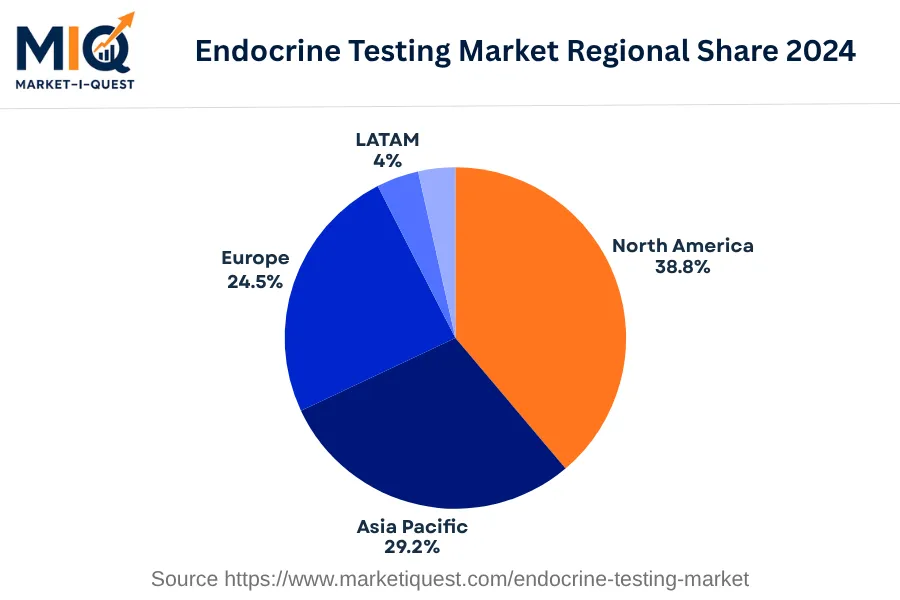
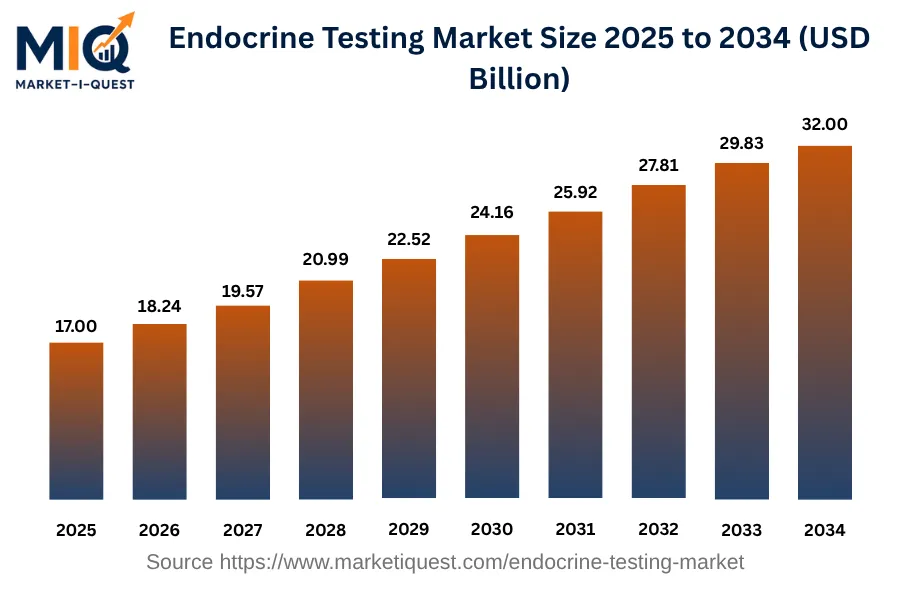
The Endocrine Testing Market stood at USD 15.85 billion in 2024, and experienced a growth to USD 17.00 billion by 2025. Over the next nine years, the market saw a steady escalation, reaching USD 32.00 billion by 2034, proliferating at a compound annual growth rate (CAGR) of 7.28%. The expansion path was defined by gradual augmentation, as observed from the anchoring points of year 2025 and the end year 2034. The geographical distribution of the market was diverse, with North America having a lion's share at 38.84% in 2024. It was followed by the Asia Pacific and Europe, possessing a significant portion of 29.16% and 24.48% respectively. On the other hand, regions such as Latin America and Middle East & Africa had a comparatively minimal share of 4.01% and 3.51% respectively.

Key Takeaways

  • By Test Type - Luteinizing Hormone (LH) Test was the fastest-growing segment reflecting the escalating global rates of diabetes.
  • By Technology - Clinical Chemistry is expanding at an accelerated pace offering superior sensitivity and specificity.
  • By End Use - Hospitals held the major share resonating with the continued reliance on traditional medical infrastructure.
endocrine-testing-market market size

Key Driving Factors

Prevalence of Endocrine Disorders

The rise in prevalence of endocrine disorders such as diabetes, thyroid disorders, and adrenal disorders globally drives the demand for endocrine testing. Diabetes alone affects over 400 million people worldwide with this figure predicted to rise in the coming years. Given this, healthcare providers and caretakers have an urgency to manage these conditions effectively. This is increasingly being done through endocrine testing which allows for adequate diagnosis and monitoring of these conditions. The increasing population of individuals affected by these disorders and the significance of managing them through continual testing makes this factor integral to the growth of the endocrine testing market.

Escalation in Obesity Rates

Obesity, a major public health concern causing serious long-term health consequences, is one of the key drivers of the endocrine testing market. The condition is closely linked to endocrine diseases, namely diabetes and thyroid disorders. Obesity rates have been climbing due to factors such as sedentary lifestyles and unhealthy food habits. The World Health Organization has reported a substantial increase in obesity rates over the past few decades. With this increase, there's a greater demand for endocrine testing to diagnose associated health conditions. Health providers and insurers, recognizing the economic burden of untreated or undiagnosed conditions, are advocating for endocrine testing both for early detection and preventive care.

Market Evolution by Timeline

2019-2023
This period marked the prominence of autoimmune diseases and usage of immunoassay in endocrine testing. North America dominated the sector, given its high healthcare expenditure. Asia-Pacific showed potential too, driven by rising patient awareness in China and India. Technology-wise, manufacturers like Roche Diagnostics and Abbott Diagnostics began shipping compact devices, though integration with electronic health record systems was still immature. Policy-wise, rigorous FDA approvals slowed down market entry. The commercial structure involved a Combination of direct sales and contractual partnerships, with volume-based pricing trends. A significant risk was inconsistent test results, addressed through frequent quality checks.
2024
The single year 2024 stands out for the adoption of Tandem Mass Spectrometry (TMS). The prediabetes epidemic was on the rise, primarily in urban areas of developing countries. This increased the market demand for sophisticated and rapid results provided by TMS. The Centers for Disease Control and Prevention drafted guidelines for TMS in newborn screening for endocrine disorders. Despite the high cost, clinics and hospitals were more open to procuring TMS equipment. However, the lack of skilled operators remained a challenge to market growth.
2025-2029
This period saw an increased demand in pediatric endocrinology, prominently in North America and Europe. Technological advances supplied the market with Point of Care Testing (PoCT) devices that allowed home-based management of endocrine disorders. More mature digital records integration facilitated this. In 2028, The National Institute of Child Health and Human Development funded research towards understanding and managing endocrine disorders in children, boosting the market. Still, the high costs of PoCT devices and lack of funding in low-income regions were considerable hurdles.
2030-2034
In the early 2030s, the aging population made metabolic syndrome cases widespread. Demand was high worldwide, but particularly high in regions like Latin America, with an aged demographic. This period also witnessed a significant rollout of lab-on-a-chip technology for portable and accurate tests. Though the technology needed aligned infrastructure, which was not widely available, especially in low-income countries. Industry-level standardization and guidelines by endocrine societies were lacking, stressing the need for global policy intervention. The commercial model leaned towards leasing-renting device models to negotiate high equipment costs.

Future Market Outlook

Future Opportunities

As the demand for personalized medicine escalates, the endocrine testing market is likely to expand due to ongoing developments in hormone therapy and precision diagnostics. In 2023, the National Institutes of Health (NIH) launched initiatives aimed at understanding the genomic underpinnings of endocrine disorders, presenting opportunities for tailored testing solutions. The increasing prevalence of conditions like diabetes and thyroid disorders globally has prompted healthcare providers to explore advanced testing methods that offer more accurate diagnoses. Companies, such as Eli Lilly and Merck, are focusing on research into novel biomarkers that could enhance diagnostic capabilities for hormonal imbalances. Additionally, the rising awareness of endocrine-disrupting chemicals in the environment has prompted regulatory bodies, such as the European Chemical Agency, to implement testing protocols for assessing endocrine activity. This regulatory support creates opportunities for laboratories to develop new assays that adhere to stringent safety and efficacy standards. Stakeholders are also exploring artificial intelligence and machine learning applications to analyze test results, thereby improving predictive analytics in endocrine health. Collaborations among pharmaceutical companies, biotech firms, and academic institutions, particularly in regions like North America and Europe, are likely to accelerate the development of advanced testing methodologies. These present-day activities indicate a robust future for innovative solutions within the endocrine testing market, driven by focused research initiatives and regulatory encouragement that promote quality and efficacy in testing practices.

Segmentation Analysis

By Test Type

The market is divided into subsegments including Thyroid Stimulating Hormone (TSH) Test, Insulin Test, Testosterone Test, Cortisol Test, Human Chorionic Gonadotropin (hCG) Hormone Test, Follicle Stimulating Hormone (FSH) Test, Luteinizing Hormone (LH) Test, Estradiol (E2) Test, Progesterone Test, Prolactin Test, Dehydroepiandrosterone Sulfate (DHEAS) Test, and others. The Insulin Test accounted for the largest revenue share while the Luteinizing Hormone (LH) Test is expected to grow at the fastest CAGR during the forecast period.

Largest Revenue Share

Insulin Test

Market Share Leader

The Insulin Test is a dominant segment due to several reasons. Worldwide, there's a rising prevalence of diabetes, a condition heavily reliant on insulin level monitoring, leading to significant demand for Insulin Tests. Additionally, increased public health campaigns urging regular check-ups and the benefits of early diabetes detection have influenced the demand positively. Besides, greater accessibility to and coverage of healthcare services in various regions, particularly in developed countries, have boosted regular health check-ups, enhancing the demand for insulin tests. Furthermore, increased patient awareness and advancements in insulin testing technologies and devices, making the tests faster, more accurate, and practical, contribute to this subsegment's substantial revenue.

Fastest CAGR

Luteinizing Hormone (LH) Test

Forecast Period Growth Leader

While the Luteinizing Hormone (LH) Test does not command the largest market share, this segment is expected to exhibit the fastest growth rate in the coming years. Key drivers of this growth include a dramatically increased prevalence of polycystic ovary syndrome (PCOS) worldwide, which typically requires LH testing for diagnosis and management. Additionally, increased utilization of LH testing in fertility clinics and home diagnostic tests for ovulation prediction are driving market expansion as fertility becomes a growing public health concern. There are potential obstacles, such as a lack of awareness and stigma around reproductive health issues in some markets that may slow this growth pace. However, continued public health efforts to disseminate knowledge and normalize these issues will likely counteract these barriers effectively.

By Technology

The technology based market is segmented into Immunoassay, Tandem Mass Spectrometry, Monoclonal & Polyclonal Antibody Technologies, Clinical Chemistry, Sensor Technology, among others. In 2024, Clinical Chemistry led the market in terms of revenue, while Immunoassay technologies are projected to witness the fastest CAGR over the forecast period.

Largest Revenue Share

Clinical Chemistry

Market Share Leader

Driving the revenue for Clinical Chemistry technologies in 2024 is its widespread acceptance and use in various medical disciplines, including endocrinology, toxicology, and hematology. The technology's ability to perform multiple analyses quickly and accurately has boosted its demand in medical and diagnostic laboratories globally. This multifaceted use in disease diagnosis is a key factor in its large market share. Regulatory bodies across the globe are ramping up efforts to implement standardized processes for medical and diagnostic testing, which is also expected to contribute to the technology's market dominance. Additionally, the technology also offers lower switching costs, making it favorable among price-sensitive customers. Factors such as advances in reagent technologies, growing prevalence of lifestyle diseases and wider accessibility to Clinical Chemistry technology in emerging markets have also significantly contributed to it commanding the highest market revenue share in 2024.

Fastest CAGR

Immunoassay

Forecast Period Growth Leader

The Immunoassay subsegment is expected to experience the highest growth with rapid CAGR over the forecast period. The exponential growth is substantially driven by the technology's ability to detect and quantify specific analytes in a variety of samples, including blood, saliva, and tissue. The technology is touted as viable for early disease detection and is widely recognized for its precision and accuracy. The advent of automated systems and high-throughput Immunoassay platforms act as growth drivers, effectively reducing turnaround times and improving efficiency. Additionally, the technology benefits from government support and funding for research and development aimed at detecting infectious diseases. However, barriers such as the high cost of instruments may slowdown adoption rates. Strategic partnerships among key players focusing on technology advancements, and an increase in capital investments in healthcare infrastructure are catalysts expected to propel growth in this subsegment.

By End Use

The market is subsegmented into Hospitals, Commercial Laboratories, Ambulatory Care Centers, and Others. Out of these, the Hospitals registered the most substantial revenue, while the Ambulatory Care Centers subsegment projects an increasingly swift CAGR in the forecast period.

Largest Revenue Share

Hospitals

Market Share Leader

The 'Hospitals' subsegment controls a significant portion of the revenue, leveraging its critical role within the healthcare ecosystem. The primary basis for the preeminence of this subsegment consists of the voluminous patient base that hospitals cater to daily, fortifying the necessity for specialized care, tools, services, and various healthcare options. Many patients are dependent on hospitals for critical medical services, thus contributing steadfastly to revenue growth. Moreover, the hospital segment benefits from government funding and support, making them relatively more financially equipped for substantial procurement. Significantly, hospitals often tend to procure products in bulk, thus leading to revenue escalation. Lastly, hospitals' integral role in implementing pandemic response plans also contributes to swift revenue growth, driven by increased demand for healthcare tools and services.

Fastest CAGR

Ambulatory Care Centers

Forecast Period Growth Leader

Ambulatory Care Centers subsegment is expected to exhibit the fastest growth rate, driven by factors such as rapid technological advancements, cost-effectiveness, and convenience. As per market analysis and industry trends, there's rising adoption and preference for ambulatory care due to shorter waiting times, lower costs, and the capacity for personalized attention in comparison to traditional hospital settings. This shift is fueling its growth and adoption rate. Technological advancements like telehealth services are providing these centers an edge in delivering immediate care in less critical scenarios. However, barriers in the form of stringent regulatory policies, the limited scope of services and the initial setup cost could pose challenges to the rapid growth of this subsegment. But given the current trend and market potential, the overall growth trajectory for the Ambulatory Care Centers subsegment remains positive.

Competitive Analysis

Key Market Players

Manufacturers / OEMs

Abbott Laboratories
US
Siemens Healthcare
Germany
Roche Diagnostics
Switzerland

Key Suppliers & Raw Materials

Sigma-Aldrich Co.
US
Thermo Fisher Scientific
US
Merck KGaA
Germany

Distributors, Integrators & Channel Partners

Cardinal Health
US
McKesson Corporation
US
Henry Schein, Inc.
US

Porter’s Five Forces Analysis

This analysis investigates the competitive forces at play within the Endocrine Testing Market.

Supplier Bargaining Power

Medium

Suppliers have moderate power due to specific equipment and knowledge required for endocrine testing.

Buyer Bargaining Power

High

High buyer power is due to an increased demand for personalized healthcare solutions and a wide array of testing options.

Threat of Substitutes

Low

Threat of substitutes is low because there are few viable alternatives for endocrine diagnosis and monitoring.

Threat of New Entrants

Medium

Medium entry barriers exist due to the need for specialized technology, accreditation, and significant R&D investment.

Competitive Rivalry

High

High rivalry is driven by market fragmentation and similar offerings from top tier companies.

Regional Analysis

Geographic market dynamics and growth opportunities across key regions

Global Market Outlook

endocrine-testing-market market regional share

North America

In the base year of 2024, the endocrine testing market in North America was driven by several key elements and demonstrated a number of noticeable trends. Driving factors included increased incidence of endocrine disorders, particularly in the United States, where prompt diagnosis and treatments necessitated continual investment in testing equipment and methodologies. Additionally, stringent FDA regulations influenced rigorous implementation of advanced diagnostic procedures. Technological adoption also played a significant part, as new testing procedures enabled efficient and accurate assessments, thereby motivating more healthcare providers to incorporate them.

On the trend front, shifting buyer behavior was perceptible in the healthcare sector's growing preference for non-invasive testing procedures, indicative of a broader movement toward patient-friendly diagnostic options. Major developments also included the integration of artificial intelligence in endocrine disorder assessment, predominantly in the U.S. and Canada, which was seen reshaping the sector. Alongside, several strategic alliances, partnerships, and M&As took place, with prominent healthcare providers and testing kit manufacturers coming together to consolidate their market position and expand their customer base. With a strong presence of endocrine testing in healthcare, manufacturing and enterprise sectors, the endocrine testing market in North America, specifically in the U.S., Canada and Mexico, strived towards advanced, accurate, and efficient testing technologies in the base year of 2024.

Asia Pacific

In 2024, the Endocrine Testing Market in Asia Pacific was characterized by significant dynamism due to various drivers and emerging trends. The increasing occurrence of endocrine diseases, coupled with escalating investment in healthcare infrastructure across countries such as China, India, and Australia, spurred demand for endocrine testing. Technological advancements in India and Japan also facilitated streamlined diagnostic procedures, further propelling the market. The intensified regulatory scrutiny in key ASEAN markets and Australia fuelled improvement in testing standardization and quality. Additionally, the affordability of tests in regions like China, due to competitive pricing strategies, contributed to higher accessibility and demand.

Regarding trends, a shift towards home-based healthcare solutions in countries like South Korea, India, and China was notable, triggering demand for portable endocrine testing devices. Collaboration between technology and healthcare companies like diagnostics manufacturers and smart device producers also became prevalent across the region, enhancing the capability of home-use endocrine tests. Furthermore, the strict enforcement of public health policies by governments, particularly in China and Australia, resulted in standardised practices in the endocrine testing market. To meet the demand from healthcare and retail sectors, manufacturers focused on producing user-friendly testing solutions. Consequently, the Asia Pacific Endocrine Testing Market in 2024 provided a well-balanced ecosystem fueled by technology, regulation, and shifts in consumer behavior.

Europe

In 2024, Europe's Endocrine Testing Market showed substantial progression, anchored by advancements in technology, emerging diagnostic facilities, and increasing disease awareness. Demand was driven by regulatory compliance for quality assurance such as CE marking, accentuated by the rising prevalence of endocrine disorders like diabetes and thyroid conditions. Investment in advanced testing methodologies, bolstered by adoption of digital health tech, favorably impacted the market landscape. Increased focus on precision medicine propelled personalized test offerings, altering supply dynamics, while competitive pricing strategies were deployed to leverage market share. Trends manifested through evolved buyer preferences for convenient, at-home testing options, prompting shift toward non-invasive, wearable technologies. Channel dynamics were characterized by a surge in online health platforms, reflecting digital transformation.

Notable M&A included partnerships across pharmaceutical companies, tech providers, and diagnostic firms, intensifying competition. Stricter policy enforcement, such as the EU Medical Device Regulation, shaped compliance standards throughout. The market primarily catered to healthcare institutions, with involvement from government bodies backing public health initiatives. Enterprise participation was evident in tech development and testing services. Primary patronage echoed from the UK, Germany, France, and Italy, on par with rising demand in Spain, the Nordics, Benelux, and Central-Eastern Europe — emblematic of the region's targeted focus on endocrine health.

Latin America

In 2024, the Latin American Endocrine Testing Market was markedly influenced by increased prevalence of endocrine disorders, improvements in testing technologies, and greater awareness of health issues. Advances in technology, primarily in Brazil and Mexico, offered faster, more accurate testing procedures, fuelling the demand for such services. The rising occurrence of endocrine ailments, such as diabetes and thyroid disorders, particularly in Argentina and Chile, led to heightened usage of endocrine testing. Health initiatives in Peru and Colombia, emphasizing regular screenings, further fostered the market growth. Consumer behavior significantly trended towards proactiveness in health management, often opting for preventive diagnostic tests. The industry noted heightened online services demand as telemedicine gained traction, exemplifying shifting channel dynamics across LATAM. In Brazil, the government's robust enforcement of health standards propelled the precision medicine adoption, strengthening the demand for personalized endocrine assessments. Furthermore, strategic partnerships witnessed an upswing, such as the collaboration between Argentina's public health sector and private laboratories, aiming to improve testing capacities and accessibility.

As primary customers, healthcare providers, alongside the enterprise sector, saw an increase in incorporating endocrine analysis in routine medical checks. The retail sector displayed growth as more pharmaceutical companies introduced home-based endocrine testing kits, pointing to an expanding market in LATAM. In summary, technology advancement, disease prevalence, and health consciousness, coupled with regulatory enforcement and sector partnerships, shaped the Endocrine Testing Market in Latin America in 2024.

Middle East & Africa

In 2024, demand in the endocrine testing market substantially rose in the Middle East and Africa due to various drivers and trends. The Saudi Arabian, South African, and Israeli healthcare sectors intensified their reliance on endocrine testing, partly due to an increase in lifestyle diseases such as diabetes, obesity, and thyroid disorders. In Saudi Arabia, a robust government investment in health infrastructure saw advancements in endocrine diagnostics facilities and technology. Regulatory support and emphasis on preventive healthcare in Israel amplified the demand for such tests. Increased adoption of automated endocrine testing in well-resourced healthcare facilities in the UAE and Qatar had a significant positive effect, improving the efficiency and scope of diagnostic procedures. Nevertheless, affordability and accessibility of these advanced tests were questionable in financially strained regions like Kenya and Nigeria.

The trend of partnering with international medical technology firms was evident in Egypt and South Africa, leading to an elevation in the quality and variety of available tests. A shift toward home-based and point-of-care testing kits, particularly correlated to the COVID-19 pandemic, was observable across all these regions, due to its convenience and time-saving benefits. Finally, digital transformation was underway, with the telecommunications sector playing an instrumental role in bridging the gap between high-end technology and affordable healthcare, primarily observed in Israel and the UAE.

Recent Industry Developments

Latest market innovations, product launches, and strategic initiatives

July 2025

Leinco Technologies, a global provider of in vitro diagnostic (IVD) raw materials, acquired BioClin, Inc.'s proprietary antibody clones used as IVD raw materials. The acquisition significantly expands Leinco's portfolio of critical reagents for endocrine hormone research and diagnostic assays, targeting key hormones such as Thyroid Stimulating Hormone (TSH), Human Chorionic Gonadotropin (hCG), Total Thyroxine (Total T4), Total Triiodothyronine (Total T-3), Follicle-Stimulating Hormone (FSH), and Prolactin (PRL). Both companies are based in St. Louis, Missouri, ensuring the manufacturing and supply chain of these critical raw materials remain local and U.S.-manufactured.

Frequently Asked Questions