
Electronic Waste Recycling Market Snapshot

Key Players

  • Sims Metal Management (Australia)
  • Stena Metall AB (Sweden)
  • Veolia Environnement SA (France)
  • Electronic Recyclers International Inc. (USA)
  • Boliden AB (Sweden)
  • Eco-Tech Environmental Services Inc. (Canada)
  • Umicore S.A. (Belgium)
  • Li Tong Group (Hong Kong)
  • TechWaste Recycling LLC (USA)
  • Fortune Plastic & Metal Inc. (USA)

Market Size

Base Year 2024
$68.63 Bn
CAGR
12.6%
Forecast 2034
$224.85 Bn

Market Segments

By Material
  • Metals And Chemicals
  • Plastics
  • Glass
  • Others
By Method
  • Mechanical recycling
  • Pyrolysis
  • Others
By Source
  • Household Appliances
  • Entertainment and Consumer Electronics
  • IT and Telecom
  • Medical Equipment
  • Others

Market Dynamics

Drivers
  • Rising environmental consciousness
  • Advancements in recycling technology
Restraints
  • Lack of consumer awareness
  • Legislative inconsistencies
Opportunities
  • Rising e-waste volume globally
  • Increasing environmental awareness

Market Size

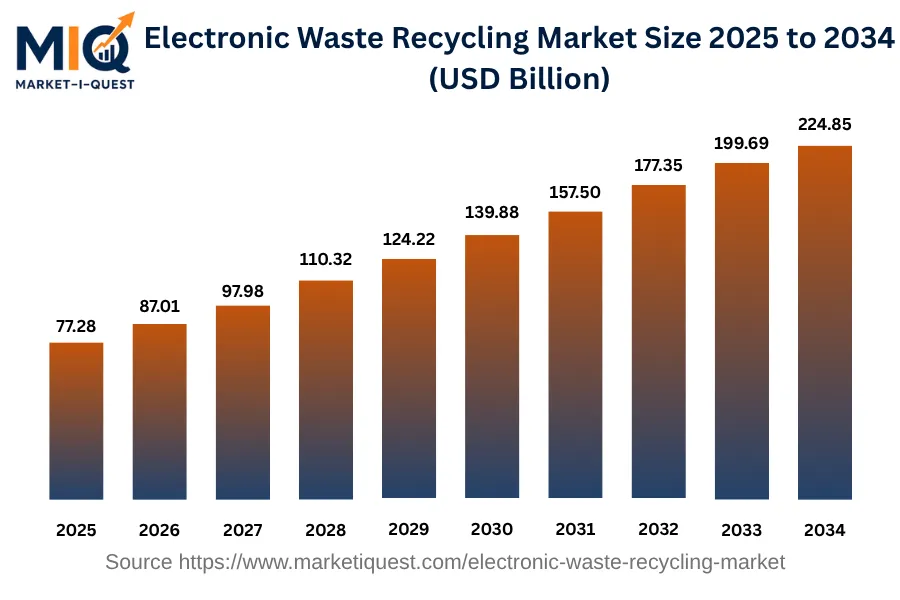
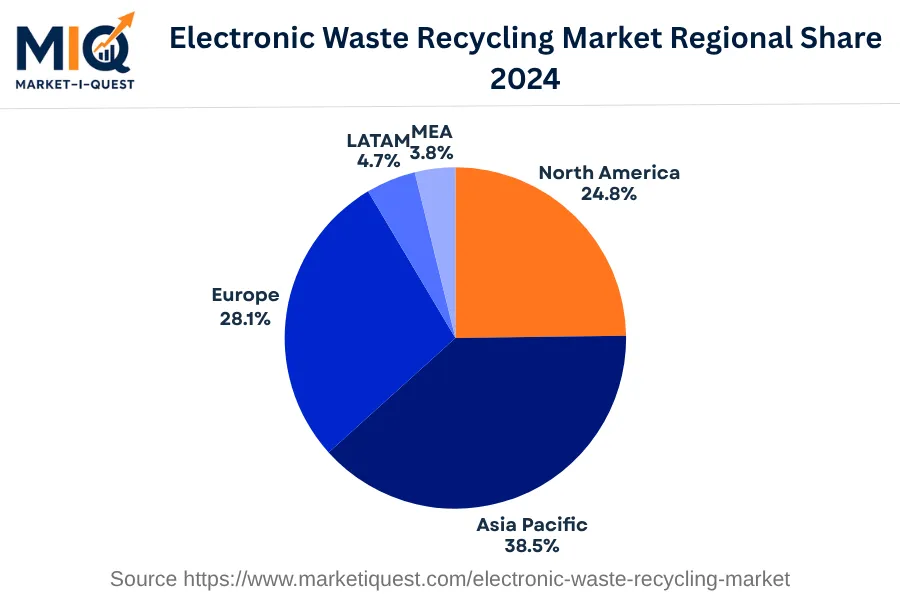
The Electronic Waste Recycling Market size for 2025 is projected to be $77.28 billion, up from $68.63 billion in 2024. By the year 2034, this market is slated to reach $224.85 billion, exhibiting a Compound Annual Growth Rate (CAGR) of 12.6% from 2025 to 2034. This growth trajectory is characterized by a steady year-on-year increase in the market size. The market expansion can be attributed to the increasing volumes of electronic waste globally and the escalating need for efficient recycling practices to mitigate adverse environmental impacts. In terms of geographical distribution, in 2024, the Asia Pacific region commanded the largest share of the total market at 38.5%. Europe accounted for the next substantial share at 28.1%, followed by North America which held a 24.8% share. The Latin America and the Middle East and Africa region represented smaller portions with 4.7% and 3.8% respectively.

Key Takeaways

  • By Material - Metals And Chemicals led accounting for the highest share.
  • By Source - IT and Telecom accounted for the largest segment driving the growth.
  • By Method - Mechanical Recycling held the largest market share of the segment.
electronic-waste-recycling-market market size

Key Driving Factors

Stricter Government Regulations on Electronic Waste Disposal

A primary market driver for electronic waste recycling is stricter government regulations concerning the disposal of such waste. Different countries, including those in the European Union and United States, have regulated electronic waste disposal due to its hazardous impact on the environment. For instance, the Waste Electrical and Electronic Equipment Directive in Europe makes companies accountable for the disposal of their electronic waste, encouraging the recycling process. Similarly, several US states have enacted legislation mandating electronic waste recycling. This state-level emphasis on responsible disposal propels the electronic waste recycling market as firms seek to remain compliant with these directives, consequently promoting safe and eco-friendly disposal methods.
Increased Manufacturer Accountability

Another non-generic, critical driver in the electronic waste recycling market is the increased accountability on electronic manufacturers to manage end-of-life products. Due to rising societal and regulatory pressures, manufacturers are taking up the responsibility of recycling their products once they become obsolete. The concept of Extended Producer Responsibility (EPR) is gaining momentum, where manufacturers are expected to handle product disposal after consumer use. This form of product stewardship encourages better design for environmental efficiency and waste reduction leading to the growth of the electronic waste recycling market. As manufacturers respond to these pressures, both regulatory and societal, their strategies increasingly include partnerships with electronic waste recycling services promoting the growth of the sector.

Market Evolution by Timeline

2019-2023
During this period, buyers were skewed towards developed nations including the U.S., Germany, and Japan due to electronic product consumption. Companies like SIMS Recycling and Greenwave, shipped high volume of refurbished electronics back into the market. Policies were adopted, with the European Union implementing the WEEE Directive requiring producers to take responsibility for e-waste. Fixed price contracts were common, usually entered by municipal bodies with service providers. However, improper e-waste management practices posed significant health and environmental risks, leading to regulation scrutiny.
2024
This year marked a significant shift to e-waste regulations, with a notable initiative, the E-cycling Central program in the U.S., increasing emphasis on recycling electronics. The demand for e-waste recycling increased in countries like India and China, largely due to expanding electronic consumer base. Major players such as Veolia developed more advanced recycling technologies, including hydrometallurgical processes. Partnerships with electronics manufacturers started arising, establishing reverse supply chains. Challenges were faced in disposing potentially hazardous materials.
2025-2029
There was a paradigm shift in the market during this period. African countries with increasing electronic usage, including Nigeria, emerged as solid e-waste recycling hotspots. Recycling facilities used artificial intelligence to segregate and extract valuable materials. The International Standards Organization implemented ISO 27040, a quality certification for e-waste recyclers. Dynamic pricing models based on global commodity prices for recovered materials were increasingly common. However, failure to meet health and safety regulations threatened the operations of many recycling plants.
2030-2034
This forecast period will likely see Latin America emerge as an important region for e-waste recycling, due to its growing electronic consumer market. Technologies for systematic collection and separation, such as robotics, may mature, but overall technology integration may still be a constraint due to cost factors. Policy-wise, new, likely standards focusing on the reuse of e-waste components can be expected, bringing changes in market practices. Pricing models may tilt towards service-based models, with recyclers charging for secure data destruction and logistics. Risk will likely persist in assuring environmentally safe e-waste disposal.

Future Market Outlook

Future Opportunities

The future of the electronic waste recycling market is poised for expansion due to the adoption of regulatory frameworks and technical innovations. The European Union's 2021 Circular Economy Action Plan underscores the commitment to sustainable practices and positions e-waste recycling as a critical pillar within circular economy principles. As countries like India implemented new policies to boost electronic waste recycling capacity, collaborative efforts among technology firms, recyclers, and governments are more crucial. Companies like Closed Loop Partners have begun investing in startups focused on innovative recycling technologies, which signify growing investment in the sector. Partnerships between manufacturers and recyclers, citing examples from Dell’s recycling initiatives, allow for closed-loop systems that ensure responsible disposal and material recovery. Moreover, rising consumer awareness regarding electronic waste's environmental impact is driving demand for responsible recycling services. Pilot programs launched in the United States and Australia demonstrate public interest in sustainable disposal solutions. Research shows that more eco-conscious consumers are willing to engage with brands that promote recycling initiatives, thus encouraging businesses to align their strategies accordingly. This confluence of regulation, consumer preference, and technological innovation is likely to enhance the capabilities of e-waste recycling operations, ensuring a more sustainable future for electronic products.

Segmentation Analysis

By Material

The market is divided into subsegments including Metals and Chemicals, Plastics, Glass, and Others. Metals and Chemicals accounted for the largest revenue share while Plastics is expected to grow at the fastest CAGR during the forecast period.

Largest Revenue Share

Metals and Chemicals

Market Share Leader

The Metals and Chemicals subsegment dominates the market due to a wide range of applications in numerous industries including automotive, construction, electronics, manufacturing, and others. Its dominance arises from its inherent properties such as durability, adaptability, and versatility, making it a preferred choice for multiple uses. Furthermore, the expanding construction and manufacturing sectors globally, driven by rapid urbanization and industrialization, particularly in emerging economies, contribute significantly to this segment's revenue. Regulatory frameworks also tend to favor metals and chemicals as they fulfill many safety and durability standards stipulated for various end-use products. The sustained demand, complemented by assured supply chains, proliferates the notable share of Metals and Chemicals in the overall market, subject to change due to unforeseen market dynamics.

Fastest CAGR

Plastics

Forecast Period Growth Leader

The Plastic subsegment is projected to exhibit the fastest growth due to its lightweight nature, cost-effectiveness, and superior handling properties, making it a popular material across industries. A noteworthy demand increase can be attributed to the packaging industry, as plastics offer an effective and affordable solution for packaging goods, particularly in the e-commerce sector, which has experienced exponential growth in recent years. Additionally, ongoing technological advancements and innovations are leading to the creation of bio-based and recyclable plastics, addressing environmental concerns associated with plastic usage and disposal, thereby amplifying market potentital. Nevertheless, regulatory challenges and environmental concerns pose a risk to this anticipated growth trajectory, implying a necessity for ongoing innovation and sustainability practices within the plastics industry.

By Method

The market is segmented by methods including Mechanical recycling, Pyrolysis, and Others. In 2024, Mechanical recycling accounted for the largest revenue share, while Pyrolysis is expected to grow at the fastest CAGR during the forecast period.

Largest Revenue Share

Mechanical recycling

Market Share Leader

Mechanical recycling holds the dominant position in terms of revenue generation, driven by its widespread acceptance and long-standing presence in the industry. Being a traditional method of recycling, it relies on physical processes like grinding, washing, and removing metal through magnetic retraction to convert waste into reusable form. This method offers a significant advantage of low operating costs as it does not require an elaborate setup or expensive chemicals. The availability of a wide range of equipment, from simple machinery for small-scale operations to sophisticated machines for industrial-scale recycling, contributes towards the dominance of mechanical recycling, making it accessible and feasible for different scales of operations. Furthermore, regulations favoring recycling, combined with businesses' commitment toward sustainability, drive the demand for mechanical recycling, creating a customer base that spans across industries, countries, and scales. Lastly, the stability and predictability of this recycling method, in terms of output quality and process manageability, make it an attractive option for recyclers.

Fastest CAGR

Pyrolysis

Forecast Period Growth Leader

Pyrolysis is identified as the fastest-growing subsegment for recycling methods. Pyrolysis is a thermal decomposition process conducted under high temperature and anoxic conditions, capable of converting complex materials like plastics into oils, gases, and char. The increasing interest in Pyrolysis stems from its ability to handle non-recyclable waste, such as complex plastics, which mechanical recycling fails to process. It adopts an energy recovery approach instead of a material recovery strategy, turning waste into resources deemed valuable for industries — a factor that accelerates its adoption. Furthermore, technical advancements in this field, such as continuous processing systems and improvements in catalysts, boost the efficiency and output quality of the process, reducing operating costs. While its capital-intensive nature, owing to the need for specialized equipment and facilities, might serve as an initial barrier, collaborations or partnerships with entities looking for waste-to-energy solutions are expected to catalyze the growth in this segment. However, while the prospects of Pyrolysis are promising, the risks of slower-than-expected technology adoption and regulatory hurdles need to be acknowledged.

By Source

The market is divided into subsegments including Household Appliances, Entertainment and Consumer Electronics, IT and Telecom, Medical Equipment, and Others. In 2024, the IT and Telecom subsegment accounted for the largest revenue share while the Medical Equipment subsegment is expected to grow at the fastest CAGR during the forecast period.

Largest Revenue Share

IT and Telecom

Market Share Leader

The IT and Telecom subsegment dominates the sector's revenue generation in 2024 due to several factors. The advancements in technology and internet-driven services have led to a surge in demand for IT and telecom products. Customers are driven by the increased dependence on technology for daily activities such as communication, work, education, and entertainment. The increasing penetration of internet services and smartphones in developing regions has also expanded the customer base. Additionally, the digital transformation efforts led by businesses and governments to improve efficiency and services cater to the demand. Regulations enabling digital operations and promoting telecom services to increase connectivity are also incumbent. Hence, considering customer demands, geographical expansion, digital transformation trends, and supportive regulations, the IT and Telecom subsegment leads in revenue generation.

Fastest CAGR

Medical Equipment

Forecast Period Growth Leader

The Medical Equipment subsegment is projected to grow fastest among the others. The growth can be attributed to the increasing global health concerns and the need for efficient diagnostic and treatment equipments. Technological advancements in medical devices and equipment have made procedures more efficacious and less invasive, leading to increased adoption. Initial high capital investments can act as a barrier for growth. However, partnerships among healthcare providers and medical equipment manufacturers, along with government-driven healthcare initiatives, are expected to overcome this. Accessibility and affordability of advanced medical equipment pose risks in less economically stable regions. Nevertheless, investments in healthcare infrastructure and increasing awareness regarding health and early diagnosis are likely to drive the growth in the Medical Equipment subsector.

Competitive Analysis - Electronic Waste Recycling Market

Key Market Players

Manufacturers / OEMs

Sims Metal Management Ltd.
Australia
Boliden AB
Sweden
Umicore
Belgium

Key Suppliers & Raw Materials

Glencore
Switzerland
Aurubis AG
Germany
LS-Nikko Copper Inc.
South Korea

Distributors, Integrators & Channel Partners

Enviro-Hub Holdings Ltd.
Singapore
ERI
US
MBA Polymers, Inc.
US

Porter’s Five Forces Analysis

This analysis delves into the competitive landscape of the Electronic Waste Recycling Market.

Supplier Bargaining Power

Medium

Varied sourcing options for electronic waste lower suppliers' power but specific components may command leverage.

Buyer Bargaining Power

High

Numerous recycling options and low switching costs provide significant bargaining power to buyers.

Threat of Substitutes

Low

There are limited substitutes for comprehensive electronic waste recycling, making the threat low.

Threat of New Entrants

Medium

Entry barriers like regulatory compliance, capital and technology make threat of new entrants medium.

Competitive Rivalry

High

The market has several large players leading to intense rivalry in the sector.

Regional Analysis

Geographic market dynamics and growth opportunities across key regions

Global Market Outlook

electronic-waste-recycling-market market regional share

North America

In 2024, the Electronic Waste Recycling market in North America exhibited complex dynamics driven by robust demand, meaningful investment, adaptations in technology, and changing regulations. Several factors fueled the market: intensified environmentally conscious consumerism, electronics manufacturers prioritizing the circular economy, and significant investment in advanced tech-savvy solutions, particularly in the U.S. and Canada. Regulatory enforcement, such as the U.S. EPA’s Resource Conservation and Recovery Act, also provided imperative impetus, aiming to protect human health and the environment from hazardous waste.

Regarding trends, circular economy adoption within the electronics sector grew substantially, pivoting towards resource efficiency through product lifespan extension and recycling. Advances in tech also led to a proliferation of sophisticated electronic recycling facilities with minimal environmental footprint. Enterprise sectors and governments across North America sought partnerships with e-waste recycling firms, integrating sustainable practices into their operations. In Mexico, informal e-waste recycling saw a significant downturn due to rising awareness and policy enforcement against environmental hazards. Simultaneously, online sales of recycled electronics gained traction, underlining the potential of this expansion channel.

The market changes reflected the imperative role of e-waste recycling in environmental protection and commitment to sustainable practices, trends reshaping sectors from manufacturing to retail.

Asia Pacific

In 2024, the Electronic Waste Recycling Market in Asia Pacific observed a sharp growth trajectory as digital consumption surged. This growth stemmed from several drivers. Regulation, for instance, the Chinese government's stringent electronic waste rules, notably amped up the demand for recycling services. Likewise, technological progression in countries like Japan and South Korea led to frequent device upgrades, thereby ramping up electronic waste. Investments from enterprises and government bodies in recycling infrastructure backed this demand, particularly in countries like India and key ASEAN markets.

Notable trends shaped the market dynamics too. Consumers, specifically in Australia, displayed a behavioral shift toward sustainability, preferring electronics manufacturers that prioritized responsible e-waste disposal. Exhibiting a similar preference, enterprises in sectors such as healthcare and manufacturing collaborated with recycling companies to manage their e-waste. Furthermore, enforcement of electronic waste disposal policies became rigorous, especially in China and Japan. Government utilities in these regions led the pack, adhering strictly to the enforcement. Interestingly, partnerships and M&A activities in the e-waste recycling industry intensified, with retail giants joining forces with established recycling companies. Technology changes also positioned themselves as a key trend. The adoption of advanced recycling practices, like hydrometallurgical processes, witnessed a widespread acceptance in the high-tech markets of South Korea and Japan. Thus, diversified drivers and trends significantly shaped the e-waste recycling market's ground realities in the Asia Pacific region for 2024.

Europe

In 2024, the European electronic waste recycling market experienced a continued growth trajectory led primarily by escalating consumer demands, regulatory changes, technological advancements, and dynamic supply factors. Sectors including healthcare, retail, government, and manufacturing saw a heightened focus on electronic and electrical equipment waste (e-waste) management.

Key drivers behind this growth were the strict EU regulations on e-waste disposal and sustainable production, and environmental prerogatives stimulating investment in waste management infrastructure. The increasingly digital-first approach of multiple sectors enhanced demand, with Germany, the United Kingdom, and France leading e-waste output. Simultaneously, rapid advancements in recycling technologies like hydrometallurgical processes primarily adopted in Spain and Benelux, mitigated supply constraints and optimized recycling capabilities.

Consequently, crucial market trends emerged in 2024. A shift was observed in buyer behavior towards enterprises offering green disposal services, encouraged by policies like the WEEE Directive. The market also saw increasing partnerships and M&A activities as firms sought to expand geographical reach and recycling capacities - an eminent example being the collaboration between Italian and Nordic firms. Lastly, rigorous policy enforcement, primarily in Central and Eastern Europe, compelled businesses to adhere to e-waste recycling standards, facilitating a regulated, compliant market landscape.

Latin America

In 2024, the Latin American market for electronic waste recycling was characterized by increasing urbanization and improved regulatory framework. Drivers of this market included growing consumer awareness of electronic waste hazards in countries like Brazil and Mexico, which led to an increase in the collection of e-waste. Regulatory support, particularly in Argentina, fueled recycling activity, with the implementation of country-wide initiatives to manage e-waste. Moreover, a rise in technology adoption across businesses in Colombia emphasized the need to responsibly dispose of redundant electronics.

Trends in 2024 showed an increase in partnerships and M&A among waste management companies. For example, Chilean recycling firms partnered with international agencies and tech companies to streamline e-waste recycling processes. Meanwhile, Peru experienced a significant shift in buyer behavior as enterprises and utilities firms led e-waste recycling. There was also a notable enforcement of e-waste disposal policies across retail and healthcare sectors in Latin America, promoting safety standards aligned with global norms. Despite the efforts, a lack of adequate infrastructure was a constant challenge. However, the accelerated adoption of e-waste recycling in the manufacturing sector in Mexico helped to establish a precedent for the rest of the region. On a final note, consumer electronics emerged as the largest waste generator in the region, underscoring the pressing need for comprehensive waste management solutions.

Middle East & Africa

In 2024, Electronic Waste Recycling emerged as a substantial market in the Middle East and Africa due to increasing electronic consumption and the resulting waste. Regulatory norms such as Saudi Arabia's National Environmental Standard (SASO 2174) enforced electronic waste management, compelling manufacturers to consider the disposal of their products, accelerating market growth. Investments in e-waste recycling facilities like the Emirates Environmental Technology, UAE, revolutionised the recycling processes, enhancing recyclability. Additionally, technological advancements in electronic waste recycling pushed the market further, especially in South Africa and Israel that had robust tech sectors.

Consumers demonstrated a growing preference for companies endorsing sustainable practices, influencing corporations to engage in electronic waste recycling. The adoption of latest recycling technologies such as hydrometallurgical e-waste recycling, especially in countries like Israel, was significant. Partnerships in the e-waste sector, such as the Bee'ah-Enviroserve venture in UAE, were noted across the region. Strict enforcement of e-waste regulations, such as the Nigerian E-waste Regulation 2011, shaped up market behaviour.

Key sectors actively involved in e-waste recycling included oil and gas, utilities, manufacturing, and telecom where electronic usage was pervasive. For example, telecom companies in Qatar had structured e-waste management policies, contributing to increased recycling of electronic waste.

Recent Industry Developments

Latest market innovations, product launches, and strategic initiatives

May 2026

Market data confirmed that over 55% of organized electronic waste recycling facilities globally have successfully integrated AI-driven computer vision and robotic dismantling arms into their sorting lines. The automation wave mitigates heavy reliance on manual labor, boosting material segregation efficiency and optimizing spatial throughput for heterogeneous electronic scrap.

April 2026

Sims Lifecycle Services (SLS) and Umicore announced significant infrastructure expansions across North America and Europe. The dual capital projects focus on introducing advanced hydrometallurgical processing lines to improve the high-purity recovery of precious metals, plastics, and critical rare-earth elements from complex IT hardware and end-of-life electric vehicle batteries.

Frequently Asked Questions