
Electronic Display Market Snapshot

Key Players

  • Samsung Electronics (South Korea)
  • LG Display (South Korea)
  • Japan Display Inc. (Japan)
  • Sharp Corporation (Japan)
  • Sony Corporation (Japan)
  • Panasonic (Japan)
  • AU Optronics (Taiwan)
  • Universal Display Corporation (United States)
  • Innolux Corporation (Taiwan)
  • BOE Technology Group Co. Ltd. (China)

Market Size

Base Year 2024
$167.83 Bn
CAGR
3.6%
Forecast 2034
$239.04 Bn

Market Segments

By Display Type
Flat Panel Displays, Flexible Displays, Transparency Displays, 3D Displays, Holographic Displays
By Technology
LCD, LED, OLED, MicroLED, E-Paper
By Screen Size
Small Screens, Medium Screens, Large Screens, Giant Screens)
By End Use
Consumer Electronics, Advertising Signage, Automotive Displays, Healthcare Displays, Industrial Displays

Market Dynamics

Drivers
  • Rising adoption of OLED technology
  • Increasing trends of digitization
Restraints
  • High production cost
  • Fast technological obsolescence
Opportunities
  • Increased demand for high-definition displays
  • Technological advancements in visualization technologies

Market Size

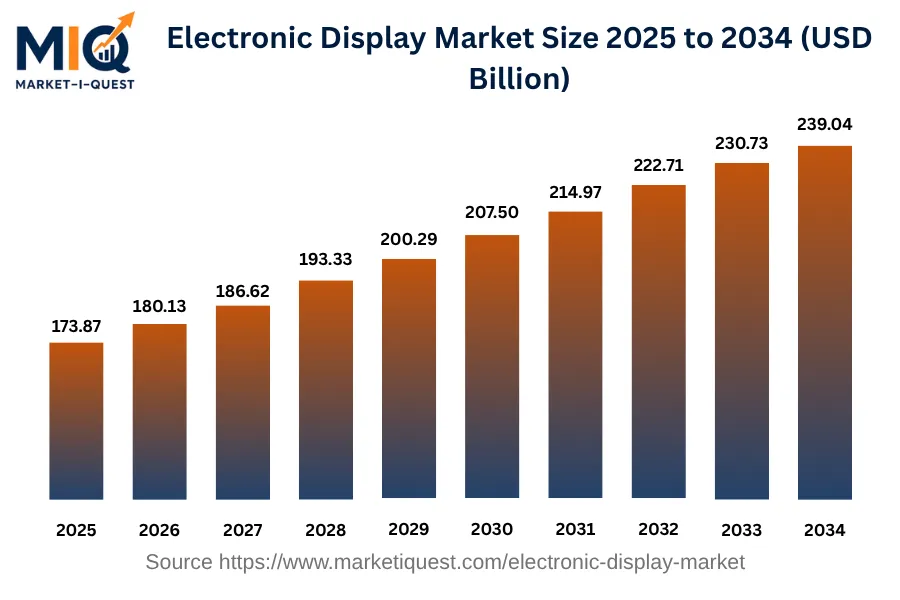
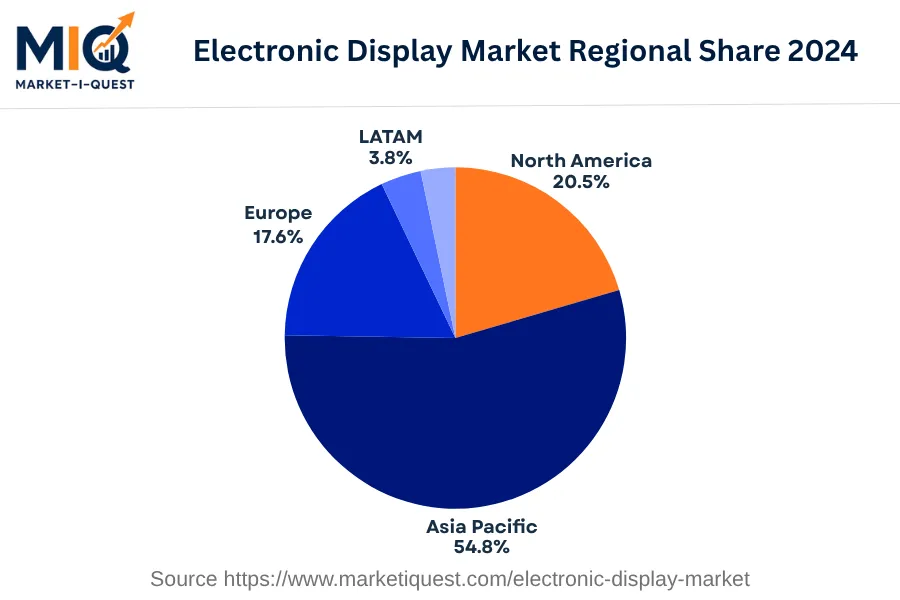
The Electronic Display Market size was 173.87 billion USD in 2025, up from 167.83 billion USD in 2024. By 2034, it is projected to grow to 239.04 billion USD at a compounded annual growth rate of 3.6%. This continuous growth over the years is due to swift technological advancements making such displays more affordable and accessible to consumers, and broad adoption across industries ranging from advertising to transportation. Another driving factor for market expansion is the proliferation of high-resolution electronic displays for home entertainment systems and professional applications that require high-quality visuals. The regional share of the market indicates that Asia Pacific had the highest percentage of the total share equal to 54.8% in 2024, followed by North America with 20.5% and Europe with a share of 17.6%. The remaining market was split between Latin America (3.8%) and the Middle East and Africa (MEA) with 3.3%.

Key Takeaways

  • By Display Type - Flat Panel Displays held the highest market share.
  • By Technology - LED led the Electronic Display Market in terms of the highest usage.
  • By Screen Size - Large Screens dominated the market largely due to popularity.
  • By End Use - Consumer Electronics led the category due to high consumer preference.
electronic-display-market market size

Key Driving Factors

Increased Adoption in Retail and Advertising Sectors

A significant driving factor in the electronic display market currently is the extensive uptake by the retail and advertising industries. Retailers worldwide are switching to digital signage for showcasing their product portfolio and special offers, realizing that they offer a visually striking, dynamic avenue to attract consumers. On the other hand, advertisers recognize that electronic displays, particularly in high-traffic spaces like shopping centers and transportation terminals, have the potential to significantly increase audience engagement and recall compared to traditional static billboards. High-definition electronic displays allow for the creation of vibrant, captivating displays and the flexibility to update content as required, providing a fresh and ever-revolving advertising avenue.
Transition to Remote Learning and Work

Another critical driving factor for the electronic display market is the global shift towards remote studies and work, accelerated by the COVID-19 pandemic. The transition has led to an uptick in demand for electronic displays as households equip themselves to facilitate e-learning and telecommuting. Products like digital whiteboards and interactive displays are seeing an increased demand as educational institutions and businesses attempt to create a digital environment that mimics the in-person experience as closely as possible. On the corporate front, high-quality electronic displays are becoming a staple in virtual meetings and conferences, locking in the need for better and more technologically advanced displays.

Market Evolution by Timeline

2019-2023
In this phase, electronic displays became omnipresent with new consumer segments dominating demand, primarily in Asia (China, India, Japan). Smartphones backed with AMOLED display technology increased, driving the shift towards energy-efficient displays. The scarcity of raw materials such as Indium used in manufacturing posed a significant constraint. Shift towards flexible displays testified the maturing integration capabilities. Policies like India's National Policy on Electronics boosted adoption by incentivizing electronic production. Falling LED display prices reshaped the commercial landscape, enabling price-sensitive markets to invest. Supply shortage risks arose due to the US-China trade war, encouraging supply chain reconfiguration to other Asian countries.
2024
Digital signage noticeably surged in popularity with buyer segments widely from retailers, corporates to educational sectors across all continents, North America being the chief contributor. Technological advancements in quantum dot displays saw a substantial push with Samsung's QD-OLED making its breakthrough. However, the high cost of QD displays presented a barrier to large-scale application. Innovations during this period geared towards display technologies with lower energy consumption and better color accuracy. QD displays met the US 8K standard, thereby gaining acceptance. Yet, the high production cost kept the pricing high, slowing mainstream adoption. The risks of relying on high-cost technology with limited scalability became evident.
2025-2029
Demand surged from the automotive and entertainment sectors adopting OLED and MicroLED technology. Europe, riding on green initiatives, pushed adoption. MicroLED was piloted extensively in this period, putting pressure on OLED dominance. However, technical issues in mass producing MicroLED remained a significant blocker. The EU's Electronic Displays Regulation under Ecodesign Directive influenced energy consumption standards. Prices for OLED and MicroLED fluctuated heavily in this period due to cost-intensive research and design. Strategic partnerships between tech and car makers, (like Apple-VW), became popular. Risks encountered in widespread adaptability of MicroLED technology persisted due to expensive solutions and manufacturing complexity.
2030-2034
Medical, aerospace and military sectors with specific display needs drove demand in this period. North America and Europe led in advancements and adoption, with the space sector exploring electronic displays for cosmos operations. Laser-phosphor displays (LPD) emerged for large screen applications. Stringent rules backing the US Energy Independence and Security Act (EISA) tightened eco-friendly standards, pushing for LPD. Lower energy cheap LPD technology changed the game by offering tight and cost-effective alternatives, increasing partnerships with larger display users like sports arenas or billboards. Risks mainly emerged from backlash against outdated electronic disposal, causing an increase in e-waste regulations.

Future Market Outlook

Future Opportunities

Amid ongoing resource constraints and heightened environmental awareness, future opportunities in the electronic display market are closely linked to sustainability initiatives and innovative technologies. As of mid-2023, numerous manufacturers, including Sony and Panasonic, are implementing recycled materials in their product lines, responding to increasing regulatory pressures for sustainable practices. In this context, the European Union's Green Deal, initiated in 2019, emphasizes circular economy principles that could create new avenues for product development. Additionally, advancements in flexible display technologies are set to open new market segments. Companies like Royole Corporation have already developed foldable displays, which gained traction in smartphone applications since their breakthrough in 2018, suggesting potential for further consumer adoption. Furthermore, the emergence of augmented and virtual reality applications, driven largely by Meta’s investments in mixed reality as of 2022, indicates substantial growth potential for displays adapted to these platforms. Collaborations between technology firms, educational institutions, and research organizations, such as the partnership between Apple and Stanford for health monitoring technologies launched in 2021, will likely foster the development of specialized electronic displays that meet diverse industry needs. Thus, addressing both sustainability and innovation demands will guide the future landscape of the electronic display market globally.

Segmentation Analysis

By Display Type

The market is divided into subsegments including Flat Panel Displays, Flexible Displays, Transparency Displays, 3D Displays, and Holographic Displays. Flat Panel Displays accounted for the largest revenue share, while Flexible Displays are expected to grow at the fastest CAGR during the forecast period.

Largest Revenue Share

Flat Panel Displays

Market Share Leader

Flat Panel Displays continue to dominate the market due to their wide adoption in various applications from television, computer monitors to mobile devices, and automotive displays. They have an edge due to their thinness and lighter weight when compared to traditional displays, making them an ideal choice for a variety of users. The rise in consumption of Smart TVs and computer monitors in both developed and developing regions has hugely driven the market for Flat Panel Displays. Innovation in HD and ultra HD technology in television and growth in demand for energy-efficient appliances globally is an important driver. Furthermore, the rising impact of the internet penetration and the high demand for internet-connected devices are pivotal to its robust growth. The dominance may persist barring any disruptive technological advancements, assuming the supply chain remains uninterrupted.

Fastest CAGR

Flexible Displays

Forecast Period Growth Leader

The sub-segment poised for the fastest growth is undoubtedly Flexible Displays. This growth can be attributed to several drivers. One of the primary influencing factors is the rising market for smartphones. The trend of thin, lightweight and foldable or bendable devices is driving manufacturers to implement these displays. Moreover, technology advancements have made flexible screen less prone to breakages, hence increasingly favored by device manufacturers. Additionally, the current pace of innovation in applications like automotive displays, smart wearables, and Television is a key growth catalyst. However, higher cost and new manufacturing processes may pose temporary challenges to its adoption rate. Despite these, flexibility appeals strongly to customers’ preferences for compact and revolutionary devices; hence significant capital expenditure is observed in new production facilities, ensuring a positive outlook. Therefore, it's reasonable to project that Flexible Displays might outperform its peers on growth during the forecast period.

By Technology

The market is divided into subsegments including LCD, LED, OLED, MicroLED, and E-Paper. In the base year 2024, the LED segment accounted for the largest revenue share while the MicroLED segment is expected to grow at the fastest CAGR during the forecast period.

Largest Revenue Share

LED

Market Share Leader

The LED segment has been in the forefront in terms of revenue generation primarily due to its widespread usage in an array of applications including commercial, residential, and industrial setups. LED's popularity can be attributed to its significant benefits such as energy efficiency, longer lifespan, compact size, and flexibility in terms of shape and color variability. The global momentum towards energy conservation and green technology adoption has inevitably resulted in growing preference for LEDs. The strict regulations on electricity consumption in many parts of the world have further propelled the adoption of LEDs. Additionally, the radical decline in the prices of LEDs over the last few years has made it more accessible, leading to increased adoption. The wide distribution channels and robust supply chains have also enabled easy availability of LEDs and contributed to its position as the highest-grossing subsegment.

Fastest CAGR

MicroLED

Forecast Period Growth Leader

Although a nascent player in the market, the MicroLED segment is forecasted to experience the highest CAGR in the coming years. This can be attributed to the technology's inherent advantages such as lower energy consumption, higher peak brightness, and longer life span compared to other technologies. A primary growth driver is the continuing demand for better display technology from consumer electronics and automotive sectors. The adoption, however, might face some barriers due to high manufacturing costs and technical challenges in production, especially for large displays. Nevertheless, continuous investments and advancements in technological innovation and process development, coupled with strategic partnerships among key stakeholders, are expected to mitigate these barriers. Potential risks could lie in the unpredictable changes in the regulatory landscape or potential disruptions in the supply chain. Despite the risks, the overall outlook on the MicroLED segment remains positive, fuelled by the relentless stride of innovation and a constant market demand for superior performance display technologies.

By Screen Size

The market for screen sizes is divided into subsegments including Small Screens, Medium Screens, Large Screens, and Giant Screens. Of these, Large Screens accounted for the largest revenue share while Small Screens is expected to witness the fastest CAGR during the forecast period.

Largest Revenue Share

Large Screens

Market Share Leader

In 2024, the subsegment that generated the most revenue was Large Screens. This subsegment continues to lead the market due to the high demand from customers who prefer these screens for an immersive and realistic viewing experience. Geographically, this demand majorly comes from developed regions where households often have more disposable income to invest in high-quality entertainment systems. Additionally, Large Screens are often a preferred choice in commercial settings like offices, hotels, and restaurants. They also have a substantial presence in the educational and healthcare sectors. Furthermore, technological advancements and innovation in the large screen segment, such as 4K resolution and smart TVs, have been catalysts for their market dominance. However, it's imperative to note that this segment might face fierce competition from its counterparts as customers grow more aware of energy consumption and space management.

Fastest CAGR

Small Screens

Forecast Period Growth Leader

While Large Screens dominate in terms of revenue, Small Screens are projected to grow at the fastest CAGR, primarily driven by their affordability, portability, and suitable size for compact living spaces. A significant driver for their swift growth are urban markets, where consumers have limited living space yet demand high-tech devices. The rise in single-person households and compact city apartments are expected to particularly stimulate this. Furthermore, partnerships between small screen producers and popular OTT platforms would contribute to the surge in interest and sales. However, the subsegment might face initial adoption barriers due to the consumers' preference for a larger viewing experience. Nevertheless, with technological breakthroughs enhancing the viewing quality on smaller screens, it is anticipated that these hurdles will be overcome. Capex in this sector could also prove to be a potential risk if not managed efficiently.

By End Use

The market is divided into subsegments including Consumer Electronics, Advertising Signage, Automotive Displays, Healthcare Displays, and Industrial Displays. Consumer Electronics accounted for the largest revenue share while Automotive Displays is expected to grow at the fastest CAGR during the forecast period.

Largest Revenue Share

Consumer Electronics

Market Share Leader

The Consumer Electronics subsegment dominates the market in terms of revenue generation. This is fundamentally driven by the consistent and widespread consumer demand for electronic goods such as smartphones, laptops, televisions and home appliances, all of which extensively incorporate display technology. Emerging markets continue to contribute significantly to this demand, with the trends of urbanisation and increasing disposable income driving a broad adoption of modern electronic goods. Regulation has had a limited impact on this subsegment, as consumer electronics have become almost indispensable in today's digital society. The primary purchasing criteria include product functionality and pricing, with consumer loyalty and brand perception also playing considerable roles, thereby creating certain barriers to entry for new players. Distribution channels typically include both online and offline retail stores. Based on these dynamics, the Consumer Electronics subsegment is plausible to continue holding the largest revenue share.

Fastest CAGR

Automotive Displays

Forecast Period Growth Leader

The Automotive Displays subsegment is expected to register the fastest growth on the basis of CAGR, driven by the rapid technological advancements in the automobile industry. In recent years, automakers have accelerated the incorporation of digital displays in vehicles to enhance user experience and provide value-added services such as GPS navigation, infotainment systems and digital speedometers. Government regulations especially for safety, have catalysed the adoption of advanced display systems in vehicles. Barriers to growth largely relate to the high costs associated with the development and deployment of such sophisticated displays. However, the introduction of cost-effective manufacturing techniques and strategic partnerships with tech firms could offset these barriers. In terms of risks, car sales saturation in certain geographies could potentially slow the growth of the Automotive Displays subsegment. However, it is expected that new vehicle models, relentless focus on innovation and burgeoning demand in developing markets will boost this subsegment’s growth.

Competitive Analysis

Key Market Players

Manufacturers / OEMs

Samsung Electronics
South Korea
LG Display
South Korea
Sony Corporation
Japan

Key Suppliers & Raw Materials

Corning Incorporated
US
Nitto Denko Corporation
Japan
Universal Display Corporation
US

Distributors, Integrators & Channel Partners

Best Buy
US
Amazon
US
Harvey Norman
Australia

Porter’s Five Forces Analysis

A comprehensive analysis of the competitive landscape of the Electronic Display Market.

Supplier Bargaining Power

Medium

Medium power due to presence of several key material providers that enable product differentiation.

Buyer Bargaining Power

High

High power due to innovation-driven market and various alternatives available for buyers.

Threat of Substitutes

Medium

Medium threat given the advancements in alternative technologies like interactive touchscreens and projector systems.

Threat of New Entrants

Low

Low threat due to high capital expenditure, regulatory compliance and technological expertise requirement.

Competitive Rivalry

High

High competition due to presence of numerous well-established firms and ongoing technological advancements.

Regional Analysis

Geographic market dynamics and growth opportunities across key regions

Global Market Outlook

electronic-display-market market regional share

North America

In 2024, the North American electronic display market showcased substantial development dynamics driven by several key factors. Technological advancements such as high-resolution display and wide color gamut have enhanced the quality of images and videos, thereby driving adoption particularly in sectors like retail, entertainment, and advertising. Furthermore, the proliferation of IoT and increasing investments in digital signage have boosted market growth. Lastly, competitive pricing strategies by key players have made these displays more affordable, further augmenting market expansion.

Severeal trens also characterized the market landscape this year. A shift towards flexible and foldable displays indicated evolving buyer behavior and technology preferences. In addition, the increased preference for digital screens in public spaces and in the advertising sector demonstrated a change in channel dynamics. Notably, numerous partnerships and M&A activities among leading players have shaped the business landscape. For instance, the integration of augmented reality (AR) and virtual reality (VR) technologies in electronic displays emerged as a significant trend, primarily affecting sectors like gaming, education, and healthcare. Lastly, policy enforcements pertaining to energy efficiency have been a crucial determinant influencing manufacturer behavior. As a result, EPEAT (Electronic Product Environmental Assessment Tool) certified products gained popularity in markets including the US, Canada, and Mexico. This shift towards sustainable practices is likely to remain a guiding trend in the years to come.

Asia Pacific

In 2024, the Asia Pacific region emerged as a flourishing hub for the Electronic Display Market, facilitated by favorable market dynamics. The uptake was driven primarily by rapid technological advancements, broadening application spheres, and increased investments, particularly in China, India, South Korea, and Japan. China's government mandates aimed at digitizing traditional sectors like retail, healthcare, manufacturing, and utilities fueled electronic display adoption. Meanwhile, India's influx of foreign direct investment in the digital sector expedified the proliferation of advanced electronic displays.

Simultaneously, rising consumer expectations for precise and dynamic visuals led to accelerated adoption of high-resolution displays in India’s entertainment and advertising sectors. Japan and South Korea, renowned for their technological prowess, introduced cutting-edge display technologies such as OLED and Quantum Dot, transforming consumer electronics and automotive landscapes. Economic integration in ASEAN markets also encouraged regional electronic display trade.

In terms of trends, partnerships and M&A activities surged, particularly geared towards enhancing in-house technological capabilities and market penetration. For instance, Chinese and Japanese companies formed strategic alliances to exploit economies of scale. Furthermore, the increasing enforcement of energy-saving regulations across the Asia Pacific steered the electronic display market towards eco-friendly developments and standards. The year also saw a shift in distribution channels, with e-commerce emerging as a preferred platform for electronic display transactions.

Europe

In 2024, the European Electronic Display Market presented a dynamic growth environment, actively shaped by specific industry drivers and trends. Key drivers included significant technology adoption in sectors such as enterprise, healthcare, and retail, facilitated by government regulations promoting digital transformation. The Covid-19 pandemic induced increased investment in remote working tools and virtual communication platforms, causing a surge in demand for electronic displays. Furthermore, stable supply dynamics and competitive pricing stimulated market growth, particularly in Germany, the United Kingdom, France, and the Nordics.

In terms of concurrent trends, a shift towards high-definition and energy-efficient display technologies was clearly observable. Moreover, there was a shift in buyer behavior towards customizable and multi-functional electronic display products, as perceived particularly in the manufacturing and utilities sectors. Channel dynamics also changed as an increased number of manufacturers aimed for direct-sale models, bypassing traditional retail channels. Increased partnerships and mergers and acquisitions, especially in Central & Eastern Europe and Benelux region, indicated an intensifying move towards consolidation. This was further exemplified by stricter policy enforcement by the European Union on quality standards for electronic display products.

Latin America

In 2024, the electronic display market in Latin America witnesses significant traction marking a substantial upshift in technology adoption across varied sectors. Increasing investment in retail digitalization, smart city projects, and e-learning has fueled the region's electronic display growth. For instance, Brazil’s regulatory efforts promoting digital transition in public services and Mexico's enterprise-level investment in digital signage highlight the supply-side dynamics.

Moreover, escalating consumer demands for high-definition displays coupled with favourable pricing strategies have captured market attention in countries like Argentina, Chile and Colombia. Proactive adoption of large format displays in retailers, restaurants, and entertainment sectors in Peru also illustrate an upward trend.

Trends include a tilt towards OLED and micro-LED technologies due to their energy efficiency and superior picture quality. The shift from offline to online sales channels has picked momentum, propelled by digital advancements. Notably, significant partnerships have been observed in the region. For example, Brazil's Petrobras partnered with a global manufacturer for digital signage solutions at its offices.

Further, policy enforcement in LATAM encourages the recycling and safe disposal of electronic displays, establishing a sustainably driven market. Consumer preference for smart displays with Internet of Things integration has driven manufacturers to prioritize innovation, keeping pace with tech-savvy customer demands across sectors such as enterprise, government, healthcare, utilities, manufacturing, and retail.

Middle East & Africa

In 2024, the Electronic Display Market in the Middle East and Africa witnessed remarkable momentum. Intensifying demand factors like urbanization and infrastructure development, especially in Saudi Arabia and the United Arab Emirates, drove market growth. A surge in smart city initiatives led by governments across Israel and Qatar, coupled with technology adoption in sectors like oil and gas, retail, and healthcare, bolstered the market considerably. Unprecedented investment in digital transformation strategies was observed in developing economies like Kenya, Nigeria, and Egypt, which further fueled the supply dynamics.

Switching to trends, consumer preference for high-resolution displays saw an upsurge, triggering a shift towards LED and OLED technologies across the region. A remarkable growth in e-commerce, with South Africa and Nigeria leading the run, spurred changes in channel dynamics, pushing for enhanced digital visualization in the retail sector. Additionally, an increase in partnerships and M&As amongst leading manufacturers was notable, especially in tech-forward Israel and UAE, to capitalize on emerging market opportunities. Moreover, stricter policy enforcement regarding energy efficiency drove the demand for energy-efficient displays, especially in sectors such as utilities and manufacturing. Overall, the Electronic Display Market in the Middle East and Africa in 2024 showed robust growth, propelled by a complex interplay of demand factors, technology adoption, and evolving trends.

Recent Industry Developments

Latest market innovations, product launches, and strategic initiatives

January 2026

Samsung Display scaled up its small and mid-sized OLED panel manufacturing capacity to hit a target of 475.6 million units annually. The strategic supply expansion directly addresses soaring original equipment manufacturer (OEM) demands for high-tier IT rigid OLEDs used in premium laptops, tablets, and foldable device form factors.

Frequently Asked Questions